1
Knowledge
Management
MOHAMMED ASRAR
© Wipro Technologies
2
Agenda
 What is KM ?
 A simple game for the participants
 The KM Framework
 KM Initiative at Wipro
Key Areas Covered
3
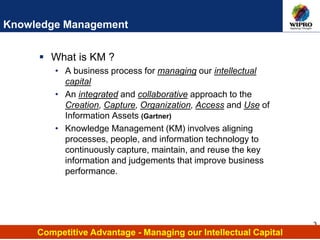
Knowledge Management
 What is KM ?
• A business process for managing our intellectual
capital
• An integrated and collaborative approach to the
Creation, Capture, Organization, Access and Use of
Information Assets (Gartner)
• Knowledge Management (KM) involves aligning
processes, people, and information technology to
continuously capture, maintain, and reuse the key
information and judgements that improve business
performance.
Competitive Advantage - Managing our Intellectual Capital
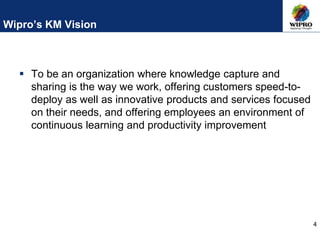
Wipro’s KM Vision
 To be an organization where knowledge capture and
sharing is the way we work, offering customers speed-to-
deploy as well as innovative products and services focused
on their needs, and offering employees an environment of
continuous learning and productivity improvement
4
5
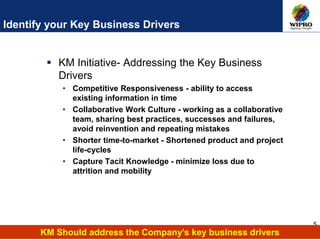
Identify your Key Business Drivers
KM Should address the Company’s key business drivers
 KM Initiative- Addressing the Key Business
Drivers
• Competitive Responsiveness - ability to access
existing information in time
• Collaborative Work Culture - working as a collaborative
team, sharing best practices, successes and failures,
avoid reinvention and repeating mistakes
• Shorter time-to-market - Shortened product and project
life-cycles
• Capture Tacit Knowledge - minimize loss due to
attrition and mobility
6
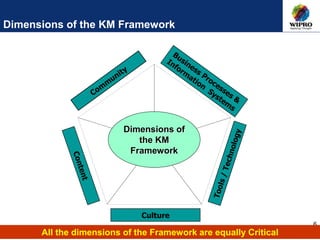
Culture
Dimensions of
the KM
Framework
All the dimensions of the Framework are equally Critical
Dimensions of the KM Framework
7
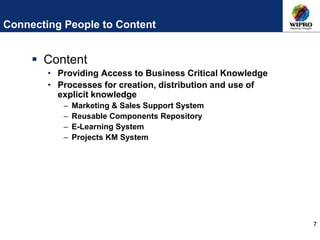
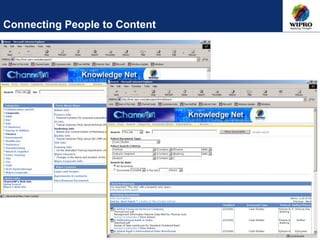
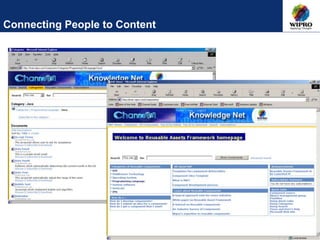
Connecting People to Content
 Content
• Providing Access to Business Critical Knowledge
• Processes for creation, distribution and use of
explicit knowledge
– Marketing & Sales Support System
– Reusable Components Repository
– E-Learning System
– Projects KM System
8
Connecting People to Content
9
Connecting People to Content
10
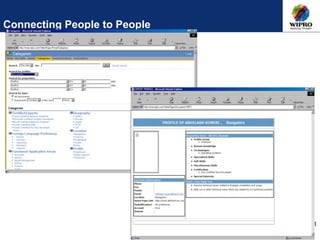
Connecting People to People
 Communities
• Connecting people in need of Knowledge to
people with Knowledge
• Flow of tacit knowledge
– Yellow Pages
– Special Interest Groups
11
Connecting People to People
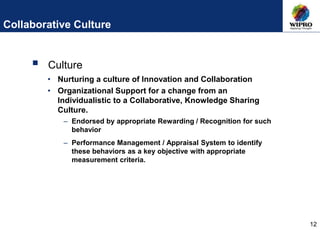
12
Collaborative Culture
 Culture
• Nurturing a culture of Innovation and Collaboration
• Organizational Support for a change from an
Individualistic to a Collaborative, Knowledge Sharing
Culture.
– Endorsed by appropriate Rewarding / Recognition for such
behavior
– Performance Management / Appraisal System to identify
these behaviors as a key objective with appropriate
measurement criteria.
13
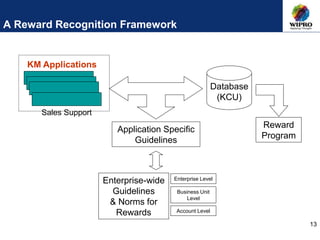
A Reward Recognition Framework
x
KM Applications
x
Yellow Pages
Sales Support
Reward
Program
Enterprise-wide
Guidelines
& Norms for
Rewards
Enterprise Level
Account Level
Business Unit
Level
Database
(KCU)
Application Specific
Guidelines
14
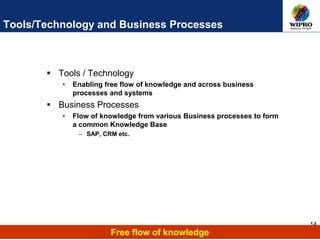
Tools/Technology and Business Processes
Free flow of knowledge
 Tools / Technology
• Enabling free flow of knowledge and across business
processes and systems
 Business Processes
• Flow of knowledge from various Business processes to form
a common Knowledge Base
– SAP, CRM etc.
15
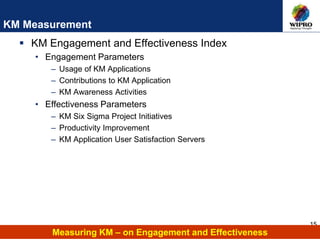
KM Measurement
Measuring KM – on Engagement and Effectiveness
 KM Engagement and Effectiveness Index
• Engagement Parameters
– Usage of KM Applications
– Contributions to KM Application
– KM Awareness Activities
• Effectiveness Parameters
– KM Six Sigma Project Initiatives
– Productivity Improvement
– KM Application User Satisfaction Servers
16
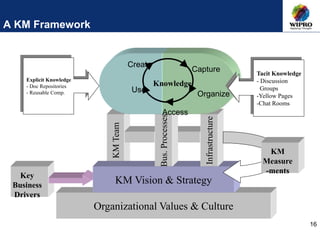
A KM Framework
KMTeam
Organizational Values & Culture
KM Vision & Strategy
Infrastructure
Bus.Processes
Explicit Knowledge
- Doc Repositories
- Reusable Comp.
Tacit Knowledge
- Discussion
Groups
-Yellow Pages
-Chat Rooms
KM
Measure
-ments
Capture
Knowledge
Create
Organize
Access
Use
Key
Business
Drivers
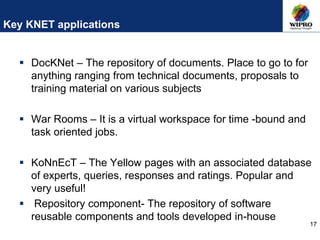
Key KNET applications
 DocKNet – The repository of documents. Place to go to for
anything ranging from technical documents, proposals to
training material on various subjects
 War Rooms – It is a virtual workspace for time -bound and
task oriented jobs.
 KoNnEcT – The Yellow pages with an associated database
of experts, queries, responses and ratings. Popular and
very useful!
 Repository component- The repository of software
reusable components and tools developed in-house
17
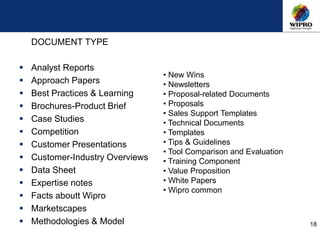
DOCUMENT TYPE
 Analyst Reports
 Approach Papers
 Best Practices & Learning
 Brochures-Product Brief
 Case Studies
 Competition
 Customer Presentations
 Customer-Industry Overviews
 Data Sheet
 Expertise notes
 Facts aboutt Wipro
 Marketscapes
 Methodologies & Model 18
• New Wins
• Newsletters
• Proposal-related Documents
• Proposals
• Sales Support Templates
• Technical Documents
• Templates
• Tips & Guidelines
• Tool Comparison and Evaluation
• Training Component
• Value Proposition
• White Papers
• Wipro common
Employee Speak on KM/KNet:
 “…I strongly believe that KNet is my productivity tool...”
 “… With KNet things have changed, you now easily get
the information orat least find a starting point. ….!”
 “KNet is the first place that i would search for any
information that is required for responding to bids….”
 “Knet is my Wipro ‘Google’ for re-usable information”
Customer Speak on Wipro’s KM:
 “It was staggering [the amount of information and the
variety of applications]
19
20

WIPRO - Knowledge Management

  • 1.
  • 2.
    2 Agenda  What isKM ?  A simple game for the participants  The KM Framework  KM Initiative at Wipro Key Areas Covered
  • 3.
    3 Knowledge Management  Whatis KM ? • A business process for managing our intellectual capital • An integrated and collaborative approach to the Creation, Capture, Organization, Access and Use of Information Assets (Gartner) • Knowledge Management (KM) involves aligning processes, people, and information technology to continuously capture, maintain, and reuse the key information and judgements that improve business performance. Competitive Advantage - Managing our Intellectual Capital
  • 4.
    Wipro’s KM Vision To be an organization where knowledge capture and sharing is the way we work, offering customers speed-to- deploy as well as innovative products and services focused on their needs, and offering employees an environment of continuous learning and productivity improvement 4
  • 5.
    5 Identify your KeyBusiness Drivers KM Should address the Company’s key business drivers  KM Initiative- Addressing the Key Business Drivers • Competitive Responsiveness - ability to access existing information in time • Collaborative Work Culture - working as a collaborative team, sharing best practices, successes and failures, avoid reinvention and repeating mistakes • Shorter time-to-market - Shortened product and project life-cycles • Capture Tacit Knowledge - minimize loss due to attrition and mobility
  • 6.
    6 Culture Dimensions of the KM Framework Allthe dimensions of the Framework are equally Critical Dimensions of the KM Framework
  • 7.
    7 Connecting People toContent  Content • Providing Access to Business Critical Knowledge • Processes for creation, distribution and use of explicit knowledge – Marketing & Sales Support System – Reusable Components Repository – E-Learning System – Projects KM System
  • 8.
  • 9.
  • 10.
    10 Connecting People toPeople  Communities • Connecting people in need of Knowledge to people with Knowledge • Flow of tacit knowledge – Yellow Pages – Special Interest Groups
  • 11.
  • 12.
    12 Collaborative Culture  Culture •Nurturing a culture of Innovation and Collaboration • Organizational Support for a change from an Individualistic to a Collaborative, Knowledge Sharing Culture. – Endorsed by appropriate Rewarding / Recognition for such behavior – Performance Management / Appraisal System to identify these behaviors as a key objective with appropriate measurement criteria.
  • 13.
    13 A Reward RecognitionFramework x KM Applications x Yellow Pages Sales Support Reward Program Enterprise-wide Guidelines & Norms for Rewards Enterprise Level Account Level Business Unit Level Database (KCU) Application Specific Guidelines
  • 14.
    14 Tools/Technology and BusinessProcesses Free flow of knowledge  Tools / Technology • Enabling free flow of knowledge and across business processes and systems  Business Processes • Flow of knowledge from various Business processes to form a common Knowledge Base – SAP, CRM etc.
  • 15.
    15 KM Measurement Measuring KM– on Engagement and Effectiveness  KM Engagement and Effectiveness Index • Engagement Parameters – Usage of KM Applications – Contributions to KM Application – KM Awareness Activities • Effectiveness Parameters – KM Six Sigma Project Initiatives – Productivity Improvement – KM Application User Satisfaction Servers
  • 16.
    16 A KM Framework KMTeam OrganizationalValues & Culture KM Vision & Strategy Infrastructure Bus.Processes Explicit Knowledge - Doc Repositories - Reusable Comp. Tacit Knowledge - Discussion Groups -Yellow Pages -Chat Rooms KM Measure -ments Capture Knowledge Create Organize Access Use Key Business Drivers
  • 17.
    Key KNET applications DocKNet – The repository of documents. Place to go to for anything ranging from technical documents, proposals to training material on various subjects  War Rooms – It is a virtual workspace for time -bound and task oriented jobs.  KoNnEcT – The Yellow pages with an associated database of experts, queries, responses and ratings. Popular and very useful!  Repository component- The repository of software reusable components and tools developed in-house 17
  • 18.
    DOCUMENT TYPE  AnalystReports  Approach Papers  Best Practices & Learning  Brochures-Product Brief  Case Studies  Competition  Customer Presentations  Customer-Industry Overviews  Data Sheet  Expertise notes  Facts aboutt Wipro  Marketscapes  Methodologies & Model 18 • New Wins • Newsletters • Proposal-related Documents • Proposals • Sales Support Templates • Technical Documents • Templates • Tips & Guidelines • Tool Comparison and Evaluation • Training Component • Value Proposition • White Papers • Wipro common
  • 19.
    Employee Speak onKM/KNet:  “…I strongly believe that KNet is my productivity tool...”  “… With KNet things have changed, you now easily get the information orat least find a starting point. ….!”  “KNet is the first place that i would search for any information that is required for responding to bids….”  “Knet is my Wipro ‘Google’ for re-usable information” Customer Speak on Wipro’s KM:  “It was staggering [the amount of information and the variety of applications] 19
  • 20.