KNOWLEDGE MANAGEMENT
TRIMESTER 6: PGDM 2011-13
By
FIRDAUS KHAN
Assoc. Professor (Finance & Corp. Training)
ICBM-SBE, AP, India
firdaus@icbm.ac.in4/30/2013
Data Overload?
Or Knowledge Revolution?
• Every day, we create 2.5 quintillion bytes
of data — so much that 90% of the data in
the world today has been created in the
last two years alone!
• 1.8 zettabytes is being created & replicated
this year alone. It would require 57.5
billion 32 GB iPads to store & will be
worth about $34.4 trillion - equivalent to
the GDP of USA, Japan, China, Germany,
France, UK & Italy combined!!
firdaus@icbm.ac.in
firdaus@icbm.ac.in
Knowledge Shared = (Knowledge)2
HOW HAS THE MODERN WORK
ENVIRONMENT CHANGED?
firdaus@icbm.ac.in
Traditional Work
• Data oriented
• Internal
• Centralized
• Hierarchy
• Structured,
deterministic
• 1 position, 1 person
• Fixed work station
• Things
• Coordination of
access, integrity &
control of
redundancy
Knowledge Work
• Communication oriented
• Cooperation, Coopetition,
Networks
• Decentralized
• Network
• Unstructured, ad-hoc
workflows
• Multiple roles per person
• Mobile, virtual, multiple
workstations,
telecommuting
• Flows
• Synchronization, info
sharing, search &
retrieval
firdaus@icbm.ac.in
Criteria
• Orientation
• Focus
• Command
• Structure
• Process
• Role
• Workspace
• Location of
value
• Data
Handling
DIMENSIONS OF KNOWLEDGE WORK
firdaus@icbm.ac.in
DATA
vs.
INFORMATION
vs.
KNOWLEDGE
firdaus@icbm.ac.in
Data, Information & Knowledge
• Data refers to facts, which have not been
structured & have not been interpreted,
therefore have no meaning.
• Information is relevant, structured and
meaningful data. There is a sender & a
receiver. It can be stored on media such as
paper, computer, audio tape, etc.
• Knowledge is factual information acquired
through personal experience. It has a purpose
& intent but is emergent & socially
constructed. It exists only in people’s heads.
firdaus@icbm.ac.in
FROM DATA TO WISDOM
Wisdom
Knowledge
Information
Data
firdaus@icbm.ac.in
MEANING
CONTEXT
INSIGHT
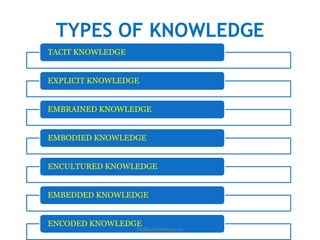
TYPES OF KNOWLEDGE
TACIT KNOWLEDGE
EXPLICIT KNOWLEDGE
EMBRAINED KNOWLEDGE
EMBODIED KNOWLEDGE
ENCULTURED KNOWLEDGE
EMBEDDED KNOWLEDGE
ENCODED KNOWLEDGE
firdaus@icbm.ac.in
firdaus@icbm.ac.in
firdaus@icbm.ac.in
KM DRIVERS
KM
Fragmentation
of Knowledge
Need for
Speed –
Cycle Time
Reduction
Knowledge
Attrition
Globalization
& Knowledge
Merging
Content
Management
E-Learning
firdaus@icbm.ac.in
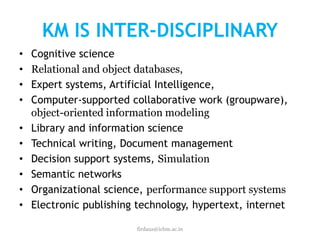
KM IS INTER-DISCIPLINARY
• Cognitive science
• Relational and object databases,
• Expert systems, Artificial Intelligence,
• Computer-supported collaborative work (groupware),
object-oriented information modeling
• Library and information science
• Technical writing, Document management
• Decision support systems, Simulation
• Semantic networks
• Organizational science, performance support systems
• Electronic publishing technology, hypertext, internet
firdaus@icbm.ac.in
KNOWLEDGE MANAGEMENT
• Knowledge Management can be defined as a
systematic process that creates, captures, shares,
and analyzes knowledge in ways that directly
improve organizational performance.
• It comprises a range of strategies and practices
used in an organization to identify, create,
represent, distribute, and enable the adoption
of insights and experiences.
• It is the ability to get the right information to the
right people at the right time, and in the right
place, so that an organization can be operated
smoothly and efficiently.
firdaus@icbm.ac.in
COMPONENTS OF KM CYCLE
firdaus@icbm.ac.in
KM TECHNOLOGIES
firdaus@icbm.ac.in
KM LIFE CYCLE
• Knowledge is acquired or captured using intranets,
extranets, groupware, web conferencing, and
document management systems.
• An organizational memory is formed by refining,
organizing, and storing knowledge using
structured repositories such as data warehouses.
• Knowledge is distributed through education,
training programs, automated knowledge based
systems, expert networks.
• Knowledge is applied or leveraged for further
learning and innovation via mining of the
organizational memory and the application of
expert systems such as decision support systems.
firdaus@icbm.ac.in
TOOLS USED IN EACH PHASE OF KM
firdaus@icbm.ac.in
OUTCOMES OF KM
• Foster innovation and organizational learning by
encouraging the free flow of ideas
• Improve decision making
• Improve customer service by streamlining
response time
• Boost revenues by getting products and services to
market faster
• Enhance employee retention rates by recognizing
the value of employees' knowledge and rewarding
them for it
• Streamline operations and reduce costs by
eliminating redundant or unnecessary processes
firdaus@icbm.ac.in
OUTCOMES OF KM (contd.)
• Achieving shorter new product development cycles
• Leveraging the expertise of people across the
organization
• Increasing network connectivity between internal
and external individuals
• Managing business environments and allowing
employees to obtain relevant insights
and ideas appropriate to their work
• Managing intellectual capital and intellectual
assets in the workforce (such as the expertise and
know-how possessed by key individuals)
firdaus@icbm.ac.in
KM IN PRACTICE
• Large revenue gains & efficiency improvements
have been recorded by many major companies.
• Ford Motor Company accelerated its concept-
to-production time from 36 months to 24
months.
• Dow Chemical Company saved $40 million a
year in the re-use of patents.
• Chase Manhattan Bank used CRM KM
initiatives to increase its annual revenue by 15%
• Pfizer credits KM practices for discovering the
hidden benefits of the Viagra drug.
firdaus@icbm.ac.in
CAN KNOWLEDGE
CREATE
COMPETITIVE ADVANTAGE?
firdaus@icbm.ac.in
“An organization’s capacity to
improve existing skills and learn
new ones is the most defensible
competitive advantage of all.”
- C.K. Prahlad
firdaus@icbm.ac.in
firdaus@icbm.ac.in
KNOWLEDGE STRATEGY
firdaus@icbm.ac.in
A Knowledge Strategy refers to the
planned balancing of an organization’s
knowledge resources & capabilities with
the knowledge required for providing
products and services superior to those of
its competitors.
– (Zack 1999b,131)
WHAT STRATEGIC OPTIONS
DOES A FIRM HAVE IN TERMS
OF A KNOWLEDGE STRATEGY?
firdaus@icbm.ac.in
Key Aspects of a Knowledge Strategy
• Which business areas should be the focus?
• Which type of knowledge should be
captured?
• Who is the target group?
• Which business process will the knowledge
strategy be applied to?
• Will the orientation be more human or
technological?
firdaus@icbm.ac.in
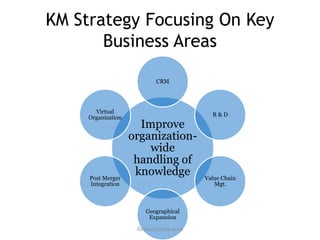
KM Strategy Focusing On Key
Business Areas
Improve
organization-
wide
handling of
knowledge
CRM
R & D
Value Chain
Mgt.
Geographical
Expansion
Post Merger
Integration
Virtual
Organization
firdaus@icbm.ac.in
KM Strategy Based on Type of
Knowledge
Degree of Increase in
Knowledge:
Primary Source of
Knowledge
Speed of Learning
Knowledge Base
Type of Knowledge to
Focus on
Orientation
• Exploitation
• Exploration
• Internal
• External
• Fast
• Slow
• Broad
• Narrow
• Tacit
• Explicit
• Human
• Technological
firdaus@icbm.ac.in
KM Strategy Based On Target
Group
Employee
Rank
Employee
Manager
Executive
Employee Life
Cycle
New recruits
Retirees
“To-be-
Promoted”
Types
Organizational
Scope
Core Group
Organization
Organization
& Partners
Unlimited
firdaus@icbm.ac.in
KM Strategy Based on Business
Process
Which
business
process
to target?
Simple vs.
Highly
Complex
Processes
Mgt. vs.
Core vs.
Service
Processes One
process vs.
Few vs. All
processes
firdaus@icbm.ac.in
firdaus@icbm.ac.in
firdaus@icbm.ac.in
EMPIRICAL ASPECTS -
Strategic KM Initiatives
Undertaken by Organizations
firdaus@icbm.ac.in
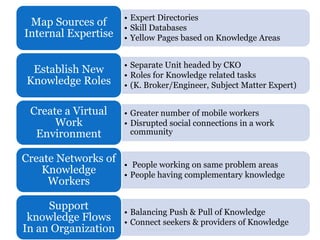
• Expert Directories
• Skill Databases
• Yellow Pages based on Knowledge Areas
Map Sources of
Internal Expertise
• Separate Unit headed by CKO
• Roles for Knowledge related tasks
• (K. Broker/Engineer, Subject Matter Expert)
Establish New
Knowledge Roles
• Greater number of mobile workers
• Disrupted social connections in a work
community
Create a Virtual
Work
Environment
• People working on same problem areas
• People having complementary knowledge
Create Networks of
Knowledge
Workers
• Balancing Push & Pull of Knowledge
• Connect seekers & providers of Knowledge
Support
knowledge Flows
In an Organization
firdaus@icbm.ac.in
• Making Knowledge available at points of action
• Spread the good word to as many in the network
Transfer of
Knowledge &
Best Practices
• Pull approach, not push. No micro-managing
• Each responsible for renewing & sharing own
knowledge assets
Personal
Responsibility for
Knowledge
• Capture knowledge about customers
• Provide customer-centric solutions, increase
customer loyalty
Customer
Focused
Knowledge
• Basic & Applied R&D
• Employee Motivation & Insights for Innovation
Innovation &
Knowledge
Creation
• Enterprise level management of patents,
technology, practices, etc
• Valuating, safekeeping, marketing of K. assets
Intellectual Asset
Management
Strategy
OPERATIONAL RISKS IN A KNOWLEDGE STR.
DEPENDENCY LIMITED QUALITY
INSUFFICIENT
KNOWLEDGE TRANSFER
LOSS OF KNOWLEDGE
ASSETS
KNOWLEDGE
RISKS
firdaus@icbm.ac.in
Barriers to a Knowledge Strategy
• Lack of motivation, ignorance or skilled
incompetence of knowledge provider
• Lack of motivation or insufficient
learning/retentive capacity or role –
constrained learning by knowledge seeker
• Insufficient context or ambiguity of
causality of transferred knowledge
• Infrastructural and cultural inadequacies
or hindrances
firdaus@icbm.ac.in
Factors Essential for the Success
of a Knowledge Strategy
• Holistic, integrated & standardized approach
• Knowledge Oriented Culture
• Management support
• Clear economic benefits
• Exact vision & language
• Effective aids for motivation
• Appropriate process orientation
• ICT & organizational infrastructure
• Stable knowledge structures
• Continuous participation of employees
firdaus@icbm.ac.in
“Knowledge has to be improved, challenged,
and increased constantly, or it vanishes.”
– Peter Drucker
firdaus@icbm.ac.in
Sources
• http://www.unc.edu/~sunnyliu/inls258/Introd
uction_to_Knowledge_Management.html
• Knowledge Management Systems - Ronald
Maier (3rd Edition, Springer)
• Mashable.com
firdaus@icbm.ac.in

Overview of Knowledge Management

  • 1.
    KNOWLEDGE MANAGEMENT TRIMESTER 6:PGDM 2011-13 By FIRDAUS KHAN Assoc. Professor (Finance & Corp. Training) ICBM-SBE, AP, India firdaus@icbm.ac.in4/30/2013
  • 2.
    Data Overload? Or KnowledgeRevolution? • Every day, we create 2.5 quintillion bytes of data — so much that 90% of the data in the world today has been created in the last two years alone! • 1.8 zettabytes is being created & replicated this year alone. It would require 57.5 billion 32 GB iPads to store & will be worth about $34.4 trillion - equivalent to the GDP of USA, Japan, China, Germany, France, UK & Italy combined!! firdaus@icbm.ac.in
  • 3.
  • 4.
    HOW HAS THEMODERN WORK ENVIRONMENT CHANGED? firdaus@icbm.ac.in
  • 5.
    Traditional Work • Dataoriented • Internal • Centralized • Hierarchy • Structured, deterministic • 1 position, 1 person • Fixed work station • Things • Coordination of access, integrity & control of redundancy Knowledge Work • Communication oriented • Cooperation, Coopetition, Networks • Decentralized • Network • Unstructured, ad-hoc workflows • Multiple roles per person • Mobile, virtual, multiple workstations, telecommuting • Flows • Synchronization, info sharing, search & retrieval firdaus@icbm.ac.in Criteria • Orientation • Focus • Command • Structure • Process • Role • Workspace • Location of value • Data Handling
  • 6.
    DIMENSIONS OF KNOWLEDGEWORK firdaus@icbm.ac.in
  • 7.
  • 8.
    Data, Information &Knowledge • Data refers to facts, which have not been structured & have not been interpreted, therefore have no meaning. • Information is relevant, structured and meaningful data. There is a sender & a receiver. It can be stored on media such as paper, computer, audio tape, etc. • Knowledge is factual information acquired through personal experience. It has a purpose & intent but is emergent & socially constructed. It exists only in people’s heads. firdaus@icbm.ac.in
  • 9.
    FROM DATA TOWISDOM Wisdom Knowledge Information Data firdaus@icbm.ac.in MEANING CONTEXT INSIGHT
  • 10.
    TYPES OF KNOWLEDGE TACITKNOWLEDGE EXPLICIT KNOWLEDGE EMBRAINED KNOWLEDGE EMBODIED KNOWLEDGE ENCULTURED KNOWLEDGE EMBEDDED KNOWLEDGE ENCODED KNOWLEDGE firdaus@icbm.ac.in
  • 11.
  • 12.
  • 13.
    KM DRIVERS KM Fragmentation of Knowledge Needfor Speed – Cycle Time Reduction Knowledge Attrition Globalization & Knowledge Merging Content Management E-Learning firdaus@icbm.ac.in
  • 14.
    KM IS INTER-DISCIPLINARY •Cognitive science • Relational and object databases, • Expert systems, Artificial Intelligence, • Computer-supported collaborative work (groupware), object-oriented information modeling • Library and information science • Technical writing, Document management • Decision support systems, Simulation • Semantic networks • Organizational science, performance support systems • Electronic publishing technology, hypertext, internet firdaus@icbm.ac.in
  • 15.
    KNOWLEDGE MANAGEMENT • KnowledgeManagement can be defined as a systematic process that creates, captures, shares, and analyzes knowledge in ways that directly improve organizational performance. • It comprises a range of strategies and practices used in an organization to identify, create, represent, distribute, and enable the adoption of insights and experiences. • It is the ability to get the right information to the right people at the right time, and in the right place, so that an organization can be operated smoothly and efficiently. firdaus@icbm.ac.in
  • 16.
    COMPONENTS OF KMCYCLE firdaus@icbm.ac.in
  • 17.
  • 18.
    KM LIFE CYCLE •Knowledge is acquired or captured using intranets, extranets, groupware, web conferencing, and document management systems. • An organizational memory is formed by refining, organizing, and storing knowledge using structured repositories such as data warehouses. • Knowledge is distributed through education, training programs, automated knowledge based systems, expert networks. • Knowledge is applied or leveraged for further learning and innovation via mining of the organizational memory and the application of expert systems such as decision support systems. firdaus@icbm.ac.in
  • 19.
    TOOLS USED INEACH PHASE OF KM firdaus@icbm.ac.in
  • 20.
    OUTCOMES OF KM •Foster innovation and organizational learning by encouraging the free flow of ideas • Improve decision making • Improve customer service by streamlining response time • Boost revenues by getting products and services to market faster • Enhance employee retention rates by recognizing the value of employees' knowledge and rewarding them for it • Streamline operations and reduce costs by eliminating redundant or unnecessary processes firdaus@icbm.ac.in
  • 21.
    OUTCOMES OF KM(contd.) • Achieving shorter new product development cycles • Leveraging the expertise of people across the organization • Increasing network connectivity between internal and external individuals • Managing business environments and allowing employees to obtain relevant insights and ideas appropriate to their work • Managing intellectual capital and intellectual assets in the workforce (such as the expertise and know-how possessed by key individuals) firdaus@icbm.ac.in
  • 22.
    KM IN PRACTICE •Large revenue gains & efficiency improvements have been recorded by many major companies. • Ford Motor Company accelerated its concept- to-production time from 36 months to 24 months. • Dow Chemical Company saved $40 million a year in the re-use of patents. • Chase Manhattan Bank used CRM KM initiatives to increase its annual revenue by 15% • Pfizer credits KM practices for discovering the hidden benefits of the Viagra drug. firdaus@icbm.ac.in
  • 23.
  • 24.
    “An organization’s capacityto improve existing skills and learn new ones is the most defensible competitive advantage of all.” - C.K. Prahlad firdaus@icbm.ac.in
  • 25.
  • 26.
    KNOWLEDGE STRATEGY firdaus@icbm.ac.in A KnowledgeStrategy refers to the planned balancing of an organization’s knowledge resources & capabilities with the knowledge required for providing products and services superior to those of its competitors. – (Zack 1999b,131)
  • 27.
    WHAT STRATEGIC OPTIONS DOESA FIRM HAVE IN TERMS OF A KNOWLEDGE STRATEGY? firdaus@icbm.ac.in
  • 28.
    Key Aspects ofa Knowledge Strategy • Which business areas should be the focus? • Which type of knowledge should be captured? • Who is the target group? • Which business process will the knowledge strategy be applied to? • Will the orientation be more human or technological? firdaus@icbm.ac.in
  • 29.
    KM Strategy FocusingOn Key Business Areas Improve organization- wide handling of knowledge CRM R & D Value Chain Mgt. Geographical Expansion Post Merger Integration Virtual Organization firdaus@icbm.ac.in
  • 30.
    KM Strategy Basedon Type of Knowledge Degree of Increase in Knowledge: Primary Source of Knowledge Speed of Learning Knowledge Base Type of Knowledge to Focus on Orientation • Exploitation • Exploration • Internal • External • Fast • Slow • Broad • Narrow • Tacit • Explicit • Human • Technological firdaus@icbm.ac.in
  • 31.
    KM Strategy BasedOn Target Group Employee Rank Employee Manager Executive Employee Life Cycle New recruits Retirees “To-be- Promoted” Types Organizational Scope Core Group Organization Organization & Partners Unlimited firdaus@icbm.ac.in
  • 32.
    KM Strategy Basedon Business Process Which business process to target? Simple vs. Highly Complex Processes Mgt. vs. Core vs. Service Processes One process vs. Few vs. All processes firdaus@icbm.ac.in
  • 33.
  • 34.
    firdaus@icbm.ac.in EMPIRICAL ASPECTS - StrategicKM Initiatives Undertaken by Organizations
  • 35.
    firdaus@icbm.ac.in • Expert Directories •Skill Databases • Yellow Pages based on Knowledge Areas Map Sources of Internal Expertise • Separate Unit headed by CKO • Roles for Knowledge related tasks • (K. Broker/Engineer, Subject Matter Expert) Establish New Knowledge Roles • Greater number of mobile workers • Disrupted social connections in a work community Create a Virtual Work Environment • People working on same problem areas • People having complementary knowledge Create Networks of Knowledge Workers • Balancing Push & Pull of Knowledge • Connect seekers & providers of Knowledge Support knowledge Flows In an Organization
  • 36.
    firdaus@icbm.ac.in • Making Knowledgeavailable at points of action • Spread the good word to as many in the network Transfer of Knowledge & Best Practices • Pull approach, not push. No micro-managing • Each responsible for renewing & sharing own knowledge assets Personal Responsibility for Knowledge • Capture knowledge about customers • Provide customer-centric solutions, increase customer loyalty Customer Focused Knowledge • Basic & Applied R&D • Employee Motivation & Insights for Innovation Innovation & Knowledge Creation • Enterprise level management of patents, technology, practices, etc • Valuating, safekeeping, marketing of K. assets Intellectual Asset Management Strategy
  • 37.
    OPERATIONAL RISKS INA KNOWLEDGE STR. DEPENDENCY LIMITED QUALITY INSUFFICIENT KNOWLEDGE TRANSFER LOSS OF KNOWLEDGE ASSETS KNOWLEDGE RISKS firdaus@icbm.ac.in
  • 38.
    Barriers to aKnowledge Strategy • Lack of motivation, ignorance or skilled incompetence of knowledge provider • Lack of motivation or insufficient learning/retentive capacity or role – constrained learning by knowledge seeker • Insufficient context or ambiguity of causality of transferred knowledge • Infrastructural and cultural inadequacies or hindrances firdaus@icbm.ac.in
  • 39.
    Factors Essential forthe Success of a Knowledge Strategy • Holistic, integrated & standardized approach • Knowledge Oriented Culture • Management support • Clear economic benefits • Exact vision & language • Effective aids for motivation • Appropriate process orientation • ICT & organizational infrastructure • Stable knowledge structures • Continuous participation of employees firdaus@icbm.ac.in
  • 40.
    “Knowledge has tobe improved, challenged, and increased constantly, or it vanishes.” – Peter Drucker firdaus@icbm.ac.in
  • 41.
    Sources • http://www.unc.edu/~sunnyliu/inls258/Introd uction_to_Knowledge_Management.html • KnowledgeManagement Systems - Ronald Maier (3rd Edition, Springer) • Mashable.com firdaus@icbm.ac.in