INTRODUCTION TO BUSINESS
WP 123
ANALYSIS OF NESTLE CASE STUDY
HISTORY
Henri Nestlé established Nestlé in 1867 in Switzerland
His first product was lactogen formula for infants by the
name “Farine Lacteé”
“Nestlé” is a Swiss-German word which means “Little Nest”
which is its trademark
Nestlé is the worlds’ number one food company
5th largest company of the world according to its turn over
NESTLE IN MALAYSIA
• Nestlé's commitment to providing quality products to
Malaysians dates back almost 100 years ago.
• Nestlé began in Malaysia in 1912 as the Anglo-Swiss
Condensed Milk Company in Penang and later, growth and
expansion made a move to Kuala Lumpur necessary in
1939.
• Since 1962, with its first factory in Petaling Jaya, Nestlé
Malaysia now manufactures its products in 7 factories and
operates from its head office in Mutiara Damansara.
MISSION STATEMENT
"Nestlé is the largest food company in the world.
But, more important to them is to be the world's
leading food company”.
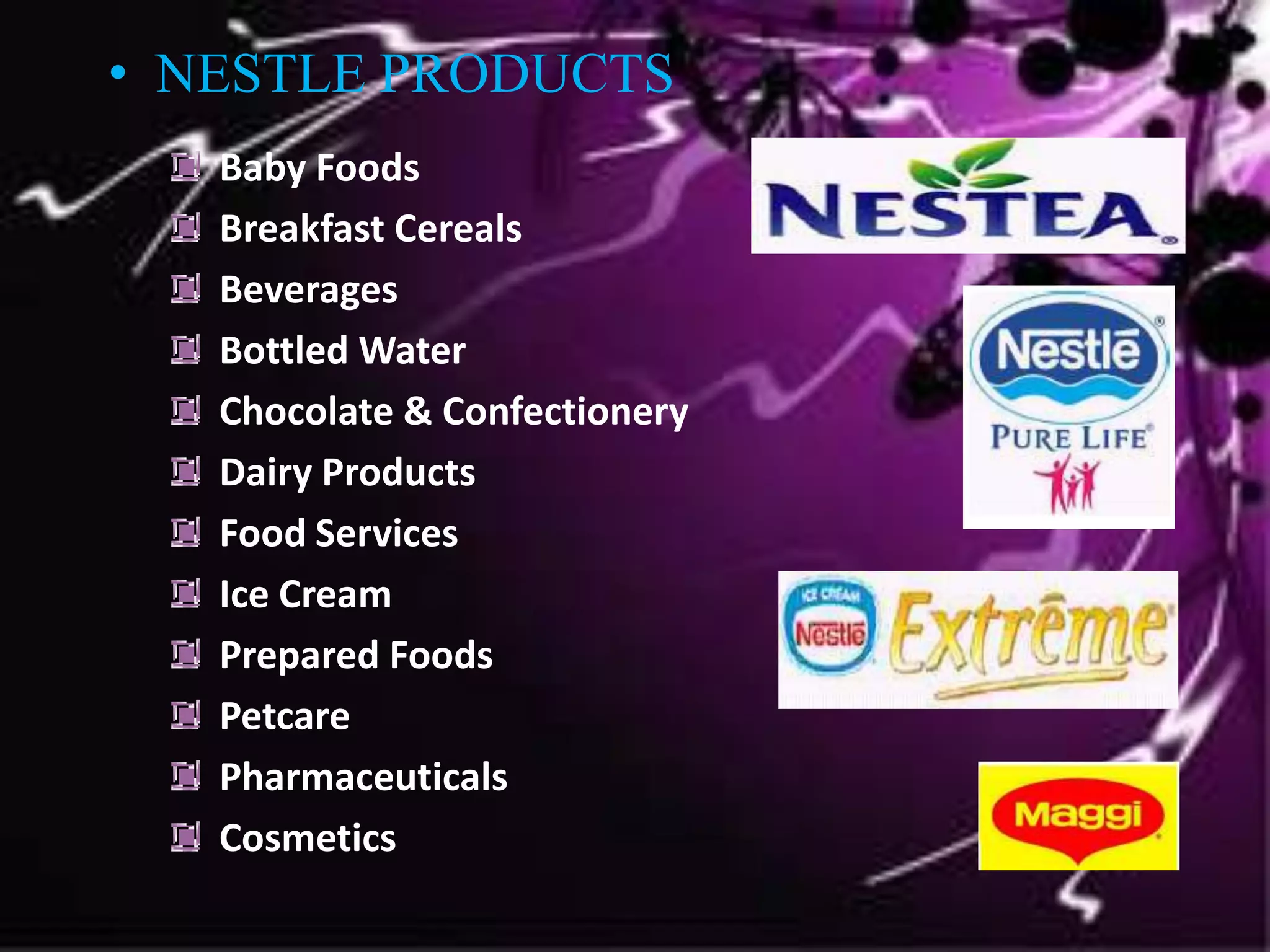
Baby Foods
Breakfast Cereals
Beverages
Bottled Water
Chocolate & Confectionery
Dairy Products
Food Services
Ice Cream
Prepared Foods
Petcare
Pharmaceuticals
Cosmetics
• NESTLE PRODUCTS
ORGANIZATIONAL STRUCTURE
Organizational chart clearly indicates the,
responsibilities, authorities and
accountability for each function.
Nestle is practicing functional structure.
Employees in the organization has clearly
written job description according to the
designation.
When delegations occurs, agreement is
written with the mutual understanding.
FUNCTIONAL STRUCTURE
 Functional organization is a common type of
organizational structure in which the organization
is grouped based on specialization by functional
areas.
 Some argue that functional departmentalization
allows for greater operational efficiencies in that
employees with shared skills and knowledge are
grouped together by functions performed.
MANAGEMENT PROCESS
PLANNING ORGANIZING CONTROLLINGLEADING
•Recognition
• R&D
•Plan
•Formulation
•Estimation
•People
•Process
•Situation
•Decentralized
•People oriented
•Motivating
activities
•Comparing of
Manufactured
products
FAYOL’S ADMINISTRATIVE
MANAGEMENT FUNCTIONS
 Nestle adapt Fayol’s management process style.
 Fayol was one of the most influential contributors
to modern concepts of management, having
proposed that there are five primary functions of
management:
(1) planning,
(2) organizing,
(3) commanding,
(4) coordinating, and
(5) controlling (Fayol, 1949, 1987).
 Controlling is described in the sense
that a manager must receive feedback
on a process in order to make
necessary adjustments.
 Many of today’s management have
reduced the five functions to four: (1)
planning, (2) organizing, (3)
leading, and (4) controlling.
Cont…
LEADERSHIP PRINCIPLES
 Nestle practices “DEMOCRATIC LEADERSHIP
STYLE”
 For taking any advice and decision Nestle
depends on its employees.
 Nestle motto is:
"Teamwork with responsible leadership".
 Nestlé is people & product oriented.
 As decentralized as possible.
MOTIVATION
Employees get Motivation by:-
 Immediate job satisfaction
 Long-term career development
 Superior pay and benefits
 The personal growth that comes from
experience and training
 Materialistic as well as internal motivation
 Motivated by Rewards & Benefits
REWARDS & BENEFITS
Health screening/on-site occupational health
facilities
Sick pay
25 days' holiday
Mobile phone on a business need basis
Company bonus scheme
Contributory final salary pension scheme
Childcare vouchers (dependent on salary)
Gym facilities at larger sites
Staff shop at most sites
Flex time at some sites
COMMUNICATION
Nestle established internal and external
communication channels.
Employees are free to communicate to any
authority. There is no particular established
channel.
Authorities are bound to listen to the
employees.
THANK
YOU
DONE BY :
KHANSA MAISARAH
BT JAMALUDIN

Nestle Case Study

  • 1.
    INTRODUCTION TO BUSINESS WP123 ANALYSIS OF NESTLE CASE STUDY
  • 3.
    HISTORY Henri Nestlé establishedNestlé in 1867 in Switzerland His first product was lactogen formula for infants by the name “Farine Lacteé” “Nestlé” is a Swiss-German word which means “Little Nest” which is its trademark Nestlé is the worlds’ number one food company 5th largest company of the world according to its turn over
  • 4.
    NESTLE IN MALAYSIA •Nestlé's commitment to providing quality products to Malaysians dates back almost 100 years ago. • Nestlé began in Malaysia in 1912 as the Anglo-Swiss Condensed Milk Company in Penang and later, growth and expansion made a move to Kuala Lumpur necessary in 1939. • Since 1962, with its first factory in Petaling Jaya, Nestlé Malaysia now manufactures its products in 7 factories and operates from its head office in Mutiara Damansara.
  • 5.
    MISSION STATEMENT "Nestlé isthe largest food company in the world. But, more important to them is to be the world's leading food company”.
  • 6.
    Baby Foods Breakfast Cereals Beverages BottledWater Chocolate & Confectionery Dairy Products Food Services Ice Cream Prepared Foods Petcare Pharmaceuticals Cosmetics • NESTLE PRODUCTS
  • 7.
    ORGANIZATIONAL STRUCTURE Organizational chartclearly indicates the, responsibilities, authorities and accountability for each function. Nestle is practicing functional structure. Employees in the organization has clearly written job description according to the designation. When delegations occurs, agreement is written with the mutual understanding.
  • 8.
    FUNCTIONAL STRUCTURE  Functionalorganization is a common type of organizational structure in which the organization is grouped based on specialization by functional areas.  Some argue that functional departmentalization allows for greater operational efficiencies in that employees with shared skills and knowledge are grouped together by functions performed.
  • 9.
    MANAGEMENT PROCESS PLANNING ORGANIZINGCONTROLLINGLEADING •Recognition • R&D •Plan •Formulation •Estimation •People •Process •Situation •Decentralized •People oriented •Motivating activities •Comparing of Manufactured products
  • 10.
    FAYOL’S ADMINISTRATIVE MANAGEMENT FUNCTIONS Nestle adapt Fayol’s management process style.  Fayol was one of the most influential contributors to modern concepts of management, having proposed that there are five primary functions of management: (1) planning, (2) organizing, (3) commanding, (4) coordinating, and (5) controlling (Fayol, 1949, 1987).
  • 11.
     Controlling isdescribed in the sense that a manager must receive feedback on a process in order to make necessary adjustments.  Many of today’s management have reduced the five functions to four: (1) planning, (2) organizing, (3) leading, and (4) controlling. Cont…
  • 12.
    LEADERSHIP PRINCIPLES  Nestlepractices “DEMOCRATIC LEADERSHIP STYLE”  For taking any advice and decision Nestle depends on its employees.  Nestle motto is: "Teamwork with responsible leadership".  Nestlé is people & product oriented.  As decentralized as possible.
  • 13.
    MOTIVATION Employees get Motivationby:-  Immediate job satisfaction  Long-term career development  Superior pay and benefits  The personal growth that comes from experience and training  Materialistic as well as internal motivation  Motivated by Rewards & Benefits
  • 14.
    REWARDS & BENEFITS Healthscreening/on-site occupational health facilities Sick pay 25 days' holiday Mobile phone on a business need basis Company bonus scheme Contributory final salary pension scheme Childcare vouchers (dependent on salary) Gym facilities at larger sites Staff shop at most sites Flex time at some sites
  • 15.
    COMMUNICATION Nestle established internaland external communication channels. Employees are free to communicate to any authority. There is no particular established channel. Authorities are bound to listen to the employees.
  • 16.
    THANK YOU DONE BY : KHANSAMAISARAH BT JAMALUDIN