Knowledge Management


          Department Day 2012
        Public Health Department
   David Hercot, Maria Paola Bertone &
            Bruno Meessen*
Knowledge


“is not
a static embedded capability or stable disposition of
actors,

but rather
an ongoing social accomplishment, constituted
and reconstituted as actors engage the world of
practice”

Orlikowski (2002)


                                                        2
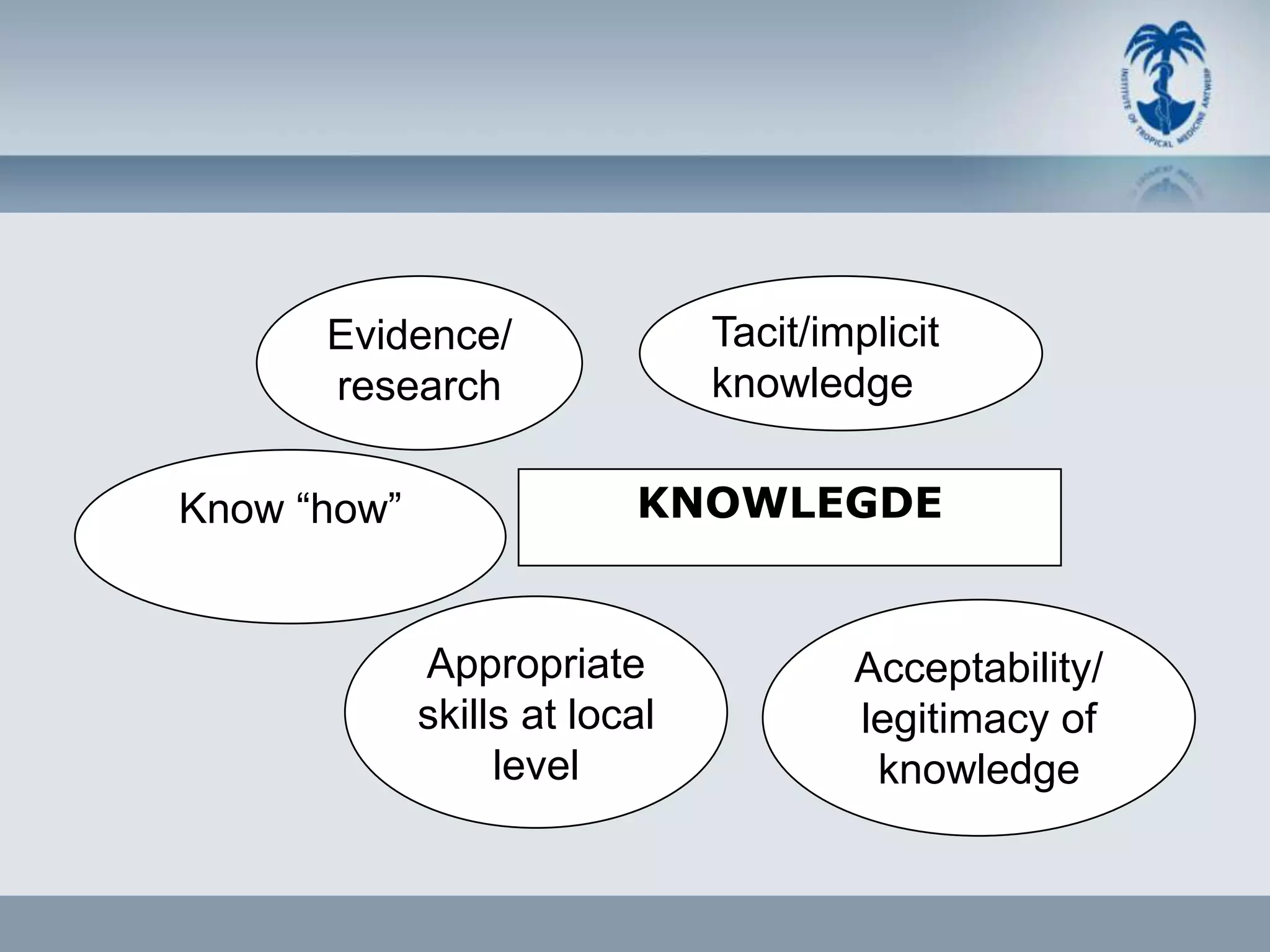
Evidence/                Tacit/implicit
      research                 knowledge

Know “how”                KNOWLEGDE


             Appropriate               Acceptability/
             skills at local           legitimacy of
                  level                 knowledge
Knowledge Management Strategies (KM)


“enabling individuals, teams and entire
organizations to collectively and systematically


capture, create, store, share and apply

knowledge, to better achieve their objectives”

Young (2008)


                                               4
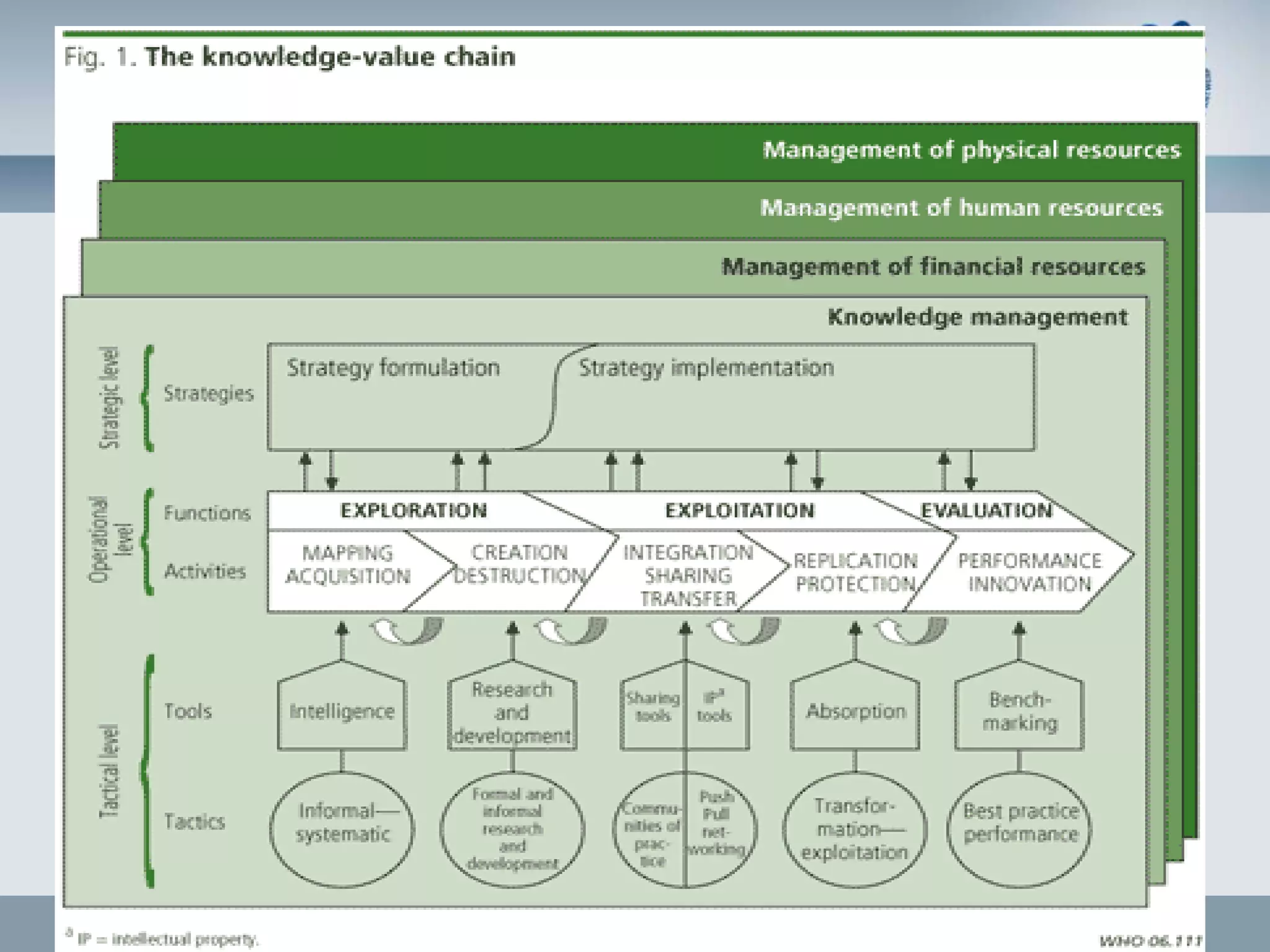
K value chain
Sharing
Knowledge

            6
ISNT’IT THE JOB OF WHO ?


                           7
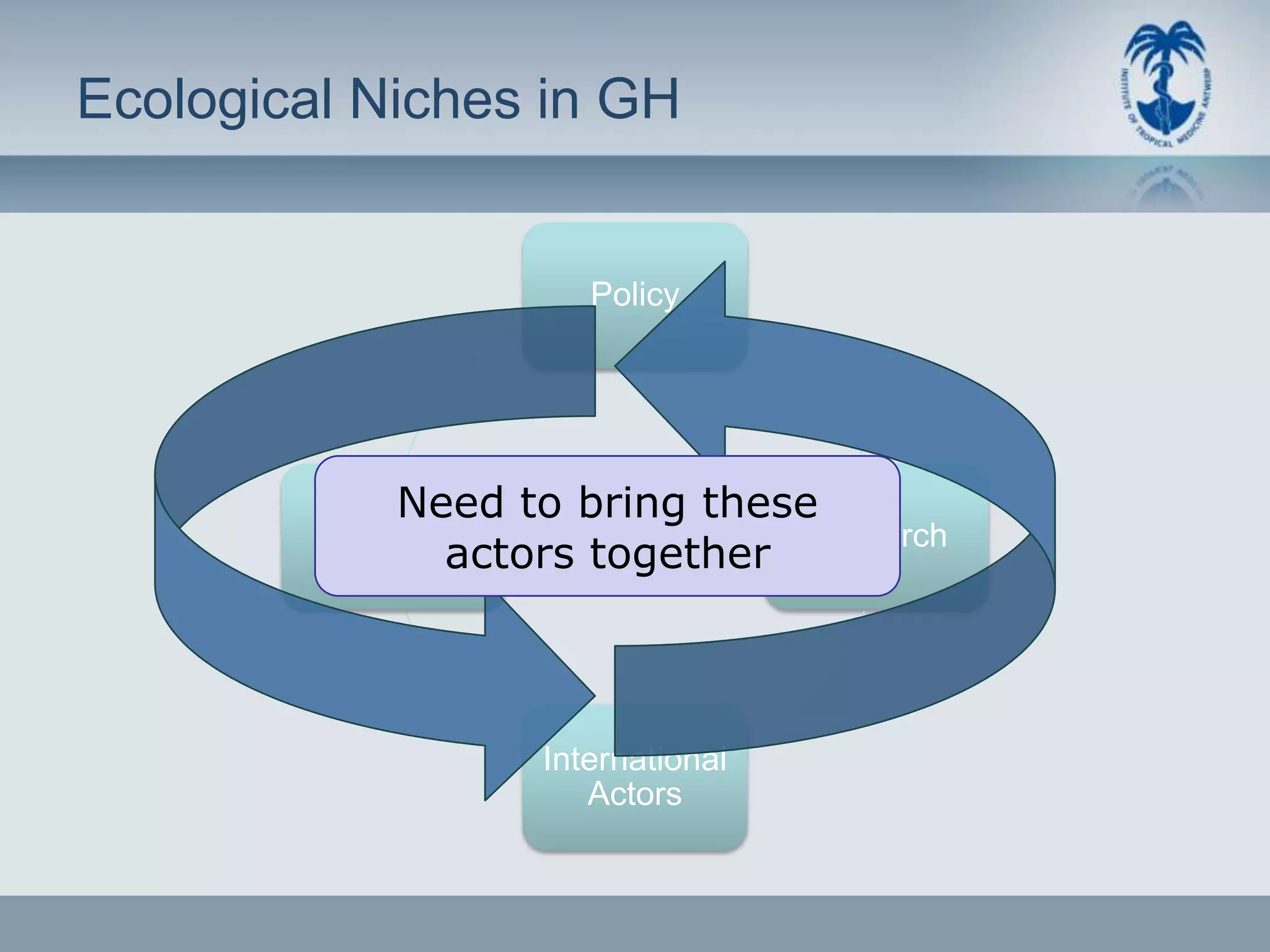
Ecological Niches in GH


                      Policy


             Need to bring these
         Practice               Research
                actors together


                   International
                      Actors
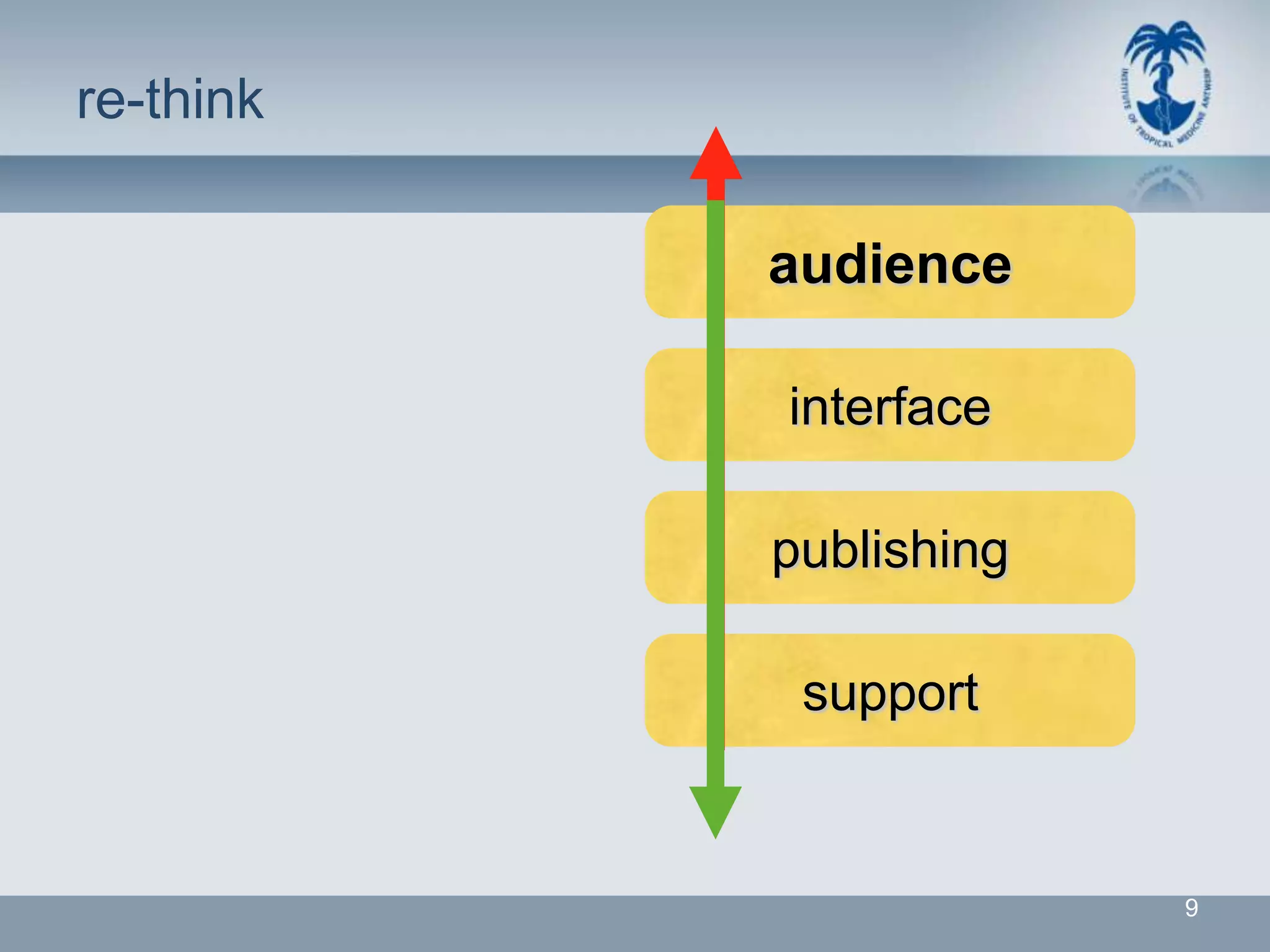
re-think

           audience

           interface

           publishing

            support


                        9
Ways of “sharing Knowledge”

• Push

• Pull generation

• Interactions


                              10
Research outputs


•   Deliverables
•   Policy Briefs
•   Academic Conference Presentation
•   Peer reviewed papers
•   Press Release
                                       11
Do you consider


•   Workshop with supposed implementers
•   One pager (25-3-1)
•   Blog post
•   Mailing/Tweet/Facebook/Linkedin
•   Contributing to discussions


                                          12
Why we need to engage in KM strategies

•   Demand for Continuing Public Health Education
•   Visibility of Dpt
•   Relevance of K creation
•   Develop our network of
    – partners in research,
    – potential students and
    – funders
• Need to find new ways of keeping touch with
  ground.

                                                    13
Why … cont’d (the research perspective)

• What -> How
  – Appropriate research design
     • (Gertler Madon Parkhurst)
  – New methodological approaches
     • (Pawson, Marchal)
  – Good collaboration on the field
     • (op re and action re – Grodos Mercenier Remme Zachariah)
  – Co Production
     • (Community of practice as a way of coproducing relevant
       knowledge - Spiegel)


                                                                 14
Why COPs

“Strengthening capabilities for producing and
applying knowledge through direct engagement
with affected populations and decision-makers
provides a fertile basis for consolidating capacities
to act on a larger scale. This can facilitate the
capturing of benefits from the “top down” (in
consolidating institutional commitments) and the
“bottom up” (to achieve local results).”
Spiegel 2011 BMC IH & HR


                                                    15
Community of Practice


   “a group of people who share a
   concern, set of problems, or a
   passion about a topic, and who
   deepen their knowledge and
   expertise in this area by
   interacting on an ongoing basis”
   Wenger et al (2002)


                                      16
Community of Practice


Three key dimensions define a CoP
• Domain of interest,
• Community of participating people and
• Practice of sharing knowledge


(Wenger et al, 2002)

                                          17
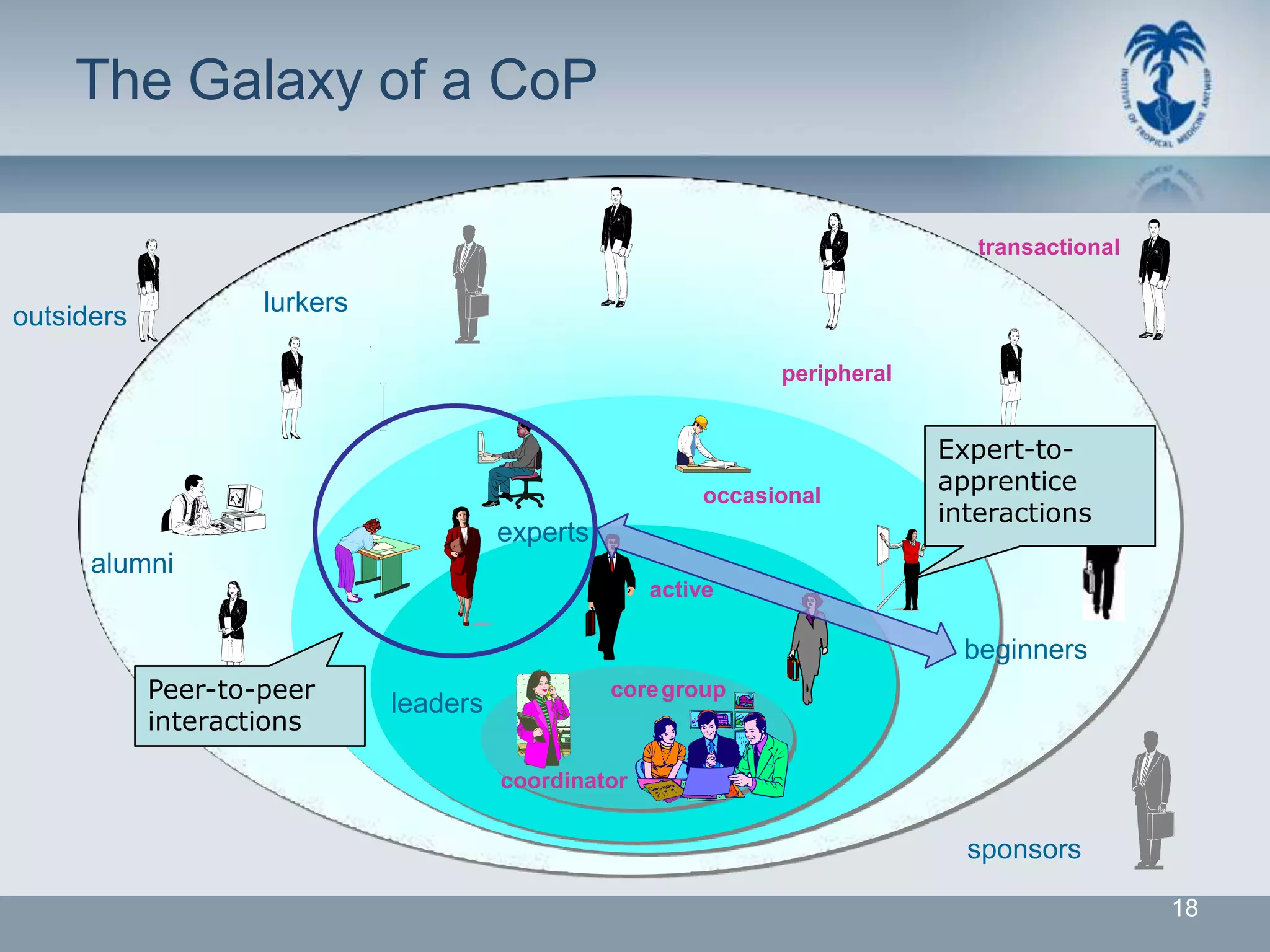
The Galaxy of a CoP

                                                                                transactional


outsiders           lurkers

                                                                peripheral


                                                                             Expert-to-
                                                          occasional
                                                                             apprentice
                                                                             interactions
                                        experts
      alumni
                                                      active

                                                                               beginners
            Peer-to-peer                          core group
                              leaders
            interactions

                                        coordinator


                                                                               sponsors

                                                                                                18
Outline


•   Concepts
•   How do we do it?
•   Key Performance Indicators – an illustration
•   Brainstorming


                                                   19
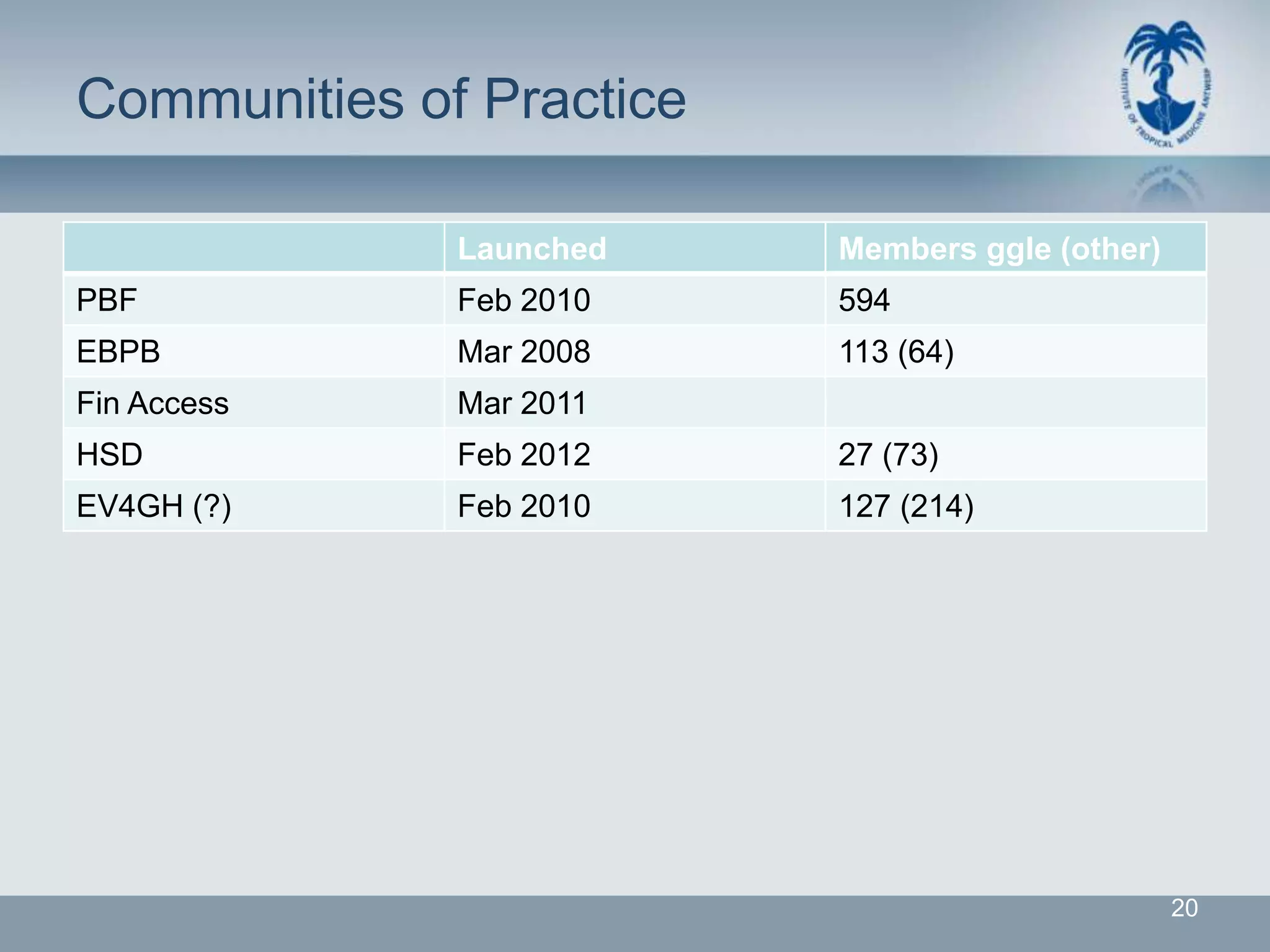
Communities of Practice

              Launched    Members ggle (other)
PBF           Feb 2010    594
EBPB          Mar 2008    113 (64)
Fin Access    Mar 2011
HSD           Feb 2012    27 (73)
EV4GH (?)     Feb 2010    127 (214)


                                                 20
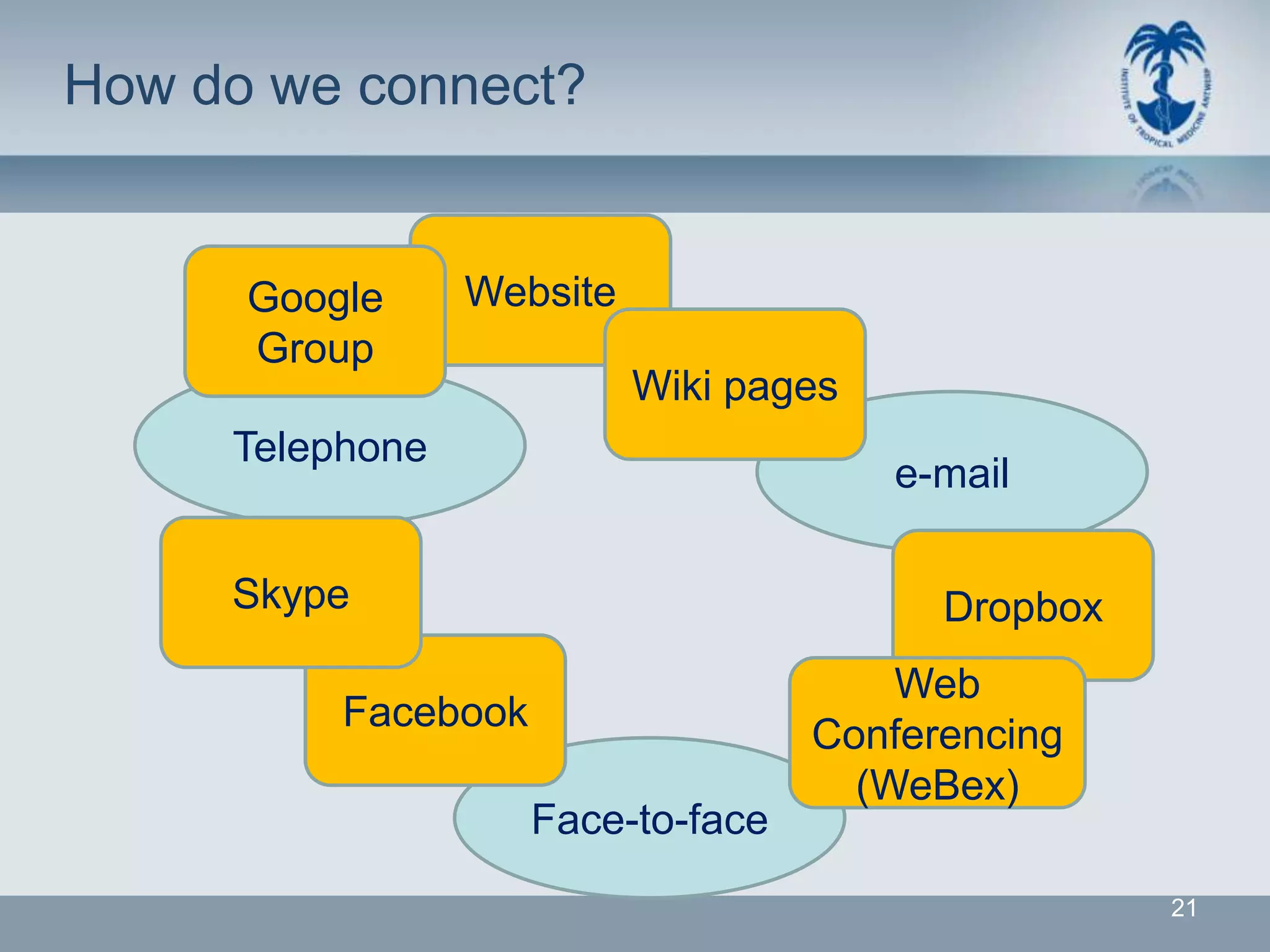
How do we connect?


      Google     Website
      Group
                           Wiki pages
     Telephone
                                        e-mail

     Skype                                Dropbox
                                        Web
          Facebook
                                    Conferencing
                                      (WeBex)
                     Face-to-face
                                                    21
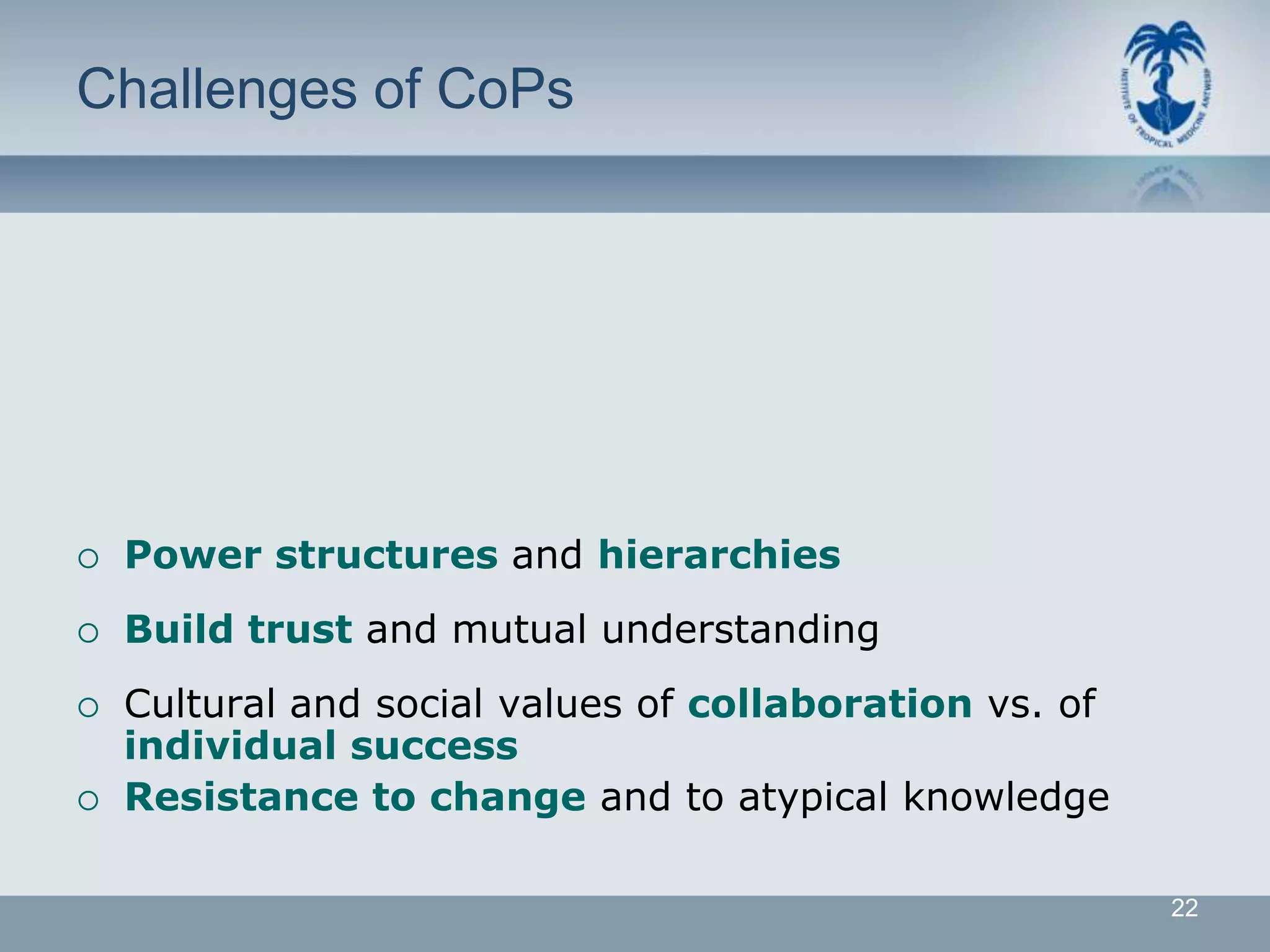
Challenges of CoPs


   Power structures and hierarchies
   Build trust and mutual understanding
   Cultural and social values of collaboration vs. of
    individual success
   Resistance to change and to atypical knowledge

                                                         22
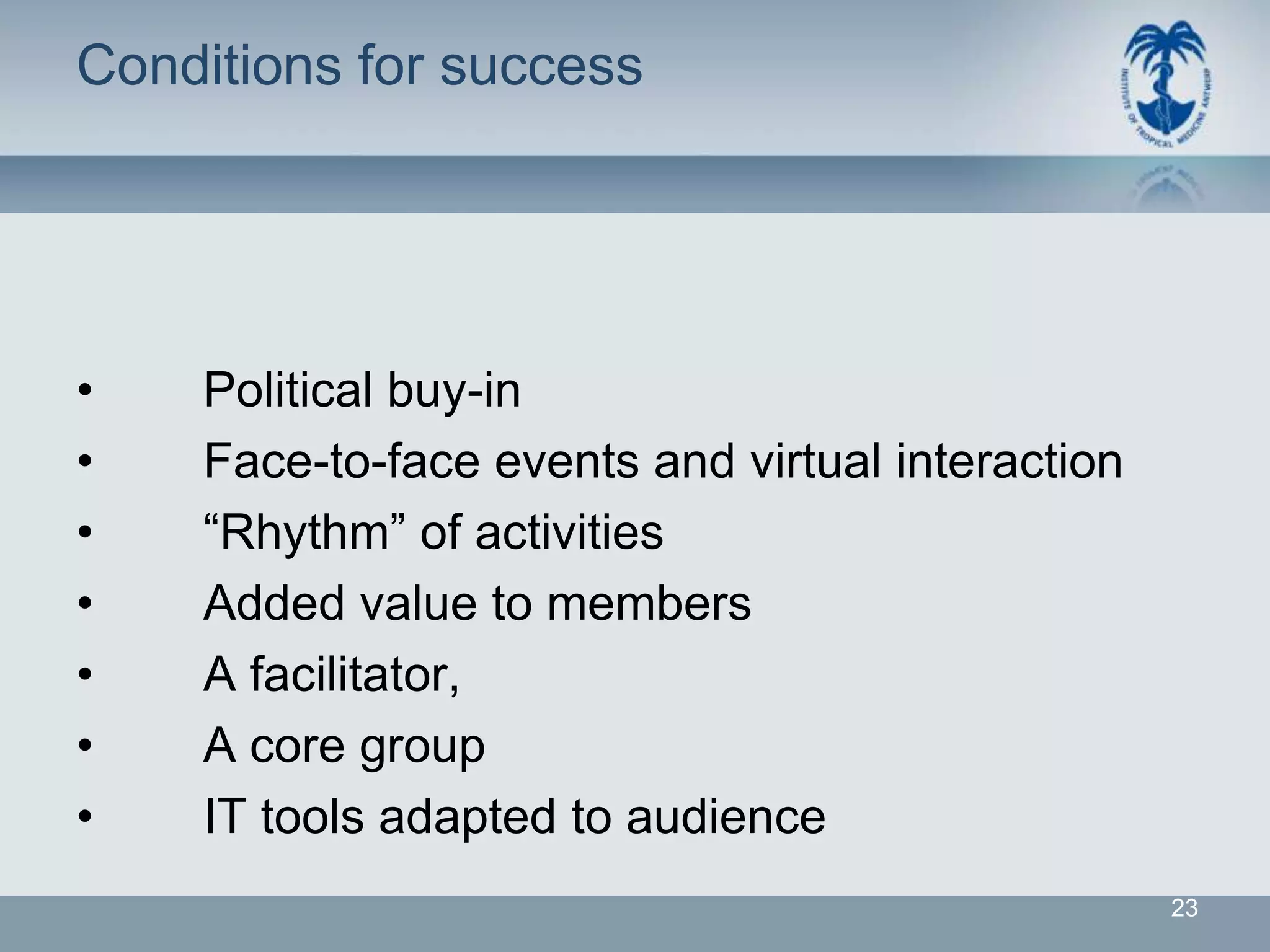
Conditions for success


•   Political buy-in
•   Face-to-face events and virtual interaction
•   “Rhythm” of activities
•   Added value to members
•   A facilitator,
•   A core group
•   IT tools adapted to audience
                                                  23
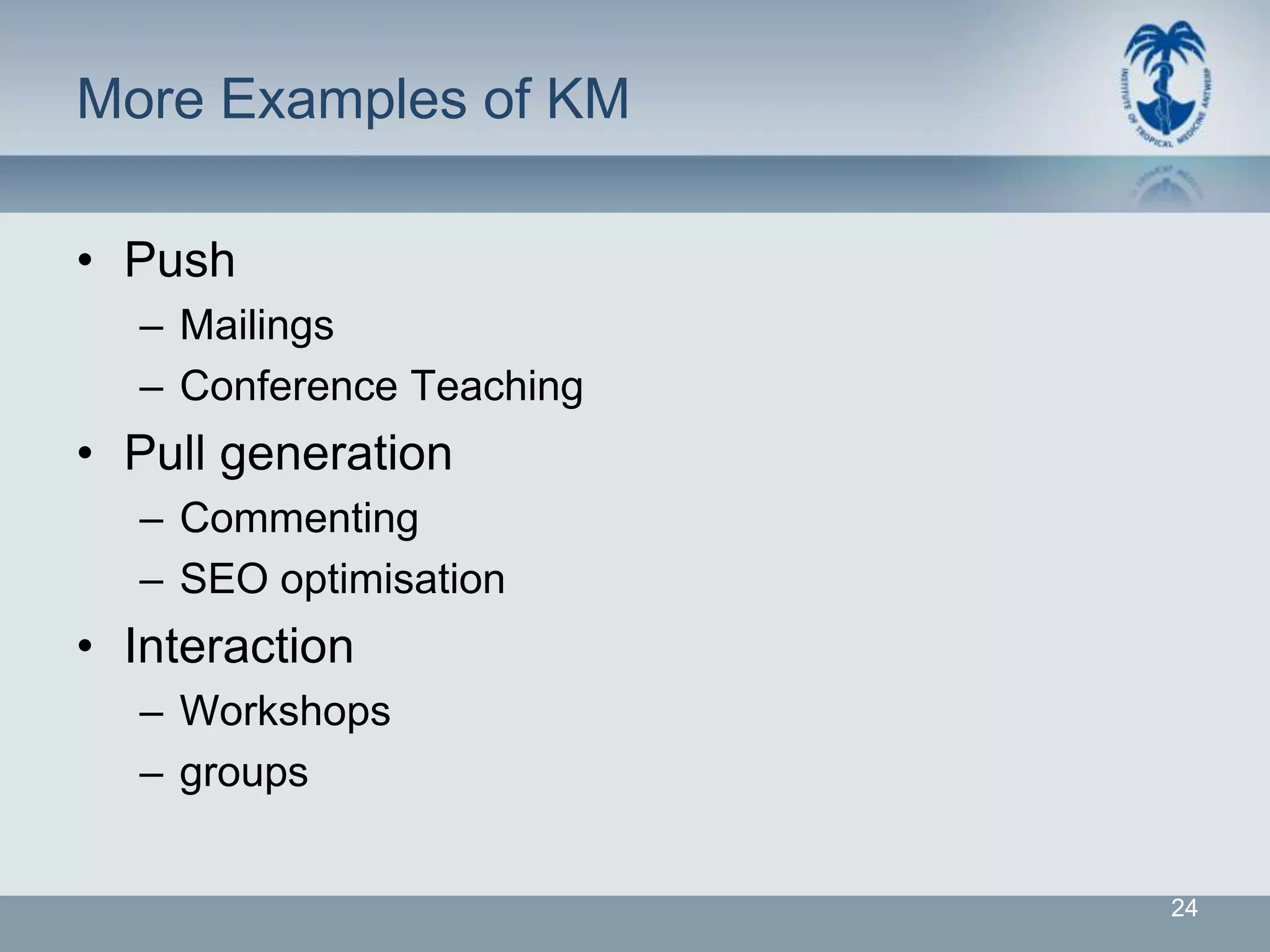
More Examples of KM

• Push
  – Mailings
  – Conference Teaching
• Pull generation
  – Commenting
  – SEO optimisation
• Interaction
  – Workshops
  – groups


                          24
CONCLUSIONS


              25
Opportunities of KM


•   Generation of new Knowledge
•   Increase relevance of Knowledge chain
•   Increase our relevance
•   Reducing carbon footprint, jetlag


                                            26
Challenges of KM activities


• The right domain
• Adequate platform(s) -> New expertise
• Online is not enough, F2F
• Resources (time and money)
                                          27
Outline


•   Concepts
•   How do we do it?
•   Key Performance Indicators – an illustration
•   Brainstorming


                                                   28
KEY PERFORMANCE
INDICATORS

                  29
30
Outline


•   Concepts
•   How do we do it?
•   Key Performance Indicators – an illustration
•   Brainstorming
                                                   31
BRAINSTORMING


                32
If KM was to become a priority of the Dept


• What would be the
  –   Domains
  –   Activities
  –   Priorities
  –   Challenges
• Which KPI would you like to see reported by
  those engaged ?


                                                33
Personal Notes from
discussion during presentation

   Incomplete, subjective, anonymised,
        unsorted and uncensored


                                         34
• Because other do it: other concurrent
  universities/institutions engage in online media
  and communities so there is no guarantee that
  this will increase our visibility we might just be
  keeping abreast of what others are doing.
• Do we need to go that (competitive) way?
• Is it our role? We should publish papers and
  when there is enough new evidence WHO or
  other will organise a meeting with policy makers
  to share the new knowledge.
                                                       35
• Is it acceptable for implementers to be told by
  researchers from the North what they have to do
  ?
• It takes a lot of time. Cost effectiveness has to
  be put in question.
• There is a need for a Knowledge manager
  person.


                                                  36
• We need to monitor the audience. It’s a basic
  principle of marketing when they try to sell
  something. Who do you want to reach ? What do
  they want to hear ?
• Look for similitudes with KCE Dominique
  Roberfroid. For synergies with new course he
  plans to organise.
• Quamed is a COP
• The message should be new enough to learn
  something to audience and close enough to their
  current knowledge to get people to move.      37
• Wikipedia can be very bad resource but the
  reality is that people use it.
• Email remains the major source of
  communication for many
• Mobile devices will be generalised among our
  audience (in Africa) in the coming years.
• People in LBW settings tend to go to websites
  they know when they need an information.
  (Christophe – Environment)

                                                  38
• If your research is pertinent it will be picked up
  by those who need it.
• The scientists who tweet are the good scientist
  that’s why they are more cited.
• If you go to interactive discussion you open the
  window for sharing knowledge/information
  inexact or against your philosophy
• It is easier/ more rewarding to network among
  like minded. Hence there might be a risk/benefit
  of selection bias for members in a network/cop.
                                                       39
• Do you know who is in your COP ? Aren’t the
  same persons in different COPs?
• As a dpt we should do it but what to do should
  be carefully thought of.
• Did you monitor how much of our alumni are
  engaging in the COPs?


                                                   40

Knowledge management dph day 2012

  • 1.
    Knowledge Management Department Day 2012 Public Health Department David Hercot, Maria Paola Bertone & Bruno Meessen*
  • 2.
    Knowledge “is not a staticembedded capability or stable disposition of actors, but rather an ongoing social accomplishment, constituted and reconstituted as actors engage the world of practice” Orlikowski (2002) 2
  • 3.
    Evidence/ Tacit/implicit research knowledge Know “how” KNOWLEGDE Appropriate Acceptability/ skills at local legitimacy of level knowledge
  • 4.
    Knowledge Management Strategies(KM) “enabling individuals, teams and entire organizations to collectively and systematically capture, create, store, share and apply knowledge, to better achieve their objectives” Young (2008) 4
  • 5.
  • 6.
  • 7.
  • 8.
    Ecological Niches inGH Policy Need to bring these Practice Research actors together International Actors
  • 9.
    re-think audience interface publishing support 9
  • 10.
    Ways of “sharingKnowledge” • Push • Pull generation • Interactions 10
  • 11.
    Research outputs • Deliverables • Policy Briefs • Academic Conference Presentation • Peer reviewed papers • Press Release 11
  • 12.
    Do you consider • Workshop with supposed implementers • One pager (25-3-1) • Blog post • Mailing/Tweet/Facebook/Linkedin • Contributing to discussions 12
  • 13.
    Why we needto engage in KM strategies • Demand for Continuing Public Health Education • Visibility of Dpt • Relevance of K creation • Develop our network of – partners in research, – potential students and – funders • Need to find new ways of keeping touch with ground. 13
  • 14.
    Why … cont’d(the research perspective) • What -> How – Appropriate research design • (Gertler Madon Parkhurst) – New methodological approaches • (Pawson, Marchal) – Good collaboration on the field • (op re and action re – Grodos Mercenier Remme Zachariah) – Co Production • (Community of practice as a way of coproducing relevant knowledge - Spiegel) 14
  • 15.
    Why COPs “Strengthening capabilitiesfor producing and applying knowledge through direct engagement with affected populations and decision-makers provides a fertile basis for consolidating capacities to act on a larger scale. This can facilitate the capturing of benefits from the “top down” (in consolidating institutional commitments) and the “bottom up” (to achieve local results).” Spiegel 2011 BMC IH & HR 15
  • 16.
    Community of Practice “a group of people who share a concern, set of problems, or a passion about a topic, and who deepen their knowledge and expertise in this area by interacting on an ongoing basis” Wenger et al (2002) 16
  • 17.
    Community of Practice Threekey dimensions define a CoP • Domain of interest, • Community of participating people and • Practice of sharing knowledge (Wenger et al, 2002) 17
  • 18.
    The Galaxy ofa CoP transactional outsiders lurkers peripheral Expert-to- occasional apprentice interactions experts alumni active beginners Peer-to-peer core group leaders interactions coordinator sponsors 18
  • 19.
    Outline • Concepts • How do we do it? • Key Performance Indicators – an illustration • Brainstorming 19
  • 20.
    Communities of Practice Launched Members ggle (other) PBF Feb 2010 594 EBPB Mar 2008 113 (64) Fin Access Mar 2011 HSD Feb 2012 27 (73) EV4GH (?) Feb 2010 127 (214) 20
  • 21.
    How do weconnect? Google Website Group Wiki pages Telephone e-mail Skype Dropbox Web Facebook Conferencing (WeBex) Face-to-face 21
  • 22.
    Challenges of CoPs  Power structures and hierarchies  Build trust and mutual understanding  Cultural and social values of collaboration vs. of individual success  Resistance to change and to atypical knowledge 22
  • 23.
    Conditions for success • Political buy-in • Face-to-face events and virtual interaction • “Rhythm” of activities • Added value to members • A facilitator, • A core group • IT tools adapted to audience 23
  • 24.
    More Examples ofKM • Push – Mailings – Conference Teaching • Pull generation – Commenting – SEO optimisation • Interaction – Workshops – groups 24
  • 25.
  • 26.
    Opportunities of KM • Generation of new Knowledge • Increase relevance of Knowledge chain • Increase our relevance • Reducing carbon footprint, jetlag 26
  • 27.
    Challenges of KMactivities • The right domain • Adequate platform(s) -> New expertise • Online is not enough, F2F • Resources (time and money) 27
  • 28.
    Outline • Concepts • How do we do it? • Key Performance Indicators – an illustration • Brainstorming 28
  • 29.
  • 30.
  • 31.
    Outline • Concepts • How do we do it? • Key Performance Indicators – an illustration • Brainstorming 31
  • 32.
  • 33.
    If KM wasto become a priority of the Dept • What would be the – Domains – Activities – Priorities – Challenges • Which KPI would you like to see reported by those engaged ? 33
  • 34.
    Personal Notes from discussionduring presentation Incomplete, subjective, anonymised, unsorted and uncensored 34
  • 35.
    • Because otherdo it: other concurrent universities/institutions engage in online media and communities so there is no guarantee that this will increase our visibility we might just be keeping abreast of what others are doing. • Do we need to go that (competitive) way? • Is it our role? We should publish papers and when there is enough new evidence WHO or other will organise a meeting with policy makers to share the new knowledge. 35
  • 36.
    • Is itacceptable for implementers to be told by researchers from the North what they have to do ? • It takes a lot of time. Cost effectiveness has to be put in question. • There is a need for a Knowledge manager person. 36
  • 37.
    • We needto monitor the audience. It’s a basic principle of marketing when they try to sell something. Who do you want to reach ? What do they want to hear ? • Look for similitudes with KCE Dominique Roberfroid. For synergies with new course he plans to organise. • Quamed is a COP • The message should be new enough to learn something to audience and close enough to their current knowledge to get people to move. 37
  • 38.
    • Wikipedia canbe very bad resource but the reality is that people use it. • Email remains the major source of communication for many • Mobile devices will be generalised among our audience (in Africa) in the coming years. • People in LBW settings tend to go to websites they know when they need an information. (Christophe – Environment) 38
  • 39.
    • If yourresearch is pertinent it will be picked up by those who need it. • The scientists who tweet are the good scientist that’s why they are more cited. • If you go to interactive discussion you open the window for sharing knowledge/information inexact or against your philosophy • It is easier/ more rewarding to network among like minded. Hence there might be a risk/benefit of selection bias for members in a network/cop. 39
  • 40.
    • Do youknow who is in your COP ? Aren’t the same persons in different COPs? • As a dpt we should do it but what to do should be carefully thought of. • Did you monitor how much of our alumni are engaging in the COPs? 40

Editor's Notes

  • #2 * Par correspondance
  • #6 Landry 2006
  • #9 Meessen et al 2011, (Jansen et al. 2010). Choiet al. 2005
  • #22 WeBex =http://www.webex.com/= web conferencing, meeting and events centre, on-line classroom environment .Wikis= http://www.wikispaces.com/ , http://wikipages.com/= simple web pages that groups, friends, and families can edit together.Dropbox =http://www.dropbox.com/free service that lets you bring your photos, docs, and videos anywhere and share them easily.Facebook = http://www.facebook.com/= is a social utility that connects people with friends and others who have something to shareSkype = http://www.skype.com/is a software application that allows users to make voice and video calls and chats over the Internet.Delicious=http://www.delicious.com/= “Delicious is a Social Bookmarking service, which means you can save all your bookmarks online, share them with other people, and see what other people are bookmarking. It also means that we can show you the most popular bookmarks being saved right now across many areas of interest. In addition, our search and tagging tools help you keep track of your entire bookmark collection and find tasty new bookmarks from people like you.”
  • #24 From our experience