KNOWLEDGE MANAGEMENT


        . . . .   From Concept to Reality


                  A Presentation by Tim Cope
                   Chief Information Officer
                            UNSW
                         5 May, 2003
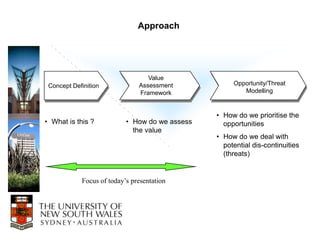
Approach


                                  Value
 Concept Definition            Assessment            Opportunity/Threat
                               Framework                Modelling


                                                • How do we prioritise the
• What is this ?           • How do we assess     opportunities
                             the value
                                                • How do we deal with
                                                  potential dis-continuities
                                                  (threats)


            Focus of today’s presentation
CONCEPT DEFINITION
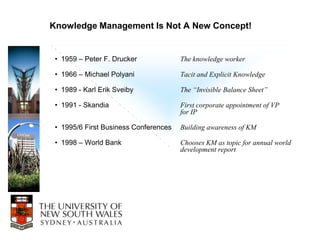
Knowledge Management Is Not A New Concept!


 • 1959 – Peter F. Drucker             The knowledge worker

 • 1966 – Michael Polyani              Tacit and Explicit Knowledge

 • 1989 - Karl Erik Sveiby             The “Invisible Balance Sheet”

 • 1991 - Skandia                      First corporate appointment of VP
                                       for IP

 • 1995/6 First Business Conferences   Building awareness of KM

 • 1998 – World Bank                   Chooses KM as topic for annual world
                                       development report
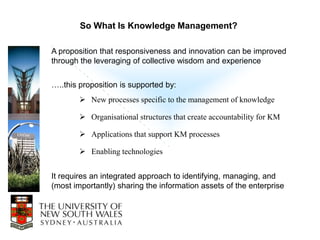
So What Is Knowledge Management?

A proposition that responsiveness and innovation can be improved
through the leveraging of collective wisdom and experience


…..this proposition is supported by:
         New processes specific to the management of knowledge

         Organisational structures that create accountability for KM

         Applications that support KM processes

         Enabling technologies


It requires an integrated approach to identifying, managing, and
(most importantly) sharing the information assets of the enterprise
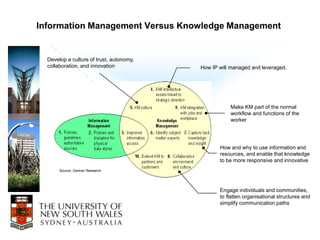
Information Management Versus Knowledge Management


  Develop a culture of trust, autonomy,
  collaboration, and innovation           How IP will managed and leveraged.


                                                     Make KM part of the normal
                                                     workflow and functions of the
                                                     worker


                                                 How and why to use information and
                                                 resources, and enable that knowledge
                                                 to be more responsive and innovative
       Source: Gartner Research


                                                 Engage individuals and communities,
                                                 to flatten organisational structures and
                                                 simplify communication paths
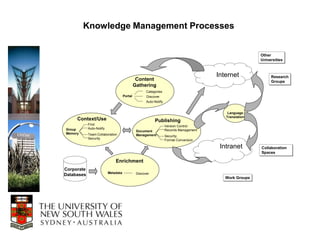
Knowledge Management Processes


                                                                                                         Other
                                                                                                         Other
                                                                                                         Universities
                                                                                                         Universities


                                                                                        Internet              Research
                                                                                                              Research
                                               Content                                                        Groups
                                                                                                              Groups
                                              Gathering
                                                     Categories
                                     Portal          Discover
                                                     Auto-Notify


                                                                                            Language
                                                                                           Translation
     Context/Use                                          Publishing
            Find
                                                                   Version Control
Group       Auto-Notify                                            Records Management
                                               Document
Memory      Team Collaboration                 Management          Security
            Security                              Nortel
                                                                   Format Conversion

                                                                                         Intranet        Collaboration
                                                                                                         Collaboration
                                                                                                         Spaces
                                                                                                         Spaces

                              Enrichment
Corporate
                          Metadata             Discover
Databases
                                                                                           Work Groups
                                                                                           Work Groups
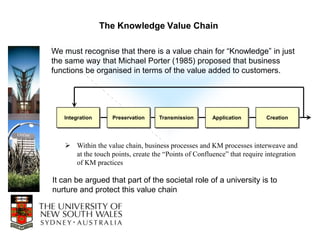
The Knowledge Value Chain

We must recognise that there is a value chain for “Knowledge” in just
the same way that Michael Porter (1985) proposed that business
functions be organised in terms of the value added to customers.


   Integration     Preservation    Transmission       Application        Creation


    Within the value chain, business processes and KM processes interweave and
     at the touch points, create the “Points of Confluence” that require integration
     of KM practices

It can be argued that part of the societal role of a university is to
nurture and protect this value chain
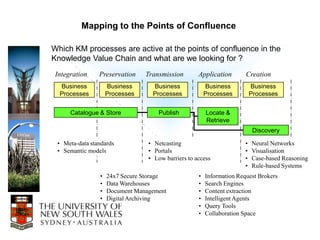
Mapping to the Points of Confluence

Which KM processes are active at the points of confluence in the
Knowledge Value Chain and what are we looking for ?
 Integration    Preservation    Transmission        Application        Creation
  Business          Business      Business              Business           Business
  Processes         Processes     Processes             Processes          Processes


      Catalogue & Store             Publish             Locate &
                                                        Retrieve
                                                                            Discovery

 • Meta-data standards           • Netcasting                          •   Neural Networks
 • Semantic models               • Portals                             •   Visualisation
                                 • Low barriers to access              •   Case-based Reasoning
                                                                       •   Rule-based Systems
                •   24x7 Secure Storage             •   Information Request Brokers
                •   Data Warehouses                 •   Search Engines
                •   Document Management             •   Content extraction
                •   Digital Archiving               •   Intelligent Agents
                                                    •   Query Tools
                                                    •   Collaboration Space
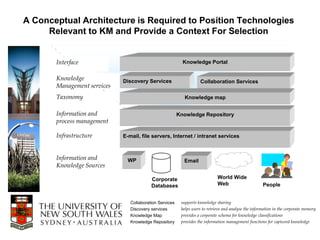
A Conceptual Architecture is Required to Position Technologies
     Relevant to KM and Provide a Context For Selection


       Interface                                           Knowledge Portal


       Knowledge             Discovery Services                     Collaboration Services
       Management services
       Taxonomy                                             Knowledge map


       Information and                                   Knowledge Repository
       process management

       Infrastructure        E-mail, file servers, Internet / intranet services


       Information and         WP                          Email
       Knowledge Sources

                                          Corporate                           World Wide
                                          Databases                           Web                      People


                                Collaboration Services    supports knowledge sharing
                                Discovery services        helps users to retrieve and analyse the information in the corporate memory
                                Knowledge Map             provides a corporate schema for knowledge classifications
                                Knowledge Repository      provides the information management functions for captured knowledge
VALUE ASSESSMENT
Commercial Organisations and Knowledge Management

  Exploring value of KM from 3 perspectives:


         1. Improvement in operating efficiency of business processes
            which benefit from having access to superior information at
            the point of need e.g customer-facing and marketing
            processes, product development etc

         2. A knowledge-empowered organisation

         3. A way of addressing concerns over the loss of corporate
            memory arising from the increasing mobility of labour

      “If we only knew half of what we know, we would be twice as profitable”

                                              Carla Fiorini, CEO Hewlett Packard Corp
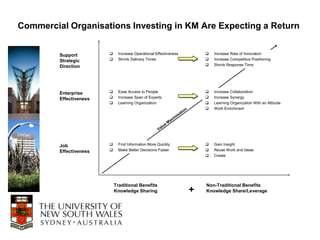
Commercial Organisations Investing in KM Are Expecting a Return


         Support              Increase Operational Effectiveness                      Increase Rate of Innovation
         Strategic            Shrink Delivery Times                                   Increase Competitive Positioning
         Direction                                                                     Shrink Response Time


         Enterprise           Ease Access to People                                   Increase Collaboration
         Effectiveness        Increase Span of Experts                                Increase Synergy
                              Learning Organization                                   Learning Organization With an Attitude
                                                                            n          Work Enrichment
                                                                        ti o
                                                                     isa
                                                                  xim
                                                            e   Ma
                                                       lu
                                                     Va


         Job                  Find Information More Quickly                           Gain Insight
         Effectiveness        Make Better Decisions Faster                            Reuse Work and Ideas
                                                                                       Create


                             Traditional Benefits                                   Non-Traditional Benefits
                             Knowledge Sharing                                  +   Knowledge Share/Leverage
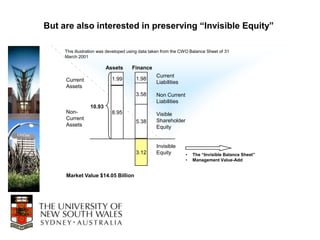
But are also interested in preserving “Invisible Equity”

     This illustration was developed using data taken from the CWO Balance Sheet of 31
     March 2001

                         Assets       Finance
                                                  Current
     Current                1.99        1.98
                                                  Liabilities
     Assets
                                        3.58      Non Current
                                                  Liabilities
                 10.93
     Non-                   8.95                  Visible
     Current                                      Shareholder
                                        5.38
     Assets                                       Equity


                                                  Invisible
                                        3.12      Equity        •   The “Invisible Balance Sheet”
                                                                •   Management Value-Add


     Market Value $14.05 Billion
Universities and Knowledge Management

Similar drivers towards business performance, but the real value lies
in enhanced research outcomes.

        1. Improving the velocity of information

        2. Increasing the impact of research (freedom of access)

        3. Long-term curatorship


The collaborative efforts of universities towards Knowledge Management are
likely to provide an „accelerator‟ effect for research in each participating
institution.

This, dis-intermediation of the current publishing business model, is
something that will need to be carefully considered.
Universities and Knowledge Management…….continued

  Relevance to the core mission:


     Protection of the Knowledge Value Chain can be directly related to the
      core mission of universities and the role they play in society.

     Loosening of the traditional bonds between faculty, students and
      institution brought about by the impact of Information Technology, may
      require even greater emphasis on the management of knowledge
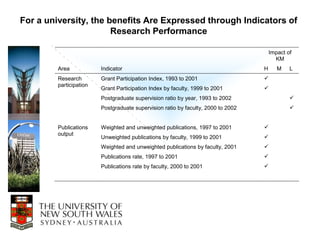
For a university, the benefits Are Expressed through Indicators of
                       Research Performance

                                                                                       Impact of
                                                                                         KM
         Area            Indicator                                                 H      M    L
         Research        Grant Participation Index, 1993 to 2001                   
         participation
                         Grant Participation Index by faculty, 1999 to 2001        
                         Postgraduate supervision ratio by year, 1993 to 2002                  
                         Postgraduate supervision ratio by faculty, 2000 to 2002               


         Publications    Weighted and unweighted publications, 1997 to 2001        
         output
                         Unweighted publications by faculty, 1999 to 2001          
                         Weighted and unweighted publications by faculty, 2001     
                         Publications rate, 1997 to 2001                           
                         Publications rate by faculty, 2000 to 2001                
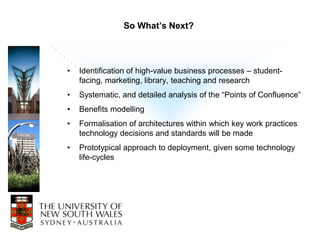
So What’s Next?


•   Identification of high-value business processes – student-
    facing, marketing, library, teaching and research
•   Systematic, and detailed analysis of the “Points of Confluence”
•   Benefits modelling
•   Formalisation of architectures within which key work practices
    technology decisions and standards will be made
•   Prototypical approach to deployment, given some technology
    life-cycles
KNOWLEDGE MANAGEMENT


        . . . .   From Concept to Reality


                     The End – Thank You


                                  QUESTIONS?

Km2003cope

  • 1.
    KNOWLEDGE MANAGEMENT . . . . From Concept to Reality A Presentation by Tim Cope Chief Information Officer UNSW 5 May, 2003
  • 2.
    Approach Value Concept Definition Assessment Opportunity/Threat Framework Modelling • How do we prioritise the • What is this ? • How do we assess opportunities the value • How do we deal with potential dis-continuities (threats) Focus of today’s presentation
  • 3.
  • 4.
    Knowledge Management IsNot A New Concept! • 1959 – Peter F. Drucker The knowledge worker • 1966 – Michael Polyani Tacit and Explicit Knowledge • 1989 - Karl Erik Sveiby The “Invisible Balance Sheet” • 1991 - Skandia First corporate appointment of VP for IP • 1995/6 First Business Conferences Building awareness of KM • 1998 – World Bank Chooses KM as topic for annual world development report
  • 5.
    So What IsKnowledge Management? A proposition that responsiveness and innovation can be improved through the leveraging of collective wisdom and experience …..this proposition is supported by:  New processes specific to the management of knowledge  Organisational structures that create accountability for KM  Applications that support KM processes  Enabling technologies It requires an integrated approach to identifying, managing, and (most importantly) sharing the information assets of the enterprise
  • 6.
    Information Management VersusKnowledge Management Develop a culture of trust, autonomy, collaboration, and innovation How IP will managed and leveraged. Make KM part of the normal workflow and functions of the worker How and why to use information and resources, and enable that knowledge to be more responsive and innovative Source: Gartner Research Engage individuals and communities, to flatten organisational structures and simplify communication paths
  • 7.
    Knowledge Management Processes Other Other Universities Universities Internet Research Research Content Groups Groups Gathering Categories Portal Discover Auto-Notify Language Translation Context/Use Publishing Find Version Control Group Auto-Notify Records Management Document Memory Team Collaboration Management Security Security Nortel Format Conversion Intranet Collaboration Collaboration Spaces Spaces Enrichment Corporate Metadata Discover Databases Work Groups Work Groups
  • 8.
    The Knowledge ValueChain We must recognise that there is a value chain for “Knowledge” in just the same way that Michael Porter (1985) proposed that business functions be organised in terms of the value added to customers. Integration Preservation Transmission Application Creation  Within the value chain, business processes and KM processes interweave and at the touch points, create the “Points of Confluence” that require integration of KM practices It can be argued that part of the societal role of a university is to nurture and protect this value chain
  • 9.
    Mapping to thePoints of Confluence Which KM processes are active at the points of confluence in the Knowledge Value Chain and what are we looking for ? Integration Preservation Transmission Application Creation Business Business Business Business Business Processes Processes Processes Processes Processes Catalogue & Store Publish Locate & Retrieve Discovery • Meta-data standards • Netcasting • Neural Networks • Semantic models • Portals • Visualisation • Low barriers to access • Case-based Reasoning • Rule-based Systems • 24x7 Secure Storage • Information Request Brokers • Data Warehouses • Search Engines • Document Management • Content extraction • Digital Archiving • Intelligent Agents • Query Tools • Collaboration Space
  • 10.
    A Conceptual Architectureis Required to Position Technologies Relevant to KM and Provide a Context For Selection Interface Knowledge Portal Knowledge Discovery Services Collaboration Services Management services Taxonomy Knowledge map Information and Knowledge Repository process management Infrastructure E-mail, file servers, Internet / intranet services Information and WP Email Knowledge Sources Corporate World Wide Databases Web People Collaboration Services supports knowledge sharing Discovery services helps users to retrieve and analyse the information in the corporate memory Knowledge Map provides a corporate schema for knowledge classifications Knowledge Repository provides the information management functions for captured knowledge
  • 11.
  • 12.
    Commercial Organisations andKnowledge Management Exploring value of KM from 3 perspectives: 1. Improvement in operating efficiency of business processes which benefit from having access to superior information at the point of need e.g customer-facing and marketing processes, product development etc 2. A knowledge-empowered organisation 3. A way of addressing concerns over the loss of corporate memory arising from the increasing mobility of labour “If we only knew half of what we know, we would be twice as profitable” Carla Fiorini, CEO Hewlett Packard Corp
  • 13.
    Commercial Organisations Investingin KM Are Expecting a Return Support  Increase Operational Effectiveness  Increase Rate of Innovation Strategic  Shrink Delivery Times  Increase Competitive Positioning Direction  Shrink Response Time Enterprise  Ease Access to People  Increase Collaboration Effectiveness  Increase Span of Experts  Increase Synergy  Learning Organization  Learning Organization With an Attitude n  Work Enrichment ti o isa xim e Ma lu Va Job  Find Information More Quickly  Gain Insight Effectiveness  Make Better Decisions Faster  Reuse Work and Ideas  Create Traditional Benefits Non-Traditional Benefits Knowledge Sharing + Knowledge Share/Leverage
  • 14.
    But are alsointerested in preserving “Invisible Equity” This illustration was developed using data taken from the CWO Balance Sheet of 31 March 2001 Assets Finance Current Current 1.99 1.98 Liabilities Assets 3.58 Non Current Liabilities 10.93 Non- 8.95 Visible Current Shareholder 5.38 Assets Equity Invisible 3.12 Equity • The “Invisible Balance Sheet” • Management Value-Add Market Value $14.05 Billion
  • 15.
    Universities and KnowledgeManagement Similar drivers towards business performance, but the real value lies in enhanced research outcomes. 1. Improving the velocity of information 2. Increasing the impact of research (freedom of access) 3. Long-term curatorship The collaborative efforts of universities towards Knowledge Management are likely to provide an „accelerator‟ effect for research in each participating institution. This, dis-intermediation of the current publishing business model, is something that will need to be carefully considered.
  • 16.
    Universities and KnowledgeManagement…….continued Relevance to the core mission:  Protection of the Knowledge Value Chain can be directly related to the core mission of universities and the role they play in society.  Loosening of the traditional bonds between faculty, students and institution brought about by the impact of Information Technology, may require even greater emphasis on the management of knowledge
  • 17.
    For a university,the benefits Are Expressed through Indicators of Research Performance Impact of KM Area Indicator H M L Research Grant Participation Index, 1993 to 2001  participation Grant Participation Index by faculty, 1999 to 2001  Postgraduate supervision ratio by year, 1993 to 2002  Postgraduate supervision ratio by faculty, 2000 to 2002  Publications Weighted and unweighted publications, 1997 to 2001  output Unweighted publications by faculty, 1999 to 2001  Weighted and unweighted publications by faculty, 2001  Publications rate, 1997 to 2001  Publications rate by faculty, 2000 to 2001 
  • 18.
    So What’s Next? • Identification of high-value business processes – student- facing, marketing, library, teaching and research • Systematic, and detailed analysis of the “Points of Confluence” • Benefits modelling • Formalisation of architectures within which key work practices technology decisions and standards will be made • Prototypical approach to deployment, given some technology life-cycles
  • 19.
    KNOWLEDGE MANAGEMENT . . . . From Concept to Reality The End – Thank You QUESTIONS?