Alternative structures of
knowledge management and
        production
     A community-of-practice approach


             By Francis Gosselin
             Ph.D. Candidate, BETA
Planning
• Communities | Concepts
    •   A brief history of the CoP approach
    •   The specifics of ‘guided’ communities
    •   How ideas move : a dynamic approach
                       [break]15mins

• Organizations | Knowledge
    •   Bureaucracy
    •   Case studies
                       [break]15mins

• Firms | Spaces
   • Leveraging creative organizations
   • Cities and cases
• Conclusion
Communities | Concepts
Communities     ‘‘A system of relationships between people, activities and the
                                world ; developing with time, and in relation to other tangential
Defining communities            and overlapping communities of practice [...] an intrinsic
                                condition to the existence of knowledge’’ - J. Roberts


• A cognitive key to understanding learning[Lave & Wenger, 1991]
• Explored as ‘spontaneous groups’ of individuals
• Based on a practice, a problem, a question
• Learning | legitimate peripheral participation (LPP)
• Peripherality as a positive term
• Forging common languages, meanings and understandings,
  through a ‘codebook’
Communities2
   A short history

• Initially a generic | ‘communities-are-everywhere’
  approach
• Case studies developed throughout the ‘90s [starting with
   Brown & Duguid, 1992]

• Introduction of virtual CoPs | open source
• Communities of users [von Hippel, 2001]
• Operationalized by consultants [notably E. Wenger]
• Increasing interest towards ‘guided’ CoPs
Communities3
                                 ‘‘One must distinguish ‘intentional’ or ‘guided’ communities -
                                 those formed by formal hierarchies, from their spontaneous
  Creating CoPs                  counterparts, which emerge without the help of any pre-existing
                                 structure ’’ - transl. from Gosselin et. al., forthcoming (2010)


• CoPs are somewhat antithetical to a rational, task-
  based approach
• The firm must create spaces to ‘favour emergence’
• Avoid the temptation of the hierarchy [Josserand & St-Léger, 2004]
• A balancing act ; b-up | t-down
• Different actors, different roles [CEFRIO, 2005]
• Uncertain returns ...
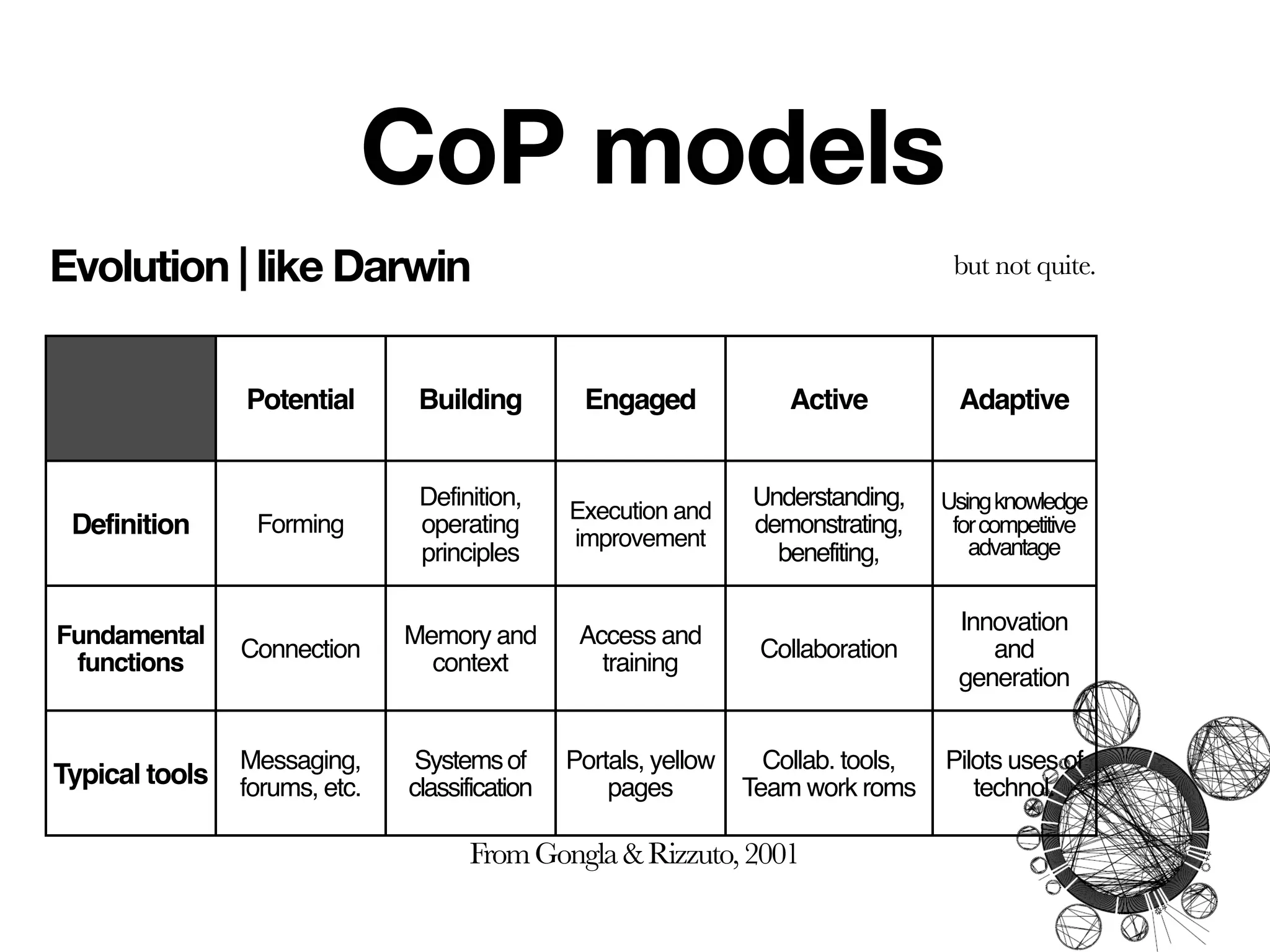
CoP models
Evolution | like Darwin                                                               but not quite.


                Potential       Building         Engaged              Active           Adaptive


                                Definition,                       Understanding,     Using knowledge
                                                Execution and
 Definition      Forming        operating
                                                improvement
                                                                  demonstrating,      for competitive
                                principles                          benefiting,         advantage


                                                                                      Innovation
Fundamental                    Memory and        Access and
                Connection                                         Collaboration         and
 functions                       context           training
                                                                                      generation


                Messaging,      Systems of      Portals, yellow     Collab. tools,   Pilots uses of
Typical tools   forums, etc.   classification       pages         Team work roms        technol.

                                     From Gongla & Rizzuto, 2001
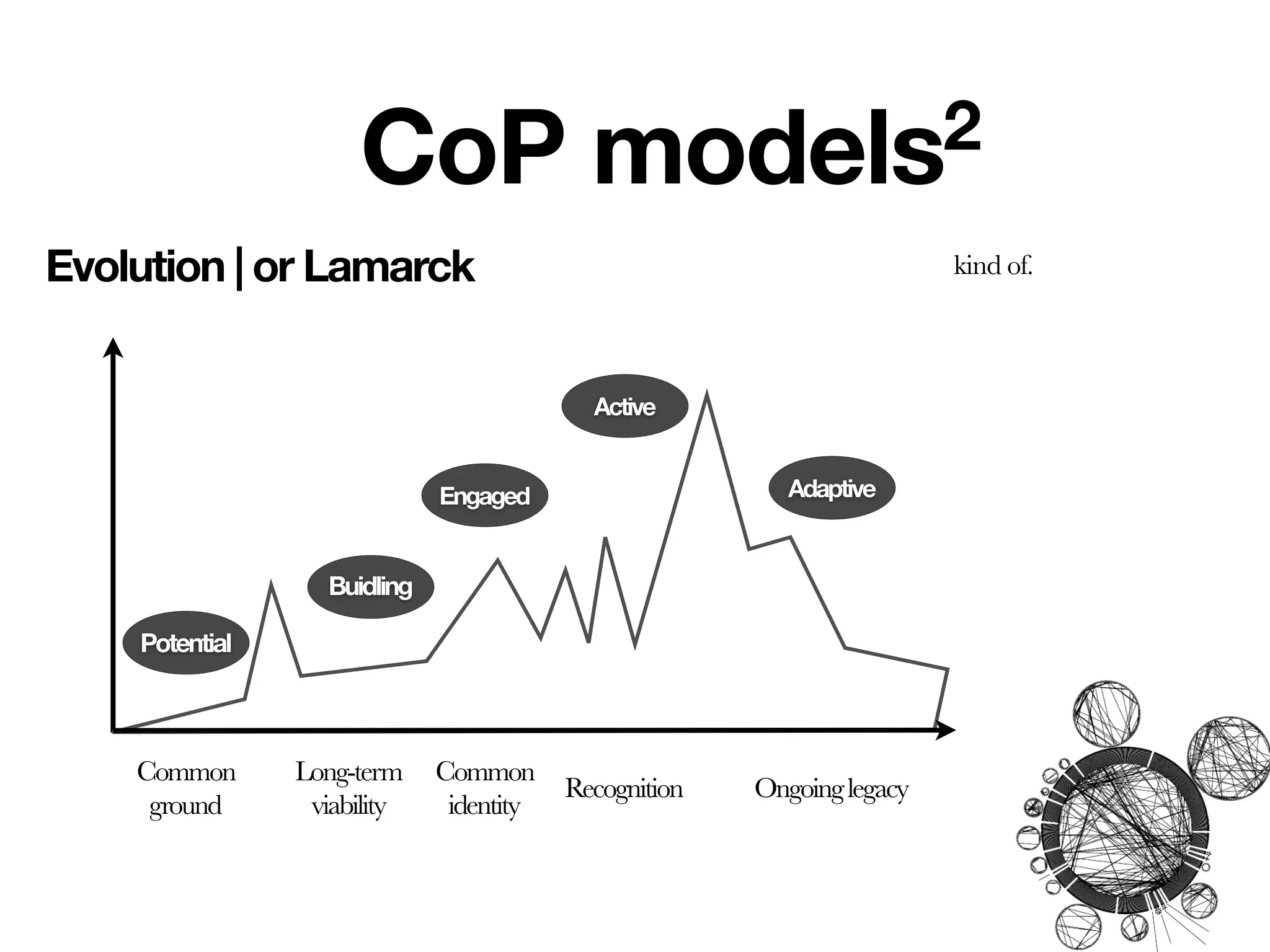
CoP                   models2
Evolution | or Lamarck                                                   kind of.


                                            Active


                              Engaged                      Adaptive


                   Buidling

    Potential


    Common      Long-term     Common
                                          Recognition   Ongoing legacy
     ground      viability     identity
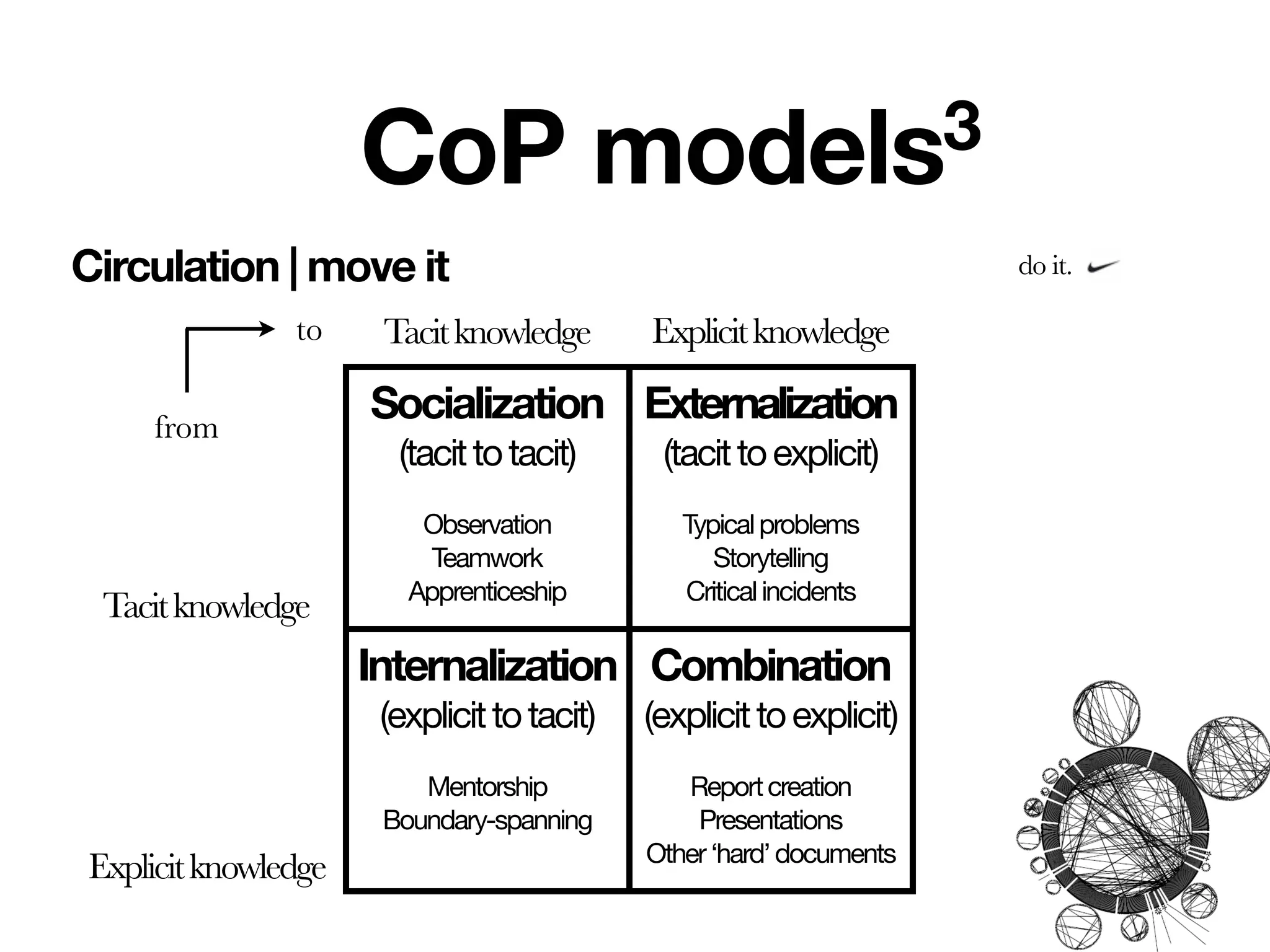
CoP                  models3
Circulation | move it                                                do it.

               to     Tacit knowledge       Explicit knowledge

     from
                     Socialization Externalization
                       (tacit to tacit)      (tacit to explicit)
                         Observation           Typical problems
                          Teamwork                Storytelling
                        Apprenticeship         Critical incidents
 Tacit knowledge
                     Internalization Combination
                      (explicit to tacit)   (explicit to explicit)
                         Mentorship            Report creation
                      Boundary-spanning         Presentations
                                            Other ‘hard’ documents
Explicit knowledge
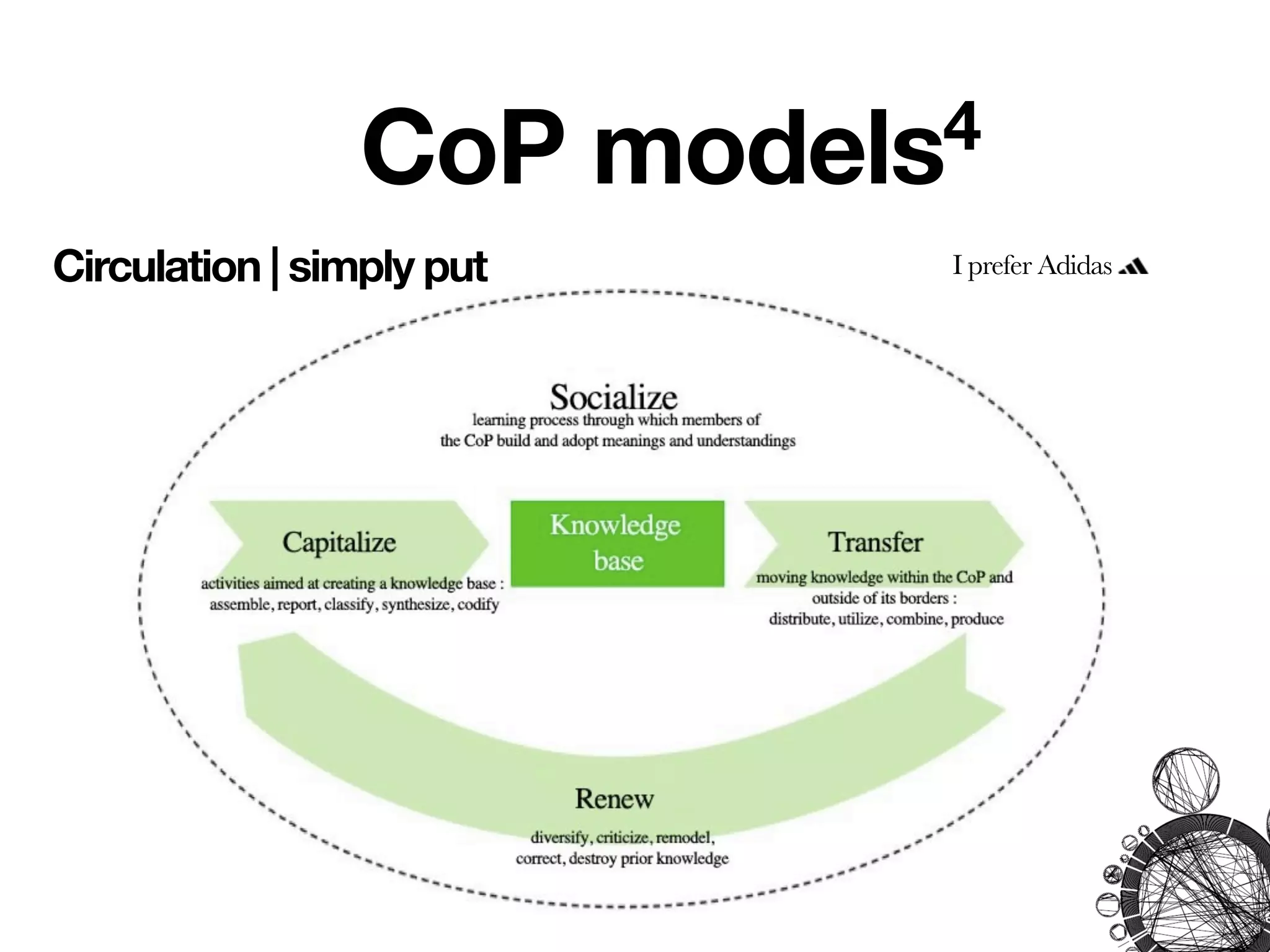
CoP        models4
Circulation | simply put         I prefer Adidas
Organizations | Knowledge
Large organizations
                              «The capitalist process, by substituting a mere parcel of shares for the walls of and
                              the machines in a factory, takes the life out of the idea of property. It loosens the
                              grip that once was so strong - the grip in the sense of the legal right and the actual
                              ability to do as one pleases with one’s own; the grip also in the sense that the
                              holder of the title loses the will to fight, economically, physically, politically, for ‘his’
                              factory and his control over it, to die if necessary on its steps» - J.A. Schumpeter


• The impersonality of growing firms
• Praising bureaucracy for its rationality
• Routinizing innovation [marginally, perhaps]
• Without ownership, what incentives ?
• Adapting a XXth century model to XXIst
  century realities
• Informality, creativity, passion...
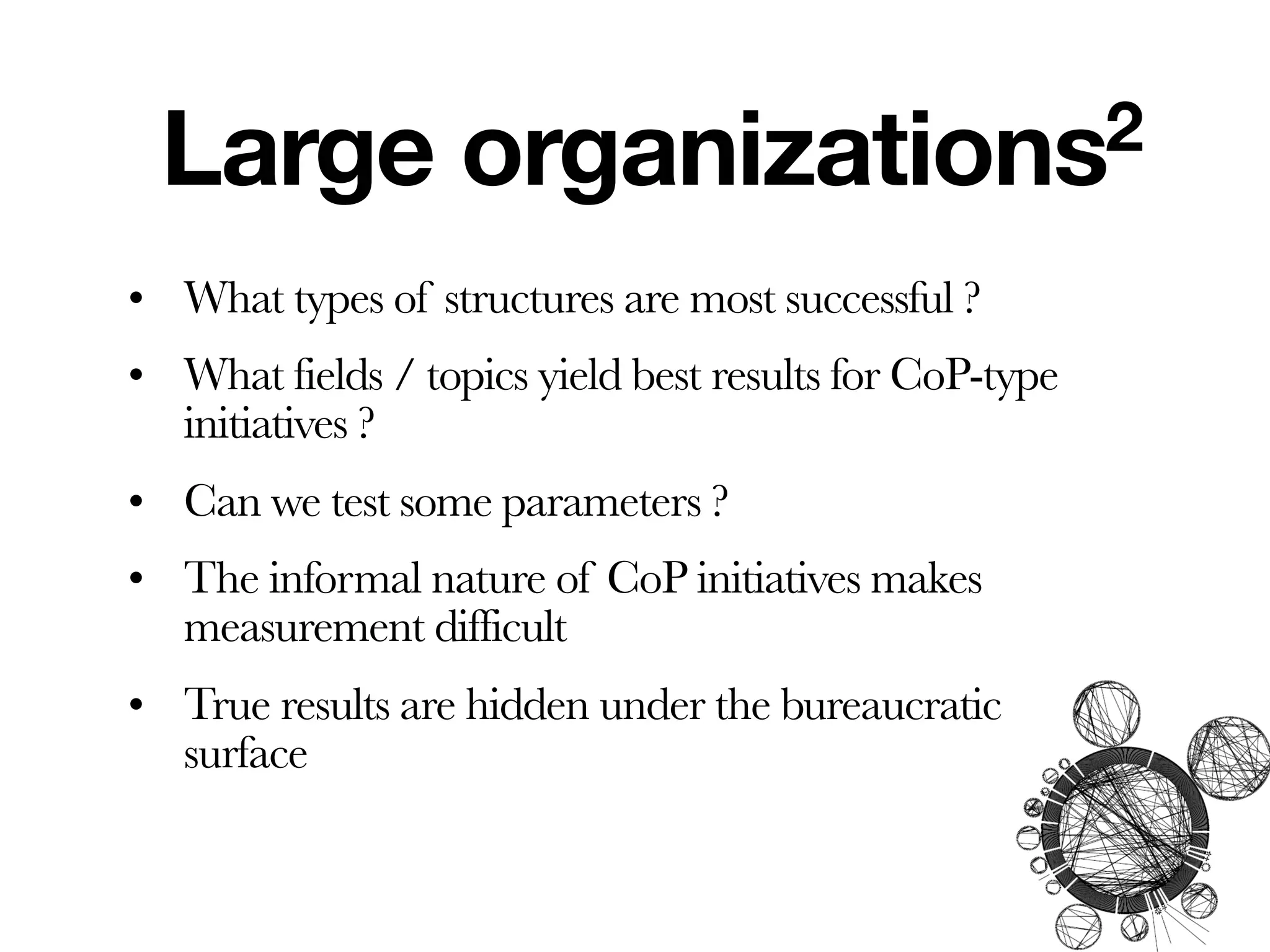
Large             organizations2

• What types of structures are most successful ?
• What fields / topics yield best results for CoP-type
  initiatives ?
• Can we test some parameters ?
• The informal nature of CoP initiatives makes
  measurement difficult
• True results are hidden under the bureaucratic
  surface
Case studies
IBM                                           business machines.


• Montreal-based manufacturing plant :
  implementing lean production
• Strategic CoP of lean coordinators
• Reciprocal objectives - theoretical / practical
• Analyzing processes / roles through time
• Convincing the hierarchy to let go...
Case studies
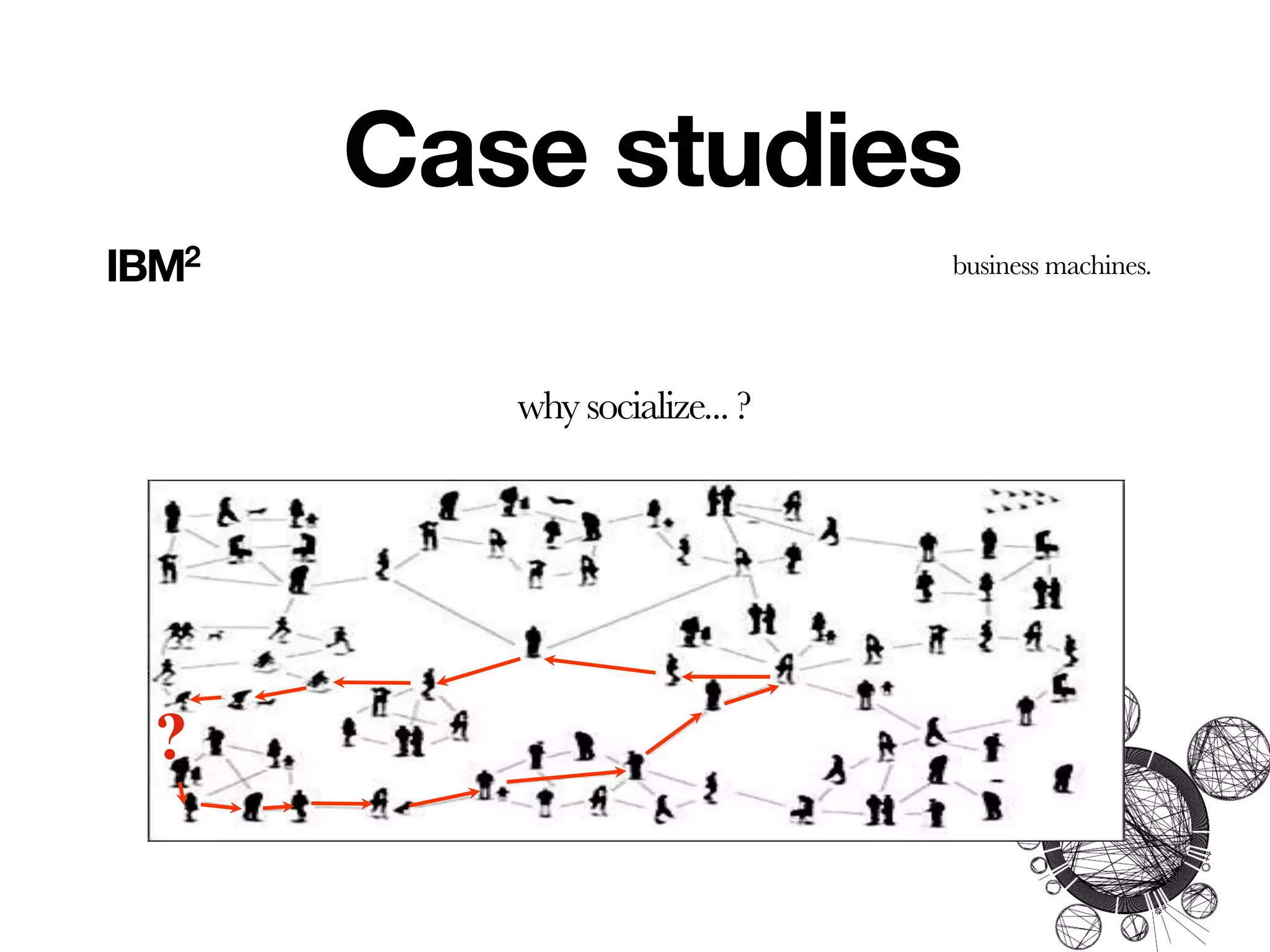
IBM2                           business machines.


          why socialize... ?


  ?
Case            studies2
Bell Canada                                      dring.


• The canonical example of the large, stale bureaucracy
• Taking pride in numbers
• ESRs with increasing responsibilities
• New ideas, old processes
• Emphasis : codification
• The logo anecdote
Case           studies2
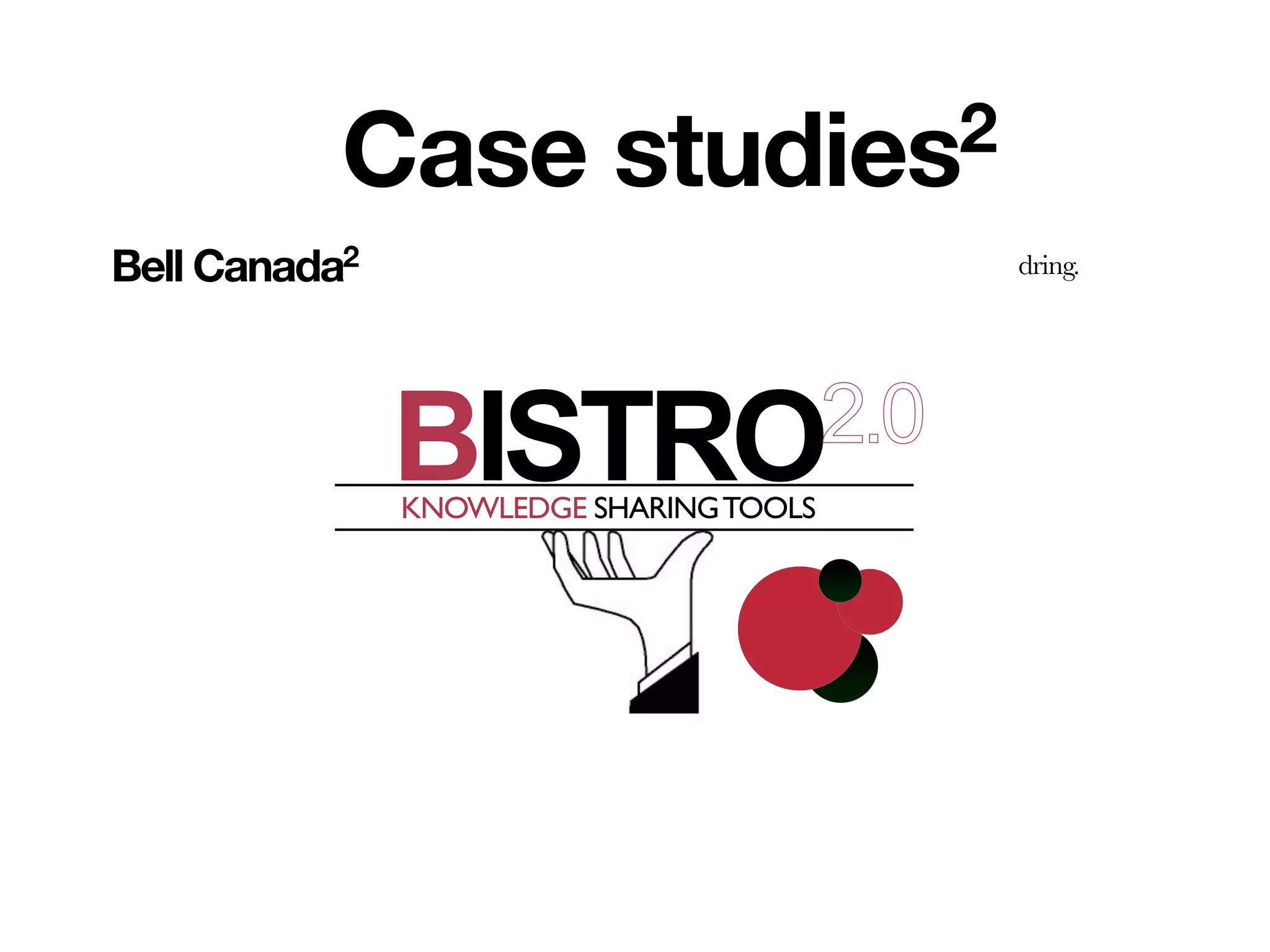
Bell Canada2                             dring.


               BISTRO2.0
               KNOWLEDGE SHARING TOOLS


     !
Case          studies3
 GDF SUEZ                                         gas+water.


• A world-class leader in energy and environment
• Cultivating hundreds of so-called CoPs
• Created CoP KM to bring together all
  ‘coaches’
• Very high number of participants (>130) ; two
  animators - some specificities
• What makes a difference? Cultural context?
  Organizational determinants?
Firms | Spaces
Communities and the city              CoPs + Spots
   • The dynamics of innovation | a social construction
   • Urbanity favours creativity [density, intensity, diversity]
   • What do ‘creative cities’ have in common ?
   • A lengthy process of maturation
   • Going back to the basics
Montreal            CoPs + Spots
• 3M ppl
• Betw. Paris+SF   • the ‘‘Quiet Revolution’’ ; expo, games
• Midpoint (NY,    • City of Festivals [...] - increase chaos
  Boston, Tor.)
                   • Areas for the underground*
• Bilingual
                   • Public/private/artistic symbiosis
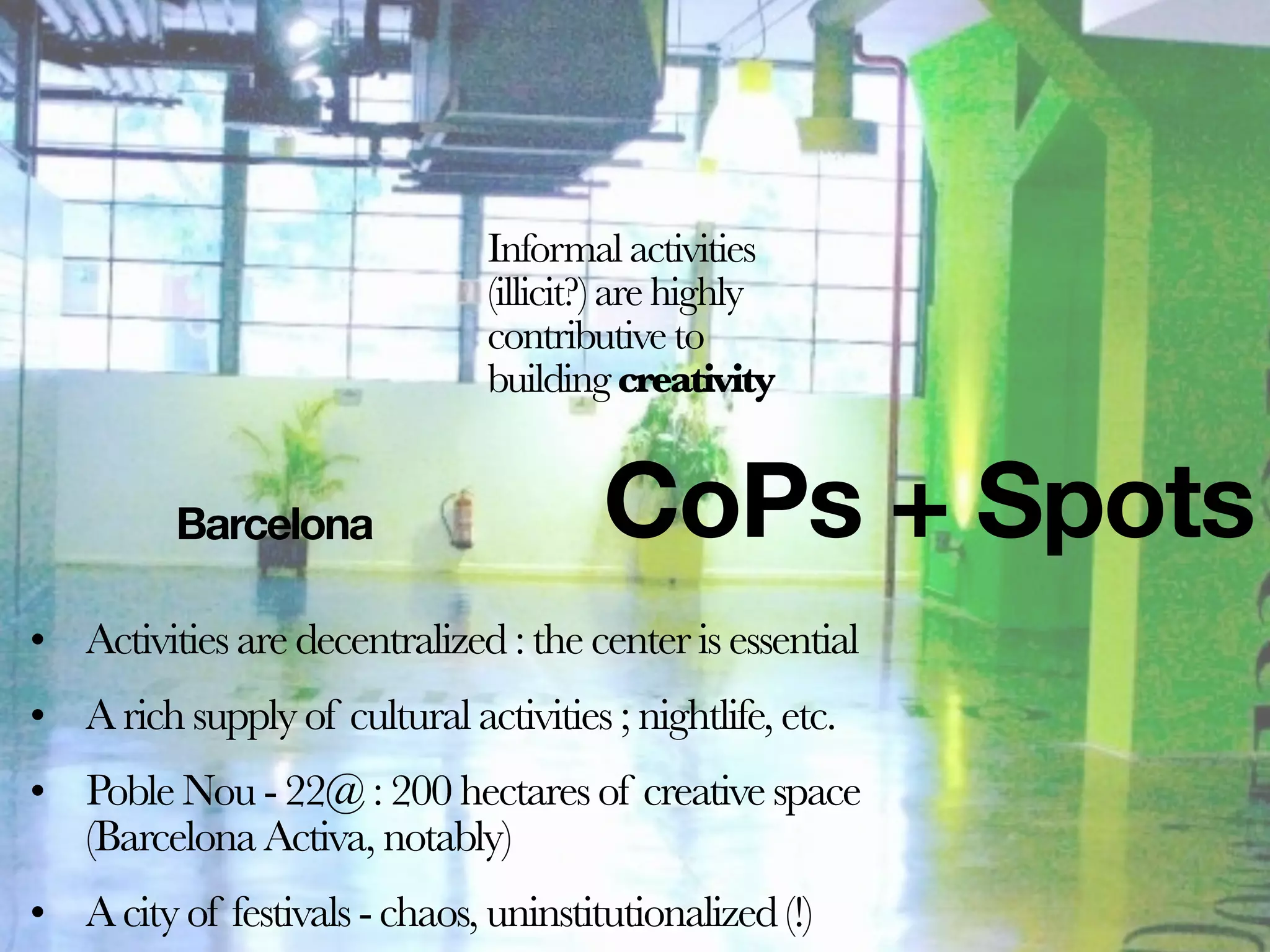
Informal activities
                               (illicit?) are highly
                               contributive to
                               building creativity


          Barcelona                    CoPs + Spots
• Activities are decentralized : the center is essential
• A rich supply of cultural activities ; nightlife, etc.
• Poble Nou - 22@ : 200 hectares of creative space
  (Barcelona Activa, notably)
• A city of festivals - chaos, uninstitutionalized (!)
Mannheim                          CoPs + Spots
•   A history of industrial development
•   The Quadrate ; what creativity comes from squares...
•   Instituting the arts : from Popakademie to Mannheim Hochschule
•   Arranging around the creative industries : security, technique, PR, etc.
•   The underground : festivals, inPop[w/schoolchildren], theaters, clubs
Alternative structures of knowledge management
                  and production
                                         Conclusion


 • The evolution of a concept
 • Management consulting fad ? [...] 
 • Alternative structures yield alternative results
  • For firms | for cities


 • Measurement difficulties
 • In search of a coherent framework

Alternative structures of knowledge management and production

  • 1.
    Alternative structures of knowledgemanagement and production A community-of-practice approach By Francis Gosselin Ph.D. Candidate, BETA
  • 2.
    Planning • Communities |Concepts • A brief history of the CoP approach • The specifics of ‘guided’ communities • How ideas move : a dynamic approach [break]15mins • Organizations | Knowledge • Bureaucracy • Case studies [break]15mins • Firms | Spaces • Leveraging creative organizations • Cities and cases • Conclusion
  • 3.
  • 4.
    Communities ‘‘A system of relationships between people, activities and the world ; developing with time, and in relation to other tangential Defining communities and overlapping communities of practice [...] an intrinsic condition to the existence of knowledge’’ - J. Roberts • A cognitive key to understanding learning[Lave & Wenger, 1991] • Explored as ‘spontaneous groups’ of individuals • Based on a practice, a problem, a question • Learning | legitimate peripheral participation (LPP) • Peripherality as a positive term • Forging common languages, meanings and understandings, through a ‘codebook’
  • 5.
    Communities2 A short history • Initially a generic | ‘communities-are-everywhere’ approach • Case studies developed throughout the ‘90s [starting with Brown & Duguid, 1992] • Introduction of virtual CoPs | open source • Communities of users [von Hippel, 2001] • Operationalized by consultants [notably E. Wenger] • Increasing interest towards ‘guided’ CoPs
  • 6.
    Communities3 ‘‘One must distinguish ‘intentional’ or ‘guided’ communities - those formed by formal hierarchies, from their spontaneous Creating CoPs counterparts, which emerge without the help of any pre-existing structure ’’ - transl. from Gosselin et. al., forthcoming (2010) • CoPs are somewhat antithetical to a rational, task- based approach • The firm must create spaces to ‘favour emergence’ • Avoid the temptation of the hierarchy [Josserand & St-Léger, 2004] • A balancing act ; b-up | t-down • Different actors, different roles [CEFRIO, 2005] • Uncertain returns ...
  • 7.
    CoP models Evolution |like Darwin but not quite. Potential Building Engaged Active Adaptive Definition, Understanding, Using knowledge Execution and Definition Forming operating improvement demonstrating, for competitive principles benefiting, advantage Innovation Fundamental Memory and Access and Connection Collaboration and functions context training generation Messaging, Systems of Portals, yellow Collab. tools, Pilots uses of Typical tools forums, etc. classification pages Team work roms technol. From Gongla & Rizzuto, 2001
  • 8.
    CoP models2 Evolution | or Lamarck kind of. Active Engaged Adaptive Buidling Potential Common Long-term Common Recognition Ongoing legacy ground viability identity
  • 9.
    CoP models3 Circulation | move it do it. to Tacit knowledge Explicit knowledge from Socialization Externalization (tacit to tacit) (tacit to explicit) Observation Typical problems Teamwork Storytelling Apprenticeship Critical incidents Tacit knowledge Internalization Combination (explicit to tacit) (explicit to explicit) Mentorship Report creation Boundary-spanning Presentations Other ‘hard’ documents Explicit knowledge
  • 10.
    CoP models4 Circulation | simply put I prefer Adidas
  • 11.
  • 12.
    Large organizations «The capitalist process, by substituting a mere parcel of shares for the walls of and the machines in a factory, takes the life out of the idea of property. It loosens the grip that once was so strong - the grip in the sense of the legal right and the actual ability to do as one pleases with one’s own; the grip also in the sense that the holder of the title loses the will to fight, economically, physically, politically, for ‘his’ factory and his control over it, to die if necessary on its steps» - J.A. Schumpeter • The impersonality of growing firms • Praising bureaucracy for its rationality • Routinizing innovation [marginally, perhaps] • Without ownership, what incentives ? • Adapting a XXth century model to XXIst century realities • Informality, creativity, passion...
  • 13.
    Large organizations2 • What types of structures are most successful ? • What fields / topics yield best results for CoP-type initiatives ? • Can we test some parameters ? • The informal nature of CoP initiatives makes measurement difficult • True results are hidden under the bureaucratic surface
  • 14.
    Case studies IBM business machines. • Montreal-based manufacturing plant : implementing lean production • Strategic CoP of lean coordinators • Reciprocal objectives - theoretical / practical • Analyzing processes / roles through time • Convincing the hierarchy to let go...
  • 15.
    Case studies IBM2 business machines. why socialize... ? ?
  • 16.
    Case studies2 Bell Canada dring. • The canonical example of the large, stale bureaucracy • Taking pride in numbers • ESRs with increasing responsibilities • New ideas, old processes • Emphasis : codification • The logo anecdote
  • 17.
    Case studies2 Bell Canada2 dring. BISTRO2.0 KNOWLEDGE SHARING TOOLS !
  • 18.
    Case studies3 GDF SUEZ gas+water. • A world-class leader in energy and environment • Cultivating hundreds of so-called CoPs • Created CoP KM to bring together all ‘coaches’ • Very high number of participants (>130) ; two animators - some specificities • What makes a difference? Cultural context? Organizational determinants?
  • 19.
  • 20.
    Communities and thecity CoPs + Spots • The dynamics of innovation | a social construction • Urbanity favours creativity [density, intensity, diversity] • What do ‘creative cities’ have in common ? • A lengthy process of maturation • Going back to the basics
  • 21.
    Montreal CoPs + Spots • 3M ppl • Betw. Paris+SF • the ‘‘Quiet Revolution’’ ; expo, games • Midpoint (NY, • City of Festivals [...] - increase chaos Boston, Tor.) • Areas for the underground* • Bilingual • Public/private/artistic symbiosis
  • 22.
    Informal activities (illicit?) are highly contributive to building creativity Barcelona CoPs + Spots • Activities are decentralized : the center is essential • A rich supply of cultural activities ; nightlife, etc. • Poble Nou - 22@ : 200 hectares of creative space (Barcelona Activa, notably) • A city of festivals - chaos, uninstitutionalized (!)
  • 23.
    Mannheim CoPs + Spots • A history of industrial development • The Quadrate ; what creativity comes from squares... • Instituting the arts : from Popakademie to Mannheim Hochschule • Arranging around the creative industries : security, technique, PR, etc. • The underground : festivals, inPop[w/schoolchildren], theaters, clubs
  • 24.
    Alternative structures ofknowledge management and production Conclusion • The evolution of a concept • Management consulting fad ? [...]  • Alternative structures yield alternative results • For firms | for cities • Measurement difficulties • In search of a coherent framework