Knowledge Based System and
Representation(Expert System)
Prof. Neeraj Bhargava
Kapil Chauhan
Department of Computer Science
School of Engineering & Systems Sciences
MDS University, Ajmer
WHAT IS KNOWLEDGE BASED SYSTEM
 KBS is a computer program that uses artificial intelligence
to solve problems within a specialized domain that
ordinarily requires human expertise
 Examples : expert systems
 Typical tasks of an expert system:- classification, diagnosis,
monitoring, design, scheduling, and planning for
specialized tasks.
KBS AS REAL-WORLD PROBLEM SOLVERS
A KBS draws upon the knowledge of human experts captured
in a knowledge-base to solve problems that normally require
human expertise
Uses Heuristic (cause-and-effect) rather than algorithms
Two approaches are used: Rule based reasoning, Code based
reasoning
Rule-based reasoning : Systems encode expert knowledge as
rules
Case-based reasoning : Systems encode expert knowledge as
cases
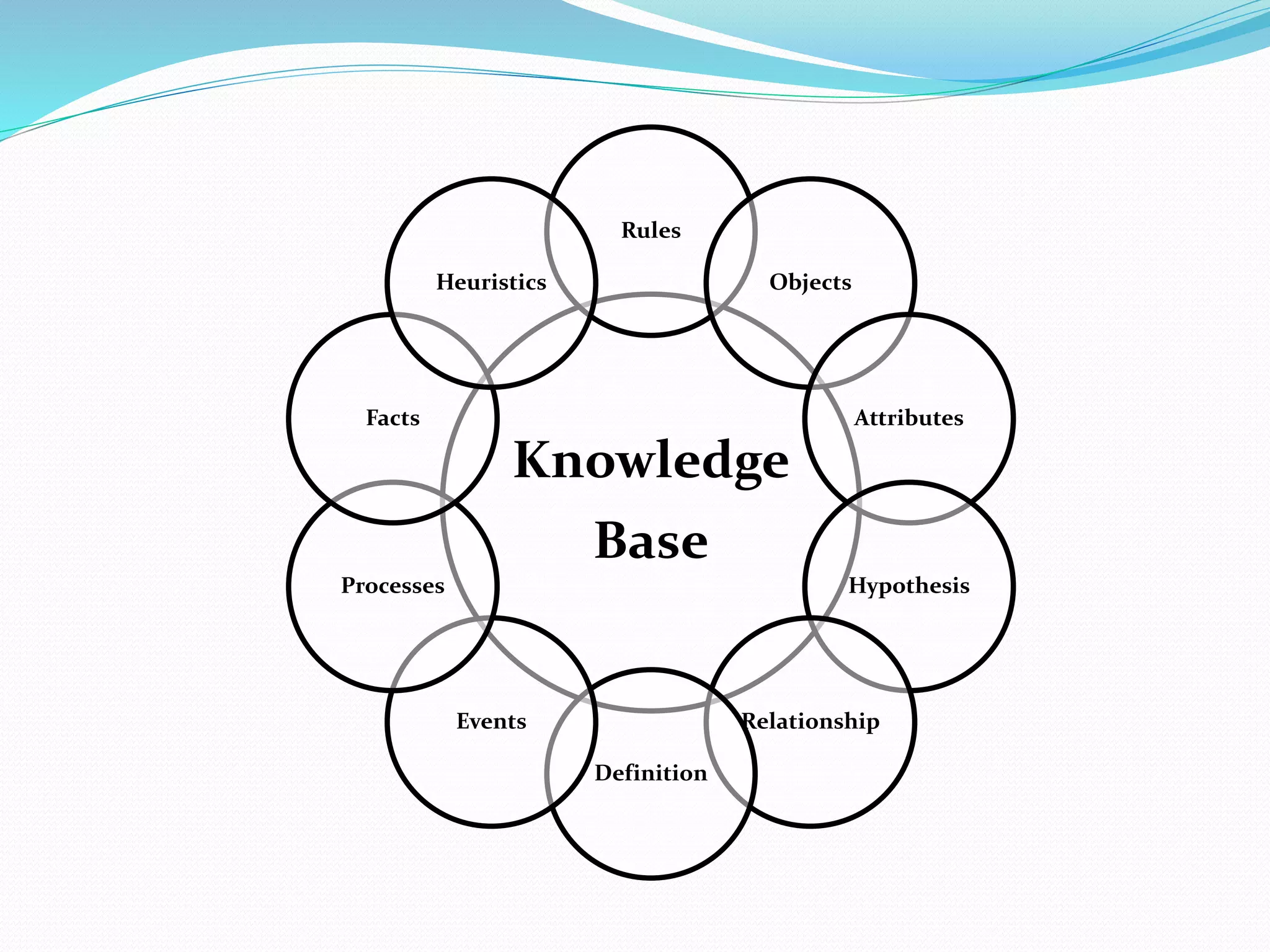
Knowledge
Base
Rules
Objects
Attributes
Hypothesis
Relationship
Definition
Events
Processes
Facts
Heuristics
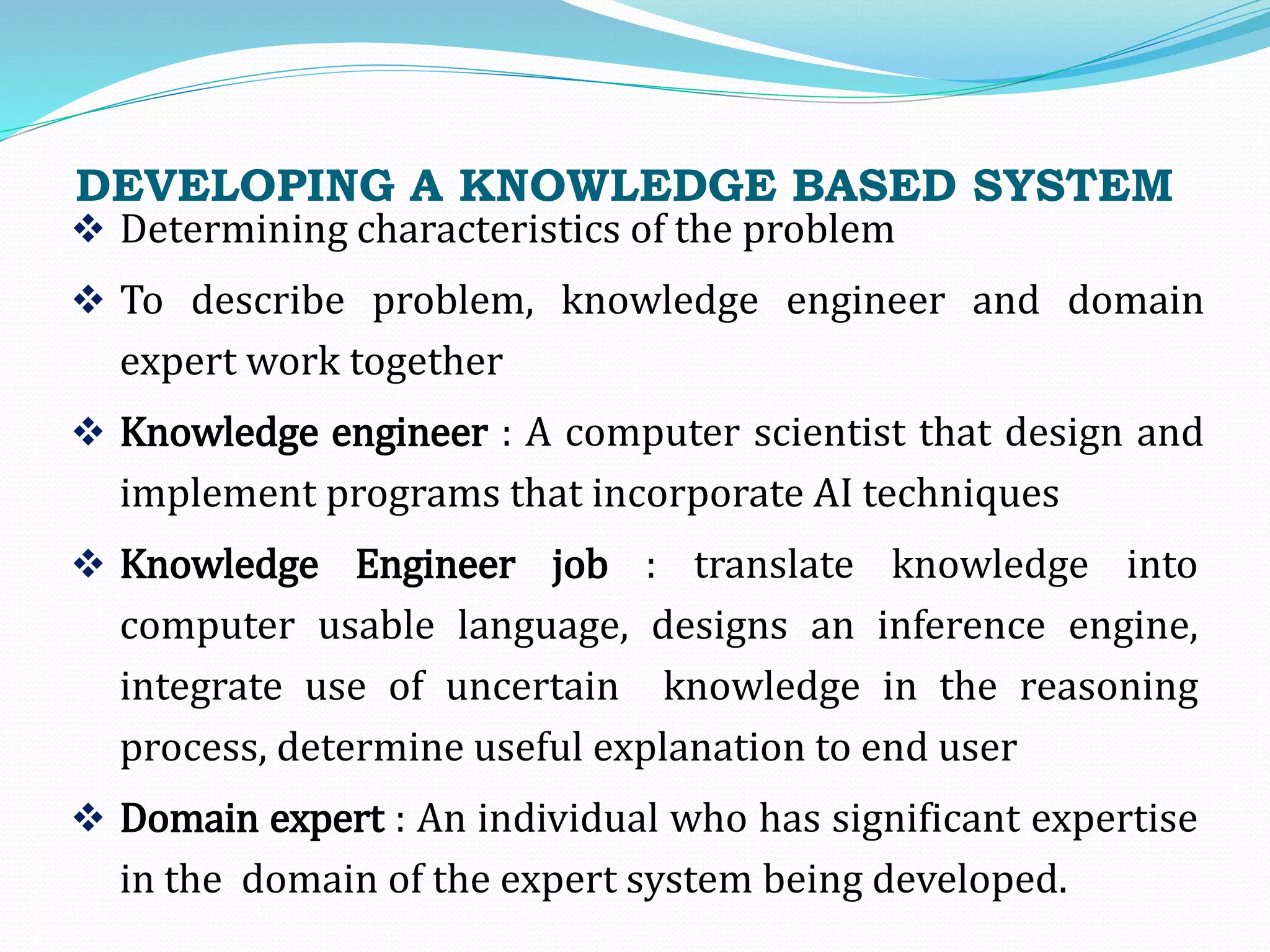
KBS AS DIAGNOSTIC TOOL
Diagnosis - Identification about a problem
Interpretation – Understanding of a situation from
available information
Design – Develops configurations that satisfy constraints of
the problem
Monitoring – Checks performance & flags inconsistencies
Control – Collects & evaluate evidence from opinions on
that evidence
Debugging – Identifies and prescribes remedies for
malfunctions
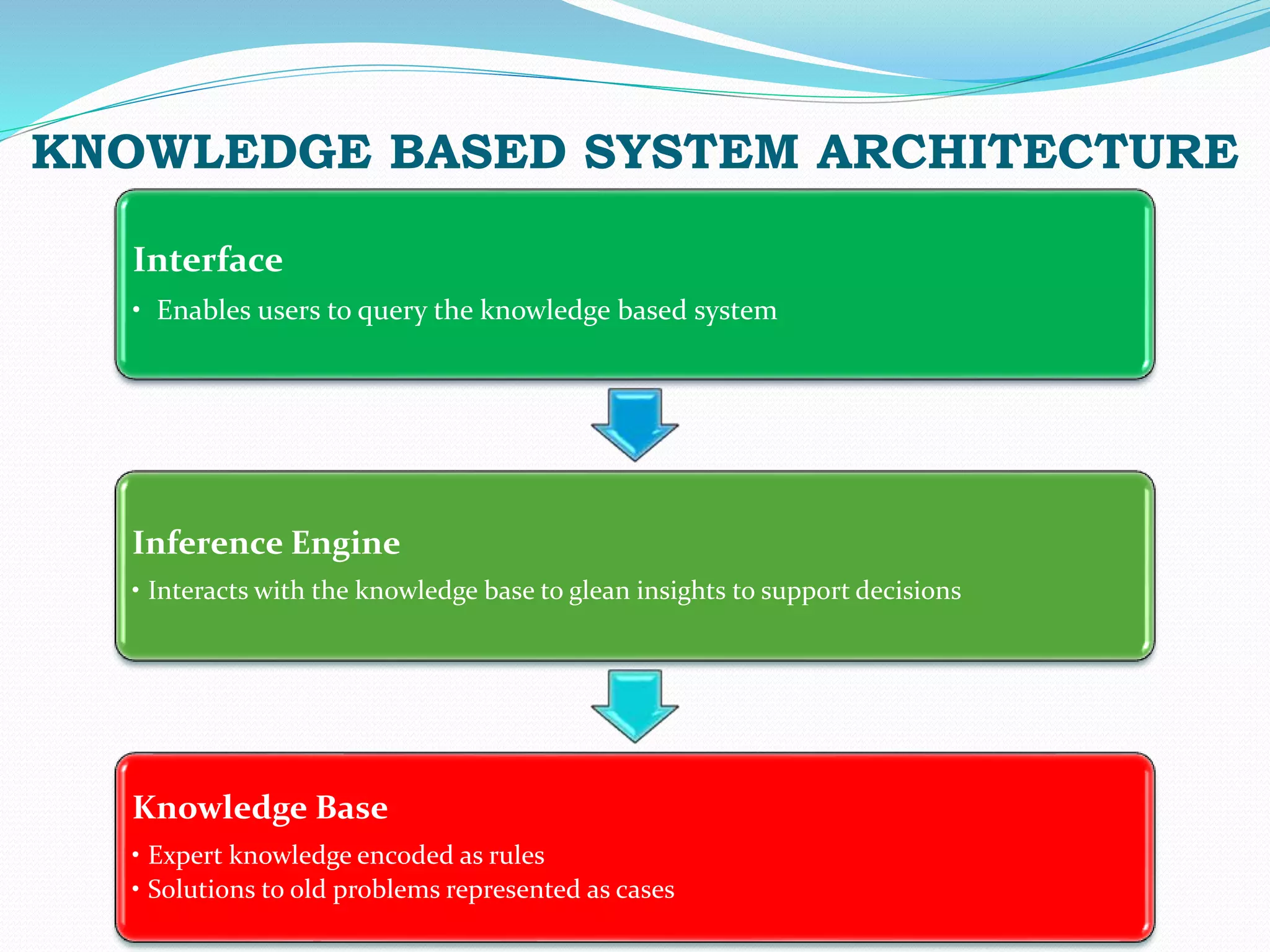
DEVELOPING A KNOWLEDGE BASED SYSTEM
 Determining characteristics of the problem
 To describe problem, knowledge engineer and domain
expert work together
 Knowledge engineer : A computer scientist that design and
implement programs that incorporate AI techniques
 Knowledge Engineer job : translate knowledge into
computer usable language, designs an inference engine,
integrate use of uncertain knowledge in the reasoning
process, determine useful explanation to end user
 Domain expert : An individual who has significant expertise
in the domain of the expert system being developed.
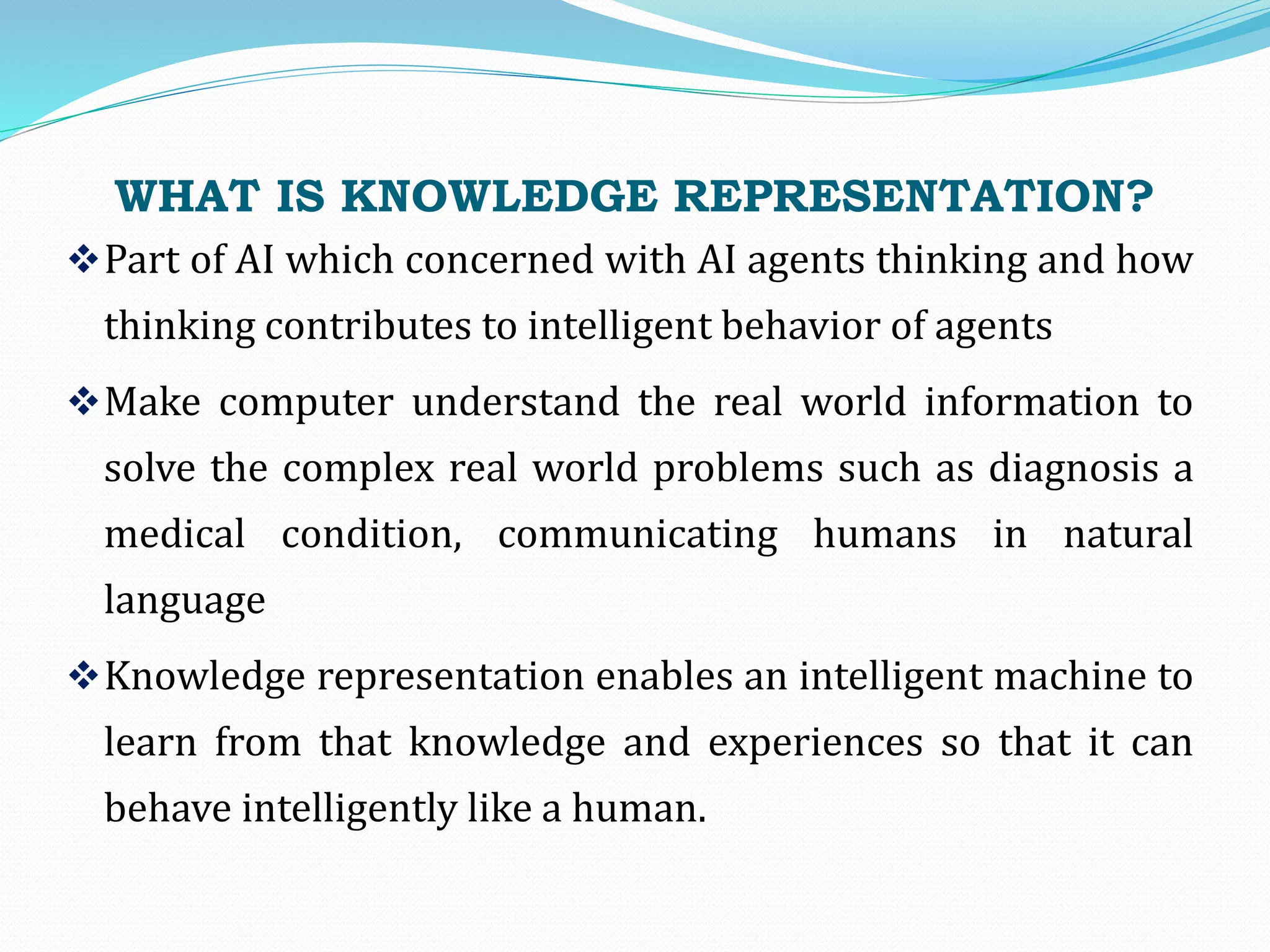
Interface
• Enables users to query the knowledge based system
Inference Engine
• Interacts with the knowledge base to glean insights to support decisions
Knowledge Base
• Expert knowledge encoded as rules
• Solutions to old problems represented as cases
KNOWLEDGE BASED SYSTEM ARCHITECTURE
WHAT IS KNOWLEDGE REPRESENTATION?
Part of AI which concerned with AI agents thinking and how
thinking contributes to intelligent behavior of agents
Make computer understand the real world information to
solve the complex real world problems such as diagnosis a
medical condition, communicating humans in natural
language
Knowledge representation enables an intelligent machine to
learn from that knowledge and experiences so that it can
behave intelligently like a human.
APPROACHES TO KNOWLEDGE
REPRESENTATION
Simple relational knowledge
 Simplest way of storing facts and each fact about a set of the
object is set out systematically in columns
 Use in database system where the relationship between
different entities is represented
Inheritable knowledge
 In this, all data stored into hierarchy of classes
 This approach contains inheritable knowledge
 This shows a relation between instance and class, and it is
called instance relation
APPROACHES TO KNOWLEDGE REPRESENTATION
Inferential knowledge
Represents knowledge in the form of formal logics
Use to derive more facts
 Procedural knowledge
This approach use small programs and codes which describes
how to do specific things, and how to proceed
Rule used : If-Then rule
Coding languages used : LISP language and Prolog language
Assignment
 Explain Knowledge based System and its
representation with example.

Knowledge based system(Expert System)

  • 1.
    Knowledge Based Systemand Representation(Expert System) Prof. Neeraj Bhargava Kapil Chauhan Department of Computer Science School of Engineering & Systems Sciences MDS University, Ajmer
  • 2.
    WHAT IS KNOWLEDGEBASED SYSTEM  KBS is a computer program that uses artificial intelligence to solve problems within a specialized domain that ordinarily requires human expertise  Examples : expert systems  Typical tasks of an expert system:- classification, diagnosis, monitoring, design, scheduling, and planning for specialized tasks.
  • 3.
    KBS AS REAL-WORLDPROBLEM SOLVERS A KBS draws upon the knowledge of human experts captured in a knowledge-base to solve problems that normally require human expertise Uses Heuristic (cause-and-effect) rather than algorithms Two approaches are used: Rule based reasoning, Code based reasoning Rule-based reasoning : Systems encode expert knowledge as rules Case-based reasoning : Systems encode expert knowledge as cases
  • 4.
  • 5.
    KBS AS DIAGNOSTICTOOL Diagnosis - Identification about a problem Interpretation – Understanding of a situation from available information Design – Develops configurations that satisfy constraints of the problem Monitoring – Checks performance & flags inconsistencies Control – Collects & evaluate evidence from opinions on that evidence Debugging – Identifies and prescribes remedies for malfunctions
  • 6.
    DEVELOPING A KNOWLEDGEBASED SYSTEM  Determining characteristics of the problem  To describe problem, knowledge engineer and domain expert work together  Knowledge engineer : A computer scientist that design and implement programs that incorporate AI techniques  Knowledge Engineer job : translate knowledge into computer usable language, designs an inference engine, integrate use of uncertain knowledge in the reasoning process, determine useful explanation to end user  Domain expert : An individual who has significant expertise in the domain of the expert system being developed.
  • 7.
    Interface • Enables usersto query the knowledge based system Inference Engine • Interacts with the knowledge base to glean insights to support decisions Knowledge Base • Expert knowledge encoded as rules • Solutions to old problems represented as cases KNOWLEDGE BASED SYSTEM ARCHITECTURE
  • 8.
    WHAT IS KNOWLEDGEREPRESENTATION? Part of AI which concerned with AI agents thinking and how thinking contributes to intelligent behavior of agents Make computer understand the real world information to solve the complex real world problems such as diagnosis a medical condition, communicating humans in natural language Knowledge representation enables an intelligent machine to learn from that knowledge and experiences so that it can behave intelligently like a human.
  • 9.
    APPROACHES TO KNOWLEDGE REPRESENTATION Simplerelational knowledge  Simplest way of storing facts and each fact about a set of the object is set out systematically in columns  Use in database system where the relationship between different entities is represented Inheritable knowledge  In this, all data stored into hierarchy of classes  This approach contains inheritable knowledge  This shows a relation between instance and class, and it is called instance relation
  • 10.
    APPROACHES TO KNOWLEDGEREPRESENTATION Inferential knowledge Represents knowledge in the form of formal logics Use to derive more facts  Procedural knowledge This approach use small programs and codes which describes how to do specific things, and how to proceed Rule used : If-Then rule Coding languages used : LISP language and Prolog language
  • 11.
    Assignment  Explain Knowledgebased System and its representation with example.