Propositional Logic
BY:SURBHI SAROHA
SYLLABUS
 Syntax and semantics
 Review:Properties of statements
 Satisfiable
 Contradiction
 Valid
 Equivalence
 Logical consequences
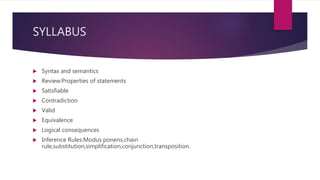
 Inference Rules:Modus ponens,chain
rule,substitution,simplification,conjunction,transposition.
Syntax and semantics
 Syntax (the rules for how to take generate complex claims from simple ones)
 Semantics (the meanings of the atomic units, and rules governing how meanings of
atomic units are put together to form complex meanings)
 Syntax of PL
 Using logical connectives and operators (which connect or operate on propositions)
 Symbols: Use letters (P, Q, R, … X, Y, Z) to stand for specific statements Unary
propositional operator: ~ Binary propositional connectives: → , ↔ , • , ∨
 Grouping symbols: ( ), [ ]
Cont….
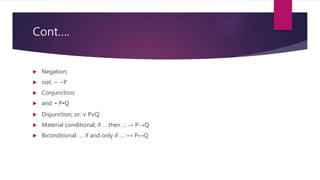
 Negation;
 not: ~ ~P
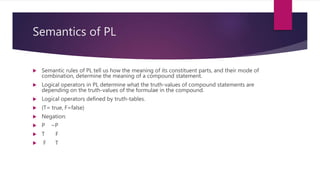
 Conjunction;
 and: • P•Q
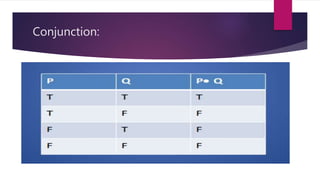
 Disjunction; or: ∨ P∨Q
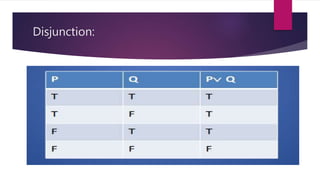
 Material conditional; if … then ..: → P→Q
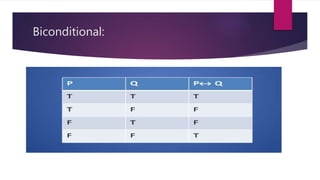
 Biconditional: … if and only if …: ↔ P↔Q
Semantics of PL
 Semantic rules of PL tell us how the meaning of its constituent parts, and their mode of
combination, determine the meaning of a compound statement.
 Logical operators in PL determine what the truth-values of compound statements are
depending on the truth-values of the formulae in the compound.
 Logical operators defined by truth-tables.
 (T= true, F=false)
 Negation:
 P ~P
 T F
 F T
Conjunction:
Disjunction:
Material conditional:
Biconditional:
Propositional Logic
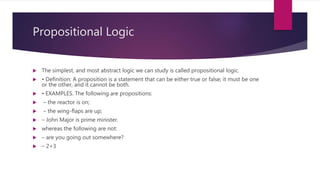
 The simplest, and most abstract logic we can study is called propositional logic.
 • Definition: A proposition is a statement that can be either true or false; it must be one
or the other, and it cannot be both.
 • EXAMPLES. The following are propositions:
 – the reactor is on;
 – the wing-flaps are up;
 – John Major is prime minister.
 whereas the following are not:
 – are you going out somewhere?
 – 2+3
Cont….
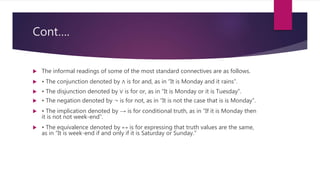
 The informal readings of some of the most standard connectives are as follows.
 • The conjunction denoted by ∧ is for and, as in “It is Monday and it rains”.
 • The disjunction denoted by ∨ is for or, as in “It is Monday or it is Tuesday”.
 • The negation denoted by ¬ is for not, as in “It is not the case that is is Monday”.
 • The implication denoted by → is for conditional truth, as in “If it is Monday then
it is not not week-end”.
 • The equivalence denoted by ↔ is for expressing that truth values are the same,
as in “It is week-end if and only if it is Saturday or Sunday.”
Inference Rules:Modus ponens,chain
rule,substitution,simplification,
conjunction,transposition
 Inference rules are the templates for generating valid arguments. Inference rules are applied to
derive proofs in artificial intelligence, and the proof is a sequence of the conclusion that leads to
the desired goal.
 In inference rules, the implication among all the connectives plays an important role. Following are
some terminologies related to inference rules:
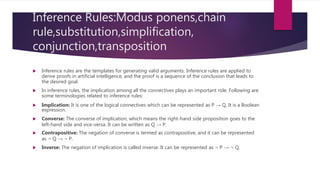
 Implication: It is one of the logical connectives which can be represented as P → Q. It is a Boolean
expression.
 Converse: The converse of implication, which means the right-hand side proposition goes to the
left-hand side and vice-versa. It can be written as Q → P.
 Contrapositive: The negation of converse is termed as contrapositive, and it can be represented
as ¬ Q → ¬ P.
 Inverse: The negation of implication is called inverse. It can be represented as ¬ P → ¬ Q.
Types of Inference rules:
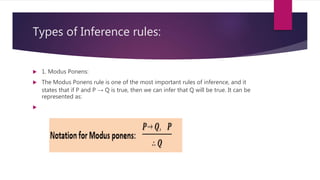
 1. Modus Ponens:
 The Modus Ponens rule is one of the most important rules of inference, and it
states that if P and P → Q is true, then we can infer that Q will be true. It can be
represented as:

Cont…..
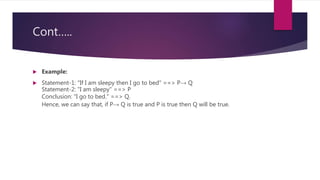
 Example:
 Statement-1: "If I am sleepy then I go to bed" ==> P→ Q
Statement-2: "I am sleepy" ==> P
Conclusion: "I go to bed." ==> Q.
Hence, we can say that, if P→ Q is true and P is true then Q will be true.
Simplification:
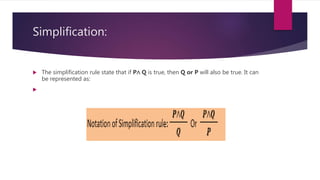
 The simplification rule state that if P∧ Q is true, then Q or P will also be true. It can
be represented as:

Conjunction
 If P and Q are two premises, we can use Conjunction rule to derive P∧Q.
 PQ∴P∧Q
 Example
 Let P − “He studies very hard”
 Let Q − “He is the best boy in the class”
 Therefore − "He studies very hard and he is the best boy in the class"
Thank you

AI Propositional logic

  • 1.
  • 2.
    SYLLABUS  Syntax andsemantics  Review:Properties of statements  Satisfiable  Contradiction  Valid  Equivalence  Logical consequences  Inference Rules:Modus ponens,chain rule,substitution,simplification,conjunction,transposition.
  • 3.
    Syntax and semantics Syntax (the rules for how to take generate complex claims from simple ones)  Semantics (the meanings of the atomic units, and rules governing how meanings of atomic units are put together to form complex meanings)  Syntax of PL  Using logical connectives and operators (which connect or operate on propositions)  Symbols: Use letters (P, Q, R, … X, Y, Z) to stand for specific statements Unary propositional operator: ~ Binary propositional connectives: → , ↔ , • , ∨  Grouping symbols: ( ), [ ]
  • 4.
    Cont….  Negation;  not:~ ~P  Conjunction;  and: • P•Q  Disjunction; or: ∨ P∨Q  Material conditional; if … then ..: → P→Q  Biconditional: … if and only if …: ↔ P↔Q
  • 5.
    Semantics of PL Semantic rules of PL tell us how the meaning of its constituent parts, and their mode of combination, determine the meaning of a compound statement.  Logical operators in PL determine what the truth-values of compound statements are depending on the truth-values of the formulae in the compound.  Logical operators defined by truth-tables.  (T= true, F=false)  Negation:  P ~P  T F  F T
  • 6.
  • 7.
  • 8.
  • 9.
  • 10.
    Propositional Logic  Thesimplest, and most abstract logic we can study is called propositional logic.  • Definition: A proposition is a statement that can be either true or false; it must be one or the other, and it cannot be both.  • EXAMPLES. The following are propositions:  – the reactor is on;  – the wing-flaps are up;  – John Major is prime minister.  whereas the following are not:  – are you going out somewhere?  – 2+3
  • 11.
    Cont….  The informalreadings of some of the most standard connectives are as follows.  • The conjunction denoted by ∧ is for and, as in “It is Monday and it rains”.  • The disjunction denoted by ∨ is for or, as in “It is Monday or it is Tuesday”.  • The negation denoted by ¬ is for not, as in “It is not the case that is is Monday”.  • The implication denoted by → is for conditional truth, as in “If it is Monday then it is not not week-end”.  • The equivalence denoted by ↔ is for expressing that truth values are the same, as in “It is week-end if and only if it is Saturday or Sunday.”
  • 12.
    Inference Rules:Modus ponens,chain rule,substitution,simplification, conjunction,transposition Inference rules are the templates for generating valid arguments. Inference rules are applied to derive proofs in artificial intelligence, and the proof is a sequence of the conclusion that leads to the desired goal.  In inference rules, the implication among all the connectives plays an important role. Following are some terminologies related to inference rules:  Implication: It is one of the logical connectives which can be represented as P → Q. It is a Boolean expression.  Converse: The converse of implication, which means the right-hand side proposition goes to the left-hand side and vice-versa. It can be written as Q → P.  Contrapositive: The negation of converse is termed as contrapositive, and it can be represented as ¬ Q → ¬ P.  Inverse: The negation of implication is called inverse. It can be represented as ¬ P → ¬ Q.
  • 13.
    Types of Inferencerules:  1. Modus Ponens:  The Modus Ponens rule is one of the most important rules of inference, and it states that if P and P → Q is true, then we can infer that Q will be true. It can be represented as: 
  • 14.
    Cont…..  Example:  Statement-1:"If I am sleepy then I go to bed" ==> P→ Q Statement-2: "I am sleepy" ==> P Conclusion: "I go to bed." ==> Q. Hence, we can say that, if P→ Q is true and P is true then Q will be true.
  • 15.
    Simplification:  The simplificationrule state that if P∧ Q is true, then Q or P will also be true. It can be represented as: 
  • 16.
    Conjunction  If Pand Q are two premises, we can use Conjunction rule to derive P∧Q.  PQ∴P∧Q  Example  Let P − “He studies very hard”  Let Q − “He is the best boy in the class”  Therefore − "He studies very hard and he is the best boy in the class"
  • 17.