Knowledge Representation
& Evaluation in Expert System
Shwetha Iyer 1032211195
Selina Shrivastava 1032211782
Malika Kaila 1032212060
Under the Guidance of:
Dr. Manisha Kumawat
Table of
Contents
01
04
02
03
Introduction to Expert
Systems
Knowledge Representation
Evaluation of Expert System
References
Introduction to
Expert Systems
01
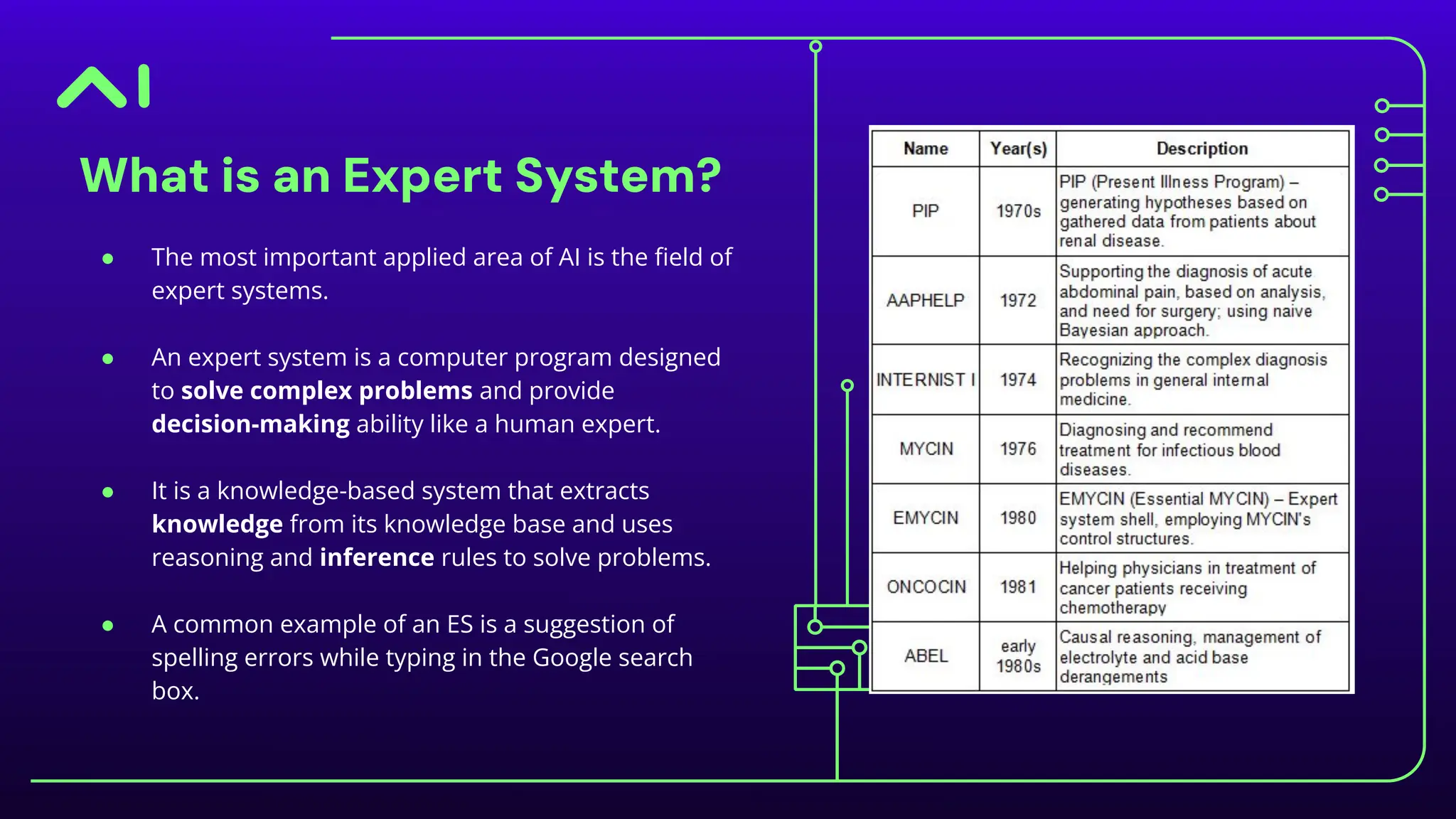
What is an Expert System?
● The most important applied area of AI is the field of
expert systems.
● An expert system is a computer program designed
to solve complex problems and provide
decision-making ability like a human expert.
● It is a knowledge-based system that extracts
knowledge from its knowledge base and uses
reasoning and inference rules to solve problems.
● A common example of an ES is a suggestion of
spelling errors while typing in the Google search
box.
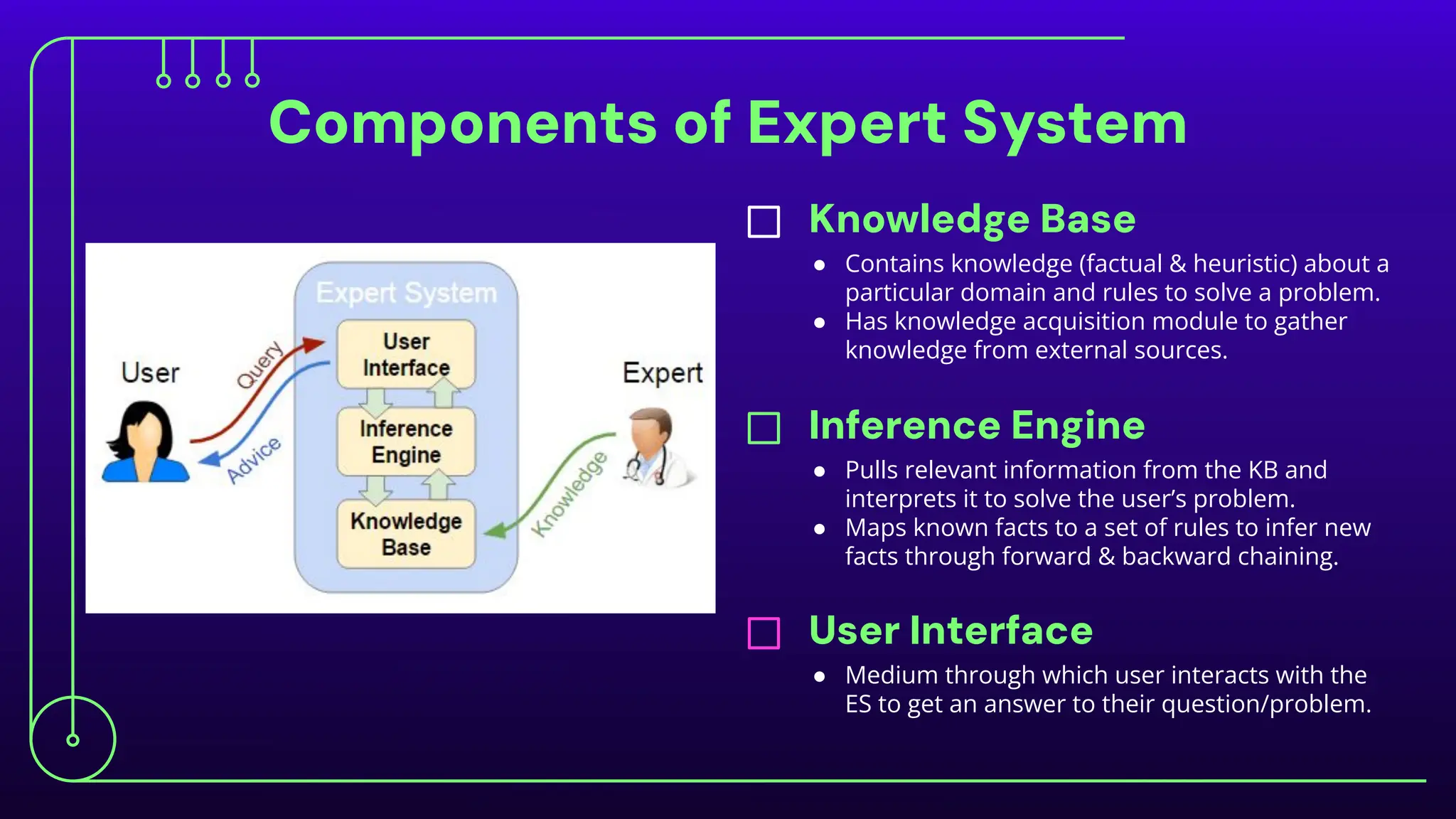
Components of Expert System
Knowledge Base
● Contains knowledge (factual & heuristic) about a
particular domain and rules to solve a problem.
● Has knowledge acquisition module to gather
knowledge from external sources.
Inference Engine
● Pulls relevant information from the KB and
interprets it to solve the user’s problem.
● Maps known facts to a set of rules to infer new
facts through forward & backward chaining.
User Interface
● Medium through which user interacts with the
ES to get an answer to their question/problem.
● ES are used in classification, diagnosis, monitoring,
process control, design, advising, predicting, and
generation of options.
● In healthcare, expert systems aid in medical diagnosis
and treatment recommendations.
● In finance, expert systems are used for risk
assessment, fraud detection, and investment advice.
● Manufacturing industries employ expert systems for
quality control, process optimization, and predictive
maintenance.
● Customer support services also benefit from expert
systems through automated troubleshooting and
customer assistance.
Applications of
Expert Systems
● They provide increased accuracy by leveraging
expert knowledge stored in their knowledge
bases. This ensures consistent
decision-making even in complex scenarios.
● They are highly scalable as they can handle
large amounts of information efficiently. This
makes them suitable for managing complex
domains.
● Moreover, expert systems in AI can be
cost-effective by reducing the need for human
experts.
Advantages of
Expert Systems
Characteristics of ES: High accuracy,
Understandable, Reliable, Highly responsive
Knowledge
Representation
02
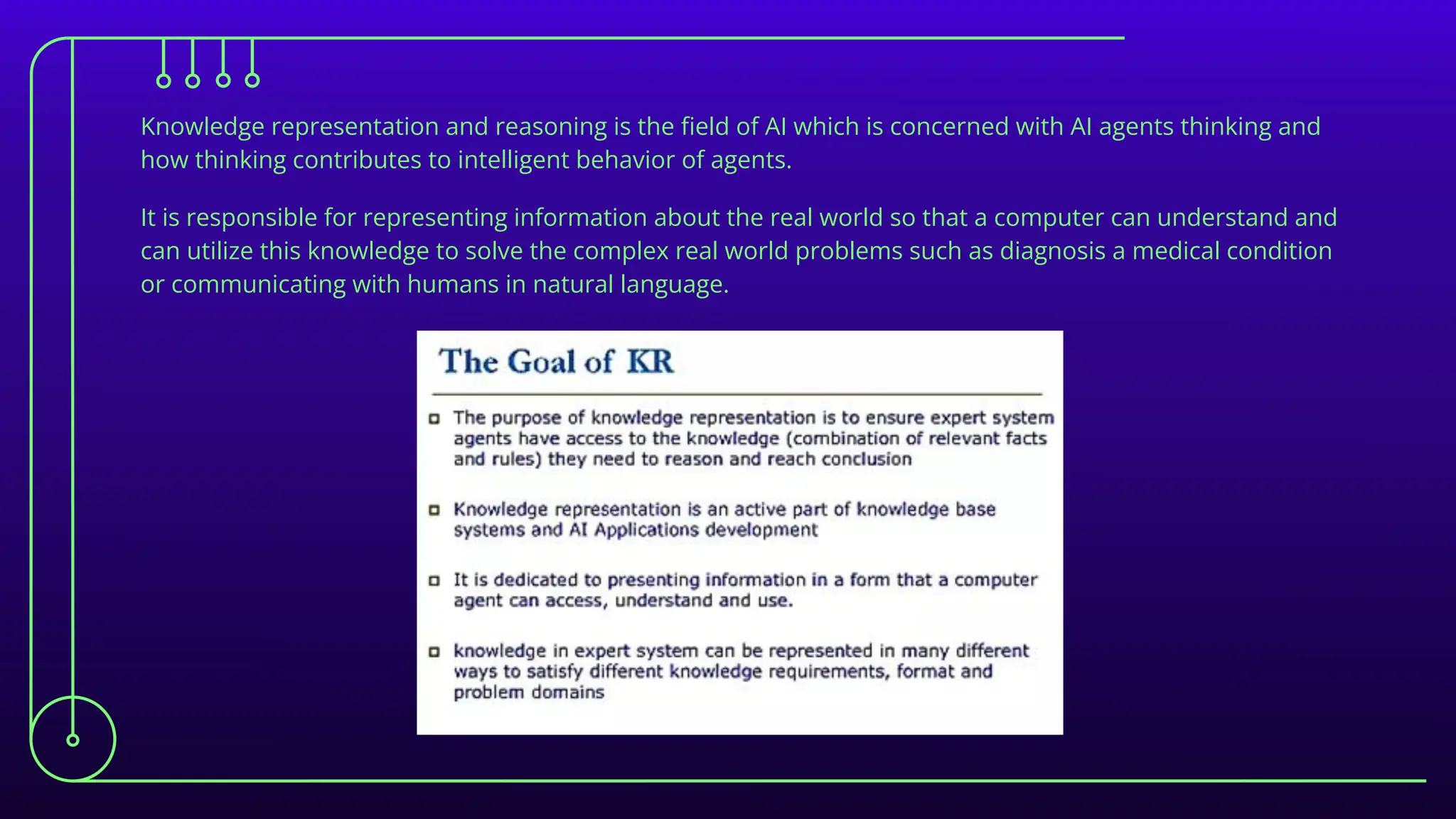
Knowledge representation and reasoning is the field of AI which is concerned with AI agents thinking and
how thinking contributes to intelligent behavior of agents.
It is responsible for representing information about the real world so that a computer can understand and
can utilize this knowledge to solve the complex real world problems such as diagnosis a medical condition
or communicating with humans in natural language.
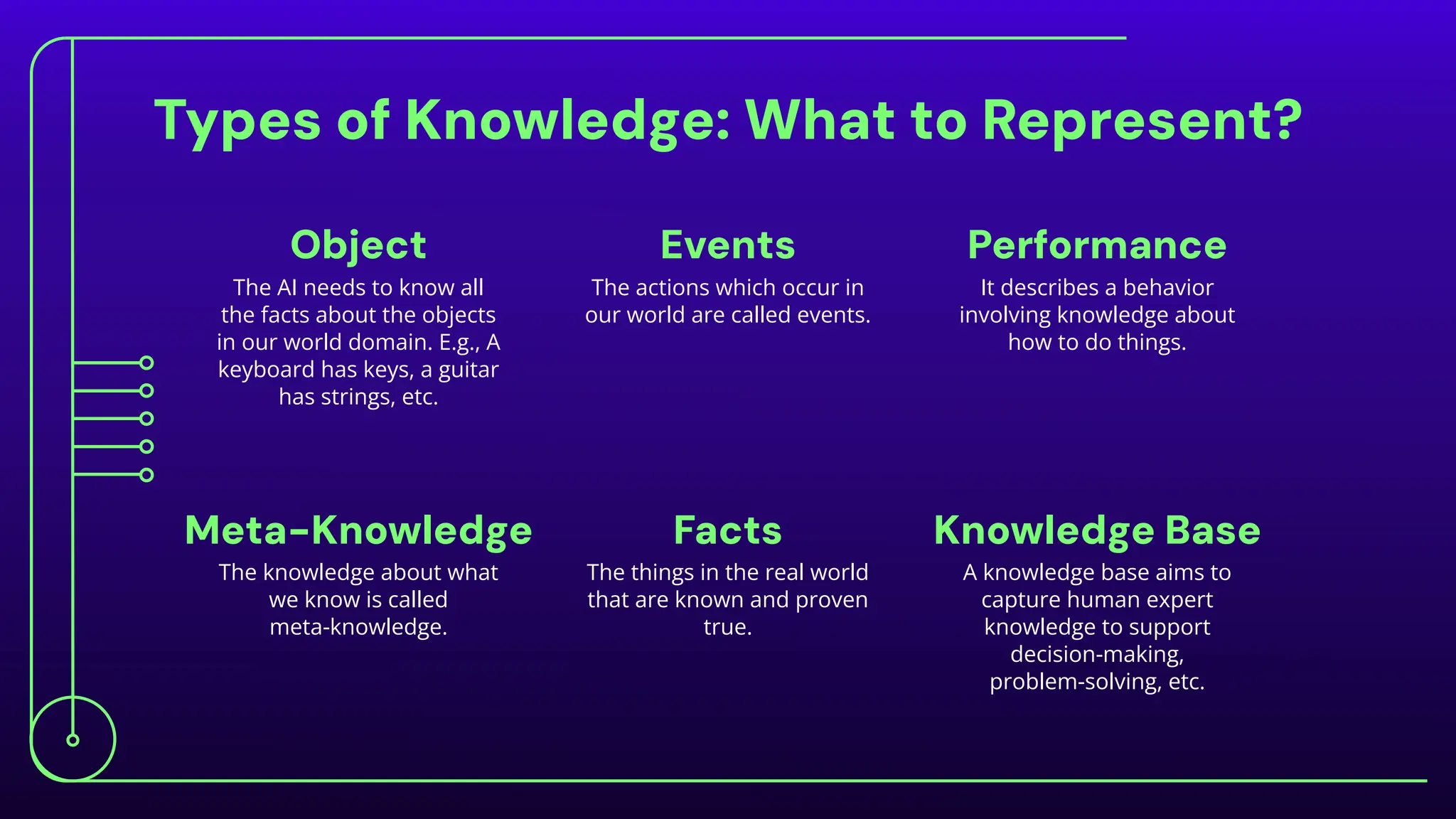
Types of Knowledge: What to Represent?
The AI needs to know all
the facts about the objects
in our world domain. E.g., A
keyboard has keys, a guitar
has strings, etc.
The actions which occur in
our world are called events.
The knowledge about what
we know is called
meta-knowledge.
The things in the real world
that are known and proven
true.
Object Events Performance
It describes a behavior
involving knowledge about
how to do things.
A knowledge base aims to
capture human expert
knowledge to support
decision-making,
problem-solving, etc.
Meta-Knowledge Facts Knowledge Base
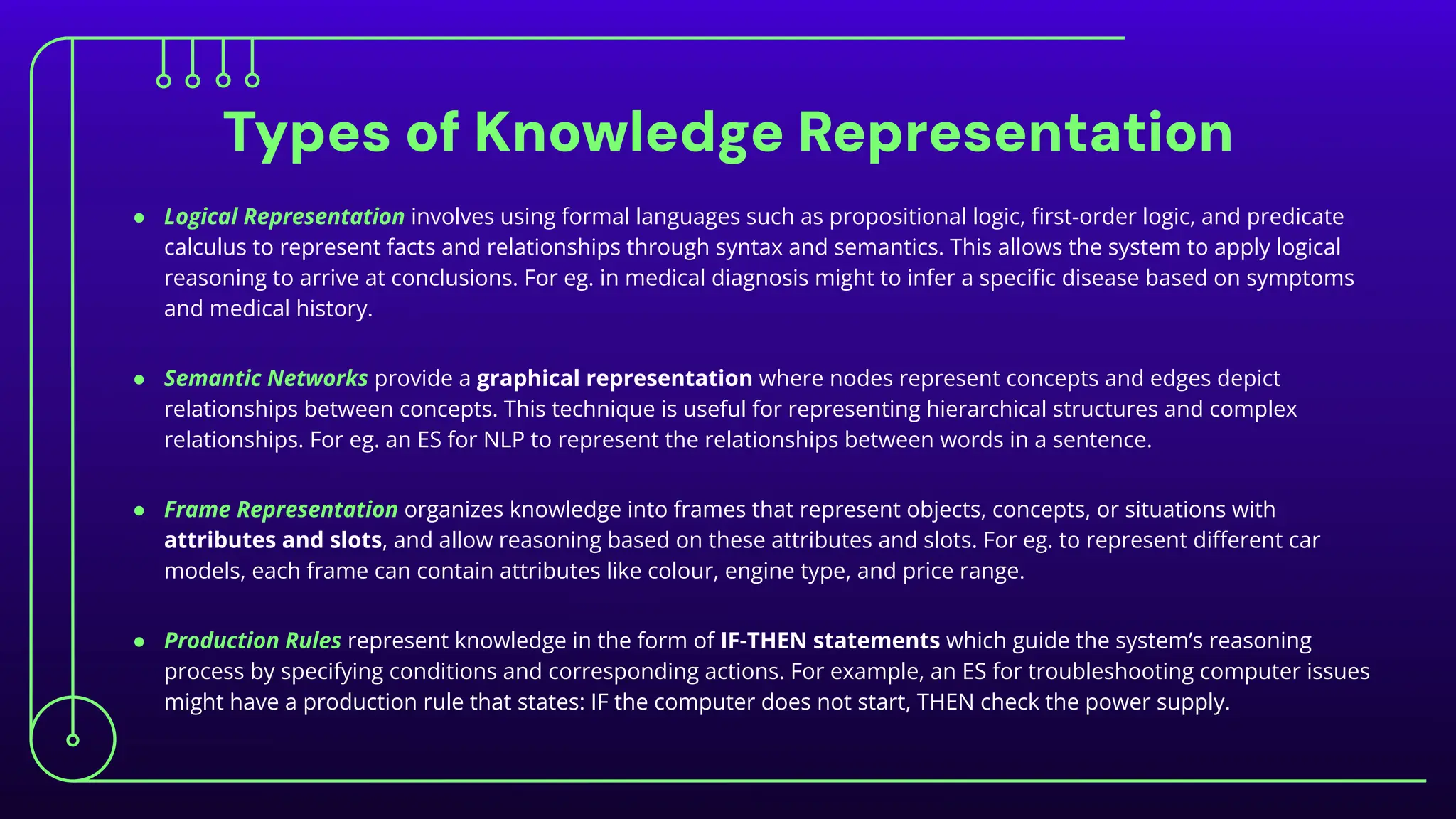
Types of Knowledge Representation
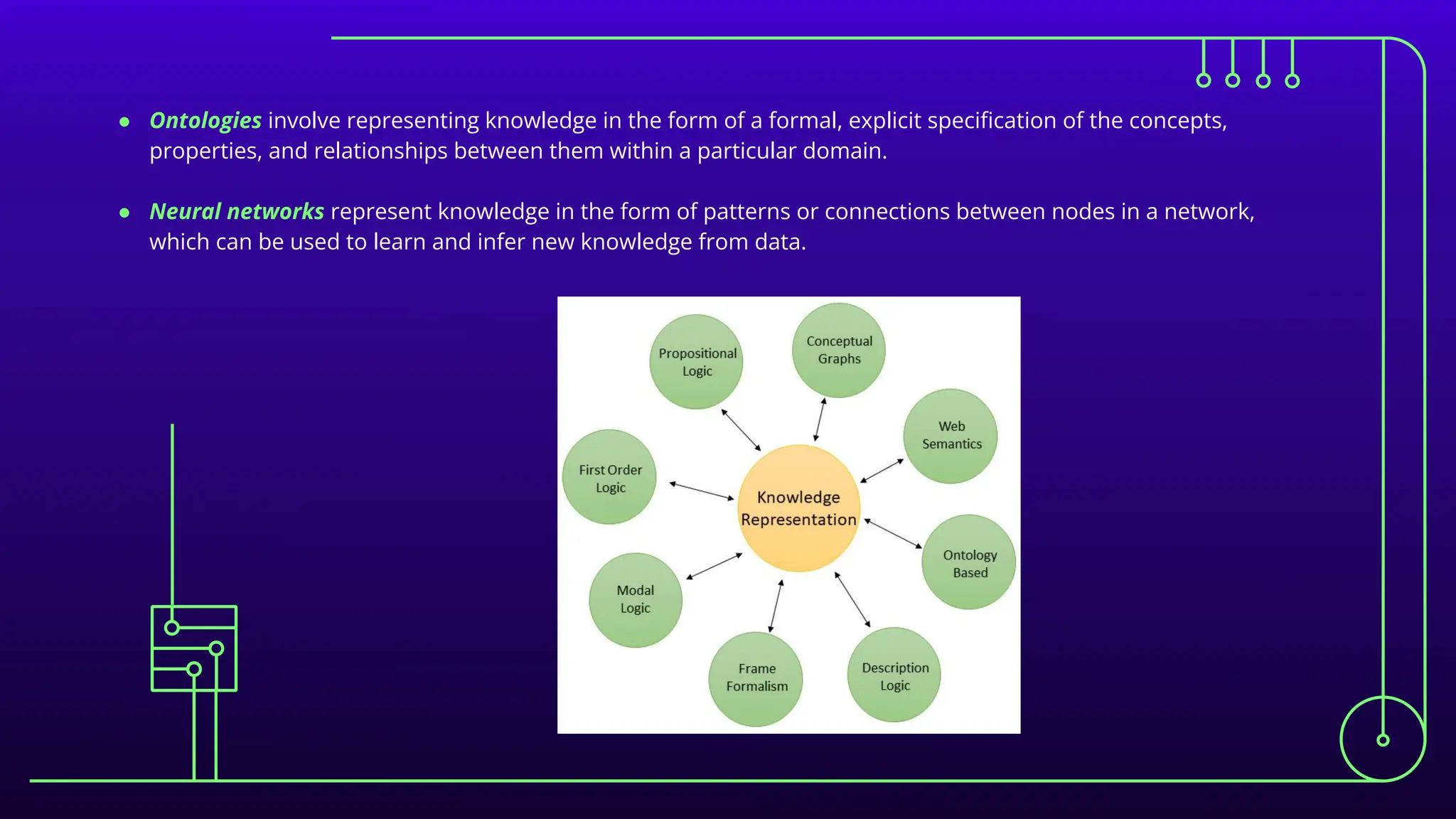
● Logical Representation involves using formal languages such as propositional logic, first-order logic, and predicate
calculus to represent facts and relationships through syntax and semantics. This allows the system to apply logical
reasoning to arrive at conclusions. For eg. in medical diagnosis might to infer a specific disease based on symptoms
and medical history.
● Semantic Networks provide a graphical representation where nodes represent concepts and edges depict
relationships between concepts. This technique is useful for representing hierarchical structures and complex
relationships. For eg. an ES for NLP to represent the relationships between words in a sentence.
● Frame Representation organizes knowledge into frames that represent objects, concepts, or situations with
attributes and slots, and allow reasoning based on these attributes and slots. For eg. to represent different car
models, each frame can contain attributes like colour, engine type, and price range.
● Production Rules represent knowledge in the form of IF-THEN statements which guide the system’s reasoning
process by specifying conditions and corresponding actions. For example, an ES for troubleshooting computer issues
might have a production rule that states: IF the computer does not start, THEN check the power supply.
● Ontologies involve representing knowledge in the form of a formal, explicit specification of the concepts,
properties, and relationships between them within a particular domain.
● Neural networks represent knowledge in the form of patterns or connections between nodes in a network,
which can be used to learn and infer new knowledge from data.
KR & Reasoning
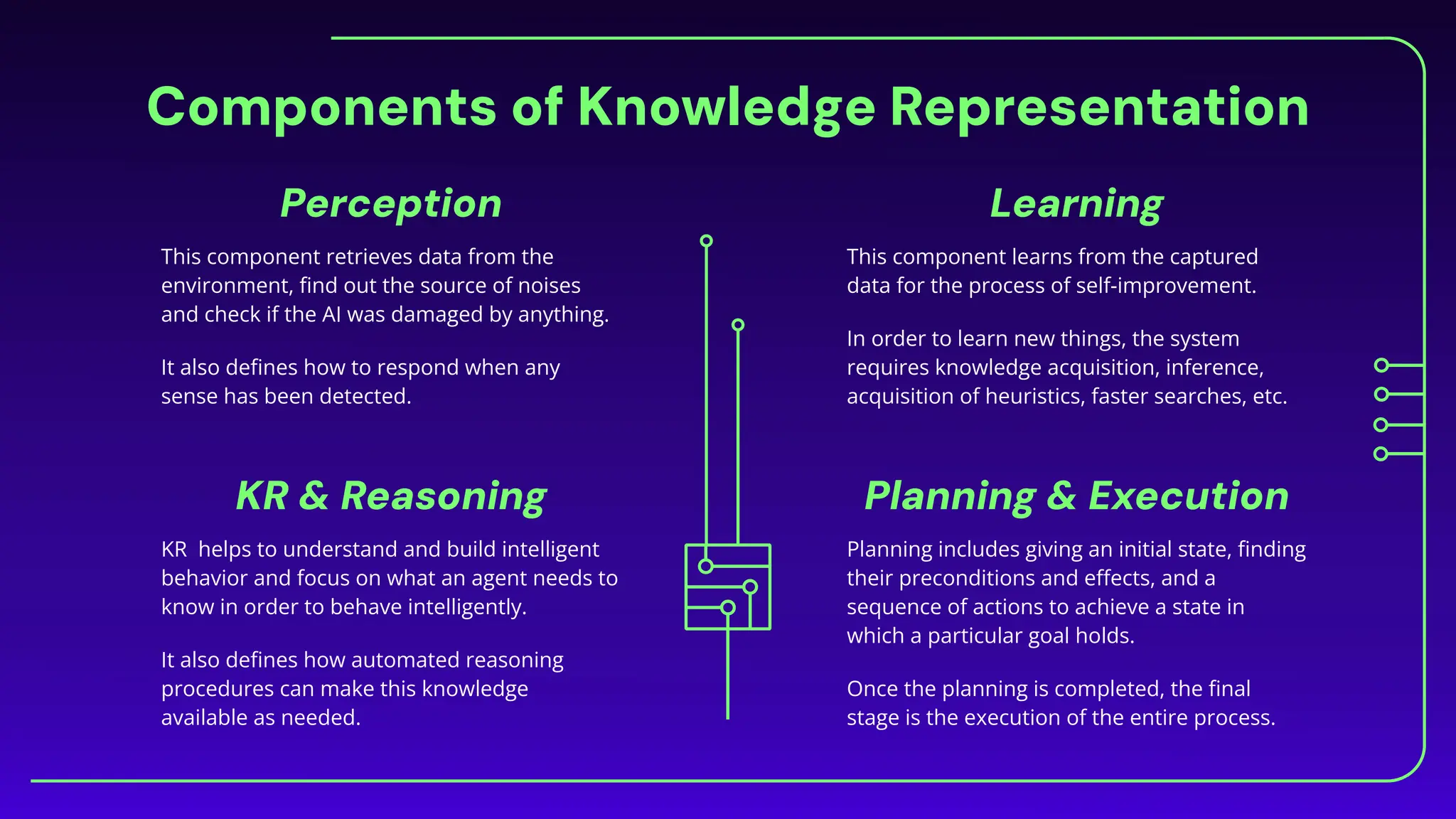
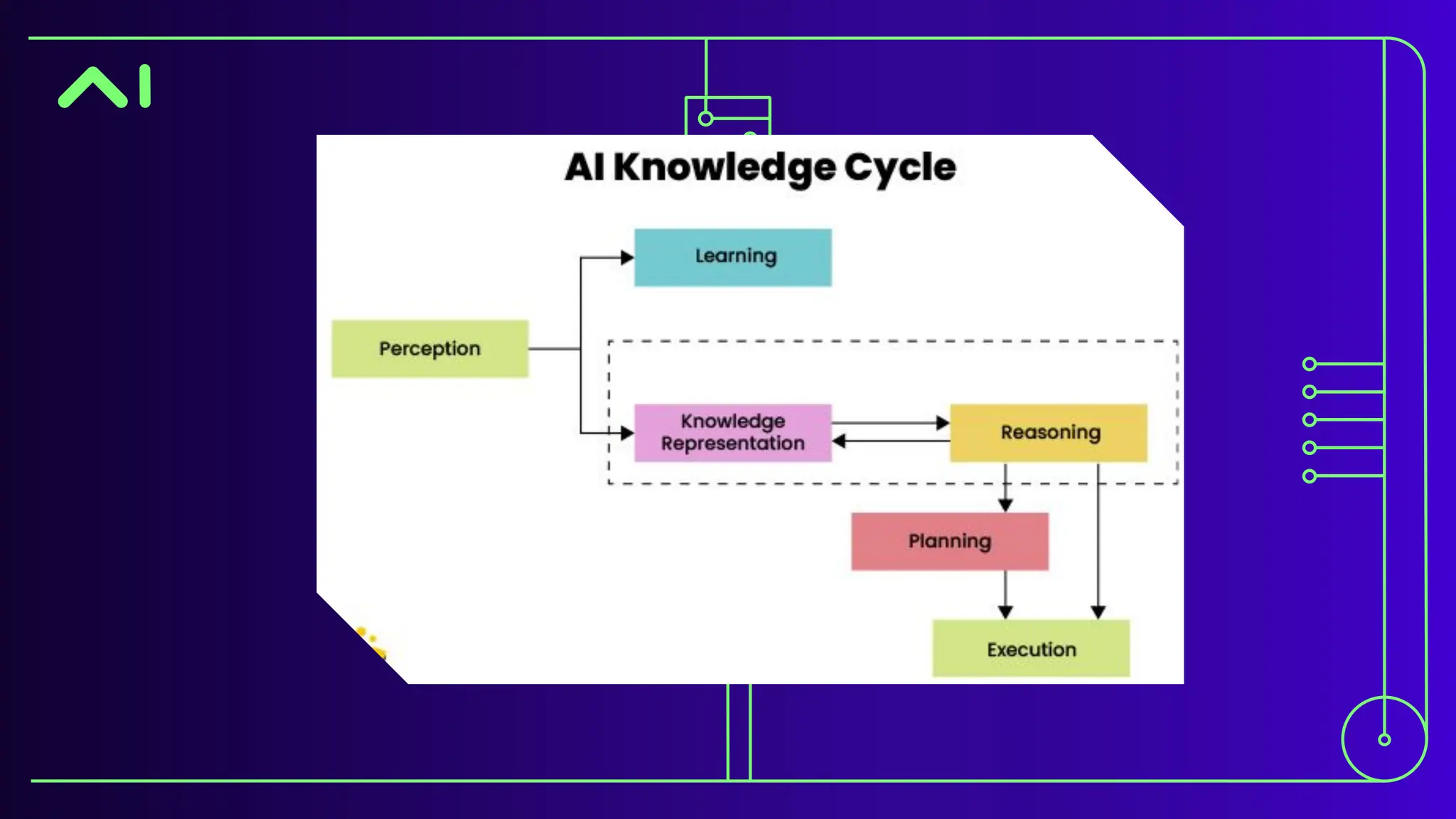
Components of Knowledge Representation
This component retrieves data from the
environment, find out the source of noises
and check if the AI was damaged by anything.
It also defines how to respond when any
sense has been detected.
This component learns from the captured
data for the process of self-improvement.
In order to learn new things, the system
requires knowledge acquisition, inference,
acquisition of heuristics, faster searches, etc.
KR helps to understand and build intelligent
behavior and focus on what an agent needs to
know in order to behave intelligently.
It also defines how automated reasoning
procedures can make this knowledge
available as needed.
Planning includes giving an initial state, finding
their preconditions and effects, and a
sequence of actions to achieve a state in
which a particular goal holds.
Once the planning is completed, the final
stage is the execution of the entire process.
Perception Learning
Planning & Execution
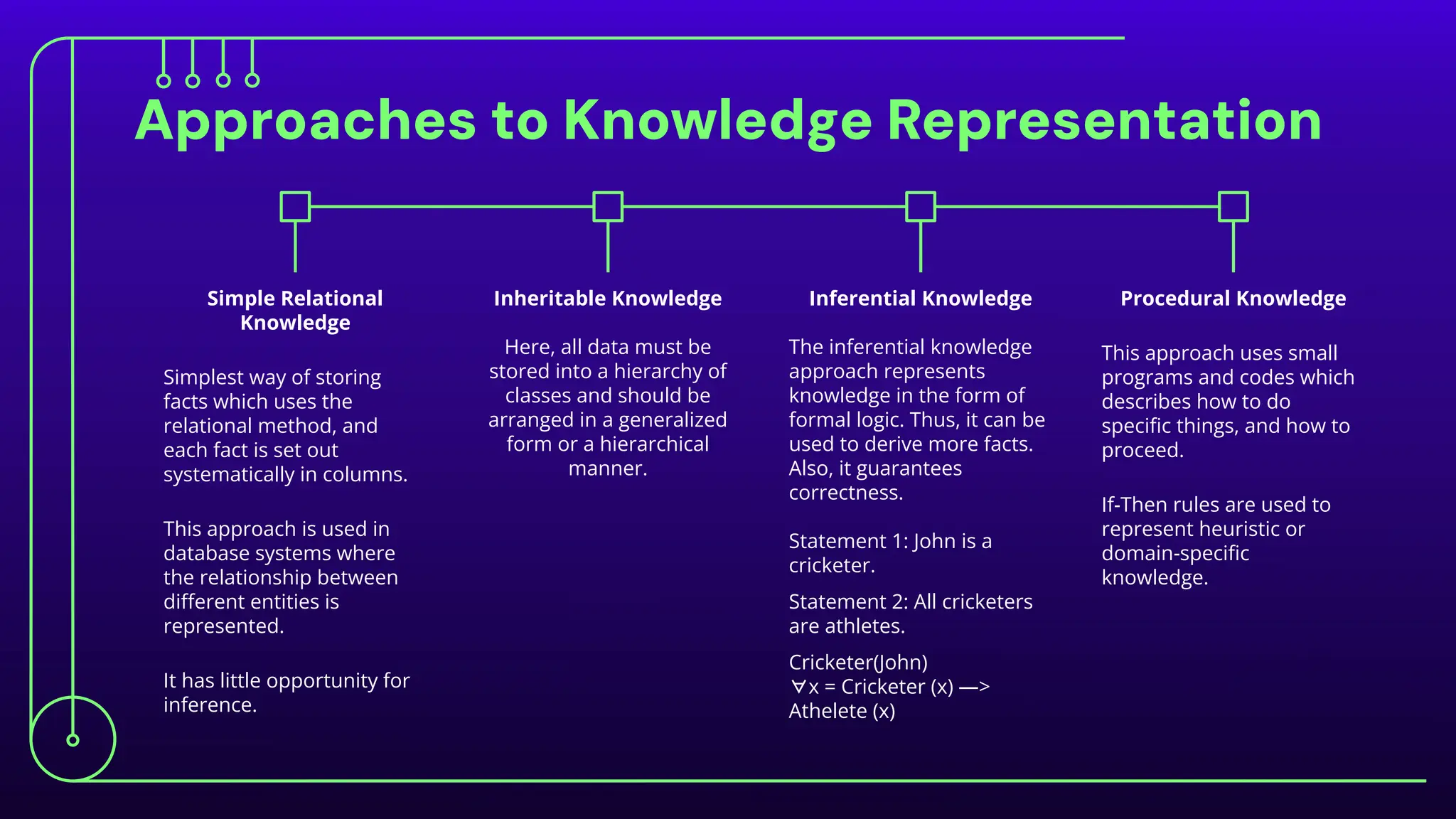
Approaches to Knowledge Representation
Simple Relational
Knowledge
Simplest way of storing
facts which uses the
relational method, and
each fact is set out
systematically in columns.
This approach is used in
database systems where
the relationship between
different entities is
represented.
It has little opportunity for
inference.
Inheritable Knowledge
Here, all data must be
stored into a hierarchy of
classes and should be
arranged in a generalized
form or a hierarchical
manner.
Inferential Knowledge
The inferential knowledge
approach represents
knowledge in the form of
formal logic. Thus, it can be
used to derive more facts.
Also, it guarantees
correctness.
Statement 1: John is a
cricketer.
Statement 2: All cricketers
are athletes.
Cricketer(John)
∀x = Cricketer (x) —>
Athelete (x)
Procedural Knowledge
This approach uses small
programs and codes which
describes how to do
specific things, and how to
proceed.
If-Then rules are used to
represent heuristic or
domain-specific
knowledge.
Evaluation of
Expert System
03
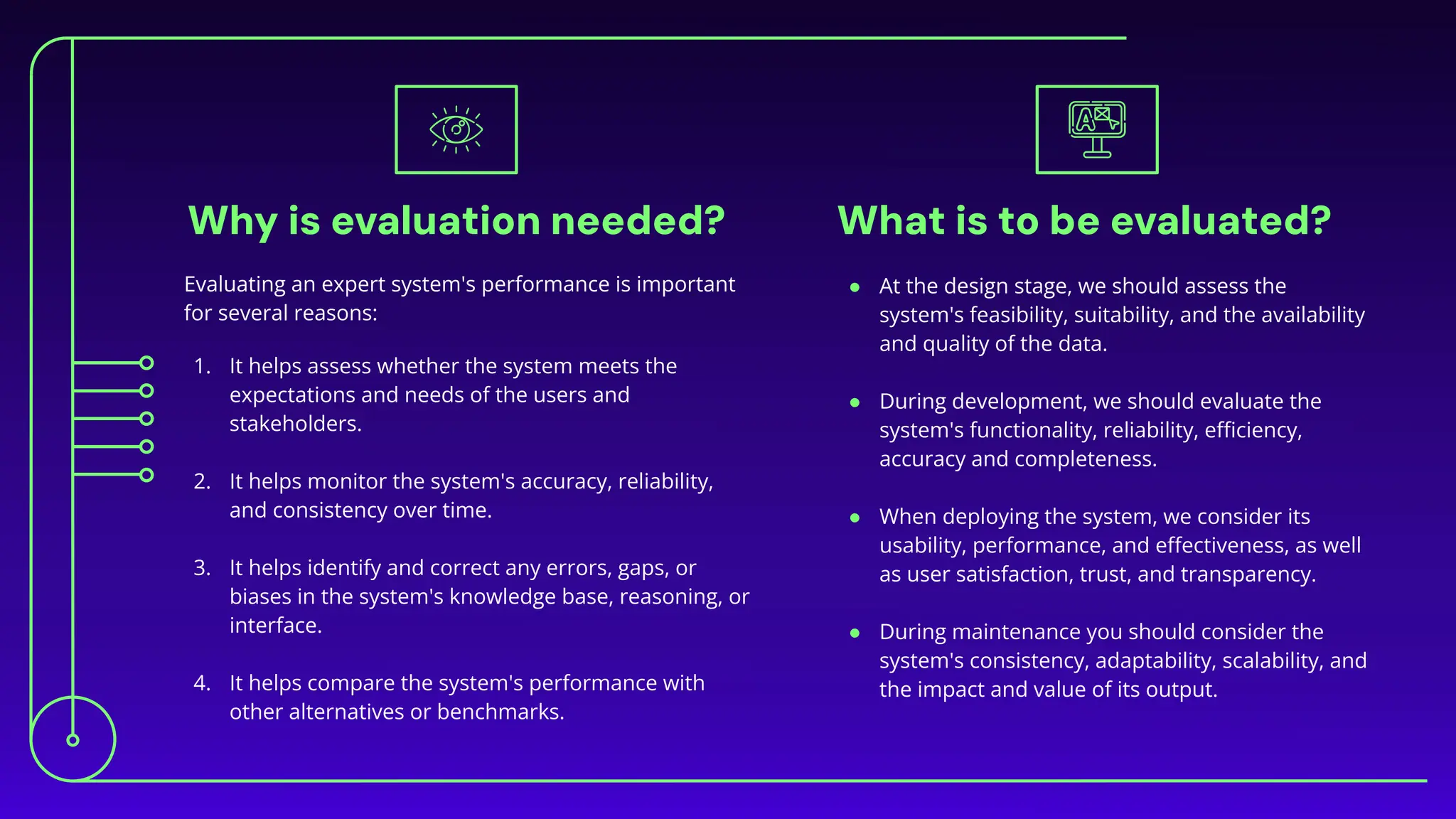
What is to be evaluated?
● At the design stage, we should assess the
system's feasibility, suitability, and the availability
and quality of the data.
● During development, we should evaluate the
system's functionality, reliability, efficiency,
accuracy and completeness.
● When deploying the system, we consider its
usability, performance, and effectiveness, as well
as user satisfaction, trust, and transparency.
● During maintenance you should consider the
system's consistency, adaptability, scalability, and
the impact and value of its output.
Evaluating an expert system's performance is important
for several reasons:
1. It helps assess whether the system meets the
expectations and needs of the users and
stakeholders.
2. It helps monitor the system's accuracy, reliability,
and consistency over time.
3. It helps identify and correct any errors, gaps, or
biases in the system's knowledge base, reasoning, or
interface.
4. It helps compare the system's performance with
other alternatives or benchmarks.
Why is evaluation needed?
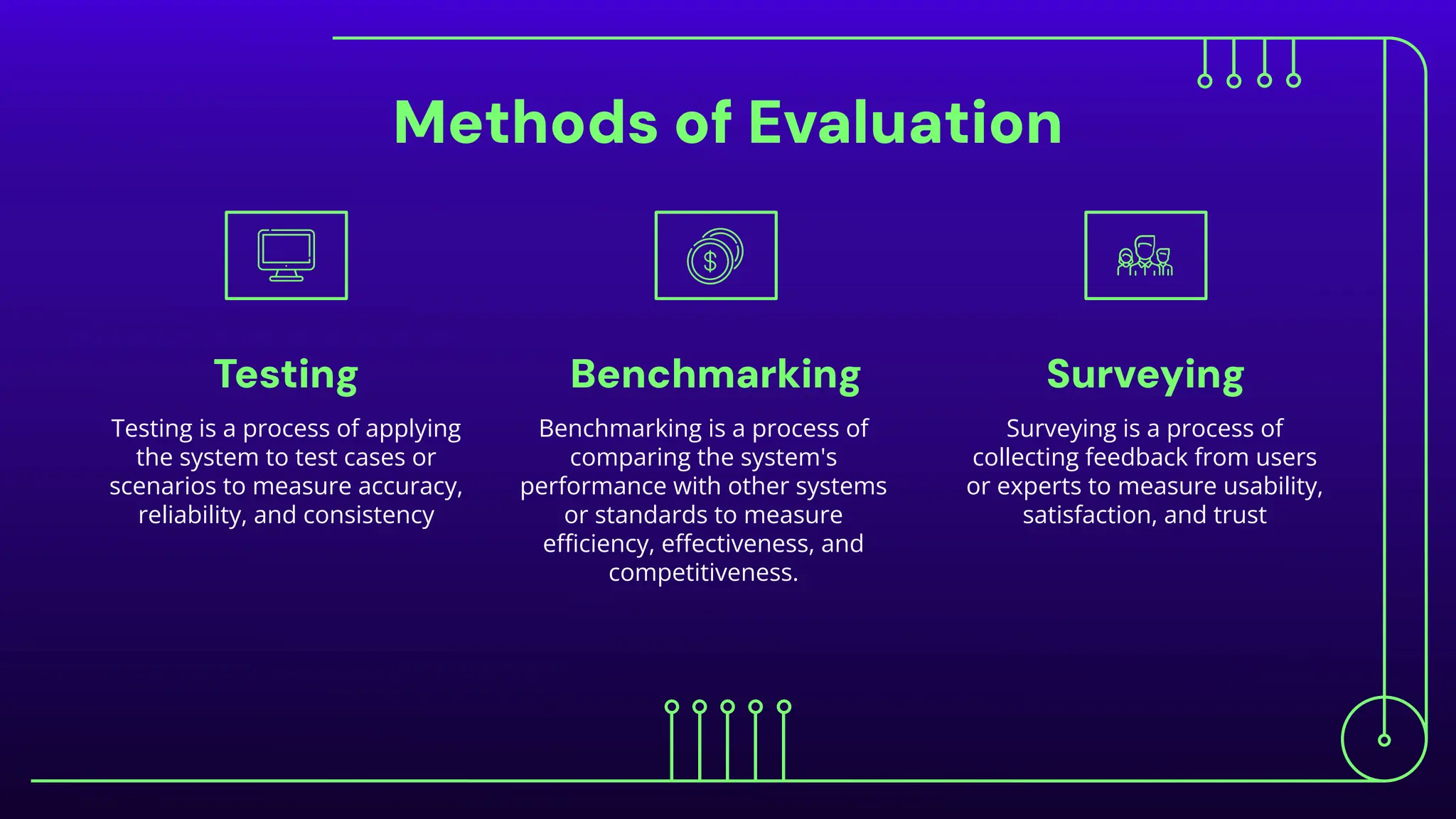
Methods of Evaluation
Testing Benchmarking
Testing is a process of applying
the system to test cases or
scenarios to measure accuracy,
reliability, and consistency
Benchmarking is a process of
comparing the system's
performance with other systems
or standards to measure
efficiency, effectiveness, and
competitiveness.
Surveying is a process of
collecting feedback from users
or experts to measure usability,
satisfaction, and trust
Surveying
References
● Miranda, P., Isaías, P., & Crisóstomo, M. (2011, January 1). Evaluation of Expert Systems: The Application
of a Reference Model to the Usability Parameter. Lecture Notes in Computer Science.
https://doi.org/10.1007/978-3-642-21672-5_12
● Zarri, G. P. (2011). Knowledge representation and inference techniques to improve the management of
gas and oil facilities. Knowledge-Based Systems, 24(7), 989–1003. doi:10.1016/j.knosys.2011.04.010
● https://www.javatpoint.com/knowledge-representation-in-ai
● https://www.tutorialspoint.com/artificial_intelligence/artificial_intelligence_expert_systems.htm
● https://www.linkedin.com/advice/0/how-can-you-evaluate-expert-systems-performance-over
● https://www.umsl.edu/~joshik/msis480/chapt11.htm
Thank
You!

Knowledge Representation & Evaluation in Expert System.pdf

  • 1.
    Knowledge Representation & Evaluationin Expert System Shwetha Iyer 1032211195 Selina Shrivastava 1032211782 Malika Kaila 1032212060 Under the Guidance of: Dr. Manisha Kumawat
  • 2.
    Table of Contents 01 04 02 03 Introduction toExpert Systems Knowledge Representation Evaluation of Expert System References
  • 3.
  • 4.
    What is anExpert System? ● The most important applied area of AI is the field of expert systems. ● An expert system is a computer program designed to solve complex problems and provide decision-making ability like a human expert. ● It is a knowledge-based system that extracts knowledge from its knowledge base and uses reasoning and inference rules to solve problems. ● A common example of an ES is a suggestion of spelling errors while typing in the Google search box.
  • 5.
    Components of ExpertSystem Knowledge Base ● Contains knowledge (factual & heuristic) about a particular domain and rules to solve a problem. ● Has knowledge acquisition module to gather knowledge from external sources. Inference Engine ● Pulls relevant information from the KB and interprets it to solve the user’s problem. ● Maps known facts to a set of rules to infer new facts through forward & backward chaining. User Interface ● Medium through which user interacts with the ES to get an answer to their question/problem.
  • 6.
    ● ES areused in classification, diagnosis, monitoring, process control, design, advising, predicting, and generation of options. ● In healthcare, expert systems aid in medical diagnosis and treatment recommendations. ● In finance, expert systems are used for risk assessment, fraud detection, and investment advice. ● Manufacturing industries employ expert systems for quality control, process optimization, and predictive maintenance. ● Customer support services also benefit from expert systems through automated troubleshooting and customer assistance. Applications of Expert Systems ● They provide increased accuracy by leveraging expert knowledge stored in their knowledge bases. This ensures consistent decision-making even in complex scenarios. ● They are highly scalable as they can handle large amounts of information efficiently. This makes them suitable for managing complex domains. ● Moreover, expert systems in AI can be cost-effective by reducing the need for human experts. Advantages of Expert Systems Characteristics of ES: High accuracy, Understandable, Reliable, Highly responsive
  • 7.
  • 8.
    Knowledge representation andreasoning is the field of AI which is concerned with AI agents thinking and how thinking contributes to intelligent behavior of agents. It is responsible for representing information about the real world so that a computer can understand and can utilize this knowledge to solve the complex real world problems such as diagnosis a medical condition or communicating with humans in natural language.
  • 9.
    Types of Knowledge:What to Represent? The AI needs to know all the facts about the objects in our world domain. E.g., A keyboard has keys, a guitar has strings, etc. The actions which occur in our world are called events. The knowledge about what we know is called meta-knowledge. The things in the real world that are known and proven true. Object Events Performance It describes a behavior involving knowledge about how to do things. A knowledge base aims to capture human expert knowledge to support decision-making, problem-solving, etc. Meta-Knowledge Facts Knowledge Base
  • 10.
    Types of KnowledgeRepresentation ● Logical Representation involves using formal languages such as propositional logic, first-order logic, and predicate calculus to represent facts and relationships through syntax and semantics. This allows the system to apply logical reasoning to arrive at conclusions. For eg. in medical diagnosis might to infer a specific disease based on symptoms and medical history. ● Semantic Networks provide a graphical representation where nodes represent concepts and edges depict relationships between concepts. This technique is useful for representing hierarchical structures and complex relationships. For eg. an ES for NLP to represent the relationships between words in a sentence. ● Frame Representation organizes knowledge into frames that represent objects, concepts, or situations with attributes and slots, and allow reasoning based on these attributes and slots. For eg. to represent different car models, each frame can contain attributes like colour, engine type, and price range. ● Production Rules represent knowledge in the form of IF-THEN statements which guide the system’s reasoning process by specifying conditions and corresponding actions. For example, an ES for troubleshooting computer issues might have a production rule that states: IF the computer does not start, THEN check the power supply.
  • 11.
    ● Ontologies involverepresenting knowledge in the form of a formal, explicit specification of the concepts, properties, and relationships between them within a particular domain. ● Neural networks represent knowledge in the form of patterns or connections between nodes in a network, which can be used to learn and infer new knowledge from data.
  • 12.
    KR & Reasoning Componentsof Knowledge Representation This component retrieves data from the environment, find out the source of noises and check if the AI was damaged by anything. It also defines how to respond when any sense has been detected. This component learns from the captured data for the process of self-improvement. In order to learn new things, the system requires knowledge acquisition, inference, acquisition of heuristics, faster searches, etc. KR helps to understand and build intelligent behavior and focus on what an agent needs to know in order to behave intelligently. It also defines how automated reasoning procedures can make this knowledge available as needed. Planning includes giving an initial state, finding their preconditions and effects, and a sequence of actions to achieve a state in which a particular goal holds. Once the planning is completed, the final stage is the execution of the entire process. Perception Learning Planning & Execution
  • 14.
    Approaches to KnowledgeRepresentation Simple Relational Knowledge Simplest way of storing facts which uses the relational method, and each fact is set out systematically in columns. This approach is used in database systems where the relationship between different entities is represented. It has little opportunity for inference. Inheritable Knowledge Here, all data must be stored into a hierarchy of classes and should be arranged in a generalized form or a hierarchical manner. Inferential Knowledge The inferential knowledge approach represents knowledge in the form of formal logic. Thus, it can be used to derive more facts. Also, it guarantees correctness. Statement 1: John is a cricketer. Statement 2: All cricketers are athletes. Cricketer(John) ∀x = Cricketer (x) —> Athelete (x) Procedural Knowledge This approach uses small programs and codes which describes how to do specific things, and how to proceed. If-Then rules are used to represent heuristic or domain-specific knowledge.
  • 15.
  • 16.
    What is tobe evaluated? ● At the design stage, we should assess the system's feasibility, suitability, and the availability and quality of the data. ● During development, we should evaluate the system's functionality, reliability, efficiency, accuracy and completeness. ● When deploying the system, we consider its usability, performance, and effectiveness, as well as user satisfaction, trust, and transparency. ● During maintenance you should consider the system's consistency, adaptability, scalability, and the impact and value of its output. Evaluating an expert system's performance is important for several reasons: 1. It helps assess whether the system meets the expectations and needs of the users and stakeholders. 2. It helps monitor the system's accuracy, reliability, and consistency over time. 3. It helps identify and correct any errors, gaps, or biases in the system's knowledge base, reasoning, or interface. 4. It helps compare the system's performance with other alternatives or benchmarks. Why is evaluation needed?
  • 19.
    Methods of Evaluation TestingBenchmarking Testing is a process of applying the system to test cases or scenarios to measure accuracy, reliability, and consistency Benchmarking is a process of comparing the system's performance with other systems or standards to measure efficiency, effectiveness, and competitiveness. Surveying is a process of collecting feedback from users or experts to measure usability, satisfaction, and trust Surveying
  • 20.
    References ● Miranda, P.,Isaías, P., & Crisóstomo, M. (2011, January 1). Evaluation of Expert Systems: The Application of a Reference Model to the Usability Parameter. Lecture Notes in Computer Science. https://doi.org/10.1007/978-3-642-21672-5_12 ● Zarri, G. P. (2011). Knowledge representation and inference techniques to improve the management of gas and oil facilities. Knowledge-Based Systems, 24(7), 989–1003. doi:10.1016/j.knosys.2011.04.010 ● https://www.javatpoint.com/knowledge-representation-in-ai ● https://www.tutorialspoint.com/artificial_intelligence/artificial_intelligence_expert_systems.htm ● https://www.linkedin.com/advice/0/how-can-you-evaluate-expert-systems-performance-over ● https://www.umsl.edu/~joshik/msis480/chapt11.htm
  • 21.