Proxemics
Prepared By
Manthan Dhavne
Definition & History
Proxemics is the study of human use of space and the effects that population density
has on behavior, communication, and social interaction. Proxemics is one among several
subcategories in the study of nonverbal communication,
including haptics (touch), kinesics (body movement), vocalics (paralanguage),
and chronemics (structure of time).
Edward T. Hall, the cultural anthropologist who coined this term in 1963. The Hidden
Dimension, Hall emphasized the impact of proxemic behavior (the use of space)
on interpersonal communication. Proxemics remains a hidden component of
interpersonal communication that is uncovered through observation and strongly
influenced by culture.
Proxemics
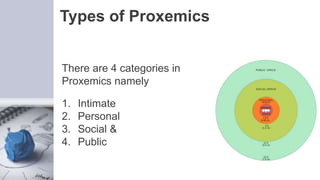
Types of Proxemics
There are 4 categories in
Proxemics namely
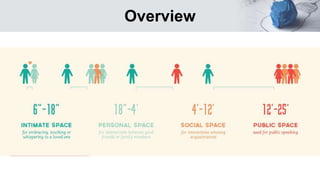
1. Intimate
2. Personal
3. Social &
4. Public
1. Intimate
Intimate distance is that which is used for very confidential
communications. This zone of distance is characterized by 0 to 2
feet of space between two individuals. An example of intimate
distance is two people hugging, holding hands, or standing side-
by-side. People in intimate distance share a unique level of
comfort with one another. Those who are not comfortable with
someone who approaches them in the intimate zone will
experince a great deal of social discomfort or awkwardness.
Examples of Intimate Proxemics
2. Personal
Personal distance is used for talking with family and close
friends. Although it gives a person a little more space than
intimate distance, it is still very close in proximity to that of
intimacy, and may involve touching. Personal distance can
range from 2 to 4 feet. Like intimate distance, if a stranger
approaches someone in the personal zone, he or she is likely
to feel uncomfortable being in such close proximity with the
stranger.
Examples of Personal Proxemics
3. Social
Social distance is used in business transactions, meeting
new people and interacting with groups of people. Social
distance has a large range in the distance that it can
incorporate. From 4 to 12 feet, it is clear that social
distance depends on the situation. Social distance may be
used among students, co-workers, or
acquaintances. Generally, people within social distance do
not engage in physical contact with one another.
Examples of Social Proxemics
4. Public
Public space is the space that characterizes how close we
sit or stand to someone, like a public figure or public
speaker. So, if you are at an event listening to a professor
give a lecture, you are probably about 12-25 feet away.
Examples of Public Proxemics
Overview
THANK YOU

Proxemics

  • 1.
  • 2.
    Definition & History Proxemicsis the study of human use of space and the effects that population density has on behavior, communication, and social interaction. Proxemics is one among several subcategories in the study of nonverbal communication, including haptics (touch), kinesics (body movement), vocalics (paralanguage), and chronemics (structure of time). Edward T. Hall, the cultural anthropologist who coined this term in 1963. The Hidden Dimension, Hall emphasized the impact of proxemic behavior (the use of space) on interpersonal communication. Proxemics remains a hidden component of interpersonal communication that is uncovered through observation and strongly influenced by culture. Proxemics
  • 3.
    Types of Proxemics Thereare 4 categories in Proxemics namely 1. Intimate 2. Personal 3. Social & 4. Public
  • 4.
    1. Intimate Intimate distanceis that which is used for very confidential communications. This zone of distance is characterized by 0 to 2 feet of space between two individuals. An example of intimate distance is two people hugging, holding hands, or standing side- by-side. People in intimate distance share a unique level of comfort with one another. Those who are not comfortable with someone who approaches them in the intimate zone will experince a great deal of social discomfort or awkwardness.
  • 5.
  • 6.
    2. Personal Personal distanceis used for talking with family and close friends. Although it gives a person a little more space than intimate distance, it is still very close in proximity to that of intimacy, and may involve touching. Personal distance can range from 2 to 4 feet. Like intimate distance, if a stranger approaches someone in the personal zone, he or she is likely to feel uncomfortable being in such close proximity with the stranger.
  • 7.
  • 8.
    3. Social Social distanceis used in business transactions, meeting new people and interacting with groups of people. Social distance has a large range in the distance that it can incorporate. From 4 to 12 feet, it is clear that social distance depends on the situation. Social distance may be used among students, co-workers, or acquaintances. Generally, people within social distance do not engage in physical contact with one another.
  • 9.
  • 10.
    4. Public Public spaceis the space that characterizes how close we sit or stand to someone, like a public figure or public speaker. So, if you are at an event listening to a professor give a lecture, you are probably about 12-25 feet away.
  • 11.
  • 12.
  • 13.