

PRESENTATION OF
BUSINESS
COMMUNICATION
PRESENTED BY:
Lovely
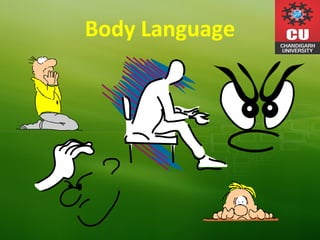
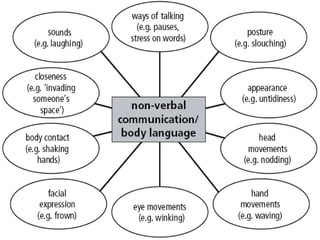
Body Language
What is Body Language ?
• Body language is non-
verbal communication
involving body
movement.
• People in the workplace
convey a great deal of
information without
even speaking; through
non-verbal
communication.
• Gesturing" is also a part
of body language.
Why is Body Language so
Important?
• People remember more of what they
see than what they hear.
• Long after a meeting, we are likely to
have forgotten the exact words
someone used, but we may retain a
vivid image of the same person's facial
expression.
What we are trying to deliver through
verbal means might not be exactly similar
to what we are delivering from our non-
verbal means i.e. BODY
Nonverbal Cues are Believed
When verbal and nonverbal cues contradict
one another, the nonverbal cues are
more likely to be believed.
Facial Expression
Your face tells a lot about what you are feeling. When you
speak, more than any other part of your body, your face
will communicate most clearly your attitudes, feelings and
emotions.
BE AWARE OF YOURSELF !
What you do might be
interpreted in several ways,
depending on the setting and
who you are talking to.
These are some common
interpretations of body
language and often more
effective ways to
communicate with your
body.
Notice how you sit, how you
stand, how you use you hands and
legs, what you do while talking to
someone.
ALL THIS IS AN INDICATION TO
YOUR PERSONALITY.
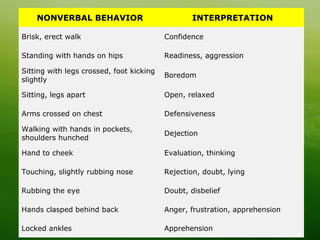
Body Language
NONVERBAL BEHAVIOR INTERPRETATION
Brisk, erect walk Confidence
Standing with hands on hips Readiness, aggression
Sitting with legs crossed, foot kicking
slightly
Boredom
Sitting, legs apart Open, relaxed
Arms crossed on chest Defensiveness
Walking with hands in pockets,
shoulders hunched
Dejection
Hand to cheek Evaluation, thinking
Touching, slightly rubbing nose Rejection, doubt, lying
Rubbing the eye Doubt, disbelief
Hands clasped behind back Anger, frustration, apprehension
Locked ankles Apprehension
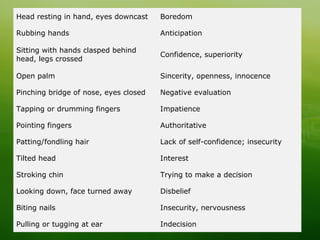
Head resting in hand, eyes downcast Boredom
Rubbing hands Anticipation
Sitting with hands clasped behind
head, legs crossed
Confidence, superiority
Open palm Sincerity, openness, innocence
Pinching bridge of nose, eyes closed Negative evaluation
Tapping or drumming fingers Impatience
Pointing fingers Authoritative
Patting/fondling hair Lack of self-confidence; insecurity
Tilted head Interest
Stroking chin Trying to make a decision
Looking down, face turned away Disbelief
Biting nails Insecurity, nervousness
Pulling or tugging at ear Indecision
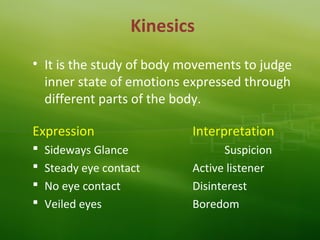
Kinesics
• It is the study of body movements to judge
inner state of emotions expressed through
different parts of the body.
Expression Interpretation
 Sideways Glance Suspicion
 Steady eye contact Active listener
 No eye contact Disinterest
 Veiled eyes Boredom
SMILE
Mahatma Gandhi has also mentioned that,
“You are not completely dressed until your face wears a
SMILE ".
KEEP SMILING, EVEN IN DIFFICULT
SITUATIONS. IT COSTS NO MONEY,
JUST STRETCHING YOUR FACIAL
MUSCLE! JUST GIVE AN INNOCENT
GENUINE
SMILE
A smile is the best in ‘BODY
LANGUAGE’ that any person can
project, beware of the fake smile it is
very easy to recognize one.
Do’s and the Don'ts
How do I know as to what I am doing is right or
not ……..????
OR
What is My Body Language like !!!!!
Let us find out.
Have eye contact, but don’t stare
If there are several people
you are talking to, give
them all some eye contact
to create a better
connection and see if they
are listening.
Keeping too much eye-
contact might creep people
out.
Giving no eye-contact might
make you seem insecure.
Nod when they are talking
Nod once in a while to
signal that you are
listening.
Don’t cross your arms
or legs
You have probably
already heard you
shouldn’t cross
your arms as it
might make you
seem defensive or
guarded. This goes
for your legs too.
Don’t be afraid to take up some space
Taking up space by for
example sitting or
standing with your
legs apart a bit signals
self-confidence and
that you are
comfortable in your
own skin.
Relax your shoulders
When you feel tense it’s
easily winds up as
tension in your
shoulders. They might
move up and forward a
bit. Try to relax. Try to
loosen up by shaking the
shoulders a bit and
move them back slightly.
Don’t touch your face
It might make you
seem nervous and
can be distracting
for the listeners or
the people in the
conversation.
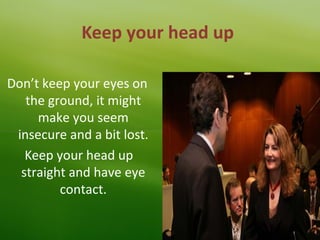
Keep your head up
Don’t keep your eyes on
the ground, it might
make you seem
insecure and a bit lost.
Keep your head up
straight and have eye
contact.
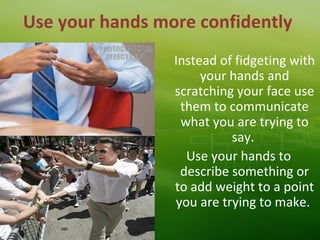
Use your hands more confidently
Instead of fidgeting with
your hands and
scratching your face use
them to communicate
what you are trying to
say.
Use your hands to
describe something or
to add weight to a point
you are trying to make.
Proxemics
The nonverbal study of
space and distance. It is
embarrassing if the more
we move back the more the
other person comes
forward.
Let people have their
personal space, don’t
invade it.
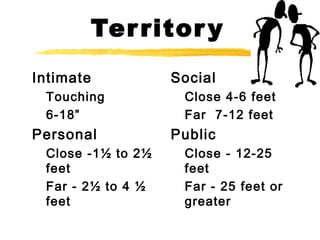
Territory
Intimate
Touching
6-18”
Personal
Close -1½ to 2½
feet
Far - 2½ to 4 ½
feet
Social
Close 4-6 feet
Far 7-12 feet
Public
Close - 12-25
feet
Far - 25 feet or
greater
Keep a good attitude
Last but not least, keep
a positive, open and
relaxed attitude.
How you feel will
come through in
your body language
and can make a
major difference.
You can change your body language but as
all new habits it takes a while. And if you try
and change to many things at once it might
become confusing and feel overwhelming.
THANK YOU

Body language

  • 1.
  • 2.
  • 3.
    What is BodyLanguage ? • Body language is non- verbal communication involving body movement. • People in the workplace convey a great deal of information without even speaking; through non-verbal communication. • Gesturing" is also a part of body language.
  • 4.
    Why is BodyLanguage so Important? • People remember more of what they see than what they hear. • Long after a meeting, we are likely to have forgotten the exact words someone used, but we may retain a vivid image of the same person's facial expression.
  • 6.
    What we aretrying to deliver through verbal means might not be exactly similar to what we are delivering from our non- verbal means i.e. BODY
  • 8.
    Nonverbal Cues areBelieved When verbal and nonverbal cues contradict one another, the nonverbal cues are more likely to be believed.
  • 9.
    Facial Expression Your facetells a lot about what you are feeling. When you speak, more than any other part of your body, your face will communicate most clearly your attitudes, feelings and emotions.
  • 10.
    BE AWARE OFYOURSELF ! What you do might be interpreted in several ways, depending on the setting and who you are talking to. These are some common interpretations of body language and often more effective ways to communicate with your body.
  • 11.
    Notice how yousit, how you stand, how you use you hands and legs, what you do while talking to someone. ALL THIS IS AN INDICATION TO YOUR PERSONALITY.
  • 12.
    Body Language NONVERBAL BEHAVIORINTERPRETATION Brisk, erect walk Confidence Standing with hands on hips Readiness, aggression Sitting with legs crossed, foot kicking slightly Boredom Sitting, legs apart Open, relaxed Arms crossed on chest Defensiveness Walking with hands in pockets, shoulders hunched Dejection Hand to cheek Evaluation, thinking Touching, slightly rubbing nose Rejection, doubt, lying Rubbing the eye Doubt, disbelief Hands clasped behind back Anger, frustration, apprehension Locked ankles Apprehension
  • 13.
    Head resting inhand, eyes downcast Boredom Rubbing hands Anticipation Sitting with hands clasped behind head, legs crossed Confidence, superiority Open palm Sincerity, openness, innocence Pinching bridge of nose, eyes closed Negative evaluation Tapping or drumming fingers Impatience Pointing fingers Authoritative Patting/fondling hair Lack of self-confidence; insecurity Tilted head Interest Stroking chin Trying to make a decision Looking down, face turned away Disbelief Biting nails Insecurity, nervousness Pulling or tugging at ear Indecision
  • 14.
    Kinesics • It isthe study of body movements to judge inner state of emotions expressed through different parts of the body. Expression Interpretation  Sideways Glance Suspicion  Steady eye contact Active listener  No eye contact Disinterest  Veiled eyes Boredom
  • 15.
    SMILE Mahatma Gandhi hasalso mentioned that, “You are not completely dressed until your face wears a SMILE ".
  • 16.
    KEEP SMILING, EVENIN DIFFICULT SITUATIONS. IT COSTS NO MONEY, JUST STRETCHING YOUR FACIAL MUSCLE! JUST GIVE AN INNOCENT GENUINE SMILE A smile is the best in ‘BODY LANGUAGE’ that any person can project, beware of the fake smile it is very easy to recognize one.
  • 17.
    Do’s and theDon'ts How do I know as to what I am doing is right or not ……..???? OR What is My Body Language like !!!!! Let us find out.
  • 18.
    Have eye contact,but don’t stare If there are several people you are talking to, give them all some eye contact to create a better connection and see if they are listening. Keeping too much eye- contact might creep people out. Giving no eye-contact might make you seem insecure.
  • 19.
    Nod when theyare talking Nod once in a while to signal that you are listening.
  • 20.
    Don’t cross yourarms or legs You have probably already heard you shouldn’t cross your arms as it might make you seem defensive or guarded. This goes for your legs too.
  • 21.
    Don’t be afraidto take up some space Taking up space by for example sitting or standing with your legs apart a bit signals self-confidence and that you are comfortable in your own skin.
  • 22.
    Relax your shoulders Whenyou feel tense it’s easily winds up as tension in your shoulders. They might move up and forward a bit. Try to relax. Try to loosen up by shaking the shoulders a bit and move them back slightly.
  • 23.
    Don’t touch yourface It might make you seem nervous and can be distracting for the listeners or the people in the conversation.
  • 24.
    Keep your headup Don’t keep your eyes on the ground, it might make you seem insecure and a bit lost. Keep your head up straight and have eye contact.
  • 25.
    Use your handsmore confidently Instead of fidgeting with your hands and scratching your face use them to communicate what you are trying to say. Use your hands to describe something or to add weight to a point you are trying to make.
  • 26.
    Proxemics The nonverbal studyof space and distance. It is embarrassing if the more we move back the more the other person comes forward. Let people have their personal space, don’t invade it.
  • 27.
    Territory Intimate Touching 6-18” Personal Close -1½ to2½ feet Far - 2½ to 4 ½ feet Social Close 4-6 feet Far 7-12 feet Public Close - 12-25 feet Far - 25 feet or greater
  • 28.
    Keep a goodattitude Last but not least, keep a positive, open and relaxed attitude. How you feel will come through in your body language and can make a major difference.
  • 29.
    You can changeyour body language but as all new habits it takes a while. And if you try and change to many things at once it might become confusing and feel overwhelming.
  • 30.