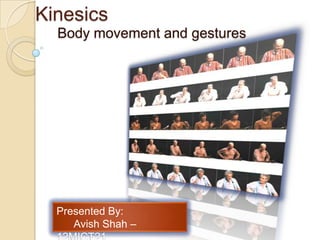
Kinesics
  Body movement and gestures


  Presented By:
     Avish Shah –
   “ A man stands
    inside of a closed
    glass phone booth.
    You cannot hear a
    word he says, but
    you see his
    postures, gestures,
    and facial
    expressions. “

You see his kinesics.
 Marjorie F. Vargas
 (Louder Than
 Words)
Kinesics is the study of body
movement, facial expressions, and
gestures.
  Points Covered In
  Presentation…
              Postures
              Gestures
              Emblems
              Illustrators
              Affect displays
              Regulators
              Adaptors
Posture & Gait
   Expressions related            In Western culture, an
                                    upright, yet relaxed body
    to posture, gait
                                    posture, is associated with
    ◦ “grow a spine”                confidence, positivity, high
    ◦ walking with a “spring        self esteem (Guerrero &
      in your step”                 Floyd, 2006).
    ◦ “stand up for yourself”
    ◦ “stand up straight”
    ◦ “hold your head high”
    ◦ “don’t slouch.”
    ◦ “stand still”
Posture & Gait
Posture and Body Movement
   Nonverbal indicators of
    Liking
    ◦ Forward lean
    ◦ Body and head orientation
      facing the other person
    ◦ Open body positions
    ◦ Affirmative head nods
    ◦ Moderate gesturing and
      animation
    ◦ Close interpersonal distances
    ◦ Moderate body relaxation
    ◦ Touching
    ◦ Initiating and maintaining eye
      contact
    ◦ Smiling
    ◦ Mirroring (congruent posture)
Posture and Body Movement
   Nonverbal indicators of
    dislike
    ◦ Indirect, oblique body
      orientation
    ◦ No eye contact, or eye
      contact of short duration
    ◦ Averted eyes
    ◦ Unpleasant facial
      expressions
    ◦ Relative absence of
      gestures
    ◦ Body rigidity, bodily tension
    ◦ Incongruent postures
Politician’s postures
nonverbal faux pas
Gestures
      Humans have uniquely
       expressive hands.
Gestures
   Gestures may be
    conflicting
    ◦ Yawning while
      saying you are not
      tired.
    ◦ Looking involved but
      saying, “I don’t
      care,”
Emblems :
     Movement communicates
    meaning
   Emblems are body
    movements that
    substitute for words and
    phrases.

    We beckon with are
    index finger to mean
    “come here.”
     We use an open hand
    held up to mean “stop.”

However,
  be wary of emblems,
  they may mean
  something different in a
  different culture.
Emblems
   Emblems are used
    intentionally.
   They have verbal
    equivalents
   They have a clear,
    consistent meaning
    within a particular
    culture
    ◦   Cross my heart
    ◦   Shame on you
    ◦   Peace sign
    ◦   I’m crazy
In much of the
   world today,
 the thumbs up
     means,
  "O.K.", "Right
 On!", or "I like
      this”

                        .
     But in Iran,
Afghanistan, Nigeria
 and parts of Italy
and Greece.. it is an
   obscene insult,
  especially when
  combined with a
sweep of the arms.
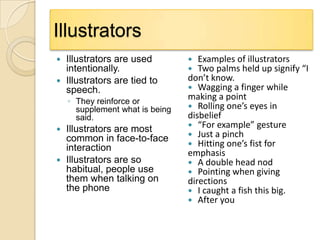
Illustrators
 Illustrators are used            Examples of illustrators
  intentionally.                   Two palms held up signify “I
 Illustrators are tied to       don’t know.
  speech.                         Wagging a finger while
    ◦ They reinforce or
                                 making a point
      supplement what is being    Rolling one’s eyes in
      said.                      disbelief
                                  “For example” gesture
 Illustrators are most
                                  Just a pinch
  common in face-to-face
                                  Hitting one’s fist for
  interaction
                                 emphasis
 Illustrators are so             A double head nod
  habitual, people use            Pointing when giving
  them when talking on           directions
  the phone                       I caught a fish this big.
                                  After you
Affect displays
Are these people expressing
the same emotion, in differing
degrees, or different emotions
altogether?
Affect displays
   Affect displays may        Interpreting affect
    or may not be               displays:
    intentional                 ◦ Look at the face to
   Affect displays               determine the emotion
    convey feeling and          ◦ Look at body cues to
                                  determine the strength or
    emotion
                                  intensity of the emotion.
   They are often
    communicated via
    facial expressions
   They can be difficult
    to interpret
Regulators
 Regulators are primarily       Types of turn-taking
  unintentional                  Turn-requesting cues
 They regulate turn-taking
                                 Turn maintaining cues
  behavior
                                 Turn yielding cues
 Conversational give and
  take depends on                Turn denying cues
  regulators
Regulators
   Regulate the ebb
    and flow of
    conversation
Adaptors
 Adaptors are usually         Examples of adaptors
  unintentional.                ◦   Fiddling with one’s hair
 Adaptors include              ◦   Chewing one’s fingernails
  self-touching                 ◦   Tapping one’s foot or leg
  behaviors                     ◦   Biting one’s lips
 Adapters signal               ◦   Scratching one’s arm
  nervousness,                  ◦   Wringing one’s hands
  anxiousness,                  ◦   Clenching one’s jaw
  boredom
 Generally speaking,
  adapters are
  perceived negatively
    ◦ However, adaptors
      may be perceived as
      more genuine,
      authentic
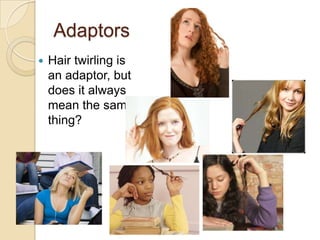
Adaptors
   Hair twirling is
    an adaptor, but
    does it always
    mean the same
    thing?
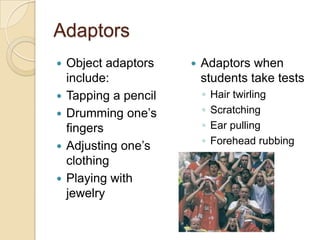
Adaptors
   Object adaptors       Adaptors when
    include:               students take tests
   Tapping a pencil       ◦   Hair twirling
   Drumming one’s         ◦   Scratching
    fingers                ◦   Ear pulling
                           ◦   Forehead rubbing
   Adjusting one’s
    clothing
   Playing with
    jewelry
How does it help to know about
kinesics?
       Understanding               nonverbal
        communication     can     help     us
        communicate better.       We avoid
        misunderstandings.    We are clearer
        in the meanings we transmit.
Sources:

 http://www.ooze.com/finger/html/foriegn.htm
    l

   http://members.aol.com/doder1/kinesic1.ht
    m

   http://www.psychcorp.com/catg/pdf/p187.p
    df

Kinesics 12 mict21

  • 1.
    Kinesics Bodymovement and gestures Presented By: Avish Shah –
  • 2.
    “ A man stands inside of a closed glass phone booth. You cannot hear a word he says, but you see his postures, gestures, and facial expressions. “ You see his kinesics. Marjorie F. Vargas (Louder Than Words)
  • 3.
    Kinesics is thestudy of body movement, facial expressions, and gestures. Points Covered In Presentation…  Postures  Gestures  Emblems  Illustrators  Affect displays  Regulators  Adaptors
  • 4.
    Posture & Gait  Expressions related  In Western culture, an upright, yet relaxed body to posture, gait posture, is associated with ◦ “grow a spine” confidence, positivity, high ◦ walking with a “spring self esteem (Guerrero & in your step” Floyd, 2006). ◦ “stand up for yourself” ◦ “stand up straight” ◦ “hold your head high” ◦ “don’t slouch.” ◦ “stand still”
  • 5.
  • 6.
    Posture and BodyMovement  Nonverbal indicators of Liking ◦ Forward lean ◦ Body and head orientation facing the other person ◦ Open body positions ◦ Affirmative head nods ◦ Moderate gesturing and animation ◦ Close interpersonal distances ◦ Moderate body relaxation ◦ Touching ◦ Initiating and maintaining eye contact ◦ Smiling ◦ Mirroring (congruent posture)
  • 7.
    Posture and BodyMovement  Nonverbal indicators of dislike ◦ Indirect, oblique body orientation ◦ No eye contact, or eye contact of short duration ◦ Averted eyes ◦ Unpleasant facial expressions ◦ Relative absence of gestures ◦ Body rigidity, bodily tension ◦ Incongruent postures
  • 8.
  • 9.
  • 10.
    Gestures  Humans have uniquely expressive hands.
  • 11.
    Gestures  Gestures may be conflicting ◦ Yawning while saying you are not tired. ◦ Looking involved but saying, “I don’t care,”
  • 12.
    Emblems : Movement communicates meaning  Emblems are body movements that substitute for words and phrases.  We beckon with are index finger to mean “come here.”  We use an open hand held up to mean “stop.” However, be wary of emblems, they may mean something different in a different culture.
  • 13.
    Emblems  Emblems are used intentionally.  They have verbal equivalents  They have a clear, consistent meaning within a particular culture ◦ Cross my heart ◦ Shame on you ◦ Peace sign ◦ I’m crazy
  • 14.
    In much ofthe world today, the thumbs up means, "O.K.", "Right On!", or "I like this” . But in Iran, Afghanistan, Nigeria and parts of Italy and Greece.. it is an obscene insult, especially when combined with a sweep of the arms.
  • 15.
    Illustrators  Illustrators areused  Examples of illustrators intentionally.  Two palms held up signify “I  Illustrators are tied to don’t know. speech.  Wagging a finger while ◦ They reinforce or making a point supplement what is being  Rolling one’s eyes in said. disbelief  “For example” gesture  Illustrators are most  Just a pinch common in face-to-face  Hitting one’s fist for interaction emphasis  Illustrators are so  A double head nod habitual, people use  Pointing when giving them when talking on directions the phone  I caught a fish this big.  After you
  • 16.
    Affect displays Are thesepeople expressing the same emotion, in differing degrees, or different emotions altogether?
  • 17.
    Affect displays  Affect displays may  Interpreting affect or may not be displays: intentional ◦ Look at the face to  Affect displays determine the emotion convey feeling and ◦ Look at body cues to determine the strength or emotion intensity of the emotion.  They are often communicated via facial expressions  They can be difficult to interpret
  • 18.
    Regulators  Regulators areprimarily  Types of turn-taking unintentional  Turn-requesting cues  They regulate turn-taking  Turn maintaining cues behavior  Turn yielding cues  Conversational give and take depends on  Turn denying cues regulators
  • 19.
    Regulators  Regulate the ebb and flow of conversation
  • 20.
    Adaptors  Adaptors areusually  Examples of adaptors unintentional. ◦ Fiddling with one’s hair  Adaptors include ◦ Chewing one’s fingernails self-touching ◦ Tapping one’s foot or leg behaviors ◦ Biting one’s lips  Adapters signal ◦ Scratching one’s arm nervousness, ◦ Wringing one’s hands anxiousness, ◦ Clenching one’s jaw boredom  Generally speaking, adapters are perceived negatively ◦ However, adaptors may be perceived as more genuine, authentic
  • 21.
    Adaptors  Hair twirling is an adaptor, but does it always mean the same thing?
  • 22.
    Adaptors  Object adaptors  Adaptors when include: students take tests  Tapping a pencil ◦ Hair twirling  Drumming one’s ◦ Scratching fingers ◦ Ear pulling ◦ Forehead rubbing  Adjusting one’s clothing  Playing with jewelry
  • 23.
    How does ithelp to know about kinesics?  Understanding nonverbal communication can help us communicate better. We avoid misunderstandings. We are clearer in the meanings we transmit.
  • 24.
    Sources:  http://www.ooze.com/finger/html/foriegn.htm l  http://members.aol.com/doder1/kinesic1.ht m  http://www.psychcorp.com/catg/pdf/p187.p df