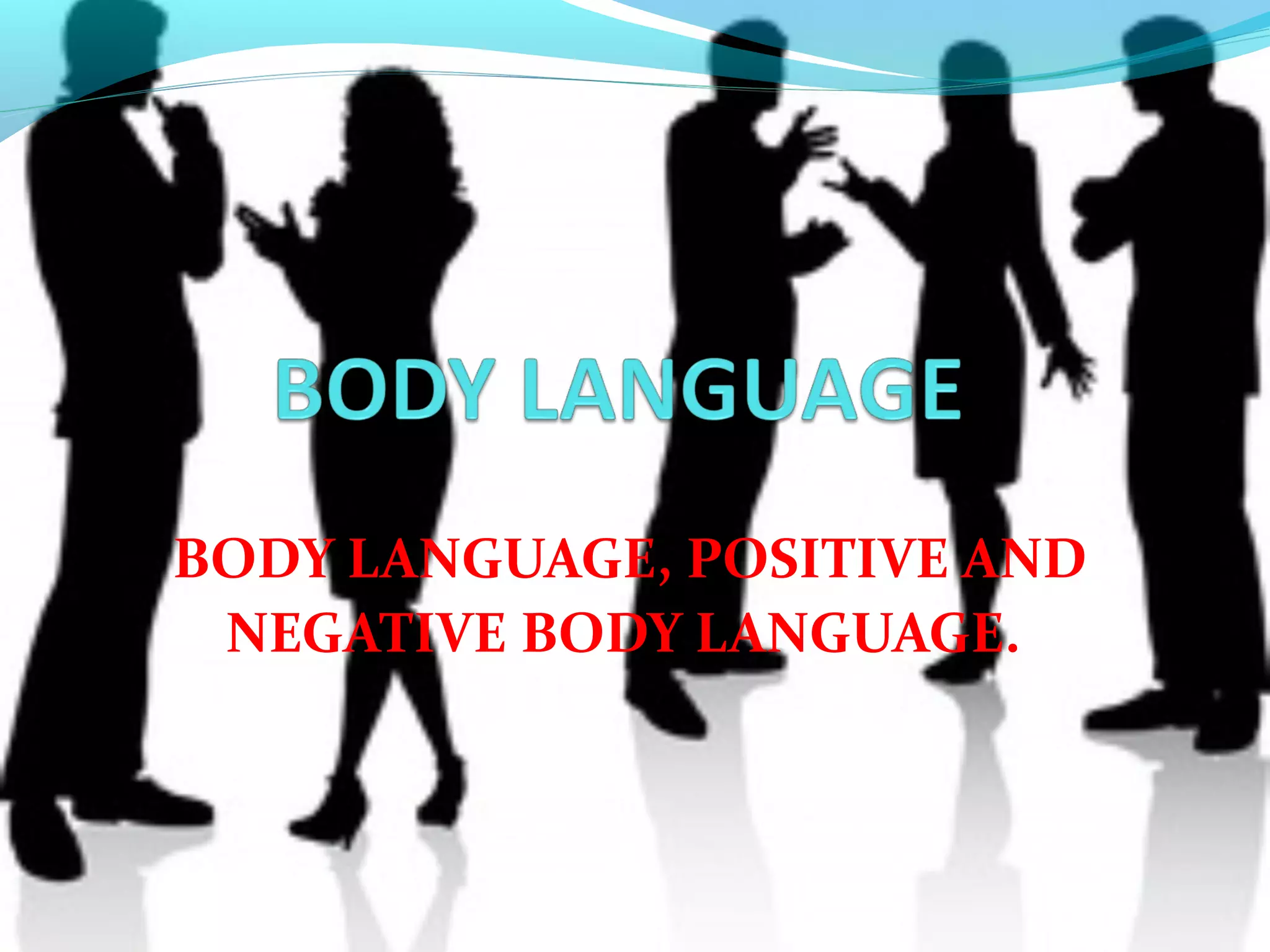
BODY LANGUAGE, POSITIVE AND
NEGATIVE BODY LANGUAGE.
BODY LANGUAGE
It’s a type of non verbal communication.
It is an essential skill to clear all interviews.
Body language also reflects the characteristics of an
individual , a person having a confident personality
will carry a confident body language where as a
person who is not confident his body language
reflects weakness.
Positive Body Language helps to convey our message
in a better way.
Negative Body Language takes away the attention of
the speaker and makes the listener stop listening .
NEGATIVE BODY LANGUAGE
Weak hand shake: Nervous, shy, insecure, afraid
of conversing with others.
Clearing throat: Nervousness.
Biting the fingernails: Nervousness.
Wringing the hands: Nervousness.
Pacing the floor: Nervousness.
Limited or No Eye Contact: Lying,
disinterested.
Arms crossed: Defensive and cautious.
NEGATIVE BODY LANGUAGE
Resting chin on palm: Critical, cynical and negative
towards the other person.
Dropping eyeglasses onto the lower bridge and
peering over them: Causes negative reactions.
Rubbing your collar: Nervousness.
Adjusting your tie: Insecurity.
Pressed Lips: Pressed lips convey disagreement and
disapproval. It communicates a desire to end the
discussion.
Biting Lips: Embarrassment, lack of self-confidence.
NEGATIVE BODY LANGUAGE
Rubbing around ears: Performed while weighing an
answer, commonly coupled with 'well, I don't know'.
Shoulders hunched forward : Lacking interest or feeling
inferior.
Tapping Fingers : Agitated, anxious, bored.
Fidgeting with hands or objects : Bored.
Breath faster: Nervous or angry.
Twisting the feet continuously : A person is nervous,
can also mean that a person is stressed or angry and don't
want to show that to anybody.
NEGATIVE BODY LANGUAGE
Clinging Hands: Those who cling to objects such as
handbags, files or tables show a need for support. It also
means confusion or insecurity. It expresses fear and difficulty
in coping with the current situation.
Covered Hands: Keeping distance and an act of concealing
feelings and covering insecurity.
Clasping the hands : Defense.
Making a fist from your hands: Aggression, angry or
irritated.
Holding the hand before the mouth: Hiding something.
In western countries it is impolite or interruption.
NEGATIVE BODY LANGUAGE
Raising the eyebrows: Surprise.
 Twisted Hands: Expression of a complex
personality. It may indicate a difficult emotional
life.
 Nose-rubbing or nose-touching: Doubt, it
often reveals a negative reaction.
 Tension in Brow : Confusion, tension, fear.
 A big smile that goes on longer and
disappears slower: Unreal or fake smile.
Making the eyes look larger: Shock.
POSITIVE BODY LANGUAGE
Direct Eye Contact: Interested, likes you.
Relaxed Brow: Comfortable.
Leaning forward : Interested.
Eyes open slightly more than usual: Gives
people the impression that they are welcome.
Nodding: Listening attentively.
Slowly nodding: Shows interest and that they
are validating the comments of the interviewer
and this subtly encourages to continue.
POSITIVE BODY LANGUAGE
Pinching bridge of the nose:
Communicates great thought.
Smiling Eyes: Comfortable.
Keeping Head-Up: Confident and
secure.
Loud sigh: Understand the thing that is
being told.
Rigid Body Posture : Anxious, upright.
POSITIVE BODY LANGUAGE
Walk briskly
Hold head up
Hold shoulders upright
Keep posture erect
Make firm handshake
Hold steady eye contact
Open arms/palms
SUMMING UP
Body language–very crucial and significant
component of Communication.
Mastering Body Language – very important skill
in today’s world.
Understanding and effective use of Body
Language – improves and strengthens our
personal and official relationships.
Effective Body Language – Effective
Communication.

Body language for effective communication

  • 1.
    BODY LANGUAGE, POSITIVEAND NEGATIVE BODY LANGUAGE.
  • 2.
    BODY LANGUAGE It’s atype of non verbal communication. It is an essential skill to clear all interviews. Body language also reflects the characteristics of an individual , a person having a confident personality will carry a confident body language where as a person who is not confident his body language reflects weakness. Positive Body Language helps to convey our message in a better way. Negative Body Language takes away the attention of the speaker and makes the listener stop listening .
  • 3.
    NEGATIVE BODY LANGUAGE Weakhand shake: Nervous, shy, insecure, afraid of conversing with others. Clearing throat: Nervousness. Biting the fingernails: Nervousness. Wringing the hands: Nervousness. Pacing the floor: Nervousness. Limited or No Eye Contact: Lying, disinterested. Arms crossed: Defensive and cautious.
  • 4.
    NEGATIVE BODY LANGUAGE Restingchin on palm: Critical, cynical and negative towards the other person. Dropping eyeglasses onto the lower bridge and peering over them: Causes negative reactions. Rubbing your collar: Nervousness. Adjusting your tie: Insecurity. Pressed Lips: Pressed lips convey disagreement and disapproval. It communicates a desire to end the discussion. Biting Lips: Embarrassment, lack of self-confidence.
  • 5.
    NEGATIVE BODY LANGUAGE Rubbingaround ears: Performed while weighing an answer, commonly coupled with 'well, I don't know'. Shoulders hunched forward : Lacking interest or feeling inferior. Tapping Fingers : Agitated, anxious, bored. Fidgeting with hands or objects : Bored. Breath faster: Nervous or angry. Twisting the feet continuously : A person is nervous, can also mean that a person is stressed or angry and don't want to show that to anybody.
  • 6.
    NEGATIVE BODY LANGUAGE ClingingHands: Those who cling to objects such as handbags, files or tables show a need for support. It also means confusion or insecurity. It expresses fear and difficulty in coping with the current situation. Covered Hands: Keeping distance and an act of concealing feelings and covering insecurity. Clasping the hands : Defense. Making a fist from your hands: Aggression, angry or irritated. Holding the hand before the mouth: Hiding something. In western countries it is impolite or interruption.
  • 7.
    NEGATIVE BODY LANGUAGE Raisingthe eyebrows: Surprise.  Twisted Hands: Expression of a complex personality. It may indicate a difficult emotional life.  Nose-rubbing or nose-touching: Doubt, it often reveals a negative reaction.  Tension in Brow : Confusion, tension, fear.  A big smile that goes on longer and disappears slower: Unreal or fake smile. Making the eyes look larger: Shock.
  • 8.
    POSITIVE BODY LANGUAGE DirectEye Contact: Interested, likes you. Relaxed Brow: Comfortable. Leaning forward : Interested. Eyes open slightly more than usual: Gives people the impression that they are welcome. Nodding: Listening attentively. Slowly nodding: Shows interest and that they are validating the comments of the interviewer and this subtly encourages to continue.
  • 9.
    POSITIVE BODY LANGUAGE Pinchingbridge of the nose: Communicates great thought. Smiling Eyes: Comfortable. Keeping Head-Up: Confident and secure. Loud sigh: Understand the thing that is being told. Rigid Body Posture : Anxious, upright.
  • 10.
    POSITIVE BODY LANGUAGE Walkbriskly Hold head up Hold shoulders upright Keep posture erect Make firm handshake Hold steady eye contact Open arms/palms
  • 11.
    SUMMING UP Body language–verycrucial and significant component of Communication. Mastering Body Language – very important skill in today’s world. Understanding and effective use of Body Language – improves and strengthens our personal and official relationships. Effective Body Language – Effective Communication.