9/29/2016 Assignment 3
Key terminology Romanesque Period
History 1
Fatma Mohamed-201210448
DR. SEIF KHIATI
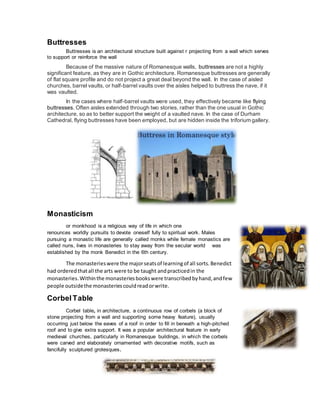
Buttresses
Buttresses is an architectural structure built against r projecting from a wall which serves
to support or reinforce the wall
Because of the massive nature of Romanesque walls, buttresses are not a highly
significant feature, as they are in Gothic architecture. Romanesque buttresses are generally
of flat square profile and do not project a great deal beyond the wall. In the case of aisled
churches, barrel vaults, or half-barrel vaults over the aisles helped to buttress the nave, if it
was vaulted.
In the cases where half-barrel vaults were used, they effectively became like flying
buttresses. Often aisles extended through two stories, rather than the one usual in Gothic
architecture, so as to better support the weight of a vaulted nave. In the case of Durham
Cathedral, flying buttresses have been employed, but are hidden inside the triforium gallery.
Monasticism
or monkhood is a religious way of life in which one
renounces worldly pursuits to devote oneself fully to spiritual work. Males
pursuing a monastic life are generally called monks while female monastics are
called nuns, lives in monasteries to stay away from the secular world was
established by the monk Benedict in the 6th century.
The monasterieswere the majorseatsof learningof all sorts.Benedict
had orderedthatall the arts were to be taught andpracticedin the
monasteries.Withinthe monasteriesbookswere transcribedbyhand,andfew
people outsidethe monasteriescouldreadorwrite.
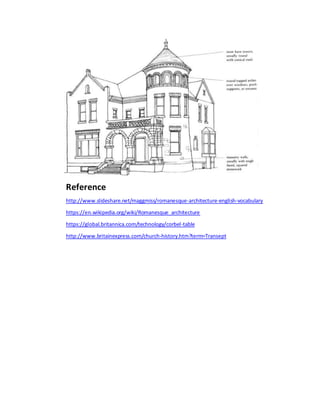
Corbel Table
Corbel table, in architecture, a continuous row of corbels (a block of
stone projecting from a wall and supporting some heavy feature), usually
occurring just below the eaves of a roof in order to fill in beneath a high-pitched
roof and to give extra support. It was a popular architectural feature in early
medieval churches, particularly in Romanesque buildings, in which the corbels
were carved and elaborately ornamented with decorative motifs, such as
fancifully sculptured grotesques.
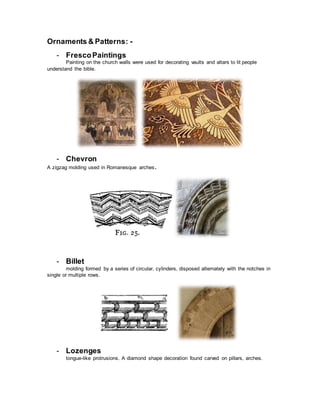
Ornaments & Patterns: -
- FrescoPaintings
Painting on the church walls were used for decorating vaults and altars to lit people
understand the bible.
- Chevron
A zigzag molding used in Romanesque arches.
- Billet
molding formed by a series of circular, cylinders, disposed alternately with the notches in
single or multiple rows.
- Lozenges
tongue-like protrusions. A diamond shape decoration found carved on pillars, arches.
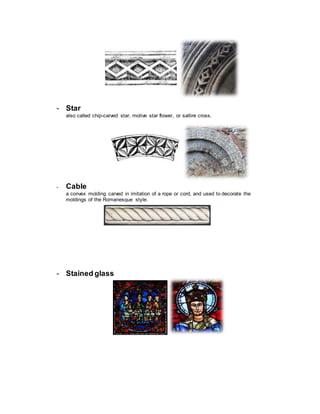
- Star
also called chip-carved star, motive star flower, or saltire cross.
- Cable
a convex molding carved in imitation of a rope or cord, and used to decorate the
moldings of the Romanesque style.
- Stained glass
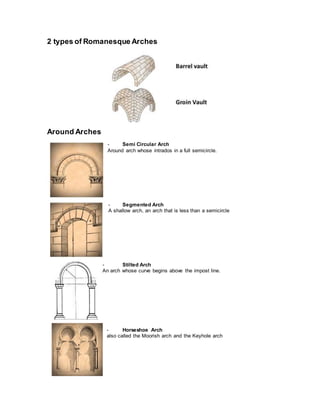
2 types of Romanesque Arches
Around Arches
- Semi Circular Arch
Around arch whose intrados in a full semicircle.
- Segmented Arch
A shallow arch, an arch that is less than a semicircle
- Stilted Arch
An arch whose curve begins above the impost line.
- Horseshoe Arch
also called the Moorish arch and the Keyhole arch
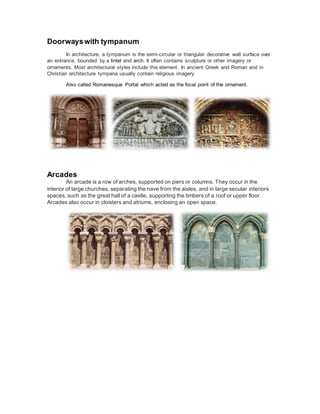
Doorwayswith tympanum
In architecture, a tympanum is the semi-circular or triangular decorative wall surface over
an entrance, bounded by a lintel and arch. It often contains sculpture or other imagery or
ornaments. Most architectural styles include this element. In ancient Greek and Roman and in
Christian architecture tympana usually contain religious imagery
Also called Romanesque Portal which acted as the focal point of the ornament.
Arcades
An arcade is a row of arches, supported on piers or columns. They occur in the
interior of large churches, separating the nave from the aisles, and in large secular interiors
spaces, such as the great hall of a castle, supporting the timbers of a roof or upper floor.
Arcades also occur in cloisters and atriums, enclosing an open space.
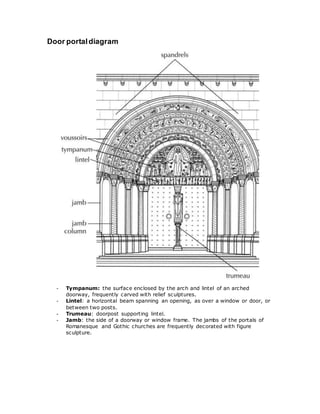
Door portaldiagram
- Tympanum: the surface enclosed by the arch and lintel of an arched
doorway, frequently carved with relief sculptures.
- Lintel: a horizontal beam spanning an opening, as over a window or door, or
between two posts.
- Trumeau: doorpost supporting lintel.
- Jamb: the side of a doorway or window frame. The jambs of the portals of
Romanesque and Gothic churches are frequently decorated with figure
sculpture.
Piers
In Romanesque architecture, piers were often employed to support arches. They
were built of masonry and square or rectangular in section, generally having a horizontal
molding representing a capital at the springing of the arch. Sometimes piers have vertical
shafts attached to them, and may also have horizontal moldings at the level of the base.
Columns
Columns are an important structural feature of Romanesque architecture. attached
shafts are also used structurally and for decoration. Monolithic columns cut from a single
piece of stone were frequently used in Italy, as they had been in Roman and Early Christian
architecture.[1]
They were also used, particularly in Germany, when they alternated between
more massive piers. Arcades of columns cut from single pieces are also common in
structures that do not bear massive weights of masonry, such as cloisters, where they are
sometimes paired.
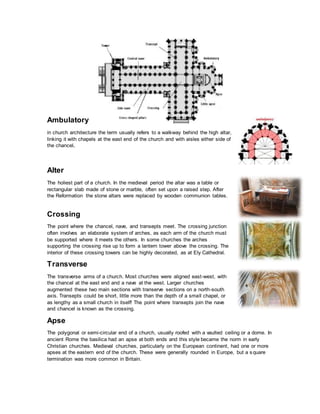
Ambulatory
in church architecture the term usually refers to a walkway behind the high altar,
linking it with chapels at the east end of the church and with aisles either side of
the chancel.
Alter
The holiest part of a church. In the medieval period the altar was a table or
rectangular slab made of stone or marble, often set upon a raised step. After
the Reformation the stone altars were replaced by wooden communion tables.
Crossing
The point where the chancel, nave, and transepts meet. The crossing junction
often involves an elaborate system of arches, as each arm of the church must
be supported where it meets the others. In some churches the arches
supporting the crossing rise up to form a lantern tower above the crossing. The
interior of these crossing towers can be highly decorated, as at Ely Cathedral.
Transverse
The transverse arms of a church. Most churches were aligned east-west, with
the chancel at the east end and a nave at the west. Larger churches
augmented these two main sections with transerve sections on a north-south
axis. Transepts could be short, little more than the depth of a small chapel, or
as lengthy as a small church in itself! The point where transepts join the nave
and chancel is known as the crossing.
Apse
The polygonal or semi-circular end of a church, usually roofed with a vaulted ceiling or a dome. In
ancient Rome the basilica had an apse at both ends and this style became the norm in early
Christian churches. Medieval churches, particularly on the European continent, had one or more
apses at the eastern end of the church. These were generally rounded in Europe, but a square
termination was more common in Britain.
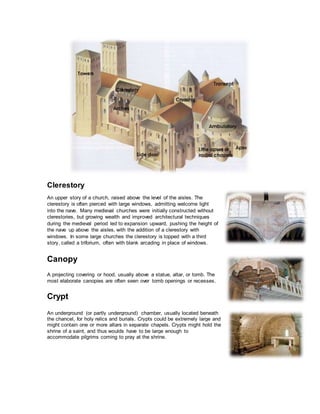
Clerestory
An upper story of a church, raised above the level of the aisles. The
clerestory is often pierced with large windows, admitting welcome light
into the nave. Many medieval churches were initially constructed without
clerestories, but growing wealth and improved architectural techniques
during the medieval period led to expansion upward, pushing the height of
the nave up above the aisles, with the addition of a clerestory with
windows. In some large churches the clerestory is topped with a third
story, called a triforium, often with blank arcading in place of windows.
Canopy
A projecting covering or hood, usually above a statue, altar, or tomb. The
most elaborate canopies are often seen over tomb openings or recesses.
Crypt
An underground (or partly underground) chamber, usually located beneath
the chancel, for holy relics and burials. Crypts could be extremely large and
might contain one or more altars in separate chapels. Crypts might hold the
shrine of a saint, and thus woulds have to be large enough to
accommodate pilgrims coming to pray at the shrine.
Reference
http://www.slideshare.net/maggmiss/romanesque-architecture-english-vocabulary
https://en.wikipedia.org/wiki/Romanesque_architecture
https://global.britannica.com/technology/corbel-table
http://www.britainexpress.com/church-history.htm?term=Transept

Key terminology Romanesque period

  • 1.
    9/29/2016 Assignment 3 Keyterminology Romanesque Period History 1 Fatma Mohamed-201210448 DR. SEIF KHIATI
  • 2.
    Buttresses Buttresses is anarchitectural structure built against r projecting from a wall which serves to support or reinforce the wall Because of the massive nature of Romanesque walls, buttresses are not a highly significant feature, as they are in Gothic architecture. Romanesque buttresses are generally of flat square profile and do not project a great deal beyond the wall. In the case of aisled churches, barrel vaults, or half-barrel vaults over the aisles helped to buttress the nave, if it was vaulted. In the cases where half-barrel vaults were used, they effectively became like flying buttresses. Often aisles extended through two stories, rather than the one usual in Gothic architecture, so as to better support the weight of a vaulted nave. In the case of Durham Cathedral, flying buttresses have been employed, but are hidden inside the triforium gallery. Monasticism or monkhood is a religious way of life in which one renounces worldly pursuits to devote oneself fully to spiritual work. Males pursuing a monastic life are generally called monks while female monastics are called nuns, lives in monasteries to stay away from the secular world was established by the monk Benedict in the 6th century. The monasterieswere the majorseatsof learningof all sorts.Benedict had orderedthatall the arts were to be taught andpracticedin the monasteries.Withinthe monasteriesbookswere transcribedbyhand,andfew people outsidethe monasteriescouldreadorwrite. Corbel Table Corbel table, in architecture, a continuous row of corbels (a block of stone projecting from a wall and supporting some heavy feature), usually occurring just below the eaves of a roof in order to fill in beneath a high-pitched roof and to give extra support. It was a popular architectural feature in early medieval churches, particularly in Romanesque buildings, in which the corbels were carved and elaborately ornamented with decorative motifs, such as fancifully sculptured grotesques.
  • 3.
    Ornaments & Patterns:- - FrescoPaintings Painting on the church walls were used for decorating vaults and altars to lit people understand the bible. - Chevron A zigzag molding used in Romanesque arches. - Billet molding formed by a series of circular, cylinders, disposed alternately with the notches in single or multiple rows. - Lozenges tongue-like protrusions. A diamond shape decoration found carved on pillars, arches.
  • 4.
    - Star also calledchip-carved star, motive star flower, or saltire cross. - Cable a convex molding carved in imitation of a rope or cord, and used to decorate the moldings of the Romanesque style. - Stained glass
  • 5.
    2 types ofRomanesque Arches Around Arches - Semi Circular Arch Around arch whose intrados in a full semicircle. - Segmented Arch A shallow arch, an arch that is less than a semicircle - Stilted Arch An arch whose curve begins above the impost line. - Horseshoe Arch also called the Moorish arch and the Keyhole arch
  • 6.
    Doorwayswith tympanum In architecture,a tympanum is the semi-circular or triangular decorative wall surface over an entrance, bounded by a lintel and arch. It often contains sculpture or other imagery or ornaments. Most architectural styles include this element. In ancient Greek and Roman and in Christian architecture tympana usually contain religious imagery Also called Romanesque Portal which acted as the focal point of the ornament. Arcades An arcade is a row of arches, supported on piers or columns. They occur in the interior of large churches, separating the nave from the aisles, and in large secular interiors spaces, such as the great hall of a castle, supporting the timbers of a roof or upper floor. Arcades also occur in cloisters and atriums, enclosing an open space.
  • 7.
    Door portaldiagram - Tympanum:the surface enclosed by the arch and lintel of an arched doorway, frequently carved with relief sculptures. - Lintel: a horizontal beam spanning an opening, as over a window or door, or between two posts. - Trumeau: doorpost supporting lintel. - Jamb: the side of a doorway or window frame. The jambs of the portals of Romanesque and Gothic churches are frequently decorated with figure sculpture.
  • 8.
    Piers In Romanesque architecture,piers were often employed to support arches. They were built of masonry and square or rectangular in section, generally having a horizontal molding representing a capital at the springing of the arch. Sometimes piers have vertical shafts attached to them, and may also have horizontal moldings at the level of the base. Columns Columns are an important structural feature of Romanesque architecture. attached shafts are also used structurally and for decoration. Monolithic columns cut from a single piece of stone were frequently used in Italy, as they had been in Roman and Early Christian architecture.[1] They were also used, particularly in Germany, when they alternated between more massive piers. Arcades of columns cut from single pieces are also common in structures that do not bear massive weights of masonry, such as cloisters, where they are sometimes paired.
  • 9.
    Ambulatory in church architecturethe term usually refers to a walkway behind the high altar, linking it with chapels at the east end of the church and with aisles either side of the chancel. Alter The holiest part of a church. In the medieval period the altar was a table or rectangular slab made of stone or marble, often set upon a raised step. After the Reformation the stone altars were replaced by wooden communion tables. Crossing The point where the chancel, nave, and transepts meet. The crossing junction often involves an elaborate system of arches, as each arm of the church must be supported where it meets the others. In some churches the arches supporting the crossing rise up to form a lantern tower above the crossing. The interior of these crossing towers can be highly decorated, as at Ely Cathedral. Transverse The transverse arms of a church. Most churches were aligned east-west, with the chancel at the east end and a nave at the west. Larger churches augmented these two main sections with transerve sections on a north-south axis. Transepts could be short, little more than the depth of a small chapel, or as lengthy as a small church in itself! The point where transepts join the nave and chancel is known as the crossing. Apse The polygonal or semi-circular end of a church, usually roofed with a vaulted ceiling or a dome. In ancient Rome the basilica had an apse at both ends and this style became the norm in early Christian churches. Medieval churches, particularly on the European continent, had one or more apses at the eastern end of the church. These were generally rounded in Europe, but a square termination was more common in Britain.
  • 10.
    Clerestory An upper storyof a church, raised above the level of the aisles. The clerestory is often pierced with large windows, admitting welcome light into the nave. Many medieval churches were initially constructed without clerestories, but growing wealth and improved architectural techniques during the medieval period led to expansion upward, pushing the height of the nave up above the aisles, with the addition of a clerestory with windows. In some large churches the clerestory is topped with a third story, called a triforium, often with blank arcading in place of windows. Canopy A projecting covering or hood, usually above a statue, altar, or tomb. The most elaborate canopies are often seen over tomb openings or recesses. Crypt An underground (or partly underground) chamber, usually located beneath the chancel, for holy relics and burials. Crypts could be extremely large and might contain one or more altars in separate chapels. Crypts might hold the shrine of a saint, and thus woulds have to be large enough to accommodate pilgrims coming to pray at the shrine.
  • 11.