ABACUS
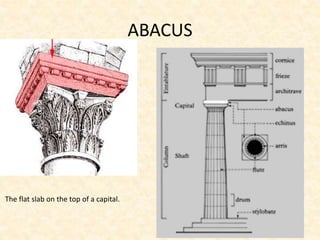
The flat slab on the top of a capital.
ACROPOLIS
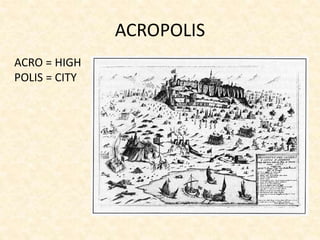
ACRO = HIGH
POLIS = CITY
ACROPOLIS
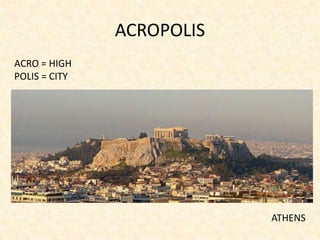
ACRO = HIGH
POLIS = CITY
ATHENS
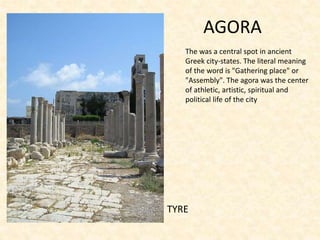
AGORA
TYRE
The was a central spot in ancient
Greek city-states. The literal meaning
of the word is "Gathering place" or
"Assembly". The agora was the center
of athletic, artistic, spiritual and
political life of the city
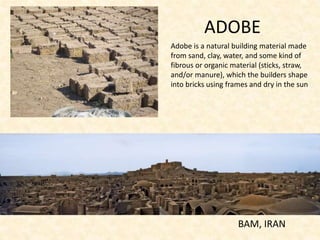
ADOBE
BAM, IRAN
Adobe is a natural building material made
from sand, clay, water, and some kind of
fibrous or organic material (sticks, straw,
and/or manure), which the builders shape
into bricks using frames and dry in the sun
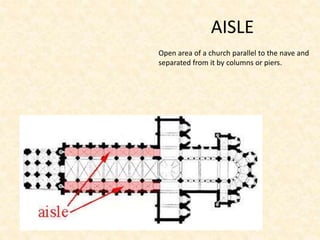
AISLE
Open area of a church parallel to the nave and
separated from it by columns or piers.
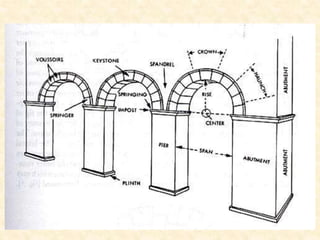
ARCH
A basic architectural structure composed of
bricks or stones so arranged as by mutual
pressure to support one another.
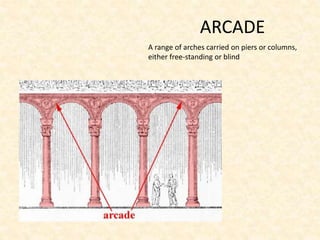
ARCADE
A range of arches carried on piers or columns,
either free-standing or blind
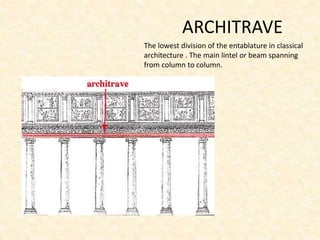
ARCHITRAVE
The lowest division of the entablature in classical
architecture . The main lintel or beam spanning
from column to column.
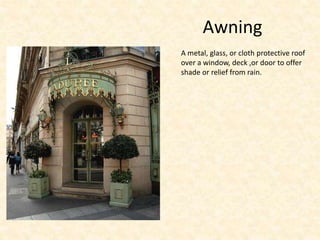
Awning
A metal, glass, or cloth protective roof
over a window, deck ,or door to offer
shade or relief from rain.
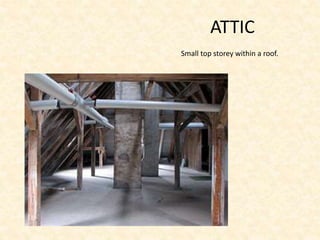
ATTIC
Small top storey within a roof.
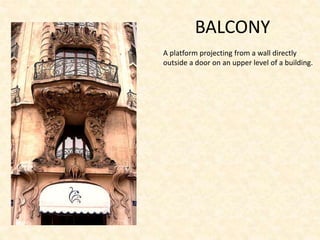
BALCONY
A platform projecting from a wall directly
outside a door on an upper level of a building.
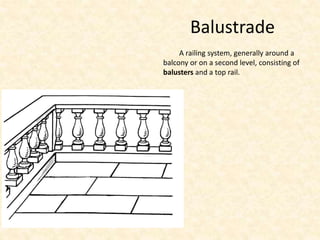
Balustrade
A railing system, generally around a
balcony or on a second level, consisting of
balusters and a top rail.
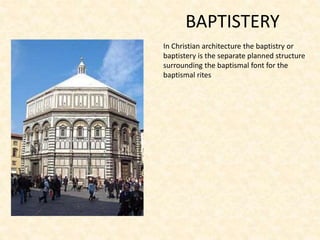
BAPTISTERY
In Christian architecture the baptistry or
baptistery is the separate planned structure
surrounding the baptismal font for the
baptismal rites
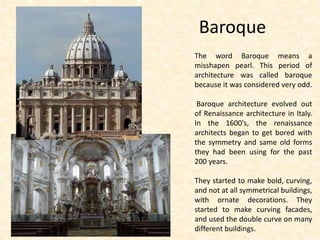
Baroque
The word Baroque means a
misshapen pearl. This period of
architecture was called baroque
because it was considered very odd.
Baroque architecture evolved out
of Renaissance architecture in Italy.
In the 1600's, the renaissance
architects began to get bored with
the symmetry and same old forms
they had been using for the past
200 years.
They started to make bold, curving,
and not at all symmetrical buildings,
with ornate decorations. They
started to make curving facades,
and used the double curve on many
different buildings.
BASEMENT
 A basement is one or more floors of a
building that are either completely or
partially below the ground floor.
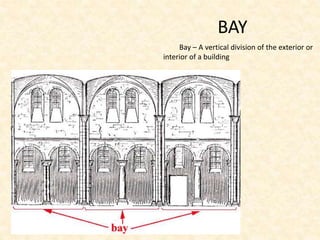
BAY
Bay – A vertical division of the exterior or
interior of a building
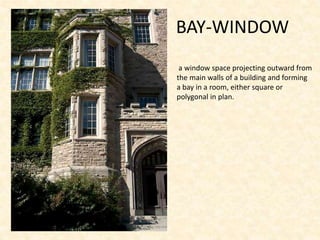
BAY-WINDOW
a window space projecting outward from
the main walls of a building and forming
a bay in a room, either square or
polygonal in plan.
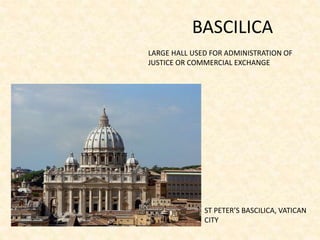
BASCILICA
LARGE HALL USED FOR ADMINISTRATION OF
JUSTICE OR COMMERCIAL EXCHANGE
ST PETER’S BASCILICA, VATICAN
CITY
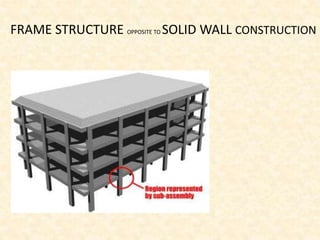
FRAME STRUCTURE OPPOSITE TO SOLID WALL CONSTRUCTION
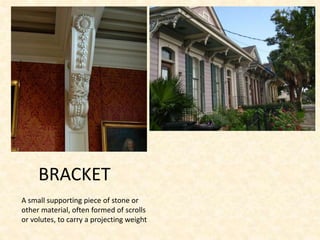
BRACKET
A small supporting piece of stone or
other material, often formed of scrolls
or volutes, to carry a projecting weight
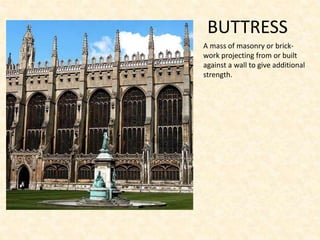
BUTTRESS
A mass of masonry or brick-
work projecting from or built
against a wall to give additional
strength.
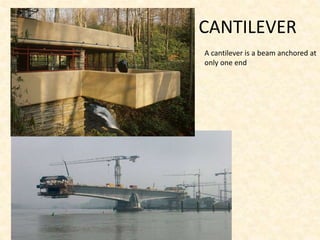
CANTILEVER
A cantilever is a beam anchored at
only one end
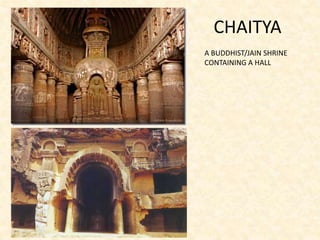
CHAITYA
A BUDDHIST/JAIN SHRINE
CONTAINING A HALL
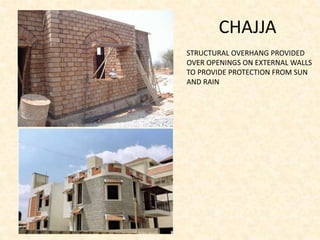
CHAJJA
STRUCTURAL OVERHANG PROVIDED
OVER OPENINGS ON EXTERNAL WALLS
TO PROVIDE PROTECTION FROM SUN
AND RAIN
CHATTRI
AN UMBRELLA SHAPED CUPOLA
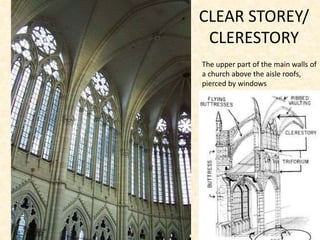
CLEAR STOREY/
CLERESTORY
The upper part of the main walls of
a church above the aisle roofs,
pierced by windows
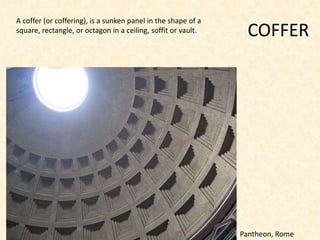
COFFER
A coffer (or coffering), is a sunken panel in the shape of a
square, rectangle, or octagon in a ceiling, soffit or vault.
Pantheon, Rome
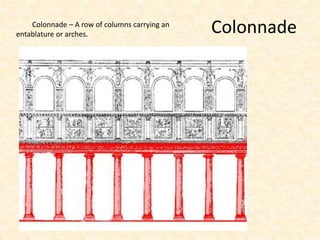
ColonnadeColonnade – A row of columns carrying an
entablature or arches.
COLLAGEDesign composition of photoghaphs and papers of different
textures, forms and materials on a hard surface
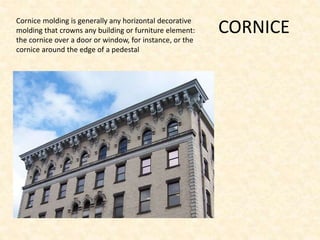
CORNICECornice molding is generally any horizontal decorative
molding that crowns any building or furniture element:
the cornice over a door or window, for instance, or the
cornice around the edge of a pedestal
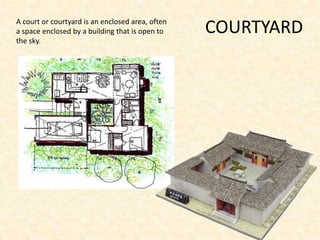
COURTYARDA court or courtyard is an enclosed area, often
a space enclosed by a building that is open to
the sky.

ARCHITECTURAL TERMS 1