Gothic Architecture Prepared by Arch. Maria Mynn Porciuncula-Alfonso


Gothic architecture   is a style of  architecture  which flourished in Europe during the high and late  medieval period . It was preceded by  Romanesque architecture  and was succeeded by  Renaissance architecture .
Originating in 12th century France and lasting into the 16th century, Gothic architecture was known during the period as  "the French Style"  ( Opus Francigenum ),  with the term  Gothic   first appearing during the latter part of the  Renaissance  as a stylistic insult . Its characteristic features include the  pointed arch , the  ribbed vault  and the  flying buttress .
 
Abbot Suger Abbot  Suger , friend and confidante of the French Kings,  Louis VI  and  Louis VII , decided in about 1127, to  rebuild the great   Church of Saint-Denis ,  attached to an abbey which was also a royal residence. Suger began with the  West front ,  reconstructing the original Carolingian facade with its single door. He designed the façade of Saint-Denis to be an echo of the Roman  Arch of Constantine  with its three-part division and three large portals to ease the problem of congestion. The  rose window  is the earliest-known example above the West portal in France.
Abbey of St Denis
Abbot Suger Leaving the Carolingian nave in use, Abbot Suger moved on to the  eastern end .  Inspired to create a physical representation of the Heavenly  Jerusalem ,  Suger designed a  choir  (chancel)  that would be suffused with light. To achieve his aim, he drew on the several new features which evolved or been introduced to Romanesque architecture,  the pointed arch, the ribbed  vault , the ambulatory with radiating chapels, the clustered columns supporting ribs springing in different directions and the flying buttresses which enabled the insertion of large  clerestorey  windows.  In combining all these features within a single structure, Abbot Suger literally  invented  Gothic architecture.
Abbot Suger The new structure was finished and dedicated on  June 11 ,  1144 , in the presence of the King. The Abbey of Saint-Denis thus became the  proto-type  for further building in the royal domain of northern France. A hundred years later, the old nave of Saint-Denis was rebuilt in the Gothic style, gaining, in its transepts, two spectacular  rose windows . [13] Through the rule of the  Angevin  dynasty , the style was introduced to England and spread throughout France, the  Low Countries ,  Germany ,  Spain  and northern of  Italy  and  Sicily . [6] [8]
Characteristic Features
Its characteristic features include the  pointed arch , the  ribbed vault  and the  flying buttress .
Arch From Wikipedia, the free encyclopedia   An  arch  is a curved structure capable of  spanning  a space while supporting significant weight (e.g. a doorway in a stone  wall ). The arch appeared in  Mesopotamia ,  Indus Valley civilization ,  Egypt ,  Assyria ,  Etruria , and later refined in  Ancient Rome . The arch became an important technique in  cathedral  building and is still used today in some modern structures such as  bridges .
A masonry  ARCH 1. Keystone 2. Voussoir 3. Extrados 4. Impost 5. Intrados 6. Rise  7. Clear span 8. Abutment
The so-called Roman arch is semicircular, and built from an odd number of arch bricks (called  voussoirs ). You need an odd number of bricks for there to be a  capstone  or  keystone . This the topmost stone in the arch. An Arch's shape is the simplest to build, but not the strongest. There is a tendency for the sides to bulge outwards, which must be counteracted by an added weight of  masonry  to push them inwards. The semicircular arch can be flattened to make an  elliptical  arch. The Romans used this type of semicircular arch freely in many of their secular structures such as aqueducts, palaces and amphitheaters.
The semicircular arch was followed in Europe by the pointed  Gothic arch  or  ogive , whose centreline more closely followed the forces of compression and which was therefore stronger. This design had been used by the Assyrians as early as 722 BC. The  parabolic  and  catenary  arches are now known to be the theoretically strongest forms. A parabolic arch was introduced in the  Ponte Santa  Trinità , Florence, constructed by the architect  Bartolomeo   Ammanati  from 1567 to 1569. Parabolic arches were introduced in construction by the  Spanish architect   Antoni   Gaudí , who admired the structural system of  Gothic style , but for the buttresses, that were designated by him “architectural  crutches ”. The catenary and parabolic arches carry all horizontal thrust to the foundation and so do not need additional elements.
The horseshoe arch is based on the semicircular arch, but its lower ends are extended further round the circle until they start to converge. The first examples known are carved into rock in India in the first century AD, while the first known built horseshoe arches are known from  Aksum  (modern day  Ethiopia  and  Eritrea ) from around the 3rd–4th century, around the same time as the earliest contemporary examples in  Syria , suggesting either an Aksumite or Syrian origin for the type of arch. [1]  It was used in Spanish Visigothic architecture,  Islamic architecture  and  mudéjar  architecture , as in the Great  Mosque  of  Damascus  and in later  Moorish  buildings. It was used for decoration rather than for strength.
Construction An arch requires all of its elements to hold it together, raising the question of how an arch is constructed. One answer is to build a frame (historically, of wood) which exactly follows the form of the underside of the arch. This is known as a centre or  centring . The  voussoirs  are laid on it until the arch is complete and self-supporting. For an arch higher than head height, scaffolding would in any case be required by the builders, so the scaffolding can be combined with the arch support. Occasionally arches would fall down when the frame was removed if construction or planning had been incorrect. (The  A85  bridge at Dalmally, Scotland suffered this fate on its first attempt, in the 1940s). The interior and lower line or curve of an arch is known as the  intrados . Old arches sometimes need reinforcement due to decay of the keystones, known as  bald arch .
Pointed Arch
The following gallery shows examples of arch forms displayed in roughly the order in which they were developed. Unequal Round Arch or Rampant round Arch Segmented Arch Round Arch or Semi-circular Arch Triangular  Arch                                                          
The following gallery shows examples of arch forms displayed in roughly the order in which they were developed. Three Foilded Cusped Arch Shouldred Flat Arch  Lancet Arch Equilateral Pointed Arch                          Shouldered flat arch  `           
Parabolic or Catenary Arch Horeshoe Arch Three-centered Arch Ogee Arch Reverse Ogee Arch Elliptical Arch Tudor Arch  Inflexed Arch
Pointed Arch
Ribbed Vault
 
 
Pointed Arch
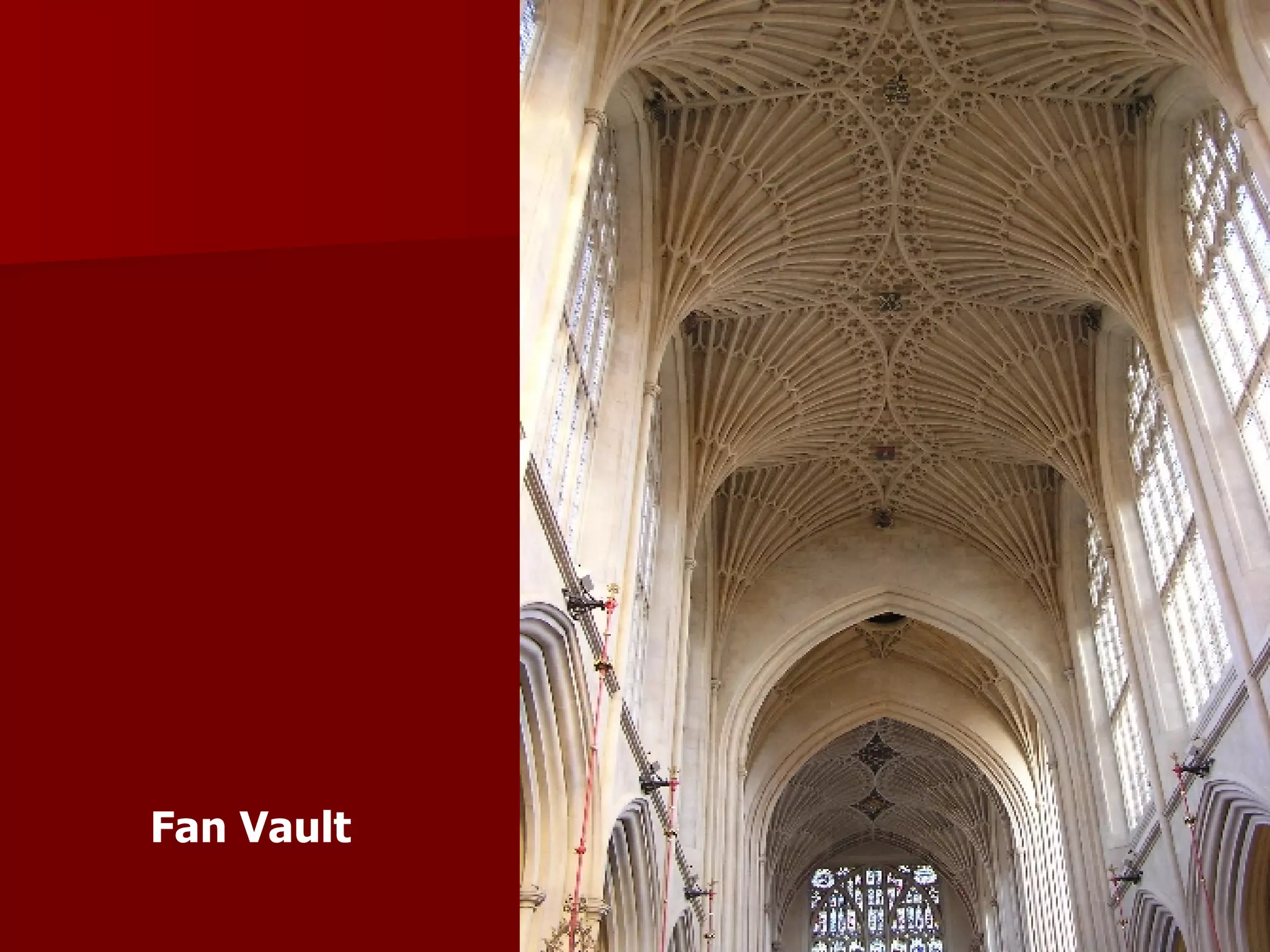
The initiation and propagation of this design element is strongly associated with  England . A  fan vault  is a form of  vault  used in the  Perpendicular Gothic  style, in which the ribs are all of the same curve and spaced equidistantly, in a manner resembling a  fan . The earliest example, dating from about the year  1351 , [1]  may be seen in the south walk of the cloisters of  Gloucester Cathedral , [2]  built by  Thomas of Cambridge . In the fourteenth century the structure was known as the  Abbey Church  at  Gloucester . A fine later example, from  1640 , is the vault over the staircase at  Christ Church  in  Oxford . The largest fan vault in the world, however, can be found in the chapel of  King's College, Cambridge .


Sexpartite vault From Wikipedia, the free encyclopedia   Sexpartite vault , in  architecture , is a name given to the single  bay  of a  vault , which, in addition to the transverse and diagonal ribs, has been divided by a second transverse rib, forming six compartments. The principal examples are those in the  Abbaye-aux-Hommes  and  Abbaye -aux-Dames  at  Caen  (which were probably the earliest examples of a construction now looked upon as transitional),  Notre Dame de Paris , and the cathedrals of  Bourges ,  Laon ,  Noyon ,  Senlis  and  Sens ; from the latter cathedral the sexpartite vault was brought by  William of  Sens  to Canterbury, and it is afterwards found at Lincoln and in St Faith's Chapel,  Westminster Abbey . [ edit ] See also
 
A  groin vault  or  groined vault  (also sometimes known as a  double barrel vault  or  cross vault ) is a  vault  produced by the intersection at  right angles  of two  barrel vaults . Sometimes the  arches  of groin vaults are pointed instead of round (See image of the Gårdslösa Church below). In comparison with a  barrel vault , a groin vault provides good economies of material and labour. The  thrust  is concentrated along the groins or  arrises  (the four diagonal edges formed along the points where the barrel vaults intersect), so the vault need only be  abutted  at its four corners.
Groin vault  construction was first exploited by the  Romans , but then fell into relative obscurity in Europe until the resurgence of quality stone building brought about by  Carolingian  and  Romanesque architecture . It reached its ultimate expression in the  gothic architecture  of the middle ages. Difficult to construct neatly because of the geometry of the cross groins (usually elliptical in cross section), the groin vault required great skill in cutting stone to form a neat arris. This difficulty, in addition to the formwork required to construct such constructions, led to the  rib vault  superseding the groin vault as the preferred solution for enclosing space in gothic architecture. [1] The construction method was particularly common on the  basement  level, such as at  Myres  Castle  in  Scotland , or at the ground floor level for the storerooms as at  Muchalls  Castle  in Scotland. [2]
Fan Vault
Fan Vault The initiation and propagation of this design element is strongly associated with  England . A fan vault is a form of  vault  used in the  Perpendicular Gothic  style, in which the ribs are all of the same curve and spaced equidistantly, in a manner resembling a  fan . The earliest example, dating from about the year  1351 , [1]  may be seen in the south walk of the cloisters of  Gloucester Cathedral , [2]  built by  Thomas of Cambridge . In the fourteenth century the structure was known as the  Abbey Church  at  Gloucester . A fine later example, from  1640 , is the vault over the staircase at  Christ Church  in  Oxford . The largest fan vault in the world, however, can be found in the chapel of  King's College, Cambridge .
Comparison with other vault designs       A groin vault viewed from the underside, showing the  arris  or 'groin'.       Plan of the vault from above showing resultant outward thrust.       Vault from above. The construction of a groin vault can be understood most simply by visualising two barrel vault sections at right angles merging to form a squarish unit. The resulting four ribs convey the stress loading to the four corners, or piers. [4]  The more complex groin vault is intrinsically a stronger design compared to the  barrel vault , since the barrel vault structure must rest on long walls creating less stable lateral stress, whereas the groin vault design can direct stresses almost purely vertically on the piers. [5]  A common association of vaulting in cathedrals of the Middle Ages involves a  nave  of barrel vault design with  transepts  of groined vaulting. [6]  The  fan vault  is similar to the groin vault in theory, but has a much more elaborate splaying of multiple ribs emanating from each springer, either decoratively or structurally.
Flying Buttress
F lying Buttress
Flying buttresses at  Bath Abbey ,  Bath ,  England . Of the six seen here the left hand five are supporting the  nave , and the right hand one is supporting the  transept . Notice their cast shadows on the windows
Flying buttress From Wikipedia, the free encyclopedia   In  architecture , a  flying buttress , or  arc-boutant , is usually on a religious building, used to transmit the thrust of a  vault  across an intervening space (which might be an  aisle ,  chapel  or  cloister ), to a  buttress  outside the building. The employment of the flying buttress means that the  load bearing walls  can contain cut-outs, such as for large windows, that would otherwise seriously weaken the vault walls. Close-up of two flying buttresses at Bath Abbey, Bath, England. These are the right hand two buttresses of the picture above
Flying buttress The purpose of a buttress was to reduce the load on the vault wall. The majority of the load is carried by the upper part of the buttress, so making the buttress as a semi-arch provides almost the same load bearing capability, yet in a much lighter as well as a much cheaper structure. As a result, the buttress flies through the air, rather than resting on the ground and hence is known as a flying buttress.
Flying buttress Construction       Villard de Honnecourt's drawing of a flying buttress at  Reims , ca. AD 1320–1335 ( Bibliothèque   nationale ) "To build the flying buttress, it was first necessary to construct temporary wooden frames which are called centering. The centering would support the weight of the stones and help maintain the shape of the arch until the mortar was dry. The centering were first built on the ground by the carpenters. Once that was done, they would be hoisted into place and fastened to the piers at the end of one buttress and at the other. These acted as temporary flying buttresses until the actual stone butt was complete."  [1]
Flying buttress From Wikipedia, the free encyclopedia Notre Dame de Paris: Flying Buttress   Flying buttresses at  Bath Abbey ,  Bath ,  England . Of the six seen here the left hand five are supporting the  nave , and the right hand one is supporting the  transept . Notice their cast shadows on the windows In  architecture , a  flying buttress , or  arc-boutant , is usually on a religious building, used to transmit the thrust of a  vault  across an intervening space (which might be an  aisle ,  chapel  or  cloister ), to a  buttress  outside the building. The employment of the flying buttress means that the  load bearing walls  can contain cut-outs, such as for large windows, that would otherwise seriously weaken the vault walls. The purpose of a buttress was to reduce the load on the vault wall. The majority of the load is carried by the upper part of the buttress, so making the buttress as a semi-arch provides almost the same load bearing capability, yet in a much lighter as well as a much cheaper structure. As a result, the buttress flies through the air, rather than resting on the ground and hence is known as a  flying buttress .
Gothic architecture is most familiar as the architecture of many of the great  cathedrals ,  abbeys  and parish  churches  of Europe. It is also the architecture of many  castles ,  palaces ,  town halls ,  guild halls ,  universities , and to a less prominent extent,  private dwellings .
The western facade of  Reims  Cathedral , France.
Interior of   San  Zanipolo ,  Venice .
Contents 1 The term "Gothic"   2 Influences   2.1 Regional   2.2 Materials   2.3 Religious   2.4 Architectural
Contents 2.4 Architectural   2.4.1 Romanesque tradition   2.4.2 Islamic influence   2.4.3 Abbot  Suger
The term Gothic", when applied to architecture, has nothing to do with the historical  Goths . It was a  pejorative  term that came to be used as early as the 1530s by  Giorgio  Vasari  to describe culture that was considered rude and barbaric. [1]  At the time in which Vasari was writing, Italy had experienced a century of building in the Classical architectural vocabulary revived in the  Renaissance  and seen as the finite evidence of a new  Golden Age  of learning and refinement.
The  Renaissance  had then overtaken Europe, overturning a system of culture that, prior to the advent of printing, was almost entirely focused on the Church and was perceived, in retrospect, as a period of ignorance and superstition. Hence,  François Rabelais , also of the 16th century, imagines an inscription over the door of his  Utopian   Abbey of  Thélème , "Here enter no hypocrites, bigots..." slipping in a slighting reference to "Gotz" and "Ostrogotz." [2]
In English 17th century usage, "Goth" was an equivalent of " vandal ", a savage despoiler with a Germanic heritage and so came to be applied to the architectural styles of northern Europe from before the revival of classical types of architecture.
  Milan Cathedral, the east end. According to a 19th century correspondent in the London Journal  Notes and Queries : There can be no doubt that the term 'Gothic' as applied to pointed styles of ecclesiastical architecture was used at first contemptuously, and in derision, by those who were ambitious to imitate and revive the Grecian orders of architecture, after the revival of classical literature. Authorities such as  Christopher Wren  lent their aid in deprecating the old mediæval style, which they termed Gothic, as synonymous with every thing that was barbarous and rude. [3] [4]
  Milan Cathedral, the east end. On  21 July   1710 , the Académie d'Architecture met in Paris, and among the subjects they discussed, the assembled company noted the new fashions of bowed and cusped arches on chimneypieces being employed  "to finish the top of their openings. The Company disapproved of several of these new manners, which are defective and which belong for the most part to the Gothic." [5]
 
Regional At the end of the 12th century Europe was divided into a multitude of city-states and kingdoms. The area encompassing modern  Germany ,  The Netherlands ,  Belgium ,  Luxembourg ,  Switzerland ,  Austria , eastern  France  and much of northern  Italy , excluding  Venice , was nominally under the authority of the  Holy Roman Empire , but local rulers exercised considerable autonomy.  France ,  Spain  and  Sicily  were independent kingdoms, as was  England , whose  Plantagenet kings  ruled large domains in France. [6]   Norway  came under the influence of England, while the other  Scandinavian  countries and  Poland  were influenced by Germany.
Regional Throughout Europe at this time there was a rapid growth in trade and an associated growth in towns, [7] [8]  especially in Germany and the Lowlands and in northern Italy. had large flourishing towns that grew in comparative peace, in trade and competition with each other, or united for mutual weal, as in the  Hanseatic  League . Civic building was of great importance to these towns as a sign of wealth and pride. England and France remained largely  feudal  and produced grand domestic architecture for their dukes, rather than grand town halls for their burghers.
 
Materials A further regional influence was the availability of materials. In France,  limestone  was readily available in several grades, the very fine white limestone of  Caen  being favoured for sculptural decoration. England had coarse limestone, red  sandstone  as well as dark green  Purbeck  marble  which was often used for architectural features. . [7] [9]
Materials In Northern Germany, Netherlands, Scandinavia, Baltic countries and northern Poland local building stone was unavailable but there was a strong tradition of building in brick. The resultant style,  Brick Gothic , is called "Backsteingotik" in Germany and Scandinavia.
Materials In Italy, stone was used for fortifications, but brick was preferred for other buildings. Because of the extensive and varied deposits of marble, many buildings were faced in marble, or were left with undecorated facades so that this might be achieved at a later date.
Materials The availability of timber also influenced the style of architecture. It is thought that the magnificent  hammer-beam  roofs of England were devised as a direct response to the lack of long straight seasoned timber by the end of the Medieval period, when forests had been decimated not only for the construction of vast roofs but also for ship building. [7] [9]
The  Romanesque   Abbey Church at  Cluny  (the remaining transept shown) provided a model for many monastic precincts and had a lasting influence on Gothic architecture
Religious The early Medieval period had seen a rapid growth in monasticism, with several different orders being prevalent and spreading their influence widely. Foremost were the  Benedictines  whose great abbey churches vastly outnumbered any others in England. Part of their influence was that they tended to build within towns, unlike the  Cistercians  whose ruined abbeys are seen in the remote countryside. The  Cluniac  and Cistercian Orders were prevalent in France, the great monastery at  Cluny  having established a formula for a well planned monastic site which was then to influence all subsequent monastic building for many centuries.
Religious In the 13th century  St. Francis of Assisi  established the  Franciscans , or so-called "Grey Friars", a mendicant order. Its off-shoot, the  Dominicans , founded by  St. Dominic  in  Toulouse  and  Bologna , were particularly influential in the building of Italy's Gothic churches. [7] [8]
Architectural Gothic architecture grew out of the previous architectural genre,  Romanesque . For the most part, there was not a clean break, as there was later to be in  Renaissance   Florence  with the sudden revival of the  Classical style  by  Brunelleschi  in the early 15th century.
Romanesque tradition Romanesque architecture, or Norman architecture as it is generally termed in England because of its association with the  Norman invasion , had already established the basic architectural forms and units that were to remain in slow evolution throughout the Medieval period. The basic structure of the  cathedral  church, the parish  church , the  monastery , the  castle , the  palace , the  great hall  and the  gatehouse  were all established. Ribbed  vaults , buttresses, clustered columns, ambulatories,  wheel windows , spires and richly carved door tympanums were already  features of ecclesiastical architecture. [10]
Romanesque tradition The widespread introduction of a single feature was to bring about the stylistic change that separates Gothic from Romanesque, and broke the tradition of massive masonry and solid walls penetrated by small openings, replacing it with a style where light appears to triumph over substance. The feature that brought the change is the pointed arch. With its use came the development of many other architectural devices, previously put to the test in scattered buildings and then called into service to meet the structural, aesthetic and ideological needs of the new style. These include the flying buttresses, pinnacles and traceried windows which typify Gothic ecclesiastical architecture. [7]
The influence of Islamic architecture on the Gothic can be most clearly seen in Spain, as here at  Salamanca Cathedral .
Islamic influence   The influence of Islamic architecture on the Gothic can be most clearly seen in Spain, as here at  Salamanca Cathedral . The pointed arch had its origins in ancient  Assyrian architecture  where it occurs in a number of structures as early as 720 BC. It passed into Sassanian-Persian architecture and from the conquest of  Persia  in 641 AD, became a standard feature of  Islamic architecture . [7]
Islamic influence   The  Norman  conquest of  Islamic Sicily  in 1090, the  Crusades  which began in 1096 and the  Islamic presence in Spain  all brought about a knowledge of this significant structural device. It is probable also that decorative carved stone screens and window openings filled with pierced stone also influenced Gothic tracery. In Spain in particular individual decorative motifs occur which are common to both Islamic and Christian architectural mouldings and sculpture. [11] [12]
Islamic influence Concurrent with its introduction and early use as a stylistic feature in French churches, it is believed that the pointed arch evolved naturally in Western Europe as a structural solution to a purely technical problem. (See below:  Pointed arch, Origins )
3 Characteristics of Gothic churches  and cathedrals   3.1 Plan   3.2 Height   3.3 Vertical emphasis   3.4 Light   3.5 Majesty   3.6 Structure: the pointed arch   3.6.1 Origins   3.6.2 Functions
Characteristics of Gothic churches and cathedrals The structure of a typical cathedral In Gothic architecture, new technology stands behind the new building style. That new technology was the  ogival  or pointed  arch . Other characteristics developed as the consequence of the use of the pointed arch. The Gothic style, when applied to an ecclesiastical building, emphasizes verticality and features almost skeletal stone structures with great expanses of glass, ribbed  vaults , clustered  columns , sharply pointed  spires ,  flying buttresses  and inventive  sculptural  detail such as  gargoyles . A Gothic  cathedral  or  abbey  was, prior to the 20th century, generally the landmark building in its town, rising high above all the domestic structures and often surmounted by one or more  towers  and perhaps  spires . [7] [13]
The structure of a typical cathedral
Plan of  Amiens Cathedral .
Plan of  Wells Cathedral .
Plan     Plan of  Wells Cathedral . Most Gothic churches, unless they are entitled  chapels , are of the  Latin cross  plan, with a long nave making the body of the church, a transverse arm called the  transept  and beyond it, an extension which may be called the  choir , chancel or presbytery. There are several regional variations on this plan.
  Plan of  Wells Cathedral . The nave is generally flanked on either side by aisles, usually singly, but sometimes double. The nave is generally considerably taller than the aisles, having  clerestorey  windows which light the central space. Gothic churches of the Germanic tradition, like  St. Stephen of Vienna , often have nave and aisles of similar height and are called  hallenkirke . In the South of France there is often a single wide nave and no aisles, as at Sainte-Marie in  Saint-Bertrand-de- Comminges .
Plan of  Wells Cathedral . In some churches with double aisles, like  Notre Dame, Paris , the transept does not project beyond the aisles. In English cathedrals transepts tend to project boldly and there may be two of them, as at  Salisbury Cathedral , though this is not the case with lesser churches.
Plan of  Wells Cathedral . The eastern arm shows considerable diversity. In England it is generally long and may have two distinct sections, both choir and presbytery. It is often square ended or has a projecting  Lady Chapel , dedicated to the  Virgin Mary . In France the eastern end is often polygonal and surrounded by a walkway called an ambulatory and sometimes a ring of chapels called a  chevette . While German churches are often similar to those of France, in Italy, the eastern projection beyond the transept is usually just a shallow apsidal chapel containing the  sanctuary , as at  Florence Cathedral . [7] [10] [13]
Salisbury Cathedral has the tallest spire in England.
Height A characteristic of Gothic church architecture is its height, both real and proportional. A section of the main body of a Gothic church usually shows the nave as considerably taller than it is wide. In England the proportion is sometimes greater than 2:1, while the extreme is reached at  Cologne Cathedral  with a ratio of 3.6:1. The extreme of actual internal height was achieved at  Beauvais  Cathedral  at 157' 6". [7]
Height Externally, towers and spires are characteristic of Gothic churches both great and small, the number and positioning being one of the greatest variables in Gothic architecture. In Italy, the tower, if present, is almost always detached from the building, as at  Florence Cathedral , and is often from an earlier structure. In France and Spain, two towers on the front is the norm. In England, Germany and Scandinavia this is often the arrangement, but an English cathedral may also be surmounted by an enormous tower at the crossing.
Height Smaller churches usually have just one tower, but this may also be the case at a very large cathedral like  Salisbury  or  Ulm  Cathedral , which has the tallest spire in the world, [14]  slightly exceeding that of  Lincoln Cathedral , the tallest which was actually completed during the medieval  period, at 527 feet (160 metres).
The Gothic east end of  Cologne Cathedral  represents the extreme of verticality. (nave- 19th century)
3 Characteristics of Gothic churches  and cathedrals   3.1 Plan   3.2 Height   3.3 Vertical emphasis   3.4 Light   3.5 Majesty   3.6 Structure: the pointed arch   3.6.1 Origins   3.6.2 Functions
Sainte-Chapelle surrounded by the Palais de Justice.
Vertical emphasis The pointed arch lends itself to a suggestion of height. This appearance is characteristically further enhanced by both the architectural features and the decoration of the building. [13]
Vertical emphasis On the exterior, the verticality is emphasised in a major way by the towers and spires and in a lesser way by strongly projecting vertical buttresses, by narrow half-columns called  attached shafts  which often pass through several storeys of the building, by long narrow windows, vertical mouldings around doors and figurative sculpture which emphasises the vertical and is often attenuated. The roofline, gable ends, buttresses and other parts of the building are often terminated by small  pinnacles ,  Milan Cathedral  being an extreme example in the use of this form of decoration.
Vertical emphasis On the interior of the building  attached shafts  often sweep unbroken from floor to ceiling and meet the ribs of the vault, like a tall tree spreading into branches. The verticals are generally repeated in the treatment of the windows and wall surfaces. In many Gothic churches, particularly in France, and in the  Perpendicular period  of  English Gothic architecture , the treatment of vertical elements in gallery and window tracery creates a strongly unifying feature that counteracts the horizontal divisions of the interior structure. [13]
Sainte-Chapelle - Interior.
Light One of the most distinctive characteristics of Gothic architecture is the expansive area of the windows as at  Sainte  Chapelle  and the very large size of many individual windows, as at  Gloucester Cathedral  and  Milan Cathedral . The increase in size between windows of the Romanesque and Gothic periods is related to the use of the ribbed vault, and in particular, the pointed ribbed vault which channeled the weight to a supporting shaft with less outward thrust than a semicircular vault. Walls did not need to be so weighty. [10] [13]
Light A further development was the flying buttress which arched externally from the springing of the vault across the roof of the aisle to a large buttress projecting well beyond the line of the external wall .
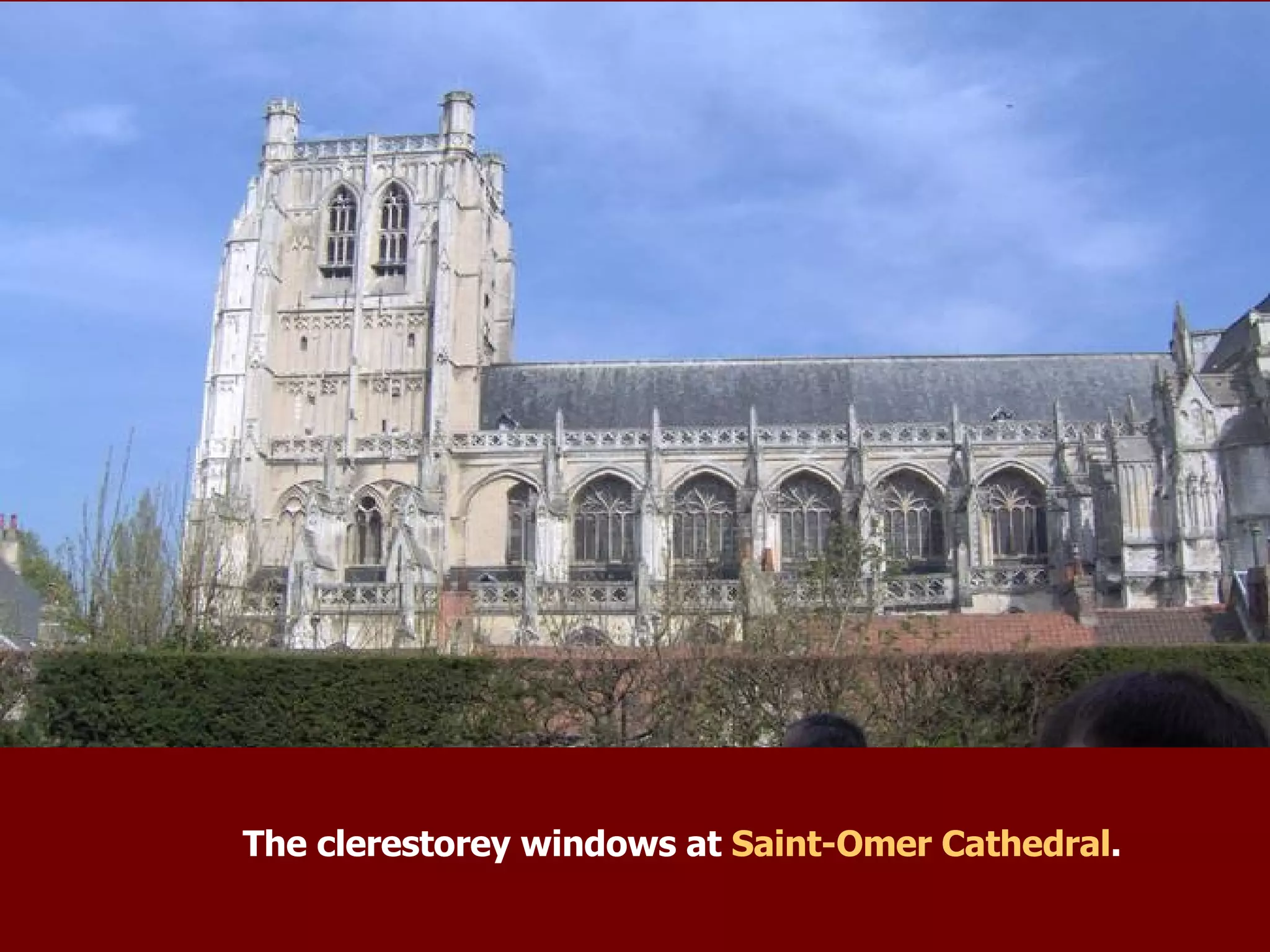
Light The clerestorey windows at  Saint-Omer Cathedral . The internal columns of the arcade with their attached shafts, the ribs of the vault and the flying buttresses, with their associated vertical buttresses jutting at right-angles to the building, created a stone skeleton. Between these parts, the walls and the infill of the vaults could be of lighter construction. Between the narrow buttresses, the walls could be opened up into large windows. [7] Through the Gothic period, due to the versatility of the pointed arch, the structure of Gothic windows developed from simple openings to immensely rich and decorative sculptural designs. The windows were very often filled with  stained glass  which added a dimension of colour to the light within the building, as well as providing a medium for figurative and narrative art. [13]
The clerestorey windows at  Saint-Omer Cathedral .
Majesty The facade of a large church or cathedral, often referred to as the  West Front , is generally designed to create a powerful impression on the approaching worshipper, demonstrating both the might of God, and the might of the institution that it represents. One of the best known and most typical of such facades is that of  Notre Dame de Paris .
Majesty Central to the facade is the main portal, often flanked by additional doors. In the arch of the door is often a significant piece of sculpture, most frequently  Christ in Majesty . If there is a central door jamb, then it frequently bears a statue of the  Madonna and Child . There may be much other carving, often of figures in niches set into the mouldings around the portals, or in sculptural screens extending across the facade.
Majesty In the centre of the middle level of the facade, there is a large window, which in countries other than England and  Belgium , is generally a  rose window  like that at  Reims  Cathedral  The gable above this is usually richly decorated with arcading or sculpture, or in the case of Italy, may be decorated, with the rest of the facade, with polychrome marble and mosaic, as at  Orvieto  Cathedral The West Front of a French cathedral and many English, Spanish and German cathedrals generally has two towers, which, particularly in France, express an enormous diversity of form and decoration. [7] [8]
Notre Dame de Paris .
Structure: the pointed arch Origins     Norman blind-arcading at  Canterbury Cathedral . The  defining  characteristic of Gothic architecture is the pointed or  ogival  arch. Arches of this type were used in  Islamic architecture  before they were used structurally in European architecture, and are thought to have to been the inspiration for their use in France, as at  Autun  Cathedral , which is otherwise stylistically Romanesque. [7]
Structure: the pointed arch Origins     However, it appears that there was probably simultaneously a structural evolution towards the pointed arch, for the purpose of  vaulting  spaces of irregular plan, or to bring transverse vaults to the same height as diagonal vaults. This latter occurs at  Durham Cathedral  in the nave aisles in 1093. Pointed arches also occur extensively in Romanesque decorative  blind arcading , where semi-circular arches overlap each other in a simple decorative pattern, and the points are accidental to the design .
Norman blind-arcading at  Canterbury Cathedral .
Functions The Gothic  vault , unlike the semi-circular vault of Roman and Romanesque buildings, can be used to roof rectangular and irregularly shaped plans such as trapezoids. The other structural advantage is that the pointed arch channels the weight onto the bearing piers or columns at a steep angle. This enabled architects to raise vaults much higher than was possible in Romanesque architecture. [7]
Functions While, structurally, use of the pointed arch gave a greater flexibility to architectural form, it also gave Gothic architecture a very different visual character to Romanesque, the verticality suggesting an aspiration to Heaven.
Functions In Gothic Architecture the pointed arch is used in every location where a vaulted shape is called for, both structural and decorative. Gothic openings such as doorways, windows, arcades and galleries have pointed arches. Gothic  vaulting  above spaces both large and small is usually supported by richly molded ribs.
Functions Rows of pointed arches upon delicate shafts form a typical wall decoration known as blind arcading. Niches with pointed arches and containing statuary are a major external feature. The pointed arch leant itself to elaborate intersecting shapes which developed within window spaces into complex Gothic tracery forming the structural support of the large windows that are characteristic of the style. [10] [9]
The south transept facade at  York Minster  presents a composition in untraceried pointed arches.
Basic shapes of Gothic arches and stylistic character The way in which the pointed arch was draughted and utilised developed throughout the Gothic period. There were fairly clear stages of development, which did not, however, progress at the same rate, or in the same way in every country. Moreover, the names used to define various periods or styles within the Gothic differs from country to country.
Basic shapes of Gothic arches and stylistic character [ edit ] Lancet arch The simplest shape is the long opening with a pointed arch known in England as the  lancet . Lancet openings are often grouped, usually as a cluster of three or five. Lancet openings may be very narrow and steeply pointed.
Basic shapes of Gothic arches and stylistic character Salisbury Cathedral  is famous for the beauty and simplicity of its Lancet Gothic, known in England as the Early English Style.  York Cathedral  has a group of lancet windows each fifty feet high and still containing ancient glass. They are known as the  Five Sisters . These simple undecorated grouped windows are found at  Chartres  and  Laon  Cathedrals  and are used extensively in  Italy . [7] [9]     Windows in the Chapter House at  York Minster  show the  equilateral arch  with typical circular motifs in the tracery.
Windows in the Chapter House at  York Minster  show the equilateral arch with typical circular motifs in the tracery.
Equilateral arch Many Gothic openings are based upon the  equilateral  form. In other words, when the arch is draughted, the  radius  is exactly the width of the opening and the centre of each arch coincides with the point from which the opposite arch springs. This makes the arch higher in relation to its width than a semi-circular arch which is exactly half as high as it is wide. [7] The Equilateral Arch gives a wide opening of satisfying proportion useful for doorways, decorative arcades and big windows. The structural beauty of the Gothic arch means, however, that no set proportion had to be rigidly maintained. The Equilateral Arch was employed as a useful tool, not as a Principle of Design. This meant that narrower or wider arches were introduced into a building plan wherever necessity dictated. In the architecture of some Italian cities, notably  Venice , semi-circular arches are interspersed with pointed ones. [15] The Equilateral Arch lends itself to filling with tracery of simple equilateral, circular and semi-circular forms. The type of tracery that evolved to fill these spaces is known in England as Geometric Decorated Gothic and can be seen to splendid effect at many English and French Cathedrals, notably Lincoln and Notre Dame in Paris. Windows of complex design and of three or more  lights  or vertical sections, are often designed by overlapping two or more equilateral arches. [9]
Flamboyant  tracery at  Limoges  Cathedral .
Flamboyant arch   Flamboyant tracery at  Limoges  Cathedral . The  Flamboyant  Arch   is one that is draughted from four points, the upper part of each main arc turning upwards into a smaller arc and meeting at a sharp, flame-like point. These arches create a rich and lively effect when used for window tracery and surface decoration. The form is structurally weak and has very rarely been used for large openings except when contained within a larger and more stable arch. It is not employed at all for  vaulting . [7] .
Flamboyant arch   Some of the most beautiful and famous traceried windows of Europe employ this type of tracery. It can be seen at  St Stephen's Vienna ,  Sainte  Chapelle  in Paris, at the Cathedrals of  Limoges  and  Rouen  in France, and at  Milan Cathedral  in Italy. In England the most famous examples are the West Window of  York Minster  with its design based on the  Sacred Heart , the extraordinarily rich seven-light East Window at  Carlisle Cathedral  and the exquisite East window of  Selby Abbey . [10] [9]
Flamboyant arch     Doorways surmounted by Flamboyant mouldings are very common in both ecclesiastical and domestic architecture in France. They are much rarer in England. A notable example is the doorway to the Chapter Room at  Rochester Cathedral . [7] [9] The style was much used in England for wall arcading and niches. Prime examples in are in the Lady Chapel at  Ely , the Screen at  Lincoln  and externally on the facade of  Exeter Cathedral . In German and Spanish Gothic architecture it often appears as openwork screens on the exterior of buildings. The style was used to rich and sometimes extraordinary effect in both these countries, notably on the famous pulpit in  Vienna Cathedral . [8]
The depressed arch supported by  fan  vaulting  at  King's College Chapel , England.
Depressed arch The Depressed or four-centred arch  is much wider than its height and gives the visual effect of having been flattened under pressure. Its structure is achieved by draughting two arcs which rise steeply from each springing point on a small radius and then turn into two arches with a wide radius and much lower springing point. [7]
Depressed arch This type of arch, when employed as a window opening, lends itself to very wide spaces, provided it is adequately supported by many narrow vertical shafts. These are often further braced by horizontal transoms. The overall effect produces a grid-like appearance of regular, delicate, rectangular forms with an emphasis on the perpendicular. It is also employed as a wall decoration in which arcade and window openings form part of the whole decorative surface. The style, known as  Perpendicular ,  that evolved from this treatment is specific to England, although very similar to contemporary Spanish style in particular, and was employed to great effect through the fifteenth century and first half of the sixteenth as Renaissance styles were much slower to arrive in England than in Italy and France. [7]
Depressed arch It can be seen notably at the East End of  Gloucester Cathedral  where the East Window is said to be as large as a tennis court. There are three very famous royal chapels and one chapel-like Abbey which show the style at its most elaborate-  King's College Chapel ,  Cambridge ;  St George's Chapel, Windsor ;  Henry  VII's  Chapel  at  Westminster Abbey  and  Bath Abbey . [9]  However very many simpler buildings, especially churches built during the wool boom in  East Anglia , are fine examples of the style.
The Royal Portal  of  Chartres  Cathedral .
Symbolism and ornamentation                                                                      The Royal Portal  of  Chartres  Cathedral . Main articles:  Cathedral architecture of Western Europe  and  Poor Man's Bible                                               
  
Symbolism and ornamentation        The Royal Portal  of  Chartres  Cathedral . Main articles:  Cathedral architecture of Western Europe  and  Poor Man's  Bible The Gothic cathedral represented the universe in microcosm and each architectural concept, including the loftiness and huge dimensions of the structure, were intended to convey a theological message: the great glory of  God . The building becomes a microcosm in two ways. Firstly, the mathematical and geometrical nature of the construction is an image of the orderly universe, in which an underlying rationality and logic can be perceived. Secondly, the  statues , sculptural decoration,  stained glass  and  murals  incorporate the essence of creation in depictions of the  Labours  of the Months  and the  Zodiac [16]  and sacred history from the Old and New Testaments and Lives of the Saints, as well as reference to the eternal in the  Last Judgment  and  Coronation of the Virgin .                                                  
The decorative schemes usually incorporated  Biblical  stories, emphasizing visual  typological allegories  between  Old Testament  prophecy and the  New Testament . [8] Many churches were very richly decorated, both inside and out. Sculpture and architectural details were often bright with coloured paint of which traces remain at  Chartres  cathedral . Wooden ceilings and panelling were usually brightly coloured. Sometimes the stone columns of the nave were painted, and the panels in decorative wall arcading contained narratives or figures of saints. These have rarely remained intact, but may be seen at the Chapterhouse of  Westminster Abbey . [9] Some important Gothic churches could be severely simple such as the  Basilica  of  Mary Magdalene  in  Saint- Maximin ,  Provence  where the local traditions of the sober, massive, Romanesque architecture were still strong.
The Devil tempting the  Foolish Virgins  at  Strasbourg .
4 Regional differences   4.1 France   4.2 England   4.3 Germany and the Holy Roman Empire   4.4 Spain   4.5 Italy   5 Secular Gothic architecture
 

U S T H O A2 Gothic Architecture P P T

  • 1.
    Gothic Architecture Preparedby Arch. Maria Mynn Porciuncula-Alfonso
  • 2.
  • 3.
  • 4.
  • 5.
  • 6.
  • 7.
  • 8.
  • 9.
    Gothic architecture is a style of architecture which flourished in Europe during the high and late medieval period . It was preceded by Romanesque architecture and was succeeded by Renaissance architecture .
  • 10.
    Originating in 12thcentury France and lasting into the 16th century, Gothic architecture was known during the period as "the French Style" ( Opus Francigenum ), with the term Gothic first appearing during the latter part of the Renaissance as a stylistic insult . Its characteristic features include the pointed arch , the ribbed vault and the flying buttress .
  • 11.
  • 12.
    Abbot Suger Abbot Suger , friend and confidante of the French Kings, Louis VI and Louis VII , decided in about 1127, to rebuild the great Church of Saint-Denis , attached to an abbey which was also a royal residence. Suger began with the West front , reconstructing the original Carolingian facade with its single door. He designed the façade of Saint-Denis to be an echo of the Roman Arch of Constantine with its three-part division and three large portals to ease the problem of congestion. The rose window is the earliest-known example above the West portal in France.
  • 13.
  • 14.
    Abbot Suger Leavingthe Carolingian nave in use, Abbot Suger moved on to the eastern end . Inspired to create a physical representation of the Heavenly Jerusalem , Suger designed a choir (chancel) that would be suffused with light. To achieve his aim, he drew on the several new features which evolved or been introduced to Romanesque architecture, the pointed arch, the ribbed vault , the ambulatory with radiating chapels, the clustered columns supporting ribs springing in different directions and the flying buttresses which enabled the insertion of large clerestorey windows. In combining all these features within a single structure, Abbot Suger literally invented Gothic architecture.
  • 15.
    Abbot Suger Thenew structure was finished and dedicated on June 11 , 1144 , in the presence of the King. The Abbey of Saint-Denis thus became the proto-type for further building in the royal domain of northern France. A hundred years later, the old nave of Saint-Denis was rebuilt in the Gothic style, gaining, in its transepts, two spectacular rose windows . [13] Through the rule of the Angevin dynasty , the style was introduced to England and spread throughout France, the Low Countries , Germany , Spain and northern of Italy and Sicily . [6] [8]
  • 16.
  • 17.
    Its characteristic featuresinclude the pointed arch , the ribbed vault and the flying buttress .
  • 18.
    Arch From Wikipedia,the free encyclopedia An arch is a curved structure capable of spanning a space while supporting significant weight (e.g. a doorway in a stone wall ). The arch appeared in Mesopotamia , Indus Valley civilization , Egypt , Assyria , Etruria , and later refined in Ancient Rome . The arch became an important technique in cathedral building and is still used today in some modern structures such as bridges .
  • 19.
    A masonry ARCH 1. Keystone 2. Voussoir 3. Extrados 4. Impost 5. Intrados 6. Rise 7. Clear span 8. Abutment
  • 20.
    The so-called Romanarch is semicircular, and built from an odd number of arch bricks (called voussoirs ). You need an odd number of bricks for there to be a capstone or keystone . This the topmost stone in the arch. An Arch's shape is the simplest to build, but not the strongest. There is a tendency for the sides to bulge outwards, which must be counteracted by an added weight of masonry to push them inwards. The semicircular arch can be flattened to make an elliptical arch. The Romans used this type of semicircular arch freely in many of their secular structures such as aqueducts, palaces and amphitheaters.
  • 21.
    The semicircular archwas followed in Europe by the pointed Gothic arch or ogive , whose centreline more closely followed the forces of compression and which was therefore stronger. This design had been used by the Assyrians as early as 722 BC. The parabolic and catenary arches are now known to be the theoretically strongest forms. A parabolic arch was introduced in the Ponte Santa Trinità , Florence, constructed by the architect Bartolomeo Ammanati from 1567 to 1569. Parabolic arches were introduced in construction by the Spanish architect Antoni Gaudí , who admired the structural system of Gothic style , but for the buttresses, that were designated by him “architectural crutches ”. The catenary and parabolic arches carry all horizontal thrust to the foundation and so do not need additional elements.
  • 22.
    The horseshoe archis based on the semicircular arch, but its lower ends are extended further round the circle until they start to converge. The first examples known are carved into rock in India in the first century AD, while the first known built horseshoe arches are known from Aksum (modern day Ethiopia and Eritrea ) from around the 3rd–4th century, around the same time as the earliest contemporary examples in Syria , suggesting either an Aksumite or Syrian origin for the type of arch. [1] It was used in Spanish Visigothic architecture, Islamic architecture and mudéjar architecture , as in the Great Mosque of Damascus and in later Moorish buildings. It was used for decoration rather than for strength.
  • 23.
    Construction An archrequires all of its elements to hold it together, raising the question of how an arch is constructed. One answer is to build a frame (historically, of wood) which exactly follows the form of the underside of the arch. This is known as a centre or centring . The voussoirs are laid on it until the arch is complete and self-supporting. For an arch higher than head height, scaffolding would in any case be required by the builders, so the scaffolding can be combined with the arch support. Occasionally arches would fall down when the frame was removed if construction or planning had been incorrect. (The A85 bridge at Dalmally, Scotland suffered this fate on its first attempt, in the 1940s). The interior and lower line or curve of an arch is known as the intrados . Old arches sometimes need reinforcement due to decay of the keystones, known as bald arch .
  • 24.
  • 25.
    The following galleryshows examples of arch forms displayed in roughly the order in which they were developed. Unequal Round Arch or Rampant round Arch Segmented Arch Round Arch or Semi-circular Arch Triangular Arch                                                    
  • 26.
    The following galleryshows examples of arch forms displayed in roughly the order in which they were developed. Three Foilded Cusped Arch Shouldred Flat Arch Lancet Arch Equilateral Pointed Arch                     Shouldered flat arch `           
  • 27.
    Parabolic or CatenaryArch Horeshoe Arch Three-centered Arch Ogee Arch Reverse Ogee Arch Elliptical Arch Tudor Arch Inflexed Arch
  • 28.
  • 29.
  • 30.
  • 31.
  • 32.
  • 33.
    The initiation andpropagation of this design element is strongly associated with England . A fan vault is a form of vault used in the Perpendicular Gothic style, in which the ribs are all of the same curve and spaced equidistantly, in a manner resembling a fan . The earliest example, dating from about the year 1351 , [1] may be seen in the south walk of the cloisters of Gloucester Cathedral , [2] built by Thomas of Cambridge . In the fourteenth century the structure was known as the Abbey Church at Gloucester . A fine later example, from 1640 , is the vault over the staircase at Christ Church in Oxford . The largest fan vault in the world, however, can be found in the chapel of King's College, Cambridge .
  • 34.
  • 35.
  • 36.
  • 37.
  • 38.
  • 39.
    Sexpartite vault FromWikipedia, the free encyclopedia Sexpartite vault , in architecture , is a name given to the single bay of a vault , which, in addition to the transverse and diagonal ribs, has been divided by a second transverse rib, forming six compartments. The principal examples are those in the Abbaye-aux-Hommes and Abbaye -aux-Dames at Caen (which were probably the earliest examples of a construction now looked upon as transitional), Notre Dame de Paris , and the cathedrals of Bourges , Laon , Noyon , Senlis and Sens ; from the latter cathedral the sexpartite vault was brought by William of Sens to Canterbury, and it is afterwards found at Lincoln and in St Faith's Chapel, Westminster Abbey . [ edit ] See also
  • 40.
  • 41.
    A groinvault or groined vault (also sometimes known as a double barrel vault or cross vault ) is a vault produced by the intersection at right angles of two barrel vaults . Sometimes the arches of groin vaults are pointed instead of round (See image of the Gårdslösa Church below). In comparison with a barrel vault , a groin vault provides good economies of material and labour. The thrust is concentrated along the groins or arrises (the four diagonal edges formed along the points where the barrel vaults intersect), so the vault need only be abutted at its four corners.
  • 42.
    Groin vault construction was first exploited by the Romans , but then fell into relative obscurity in Europe until the resurgence of quality stone building brought about by Carolingian and Romanesque architecture . It reached its ultimate expression in the gothic architecture of the middle ages. Difficult to construct neatly because of the geometry of the cross groins (usually elliptical in cross section), the groin vault required great skill in cutting stone to form a neat arris. This difficulty, in addition to the formwork required to construct such constructions, led to the rib vault superseding the groin vault as the preferred solution for enclosing space in gothic architecture. [1] The construction method was particularly common on the basement level, such as at Myres Castle in Scotland , or at the ground floor level for the storerooms as at Muchalls Castle in Scotland. [2]
  • 43.
  • 44.
    Fan Vault Theinitiation and propagation of this design element is strongly associated with England . A fan vault is a form of vault used in the Perpendicular Gothic style, in which the ribs are all of the same curve and spaced equidistantly, in a manner resembling a fan . The earliest example, dating from about the year 1351 , [1] may be seen in the south walk of the cloisters of Gloucester Cathedral , [2] built by Thomas of Cambridge . In the fourteenth century the structure was known as the Abbey Church at Gloucester . A fine later example, from 1640 , is the vault over the staircase at Christ Church in Oxford . The largest fan vault in the world, however, can be found in the chapel of King's College, Cambridge .
  • 45.
    Comparison with othervault designs A groin vault viewed from the underside, showing the arris or 'groin'. Plan of the vault from above showing resultant outward thrust. Vault from above. The construction of a groin vault can be understood most simply by visualising two barrel vault sections at right angles merging to form a squarish unit. The resulting four ribs convey the stress loading to the four corners, or piers. [4] The more complex groin vault is intrinsically a stronger design compared to the barrel vault , since the barrel vault structure must rest on long walls creating less stable lateral stress, whereas the groin vault design can direct stresses almost purely vertically on the piers. [5] A common association of vaulting in cathedrals of the Middle Ages involves a nave of barrel vault design with transepts of groined vaulting. [6] The fan vault is similar to the groin vault in theory, but has a much more elaborate splaying of multiple ribs emanating from each springer, either decoratively or structurally.
  • 46.
    Comparison with othervault designs A groin vault viewed from the underside, showing the arris or 'groin'. Plan of the vault from above showing resultant outward thrust. Vault from above. The construction of a groin vault can be understood most simply by visualising two barrel vault sections at right angles merging to form a squarish unit. The resulting four ribs convey the stress loading to the four corners, or piers. [4] The more complex groin vault is intrinsically a stronger design compared to the barrel vault , since the barrel vault structure must rest on long walls creating less stable lateral stress, whereas the groin vault design can direct stresses almost purely vertically on the piers. [5] A common association of vaulting in cathedrals of the Middle Ages involves a nave of barrel vault design with transepts of groined vaulting. [6] The fan vault is similar to the groin vault in theory, but has a much more elaborate splaying of multiple ribs emanating from each springer, either decoratively or structurally.
  • 47.
  • 48.
  • 49.
    Flying buttresses at Bath Abbey , Bath , England . Of the six seen here the left hand five are supporting the nave , and the right hand one is supporting the transept . Notice their cast shadows on the windows
  • 50.
    Flying buttress FromWikipedia, the free encyclopedia In architecture , a flying buttress , or arc-boutant , is usually on a religious building, used to transmit the thrust of a vault across an intervening space (which might be an aisle , chapel or cloister ), to a buttress outside the building. The employment of the flying buttress means that the load bearing walls can contain cut-outs, such as for large windows, that would otherwise seriously weaken the vault walls. Close-up of two flying buttresses at Bath Abbey, Bath, England. These are the right hand two buttresses of the picture above
  • 51.
    Flying buttress Thepurpose of a buttress was to reduce the load on the vault wall. The majority of the load is carried by the upper part of the buttress, so making the buttress as a semi-arch provides almost the same load bearing capability, yet in a much lighter as well as a much cheaper structure. As a result, the buttress flies through the air, rather than resting on the ground and hence is known as a flying buttress.
  • 52.
    Flying buttress Construction Villard de Honnecourt's drawing of a flying buttress at Reims , ca. AD 1320–1335 ( Bibliothèque nationale ) "To build the flying buttress, it was first necessary to construct temporary wooden frames which are called centering. The centering would support the weight of the stones and help maintain the shape of the arch until the mortar was dry. The centering were first built on the ground by the carpenters. Once that was done, they would be hoisted into place and fastened to the piers at the end of one buttress and at the other. These acted as temporary flying buttresses until the actual stone butt was complete." [1]
  • 53.
    Flying buttress FromWikipedia, the free encyclopedia Notre Dame de Paris: Flying Buttress Flying buttresses at Bath Abbey , Bath , England . Of the six seen here the left hand five are supporting the nave , and the right hand one is supporting the transept . Notice their cast shadows on the windows In architecture , a flying buttress , or arc-boutant , is usually on a religious building, used to transmit the thrust of a vault across an intervening space (which might be an aisle , chapel or cloister ), to a buttress outside the building. The employment of the flying buttress means that the load bearing walls can contain cut-outs, such as for large windows, that would otherwise seriously weaken the vault walls. The purpose of a buttress was to reduce the load on the vault wall. The majority of the load is carried by the upper part of the buttress, so making the buttress as a semi-arch provides almost the same load bearing capability, yet in a much lighter as well as a much cheaper structure. As a result, the buttress flies through the air, rather than resting on the ground and hence is known as a flying buttress .
  • 54.
    Gothic architecture ismost familiar as the architecture of many of the great cathedrals , abbeys and parish churches of Europe. It is also the architecture of many castles , palaces , town halls , guild halls , universities , and to a less prominent extent, private dwellings .
  • 55.
    The western facadeof Reims Cathedral , France.
  • 56.
    Interior of San Zanipolo , Venice .
  • 57.
    Contents 1 Theterm "Gothic" 2 Influences 2.1 Regional 2.2 Materials 2.3 Religious 2.4 Architectural
  • 58.
    Contents 2.4 Architectural 2.4.1 Romanesque tradition 2.4.2 Islamic influence 2.4.3 Abbot Suger
  • 59.
    The term Gothic",when applied to architecture, has nothing to do with the historical Goths . It was a pejorative term that came to be used as early as the 1530s by Giorgio Vasari to describe culture that was considered rude and barbaric. [1] At the time in which Vasari was writing, Italy had experienced a century of building in the Classical architectural vocabulary revived in the Renaissance and seen as the finite evidence of a new Golden Age of learning and refinement.
  • 60.
    The Renaissance had then overtaken Europe, overturning a system of culture that, prior to the advent of printing, was almost entirely focused on the Church and was perceived, in retrospect, as a period of ignorance and superstition. Hence, François Rabelais , also of the 16th century, imagines an inscription over the door of his Utopian Abbey of Thélème , "Here enter no hypocrites, bigots..." slipping in a slighting reference to "Gotz" and "Ostrogotz." [2]
  • 61.
    In English 17thcentury usage, "Goth" was an equivalent of " vandal ", a savage despoiler with a Germanic heritage and so came to be applied to the architectural styles of northern Europe from before the revival of classical types of architecture.
  • 62.
    MilanCathedral, the east end. According to a 19th century correspondent in the London Journal Notes and Queries : There can be no doubt that the term 'Gothic' as applied to pointed styles of ecclesiastical architecture was used at first contemptuously, and in derision, by those who were ambitious to imitate and revive the Grecian orders of architecture, after the revival of classical literature. Authorities such as Christopher Wren lent their aid in deprecating the old mediæval style, which they termed Gothic, as synonymous with every thing that was barbarous and rude. [3] [4]
  • 63.
    MilanCathedral, the east end. On 21 July 1710 , the Académie d'Architecture met in Paris, and among the subjects they discussed, the assembled company noted the new fashions of bowed and cusped arches on chimneypieces being employed "to finish the top of their openings. The Company disapproved of several of these new manners, which are defective and which belong for the most part to the Gothic." [5]
  • 64.
  • 65.
    Regional At theend of the 12th century Europe was divided into a multitude of city-states and kingdoms. The area encompassing modern Germany , The Netherlands , Belgium , Luxembourg , Switzerland , Austria , eastern France and much of northern Italy , excluding Venice , was nominally under the authority of the Holy Roman Empire , but local rulers exercised considerable autonomy. France , Spain and Sicily were independent kingdoms, as was England , whose Plantagenet kings ruled large domains in France. [6] Norway came under the influence of England, while the other Scandinavian countries and Poland were influenced by Germany.
  • 66.
    Regional Throughout Europeat this time there was a rapid growth in trade and an associated growth in towns, [7] [8] especially in Germany and the Lowlands and in northern Italy. had large flourishing towns that grew in comparative peace, in trade and competition with each other, or united for mutual weal, as in the Hanseatic League . Civic building was of great importance to these towns as a sign of wealth and pride. England and France remained largely feudal and produced grand domestic architecture for their dukes, rather than grand town halls for their burghers.
  • 67.
  • 68.
    Materials A furtherregional influence was the availability of materials. In France, limestone was readily available in several grades, the very fine white limestone of Caen being favoured for sculptural decoration. England had coarse limestone, red sandstone as well as dark green Purbeck marble which was often used for architectural features. . [7] [9]
  • 69.
    Materials In NorthernGermany, Netherlands, Scandinavia, Baltic countries and northern Poland local building stone was unavailable but there was a strong tradition of building in brick. The resultant style, Brick Gothic , is called "Backsteingotik" in Germany and Scandinavia.
  • 70.
    Materials In Italy,stone was used for fortifications, but brick was preferred for other buildings. Because of the extensive and varied deposits of marble, many buildings were faced in marble, or were left with undecorated facades so that this might be achieved at a later date.
  • 71.
    Materials The availabilityof timber also influenced the style of architecture. It is thought that the magnificent hammer-beam roofs of England were devised as a direct response to the lack of long straight seasoned timber by the end of the Medieval period, when forests had been decimated not only for the construction of vast roofs but also for ship building. [7] [9]
  • 72.
    The Romanesque Abbey Church at Cluny (the remaining transept shown) provided a model for many monastic precincts and had a lasting influence on Gothic architecture
  • 73.
    Religious The earlyMedieval period had seen a rapid growth in monasticism, with several different orders being prevalent and spreading their influence widely. Foremost were the Benedictines whose great abbey churches vastly outnumbered any others in England. Part of their influence was that they tended to build within towns, unlike the Cistercians whose ruined abbeys are seen in the remote countryside. The Cluniac and Cistercian Orders were prevalent in France, the great monastery at Cluny having established a formula for a well planned monastic site which was then to influence all subsequent monastic building for many centuries.
  • 74.
    Religious In the13th century St. Francis of Assisi established the Franciscans , or so-called "Grey Friars", a mendicant order. Its off-shoot, the Dominicans , founded by St. Dominic in Toulouse and Bologna , were particularly influential in the building of Italy's Gothic churches. [7] [8]
  • 75.
    Architectural Gothic architecturegrew out of the previous architectural genre, Romanesque . For the most part, there was not a clean break, as there was later to be in Renaissance Florence with the sudden revival of the Classical style by Brunelleschi in the early 15th century.
  • 76.
    Romanesque tradition Romanesquearchitecture, or Norman architecture as it is generally termed in England because of its association with the Norman invasion , had already established the basic architectural forms and units that were to remain in slow evolution throughout the Medieval period. The basic structure of the cathedral church, the parish church , the monastery , the castle , the palace , the great hall and the gatehouse were all established. Ribbed vaults , buttresses, clustered columns, ambulatories, wheel windows , spires and richly carved door tympanums were already features of ecclesiastical architecture. [10]
  • 77.
    Romanesque tradition Thewidespread introduction of a single feature was to bring about the stylistic change that separates Gothic from Romanesque, and broke the tradition of massive masonry and solid walls penetrated by small openings, replacing it with a style where light appears to triumph over substance. The feature that brought the change is the pointed arch. With its use came the development of many other architectural devices, previously put to the test in scattered buildings and then called into service to meet the structural, aesthetic and ideological needs of the new style. These include the flying buttresses, pinnacles and traceried windows which typify Gothic ecclesiastical architecture. [7]
  • 78.
    The influence ofIslamic architecture on the Gothic can be most clearly seen in Spain, as here at Salamanca Cathedral .
  • 79.
    Islamic influence The influence of Islamic architecture on the Gothic can be most clearly seen in Spain, as here at Salamanca Cathedral . The pointed arch had its origins in ancient Assyrian architecture where it occurs in a number of structures as early as 720 BC. It passed into Sassanian-Persian architecture and from the conquest of Persia in 641 AD, became a standard feature of Islamic architecture . [7]
  • 80.
    Islamic influence The Norman conquest of Islamic Sicily in 1090, the Crusades which began in 1096 and the Islamic presence in Spain all brought about a knowledge of this significant structural device. It is probable also that decorative carved stone screens and window openings filled with pierced stone also influenced Gothic tracery. In Spain in particular individual decorative motifs occur which are common to both Islamic and Christian architectural mouldings and sculpture. [11] [12]
  • 81.
    Islamic influence Concurrentwith its introduction and early use as a stylistic feature in French churches, it is believed that the pointed arch evolved naturally in Western Europe as a structural solution to a purely technical problem. (See below: Pointed arch, Origins )
  • 82.
    3 Characteristics ofGothic churches and cathedrals 3.1 Plan 3.2 Height 3.3 Vertical emphasis 3.4 Light 3.5 Majesty 3.6 Structure: the pointed arch 3.6.1 Origins 3.6.2 Functions
  • 83.
    Characteristics of Gothicchurches and cathedrals The structure of a typical cathedral In Gothic architecture, new technology stands behind the new building style. That new technology was the ogival or pointed arch . Other characteristics developed as the consequence of the use of the pointed arch. The Gothic style, when applied to an ecclesiastical building, emphasizes verticality and features almost skeletal stone structures with great expanses of glass, ribbed vaults , clustered columns , sharply pointed spires , flying buttresses and inventive sculptural detail such as gargoyles . A Gothic cathedral or abbey was, prior to the 20th century, generally the landmark building in its town, rising high above all the domestic structures and often surmounted by one or more towers and perhaps spires . [7] [13]
  • 84.
    The structure ofa typical cathedral
  • 85.
    Plan of Amiens Cathedral .
  • 86.
    Plan of Wells Cathedral .
  • 87.
    Plan Plan of Wells Cathedral . Most Gothic churches, unless they are entitled chapels , are of the Latin cross plan, with a long nave making the body of the church, a transverse arm called the transept and beyond it, an extension which may be called the choir , chancel or presbytery. There are several regional variations on this plan.
  • 88.
    Planof Wells Cathedral . The nave is generally flanked on either side by aisles, usually singly, but sometimes double. The nave is generally considerably taller than the aisles, having clerestorey windows which light the central space. Gothic churches of the Germanic tradition, like St. Stephen of Vienna , often have nave and aisles of similar height and are called hallenkirke . In the South of France there is often a single wide nave and no aisles, as at Sainte-Marie in Saint-Bertrand-de- Comminges .
  • 89.
    Plan of Wells Cathedral . In some churches with double aisles, like Notre Dame, Paris , the transept does not project beyond the aisles. In English cathedrals transepts tend to project boldly and there may be two of them, as at Salisbury Cathedral , though this is not the case with lesser churches.
  • 90.
    Plan of Wells Cathedral . The eastern arm shows considerable diversity. In England it is generally long and may have two distinct sections, both choir and presbytery. It is often square ended or has a projecting Lady Chapel , dedicated to the Virgin Mary . In France the eastern end is often polygonal and surrounded by a walkway called an ambulatory and sometimes a ring of chapels called a chevette . While German churches are often similar to those of France, in Italy, the eastern projection beyond the transept is usually just a shallow apsidal chapel containing the sanctuary , as at Florence Cathedral . [7] [10] [13]
  • 91.
    Salisbury Cathedral hasthe tallest spire in England.
  • 92.
    Height A characteristicof Gothic church architecture is its height, both real and proportional. A section of the main body of a Gothic church usually shows the nave as considerably taller than it is wide. In England the proportion is sometimes greater than 2:1, while the extreme is reached at Cologne Cathedral with a ratio of 3.6:1. The extreme of actual internal height was achieved at Beauvais Cathedral at 157' 6". [7]
  • 93.
    Height Externally, towersand spires are characteristic of Gothic churches both great and small, the number and positioning being one of the greatest variables in Gothic architecture. In Italy, the tower, if present, is almost always detached from the building, as at Florence Cathedral , and is often from an earlier structure. In France and Spain, two towers on the front is the norm. In England, Germany and Scandinavia this is often the arrangement, but an English cathedral may also be surmounted by an enormous tower at the crossing.
  • 94.
    Height Smaller churchesusually have just one tower, but this may also be the case at a very large cathedral like Salisbury or Ulm Cathedral , which has the tallest spire in the world, [14] slightly exceeding that of Lincoln Cathedral , the tallest which was actually completed during the medieval period, at 527 feet (160 metres).
  • 95.
    The Gothic eastend of Cologne Cathedral represents the extreme of verticality. (nave- 19th century)
  • 96.
    3 Characteristics ofGothic churches and cathedrals 3.1 Plan 3.2 Height 3.3 Vertical emphasis 3.4 Light 3.5 Majesty 3.6 Structure: the pointed arch 3.6.1 Origins 3.6.2 Functions
  • 97.
    Sainte-Chapelle surrounded bythe Palais de Justice.
  • 98.
    Vertical emphasis Thepointed arch lends itself to a suggestion of height. This appearance is characteristically further enhanced by both the architectural features and the decoration of the building. [13]
  • 99.
    Vertical emphasis Onthe exterior, the verticality is emphasised in a major way by the towers and spires and in a lesser way by strongly projecting vertical buttresses, by narrow half-columns called attached shafts which often pass through several storeys of the building, by long narrow windows, vertical mouldings around doors and figurative sculpture which emphasises the vertical and is often attenuated. The roofline, gable ends, buttresses and other parts of the building are often terminated by small pinnacles , Milan Cathedral being an extreme example in the use of this form of decoration.
  • 100.
    Vertical emphasis Onthe interior of the building attached shafts often sweep unbroken from floor to ceiling and meet the ribs of the vault, like a tall tree spreading into branches. The verticals are generally repeated in the treatment of the windows and wall surfaces. In many Gothic churches, particularly in France, and in the Perpendicular period of English Gothic architecture , the treatment of vertical elements in gallery and window tracery creates a strongly unifying feature that counteracts the horizontal divisions of the interior structure. [13]
  • 101.
  • 102.
    Light One ofthe most distinctive characteristics of Gothic architecture is the expansive area of the windows as at Sainte Chapelle and the very large size of many individual windows, as at Gloucester Cathedral and Milan Cathedral . The increase in size between windows of the Romanesque and Gothic periods is related to the use of the ribbed vault, and in particular, the pointed ribbed vault which channeled the weight to a supporting shaft with less outward thrust than a semicircular vault. Walls did not need to be so weighty. [10] [13]
  • 103.
    Light A furtherdevelopment was the flying buttress which arched externally from the springing of the vault across the roof of the aisle to a large buttress projecting well beyond the line of the external wall .
  • 104.
    Light The clerestoreywindows at Saint-Omer Cathedral . The internal columns of the arcade with their attached shafts, the ribs of the vault and the flying buttresses, with their associated vertical buttresses jutting at right-angles to the building, created a stone skeleton. Between these parts, the walls and the infill of the vaults could be of lighter construction. Between the narrow buttresses, the walls could be opened up into large windows. [7] Through the Gothic period, due to the versatility of the pointed arch, the structure of Gothic windows developed from simple openings to immensely rich and decorative sculptural designs. The windows were very often filled with stained glass which added a dimension of colour to the light within the building, as well as providing a medium for figurative and narrative art. [13]
  • 105.
    The clerestorey windowsat Saint-Omer Cathedral .
  • 106.
    Majesty The facadeof a large church or cathedral, often referred to as the West Front , is generally designed to create a powerful impression on the approaching worshipper, demonstrating both the might of God, and the might of the institution that it represents. One of the best known and most typical of such facades is that of Notre Dame de Paris .
  • 107.
    Majesty Central tothe facade is the main portal, often flanked by additional doors. In the arch of the door is often a significant piece of sculpture, most frequently Christ in Majesty . If there is a central door jamb, then it frequently bears a statue of the Madonna and Child . There may be much other carving, often of figures in niches set into the mouldings around the portals, or in sculptural screens extending across the facade.
  • 108.
    Majesty In thecentre of the middle level of the facade, there is a large window, which in countries other than England and Belgium , is generally a rose window like that at Reims Cathedral The gable above this is usually richly decorated with arcading or sculpture, or in the case of Italy, may be decorated, with the rest of the facade, with polychrome marble and mosaic, as at Orvieto Cathedral The West Front of a French cathedral and many English, Spanish and German cathedrals generally has two towers, which, particularly in France, express an enormous diversity of form and decoration. [7] [8]
  • 109.
  • 110.
    Structure: the pointedarch Origins Norman blind-arcading at Canterbury Cathedral . The defining characteristic of Gothic architecture is the pointed or ogival arch. Arches of this type were used in Islamic architecture before they were used structurally in European architecture, and are thought to have to been the inspiration for their use in France, as at Autun Cathedral , which is otherwise stylistically Romanesque. [7]
  • 111.
    Structure: the pointedarch Origins However, it appears that there was probably simultaneously a structural evolution towards the pointed arch, for the purpose of vaulting spaces of irregular plan, or to bring transverse vaults to the same height as diagonal vaults. This latter occurs at Durham Cathedral in the nave aisles in 1093. Pointed arches also occur extensively in Romanesque decorative blind arcading , where semi-circular arches overlap each other in a simple decorative pattern, and the points are accidental to the design .
  • 112.
    Norman blind-arcading at Canterbury Cathedral .
  • 113.
    Functions The Gothic vault , unlike the semi-circular vault of Roman and Romanesque buildings, can be used to roof rectangular and irregularly shaped plans such as trapezoids. The other structural advantage is that the pointed arch channels the weight onto the bearing piers or columns at a steep angle. This enabled architects to raise vaults much higher than was possible in Romanesque architecture. [7]
  • 114.
    Functions While, structurally,use of the pointed arch gave a greater flexibility to architectural form, it also gave Gothic architecture a very different visual character to Romanesque, the verticality suggesting an aspiration to Heaven.
  • 115.
    Functions In GothicArchitecture the pointed arch is used in every location where a vaulted shape is called for, both structural and decorative. Gothic openings such as doorways, windows, arcades and galleries have pointed arches. Gothic vaulting above spaces both large and small is usually supported by richly molded ribs.
  • 116.
    Functions Rows ofpointed arches upon delicate shafts form a typical wall decoration known as blind arcading. Niches with pointed arches and containing statuary are a major external feature. The pointed arch leant itself to elaborate intersecting shapes which developed within window spaces into complex Gothic tracery forming the structural support of the large windows that are characteristic of the style. [10] [9]
  • 117.
    The south transeptfacade at York Minster presents a composition in untraceried pointed arches.
  • 118.
    Basic shapes ofGothic arches and stylistic character The way in which the pointed arch was draughted and utilised developed throughout the Gothic period. There were fairly clear stages of development, which did not, however, progress at the same rate, or in the same way in every country. Moreover, the names used to define various periods or styles within the Gothic differs from country to country.
  • 119.
    Basic shapes ofGothic arches and stylistic character [ edit ] Lancet arch The simplest shape is the long opening with a pointed arch known in England as the lancet . Lancet openings are often grouped, usually as a cluster of three or five. Lancet openings may be very narrow and steeply pointed.
  • 120.
    Basic shapes ofGothic arches and stylistic character Salisbury Cathedral is famous for the beauty and simplicity of its Lancet Gothic, known in England as the Early English Style. York Cathedral has a group of lancet windows each fifty feet high and still containing ancient glass. They are known as the Five Sisters . These simple undecorated grouped windows are found at Chartres and Laon Cathedrals and are used extensively in Italy . [7] [9] Windows in the Chapter House at York Minster show the equilateral arch with typical circular motifs in the tracery.
  • 121.
    Windows in theChapter House at York Minster show the equilateral arch with typical circular motifs in the tracery.
  • 122.
    Equilateral arch ManyGothic openings are based upon the equilateral form. In other words, when the arch is draughted, the radius is exactly the width of the opening and the centre of each arch coincides with the point from which the opposite arch springs. This makes the arch higher in relation to its width than a semi-circular arch which is exactly half as high as it is wide. [7] The Equilateral Arch gives a wide opening of satisfying proportion useful for doorways, decorative arcades and big windows. The structural beauty of the Gothic arch means, however, that no set proportion had to be rigidly maintained. The Equilateral Arch was employed as a useful tool, not as a Principle of Design. This meant that narrower or wider arches were introduced into a building plan wherever necessity dictated. In the architecture of some Italian cities, notably Venice , semi-circular arches are interspersed with pointed ones. [15] The Equilateral Arch lends itself to filling with tracery of simple equilateral, circular and semi-circular forms. The type of tracery that evolved to fill these spaces is known in England as Geometric Decorated Gothic and can be seen to splendid effect at many English and French Cathedrals, notably Lincoln and Notre Dame in Paris. Windows of complex design and of three or more lights or vertical sections, are often designed by overlapping two or more equilateral arches. [9]
  • 123.
    Flamboyant traceryat Limoges Cathedral .
  • 124.
    Flamboyant arch Flamboyant tracery at Limoges Cathedral . The Flamboyant Arch is one that is draughted from four points, the upper part of each main arc turning upwards into a smaller arc and meeting at a sharp, flame-like point. These arches create a rich and lively effect when used for window tracery and surface decoration. The form is structurally weak and has very rarely been used for large openings except when contained within a larger and more stable arch. It is not employed at all for vaulting . [7] .
  • 125.
    Flamboyant arch Some of the most beautiful and famous traceried windows of Europe employ this type of tracery. It can be seen at St Stephen's Vienna , Sainte Chapelle in Paris, at the Cathedrals of Limoges and Rouen in France, and at Milan Cathedral in Italy. In England the most famous examples are the West Window of York Minster with its design based on the Sacred Heart , the extraordinarily rich seven-light East Window at Carlisle Cathedral and the exquisite East window of Selby Abbey . [10] [9]
  • 126.
    Flamboyant arch Doorways surmounted by Flamboyant mouldings are very common in both ecclesiastical and domestic architecture in France. They are much rarer in England. A notable example is the doorway to the Chapter Room at Rochester Cathedral . [7] [9] The style was much used in England for wall arcading and niches. Prime examples in are in the Lady Chapel at Ely , the Screen at Lincoln and externally on the facade of Exeter Cathedral . In German and Spanish Gothic architecture it often appears as openwork screens on the exterior of buildings. The style was used to rich and sometimes extraordinary effect in both these countries, notably on the famous pulpit in Vienna Cathedral . [8]
  • 127.
    The depressed archsupported by fan vaulting at King's College Chapel , England.
  • 128.
    Depressed arch TheDepressed or four-centred arch is much wider than its height and gives the visual effect of having been flattened under pressure. Its structure is achieved by draughting two arcs which rise steeply from each springing point on a small radius and then turn into two arches with a wide radius and much lower springing point. [7]
  • 129.
    Depressed arch Thistype of arch, when employed as a window opening, lends itself to very wide spaces, provided it is adequately supported by many narrow vertical shafts. These are often further braced by horizontal transoms. The overall effect produces a grid-like appearance of regular, delicate, rectangular forms with an emphasis on the perpendicular. It is also employed as a wall decoration in which arcade and window openings form part of the whole decorative surface. The style, known as Perpendicular , that evolved from this treatment is specific to England, although very similar to contemporary Spanish style in particular, and was employed to great effect through the fifteenth century and first half of the sixteenth as Renaissance styles were much slower to arrive in England than in Italy and France. [7]
  • 130.
    Depressed arch Itcan be seen notably at the East End of Gloucester Cathedral where the East Window is said to be as large as a tennis court. There are three very famous royal chapels and one chapel-like Abbey which show the style at its most elaborate- King's College Chapel , Cambridge ; St George's Chapel, Windsor ; Henry VII's Chapel at Westminster Abbey and Bath Abbey . [9] However very many simpler buildings, especially churches built during the wool boom in East Anglia , are fine examples of the style.
  • 131.
    The Royal Portal of Chartres Cathedral .
  • 132.
    Symbolism and ornamentation                                                              The Royal Portal of Chartres Cathedral . Main articles: Cathedral architecture of Western Europe and Poor Man's Bible                                           
  • 133.
  • 134.
    Symbolism and ornamentation     The Royal Portal of Chartres Cathedral . Main articles: Cathedral architecture of Western Europe and Poor Man's Bible The Gothic cathedral represented the universe in microcosm and each architectural concept, including the loftiness and huge dimensions of the structure, were intended to convey a theological message: the great glory of God . The building becomes a microcosm in two ways. Firstly, the mathematical and geometrical nature of the construction is an image of the orderly universe, in which an underlying rationality and logic can be perceived. Secondly, the statues , sculptural decoration, stained glass and murals incorporate the essence of creation in depictions of the Labours of the Months and the Zodiac [16] and sacred history from the Old and New Testaments and Lives of the Saints, as well as reference to the eternal in the Last Judgment and Coronation of the Virgin .                                           
  • 135.
    The decorative schemesusually incorporated Biblical stories, emphasizing visual typological allegories between Old Testament prophecy and the New Testament . [8] Many churches were very richly decorated, both inside and out. Sculpture and architectural details were often bright with coloured paint of which traces remain at Chartres cathedral . Wooden ceilings and panelling were usually brightly coloured. Sometimes the stone columns of the nave were painted, and the panels in decorative wall arcading contained narratives or figures of saints. These have rarely remained intact, but may be seen at the Chapterhouse of Westminster Abbey . [9] Some important Gothic churches could be severely simple such as the Basilica of Mary Magdalene in Saint- Maximin , Provence where the local traditions of the sober, massive, Romanesque architecture were still strong.
  • 136.
    The Devil temptingthe Foolish Virgins at Strasbourg .
  • 137.
    4 Regional differences 4.1 France 4.2 England 4.3 Germany and the Holy Roman Empire 4.4 Spain 4.5 Italy 5 Secular Gothic architecture
  • 138.