RAR- 407 HISTORY OF ARCHITECTURE
SUBMITTED TO: SUBMITTED BY:
LEENA CHAUDHARY CHANDAN
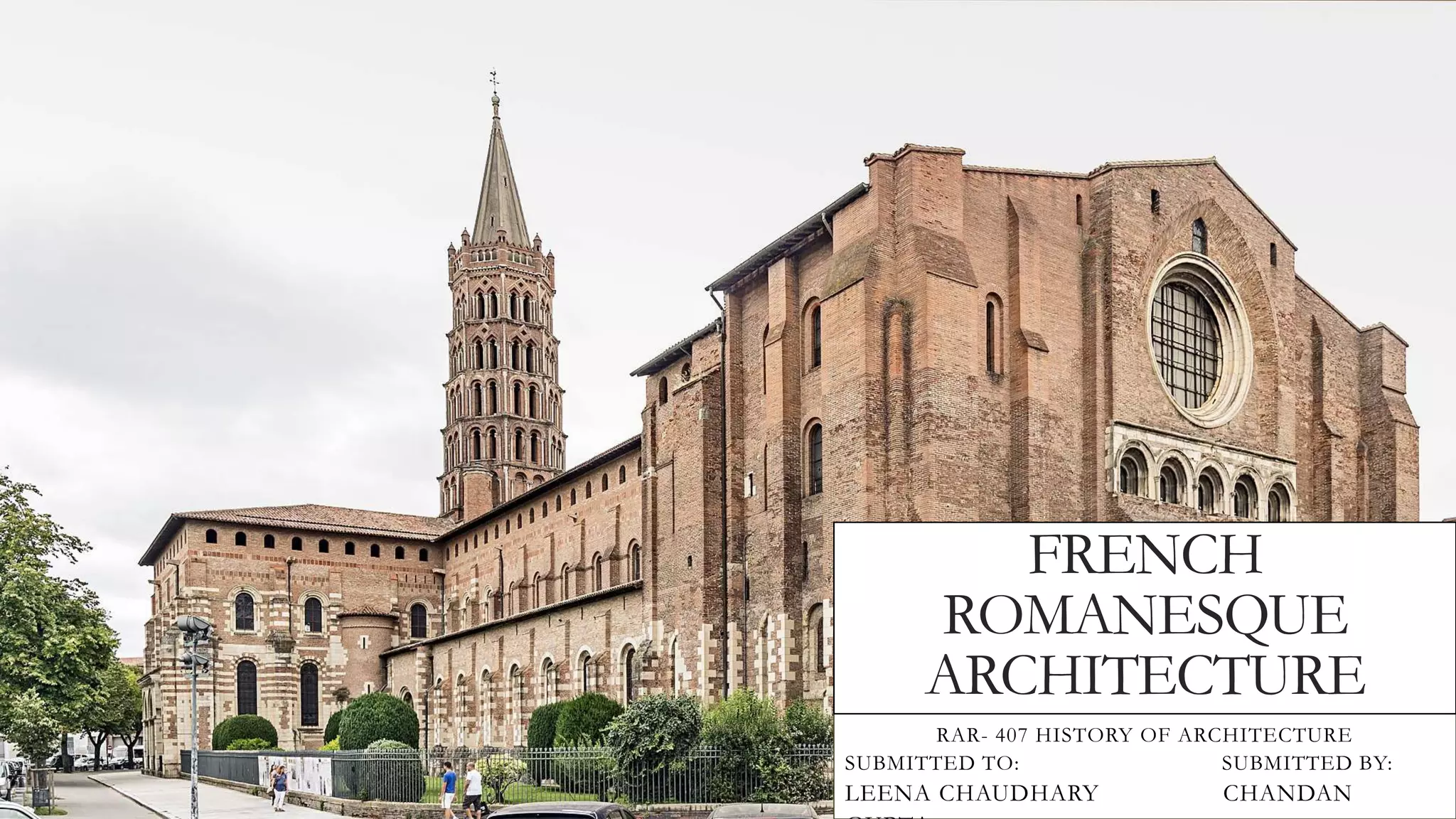
FRENCH
ROMANESQUE
ARCHITECTURE
INTRODUCTION
◦ Romanesque architecture appeared in France at the end of the 10th century, with the development
of feudal society and the rise and spread of monastic orders.
◦ Distinctive features of French Romanesque architecture include thick walls with small windows, rounded
arches; a long nave covered with barrel vaults.
◦ Churches commonly had a cupola over the transept, supported by four adjoining arches; one or more large
square towers, and a semi-circular apse with radiating small chapels.
◦ Decoration usually included very ornate sculpted capitals on columns and an elaborate semi-circular
sculpted tympanum, usually illustrating the Last Judgement, over the main portal.
◦ Interior decoration often included murals covering the walls, colored tiles, and early stained glass windows.
ROMANESQUE CHURCHES IN FRANCE
◦ The Church of St. Trophime in Arles
◦ The Abbey of Saint-Gilles-du-Gard
◦ The Basilica of St. Sernin
◦ The Abbey Church of Sainte Foy
◦ Le Puy Cathedral
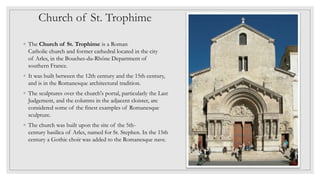
Church of St. Trophime
◦ The Church of St. Trophime is a Roman
Catholic church and former cathedral located in the city
of Arles, in the Bouches-du-Rhône Department of
southern France.
◦ It was built between the 12th century and the 15th century,
and is in the Romanesque architectural tradition.
◦ The sculptures over the church's portal, particularly the Last
Judgement, and the columns in the adjacent cloister, are
considered some of the finest examples of Romanesque
sculpture.
◦ The church was built upon the site of the 5th-
century basilica of Arles, named for St. Stephen. In the 15th
century a Gothic choir was added to the Romanesque nave.
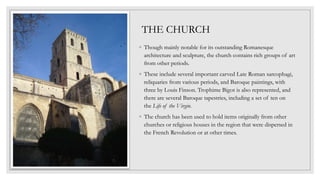
◦ Though mainly notable for its outstanding Romanesque
architecture and sculpture, the church contains rich groups of art
from other periods.
◦ These include several important carved Late Roman sarcophagi,
reliquaries from various periods, and Baroque paintings, with
three by Louis Finson. Trophime Bigot is also represented, and
there are several Baroque tapestries, including a set of ten on
the Life of the Virgin.
◦ The church has been used to hold items originally from other
churches or religious houses in the region that were dispersed in
the French Revolution or at other times.
THE CHURCH
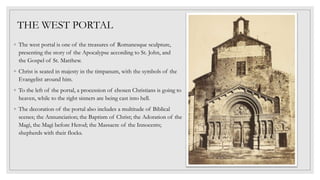
◦ The west portal is one of the treasures of Romanesque sculpture,
presenting the story of the Apocalypse according to St. John, and
the Gospel of St. Matthew.
◦ Christ is seated in majesty in the timpanum, with the symbols of the
Evangelist around him.
◦ To the left of the portal, a procession of chosen Christians is going to
heaven, while to the right sinners are being cast into hell.
◦ The decoration of the portal also includes a multitude of Biblical
scenes; the Annunciation; the Baptism of Christ; the Adoration of the
Magi, the Magi before Herod; the Massacre of the Innocents;
shepherds with their flocks.
THE WEST PORTAL
The Abbey of Saint-Gilles-du-Gard
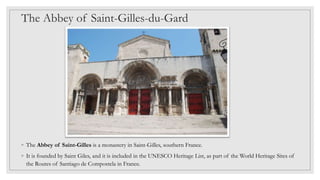
◦ The Abbey of Saint-Gilles is a monastery in Saint-Gilles, southern France.
◦ It is founded by Saint Giles, and it is included in the UNESCO Heritage List, as part of the World Heritage Sites of
the Routes of Santiago de Compostela in France.
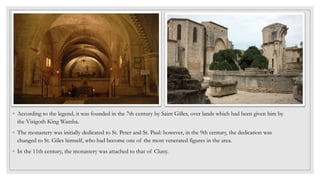
◦ According to the legend, it was founded in the 7th century by Saint Gilles, over lands which had been given him by
the Visigoth King Wamba.
◦ The monastery was initially dedicated to St. Peter and St. Paul: however, in the 9th century, the dedication was
changed to St. Giles himself, who had become one of the most venerated figures in the area.
◦ In the 11th century, the monastery was attached to that of Cluny.
The Basilica of St. Sernin
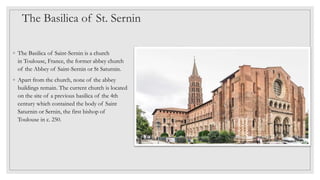
◦ The Basilica of Saint-Sernin is a church
in Toulouse, France, the former abbey church
of the Abbey of Saint-Sernin or St Saturnin.
◦ Apart from the church, none of the abbey
buildings remain. The current church is located
on the site of a previous basilica of the 4th
century which contained the body of Saint
Saturnin or Sernin, the first bishop of
Toulouse in c. 250.
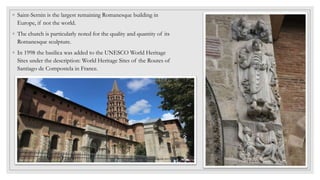
◦ Saint-Sernin is the largest remaining Romanesque building in
Europe, if not the world.
◦ The church is particularly noted for the quality and quantity of its
Romanesque sculpture.
◦ In 1998 the basilica was added to the UNESCO World Heritage
Sites under the description: World Heritage Sites of the Routes of
Santiago de Compostela in France.
The Abbey Church of Sainte Foy
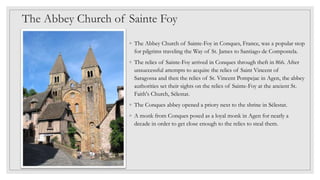
◦ The Abbey Church of Sainte-Foy in Conques, France, was a popular stop
for pilgrims traveling the Way of St. James to Santiago de Compostela.
◦ The relics of Sainte-Foy arrived in Conques through theft in 866. After
unsuccessful attempts to acquire the relics of Saint Vincent of
Saragossa and then the relics of St. Vincent Pompejac in Agen, the abbey
authorities set their sights on the relics of Sainte-Foy at the ancient St.
Faith's Church, Sélestat.
◦ The Conques abbey opened a priory next to the shrine in Sélestat.
◦ A monk from Conques posed as a loyal monk in Agen for nearly a
decade in order to get close enough to the relics to steal them.
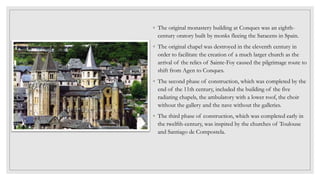
◦ The original monastery building at Conques was an eighth-
century oratory built by monks fleeing the Saracens in Spain.
◦ The original chapel was destroyed in the eleventh century in
order to facilitate the creation of a much larger church as the
arrival of the relics of Sainte-Foy caused the pilgrimage route to
shift from Agen to Conques.
◦ The second phase of construction, which was completed by the
end of the 11th century, included the building of the five
radiating chapels, the ambulatory with a lower roof, the choir
without the gallery and the nave without the galleries.
◦ The third phase of construction, which was completed early in
the twelfth-century, was inspired by the churches of Toulouse
and Santiago de Compostela.
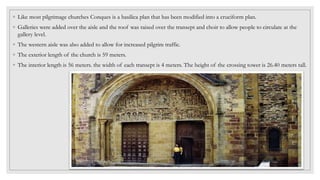
◦ Like most pilgrimage churches Conques is a basilica plan that has been modified into a cruciform plan.
◦ Galleries were added over the aisle and the roof was raised over the transept and choir to allow people to circulate at the
gallery level.
◦ The western aisle was also added to allow for increased pilgrim traffic.
◦ The exterior length of the church is 59 meters.
◦ The interior length is 56 meters. the width of each transept is 4 meters. The height of the crossing tower is 26.40 meters tall.
Le Puy Cathedral
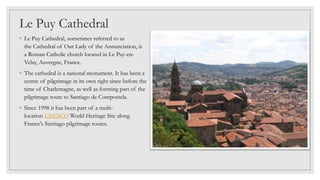
◦ Le Puy Cathedral, sometimes referred to as
the Cathedral of Our Lady of the Annunciation, is
a Roman Catholic church located in Le Puy-en-
Velay, Auvergne, France.
◦ The cathedral is a national monument. It has been a
centre of pilgrimage in its own right since before the
time of Charlemagne, as well as forming part of the
pilgrimage route to Santiago de Compostela.
◦ Since 1998 it has been part of a multi-
location UNESCO World Heritage Site along
France's Santiago pilgrimage routes.
◦ The cathedral forms the highest point of the city,
rising from the foot of the Rocher Corneille.
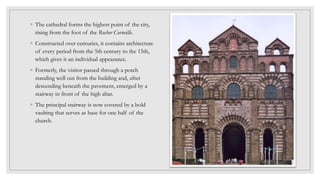
◦ Constructed over centuries, it contains architecture
of every period from the 5th century to the 15th,
which gives it an individual appearance.
◦ Formerly, the visitor passed through a porch
standing well out from the building and, after
descending beneath the pavement, emerged by a
stairway in front of the high altar.
◦ The principal stairway is now covered by a bold
vaulting that serves as base for one half of the
church.
THANK YOU

French Romanesque Architecture

  • 1.
    RAR- 407 HISTORYOF ARCHITECTURE SUBMITTED TO: SUBMITTED BY: LEENA CHAUDHARY CHANDAN FRENCH ROMANESQUE ARCHITECTURE
  • 2.
    INTRODUCTION ◦ Romanesque architectureappeared in France at the end of the 10th century, with the development of feudal society and the rise and spread of monastic orders. ◦ Distinctive features of French Romanesque architecture include thick walls with small windows, rounded arches; a long nave covered with barrel vaults. ◦ Churches commonly had a cupola over the transept, supported by four adjoining arches; one or more large square towers, and a semi-circular apse with radiating small chapels. ◦ Decoration usually included very ornate sculpted capitals on columns and an elaborate semi-circular sculpted tympanum, usually illustrating the Last Judgement, over the main portal. ◦ Interior decoration often included murals covering the walls, colored tiles, and early stained glass windows.
  • 3.
    ROMANESQUE CHURCHES INFRANCE ◦ The Church of St. Trophime in Arles ◦ The Abbey of Saint-Gilles-du-Gard ◦ The Basilica of St. Sernin ◦ The Abbey Church of Sainte Foy ◦ Le Puy Cathedral
  • 4.
    Church of St.Trophime ◦ The Church of St. Trophime is a Roman Catholic church and former cathedral located in the city of Arles, in the Bouches-du-Rhône Department of southern France. ◦ It was built between the 12th century and the 15th century, and is in the Romanesque architectural tradition. ◦ The sculptures over the church's portal, particularly the Last Judgement, and the columns in the adjacent cloister, are considered some of the finest examples of Romanesque sculpture. ◦ The church was built upon the site of the 5th- century basilica of Arles, named for St. Stephen. In the 15th century a Gothic choir was added to the Romanesque nave.
  • 5.
    ◦ Though mainlynotable for its outstanding Romanesque architecture and sculpture, the church contains rich groups of art from other periods. ◦ These include several important carved Late Roman sarcophagi, reliquaries from various periods, and Baroque paintings, with three by Louis Finson. Trophime Bigot is also represented, and there are several Baroque tapestries, including a set of ten on the Life of the Virgin. ◦ The church has been used to hold items originally from other churches or religious houses in the region that were dispersed in the French Revolution or at other times. THE CHURCH
  • 6.
    ◦ The westportal is one of the treasures of Romanesque sculpture, presenting the story of the Apocalypse according to St. John, and the Gospel of St. Matthew. ◦ Christ is seated in majesty in the timpanum, with the symbols of the Evangelist around him. ◦ To the left of the portal, a procession of chosen Christians is going to heaven, while to the right sinners are being cast into hell. ◦ The decoration of the portal also includes a multitude of Biblical scenes; the Annunciation; the Baptism of Christ; the Adoration of the Magi, the Magi before Herod; the Massacre of the Innocents; shepherds with their flocks. THE WEST PORTAL
  • 7.
    The Abbey ofSaint-Gilles-du-Gard ◦ The Abbey of Saint-Gilles is a monastery in Saint-Gilles, southern France. ◦ It is founded by Saint Giles, and it is included in the UNESCO Heritage List, as part of the World Heritage Sites of the Routes of Santiago de Compostela in France.
  • 8.
    ◦ According tothe legend, it was founded in the 7th century by Saint Gilles, over lands which had been given him by the Visigoth King Wamba. ◦ The monastery was initially dedicated to St. Peter and St. Paul: however, in the 9th century, the dedication was changed to St. Giles himself, who had become one of the most venerated figures in the area. ◦ In the 11th century, the monastery was attached to that of Cluny.
  • 9.
    The Basilica ofSt. Sernin ◦ The Basilica of Saint-Sernin is a church in Toulouse, France, the former abbey church of the Abbey of Saint-Sernin or St Saturnin. ◦ Apart from the church, none of the abbey buildings remain. The current church is located on the site of a previous basilica of the 4th century which contained the body of Saint Saturnin or Sernin, the first bishop of Toulouse in c. 250.
  • 10.
    ◦ Saint-Sernin isthe largest remaining Romanesque building in Europe, if not the world. ◦ The church is particularly noted for the quality and quantity of its Romanesque sculpture. ◦ In 1998 the basilica was added to the UNESCO World Heritage Sites under the description: World Heritage Sites of the Routes of Santiago de Compostela in France.
  • 11.
    The Abbey Churchof Sainte Foy ◦ The Abbey Church of Sainte-Foy in Conques, France, was a popular stop for pilgrims traveling the Way of St. James to Santiago de Compostela. ◦ The relics of Sainte-Foy arrived in Conques through theft in 866. After unsuccessful attempts to acquire the relics of Saint Vincent of Saragossa and then the relics of St. Vincent Pompejac in Agen, the abbey authorities set their sights on the relics of Sainte-Foy at the ancient St. Faith's Church, Sélestat. ◦ The Conques abbey opened a priory next to the shrine in Sélestat. ◦ A monk from Conques posed as a loyal monk in Agen for nearly a decade in order to get close enough to the relics to steal them.
  • 12.
    ◦ The originalmonastery building at Conques was an eighth- century oratory built by monks fleeing the Saracens in Spain. ◦ The original chapel was destroyed in the eleventh century in order to facilitate the creation of a much larger church as the arrival of the relics of Sainte-Foy caused the pilgrimage route to shift from Agen to Conques. ◦ The second phase of construction, which was completed by the end of the 11th century, included the building of the five radiating chapels, the ambulatory with a lower roof, the choir without the gallery and the nave without the galleries. ◦ The third phase of construction, which was completed early in the twelfth-century, was inspired by the churches of Toulouse and Santiago de Compostela.
  • 13.
    ◦ Like mostpilgrimage churches Conques is a basilica plan that has been modified into a cruciform plan. ◦ Galleries were added over the aisle and the roof was raised over the transept and choir to allow people to circulate at the gallery level. ◦ The western aisle was also added to allow for increased pilgrim traffic. ◦ The exterior length of the church is 59 meters. ◦ The interior length is 56 meters. the width of each transept is 4 meters. The height of the crossing tower is 26.40 meters tall.
  • 14.
    Le Puy Cathedral ◦Le Puy Cathedral, sometimes referred to as the Cathedral of Our Lady of the Annunciation, is a Roman Catholic church located in Le Puy-en- Velay, Auvergne, France. ◦ The cathedral is a national monument. It has been a centre of pilgrimage in its own right since before the time of Charlemagne, as well as forming part of the pilgrimage route to Santiago de Compostela. ◦ Since 1998 it has been part of a multi- location UNESCO World Heritage Site along France's Santiago pilgrimage routes.
  • 15.
    ◦ The cathedralforms the highest point of the city, rising from the foot of the Rocher Corneille. ◦ Constructed over centuries, it contains architecture of every period from the 5th century to the 15th, which gives it an individual appearance. ◦ Formerly, the visitor passed through a porch standing well out from the building and, after descending beneath the pavement, emerged by a stairway in front of the high altar. ◦ The principal stairway is now covered by a bold vaulting that serves as base for one half of the church.
  • 16.