CRYPTOGRAPHY
Key Management
Key Management
• The distribution of public keys
– Public announcement
– Public available directory
– Public-key authority
– Public-key certificates
• The use of public-key encryption to distribute secret keys
Public Announcement of Public
Keys
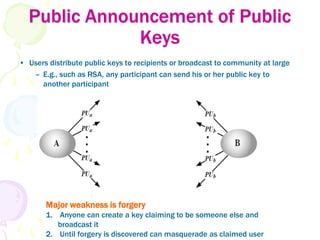
• Users distribute public keys to recipients or broadcast to community at large
– E.g., such as RSA, any participant can send his or her public key to
another participant
Major weakness is forgery
1. Anyone can create a key claiming to be someone else and
broadcast it
2. Until forgery is discovered can masquerade as claimed user
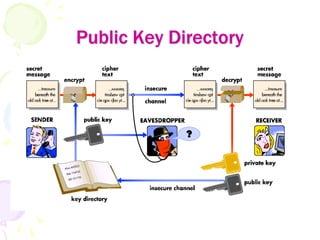
Public Key Directory
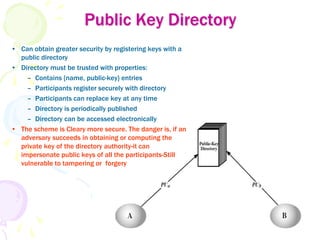
• Can obtain greater security by registering keys with a
public directory
• Directory must be trusted with properties:
– Contains {name, public-key} entries
– Participants register securely with directory
– Participants can replace key at any time
– Directory is periodically published
– Directory can be accessed electronically
• The scheme is Cleary more secure. The danger is, if an
adversary succeeds in obtaining or computing the
private key of the directory authority-it can
impersonate public keys of all the participants-Still
vulnerable to tampering or forgery
Public Key Directory
Public Key Authority
• Improve security by tightening control over distribution of public
keys from the directory
• Has properties of directory
• Requires users to know public key for the directory
• Users interact with directory to obtain any desired public key
securely
– Require real-time access to directory when keys are needed
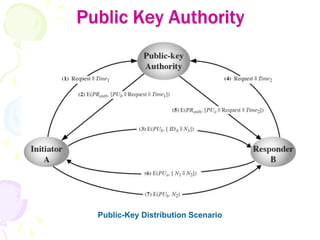
• Users A and B mutually authenticate and assure freshness
• Drawbacks
– Public key authority could be a performance bottleneck
– The directory is vulnerable to tampering
Public Key Authority
Public-Key Distribution Scenario
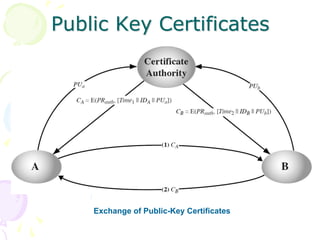
Public Key Certificates
• Goal is to provide a mechanism as secure and reliable as the public key
authority without requiring direct contact-use of public key certificate
• Public key certificate
– Binds identity to public key
– Usually with other info such as period of validity, rights of use etc.
– With all contents signed by a TTP or Certificate Authority (CA)
• Public key certificate requirements
– Anyone can read a certificate and determine the name and public key of
the owner
– Anyone can verify that the certificate originated from the public key
certification authority
– Only the public key certification authority can issue or update certificates
– Anyone can verify the currency of the certificate
Public Key Certificates
Exchange of Public-Key Certificates
Distribution of Secret Keys using
PKC
• Because of its huge computational cost, Public-Key
cryptosystem usage tends to be restricted
– Secret key distribution
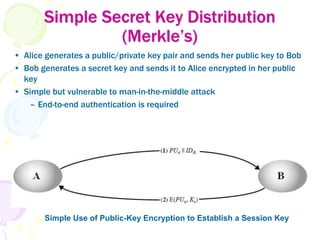
Simple Secret Key Distribution
(Merkle’s)
• Alice generates a public/private key pair and sends her public key to Bob
• Bob generates a secret key and sends it to Alice encrypted in her public
key
• Simple but vulnerable to man-in-the-middle attack
– End-to-end authentication is required
Simple Use of Public-Key Encryption to Establish a Session Key
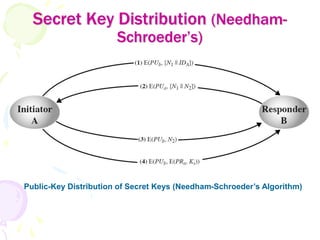
Secret Key Distribution (Needham-
Schroeder’s)
• Provides a protection against both active and passive attacks
• Assume Alice and Bob have exchanged public keys (by any scheme described
earlier)
• Steps
1. Alice encrypts and sends an identifier of Alice and a nonce to Bob
2. Bob encrypts and sends Alice’s nonce and his own nonce
3. Alice encrypts and sends Bob’s nonce back to Bob
4. Alice selects, signs, encrypts and sends a secret key to Bob
• Ensure both confidentiality and authentication in the exchange of a secret
key
Secret Key Distribution (Needham-
Schroeder’s)
Public-Key Distribution of Secret Keys (Needham-Schroeder’s Algorithm)
Diffie-Hellman Key Exchange
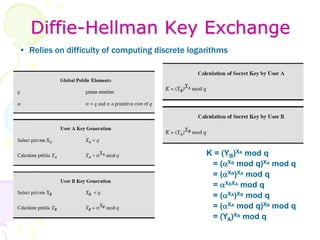
• Relies on difficulty of computing discrete logarithms
K = (YB)XA mod q
= (XB mod q)XA mod q
= (XB)XA mod q
= XBXA mod q
= (XA)XB mod q
= (XA mod q)XB mod q
= (YA)XB mod q
Diffie-Hellman Key Exchange
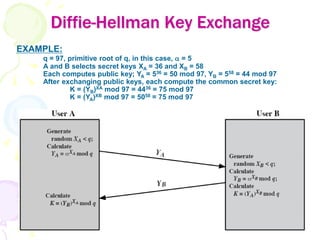
EXAMPLE:
q = 97, primitive root of q, in this case,  = 5
A and B selects secret keys XA = 36 and XB = 58
Each computes public key; YA = 536 = 50 mod 97, YB = 558 = 44 mod 97
After exchanging public keys, each compute the common secret key:
K = (YB)XA mod 97 = 4436 = 75 mod 97
K = (YA)XB mod 97 = 5058 = 75 mod 97
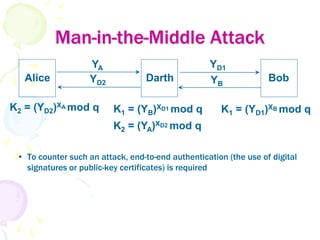
Man-in-the-Middle Attack
Alice Bob
Darth
YA YD1
K1 = (YD1)XB mod q
K2 = (YD2)XA mod q
K2 = (YA)XD2 mod q
YB
K1 = (YB)XD1 mod q
YD2
• To counter such an attack, end-to-end authentication (the use of digital
signatures or public-key certificates) is required

Lec 10 - Key Management.ppt

  • 1.
  • 2.
    Key Management • Thedistribution of public keys – Public announcement – Public available directory – Public-key authority – Public-key certificates • The use of public-key encryption to distribute secret keys
  • 3.
    Public Announcement ofPublic Keys • Users distribute public keys to recipients or broadcast to community at large – E.g., such as RSA, any participant can send his or her public key to another participant Major weakness is forgery 1. Anyone can create a key claiming to be someone else and broadcast it 2. Until forgery is discovered can masquerade as claimed user
  • 4.
    Public Key Directory •Can obtain greater security by registering keys with a public directory • Directory must be trusted with properties: – Contains {name, public-key} entries – Participants register securely with directory – Participants can replace key at any time – Directory is periodically published – Directory can be accessed electronically • The scheme is Cleary more secure. The danger is, if an adversary succeeds in obtaining or computing the private key of the directory authority-it can impersonate public keys of all the participants-Still vulnerable to tampering or forgery
  • 5.
  • 6.
    Public Key Authority •Improve security by tightening control over distribution of public keys from the directory • Has properties of directory • Requires users to know public key for the directory • Users interact with directory to obtain any desired public key securely – Require real-time access to directory when keys are needed • Users A and B mutually authenticate and assure freshness • Drawbacks – Public key authority could be a performance bottleneck – The directory is vulnerable to tampering
  • 7.
    Public Key Authority Public-KeyDistribution Scenario
  • 8.
    Public Key Certificates •Goal is to provide a mechanism as secure and reliable as the public key authority without requiring direct contact-use of public key certificate • Public key certificate – Binds identity to public key – Usually with other info such as period of validity, rights of use etc. – With all contents signed by a TTP or Certificate Authority (CA) • Public key certificate requirements – Anyone can read a certificate and determine the name and public key of the owner – Anyone can verify that the certificate originated from the public key certification authority – Only the public key certification authority can issue or update certificates – Anyone can verify the currency of the certificate
  • 9.
    Public Key Certificates Exchangeof Public-Key Certificates
  • 10.
    Distribution of SecretKeys using PKC • Because of its huge computational cost, Public-Key cryptosystem usage tends to be restricted – Secret key distribution
  • 11.
    Simple Secret KeyDistribution (Merkle’s) • Alice generates a public/private key pair and sends her public key to Bob • Bob generates a secret key and sends it to Alice encrypted in her public key • Simple but vulnerable to man-in-the-middle attack – End-to-end authentication is required Simple Use of Public-Key Encryption to Establish a Session Key
  • 12.
    Secret Key Distribution(Needham- Schroeder’s) • Provides a protection against both active and passive attacks • Assume Alice and Bob have exchanged public keys (by any scheme described earlier) • Steps 1. Alice encrypts and sends an identifier of Alice and a nonce to Bob 2. Bob encrypts and sends Alice’s nonce and his own nonce 3. Alice encrypts and sends Bob’s nonce back to Bob 4. Alice selects, signs, encrypts and sends a secret key to Bob • Ensure both confidentiality and authentication in the exchange of a secret key
  • 13.
    Secret Key Distribution(Needham- Schroeder’s) Public-Key Distribution of Secret Keys (Needham-Schroeder’s Algorithm)
  • 14.
    Diffie-Hellman Key Exchange •Relies on difficulty of computing discrete logarithms K = (YB)XA mod q = (XB mod q)XA mod q = (XB)XA mod q = XBXA mod q = (XA)XB mod q = (XA mod q)XB mod q = (YA)XB mod q
  • 15.
    Diffie-Hellman Key Exchange EXAMPLE: q= 97, primitive root of q, in this case,  = 5 A and B selects secret keys XA = 36 and XB = 58 Each computes public key; YA = 536 = 50 mod 97, YB = 558 = 44 mod 97 After exchanging public keys, each compute the common secret key: K = (YB)XA mod 97 = 4436 = 75 mod 97 K = (YA)XB mod 97 = 5058 = 75 mod 97
  • 16.
    Man-in-the-Middle Attack Alice Bob Darth YAYD1 K1 = (YD1)XB mod q K2 = (YD2)XA mod q K2 = (YA)XD2 mod q YB K1 = (YB)XD1 mod q YD2 • To counter such an attack, end-to-end authentication (the use of digital signatures or public-key certificates) is required