CRYPTOGRAPHY & NETWORK
SECURITY
Dr R Jegadeesan Prof-CSE
Jyothishmathi Institute of Technology and Science, karimnagar
Syllabus
UNIT – I:
Security Concepts: Introduction, The need for security, Security approaches,
Principles of security, Types of Security attacks, Security services, Security
Mechanisms, A model for Network Security Cryptography Concepts and
Techniques: Introduction, plain text and cipher text, substitution techniques,
transposition techniques, encryption and decryption, symmetric and asymmetric
key cryptography, steganography, key range and key size, possible types of
attacks
Security Concepts
Aim & Objective :
➢ Our focus is on Internet Security
➢ Consists of measures to deter, prevent, detect, and correct security
violations that involve the transmission of information
Security Introduction
3
Security Concepts
Security Introduction:
➢ Information Security requirements have changed in recent times.
➢ traditionally provided by physical and administrative mechanisms.
➢ computer use requires automated tools to protect files and other stored
information.
➢ use of networks and communications links requires measures to protect
data during transmission.
Security Background
4
Security Concepts
Security Introduction & Definitions:
➢ Computer Security - generic name for the collection of tools designed to
protect data and to thwart hackers
➢ Network Security - measures to protect data during their transmission
➢ Internet Security - measures to protect data during their transmission
over a collection of interconnected networks.
Security -Definitions
5
Security Concepts
➢ Need systematic way to define requirements
➢ consider three aspects of information security:
➢ security attack
➢ security mechanism
➢ security service
➢consider in reverse order
Services, Mechanisms, Attacks
6
Security Concepts
➢ Is something that enhances the security of the data processing
systems and the information transfers of an organization
➢ Intended to counter security attacks
➢ Make use of one or more security mechanisms to provide the service
➢ Replicate functions normally associated with physical documents
➢ eg have signatures, dates; need protection from disclosure,
tampering, or destruction; be notarized or witnessed; be recorded
or licensed
Security Services
7
Security Concepts
➢ A mechanism that is designed to detect, prevent, or recover from a
security attack.
➢ No single mechanism that will support all functions required.
➢ However one particular element underlies many of the security
mechanisms in use: cryptographic techniques.
➢ Hence our focus on this area.
Security Mechanism
8
Security Concepts
➢ Any action that compromises the security of information owned by
an organization.
➢ Information security is about how to prevent attacks, or failing that, to
detect attacks on information-based systems.
➢ Have a wide range of attacks.
➢ Can focus of generic types of attacks.
➢ Note: often threat & attack mean same.
Security Attacks
9
Security Concepts
➢ ITU-T X.800 Security Architecture for OSI.
➢ Defines a systematic way of defining and providing security
requirements.
➢ For us it provides a useful, if abstract, overview of concepts we will
study.
OSI Security Architecture
10
Security Concepts
➢ X.800 defines it as: a service provided by a protocol layer of
communicating open systems, which ensures adequate security of
the systems or of data transfers.
➢ RFC 2828 defines it as: a processing or communication service
provided by a system to give a specific kind of protection to system
resources.
➢ X.800 defines it in 5 major categories
Security Services
11
Security Concepts
Authentication - Aassurance that the communicating entity is the
one claimed
Access Control - prevention of the unauthorized use of a resource
Data Confidentiality –protection of data from unauthorized disclosure
Data Integrity - assurance that data received is as sent by an
authorized entity
Non-Repudiation - protection against denial by one of the parties in
a communication.
Security Services (X.800)
12
Security Concepts
➢specific security mechanisms:
Encipherment, digital signatures, access controls, data integrity,
authentication exchange, traffic padding, routing control, notarization.
➢pervasive security mechanisms:
Trusted functionality, security labels, event detection, security audit trails,
security recovery.
Security Mechanisms (X.800)
13
Security Concepts
passive attacks - eavesdropping on, or monitoring of, transmissions to:
•obtain message contents, or
•monitor traffic flows
active attacks – modification of data stream to:
•masquerade of one entity as some other
•replay previous messages
•modify messages in transit
•denial of service
Classify Security Attacks as
14
Security Concepts
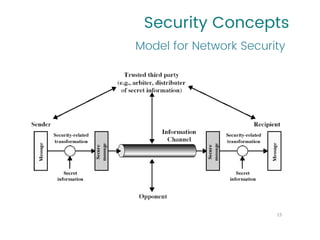
Model for Network Security
15
Security Concepts
using this model requires us to:
✓ Design a suitable algorithm for the security transformation
✓ Generate the secret information (keys) used by the algorithm
✓ Develop methods to distribute and share the secret information
✓ Specify a protocol enabling the principals to use the transformation
and secret information for a security service
Model for Network Security
16
Security Concepts
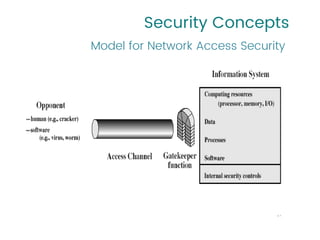
Model for Network Access Security
17
Security Concepts
➢using this model requires us to:
• Select appropriate gatekeeper functions to identify users
• Implement security controls to ensure only authorised users
access designated information or resources
➢trusted computer systems can be used to implement this model
Model for Network Access Security
18
Security Concepts
Text & Reference Books
19
Book Details :
TEXT BOOKS:
1. Cryptography and Network Security – Principles and Practice: William Stallings, Pearson
Education, 6th Edition
2. Cryptography and Network Security: Atul Kahate, Mc Graw Hill, 3rd Edition
REFERENCE BOOKS:
1. Cryptography and Network Security: C K Shyamala, N Harini, Dr T R Padmanabhan, Wiley
India, 1st Edition.
2. Cryptography and Network Security : Forouzan Mukhopadhyay, Mc Graw Hill, 3rd Edition
3. Information Security, Principles, and Practice: Mark Stamp, Wiley India.
4. Principles of Computer Security: WM. Arthur Conklin, Greg White, TMH
5. Introduction to Network Security: Neal Krawetz, CENGAGE Learning
6. Network Security and Cryptography: Bernard Menezes, CENGAGE Learning
Security Concepts
Video reference
20
Video Link details (NPTEL, YOUTUBE Lectures and etc.)
•https://nptel.ac.in/courses/106105031/
•https://nptel.ac.in/courses/106105162/
•http://www.nptelvideos.in/2012/11/cryptography-and-network-
security.html
Security Concepts
Security courses
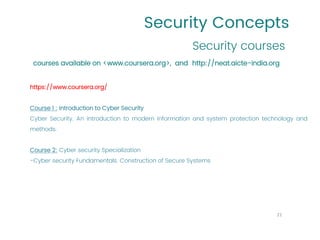
21
courses available on <www.coursera.org>, and http://neat.aicte-india.org
https://www.coursera.org/
Course 1 : Introduction to Cyber Security
Cyber Security. An introduction to modern information and system protection technology and
methods.
Course 2: Cyber security Specialization
-Cyber security Fundamentals. Construction of Secure Systems
Security Concepts
Security Tutorials
22
Tutorial topic wise
➢Cryptography Tutorial – Tutorialspoint www.tutorialspoint.com › cryptography
➢Cryptography Introduction – GeeksforGeeks www.geeksforgeeks.org › cryptography-
introduction
➢www.cse.iitm.ac.in › ~chester › courses › slides › 01_ Introduction
Security Concepts
Network Security MCQs
23
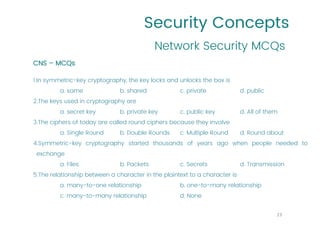
CNS – MCQs
1.In symmetric-key cryptography, the key locks and unlocks the box is
a. same b. shared c. private d. public
2.The keys used in cryptography are
a. secret key b. private key c. public key d. All of them
3.The ciphers of today are called round ciphers because they involve
a. Single Round b. Double Rounds c. Multiple Round d. Round about
4.Symmetric-key cryptography started thousands of years ago when people needed to
exchange
a. Files b. Packets c. Secrets d. Transmission
5.The relationship between a character in the plaintext to a character is
a. many-to-one relationship b. one-to-many relationship
c. many-to-many relationship d. None
Security Concepts
Security Tutorial
24
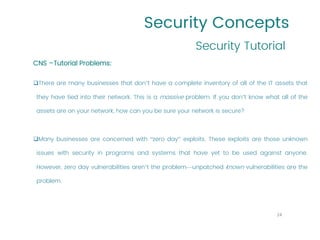
CNS –Tutorial Problems:
❑There are many businesses that don’t have a complete inventory of all of the IT assets that
they have tied into their network. This is a massive problem. If you don’t know what all of the
assets are on your network, how can you be sure your network is secure?
❑Many businesses are concerned with “zero day” exploits. These exploits are those unknown
issues with security in programs and systems that have yet to be used against anyone.
However, zero day vulnerabilities aren’t the problem—unpatched known vulnerabilities are the
problem.
Security Concepts
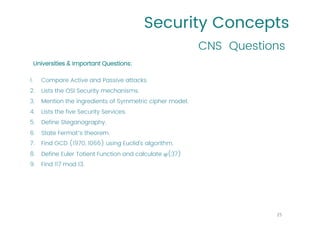
CNS Questions
25
Universities & Important Questions:
1. Compare Active and Passive attacks.
2. Lists the OSI Security mechanisms.
3. Mention the ingredients of Symmetric cipher model.
4. Lists the five Security Services.
5. Define Steganography.
6. State Fermat’s theorem.
7. Find GCD (1970, 1066) using Euclid's algorithm.
8. Define Euler Totient Function and calculate φ(37)
9. Find 117 mod 13.
26
Thank you

CRYPTOGRAPHY & NETWORK SECURITY

  • 1.
    CRYPTOGRAPHY & NETWORK SECURITY DrR Jegadeesan Prof-CSE Jyothishmathi Institute of Technology and Science, karimnagar
  • 2.
    Syllabus UNIT – I: SecurityConcepts: Introduction, The need for security, Security approaches, Principles of security, Types of Security attacks, Security services, Security Mechanisms, A model for Network Security Cryptography Concepts and Techniques: Introduction, plain text and cipher text, substitution techniques, transposition techniques, encryption and decryption, symmetric and asymmetric key cryptography, steganography, key range and key size, possible types of attacks
  • 3.
    Security Concepts Aim &Objective : ➢ Our focus is on Internet Security ➢ Consists of measures to deter, prevent, detect, and correct security violations that involve the transmission of information Security Introduction 3
  • 4.
    Security Concepts Security Introduction: ➢Information Security requirements have changed in recent times. ➢ traditionally provided by physical and administrative mechanisms. ➢ computer use requires automated tools to protect files and other stored information. ➢ use of networks and communications links requires measures to protect data during transmission. Security Background 4
  • 5.
    Security Concepts Security Introduction& Definitions: ➢ Computer Security - generic name for the collection of tools designed to protect data and to thwart hackers ➢ Network Security - measures to protect data during their transmission ➢ Internet Security - measures to protect data during their transmission over a collection of interconnected networks. Security -Definitions 5
  • 6.
    Security Concepts ➢ Needsystematic way to define requirements ➢ consider three aspects of information security: ➢ security attack ➢ security mechanism ➢ security service ➢consider in reverse order Services, Mechanisms, Attacks 6
  • 7.
    Security Concepts ➢ Issomething that enhances the security of the data processing systems and the information transfers of an organization ➢ Intended to counter security attacks ➢ Make use of one or more security mechanisms to provide the service ➢ Replicate functions normally associated with physical documents ➢ eg have signatures, dates; need protection from disclosure, tampering, or destruction; be notarized or witnessed; be recorded or licensed Security Services 7
  • 8.
    Security Concepts ➢ Amechanism that is designed to detect, prevent, or recover from a security attack. ➢ No single mechanism that will support all functions required. ➢ However one particular element underlies many of the security mechanisms in use: cryptographic techniques. ➢ Hence our focus on this area. Security Mechanism 8
  • 9.
    Security Concepts ➢ Anyaction that compromises the security of information owned by an organization. ➢ Information security is about how to prevent attacks, or failing that, to detect attacks on information-based systems. ➢ Have a wide range of attacks. ➢ Can focus of generic types of attacks. ➢ Note: often threat & attack mean same. Security Attacks 9
  • 10.
    Security Concepts ➢ ITU-TX.800 Security Architecture for OSI. ➢ Defines a systematic way of defining and providing security requirements. ➢ For us it provides a useful, if abstract, overview of concepts we will study. OSI Security Architecture 10
  • 11.
    Security Concepts ➢ X.800defines it as: a service provided by a protocol layer of communicating open systems, which ensures adequate security of the systems or of data transfers. ➢ RFC 2828 defines it as: a processing or communication service provided by a system to give a specific kind of protection to system resources. ➢ X.800 defines it in 5 major categories Security Services 11
  • 12.
    Security Concepts Authentication -Aassurance that the communicating entity is the one claimed Access Control - prevention of the unauthorized use of a resource Data Confidentiality –protection of data from unauthorized disclosure Data Integrity - assurance that data received is as sent by an authorized entity Non-Repudiation - protection against denial by one of the parties in a communication. Security Services (X.800) 12
  • 13.
    Security Concepts ➢specific securitymechanisms: Encipherment, digital signatures, access controls, data integrity, authentication exchange, traffic padding, routing control, notarization. ➢pervasive security mechanisms: Trusted functionality, security labels, event detection, security audit trails, security recovery. Security Mechanisms (X.800) 13
  • 14.
    Security Concepts passive attacks- eavesdropping on, or monitoring of, transmissions to: •obtain message contents, or •monitor traffic flows active attacks – modification of data stream to: •masquerade of one entity as some other •replay previous messages •modify messages in transit •denial of service Classify Security Attacks as 14
  • 15.
    Security Concepts Model forNetwork Security 15
  • 16.
    Security Concepts using thismodel requires us to: ✓ Design a suitable algorithm for the security transformation ✓ Generate the secret information (keys) used by the algorithm ✓ Develop methods to distribute and share the secret information ✓ Specify a protocol enabling the principals to use the transformation and secret information for a security service Model for Network Security 16
  • 17.
    Security Concepts Model forNetwork Access Security 17
  • 18.
    Security Concepts ➢using thismodel requires us to: • Select appropriate gatekeeper functions to identify users • Implement security controls to ensure only authorised users access designated information or resources ➢trusted computer systems can be used to implement this model Model for Network Access Security 18
  • 19.
    Security Concepts Text &Reference Books 19 Book Details : TEXT BOOKS: 1. Cryptography and Network Security – Principles and Practice: William Stallings, Pearson Education, 6th Edition 2. Cryptography and Network Security: Atul Kahate, Mc Graw Hill, 3rd Edition REFERENCE BOOKS: 1. Cryptography and Network Security: C K Shyamala, N Harini, Dr T R Padmanabhan, Wiley India, 1st Edition. 2. Cryptography and Network Security : Forouzan Mukhopadhyay, Mc Graw Hill, 3rd Edition 3. Information Security, Principles, and Practice: Mark Stamp, Wiley India. 4. Principles of Computer Security: WM. Arthur Conklin, Greg White, TMH 5. Introduction to Network Security: Neal Krawetz, CENGAGE Learning 6. Network Security and Cryptography: Bernard Menezes, CENGAGE Learning
  • 20.
    Security Concepts Video reference 20 VideoLink details (NPTEL, YOUTUBE Lectures and etc.) •https://nptel.ac.in/courses/106105031/ •https://nptel.ac.in/courses/106105162/ •http://www.nptelvideos.in/2012/11/cryptography-and-network- security.html
  • 21.
    Security Concepts Security courses 21 coursesavailable on <www.coursera.org>, and http://neat.aicte-india.org https://www.coursera.org/ Course 1 : Introduction to Cyber Security Cyber Security. An introduction to modern information and system protection technology and methods. Course 2: Cyber security Specialization -Cyber security Fundamentals. Construction of Secure Systems
  • 22.
    Security Concepts Security Tutorials 22 Tutorialtopic wise ➢Cryptography Tutorial – Tutorialspoint www.tutorialspoint.com › cryptography ➢Cryptography Introduction – GeeksforGeeks www.geeksforgeeks.org › cryptography- introduction ➢www.cse.iitm.ac.in › ~chester › courses › slides › 01_ Introduction
  • 23.
    Security Concepts Network SecurityMCQs 23 CNS – MCQs 1.In symmetric-key cryptography, the key locks and unlocks the box is a. same b. shared c. private d. public 2.The keys used in cryptography are a. secret key b. private key c. public key d. All of them 3.The ciphers of today are called round ciphers because they involve a. Single Round b. Double Rounds c. Multiple Round d. Round about 4.Symmetric-key cryptography started thousands of years ago when people needed to exchange a. Files b. Packets c. Secrets d. Transmission 5.The relationship between a character in the plaintext to a character is a. many-to-one relationship b. one-to-many relationship c. many-to-many relationship d. None
  • 24.
    Security Concepts Security Tutorial 24 CNS–Tutorial Problems: ❑There are many businesses that don’t have a complete inventory of all of the IT assets that they have tied into their network. This is a massive problem. If you don’t know what all of the assets are on your network, how can you be sure your network is secure? ❑Many businesses are concerned with “zero day” exploits. These exploits are those unknown issues with security in programs and systems that have yet to be used against anyone. However, zero day vulnerabilities aren’t the problem—unpatched known vulnerabilities are the problem.
  • 25.
    Security Concepts CNS Questions 25 Universities& Important Questions: 1. Compare Active and Passive attacks. 2. Lists the OSI Security mechanisms. 3. Mention the ingredients of Symmetric cipher model. 4. Lists the five Security Services. 5. Define Steganography. 6. State Fermat’s theorem. 7. Find GCD (1970, 1066) using Euclid's algorithm. 8. Define Euler Totient Function and calculate φ(37) 9. Find 117 mod 13.
  • 26.