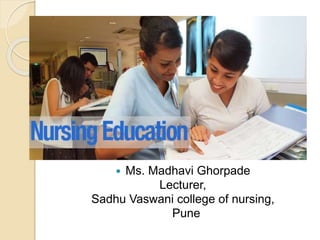
 Ms. Madhavi Ghorpade
Lecturer,
Sadhu Vaswani college of nursing,
Pune
Concept of education
 Education is derived from Latin word
“EDUCARE” which means to “lead out”.
 Derivation denotes “growth from the
within”
 The word “educere” also means “bring up”,
“to train” or “to mould”
Definition
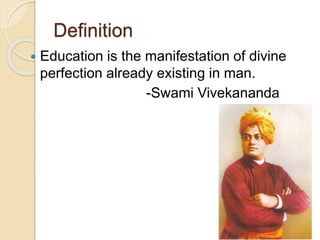
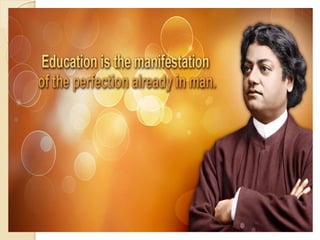
 Education is the manifestation of divine
perfection already existing in man.
-Swami Vivekananda
Definition
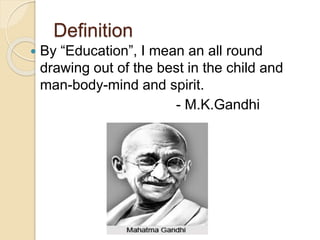
 By “Education”, I mean an all round
drawing out of the best in the child and
man-body-mind and spirit.
- M.K.Gandhi
Definition
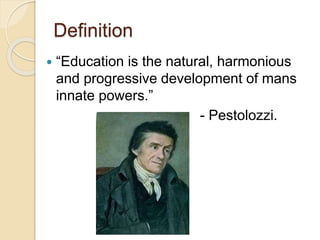
 “Education is the natural, harmonious
and progressive development of mans
innate powers.”
- Pestolozzi.
Definition
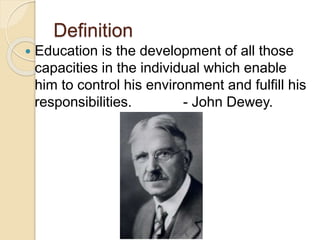
 Education is the development of all those
capacities in the individual which enable
him to control his environment and fulfill his
responsibilities. - John Dewey.
Definition
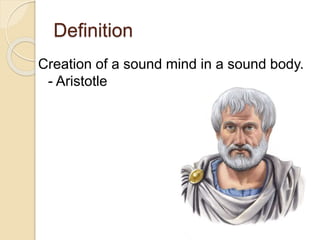
Creation of a sound mind in a sound body.
- Aristotle
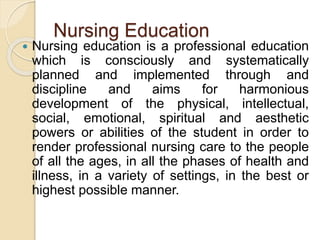
Nursing Education
 Nursing education is a professional education
which is consciously and systematically
planned and implemented through and
discipline and aims for harmonious
development of the physical, intellectual,
social, emotional, spiritual and aesthetic
powers or abilities of the student in order to
render professional nursing care to the people
of all the ages, in all the phases of health and
illness, in a variety of settings, in the best or
highest possible manner.
Functions of education
 Enabling the child to have self-realization
and individual development.
 Enabling the child to have civic efficiency
and social development
 Education is social function.
 It helps to transmit the cultural heritage
 Education for occupational placement on
instrument of livelihood.
 Education trains in skill that requires
by the economy.
 It mainly helps to develop specific
profession.
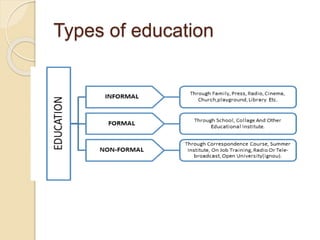
Types of education
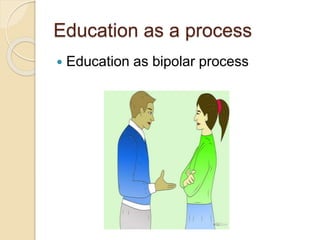
Education as a process
 Education as bipolar process
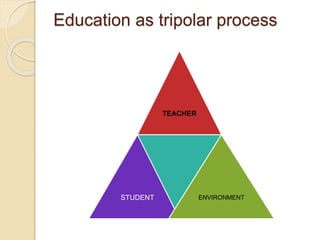
Education as tripolar process
TEACHER
STUDENT ENVIRONMENT
EDUCATION AS MULTIPOLAR
PROCESS
 Tripolar
 New self learning concept influenced by
non formal and formal types.
Characteristics of education
 Education is a purposeful activity
 Education is child centered process
 Education is planned activity based on
objectives
 Education is sociological process
 Education process is influenced by society,
social changes and technological
advancements
 Education is life long process
 Education is developing knowledge, skill
and attitudes.
Aims of Education
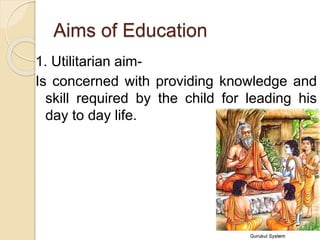
1. Utilitarian aim-

Is concerned with providing knowledge and
skill required by the child for leading his
day to day life.
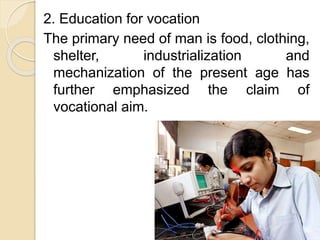
2. Education for vocation
The primary need of man is food, clothing,
shelter, industrialization and
mechanization of the present age has
further emphasized the claim of
vocational aim.
3. Education for knowledge
Knowledge is power by which things are
done. Education should be the
acquisition of knowledge. Education is
knowledge that has enabled humanity to
make progress.
 Education for culture
Knowledge for knowledge sake has been
advocated by many.
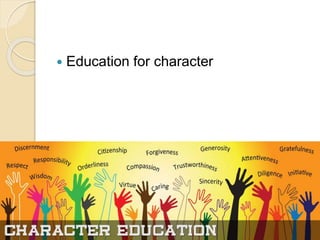
 Education for character
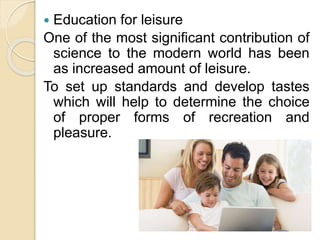
 Education for leisure
One of the most significant contribution of
science to the modern world has been
as increased amount of leisure.
To set up standards and develop tastes
which will help to determine the choice
of proper forms of recreation and
pleasure.
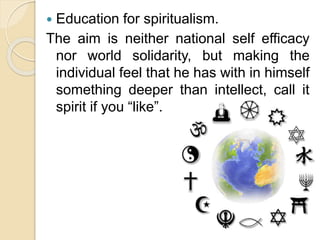
 Education for spiritualism.
The aim is neither national self efficacy
nor world solidarity, but making the
individual feel that he has with in himself
something deeper than intellect, call it
spirit if you “like”.
Education for individual development
A scheme of education is ultimately to be
valued by it success in fostering the
highest degree of individual excellence.
 Education for self efficacy
social efficacy implies social awareness,
economy productivity and cultural and
moral refinement.
 Physical health and social wellbeing
Education prepare the child to lead a
healthy life through providing knowledge
required for healthy life through providing
the knowledge required for a healthy
living and helping him to develop a
positive attitude towards health
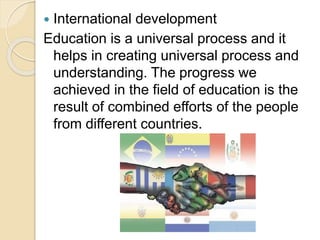
 International development
Education is a universal process and it
helps in creating universal process and
understanding. The progress we
achieved in the field of education is the
result of combined efforts of the people
from different countries.
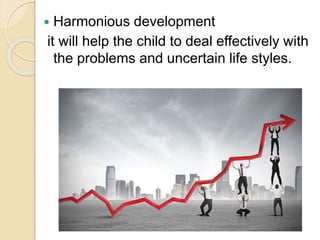
 Harmonious development
it will help the child to deal effectively with
the problems and uncertain life styles.
 Self realization
“what we are is God’s gift to us and what
we become is our gift to God.”
Self-realization helps the child to realize
his strengths, weakness, opportunities
and threats so that they can exert a
good control over his life by
strengthening the weakness.
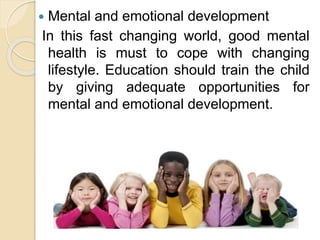
 Mental and emotional development
In this fast changing world, good mental
health is must to cope with changing
lifestyle. Education should train the child
by giving adequate opportunities for
mental and emotional development.
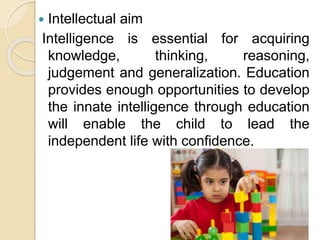
 Intellectual aim
Intelligence is essential for acquiring
knowledge, thinking, reasoning,
judgement and generalization. Education
provides enough opportunities to develop
the innate intelligence through education
will enable the child to lead the
independent life with confidence.
 Citizenship
Education helps the children to grow as
productive citizens by following the
social and moral standards set by the
society.
 Moral developement
moral values like honesty, justice,
truthfulness, purity, goodness, courage,
reverence, punctuality, self-confidence,
belief in systematic organization.
Aims of nursing education
 Harmonious development
 Inculcating the right attitude
 Knowledge and skill aim
 Emphasis on high-tech-high touch approach
 Prepare students to take up a proactive in
learning
 Professional development
 Assist in developing promising career
 Social aim
 Citizenship
 To prepare global nurses
 Leadership aim.
Trends in nursing education
 Curriculum changes
 Innovations in teaching and learning
 Educational quality assurance
 More reliance on technology
 Emphasis on high-tech-high touch
approach
 Preparation for global nurses
 Transnational acceptance
 Ensuring promising career
 Emergence of new specialities.
 Increased opportunities for higher
studies.
 Uniformity and standardization
 Coping with impact of globalization
Evolution of nursing education in
India
 1871 - School of nursing started in general hospital
Madras.
 1886 - School of nursing in a full-fledged form was
started in J.J. hospital, Bombay.
 1892 - Many hospitals in Bombay started nursing
associations which were intended to provide additional
facilities for the training of local nurses.
 1908 - TNAI established.
 1909 - Bombay presidency nursing association was
formed.
 1910 - United board of examination for nurses was
organized.
 1913 - South India Board was organized.
 1926 - First nurses registration act passed in Madras.
Evolution of nursing education in
India
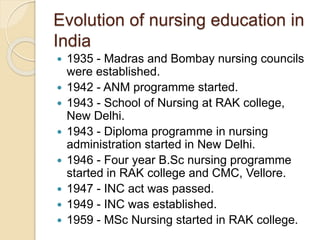
 1935 - Madras and Bombay nursing councils
were established.
 1942 - ANM programme started.
 1943 - School of Nursing at RAK college,
New Delhi.
 1943 - Diploma programme in nursing
administration started in New Delhi.
 1946 - Four year B.Sc nursing programme
started in RAK college and CMC, Vellore.
 1947 - INC act was passed.
 1949 - INC was established.
 1959 - MSc Nursing started in RAK college.
Evolution of nursing education in
India
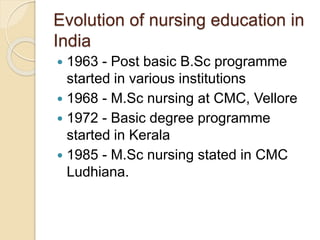
 1963 - Post basic B.Sc programme
started in various institutions
 1968 - M.Sc nursing at CMC, Vellore
 1972 - Basic degree programme
started in Kerala
 1985 - M.Sc nursing stated in CMC
Ludhiana.
Evolution of nursing education in
India
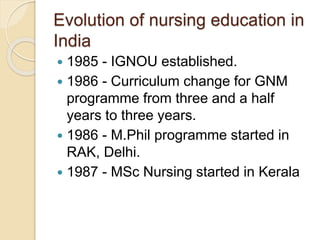
 1985 - IGNOU established.
 1986 - Curriculum change for GNM
programme from three and a half
years to three years.
 1986 - M.Phil programme started in
RAK, Delhi.
 1987 - MSc Nursing started in Kerala
Evolution of nursing education in
India
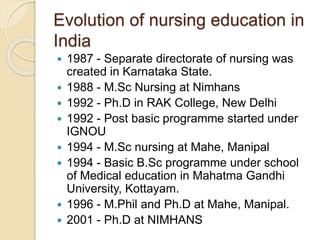
 1987 - Separate directorate of nursing was
created in Karnataka State.
 1988 - M.Sc Nursing at Nimhans
 1992 - Ph.D in RAK College, New Delhi
 1992 - Post basic programme started under
IGNOU
 1994 - M.Sc nursing at Mahe, Manipal
 1994 - Basic B.Sc programme under school
of Medical education in Mahatma Gandhi
University, Kottayam.
 1996 - M.Phil and Ph.D at Mahe, Manipal.
 2001 - Ph.D at NIMHANS
 Any questions??????
Nursing education

Nursing education

  • 1.
     Ms. MadhaviGhorpade Lecturer, Sadhu Vaswani college of nursing, Pune
  • 2.
    Concept of education Education is derived from Latin word “EDUCARE” which means to “lead out”.  Derivation denotes “growth from the within”  The word “educere” also means “bring up”, “to train” or “to mould”
  • 3.
    Definition  Education isthe manifestation of divine perfection already existing in man. -Swami Vivekananda
  • 6.
    Definition  By “Education”,I mean an all round drawing out of the best in the child and man-body-mind and spirit. - M.K.Gandhi
  • 8.
    Definition  “Education isthe natural, harmonious and progressive development of mans innate powers.” - Pestolozzi.
  • 9.
    Definition  Education isthe development of all those capacities in the individual which enable him to control his environment and fulfill his responsibilities. - John Dewey.
  • 12.
    Definition Creation of asound mind in a sound body. - Aristotle
  • 18.
    Nursing Education  Nursingeducation is a professional education which is consciously and systematically planned and implemented through and discipline and aims for harmonious development of the physical, intellectual, social, emotional, spiritual and aesthetic powers or abilities of the student in order to render professional nursing care to the people of all the ages, in all the phases of health and illness, in a variety of settings, in the best or highest possible manner.
  • 19.
    Functions of education Enabling the child to have self-realization and individual development.  Enabling the child to have civic efficiency and social development  Education is social function.  It helps to transmit the cultural heritage  Education for occupational placement on instrument of livelihood.
  • 20.
     Education trainsin skill that requires by the economy.  It mainly helps to develop specific profession.
  • 21.
  • 22.
    Education as aprocess  Education as bipolar process
  • 23.
    Education as tripolarprocess TEACHER STUDENT ENVIRONMENT
  • 24.
    EDUCATION AS MULTIPOLAR PROCESS Tripolar  New self learning concept influenced by non formal and formal types.
  • 25.
    Characteristics of education Education is a purposeful activity  Education is child centered process  Education is planned activity based on objectives  Education is sociological process  Education process is influenced by society, social changes and technological advancements  Education is life long process  Education is developing knowledge, skill and attitudes.
  • 26.
    Aims of Education 1.Utilitarian aim- Is concerned with providing knowledge and skill required by the child for leading his day to day life.
  • 27.
    2. Education forvocation The primary need of man is food, clothing, shelter, industrialization and mechanization of the present age has further emphasized the claim of vocational aim.
  • 28.
    3. Education forknowledge Knowledge is power by which things are done. Education should be the acquisition of knowledge. Education is knowledge that has enabled humanity to make progress.
  • 29.
     Education forculture Knowledge for knowledge sake has been advocated by many.
  • 30.
  • 31.
     Education forleisure One of the most significant contribution of science to the modern world has been as increased amount of leisure. To set up standards and develop tastes which will help to determine the choice of proper forms of recreation and pleasure.
  • 32.
     Education forspiritualism. The aim is neither national self efficacy nor world solidarity, but making the individual feel that he has with in himself something deeper than intellect, call it spirit if you “like”.
  • 33.
    Education for individualdevelopment A scheme of education is ultimately to be valued by it success in fostering the highest degree of individual excellence.
  • 34.
     Education forself efficacy social efficacy implies social awareness, economy productivity and cultural and moral refinement.
  • 35.
     Physical healthand social wellbeing Education prepare the child to lead a healthy life through providing knowledge required for healthy life through providing the knowledge required for a healthy living and helping him to develop a positive attitude towards health
  • 36.
     International development Educationis a universal process and it helps in creating universal process and understanding. The progress we achieved in the field of education is the result of combined efforts of the people from different countries.
  • 37.
     Harmonious development itwill help the child to deal effectively with the problems and uncertain life styles.
  • 38.
     Self realization “whatwe are is God’s gift to us and what we become is our gift to God.” Self-realization helps the child to realize his strengths, weakness, opportunities and threats so that they can exert a good control over his life by strengthening the weakness.
  • 39.
     Mental andemotional development In this fast changing world, good mental health is must to cope with changing lifestyle. Education should train the child by giving adequate opportunities for mental and emotional development.
  • 40.
     Intellectual aim Intelligenceis essential for acquiring knowledge, thinking, reasoning, judgement and generalization. Education provides enough opportunities to develop the innate intelligence through education will enable the child to lead the independent life with confidence.
  • 41.
     Citizenship Education helpsthe children to grow as productive citizens by following the social and moral standards set by the society.
  • 42.
     Moral developement moralvalues like honesty, justice, truthfulness, purity, goodness, courage, reverence, punctuality, self-confidence, belief in systematic organization.
  • 43.
    Aims of nursingeducation  Harmonious development  Inculcating the right attitude  Knowledge and skill aim  Emphasis on high-tech-high touch approach  Prepare students to take up a proactive in learning  Professional development  Assist in developing promising career  Social aim  Citizenship  To prepare global nurses  Leadership aim.
  • 44.
    Trends in nursingeducation  Curriculum changes  Innovations in teaching and learning  Educational quality assurance  More reliance on technology  Emphasis on high-tech-high touch approach  Preparation for global nurses  Transnational acceptance  Ensuring promising career  Emergence of new specialities.
  • 45.
     Increased opportunitiesfor higher studies.  Uniformity and standardization  Coping with impact of globalization
  • 46.
    Evolution of nursingeducation in India  1871 - School of nursing started in general hospital Madras.  1886 - School of nursing in a full-fledged form was started in J.J. hospital, Bombay.  1892 - Many hospitals in Bombay started nursing associations which were intended to provide additional facilities for the training of local nurses.  1908 - TNAI established.  1909 - Bombay presidency nursing association was formed.  1910 - United board of examination for nurses was organized.  1913 - South India Board was organized.  1926 - First nurses registration act passed in Madras.
  • 47.
    Evolution of nursingeducation in India  1935 - Madras and Bombay nursing councils were established.  1942 - ANM programme started.  1943 - School of Nursing at RAK college, New Delhi.  1943 - Diploma programme in nursing administration started in New Delhi.  1946 - Four year B.Sc nursing programme started in RAK college and CMC, Vellore.  1947 - INC act was passed.  1949 - INC was established.  1959 - MSc Nursing started in RAK college.
  • 48.
    Evolution of nursingeducation in India  1963 - Post basic B.Sc programme started in various institutions  1968 - M.Sc nursing at CMC, Vellore  1972 - Basic degree programme started in Kerala  1985 - M.Sc nursing stated in CMC Ludhiana.
  • 49.
    Evolution of nursingeducation in India  1985 - IGNOU established.  1986 - Curriculum change for GNM programme from three and a half years to three years.  1986 - M.Phil programme started in RAK, Delhi.  1987 - MSc Nursing started in Kerala
  • 50.
    Evolution of nursingeducation in India  1987 - Separate directorate of nursing was created in Karnataka State.  1988 - M.Sc Nursing at Nimhans  1992 - Ph.D in RAK College, New Delhi  1992 - Post basic programme started under IGNOU  1994 - M.Sc nursing at Mahe, Manipal  1994 - Basic B.Sc programme under school of Medical education in Mahatma Gandhi University, Kottayam.  1996 - M.Phil and Ph.D at Mahe, Manipal.  2001 - Ph.D at NIMHANS
  • 51.