Salale University
College of Health Sciences
Department of Adult Health Nursing
Seminar Presentation on: ENCEPHALITIS
Presented by : Kedir Mohammed ID : 182/15
Presented to : Bikila (Assistant professor)
OCT 3/05/ 2023
Fiche
CONTENTS
• Definitions
• Etiology
• Pathophysiology
• Clinical Manifestations
• Investigations
• Treatment
• Nursing Management
• Complications
• Summary
• Reference
OBJECTIVE
• To introduce & define the topic
• To explain types of encephalitis
• To enlist risk factors & etiology
• To explain clinical manifestation & diagnostic evaluatio
n
• To explain medical & nursing management and prevent
ion of encephalitis.
ENCEPHALITIS
• Encephalitis is a rare yet serious disease that can be life-
threatening.
• Encephalitis is the inflammation of the brain parenchym
a.
• Encephalitis with meningitis is known as meningoencep
halitis.
• Encephalitis can be infectious or noninfectious and ac
ute, subacute,or chronic.
ENCEPHALITIS
TYPES
• There are two main types of encephalitis:
• Primary encephalitis- It occurs when a virus directly
infects the brain and spinal cord.
• Secondary encephalitis- It occurs when an infection s
tarts elsewhere in the body and then travels to your bra
in. Results from a faulty immune system reaction.
EPIDEMIOLOGY
• A rare disease
• Most common in children , elderly, and people with w
eakened immune systems (HIV/AIDS or cancer).
Etiology
• The cause of encephalitis is usually infectious.
• is viral infections.
• Viral Causes: The most common cause
 Enteroviruses (it is the most common cause of the viral
infection)
 HSV-1, Arboviruses, Adenoviruses, Rabies, Measles,
Mumps virus
• Bacteria -Mycoplasma, Toxoplasmosis , malaria , prim
ary amoebic meningoencephalitis.
• Fungus
• Immunosuppressed
• Upper respiratory infections
Risk Factors
• Anyone can develop encephalitis
• Factors that may increase the risk include:
 Older adults
 Children under the age of 1 year
 People with weak immune systems
 Geographical regions. Mosquito- or tick-borne virus
es are common in particular geographical regions.
 Season of the year. Mosquito- and tick-borne diseases
tend to be more common in summer in many areas of t
he United States.
PATHOLOGY
SIGN And SYMPTOMS
• Fever with hallucinations
• Headache – may be severe with double vision
• Nausea & Vomiting
• Raised ICP- Stiff neck, pupils, motor weakness
• Confusion, personality changes, convulsions
• Poor appetite
• Loss of energy
• problems with memory
• speech problems
• Seizures are common at presentation
SIGN And SYMPTOMS
• The specific prodrome in encephalitis caused by (herpe
sviruses ) such as varicella-zoster virus, Epstein-Barr vi
rus or cytomegalovirus, and measles or mumps viruses i
ncludes :
 lymphadenopathy, hepatosplenomegaly, and parotid enl
argement.
Widespread edema and subarachnoid hem
orrhage areas in medial temporal and orbit
ofrontal regions
DIAGNOSIS
• Signs & Symptoms
 Neurological examinations reveal a drowsy or con
fused patient.
 Stiff neck ,may indicate meningoncephalitis.
• CT/MRI - to check for cerebral swelling of the p
arenchyma or focal abnormalities in temporal lobe
.
• EEG – Is the definitive test and shows abnormal b
rain waves ( spike and slow wave activity) from th
e temporal lobe.
• Blood test - Confirm presence of bacteria/viruses i
n cerebrospinal fluid and antibodies to fight infecti
on
DIAGNOSIS
• LP Analysis of CSF - increased amounts of protei
n and white blood cells (mainly lymphocytes) with
normal glucose levels
• PCR - it is the best choice when you suspect herp
es simplex infection)
• BRAIN BIOBSY - Rare
TREATMENT
• Early therapy is a critical factor in outcome
• People with severe symptoms are likely to need tre
atment in an intensive care unit (ICU) admission.
TREATMENT
PHARMACOLOGICAL MANAGEMENT
• Anti-inflammatory drugs & antipyretics - aceta
minophen (Tylenol, others), ibuprofen (Advil, Mo
trin IB, others) and naproxen sodium (Aleve) — t
o relieve headaches and fever
• Pyrimethamine (Daraprim) and sulfadoxine (Fa
nsidar) are commonly used to treat Toxoplasma en
cephalitis.
TREATMENT
• Mannitol or glycerol may be needed to reduce I
CP.
• Antibiotics
• Vitamin and mineral supplementation
• IV fluid therapy and dopamine to be given to tre
at shock and fluid electrolyte imbalance.
• Anticonvulsive drugs
TREATMENT
• Corticosteroids are used to reduce brain swelling
and inflammation (Reduce ICP and to suppress the
activity of their immune system.
• Sedatives may be needed for irritability or restless
ness.
• Antiviral drugs - Acyclovir (Zovirax) Ganciclovi
r (Cytovene)
• Acyclovir - Iv injection is the treatment of choice
(for 14 days). When the diagnosis of HSE is suspe
cted or has been established.
TREATMENT
NON- PHARMACOLOGICAL MANAGEMENT
• close monitoring (neuro obs, vital signs & body fl
uids to prevent further swelling
• Oxygenation to be provided by nasal cannula
• Mechanical ventilation is necessary in cardio-respi
ratory insufficiency
• Timely detection of electrolyte abnormalities
• position -Reduce ICP
NURSING MANAGEMENT
1. ASSESSMENT
• Obtain a history of recent infections such as upper respir
atory infection, and exposure to causative agents.
• Assess neurologic status and vital signs.
• Evaluate for signs of meningeal irritation.
• Assess sensorineural hearing loss (vision and hearing), c
ranial nerve damage (eg, facial nerve palsy), and diminis
hed cognitive function.
NURSING MANAGEMENT
2. Nursing Diagnosis
• Ineffective Tissue Perfusion (cerebral) related to infecti
ous process and cerebral edema
• Risk for Imbalanced Fluid Volume related to fever and
decreased intake
• Hyperthermia related to the infectious process and cere
bral edema.
• Acute Pain related to meningeal irritation
• Impaired Physical Mobility related to prolonged bed re
st.
NURSING MANAGEMENT
3. Goal
• To Enhanced Cerebral Tissue Perfusion
• To Maintain Fluid Balance
• To Reduce Fever
• To Reduce Pain
• To Return to Optimal Level of Functioning/ mobility
NURSING MANAGEMENT
4. Intervention
• Enhancing Cerebral Perfusion
 Assess LOC, vital signs, and neurologic parameters freq
uently. Observe for signs and symptoms of ICP
 Maintain a quiet, calm environment to prevent agitation,
which may cause an increased ICP.
• Maintaining Fluid Balance
 Prevent I.V. fluid overload, which may worsen cerebral
edema.
 Monitor intake and output closely.
NURSING MANAGEMENT
• Reducing Fever
 Administer antimicrobial agents on time to maintain o
ptimal blood levels.
 Monitor temperature frequently or continuously, and ad
minister antipyretics as ordered.
• Promoting Return to Optimal Level of Functioning
 Implement rehabilitation interventions after admission (
eg, turning, positioning).
 Progress from passive to active exercises based on the
patient's neurologic status.
NURSING MANAGEMENT
• Reducing Pain
 Administer analgesics as ordered; monitor for response
and adverse reactions.
 Avoid opioids, which may mask a decreasing LOC.
 Darken the room if photophobia is present.
 Assist with position of comfort for neck stiffness, and tu
rn patient slowly and carefully with head and neck in ali
gnment.
 Elevate the head of the bed to decrease ICP and reduce
pain.
NURSING MANAGEMENT
5. EXPECTED OUTCOMES
 Enhanced Cerebral Tissue Perfusion
 Reduced Fever
 Fluid Balance Maintained
 Reduced Pain
 Return to Optimal Level of Functioning
COMPLICATIONS
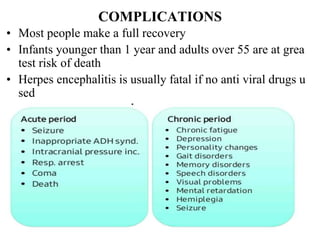
• Most people make a full recovery
• Infants younger than 1 year and adults over 55 are at grea
test risk of death
• Herpes encephalitis is usually fatal if no anti viral drugs u
sed
PREVENTION
• Practice good hygiene.
• Don't share utensils.
• Get vaccinations.
• Protection against mosquitoes and ticks
• Dress to protect yourself.
• Apply mosquito repellent.
• Use insecticide.
• Avoid mosquitoes.
• Get rid of water sources outside your home.
SUMMARY
• Encephalitis is an inflammation of the brain.
Usually the cause is a viral infection, but ba
cteria can also cause it. It can be mild or sev
ere.
• Most cases are mild. People may have flu-li
ke symptoms.
REFERENCE
• Boyer Jo Mary(2004), Textbook Of Medical Surgi
cal Nursing, Philadelphia, Lippincott William &
Wilkins.
• Lewis Mantik Sharon et. Al. (2000), Medical Surg
ical Nursing, Assessment & Management Of Clini
cal Problems, St. Louis, Missouri, Mosby Publishe
rs.
• Lippincott (2001), Manual of Nursing Practice, J.P
. Brothers,Philadelphia.
Kedir (Encephalitis).pptx

Kedir (Encephalitis).pptx

  • 1.
    Salale University College ofHealth Sciences Department of Adult Health Nursing Seminar Presentation on: ENCEPHALITIS Presented by : Kedir Mohammed ID : 182/15 Presented to : Bikila (Assistant professor) OCT 3/05/ 2023 Fiche
  • 2.
    CONTENTS • Definitions • Etiology •Pathophysiology • Clinical Manifestations • Investigations • Treatment • Nursing Management • Complications • Summary • Reference
  • 3.
    OBJECTIVE • To introduce& define the topic • To explain types of encephalitis • To enlist risk factors & etiology • To explain clinical manifestation & diagnostic evaluatio n • To explain medical & nursing management and prevent ion of encephalitis.
  • 4.
    ENCEPHALITIS • Encephalitis isa rare yet serious disease that can be life- threatening. • Encephalitis is the inflammation of the brain parenchym a. • Encephalitis with meningitis is known as meningoencep halitis. • Encephalitis can be infectious or noninfectious and ac ute, subacute,or chronic.
  • 5.
    ENCEPHALITIS TYPES • There aretwo main types of encephalitis: • Primary encephalitis- It occurs when a virus directly infects the brain and spinal cord. • Secondary encephalitis- It occurs when an infection s tarts elsewhere in the body and then travels to your bra in. Results from a faulty immune system reaction. EPIDEMIOLOGY • A rare disease • Most common in children , elderly, and people with w eakened immune systems (HIV/AIDS or cancer).
  • 6.
    Etiology • The causeof encephalitis is usually infectious. • is viral infections. • Viral Causes: The most common cause  Enteroviruses (it is the most common cause of the viral infection)  HSV-1, Arboviruses, Adenoviruses, Rabies, Measles, Mumps virus • Bacteria -Mycoplasma, Toxoplasmosis , malaria , prim ary amoebic meningoencephalitis. • Fungus • Immunosuppressed • Upper respiratory infections
  • 7.
    Risk Factors • Anyonecan develop encephalitis • Factors that may increase the risk include:  Older adults  Children under the age of 1 year  People with weak immune systems  Geographical regions. Mosquito- or tick-borne virus es are common in particular geographical regions.  Season of the year. Mosquito- and tick-borne diseases tend to be more common in summer in many areas of t he United States.
  • 8.
  • 9.
    SIGN And SYMPTOMS •Fever with hallucinations • Headache – may be severe with double vision • Nausea & Vomiting • Raised ICP- Stiff neck, pupils, motor weakness • Confusion, personality changes, convulsions • Poor appetite • Loss of energy • problems with memory • speech problems • Seizures are common at presentation
  • 10.
    SIGN And SYMPTOMS •The specific prodrome in encephalitis caused by (herpe sviruses ) such as varicella-zoster virus, Epstein-Barr vi rus or cytomegalovirus, and measles or mumps viruses i ncludes :  lymphadenopathy, hepatosplenomegaly, and parotid enl argement.
  • 11.
    Widespread edema andsubarachnoid hem orrhage areas in medial temporal and orbit ofrontal regions
  • 12.
    DIAGNOSIS • Signs &Symptoms  Neurological examinations reveal a drowsy or con fused patient.  Stiff neck ,may indicate meningoncephalitis. • CT/MRI - to check for cerebral swelling of the p arenchyma or focal abnormalities in temporal lobe . • EEG – Is the definitive test and shows abnormal b rain waves ( spike and slow wave activity) from th e temporal lobe. • Blood test - Confirm presence of bacteria/viruses i n cerebrospinal fluid and antibodies to fight infecti on
  • 13.
    DIAGNOSIS • LP Analysisof CSF - increased amounts of protei n and white blood cells (mainly lymphocytes) with normal glucose levels • PCR - it is the best choice when you suspect herp es simplex infection) • BRAIN BIOBSY - Rare
  • 14.
    TREATMENT • Early therapyis a critical factor in outcome • People with severe symptoms are likely to need tre atment in an intensive care unit (ICU) admission.
  • 15.
    TREATMENT PHARMACOLOGICAL MANAGEMENT • Anti-inflammatorydrugs & antipyretics - aceta minophen (Tylenol, others), ibuprofen (Advil, Mo trin IB, others) and naproxen sodium (Aleve) — t o relieve headaches and fever • Pyrimethamine (Daraprim) and sulfadoxine (Fa nsidar) are commonly used to treat Toxoplasma en cephalitis.
  • 16.
    TREATMENT • Mannitol orglycerol may be needed to reduce I CP. • Antibiotics • Vitamin and mineral supplementation • IV fluid therapy and dopamine to be given to tre at shock and fluid electrolyte imbalance. • Anticonvulsive drugs
  • 17.
    TREATMENT • Corticosteroids areused to reduce brain swelling and inflammation (Reduce ICP and to suppress the activity of their immune system. • Sedatives may be needed for irritability or restless ness. • Antiviral drugs - Acyclovir (Zovirax) Ganciclovi r (Cytovene) • Acyclovir - Iv injection is the treatment of choice (for 14 days). When the diagnosis of HSE is suspe cted or has been established.
  • 18.
    TREATMENT NON- PHARMACOLOGICAL MANAGEMENT •close monitoring (neuro obs, vital signs & body fl uids to prevent further swelling • Oxygenation to be provided by nasal cannula • Mechanical ventilation is necessary in cardio-respi ratory insufficiency • Timely detection of electrolyte abnormalities • position -Reduce ICP
  • 19.
    NURSING MANAGEMENT 1. ASSESSMENT •Obtain a history of recent infections such as upper respir atory infection, and exposure to causative agents. • Assess neurologic status and vital signs. • Evaluate for signs of meningeal irritation. • Assess sensorineural hearing loss (vision and hearing), c ranial nerve damage (eg, facial nerve palsy), and diminis hed cognitive function.
  • 20.
    NURSING MANAGEMENT 2. NursingDiagnosis • Ineffective Tissue Perfusion (cerebral) related to infecti ous process and cerebral edema • Risk for Imbalanced Fluid Volume related to fever and decreased intake • Hyperthermia related to the infectious process and cere bral edema. • Acute Pain related to meningeal irritation • Impaired Physical Mobility related to prolonged bed re st.
  • 21.
    NURSING MANAGEMENT 3. Goal •To Enhanced Cerebral Tissue Perfusion • To Maintain Fluid Balance • To Reduce Fever • To Reduce Pain • To Return to Optimal Level of Functioning/ mobility
  • 22.
    NURSING MANAGEMENT 4. Intervention •Enhancing Cerebral Perfusion  Assess LOC, vital signs, and neurologic parameters freq uently. Observe for signs and symptoms of ICP  Maintain a quiet, calm environment to prevent agitation, which may cause an increased ICP. • Maintaining Fluid Balance  Prevent I.V. fluid overload, which may worsen cerebral edema.  Monitor intake and output closely.
  • 23.
    NURSING MANAGEMENT • ReducingFever  Administer antimicrobial agents on time to maintain o ptimal blood levels.  Monitor temperature frequently or continuously, and ad minister antipyretics as ordered. • Promoting Return to Optimal Level of Functioning  Implement rehabilitation interventions after admission ( eg, turning, positioning).  Progress from passive to active exercises based on the patient's neurologic status.
  • 24.
    NURSING MANAGEMENT • ReducingPain  Administer analgesics as ordered; monitor for response and adverse reactions.  Avoid opioids, which may mask a decreasing LOC.  Darken the room if photophobia is present.  Assist with position of comfort for neck stiffness, and tu rn patient slowly and carefully with head and neck in ali gnment.  Elevate the head of the bed to decrease ICP and reduce pain.
  • 25.
    NURSING MANAGEMENT 5. EXPECTEDOUTCOMES  Enhanced Cerebral Tissue Perfusion  Reduced Fever  Fluid Balance Maintained  Reduced Pain  Return to Optimal Level of Functioning
  • 26.
    COMPLICATIONS • Most peoplemake a full recovery • Infants younger than 1 year and adults over 55 are at grea test risk of death • Herpes encephalitis is usually fatal if no anti viral drugs u sed
  • 27.
    PREVENTION • Practice goodhygiene. • Don't share utensils. • Get vaccinations. • Protection against mosquitoes and ticks • Dress to protect yourself. • Apply mosquito repellent. • Use insecticide. • Avoid mosquitoes. • Get rid of water sources outside your home.
  • 28.
    SUMMARY • Encephalitis isan inflammation of the brain. Usually the cause is a viral infection, but ba cteria can also cause it. It can be mild or sev ere. • Most cases are mild. People may have flu-li ke symptoms.
  • 29.
    REFERENCE • Boyer JoMary(2004), Textbook Of Medical Surgi cal Nursing, Philadelphia, Lippincott William & Wilkins. • Lewis Mantik Sharon et. Al. (2000), Medical Surg ical Nursing, Assessment & Management Of Clini cal Problems, St. Louis, Missouri, Mosby Publishe rs. • Lippincott (2001), Manual of Nursing Practice, J.P . Brothers,Philadelphia.