CHROMOSOME BANDING
TECHNIQUE
DR.G.KALAISELVI
ASSISTANT PROFESSOR, TANUVAS
INDIA
Point to be studied
Chromosomes
A. Definition
B. Structure
C. Identification
Karyotypes
A. Definition
B. Methods
C. Staining
D. Importance
Chromosome
Definition
 Genetic structures of cells
containing DNA
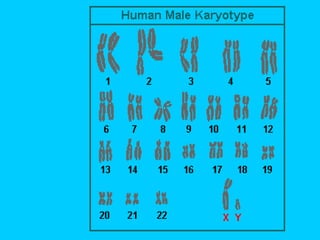
Identification
 Each chromosome has a
characteristic length and banding
pattern
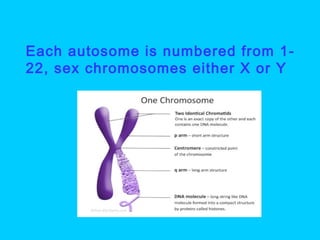
 Each autosome is numbered from 1-
22, sex chromosomes either X or Y
Samples for karyotyping
 Amniocentesis – sample taken from
the fluid of the amniotic sac
 Chorionic Villus Sampling – sample
taken from the fetal tissue that forms
part of the placenta
CYTOGENETICSCYTOGENETICS
 Is the study of the structure and properties ofIs the study of the structure and properties of
chromosomes, chromosomal behaviour duringchromosomes, chromosomal behaviour during
mitosis and meiosis, chromosomal influence onmitosis and meiosis, chromosomal influence on
the phenotype and the factors that causethe phenotype and the factors that cause
chromosomal changes (Hare and Singh, 1979).chromosomal changes (Hare and Singh, 1979).
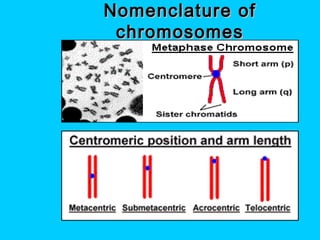
Nomenclature ofNomenclature of
chromosomeschromosomes
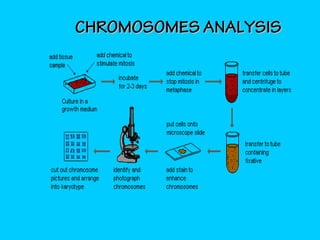
CHROMOSOMES ANALYSISCHROMOSOMES ANALYSIS
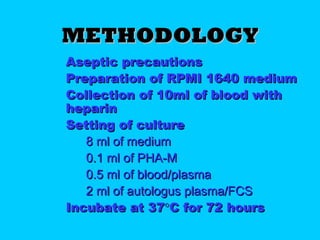
METHODOLOGYMETHODOLOGY
 Aseptic precautionsAseptic precautions
 Preparation of RPMI 1640 mediumPreparation of RPMI 1640 medium
 Collection of 10ml of blood withCollection of 10ml of blood with
heparinheparin
 Setting of cultureSetting of culture
8 ml of medium8 ml of medium
0.1 ml of PHA-M0.1 ml of PHA-M
0.5 ml of blood/plasma0.5 ml of blood/plasma
2 ml of autologus plasma/FCS2 ml of autologus plasma/FCS
 Incubate at 37Incubate at 37°°C for 72 hoursC for 72 hours
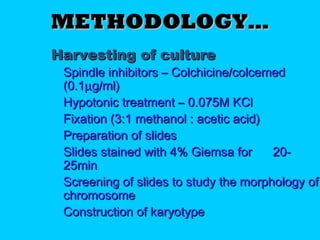
METHODOLOGY…METHODOLOGY…
Harvesting of cultureHarvesting of culture
 Spindle inhibitors – Colchicine/colcemedSpindle inhibitors – Colchicine/colcemed
(0.1(0.1µµg/ml)g/ml)
 Hypotonic treatment – 0.075M KClHypotonic treatment – 0.075M KCl
 Fixation (3:1 methanol : acetic acid)Fixation (3:1 methanol : acetic acid)
 Preparation of slidesPreparation of slides
 Slides stained with 4% Giemsa for 20-Slides stained with 4% Giemsa for 20-
25min25min
 Screening of slides to study the morphology ofScreening of slides to study the morphology of
chromosomechromosome
 Construction of karyotypeConstruction of karyotype
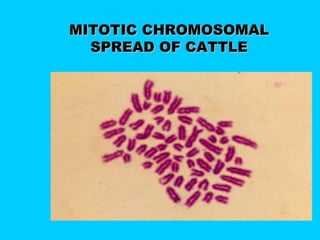
MITOTIC CHROMOSOMALMITOTIC CHROMOSOMAL
SPREAD OF CATTLESPREAD OF CATTLE
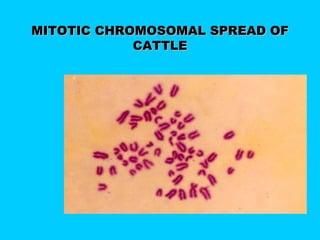
MITOTIC CHROMOSOMAL SPREAD OFMITOTIC CHROMOSOMAL SPREAD OF
CATTLECATTLE
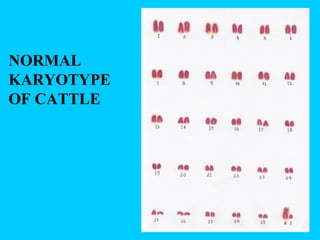
NORMAL
KARYOTYPE
OF CATTLE
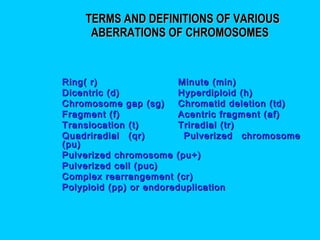
TERMS AND DEFINITIONS OF VARIOUSTERMS AND DEFINITIONS OF VARIOUS
ABERRATIONS OF CHROMOSOMESABERRATIONS OF CHROMOSOMES
 Ring( r)Ring( r) Minute (min)Minute (min)
 Dicentric (d)Dicentric (d) Hyperdiploid (h)Hyperdiploid (h)
 Chromosome gap (sg)Chromosome gap (sg) Chromatid deletion (td)Chromatid deletion (td)
 Fragment (f)Fragment (f) Acentric fragment (af)Acentric fragment (af)
 Translocation (t)Translocation (t) Triradial (tr)Triradial (tr)
 Quadriradial (qr)Quadriradial (qr) Pulverized chromosomePulverized chromosome
(pu)(pu)
 Pulverized chromosome (pu+)Pulverized chromosome (pu+)
 Pulverized cell (puc)Pulverized cell (puc)
 Complex rearrangement (cr)Complex rearrangement (cr)
 Polyploid (pp) or endoreduplicationPolyploid (pp) or endoreduplication
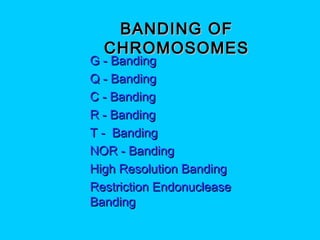
BANDING OFBANDING OF
CHROMOSOMESCHROMOSOMES
 G - BandingG - Banding
 Q - BandingQ - Banding
 C - BandingC - Banding
 R - BandingR - Banding
 T - BandingT - Banding
 NOR - BandingNOR - Banding
 High Resolution BandingHigh Resolution Banding
 Restriction EndonucleaseRestriction Endonuclease
BandingBanding
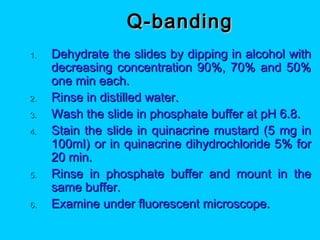
Q-bandingQ-banding
1.1. Dehydrate the slides by dipping in alcohol withDehydrate the slides by dipping in alcohol with
decreasing concentration 90%, 70% and 50%decreasing concentration 90%, 70% and 50%
one min each.one min each.
2.2. Rinse in distilled water.Rinse in distilled water.
3.3. Wash the slide in phosphate buffer at pH 6.8.Wash the slide in phosphate buffer at pH 6.8.
4.4. Stain the slide in quinacrine mustard (5 mg inStain the slide in quinacrine mustard (5 mg in
100mI) or in quinacrine dihydrochloride 5% for100mI) or in quinacrine dihydrochloride 5% for
20 min.20 min.
5.5. Rinse in phosphate buffer and mount in theRinse in phosphate buffer and mount in the
same buffer.same buffer.
6.6. Examine under fluorescent microscope.Examine under fluorescent microscope.
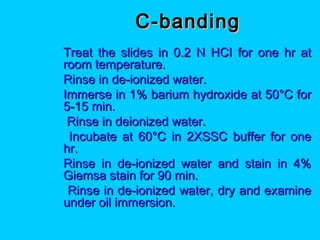
C-bandingC-banding
 Treat the slides in 0.2 N HCI for one hr atTreat the slides in 0.2 N HCI for one hr at
room temperature.room temperature.
 Rinse in de-ionized water.Rinse in de-ionized water.
 Immerse in 1% barium hydroxide at 50°C forImmerse in 1% barium hydroxide at 50°C for
5-15 min.5-15 min.
 Rinse in deionized water.Rinse in deionized water.
 Incubate at 60°C in 2XSSC buffer for oneIncubate at 60°C in 2XSSC buffer for one
hr.hr.
 Rinse in de-ionized water and stain in 4%Rinse in de-ionized water and stain in 4%
Giemsa stain for 90 min.Giemsa stain for 90 min.
 Rinse in de-ionized water, dry and examineRinse in de-ionized water, dry and examine
under oil immersion.under oil immersion.
R-bandingR-banding
 Age the slides for 7 -10 days .Age the slides for 7 -10 days .
 Place the slides in a Coplinjar containingPlace the slides in a Coplinjar containing
phosphate buffer ofpH 6.5 at 85°C andphosphate buffer ofpH 6.5 at 85°C and
incubate for 20-25 min.incubate for 20-25 min.
 Stain the slides in 0.01% acridine orangeStain the slides in 0.01% acridine orange
in the phosphate buffer pH 6.5 for 4-6 min.in the phosphate buffer pH 6.5 for 4-6 min.
Rinse in phosphate buffer and mount inRinse in phosphate buffer and mount in
the same buffer.the same buffer.
 Examine under fluorescent microscope.Examine under fluorescent microscope.
T -bandingT -banding
 Age the slide for 7 days.Age the slide for 7 days.
 Place the slides in PBS pH 5.0 for 20-60 min at 87°C.Place the slides in PBS pH 5.0 for 20-60 min at 87°C.
 Rinse in PBS.Rinse in PBS.
 Stain in 3% Giemsa in phosphate buffer pH 6.8 atStain in 3% Giemsa in phosphate buffer pH 6.8 at
87°C, leave for 5-30 min and rinse.87°C, leave for 5-30 min and rinse.
 Slides are stained in Hoechst 33258 stain for 10 minSlides are stained in Hoechst 33258 stain for 10 min
(Hoechst stain 0.5 pg/m1 of phosphate buffer).Rinse in(Hoechst stain 0.5 pg/m1 of phosphate buffer).Rinse in
phosphate buffer and examine in fluorescentphosphate buffer and examine in fluorescent
microscope.microscope.
 Alternatively, the stained slides are covered with aAlternatively, the stained slides are covered with a
cover slip and placed in a wet chamber under UV lampcover slip and placed in a wet chamber under UV lamp
for 2 to 3 hrs or under direct sunlight for 2 hrs.for 2 to 3 hrs or under direct sunlight for 2 hrs.
 Remove the cover slip and stain in Giemsa stain forRemove the cover slip and stain in Giemsa stain for
10 min.10 min.
 Rinse in buffer, dry and mount in DPX.Rinse in buffer, dry and mount in DPX.
METHODOLOGYMETHODOLOGY
G- Banding techniqueG- Banding technique
 Ageing of good slides for 10 daysAgeing of good slides for 10 days
 Treated with trypsin 0.25% solution 10-15 secTreated with trypsin 0.25% solution 10-15 sec
 Immersed in 70% ethanol for few minutes.Immersed in 70% ethanol for few minutes.
 Stained with 10% Giemsa for 6-10min.Stained with 10% Giemsa for 6-10min.
 Microphotograph good spreadsMicrophotograph good spreads
 Construction of G-banded karyotypeConstruction of G-banded karyotype
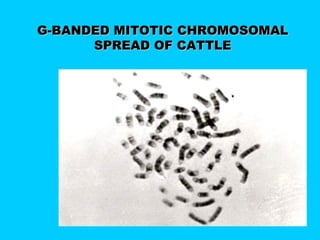
G-BANDED MITOTIC CHROMOSOMALG-BANDED MITOTIC CHROMOSOMAL
SPREAD OF CATTLESPREAD OF CATTLE
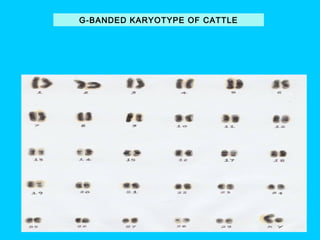
G-BANDED KARYOTYPE OF CATTLE
THANK YOU

Karyotyping

  • 1.
  • 2.
    Point to bestudied Chromosomes A. Definition B. Structure C. Identification Karyotypes A. Definition B. Methods C. Staining D. Importance
  • 3.
    Chromosome Definition  Genetic structuresof cells containing DNA Identification  Each chromosome has a characteristic length and banding pattern
  • 4.
     Each autosomeis numbered from 1- 22, sex chromosomes either X or Y
  • 5.
    Samples for karyotyping Amniocentesis – sample taken from the fluid of the amniotic sac  Chorionic Villus Sampling – sample taken from the fetal tissue that forms part of the placenta
  • 6.
    CYTOGENETICSCYTOGENETICS  Is thestudy of the structure and properties ofIs the study of the structure and properties of chromosomes, chromosomal behaviour duringchromosomes, chromosomal behaviour during mitosis and meiosis, chromosomal influence onmitosis and meiosis, chromosomal influence on the phenotype and the factors that causethe phenotype and the factors that cause chromosomal changes (Hare and Singh, 1979).chromosomal changes (Hare and Singh, 1979).
  • 7.
  • 8.
  • 9.
    METHODOLOGYMETHODOLOGY  Aseptic precautionsAsepticprecautions  Preparation of RPMI 1640 mediumPreparation of RPMI 1640 medium  Collection of 10ml of blood withCollection of 10ml of blood with heparinheparin  Setting of cultureSetting of culture 8 ml of medium8 ml of medium 0.1 ml of PHA-M0.1 ml of PHA-M 0.5 ml of blood/plasma0.5 ml of blood/plasma 2 ml of autologus plasma/FCS2 ml of autologus plasma/FCS  Incubate at 37Incubate at 37°°C for 72 hoursC for 72 hours
  • 10.
    METHODOLOGY…METHODOLOGY… Harvesting of cultureHarvestingof culture  Spindle inhibitors – Colchicine/colcemedSpindle inhibitors – Colchicine/colcemed (0.1(0.1µµg/ml)g/ml)  Hypotonic treatment – 0.075M KClHypotonic treatment – 0.075M KCl  Fixation (3:1 methanol : acetic acid)Fixation (3:1 methanol : acetic acid)  Preparation of slidesPreparation of slides  Slides stained with 4% Giemsa for 20-Slides stained with 4% Giemsa for 20- 25min25min  Screening of slides to study the morphology ofScreening of slides to study the morphology of chromosomechromosome  Construction of karyotypeConstruction of karyotype
  • 11.
  • 12.
    MITOTIC CHROMOSOMAL SPREADOFMITOTIC CHROMOSOMAL SPREAD OF CATTLECATTLE
  • 14.
  • 15.
    TERMS AND DEFINITIONSOF VARIOUSTERMS AND DEFINITIONS OF VARIOUS ABERRATIONS OF CHROMOSOMESABERRATIONS OF CHROMOSOMES  Ring( r)Ring( r) Minute (min)Minute (min)  Dicentric (d)Dicentric (d) Hyperdiploid (h)Hyperdiploid (h)  Chromosome gap (sg)Chromosome gap (sg) Chromatid deletion (td)Chromatid deletion (td)  Fragment (f)Fragment (f) Acentric fragment (af)Acentric fragment (af)  Translocation (t)Translocation (t) Triradial (tr)Triradial (tr)  Quadriradial (qr)Quadriradial (qr) Pulverized chromosomePulverized chromosome (pu)(pu)  Pulverized chromosome (pu+)Pulverized chromosome (pu+)  Pulverized cell (puc)Pulverized cell (puc)  Complex rearrangement (cr)Complex rearrangement (cr)  Polyploid (pp) or endoreduplicationPolyploid (pp) or endoreduplication
  • 16.
    BANDING OFBANDING OF CHROMOSOMESCHROMOSOMES G - BandingG - Banding  Q - BandingQ - Banding  C - BandingC - Banding  R - BandingR - Banding  T - BandingT - Banding  NOR - BandingNOR - Banding  High Resolution BandingHigh Resolution Banding  Restriction EndonucleaseRestriction Endonuclease BandingBanding
  • 17.
    Q-bandingQ-banding 1.1. Dehydrate theslides by dipping in alcohol withDehydrate the slides by dipping in alcohol with decreasing concentration 90%, 70% and 50%decreasing concentration 90%, 70% and 50% one min each.one min each. 2.2. Rinse in distilled water.Rinse in distilled water. 3.3. Wash the slide in phosphate buffer at pH 6.8.Wash the slide in phosphate buffer at pH 6.8. 4.4. Stain the slide in quinacrine mustard (5 mg inStain the slide in quinacrine mustard (5 mg in 100mI) or in quinacrine dihydrochloride 5% for100mI) or in quinacrine dihydrochloride 5% for 20 min.20 min. 5.5. Rinse in phosphate buffer and mount in theRinse in phosphate buffer and mount in the same buffer.same buffer. 6.6. Examine under fluorescent microscope.Examine under fluorescent microscope.
  • 18.
    C-bandingC-banding  Treat theslides in 0.2 N HCI for one hr atTreat the slides in 0.2 N HCI for one hr at room temperature.room temperature.  Rinse in de-ionized water.Rinse in de-ionized water.  Immerse in 1% barium hydroxide at 50°C forImmerse in 1% barium hydroxide at 50°C for 5-15 min.5-15 min.  Rinse in deionized water.Rinse in deionized water.  Incubate at 60°C in 2XSSC buffer for oneIncubate at 60°C in 2XSSC buffer for one hr.hr.  Rinse in de-ionized water and stain in 4%Rinse in de-ionized water and stain in 4% Giemsa stain for 90 min.Giemsa stain for 90 min.  Rinse in de-ionized water, dry and examineRinse in de-ionized water, dry and examine under oil immersion.under oil immersion.
  • 19.
    R-bandingR-banding  Age theslides for 7 -10 days .Age the slides for 7 -10 days .  Place the slides in a Coplinjar containingPlace the slides in a Coplinjar containing phosphate buffer ofpH 6.5 at 85°C andphosphate buffer ofpH 6.5 at 85°C and incubate for 20-25 min.incubate for 20-25 min.  Stain the slides in 0.01% acridine orangeStain the slides in 0.01% acridine orange in the phosphate buffer pH 6.5 for 4-6 min.in the phosphate buffer pH 6.5 for 4-6 min. Rinse in phosphate buffer and mount inRinse in phosphate buffer and mount in the same buffer.the same buffer.  Examine under fluorescent microscope.Examine under fluorescent microscope.
  • 20.
    T -bandingT -banding Age the slide for 7 days.Age the slide for 7 days.  Place the slides in PBS pH 5.0 for 20-60 min at 87°C.Place the slides in PBS pH 5.0 for 20-60 min at 87°C.  Rinse in PBS.Rinse in PBS.  Stain in 3% Giemsa in phosphate buffer pH 6.8 atStain in 3% Giemsa in phosphate buffer pH 6.8 at 87°C, leave for 5-30 min and rinse.87°C, leave for 5-30 min and rinse.  Slides are stained in Hoechst 33258 stain for 10 minSlides are stained in Hoechst 33258 stain for 10 min (Hoechst stain 0.5 pg/m1 of phosphate buffer).Rinse in(Hoechst stain 0.5 pg/m1 of phosphate buffer).Rinse in phosphate buffer and examine in fluorescentphosphate buffer and examine in fluorescent microscope.microscope.  Alternatively, the stained slides are covered with aAlternatively, the stained slides are covered with a cover slip and placed in a wet chamber under UV lampcover slip and placed in a wet chamber under UV lamp for 2 to 3 hrs or under direct sunlight for 2 hrs.for 2 to 3 hrs or under direct sunlight for 2 hrs.  Remove the cover slip and stain in Giemsa stain forRemove the cover slip and stain in Giemsa stain for 10 min.10 min.  Rinse in buffer, dry and mount in DPX.Rinse in buffer, dry and mount in DPX.
  • 21.
    METHODOLOGYMETHODOLOGY G- Banding techniqueG-Banding technique  Ageing of good slides for 10 daysAgeing of good slides for 10 days  Treated with trypsin 0.25% solution 10-15 secTreated with trypsin 0.25% solution 10-15 sec  Immersed in 70% ethanol for few minutes.Immersed in 70% ethanol for few minutes.  Stained with 10% Giemsa for 6-10min.Stained with 10% Giemsa for 6-10min.  Microphotograph good spreadsMicrophotograph good spreads  Construction of G-banded karyotypeConstruction of G-banded karyotype
  • 22.
    G-BANDED MITOTIC CHROMOSOMALG-BANDEDMITOTIC CHROMOSOMAL SPREAD OF CATTLESPREAD OF CATTLE
  • 23.
  • 24.