Diffraction
Wave Optics
Dr.Ehab Hegazy
2
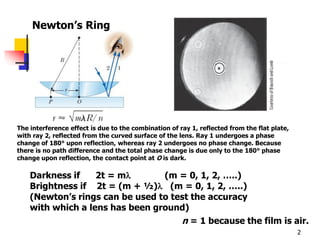
Newton’s Ring
The interference effect is due to the combination of ray 1, reflected from the flat plate,
with ray 2, reflected from the curved surface of the lens. Ray 1 undergoes a phase
change of 180° upon reflection, whereas ray 2 undergoes no phase change. Because
there is no path difference and the total phase change is due only to the 180° phase
change upon reflection, the contact point at O is dark.
n = 1 because the film is air.
Darkness if 2t = ml (m = 0, 1, 2, …..)
Brightness if 2t = (m + ½)l (m = 0, 1, 2, …..)
(Newton’s rings can be used to test the accuracy
with which a lens has been ground)
Questions
1. Derive from scratch the equation for the position of constructive
interference fringes on the screen above the center of the central
bright fringe in terms of the variables L, d, n, λ and θ.
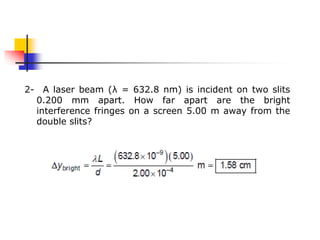
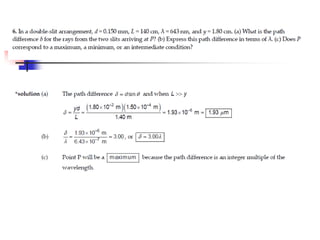
2- A laser beam (λ = 632.8 nm) is incident on two slits
0.200 mm apart. How far apart are the bright
interference fringes on a screen 5.00 m away from the
double slits?
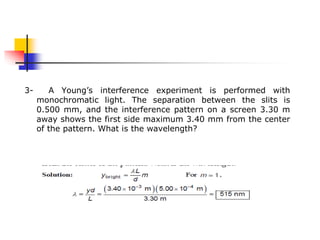
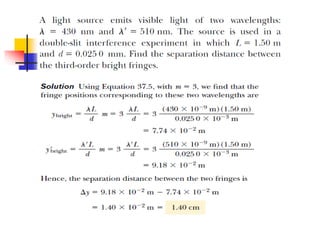
3- A Young’s interference experiment is performed with
monochromatic light. The separation between the slits is
0.500 mm, and the interference pattern on a screen 3.30 m
away shows the first side maximum 3.40 mm from the center
of the pattern. What is the wavelength?
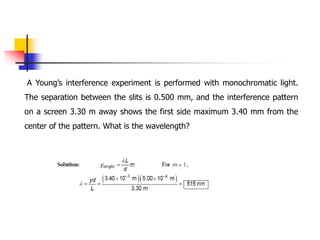
A Young’s interference experiment is performed with monochromatic light.
The separation between the slits is 0.500 mm, and the interference pattern
on a screen 3.30 m away shows the first side maximum 3.40 mm from the
center of the pattern. What is the wavelength?
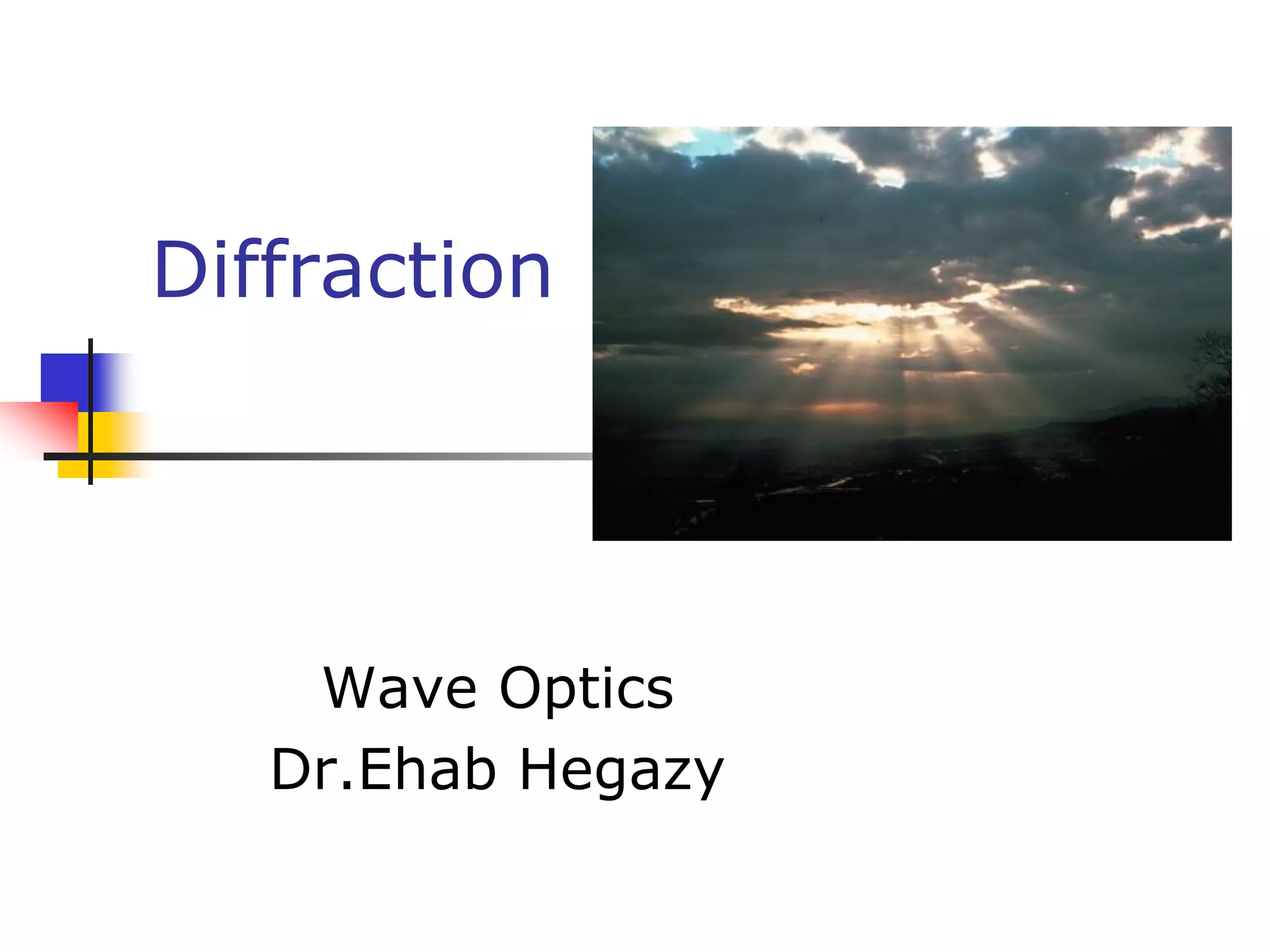
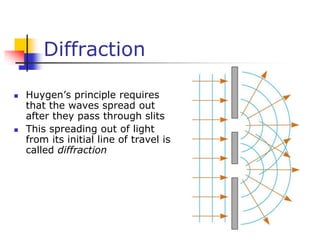
Diffraction
 Huygen’s principle requires
that the waves spread out
after they pass through slits
 This spreading out of light
from its initial line of travel is
called diffraction
Diffraction
 the process by which a beam of light or other system of
waves is spread out as a result of passing through a
narrow aperture or across an edge, typically accompanied
by interference between the wave forms produced.
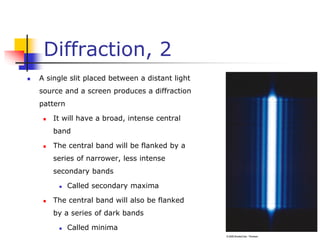
Diffraction, 2
 A single slit placed between a distant light
source and a screen produces a diffraction
pattern
 It will have a broad, intense central
band
 The central band will be flanked by a
series of narrower, less intense
secondary bands
 Called secondary maxima
 The central band will also be flanked
by a series of dark bands
 Called minima
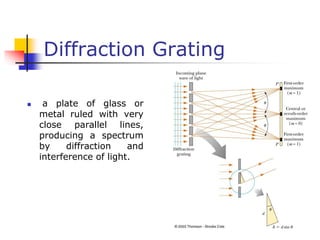
Diffraction Grating
 a plate of glass or
metal ruled with very
close parallel lines,
producing a spectrum
by diffraction and
interference of light.
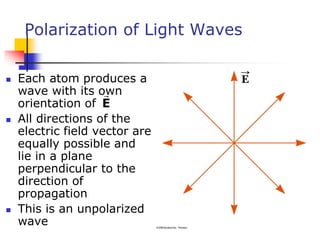
Polarization of Light Waves
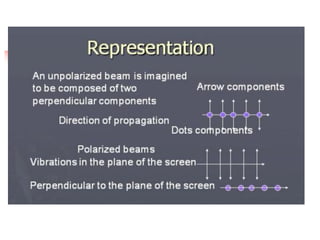
 Each atom produces a
wave with its own
orientation of
 All directions of the
electric field vector are
equally possible and
lie in a plane
perpendicular to the
direction of
propagation
 This is an unpolarized
wave
E
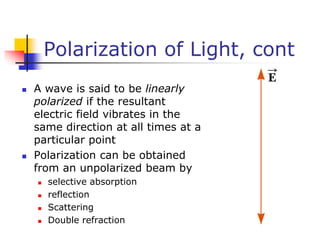
Polarization of Light, cont
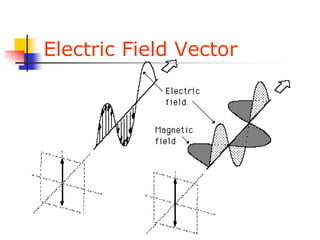
 A wave is said to be linearly
polarized if the resultant
electric field vibrates in the
same direction at all times at a
particular point
 Polarization can be obtained
from an unpolarized beam by
 selective absorption
 reflection
 Scattering
 Double refraction
Electric Field Vector
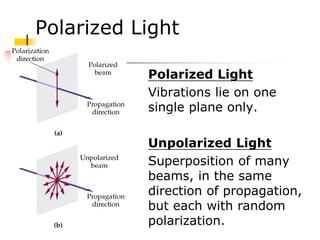
Polarized Light
Polarized Light
Vibrations lie on one
single plane only.
Unpolarized Light
Superposition of many
beams, in the same
direction of propagation,
but each with random
polarization.
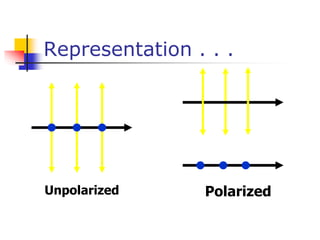
Representation . . .
Unpolarized Polarized
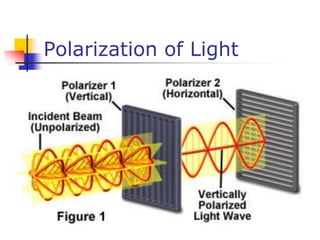
Polarization of Light
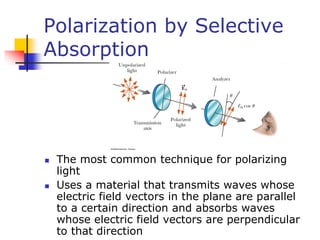
Polarization by Selective
Absorption
 The most common technique for polarizing
light
 Uses a material that transmits waves whose
electric field vectors in the plane are parallel
to a certain direction and absorbs waves
whose electric field vectors are perpendicular
to that direction
Selective Absorption, cont
 E. H. Land discovered a material
that polarizes light through
selective absorption
 He called the material Polaroid
 The molecules readily absorb light
whose electric field vector is parallel
to their lengths and transmit light
whose electric field vector is
perpendicular to their lengths
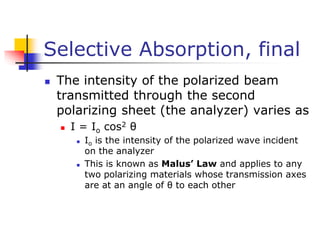
Selective Absorption, final
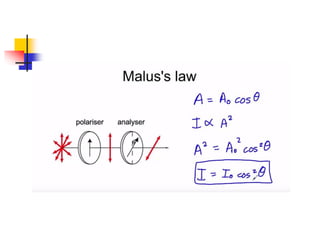
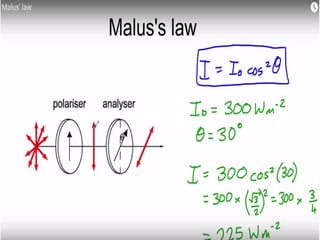
 The intensity of the polarized beam
transmitted through the second
polarizing sheet (the analyzer) varies as
 I = Io cos2 θ
 Io is the intensity of the polarized wave incident
on the analyzer
 This is known as Malus’ Law and applies to any
two polarizing materials whose transmission axes
are at an angle of θ to each other
Polarization by Reflection
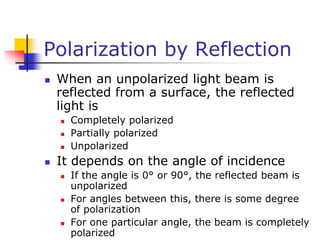
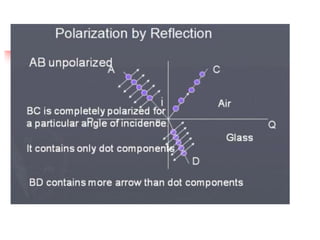
 When an unpolarized light beam is
reflected from a surface, the reflected
light is
 Completely polarized
 Partially polarized
 Unpolarized
 It depends on the angle of incidence
 If the angle is 0° or 90°, the reflected beam is
unpolarized
 For angles between this, there is some degree
of polarization
 For one particular angle, the beam is completely
polarized
Polarization by Reflection,
cont
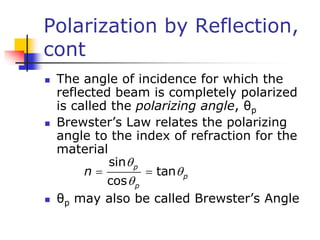
 The angle of incidence for which the
reflected beam is completely polarized
is called the polarizing angle, θp
 Brewster’s Law relates the polarizing
angle to the index of refraction for the
material
 θp may also be called Brewster’s Angle
sin
tan
cos
p
p
p
n



 
Polarization by Scattering
 When light is incident on a system
of particles, the electrons in the
medium can absorb and reradiate
part of the light
 This process is called scattering
 An example of scattering is the
sunlight reaching an observer on
the earth becoming polarized
Polarization by Scattering,
cont
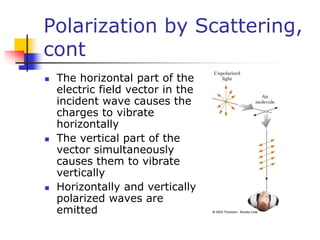
 The horizontal part of the
electric field vector in the
incident wave causes the
charges to vibrate
horizontally
 The vertical part of the
vector simultaneously
causes them to vibrate
vertically
 Horizontally and vertically
polarized waves are
emitted
Polarization by Refraction
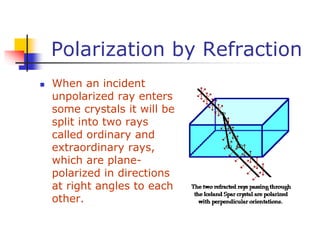
 When an incident
unpolarized ray enters
some crystals it will be
split into two rays
called ordinary and
extraordinary rays,
which are plane-
polarized in directions
at right angles to each
other.
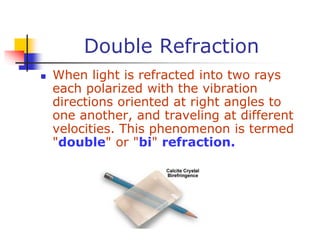
Double Refraction
 When light is refracted into two rays
each polarized with the vibration
directions oriented at right angles to
one another, and traveling at different
velocities. This phenomenon is termed
"double" or "bi" refraction.
Optical Activity
 Certain materials display the
property of optical activity
 A substance is optically active if it
rotates the plane of polarization of
transmitted light
 Optical activity occurs in a material
because of an asymmetry in the
shape of its constituent materials
Liquid Crystals
 A liquid crystal is a substance with
properties intermediate between those
of a crystalline solid and those of a
liquid
 The molecules of the substance are more
orderly than those of a liquid but less than
those in a pure crystalline solid
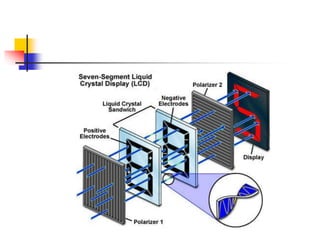
 To create a display, the liquid crystal is
placed between two glass plates and
electrical contacts are made to the
liquid crystal
 A voltage is applied across any segment in the
display and that segment turns on
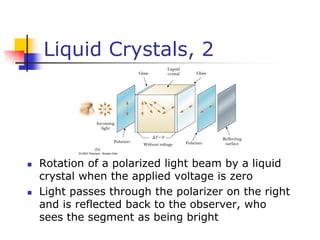
Liquid Crystals, 2
 Rotation of a polarized light beam by a liquid
crystal when the applied voltage is zero
 Light passes through the polarizer on the right
and is reflected back to the observer, who
sees the segment as being bright
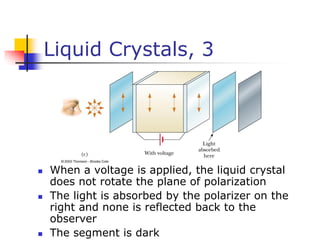
Liquid Crystals, 3
 When a voltage is applied, the liquid crystal
does not rotate the plane of polarization
 The light is absorbed by the polarizer on the
right and none is reflected back to the
observer
 The segment is dark
Liquid Crystals, final
 Changing the applied voltage in a
precise pattern can
 Tick off the seconds on a watch
 Display a letter on a computer display
3 polarization

3 polarization

  • 1.
  • 2.
    2 Newton’s Ring The interferenceeffect is due to the combination of ray 1, reflected from the flat plate, with ray 2, reflected from the curved surface of the lens. Ray 1 undergoes a phase change of 180° upon reflection, whereas ray 2 undergoes no phase change. Because there is no path difference and the total phase change is due only to the 180° phase change upon reflection, the contact point at O is dark. n = 1 because the film is air. Darkness if 2t = ml (m = 0, 1, 2, …..) Brightness if 2t = (m + ½)l (m = 0, 1, 2, …..) (Newton’s rings can be used to test the accuracy with which a lens has been ground)
  • 3.
    Questions 1. Derive fromscratch the equation for the position of constructive interference fringes on the screen above the center of the central bright fringe in terms of the variables L, d, n, λ and θ.
  • 4.
    2- A laserbeam (λ = 632.8 nm) is incident on two slits 0.200 mm apart. How far apart are the bright interference fringes on a screen 5.00 m away from the double slits?
  • 5.
    3- A Young’sinterference experiment is performed with monochromatic light. The separation between the slits is 0.500 mm, and the interference pattern on a screen 3.30 m away shows the first side maximum 3.40 mm from the center of the pattern. What is the wavelength?
  • 7.
    A Young’s interferenceexperiment is performed with monochromatic light. The separation between the slits is 0.500 mm, and the interference pattern on a screen 3.30 m away shows the first side maximum 3.40 mm from the center of the pattern. What is the wavelength?
  • 10.
    Diffraction  Huygen’s principlerequires that the waves spread out after they pass through slits  This spreading out of light from its initial line of travel is called diffraction
  • 11.
    Diffraction  the processby which a beam of light or other system of waves is spread out as a result of passing through a narrow aperture or across an edge, typically accompanied by interference between the wave forms produced.
  • 12.
    Diffraction, 2  Asingle slit placed between a distant light source and a screen produces a diffraction pattern  It will have a broad, intense central band  The central band will be flanked by a series of narrower, less intense secondary bands  Called secondary maxima  The central band will also be flanked by a series of dark bands  Called minima
  • 13.
    Diffraction Grating  aplate of glass or metal ruled with very close parallel lines, producing a spectrum by diffraction and interference of light.
  • 14.
    Polarization of LightWaves  Each atom produces a wave with its own orientation of  All directions of the electric field vector are equally possible and lie in a plane perpendicular to the direction of propagation  This is an unpolarized wave E
  • 15.
    Polarization of Light,cont  A wave is said to be linearly polarized if the resultant electric field vibrates in the same direction at all times at a particular point  Polarization can be obtained from an unpolarized beam by  selective absorption  reflection  Scattering  Double refraction
  • 17.
  • 18.
    Polarized Light Polarized Light Vibrationslie on one single plane only. Unpolarized Light Superposition of many beams, in the same direction of propagation, but each with random polarization.
  • 19.
    Representation . .. Unpolarized Polarized
  • 20.
  • 21.
    Polarization by Selective Absorption The most common technique for polarizing light  Uses a material that transmits waves whose electric field vectors in the plane are parallel to a certain direction and absorbs waves whose electric field vectors are perpendicular to that direction
  • 22.
    Selective Absorption, cont E. H. Land discovered a material that polarizes light through selective absorption  He called the material Polaroid  The molecules readily absorb light whose electric field vector is parallel to their lengths and transmit light whose electric field vector is perpendicular to their lengths
  • 23.
    Selective Absorption, final The intensity of the polarized beam transmitted through the second polarizing sheet (the analyzer) varies as  I = Io cos2 θ  Io is the intensity of the polarized wave incident on the analyzer  This is known as Malus’ Law and applies to any two polarizing materials whose transmission axes are at an angle of θ to each other
  • 26.
    Polarization by Reflection When an unpolarized light beam is reflected from a surface, the reflected light is  Completely polarized  Partially polarized  Unpolarized  It depends on the angle of incidence  If the angle is 0° or 90°, the reflected beam is unpolarized  For angles between this, there is some degree of polarization  For one particular angle, the beam is completely polarized
  • 28.
    Polarization by Reflection, cont The angle of incidence for which the reflected beam is completely polarized is called the polarizing angle, θp  Brewster’s Law relates the polarizing angle to the index of refraction for the material  θp may also be called Brewster’s Angle sin tan cos p p p n     
  • 29.
    Polarization by Scattering When light is incident on a system of particles, the electrons in the medium can absorb and reradiate part of the light  This process is called scattering  An example of scattering is the sunlight reaching an observer on the earth becoming polarized
  • 30.
    Polarization by Scattering, cont The horizontal part of the electric field vector in the incident wave causes the charges to vibrate horizontally  The vertical part of the vector simultaneously causes them to vibrate vertically  Horizontally and vertically polarized waves are emitted
  • 31.
    Polarization by Refraction When an incident unpolarized ray enters some crystals it will be split into two rays called ordinary and extraordinary rays, which are plane- polarized in directions at right angles to each other.
  • 32.
    Double Refraction  Whenlight is refracted into two rays each polarized with the vibration directions oriented at right angles to one another, and traveling at different velocities. This phenomenon is termed "double" or "bi" refraction.
  • 33.
    Optical Activity  Certainmaterials display the property of optical activity  A substance is optically active if it rotates the plane of polarization of transmitted light  Optical activity occurs in a material because of an asymmetry in the shape of its constituent materials
  • 34.
    Liquid Crystals  Aliquid crystal is a substance with properties intermediate between those of a crystalline solid and those of a liquid  The molecules of the substance are more orderly than those of a liquid but less than those in a pure crystalline solid  To create a display, the liquid crystal is placed between two glass plates and electrical contacts are made to the liquid crystal  A voltage is applied across any segment in the display and that segment turns on
  • 35.
    Liquid Crystals, 2 Rotation of a polarized light beam by a liquid crystal when the applied voltage is zero  Light passes through the polarizer on the right and is reflected back to the observer, who sees the segment as being bright
  • 36.
    Liquid Crystals, 3 When a voltage is applied, the liquid crystal does not rotate the plane of polarization  The light is absorbed by the polarizer on the right and none is reflected back to the observer  The segment is dark
  • 37.
    Liquid Crystals, final Changing the applied voltage in a precise pattern can  Tick off the seconds on a watch  Display a letter on a computer display