Better lives through livestock
Animal health and animal welfare
(focus on One Health)
Jimmy Smith
Director General
International Livestock Research Institute (ILRI)
Advancing the Global Agenda for Sustainable Livestock
22 September 2020
Better lives through livestock
2
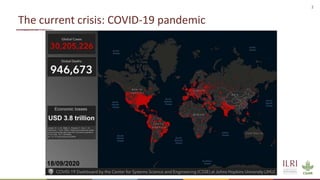
The current crisis: COVID-19 pandemic
3
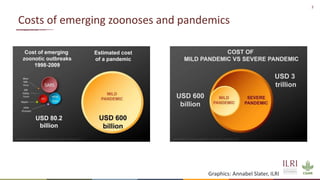
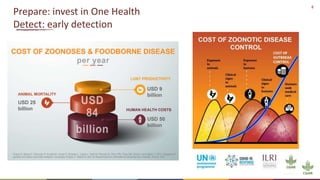
Costs of emerging zoonoses and pandemics
Graphics: Annabel Slater, ILRI
4
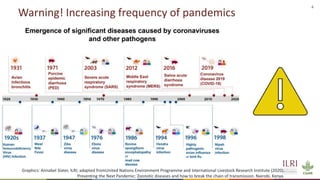
Warning! Increasing frequency of pandemics
Graphics: Annabel Slater, ILRI; adapted fromUnited Nations Environment Programme and International Livestock Research Institute (2020).
Preventing the Next Pandemic: Zoonotic diseases and how to break the chain of transmission. Nairobi, Kenya.
5
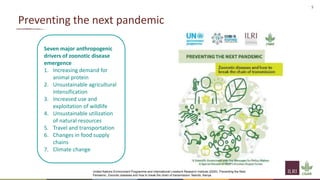
Preventing the next pandemic
Seven major anthropogenic
drivers of zoonotic disease
emergence
1. Increasing demand for
animal protein
2. Unsustainable agricultural
intensification
3. Increased use and
exploitation of wildlife
4. Unsustainable utilization
of natural resources
5. Travel and transportation
6. Changes in food supply
chains
7. Climate change
United Nations Environment Programme and International Livestock Research Institute (2020). Preventing the Next
Pandemic: Zoonotic diseases and how to break the chain of transmission. Nairobi, Kenya.
6
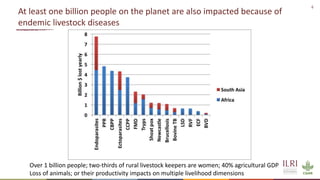
At least one billion people on the planet are also impacted because of
endemic livestock diseases
Over 1 billion people; two-thirds of rural livestock keepers are women; 40% agricultural GDP
Loss of animals; or their productivity impacts on multiple livelihood dimensions
7
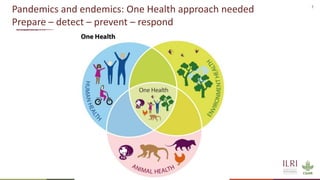
Pandemics and endemics: One Health approach needed
Prepare – detect – prevent – respond
8
Prepare: invest in One Health
Detect: early detection
9
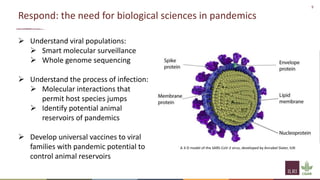
Respond: the need for biological sciences in pandemics
 Understand viral populations:
 Smart molecular surveillance
 Whole genome sequencing
 Understand the process of infection:
 Molecular interactions that
permit host species jumps
 Identify potential animal
reservoirs of pandemics
 Develop universal vaccines to viral
families with pandemic potential to
control animal reservoirs
A 3-D model of the SARS-CoV-2 virus, developed by Annabel Slater, ILRI
10
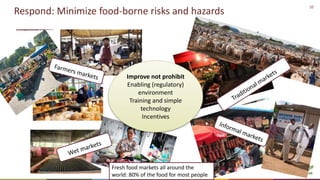
Respond: Minimize food-borne risks and hazards
Improve not prohibit
Enabling (regulatory)
environment
Training and simple
technology
Incentives
Fresh food markets all around the
world: 80% of the food for most people
11
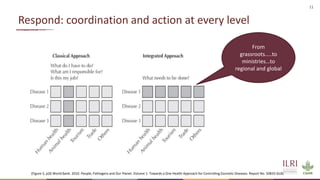
Respond: coordination and action at every level
(Figure 5, p26 World Bank. 2010. People, Pathogens and Our Planet. Volume 1: Towards a One Health Approach for Controlling Zoonotic Diseases. Report No. 50833-GLB)
From
grassroots…..to
ministries…to
regional and global
12
Key messages
Human-animal-environment health are inextricably linked
A One Health approach is essential
Strong health systems mean coordination and action for:
- Preparedness
- Detection
- Prevention
- Response
Beware of reactions that don’t consider trade-offs:
- E.g. improve don’t close wet markets
Science has a key role, and must connect across all other stakeholders
THANK YOU

Animal health and animal welfare (focus on One Health)

  • 1.
    Better lives throughlivestock Animal health and animal welfare (focus on One Health) Jimmy Smith Director General International Livestock Research Institute (ILRI) Advancing the Global Agenda for Sustainable Livestock 22 September 2020 Better lives through livestock
  • 2.
    2 The current crisis:COVID-19 pandemic
  • 3.
    3 Costs of emergingzoonoses and pandemics Graphics: Annabel Slater, ILRI
  • 4.
    4 Warning! Increasing frequencyof pandemics Graphics: Annabel Slater, ILRI; adapted fromUnited Nations Environment Programme and International Livestock Research Institute (2020). Preventing the Next Pandemic: Zoonotic diseases and how to break the chain of transmission. Nairobi, Kenya.
  • 5.
    5 Preventing the nextpandemic Seven major anthropogenic drivers of zoonotic disease emergence 1. Increasing demand for animal protein 2. Unsustainable agricultural intensification 3. Increased use and exploitation of wildlife 4. Unsustainable utilization of natural resources 5. Travel and transportation 6. Changes in food supply chains 7. Climate change United Nations Environment Programme and International Livestock Research Institute (2020). Preventing the Next Pandemic: Zoonotic diseases and how to break the chain of transmission. Nairobi, Kenya.
  • 6.
    6 At least onebillion people on the planet are also impacted because of endemic livestock diseases Over 1 billion people; two-thirds of rural livestock keepers are women; 40% agricultural GDP Loss of animals; or their productivity impacts on multiple livelihood dimensions
  • 7.
    7 Pandemics and endemics:One Health approach needed Prepare – detect – prevent – respond
  • 8.
    8 Prepare: invest inOne Health Detect: early detection
  • 9.
    9 Respond: the needfor biological sciences in pandemics  Understand viral populations:  Smart molecular surveillance  Whole genome sequencing  Understand the process of infection:  Molecular interactions that permit host species jumps  Identify potential animal reservoirs of pandemics  Develop universal vaccines to viral families with pandemic potential to control animal reservoirs A 3-D model of the SARS-CoV-2 virus, developed by Annabel Slater, ILRI
  • 10.
    10 Respond: Minimize food-bornerisks and hazards Improve not prohibit Enabling (regulatory) environment Training and simple technology Incentives Fresh food markets all around the world: 80% of the food for most people
  • 11.
    11 Respond: coordination andaction at every level (Figure 5, p26 World Bank. 2010. People, Pathogens and Our Planet. Volume 1: Towards a One Health Approach for Controlling Zoonotic Diseases. Report No. 50833-GLB) From grassroots…..to ministries…to regional and global
  • 12.
    12 Key messages Human-animal-environment healthare inextricably linked A One Health approach is essential Strong health systems mean coordination and action for: - Preparedness - Detection - Prevention - Response Beware of reactions that don’t consider trade-offs: - E.g. improve don’t close wet markets Science has a key role, and must connect across all other stakeholders
  • 13.

Editor's Notes

  • #11 Photo credits: ILRI/HUPH/Ngan Tran EADD/Neil Thomas ILRI/Jules Mateo A work-station at a local slaughterhouse in the Vietnamese central highland province of Binh Phuoc (photo credit: ILRI/Andrew Nguyen). Carcass surfaces is roasted with a gas burner in the market in Phnom Penh, Cambodia (photo credit: ILRI/ Fred Unger) China in 2005 (photo credit: ILRI/ Stevie Mann).