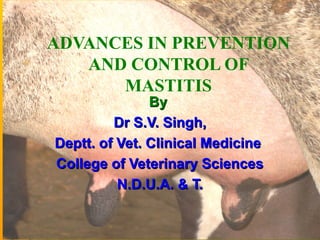
ADVANCES IN PREVENTION
AND CONTROL OF
MASTITIS
ByBy
Dr S.V. Singh,Dr S.V. Singh,
Deptt. of Vet. Clinical MedicineDeptt. of Vet. Clinical Medicine
College of Veterinary SciencesCollege of Veterinary Sciences
N.D.U.A. & T.N.D.U.A. & T.
Mastitis ?
 Inflammation of mammary glandInflammation of mammary gland
parenchymaparenchyma
 Characterised by:Characterised by: abnormalities of milkabnormalities of milk
&& abnormalities of udderabnormalities of udder
Why Mastitis?
 It is theIt is the MOST EXPENSIVE DISEASEMOST EXPENSIVE DISEASE ofof
dairy cattle resulting in thedairy cattle resulting in the reduction in milkreduction in milk
production, losses in milk quality andproduction, losses in milk quality and
quantity, losses due to discarded milk,quantity, losses due to discarded milk,
premature culling, treatment costs and labourpremature culling, treatment costs and labour
costcost
(Hogeveen(Hogeveen et al., 2011).et al., 2011).
 The worldwide estimated cost of mastitis toThe worldwide estimated cost of mastitis to
the dairy industry isthe dairy industry is $10.34 Billion$10.34 Billion annually.annually.
Scenario in INDIA
 In India, the total annual economic losses
due to mastitis was calculated to be 7165.51
crore rupees
(Bansal and Gupta, 2009)
Contd.Contd.
 Meta-analysis of 43 and 22 studies on SCM and CM,
respectively was carried out with random effects model
using Metaprop package in R-Software.
 The pooled prevalence of SCM and CM were 41% [33-
49%] and 27% [19- 37%], obtained by using 25,455 and
6,978 dairy animals.
 Pooled prevalence estimate of Staphylococcus sp.,
Streptococcus sp. and Escherichia coli were 45%, 13% and
14%, respectively.
 This study showed that the SCM was increasing and CM
prevalence was decreasing over the past six year period
[2011-16].
Krishnamoorthy et.al. (2017)
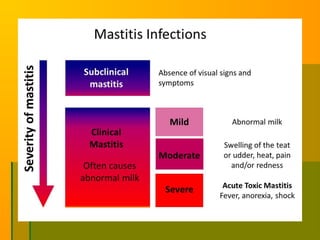
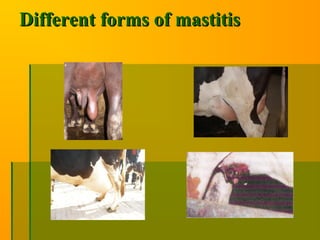
Different forms of mastitisDifferent forms of mastitis
Prevention is better than cure
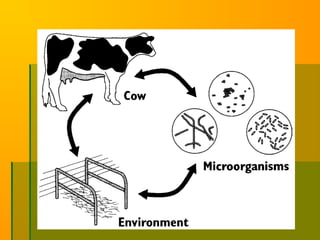
Mastitis control depends on
• Reducing the exposure of teat ends to
pathogens
• Increasing the resistance of cows to
infection.
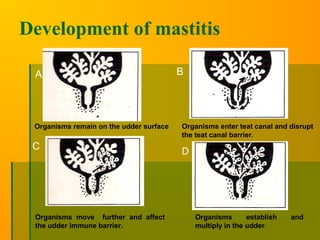
Development of mastitis
A
Organisms remain on the udder surface.
B
Organisms enter teat canal and disrupt
the teat canal barrier.
C
Organisms move further and affect
the udder immune barrier.
D
Organisms establish and
multiply in the udder.
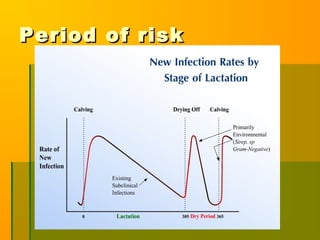
Period of riskPeriod of risk
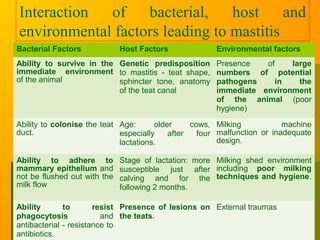
Interaction of bacterial, host and
environmental factors leading to mastitis
Bacterial Factors Host Factors Environmental factors
Ability to survive in the
immediate environment
of the animal
Genetic predisposition
to mastitis - teat shape,
sphincter tone, anatomy
of the teat canal
Presence of large
numbers of potential
pathogens in the
immediate environment
of the animal (poor
hygiene)
Ability to colonise the teat
duct.
Age: older cows,
especially after four
lactations.
Milking machine
malfunction or inadequate
design.
Ability to adhere to
mammary epithelium and
not be flushed out with the
milk flow
Stage of lactation: more
susceptible just after
calving and for the
following 2 months.
Milking shed environment
including poor milking
techniques and hygiene.
Ability to resist
phagocytosis and
antibacterial - resistance to
antibiotics.
Presence of lesions on
the teats.
External traumas
 Contagious mastitis - break the chain of
transmission
 Eliminating the source of infection (the infected
mammary gland, by isolation and quarantine)
and
 With strict sanitation at the time of milking.
 Environmental mastitis - restrict the contact of
populations of environmental bacteria with the
mammary gland.
 Good hygiene
 Invasion stateInvasion state
 Minimise exposureMinimise exposure
 Avoid the animals to sit immediately afterAvoid the animals to sit immediately after
calving, approx. 10 min (prevents the contactcalving, approx. 10 min (prevents the contact
of microbes to udder).of microbes to udder).
 Teat dippingTeat dipping
 Infection stageInfection stage
 Boosting udder immunity by supplementingBoosting udder immunity by supplementing
different antioxidantsdifferent antioxidants
 Inflammation stageInflammation stage
 Provide immediate medical careProvide immediate medical care
 Animals should be segregated from the rest.Animals should be segregated from the rest.
Key points to minimize mastitis in
dairy cows
 EnvironmentEnvironment
 NutritionNutrition
 Prompt treatmentPrompt treatment
 Dry Cow TreatmentDry Cow Treatment
 Vaccination?Vaccination?
Environment
 Sanitization and udder hygiene
 Udder hygiene,Udder hygiene,
 Environmental hygiene andEnvironmental hygiene and
 Sanitization measures for milker’s hands orSanitization measures for milker’s hands or
milking machines.milking machines.
Must do’s
 Proper and regular disposal of excreta
 Disinfection of housing premises
 Sanitization of cow’s udders and milker’s
hands or the milking machines prior to use.
 Prior and post milking teat dips with isopropyl
alcohol, chlorhexidine and 1% sodium
hypochlorite solution is effective.
Milking order
 Thumb rule is to milk primiparous cows’ first
and multiparous cows later.
 Among these healthy cows are to be milked
first and mastitic cows milked at last.
 Hind quarter milking should preferably
follow fore quarter milking.
Teat dipsTeat dips
 Pre- and post milking teat antisepsis -the most
important management strategy to reduce the
new intramammary infection rate in dairy cows
and to maintain a low level of mastitis.
 Chlorhexidine (0.2%), a commercial iodophor
(1% available iodine) , a hypochlorite (4%
available chlorine), reduced infections by 95,
87, 67%.
 Tap water -a small reduction in microflora.
Schultze and Smith(1972)Schultze and Smith(1972)
 1% H2O2; 1% chlorine dioxide; 1% iodophor; and
0.5% iodophor
 A 30-s premilking dip contact time for iodophors
and 15 s for H2O2 dips : optimal in reducing pathogen
load in the shortest amount of time.
 Mycoplasma bovis (97.9% log reduction) : most
sensitive to tested teat dips and Staphylococcus
haemolyticus (71.4% log reduction) : most resistant.
EngerEnger et al.,et al., 20152015
Herbal teat dip
 Mastidip liquid –Dabur Ayurvet
 Herbal teat dip Mastidip Liquid applied post milking in
1:1 dilution (one part concentrated solution + one part
clean water) twice daily immediately after milking
 The pH and SCC was normalized and milk yield
improved after treatment (Vala et al., 2013)
 Constituents : Berberis lycium, Curcuma longa and
Eucalyptus globulus
 Antimicrobial, antiinflammatory and
immunomodulatory activities (Bachir et al. 2008).
Home Made dip
 20 drops20 drops lavender oillavender oil
 10 drops10 drops tea tree oiltea tree oil
 2 tbsp soap2 tbsp soap
Dry Cow Treatment
WHY?
 Dry period can also be one of the busiest times
for intramammary infections.
 Because the cow is not being milked, any
pathogens in the udder are not being removed
and, therefore, have the chance to multiply.
 Mastitis is a very common problem during the
dry period.
The 4 goals of Dry Cow Therapy (DCT)
1. Cure existing infections at dry off.
 Reducing the number of cows carrying infections
through the dry period not only prevents these flaring
up into clinical infections but limits the source of
contagious bacteria to other cows in the herd.
2. Prevent new infections at dry off and throughout
the dry period.
 Dry period mastitis is difficult to treat, is costly and
time consuming and can have long term effects on the
cows’ production.
 Prevention is vital, especially where it is difficult to
inspect the cows regularly during the dry period.
 3. Protect against mastitis and reduce new
infections around the calving period.
 Mastitis around calving is common. The cow’s
defences are down around the calving period and
there is plenty of exposure to environmental
bacteria.
 4. Reduce Somatic Cell Count (SCC) and
mastitis into the subsequent lactation.
 Effective DCT will significantly reduce Somatic
cell count
Williamson J.H. et al. (1995).
Blanket versus Selective dry cow
treatment
 Concerns of antimicrobial resistance,Concerns of antimicrobial resistance,
selective dry cow treatment may be anselective dry cow treatment may be an
optionoption
Teat sealantTeat sealant
 The use of anThe use of an
internal teatinternal teat
sealant is ansealant is an
important part of aimportant part of a
dry cow therapydry cow therapy
program.program.
Step 1: Clean and dry teats.
Step 2: Using an alcohol pad, clean the end of the teat to remove
any contaminated skin, dirt or manure.
Step 3: Disinfect the far teats before the near teats to avoid
accidental contamination of previously disinfected teats.
Step 4: Insert the syringe nozzle into the teat canal. Grasp the
base of the teat near the udder attachment with two fingers
pressed firmly together and slowly inject all contents. Use one
complete syringe per quarter. Do not massage as the product
must remain in the teat canal to be effective.
Step 5: Insert the product into the nearest teats first to minimize
contamination of teats that have not been treated.
Step 6: After inserting the product, mark the cow so other
employees can tell she has been dried off. Then dip each teat
with a quality teat dip.
 The combination of Antibiotic Dry CowThe combination of Antibiotic Dry Cow
therapy and Teat Sealant providestherapy and Teat Sealant provides
benefits over Antibiotic Dry Cow therapybenefits over Antibiotic Dry Cow therapy
use alone through improved preventionuse alone through improved prevention
of subclinical mastitis and reduced ISCCof subclinical mastitis and reduced ISCC
in the first 60 d of lactation.in the first 60 d of lactation.
GolderGolder et al.,et al., 20162016
Lactation Cow therapy
 Sub-clinically mastitic cows should beSub-clinically mastitic cows should be
identified and subjected to short termidentified and subjected to short term
treatment with effective antibiotics attreatment with effective antibiotics at
least for 3-5 daysleast for 3-5 days
 Clinical mastitis : longer treatmentClinical mastitis : longer treatment
duration.duration.
PROMPT TREATMENTPROMPT TREATMENT
Antibiotics SystemicAntibiotics Systemic
IntramammaryIntramammary
Preferably the same antibiotic shouldPreferably the same antibiotic should
be usedbe used
Anti inflammatory drugsAnti inflammatory drugs
Anti histaminesAnti histamines
Extended Therapy for Mastitis
 An “extended therapy protocol” or “extended duration of
therapy” is defined as administering intramammary treatment
(mastitis tubes used in the quarter) for 2 to 8 days consecutively
 Extended duration intramammary therapy (“Extended
Therapy”) increases the chance of complete bacteriological cure
of mastitis in which all of the bacteria in the gland causing the
infection are killed.
 Complete cure often prevents relapses, prevents further damage
to the mammary tissue, lowers somatic cell count, and helps to
sustain future milk production.
Maintenance of optimum udder
immunity
 Udder’s local defense system, involvingUdder’s local defense system, involving
cellular reaction to infectious agents andcellular reaction to infectious agents and
enzyme as well as non-enzyme basedenzyme as well as non-enzyme based
antioxidant system requires activation.antioxidant system requires activation.
 Activation and interplay of these factorsActivation and interplay of these factors
is largely dependent on nutritional statusis largely dependent on nutritional status
of the animal.of the animal.
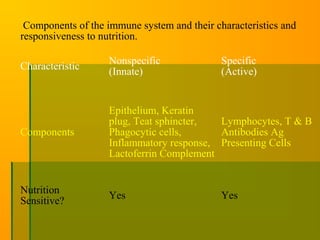
Components of the immune system and their characteristics and
responsiveness to nutrition.
Characteristic
Nonspecific
(Innate)
Specific
(Active)
Components
Epithelium, Keratin
plug, Teat sphincter,
Phagocytic cells,
Inflammatory response,
Lactoferrin Complement
Lymphocytes, T & B
Antibodies Ag
Presenting Cells
Nutrition
Sensitive?
Yes Yes
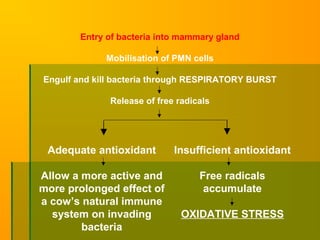
Entry of bacteria into mammary gland
Mobilisation of PMN cells
Engulf and kill bacteria through RESPIRATORY BURST
Release of free radicals
Adequate antioxidant
Allow a more active and
more prolonged effect of
a cow’s natural immune
system on invading
bacteria
Insufficient antioxidant
Free radicals
accumulate
OXIDATIVE STRESS
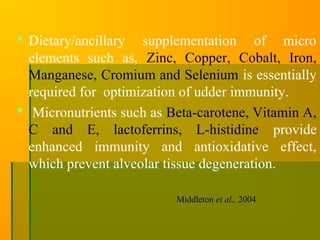
 Dietary/ancillary supplementation of micro
elements such as, Zinc, Copper, Cobalt, Iron,
Manganese, Cromium and Selenium is essentially
required for optimization of udder immunity.
 Micronutrients such as Beta-carotene, Vitamin A,
C and E, lactoferrins, L-histidine provide
enhanced immunity and antioxidative effect,
which prevent alveolar tissue degeneration.
Middleton et al., 2004
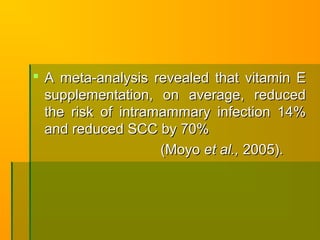
 A meta-analysis revealed that vitamin EA meta-analysis revealed that vitamin E
supplementation, on average, reducedsupplementation, on average, reduced
the risk of intramammary infection 14%the risk of intramammary infection 14%
and reduced SCC by 70%and reduced SCC by 70%
(Moyo(Moyo et al.,et al., 2005).2005).
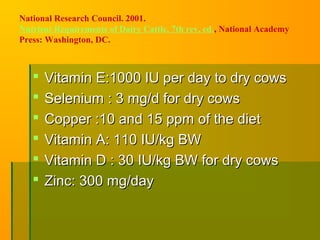
National Research Council. 2001.
Nutrient Requirements of Dairy Cattle, 7th rev. ed., National Academy
Press: Washington, DC.
 Vitamin E:1000 IU per day to dry cowsVitamin E:1000 IU per day to dry cows
 Selenium : 3 mg/d for dry cowsSelenium : 3 mg/d for dry cows
 Copper :10 and 15 ppm of the dietCopper :10 and 15 ppm of the diet
 Vitamin A: 110 IU/kg BWVitamin A: 110 IU/kg BW
 Vitamin D : 30 IU/kg BW for dry cowsVitamin D : 30 IU/kg BW for dry cows
 Zinc: 300 mg/dayZinc: 300 mg/day
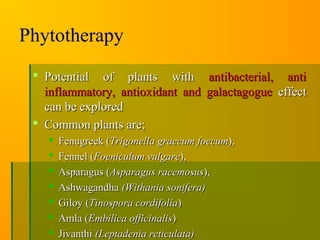
Phytotherapy
 Potential of plants withPotential of plants with antibacterial, antiantibacterial, anti
inflammatory, antioxidant and galactagogueinflammatory, antioxidant and galactagogue effecteffect
can be exploredcan be explored
 Common plants are;Common plants are;
 Fenugreek (Fenugreek (Trigonella graecum foecumTrigonella graecum foecum),),
 Fennel (Fennel (Foeniculum vulgareFoeniculum vulgare),),
 Asparagus (Asparagus (Asparagus racemosusAsparagus racemosus),),
 AshwagandhaAshwagandha (Withania sonifera)(Withania sonifera)
 Giloy (Giloy (Tinospora cordifoliaTinospora cordifolia))
 Amla (Amla (Embilica officinalisEmbilica officinalis))
 JivanthiJivanthi (Leptadenia reticulata)(Leptadenia reticulata)
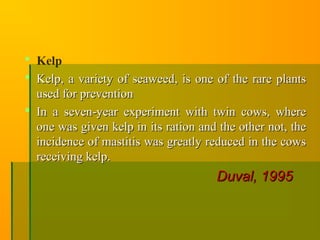
 Kelp
 Kelp, a variety of seaweed, is one of the rare plantsKelp, a variety of seaweed, is one of the rare plants
used for preventionused for prevention
 In a seven-year experiment with twin cows, whereIn a seven-year experiment with twin cows, where
one was given kelp in its ration and the other not, theone was given kelp in its ration and the other not, the
incidence of mastitis was greatly reduced in the cowsincidence of mastitis was greatly reduced in the cows
receiving kelp.receiving kelp.
Duval, 1995Duval, 1995
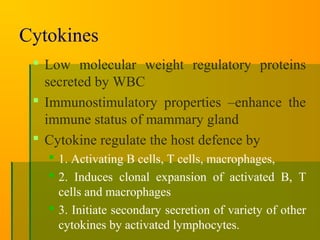
Cytokines
 Low molecular weight regulatory proteins
secreted by WBC
 Immunostimulatory properties –enhance the
immune status of mammary gland
 Cytokine regulate the host defence by
 1. Activating B cells, T cells, macrophages,
 2. Induces clonal expansion of activated B, T
cells and macrophages
 3. Initiate secondary secretion of variety of other
cytokines by activated lymphocytes.
Cytokines
 Uninfected mammary glands infused with Granulocyte
Monocyte-Colony stimulating factor or Interlukin (IL-2)
increased the percentage of phagocytic cells in the milk
by 2-3 fold.
 Treatment with IL-2 increased the number of
polymorphonuclear cells in the milk, enhanced their
inducible oxygen radical formation, and enhanced their
phagocytosis.
 All cytokines were effective in preventing S. aureus
infections (20-100%).
Daley et al., 1993
 Invitro and invivo studies indicate that rbIL2
enhance the functional capabilities of mono
nuclear cells within mammary gland.
WeaverWeaver et al.,et al., 19961996
 Interferons IFN gamma can be intrammarily
infused at doses as high as 105
per quarter
BabiukBabiuk et al.,et al., 19911991
 The subcutaneous administration of G-CSF
@1-5µg/kg per day -2-5 fold increase in
peripheral neutrophils KehriKehri et al.,et al., 19911991
Vaccination
 Vaccine available againstVaccine available against Streptococcus uberis , S.
agaglactiae , Staph. aureus and E. coli
 Vaccines againstVaccines against S. aureusS. aureus andand S. agalactiaeS. agalactiae
contains either the whole organism (cellular lysates,contains either the whole organism (cellular lysates,
inactive, and attenuated vaccines) or subunitsinactive, and attenuated vaccines) or subunits
(toxins, surface proteins, and polysaccharides)(toxins, surface proteins, and polysaccharides)
 E. coli:E. coli: the mutant core antigen J5 is mostthe mutant core antigen J5 is most
commonly used.commonly used.
 Vaccines : mono or polyvalent according to theVaccines : mono or polyvalent according to the
number of targeted pathogens it contained.number of targeted pathogens it contained.
 The commercial vaccines may not contain the mastitisThe commercial vaccines may not contain the mastitis
strains endemic to a particular dairy herd.strains endemic to a particular dairy herd.
 Multietiological nature of mastitis is the main constraintMultietiological nature of mastitis is the main constraint
in the development of an efficacious vaccine.in the development of an efficacious vaccine.
 No effect on udder health parameters @ 2ml IM onceNo effect on udder health parameters @ 2ml IM once
FreickFreick et al.,et al.,
20162016
 Moderate reduction in mastitis incidence PronouncedModerate reduction in mastitis incidence Pronounced
reduction in duration of mastitis @2 ml, intramuscularlyreduction in duration of mastitis @2 ml, intramuscularly
at 45, 10 days before calving; 52 days after calvingat 45, 10 days before calving; 52 days after calving
SchukkenSchukken et alet al., 2014., 2014
Breeding for resistance to mastitis
 The incorporation ofThe incorporation of SCC and clinical mastitisSCC and clinical mastitis
records in selection of dairy cattlerecords in selection of dairy cattle for breeding hasfor breeding has
the potential to reduce mastitis.the potential to reduce mastitis.
 Demand for more milk yield causes more incidenceDemand for more milk yield causes more incidence
of mastitis, and that selection for improved udderof mastitis, and that selection for improved udder
health is sacrificed for improvement in productionhealth is sacrificed for improvement in production
traits [Rogerstraits [Rogers et al.,et al., 1998].1998].
 Future innovations inFuture innovations in genomic selection technologiesgenomic selection technologies
will likely be used to accelerate genetic gains inwill likely be used to accelerate genetic gains in
resistance to mastitis (Vukasinovic et al., 2017).resistance to mastitis (Vukasinovic et al., 2017).
Probiotics: A Healthy Alternative
 Probiotics are "live microorganisms, which
when administered in adequate amounts
confer a health benefit on the host“.
 Administration of the lactococcal culture into
the mammary glands of uninfected animals
elicits an immunomodulatory effect that
substantially produces a recruitment of
polymorphonuclear and lymphocytes to the
infused quarters.
Crispie et al., 2008
Lactic acid bacteria (LAB) teat dips
 Probiotic lactobacilli-based teat disinfectant
could reduce mastitis-associated bacteria and
improve the microbial environment of the
cow teat.
 It could be used as an alternative to chemical
pre- and post-milking teat disinfectants
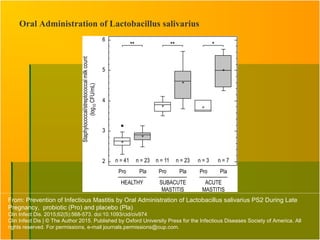
From: Prevention of Infectious Mastitis by Oral Administration of Lactobacillus salivarius PS2 During Late
Pregnancy, probiotic (Pro) and placebo (Pla)
Clin Infect Dis. 2015;62(5):568-573. doi:10.1093/cid/civ974
Clin Infect Dis | © The Author 2015. Published by Oxford University Press for the Infectious Diseases Society of America. All
rights reserved. For permissions, e-mail journals.permissions@oup.com.
Oral Administration of Lactobacillus salivarius
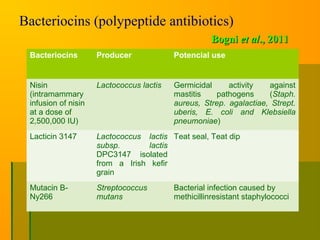
Bacteriocins (polypeptide antibiotics)
BogniBogni et alet al., 2011., 2011
Bacteriocins Producer Potencial use
Nisin
(intramammary
infusion of nisin
at a dose of
2,500,000 IU)
Lactococcus lactis Germicidal activity against
mastitis pathogens (Staph.
aureus, Strep. agalactiae, Strept.
uberis, E. coli and Klebsiella
pneumoniae)
Lacticin 3147 Lactococcus lactis
subsp. lactis
DPC3147 isolated
from a Irish kefir
grain
Teat seal, Teat dip
Mutacin B-
Ny266
Streptococcus
mutans
Bacterial infection caused by
methicillinresistant staphylococci
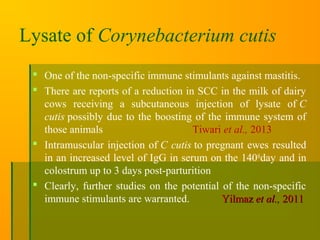
Lysate of Corynebacterium cutis
 One of the non-specific immune stimulants against mastitis.
 There are reports of a reduction in SCC in the milk of dairy
cows receiving a subcutaneous injection of lysate of C
cutis possibly due to the boosting of the immune system of
those animals Tiwari et al., 2013
 Intramuscular injection of C cutis to pregnant ewes resulted
in an increased level of IgG in serum on the 140th
day and in
colostrum up to 3 days post-parturition
 Clearly, further studies on the potential of the non-specific
immune stimulants are warranted. YilmazYilmaz et al.,et al., 20112011
Robotic milking may provide betterRobotic milking may provide better
possibility for proper milking andpossibility for proper milking and
improved udder health.improved udder health.  
Pyorola 2002Pyorola 2002
CullingCulling
 Culling cows for mastitis is effective in
eliminating mastitis in the herd.
 Cows that have been treated many times in a
single lactation are prime candidates for culling
Bovine mastitis   prevention and control

Bovine mastitis prevention and control

  • 1.
    ADVANCES IN PREVENTION ANDCONTROL OF MASTITIS ByBy Dr S.V. Singh,Dr S.V. Singh, Deptt. of Vet. Clinical MedicineDeptt. of Vet. Clinical Medicine College of Veterinary SciencesCollege of Veterinary Sciences N.D.U.A. & T.N.D.U.A. & T.
  • 2.
    Mastitis ?  Inflammationof mammary glandInflammation of mammary gland parenchymaparenchyma  Characterised by:Characterised by: abnormalities of milkabnormalities of milk && abnormalities of udderabnormalities of udder
  • 3.
    Why Mastitis?  Itis theIt is the MOST EXPENSIVE DISEASEMOST EXPENSIVE DISEASE ofof dairy cattle resulting in thedairy cattle resulting in the reduction in milkreduction in milk production, losses in milk quality andproduction, losses in milk quality and quantity, losses due to discarded milk,quantity, losses due to discarded milk, premature culling, treatment costs and labourpremature culling, treatment costs and labour costcost (Hogeveen(Hogeveen et al., 2011).et al., 2011).  The worldwide estimated cost of mastitis toThe worldwide estimated cost of mastitis to the dairy industry isthe dairy industry is $10.34 Billion$10.34 Billion annually.annually.
  • 4.
    Scenario in INDIA In India, the total annual economic losses due to mastitis was calculated to be 7165.51 crore rupees (Bansal and Gupta, 2009)
  • 5.
    Contd.Contd.  Meta-analysis of43 and 22 studies on SCM and CM, respectively was carried out with random effects model using Metaprop package in R-Software.  The pooled prevalence of SCM and CM were 41% [33- 49%] and 27% [19- 37%], obtained by using 25,455 and 6,978 dairy animals.  Pooled prevalence estimate of Staphylococcus sp., Streptococcus sp. and Escherichia coli were 45%, 13% and 14%, respectively.  This study showed that the SCM was increasing and CM prevalence was decreasing over the past six year period [2011-16]. Krishnamoorthy et.al. (2017)
  • 7.
    Different forms ofmastitisDifferent forms of mastitis
  • 8.
    Prevention is betterthan cure Mastitis control depends on • Reducing the exposure of teat ends to pathogens • Increasing the resistance of cows to infection.
  • 9.
    Development of mastitis A Organismsremain on the udder surface. B Organisms enter teat canal and disrupt the teat canal barrier. C Organisms move further and affect the udder immune barrier. D Organisms establish and multiply in the udder.
  • 10.
  • 12.
    Interaction of bacterial,host and environmental factors leading to mastitis Bacterial Factors Host Factors Environmental factors Ability to survive in the immediate environment of the animal Genetic predisposition to mastitis - teat shape, sphincter tone, anatomy of the teat canal Presence of large numbers of potential pathogens in the immediate environment of the animal (poor hygiene) Ability to colonise the teat duct. Age: older cows, especially after four lactations. Milking machine malfunction or inadequate design. Ability to adhere to mammary epithelium and not be flushed out with the milk flow Stage of lactation: more susceptible just after calving and for the following 2 months. Milking shed environment including poor milking techniques and hygiene. Ability to resist phagocytosis and antibacterial - resistance to antibiotics. Presence of lesions on the teats. External traumas
  • 13.
     Contagious mastitis- break the chain of transmission  Eliminating the source of infection (the infected mammary gland, by isolation and quarantine) and  With strict sanitation at the time of milking.  Environmental mastitis - restrict the contact of populations of environmental bacteria with the mammary gland.  Good hygiene
  • 14.
     Invasion stateInvasionstate  Minimise exposureMinimise exposure  Avoid the animals to sit immediately afterAvoid the animals to sit immediately after calving, approx. 10 min (prevents the contactcalving, approx. 10 min (prevents the contact of microbes to udder).of microbes to udder).  Teat dippingTeat dipping  Infection stageInfection stage  Boosting udder immunity by supplementingBoosting udder immunity by supplementing different antioxidantsdifferent antioxidants  Inflammation stageInflammation stage  Provide immediate medical careProvide immediate medical care  Animals should be segregated from the rest.Animals should be segregated from the rest.
  • 15.
    Key points tominimize mastitis in dairy cows  EnvironmentEnvironment  NutritionNutrition  Prompt treatmentPrompt treatment  Dry Cow TreatmentDry Cow Treatment  Vaccination?Vaccination?
  • 16.
    Environment  Sanitization andudder hygiene  Udder hygiene,Udder hygiene,  Environmental hygiene andEnvironmental hygiene and  Sanitization measures for milker’s hands orSanitization measures for milker’s hands or milking machines.milking machines.
  • 17.
    Must do’s  Properand regular disposal of excreta  Disinfection of housing premises  Sanitization of cow’s udders and milker’s hands or the milking machines prior to use.  Prior and post milking teat dips with isopropyl alcohol, chlorhexidine and 1% sodium hypochlorite solution is effective.
  • 18.
    Milking order  Thumbrule is to milk primiparous cows’ first and multiparous cows later.  Among these healthy cows are to be milked first and mastitic cows milked at last.  Hind quarter milking should preferably follow fore quarter milking.
  • 19.
    Teat dipsTeat dips Pre- and post milking teat antisepsis -the most important management strategy to reduce the new intramammary infection rate in dairy cows and to maintain a low level of mastitis.  Chlorhexidine (0.2%), a commercial iodophor (1% available iodine) , a hypochlorite (4% available chlorine), reduced infections by 95, 87, 67%.  Tap water -a small reduction in microflora. Schultze and Smith(1972)Schultze and Smith(1972)
  • 20.
     1% H2O2;1% chlorine dioxide; 1% iodophor; and 0.5% iodophor  A 30-s premilking dip contact time for iodophors and 15 s for H2O2 dips : optimal in reducing pathogen load in the shortest amount of time.  Mycoplasma bovis (97.9% log reduction) : most sensitive to tested teat dips and Staphylococcus haemolyticus (71.4% log reduction) : most resistant. EngerEnger et al.,et al., 20152015
  • 21.
    Herbal teat dip Mastidip liquid –Dabur Ayurvet  Herbal teat dip Mastidip Liquid applied post milking in 1:1 dilution (one part concentrated solution + one part clean water) twice daily immediately after milking  The pH and SCC was normalized and milk yield improved after treatment (Vala et al., 2013)  Constituents : Berberis lycium, Curcuma longa and Eucalyptus globulus  Antimicrobial, antiinflammatory and immunomodulatory activities (Bachir et al. 2008).
  • 22.
    Home Made dip 20 drops20 drops lavender oillavender oil  10 drops10 drops tea tree oiltea tree oil  2 tbsp soap2 tbsp soap
  • 23.
    Dry Cow Treatment WHY? Dry period can also be one of the busiest times for intramammary infections.  Because the cow is not being milked, any pathogens in the udder are not being removed and, therefore, have the chance to multiply.  Mastitis is a very common problem during the dry period.
  • 24.
    The 4 goalsof Dry Cow Therapy (DCT) 1. Cure existing infections at dry off.  Reducing the number of cows carrying infections through the dry period not only prevents these flaring up into clinical infections but limits the source of contagious bacteria to other cows in the herd. 2. Prevent new infections at dry off and throughout the dry period.  Dry period mastitis is difficult to treat, is costly and time consuming and can have long term effects on the cows’ production.  Prevention is vital, especially where it is difficult to inspect the cows regularly during the dry period.
  • 25.
     3. Protectagainst mastitis and reduce new infections around the calving period.  Mastitis around calving is common. The cow’s defences are down around the calving period and there is plenty of exposure to environmental bacteria.  4. Reduce Somatic Cell Count (SCC) and mastitis into the subsequent lactation.  Effective DCT will significantly reduce Somatic cell count Williamson J.H. et al. (1995).
  • 26.
    Blanket versus Selectivedry cow treatment  Concerns of antimicrobial resistance,Concerns of antimicrobial resistance, selective dry cow treatment may be anselective dry cow treatment may be an optionoption
  • 27.
    Teat sealantTeat sealant The use of anThe use of an internal teatinternal teat sealant is ansealant is an important part of aimportant part of a dry cow therapydry cow therapy program.program.
  • 28.
    Step 1: Cleanand dry teats. Step 2: Using an alcohol pad, clean the end of the teat to remove any contaminated skin, dirt or manure. Step 3: Disinfect the far teats before the near teats to avoid accidental contamination of previously disinfected teats. Step 4: Insert the syringe nozzle into the teat canal. Grasp the base of the teat near the udder attachment with two fingers pressed firmly together and slowly inject all contents. Use one complete syringe per quarter. Do not massage as the product must remain in the teat canal to be effective. Step 5: Insert the product into the nearest teats first to minimize contamination of teats that have not been treated. Step 6: After inserting the product, mark the cow so other employees can tell she has been dried off. Then dip each teat with a quality teat dip.
  • 29.
     The combinationof Antibiotic Dry CowThe combination of Antibiotic Dry Cow therapy and Teat Sealant providestherapy and Teat Sealant provides benefits over Antibiotic Dry Cow therapybenefits over Antibiotic Dry Cow therapy use alone through improved preventionuse alone through improved prevention of subclinical mastitis and reduced ISCCof subclinical mastitis and reduced ISCC in the first 60 d of lactation.in the first 60 d of lactation. GolderGolder et al.,et al., 20162016
  • 30.
    Lactation Cow therapy Sub-clinically mastitic cows should beSub-clinically mastitic cows should be identified and subjected to short termidentified and subjected to short term treatment with effective antibiotics attreatment with effective antibiotics at least for 3-5 daysleast for 3-5 days  Clinical mastitis : longer treatmentClinical mastitis : longer treatment duration.duration.
  • 31.
    PROMPT TREATMENTPROMPT TREATMENT AntibioticsSystemicAntibiotics Systemic IntramammaryIntramammary Preferably the same antibiotic shouldPreferably the same antibiotic should be usedbe used Anti inflammatory drugsAnti inflammatory drugs Anti histaminesAnti histamines
  • 32.
    Extended Therapy forMastitis  An “extended therapy protocol” or “extended duration of therapy” is defined as administering intramammary treatment (mastitis tubes used in the quarter) for 2 to 8 days consecutively  Extended duration intramammary therapy (“Extended Therapy”) increases the chance of complete bacteriological cure of mastitis in which all of the bacteria in the gland causing the infection are killed.  Complete cure often prevents relapses, prevents further damage to the mammary tissue, lowers somatic cell count, and helps to sustain future milk production.
  • 33.
    Maintenance of optimumudder immunity  Udder’s local defense system, involvingUdder’s local defense system, involving cellular reaction to infectious agents andcellular reaction to infectious agents and enzyme as well as non-enzyme basedenzyme as well as non-enzyme based antioxidant system requires activation.antioxidant system requires activation.  Activation and interplay of these factorsActivation and interplay of these factors is largely dependent on nutritional statusis largely dependent on nutritional status of the animal.of the animal.
  • 34.
    Components of theimmune system and their characteristics and responsiveness to nutrition. Characteristic Nonspecific (Innate) Specific (Active) Components Epithelium, Keratin plug, Teat sphincter, Phagocytic cells, Inflammatory response, Lactoferrin Complement Lymphocytes, T & B Antibodies Ag Presenting Cells Nutrition Sensitive? Yes Yes
  • 35.
    Entry of bacteriainto mammary gland Mobilisation of PMN cells Engulf and kill bacteria through RESPIRATORY BURST Release of free radicals Adequate antioxidant Allow a more active and more prolonged effect of a cow’s natural immune system on invading bacteria Insufficient antioxidant Free radicals accumulate OXIDATIVE STRESS
  • 36.
     Dietary/ancillary supplementationof micro elements such as, Zinc, Copper, Cobalt, Iron, Manganese, Cromium and Selenium is essentially required for optimization of udder immunity.  Micronutrients such as Beta-carotene, Vitamin A, C and E, lactoferrins, L-histidine provide enhanced immunity and antioxidative effect, which prevent alveolar tissue degeneration. Middleton et al., 2004
  • 37.
     A meta-analysisrevealed that vitamin EA meta-analysis revealed that vitamin E supplementation, on average, reducedsupplementation, on average, reduced the risk of intramammary infection 14%the risk of intramammary infection 14% and reduced SCC by 70%and reduced SCC by 70% (Moyo(Moyo et al.,et al., 2005).2005).
  • 38.
    National Research Council.2001. Nutrient Requirements of Dairy Cattle, 7th rev. ed., National Academy Press: Washington, DC.  Vitamin E:1000 IU per day to dry cowsVitamin E:1000 IU per day to dry cows  Selenium : 3 mg/d for dry cowsSelenium : 3 mg/d for dry cows  Copper :10 and 15 ppm of the dietCopper :10 and 15 ppm of the diet  Vitamin A: 110 IU/kg BWVitamin A: 110 IU/kg BW  Vitamin D : 30 IU/kg BW for dry cowsVitamin D : 30 IU/kg BW for dry cows  Zinc: 300 mg/dayZinc: 300 mg/day
  • 39.
    Phytotherapy  Potential ofplants withPotential of plants with antibacterial, antiantibacterial, anti inflammatory, antioxidant and galactagogueinflammatory, antioxidant and galactagogue effecteffect can be exploredcan be explored  Common plants are;Common plants are;  Fenugreek (Fenugreek (Trigonella graecum foecumTrigonella graecum foecum),),  Fennel (Fennel (Foeniculum vulgareFoeniculum vulgare),),  Asparagus (Asparagus (Asparagus racemosusAsparagus racemosus),),  AshwagandhaAshwagandha (Withania sonifera)(Withania sonifera)  Giloy (Giloy (Tinospora cordifoliaTinospora cordifolia))  Amla (Amla (Embilica officinalisEmbilica officinalis))  JivanthiJivanthi (Leptadenia reticulata)(Leptadenia reticulata)
  • 40.
     Kelp  Kelp,a variety of seaweed, is one of the rare plantsKelp, a variety of seaweed, is one of the rare plants used for preventionused for prevention  In a seven-year experiment with twin cows, whereIn a seven-year experiment with twin cows, where one was given kelp in its ration and the other not, theone was given kelp in its ration and the other not, the incidence of mastitis was greatly reduced in the cowsincidence of mastitis was greatly reduced in the cows receiving kelp.receiving kelp. Duval, 1995Duval, 1995
  • 41.
    Cytokines  Low molecularweight regulatory proteins secreted by WBC  Immunostimulatory properties –enhance the immune status of mammary gland  Cytokine regulate the host defence by  1. Activating B cells, T cells, macrophages,  2. Induces clonal expansion of activated B, T cells and macrophages  3. Initiate secondary secretion of variety of other cytokines by activated lymphocytes.
  • 42.
    Cytokines  Uninfected mammaryglands infused with Granulocyte Monocyte-Colony stimulating factor or Interlukin (IL-2) increased the percentage of phagocytic cells in the milk by 2-3 fold.  Treatment with IL-2 increased the number of polymorphonuclear cells in the milk, enhanced their inducible oxygen radical formation, and enhanced their phagocytosis.  All cytokines were effective in preventing S. aureus infections (20-100%). Daley et al., 1993
  • 43.
     Invitro andinvivo studies indicate that rbIL2 enhance the functional capabilities of mono nuclear cells within mammary gland. WeaverWeaver et al.,et al., 19961996  Interferons IFN gamma can be intrammarily infused at doses as high as 105 per quarter BabiukBabiuk et al.,et al., 19911991  The subcutaneous administration of G-CSF @1-5µg/kg per day -2-5 fold increase in peripheral neutrophils KehriKehri et al.,et al., 19911991
  • 44.
    Vaccination  Vaccine availableagainstVaccine available against Streptococcus uberis , S. agaglactiae , Staph. aureus and E. coli  Vaccines againstVaccines against S. aureusS. aureus andand S. agalactiaeS. agalactiae contains either the whole organism (cellular lysates,contains either the whole organism (cellular lysates, inactive, and attenuated vaccines) or subunitsinactive, and attenuated vaccines) or subunits (toxins, surface proteins, and polysaccharides)(toxins, surface proteins, and polysaccharides)  E. coli:E. coli: the mutant core antigen J5 is mostthe mutant core antigen J5 is most commonly used.commonly used.  Vaccines : mono or polyvalent according to theVaccines : mono or polyvalent according to the number of targeted pathogens it contained.number of targeted pathogens it contained.
  • 45.
     The commercialvaccines may not contain the mastitisThe commercial vaccines may not contain the mastitis strains endemic to a particular dairy herd.strains endemic to a particular dairy herd.  Multietiological nature of mastitis is the main constraintMultietiological nature of mastitis is the main constraint in the development of an efficacious vaccine.in the development of an efficacious vaccine.  No effect on udder health parameters @ 2ml IM onceNo effect on udder health parameters @ 2ml IM once FreickFreick et al.,et al., 20162016  Moderate reduction in mastitis incidence PronouncedModerate reduction in mastitis incidence Pronounced reduction in duration of mastitis @2 ml, intramuscularlyreduction in duration of mastitis @2 ml, intramuscularly at 45, 10 days before calving; 52 days after calvingat 45, 10 days before calving; 52 days after calving SchukkenSchukken et alet al., 2014., 2014
  • 46.
    Breeding for resistanceto mastitis  The incorporation ofThe incorporation of SCC and clinical mastitisSCC and clinical mastitis records in selection of dairy cattlerecords in selection of dairy cattle for breeding hasfor breeding has the potential to reduce mastitis.the potential to reduce mastitis.  Demand for more milk yield causes more incidenceDemand for more milk yield causes more incidence of mastitis, and that selection for improved udderof mastitis, and that selection for improved udder health is sacrificed for improvement in productionhealth is sacrificed for improvement in production traits [Rogerstraits [Rogers et al.,et al., 1998].1998].  Future innovations inFuture innovations in genomic selection technologiesgenomic selection technologies will likely be used to accelerate genetic gains inwill likely be used to accelerate genetic gains in resistance to mastitis (Vukasinovic et al., 2017).resistance to mastitis (Vukasinovic et al., 2017).
  • 47.
    Probiotics: A HealthyAlternative  Probiotics are "live microorganisms, which when administered in adequate amounts confer a health benefit on the host“.  Administration of the lactococcal culture into the mammary glands of uninfected animals elicits an immunomodulatory effect that substantially produces a recruitment of polymorphonuclear and lymphocytes to the infused quarters. Crispie et al., 2008
  • 48.
    Lactic acid bacteria(LAB) teat dips  Probiotic lactobacilli-based teat disinfectant could reduce mastitis-associated bacteria and improve the microbial environment of the cow teat.  It could be used as an alternative to chemical pre- and post-milking teat disinfectants
  • 49.
    From: Prevention ofInfectious Mastitis by Oral Administration of Lactobacillus salivarius PS2 During Late Pregnancy, probiotic (Pro) and placebo (Pla) Clin Infect Dis. 2015;62(5):568-573. doi:10.1093/cid/civ974 Clin Infect Dis | © The Author 2015. Published by Oxford University Press for the Infectious Diseases Society of America. All rights reserved. For permissions, e-mail journals.permissions@oup.com. Oral Administration of Lactobacillus salivarius
  • 50.
    Bacteriocins (polypeptide antibiotics) BogniBogniet alet al., 2011., 2011 Bacteriocins Producer Potencial use Nisin (intramammary infusion of nisin at a dose of 2,500,000 IU) Lactococcus lactis Germicidal activity against mastitis pathogens (Staph. aureus, Strep. agalactiae, Strept. uberis, E. coli and Klebsiella pneumoniae) Lacticin 3147 Lactococcus lactis subsp. lactis DPC3147 isolated from a Irish kefir grain Teat seal, Teat dip Mutacin B- Ny266 Streptococcus mutans Bacterial infection caused by methicillinresistant staphylococci
  • 51.
    Lysate of Corynebacteriumcutis  One of the non-specific immune stimulants against mastitis.  There are reports of a reduction in SCC in the milk of dairy cows receiving a subcutaneous injection of lysate of C cutis possibly due to the boosting of the immune system of those animals Tiwari et al., 2013  Intramuscular injection of C cutis to pregnant ewes resulted in an increased level of IgG in serum on the 140th day and in colostrum up to 3 days post-parturition  Clearly, further studies on the potential of the non-specific immune stimulants are warranted. YilmazYilmaz et al.,et al., 20112011
  • 52.
    Robotic milking mayprovide betterRobotic milking may provide better possibility for proper milking andpossibility for proper milking and improved udder health.improved udder health.   Pyorola 2002Pyorola 2002
  • 53.
    CullingCulling  Culling cowsfor mastitis is effective in eliminating mastitis in the herd.  Cows that have been treated many times in a single lactation are prime candidates for culling

Editor's Notes

  • #50 Figure 1. Staphylococcal/streptococcal counts in milk samples provided by the recruited women (N = 108). Differences in mean staphylococcal/streptococcal counts between probiotic (Pro) and placebo (Pla) groups for each status (healthy, subacute mastitis, and acute mastitis) were evaluated with t tests and are shown with horizontal lines inside the graph (*P < .01; **P < .001). Abbreviation: CFU, colony-forming units.