Heat Stress and the Dairy
Industry
Lance Baumgard
AnSc 435
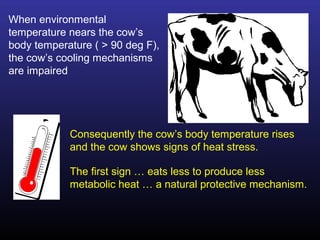
When environmental
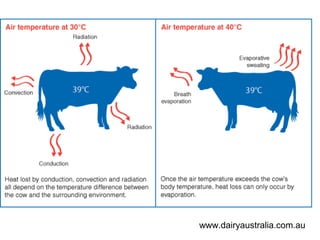
temperature nears the cow’s
body temperature ( > 90 deg F),
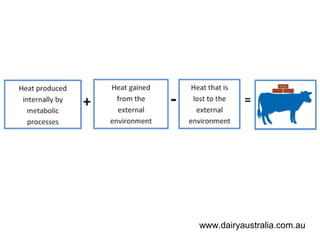
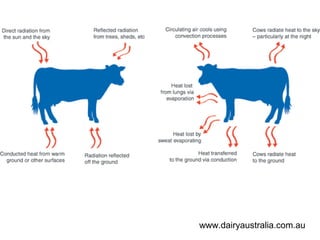
the cow’s cooling mechanisms
are impaired
Consequently the cow’s body temperature rises
and the cow shows signs of heat stress.
The first sign … eats less to produce less
metabolic heat … a natural protective mechanism.
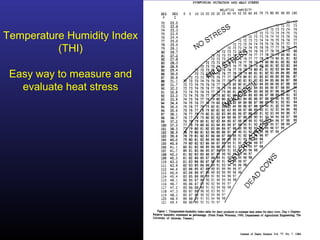
Temperature Humidity Index
(THI)
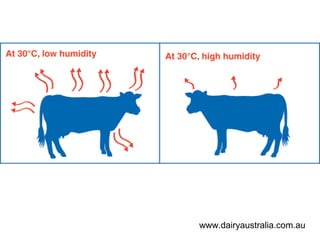
Easy way to measure and
evaluate heat stress
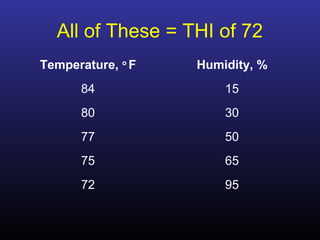
All of These = THI of 72
Temperature, o
F Humidity, %
84 15
80 30
77 50
75 65
72 95
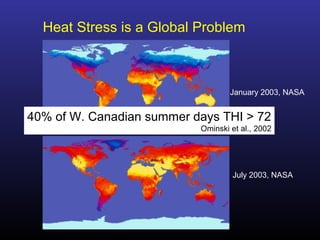
Heat Stress is a Global Problem
January 2003, NASA
July 2003, NASA
40% of W. Canadian summer days THI > 72
Ominski et al., 2002
Decrease in production (milk and growth)
Reduced body condition
Acute and chronic health problems
Decreased reproductive indices
Abortions
Animal death
Possibly the most costly
issue affecting global animal
agriculture
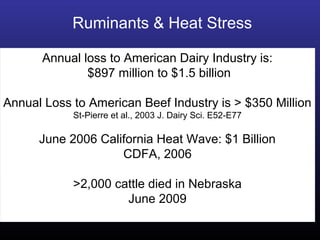
Ruminants & Heat Stress
rumen acidosis & laminitis
Annual loss to American Dairy Industry is:
$897 million to $1.5 billion
Annual Loss to American Beef Industry is > $350 Million
St-Pierre et al., 2003 J. Dairy Sci. E52-E77
June 2006 California Heat Wave: $1 Billion
CDFA, 2006
>2,000 cattle died in Nebraska
June 2009
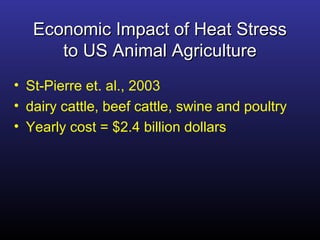
Economic Impact of Heat StressEconomic Impact of Heat Stress
to US Animal Agricultureto US Animal Agriculture
• St-Pierre et. al., 2003
• dairy cattle, beef cattle, swine and poultry
• Yearly cost = $2.4 billion dollars
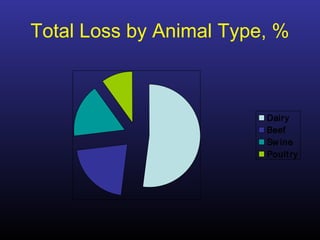
Total Loss by Animal Type, %
Dairy
Beef
Sw ine
Poultry
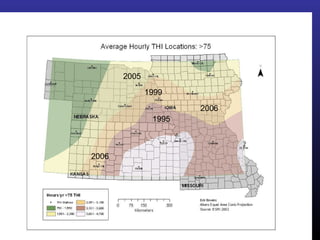
1995
1999
2005
2006
2006
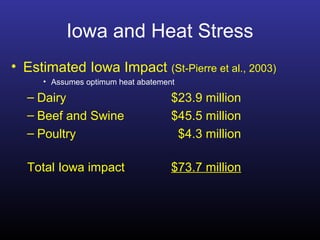
Iowa and Heat Stress
• Estimated Iowa Impact (St-Pierre et al., 2003)
• Assumes optimum heat abatement
– Dairy $23.9 million
– Beef and Swine $45.5 million
– Poultry $4.3 million
Total Iowa impact $73.7 million
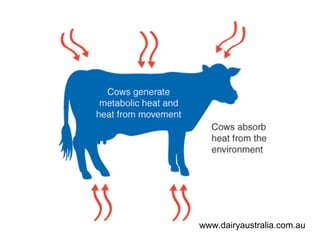
www.dairyaustralia.com.au
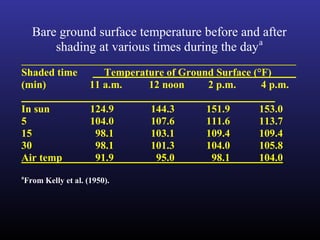
Bare ground surface temperature before and after
shading at various times during the daya
Shaded time Temperature of Ground Surface (°F)
(min) 11 a.m. 12 noon 2 p.m. 4 p.m.
In sun 124.9 144.3 151.9 153.0
5 104.0 107.6 111.6 113.7
15 98.1 103.1 109.4 109.4
30 98.1 101.3 104.0 105.8
Air temp 91.9 95.0 98.1 104.0
a
From Kelly et al. (1950).
www.dairyaustralia.com.au
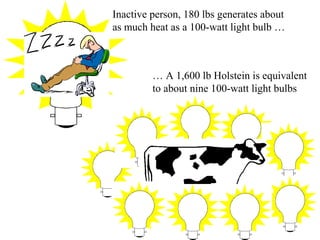
Inactive person, 180 lbs generates about
as much heat as a 100-watt light bulb …
… A 1,600 lb Holstein is equivalent
to about nine 100-watt light bulbs
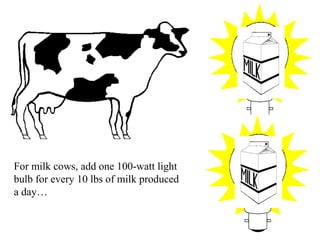
For milk cows, add one 100-watt light
bulb for every 10 lbs of milk produced
a day…
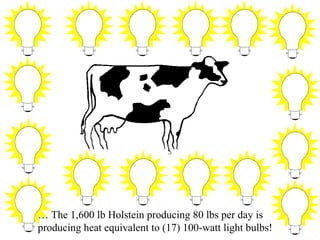
… The 1,600 lb Holstein producing 80 lbs per day is
producing heat equivalent to (17) 100-watt light bulbs!
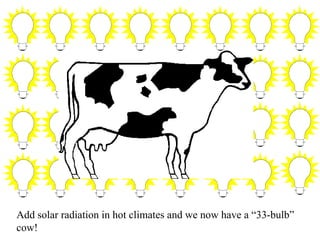
Add solar radiation in hot climates and we now have a “33-bulb”
cow!
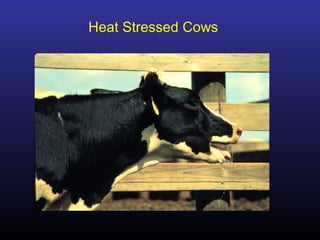
Heat Stressed Cows
Decrease in milk production
Reduced body condition
Acute health problems
Significant drop in pregnancy rate
High incidence of abortions
High death loss
Added all up …
costly!
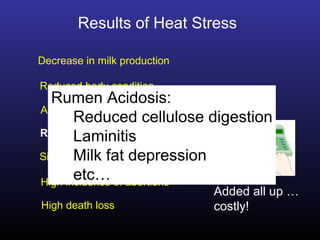
Results of Heat Stress
Rumen acidosis
Rumen Acidosis:
Reduced cellulose digestion
Laminitis
Milk fat depression
etc…
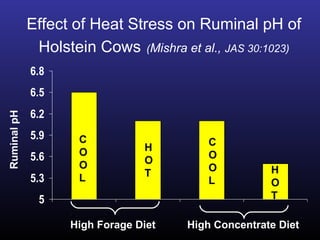
Effect of Heat Stress on Ruminal pH of
Holstein Cows (Mishra et al., JAS 30:1023)
5
5.3
5.6
5.9
6.2
6.5
6.8
High Forage Diet High Concentrate Diet
C
O
O
L
C
O
O
L
H
O
T H
O
T
RuminalpH
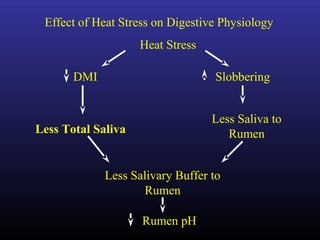
Effect of Heat Stress on Digestive Physiology
DMI
Less Total Saliva
Slobbering
Less Saliva to
Rumen
Less Salivary Buffer to
Rumen
Heat Stress
Rumen pH
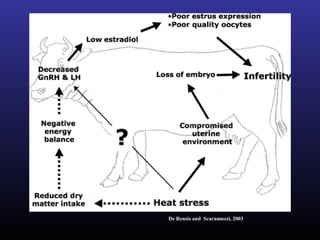
De Rensis and Scaramuzzi, 2003
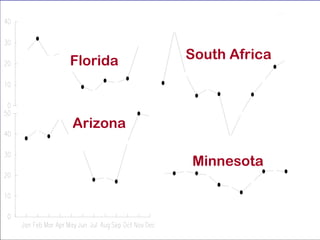
Florida South Africa
Arizona
Minnesota
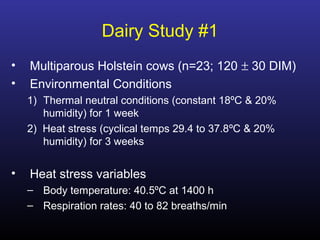
Dairy Study #1
• Multiparous Holstein cows (n=23; 120 ± 30 DIM)
• Environmental Conditions
1) Thermal neutral conditions (constant 18ºC & 20%
humidity) for 1 week
2) Heat stress (cyclical temps 29.4 to 37.8ºC & 20%
humidity) for 3 weeks
• Heat stress variables
– Body temperature: 40.5ºC at 1400 h
– Respiration rates: 40 to 82 breaths/min
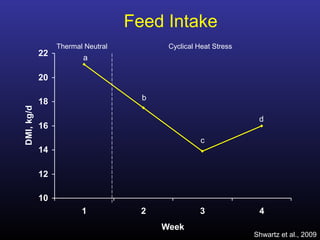
Feed Intake
10
12
14
16
18
20
22
1 2 3 4
Week
DMI,kg/d
Thermal Neutral Cyclical Heat Stress
a
b
c
d
Shwartz et al., 2009
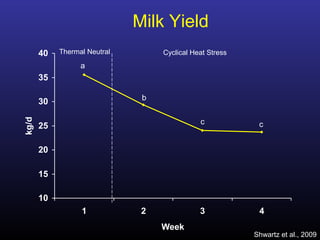
Milk Yield
10
15
20
25
30
35
40
1 2 3 4
Week
kg/d
Thermal Neutral Cyclical Heat Stress
a
b
c c
Shwartz et al., 2009
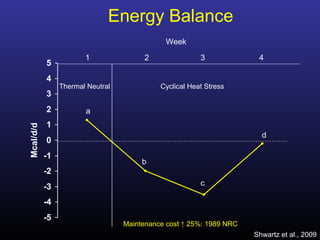
Energy Balance
-5
-4
-3
-2
-1
0
1
2
3
4
5
Mcal/d/d
Thermal Neutral Cyclical Heat Stress
a
b
c
d
1 2 3 4
Week
Shwartz et al., 2009
Maintenance cost ↑ 25%: 1989 NRC
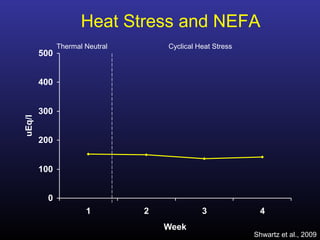
Heat Stress and NEFA
0
100
200
300
400
500
1 2 3 4
Week
uEq/l
Thermal Neutral Cyclical Heat Stress
Shwartz et al., 2009
Interesting Observations
– Feed intake acclimated to heat stress but milk
yield did not
• Suggests something in addition to reduced feed intake is
decreasing milk yield during heat stress
– Despite the negative energy balance and loss
of body weight adipose tissue was not
mobilized
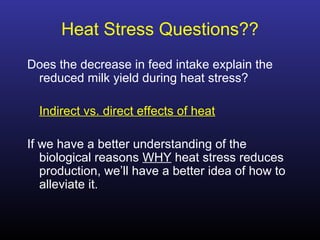
Heat Stress Questions??
Does the decrease in feed intake explain the
reduced milk yield during heat stress?
Indirect vs. direct effects of heat
If we have a better understanding of the
biological reasons WHY heat stress reduces
production, we’ll have a better idea of how to
alleviate it.
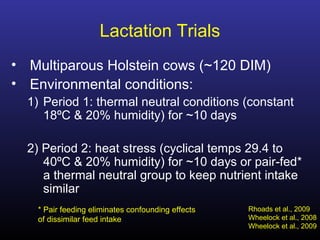
Lactation Trials
• Multiparous Holstein cows (~120 DIM)
• Environmental conditions:
1) Period 1: thermal neutral conditions (constant
18ºC & 20% humidity) for ~10 days
2) Period 2: heat stress (cyclical temps 29.4 to
40ºC & 20% humidity) for ~10 days or pair-fed*
a thermal neutral group to keep nutrient intake
similar
Rhoads et al., 2009
Wheelock et al., 2008
Wheelock et al., 2009
* Pair feeding eliminates confounding effects
of dissimilar feed intake
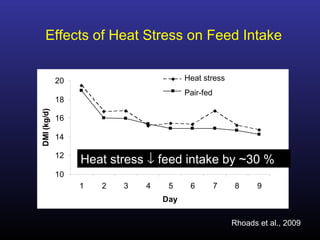
10
12
14
16
18
20
1 2 3 4 5 6 7 8 9
Day
DMI(kg/d)
Heat Stress
Underfed
Effects of Heat Stress on Feed Intake
Rhoads et al., 2009
Heat stress ↓ feed intake by ~30 %
Heat stress
Pair-fed
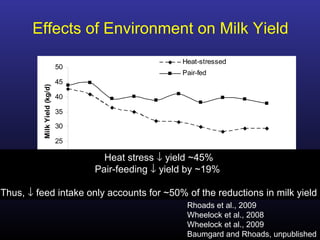
20
25
30
35
40
45
50
0 1 2 3 4 5 6 7 8 9
Day
MilkYield(kg/d)
Heat-stressed
Pair-fed
Effects of Environment on Milk Yield
Rhoads et al., 2009
Wheelock et al., 2008
Wheelock et al., 2009
Baumgard and Rhoads, unpublished
Heat stress ↓ yield ~45%
Pair-feeding ↓ yield by ~19%
Thus, ↓ feed intake only accounts for ~50% of the reductions in milk yield
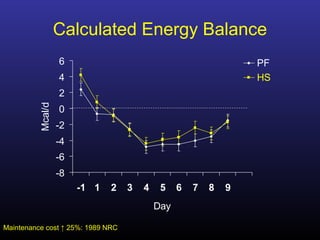
Calculated Energy Balance
-8
-6
-4
-2
0
2
4
6
-1 1 2 3 4 5 6 7 8 9
Day
Mcal/d
PF
HS
Maintenance cost ↑ 25%: 1989 NRC
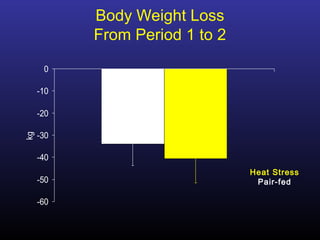
Body Weight Loss
From Period 1 to 2
-60
-50
-40
-30
-20
-10
0
kg
Heat Stress
Pair-fed
0
100
200
300
400
500
600
1 2 3 4 5 6 7 8 9
Day
NEFA(uEq/l)
Heat-stressed
Pair-fed
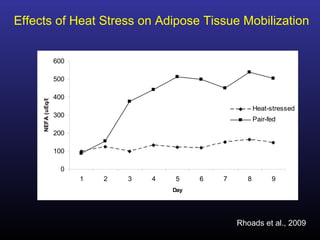
Effects of Heat Stress on Adipose Tissue Mobilization
Rhoads et al., 2009
-0.1
0.1
0.3
0.5
0.7
0.9
1.1
1.3
1.5
1 2 3
Period
Insulin(ng/ml)
Heat Stressed
Pair-fed
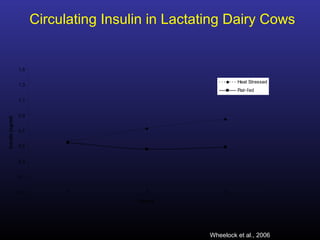
Circulating Insulin in Lactating Dairy Cows
Wheelock et al., 2006
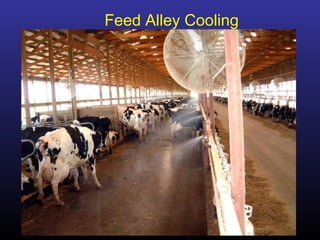
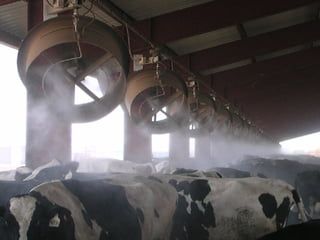
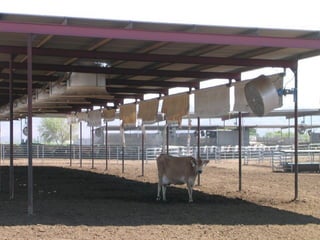
Where to cool cows?
• Free stalls or dry lot pens
• Holding pen
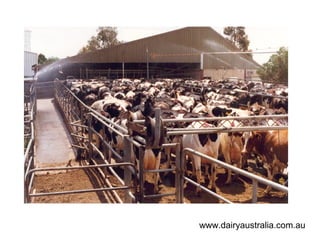
• Maternity pen
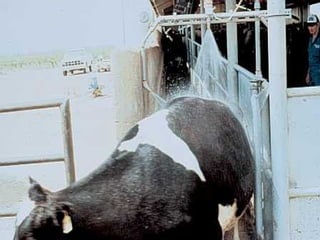
• Parlor exit lane
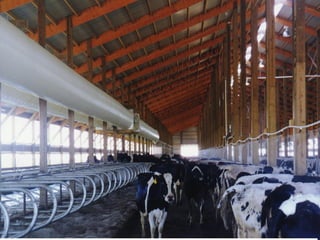
• Feed lines/feed alleys
• Feed bunks
Feed Alley Cooling
www.dairyaustralia.com.au
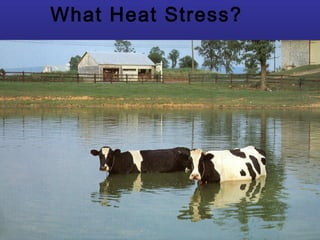
What Heat Stress?
Heat stress

Heat stress

  • 1.
    Heat Stress andthe Dairy Industry Lance Baumgard AnSc 435
  • 2.
    When environmental temperature nearsthe cow’s body temperature ( > 90 deg F), the cow’s cooling mechanisms are impaired Consequently the cow’s body temperature rises and the cow shows signs of heat stress. The first sign … eats less to produce less metabolic heat … a natural protective mechanism.
  • 3.
    Temperature Humidity Index (THI) Easyway to measure and evaluate heat stress
  • 4.
    All of These= THI of 72 Temperature, o F Humidity, % 84 15 80 30 77 50 75 65 72 95
  • 5.
    Heat Stress isa Global Problem January 2003, NASA July 2003, NASA 40% of W. Canadian summer days THI > 72 Ominski et al., 2002
  • 6.
    Decrease in production(milk and growth) Reduced body condition Acute and chronic health problems Decreased reproductive indices Abortions Animal death Possibly the most costly issue affecting global animal agriculture Ruminants & Heat Stress rumen acidosis & laminitis Annual loss to American Dairy Industry is: $897 million to $1.5 billion Annual Loss to American Beef Industry is > $350 Million St-Pierre et al., 2003 J. Dairy Sci. E52-E77 June 2006 California Heat Wave: $1 Billion CDFA, 2006 >2,000 cattle died in Nebraska June 2009
  • 7.
    Economic Impact ofHeat StressEconomic Impact of Heat Stress to US Animal Agricultureto US Animal Agriculture • St-Pierre et. al., 2003 • dairy cattle, beef cattle, swine and poultry • Yearly cost = $2.4 billion dollars
  • 8.
    Total Loss byAnimal Type, % Dairy Beef Sw ine Poultry
  • 9.
  • 10.
    Iowa and HeatStress • Estimated Iowa Impact (St-Pierre et al., 2003) • Assumes optimum heat abatement – Dairy $23.9 million – Beef and Swine $45.5 million – Poultry $4.3 million Total Iowa impact $73.7 million
  • 11.
  • 12.
    Bare ground surfacetemperature before and after shading at various times during the daya Shaded time Temperature of Ground Surface (°F) (min) 11 a.m. 12 noon 2 p.m. 4 p.m. In sun 124.9 144.3 151.9 153.0 5 104.0 107.6 111.6 113.7 15 98.1 103.1 109.4 109.4 30 98.1 101.3 104.0 105.8 Air temp 91.9 95.0 98.1 104.0 a From Kelly et al. (1950).
  • 13.
  • 14.
  • 15.
  • 16.
  • 17.
    Inactive person, 180lbs generates about as much heat as a 100-watt light bulb … … A 1,600 lb Holstein is equivalent to about nine 100-watt light bulbs
  • 18.
    For milk cows,add one 100-watt light bulb for every 10 lbs of milk produced a day…
  • 19.
    … The 1,600lb Holstein producing 80 lbs per day is producing heat equivalent to (17) 100-watt light bulbs!
  • 20.
    Add solar radiationin hot climates and we now have a “33-bulb” cow!
  • 21.
  • 22.
    Decrease in milkproduction Reduced body condition Acute health problems Significant drop in pregnancy rate High incidence of abortions High death loss Added all up … costly! Results of Heat Stress Rumen acidosis Rumen Acidosis: Reduced cellulose digestion Laminitis Milk fat depression etc…
  • 23.
    Effect of HeatStress on Ruminal pH of Holstein Cows (Mishra et al., JAS 30:1023) 5 5.3 5.6 5.9 6.2 6.5 6.8 High Forage Diet High Concentrate Diet C O O L C O O L H O T H O T RuminalpH
  • 24.
    Effect of HeatStress on Digestive Physiology DMI Less Total Saliva Slobbering Less Saliva to Rumen Less Salivary Buffer to Rumen Heat Stress Rumen pH
  • 25.
    De Rensis andScaramuzzi, 2003
  • 26.
  • 27.
    Dairy Study #1 •Multiparous Holstein cows (n=23; 120 ± 30 DIM) • Environmental Conditions 1) Thermal neutral conditions (constant 18ºC & 20% humidity) for 1 week 2) Heat stress (cyclical temps 29.4 to 37.8ºC & 20% humidity) for 3 weeks • Heat stress variables – Body temperature: 40.5ºC at 1400 h – Respiration rates: 40 to 82 breaths/min
  • 28.
    Feed Intake 10 12 14 16 18 20 22 1 23 4 Week DMI,kg/d Thermal Neutral Cyclical Heat Stress a b c d Shwartz et al., 2009
  • 29.
    Milk Yield 10 15 20 25 30 35 40 1 23 4 Week kg/d Thermal Neutral Cyclical Heat Stress a b c c Shwartz et al., 2009
  • 30.
    Energy Balance -5 -4 -3 -2 -1 0 1 2 3 4 5 Mcal/d/d Thermal NeutralCyclical Heat Stress a b c d 1 2 3 4 Week Shwartz et al., 2009 Maintenance cost ↑ 25%: 1989 NRC
  • 31.
    Heat Stress andNEFA 0 100 200 300 400 500 1 2 3 4 Week uEq/l Thermal Neutral Cyclical Heat Stress Shwartz et al., 2009
  • 32.
    Interesting Observations – Feedintake acclimated to heat stress but milk yield did not • Suggests something in addition to reduced feed intake is decreasing milk yield during heat stress – Despite the negative energy balance and loss of body weight adipose tissue was not mobilized
  • 33.
    Heat Stress Questions?? Doesthe decrease in feed intake explain the reduced milk yield during heat stress? Indirect vs. direct effects of heat If we have a better understanding of the biological reasons WHY heat stress reduces production, we’ll have a better idea of how to alleviate it.
  • 34.
    Lactation Trials • MultiparousHolstein cows (~120 DIM) • Environmental conditions: 1) Period 1: thermal neutral conditions (constant 18ºC & 20% humidity) for ~10 days 2) Period 2: heat stress (cyclical temps 29.4 to 40ºC & 20% humidity) for ~10 days or pair-fed* a thermal neutral group to keep nutrient intake similar Rhoads et al., 2009 Wheelock et al., 2008 Wheelock et al., 2009 * Pair feeding eliminates confounding effects of dissimilar feed intake
  • 35.
    10 12 14 16 18 20 1 2 34 5 6 7 8 9 Day DMI(kg/d) Heat Stress Underfed Effects of Heat Stress on Feed Intake Rhoads et al., 2009 Heat stress ↓ feed intake by ~30 % Heat stress Pair-fed
  • 36.
    20 25 30 35 40 45 50 0 1 23 4 5 6 7 8 9 Day MilkYield(kg/d) Heat-stressed Pair-fed Effects of Environment on Milk Yield Rhoads et al., 2009 Wheelock et al., 2008 Wheelock et al., 2009 Baumgard and Rhoads, unpublished Heat stress ↓ yield ~45% Pair-feeding ↓ yield by ~19% Thus, ↓ feed intake only accounts for ~50% of the reductions in milk yield
  • 37.
    Calculated Energy Balance -8 -6 -4 -2 0 2 4 6 -11 2 3 4 5 6 7 8 9 Day Mcal/d PF HS Maintenance cost ↑ 25%: 1989 NRC
  • 38.
    Body Weight Loss FromPeriod 1 to 2 -60 -50 -40 -30 -20 -10 0 kg Heat Stress Pair-fed
  • 39.
    0 100 200 300 400 500 600 1 2 34 5 6 7 8 9 Day NEFA(uEq/l) Heat-stressed Pair-fed Effects of Heat Stress on Adipose Tissue Mobilization Rhoads et al., 2009
  • 40.
    -0.1 0.1 0.3 0.5 0.7 0.9 1.1 1.3 1.5 1 2 3 Period Insulin(ng/ml) HeatStressed Pair-fed Circulating Insulin in Lactating Dairy Cows Wheelock et al., 2006
  • 41.
    Where to coolcows? • Free stalls or dry lot pens • Holding pen • Maternity pen • Parlor exit lane • Feed lines/feed alleys • Feed bunks
  • 42.
  • 45.
  • 48.

Editor's Notes

  • #5 This chart indicates the interaction of temperature and humidity in determining potential heat stress. All of these temperature-humidity interactions all have the same THI of 72.
  • #8 These results are from a paper by Dr. Normand St-Piere from Ohio State University. H estimated the costs of heat stress on dairy, beef, swine and poultry in the US. The values represented would be from 2002-2003. The total yearly cost estimated was $2.4 billion if minimum heat stress abatement practices were in place. He also estimated that this would decrease to $1.7 billion if heat stress abatement practices were implemented.
  • #9 This chart breaks down the total cost of heat stress by animal type. These proportiins are: Dairy cattle = 52% of the total loss Beef cattle = 21% of the total loss Swine = 17% of the total loss Poultry = 10% of the total loss
  • #24 pH measured 12 times in 8 hours after feeding. Cows fed the high forage diet had higher pHs than those on the high concentrate diet, as expected. When cows were exposed to increased temp and humidity, ruminal pH became more acidic, 0.4° for cows fed the high forage diet and 0.6 ° for cows fed the high concentrate diet. The drop was greater for cows fed the high concentrate diet. Why is that?
  • #49 Cow cooling ponds are used in some southern states to help keep cows cool. These may not be very applicable to New York and the Northeast.