FEEDING OF DOGS & CATS
Dr. Kaushalendra Kumar, Assistant Professor
Bihar Veterinary College, Bihar Animal Sciences University, Patna
E-mail ID: drkaushalbvc@gmail.com
Objective………………………..
29-04-2020 Kaushalendra Kumar, BVC, BASU, Patna 2
 Learn about the nutrient requirements and feeding of dogs and cats.
NUTRIENT REQUIREMENTS
The requirements of various nutrients discussed here are as follows;
o Carbohydrate
o Protein
o Fat
o Minerals
o Vitamins
o Water
29-04-2020 Kaushalendra Kumar, BVC, BASU, Patna 3
Carbohydrates
 CHO are sugars, starches and dietary fibres (not completely digestible).
 Supplied in the diet by cereal grains, sugars, milk, beet pulp etc.
 Excess carbohydrate energy is stored in the form of glycogen in the liver
& muscles and are converted to fat & stored in adipose tissues.
 During fasting, stress, or exercise, glycogen is broken down to glucose &
delivered to the bloodstream where it is distributed to all body tissues.
29-04-2020 Kaushalendra Kumar, BVC, BASU, Patna 4
Fibres
 Dietary fibres has numerous effects within the GI tract.
 Fibres has high water-holding capacity leads to easy passage of digesta.
 Due to bulkiness, cause stomach distention, which reduce feed intake.
 Decreases digestion and absorption of fat, vitamins and minerals.
 Fibre can bind to some toxins and prevent their absorption.
 Excessive dietary fibre is associated with loose stools, flatulence,
increased stool volume & frequency & decreased dietary caloric density.
29-04-2020 Kaushalendra Kumar, BVC, BASU, Patna 5
Protein
 Dietary proteins, digested in stomach & SI, to form free AA, then
absorbed into the blood stream and are utilized to build body tissue.
 Out of the 22 amino acids 10 are essential for dogs which included
arginine, histidine, isoleucine, leucine, lysine, methionine,
phenylalanine, threonine , tryptophan & valine.
 In cat, taurine is also essential.
29-04-2020 Kaushalendra Kumar, BVC, BASU, Patna 6
Protein Requirements
 Protein requirement depends on stage of life and their activity.
 Puppies need more protein than adult dogs.
 Severe protein deficiency in dogs results in poor food intake, growth
retardation or weight loss, muscle wasting, emaciation & death.
 Less severe deficiency, causes a rough & dull hair coat, compromised
immune system & poor milk production in reproducing bitches.
 During stress, the protein requirement may be increased.
 If diets containing more protein than required, extra protein metabolized
& used for energy.
29-04-2020 Kaushalendra Kumar, BVC, BASU, Patna 7
Fat
 Fats are concentrated forms of energy.
 Fat digestion is more complex than protein or carbohydrates.
 Healthy dogs & cats can digest fats with great efficiency, approx. 90-95%.
Fat Requirement
 Three EFA such as linoleic, linolenic and arachidonic acid.
 Fat is the source of linoleic acid which is essential for dogs to maintain
healthy skin, haircoat & serves as a carrier for fat-soluble vitamins.
 Fat also contributes to the palatability and too low fat in the diet may
develop coarse hair, dry thick skin, itching, cell damage, skin lesion etc.
29-04-2020 Kaushalendra Kumar, BVC, BASU, Patna 8
Water
 Water requirement is depends on the amount of food consumes.
 Generally, animals require 1 ml of water for each kcal of energy.
 If a dog requires 1000 kcals/day, then it requires 1000 ml of water.
 As food intake increases, water intake also increases.
 When the water content of a diet increases, animal drinks less water.
 Water assist in maintaining body temperature, blood formation, body
fluid, prevent dehydration etc.
 Provide clean and fresh water all the time to pets.
29-04-2020 Kaushalendra Kumar, BVC, BASU, Patna 9
DOG
Energy density 3.5 kcal ME/g DM
CAT
Energy density 4.0 kcal ME/g DM
Nutrients
(%)
Growth &
Reproduction
(Min)
Adult
Maintenance
(Min)
Growth &
Reproduction
(Min)
Adult
Maintenance
(Min)
Protein 22 18 30 26
Fat 8 5 9 9
Linoleic acid 1 1 0.5 0.5
Arachidonic acid - - 0.02 0.02
Vitamin A IU 5000 5000 9000 5000
Taurine - - 0.10 - 0.20 0.10 - 0.20
Calcium 1.1 0.6 1 0.6
Phosphorous 0.9 0.5 0.8
0.5
29-04-2020 Kaushalendra Kumar, BVC, BASU, Patna 10
NUTRIENT REQUIREMENT FOR DOG & CAT
(As per Association of American Feed Control Officials)
NUTRIENT CONTENT FOR DOG FOODS
(As per Association of American Feed Control Officials)
Nutrients DM Basis Growth Reproduction Mantenance
Units
Protein % 22 18
Fat % 8.0 5.0
Linoleic Acid 18:2 % 1 1
Arginine % 0.62 0.51
Histidine % 0.22 0.18
Isoleucine % 0.45 0.37
Leucine % 0.72 0.59
Lysine % 0.77 0.63
Methionine + Cystine % 0.53 0.43
Phenylalanine + Tyrosine % 0.89 0.73
Threonine % 0.58 0.48
Tryptophan % 0.20 0.16
Valine % 0.48 0.39
29-04-2020 Kaushalendra Kumar, BVC, BASU, Patna 11
Nutrients DM Basis Growth
Reproduction
Mantenance
Units
Minerals
Calcium % 1.0 0.6
Phosphorus % 0.8 0.5
Ca:P Ratio 1 to 1 1 to 1
Potassium % 0.6 0.6
Sodium % 0.3 0.06
Chloride % 0.45 0.09
Magnesium % 0.04 0.04
Iron mg/kg 80 80
Copper mg/kg 7.3 7.3
Manganese mg/kg 5 5
Zinc mg/kg 120 120
Iodine mg/kg 1.5 1.5
Selenium mg/kg 0.11 0.11
29-04-2020 Kaushalendra Kumar, BVC, BASU, Patna 12
Nutrients DM Basis Growth Reproduction Mantenance
Units
Vitamins
Vitamin A IU/kg 5000 5000
Vitamin D IU/kg 500 500
Vitamin E IU/kg 50 50
Vitamin B1 (Thiamine) mg/kg 1.0 1
Vitamin
B2 (Riboflavin)
mg/kg 2.2 2.2
Pantothenic Acid mg/kg 10 10
Niacin mg mg/kg 11.4 11.4
Vitamin
B6 Pyridoxine)
mg/kg 1.0 1.0
Folic Acid mg/kg 0.18 0.18
Vitamin B12 mg/kg 0.022 0.022
Choline mg/kg 1200 1200
29-04-2020 Kaushalendra Kumar, BVC, BASU, Patna 13
29-04-2020 Kaushalendra Kumar, BVC, BASU, Patna 14
Factors Affecting Nutritional Requirement in Pets
 Optimum nutrition is a key element in raising a healthy dog or cat.
 Many factors affecting pet nutritional requirements includes;
 Breed
 Age
 Gender
o Intact
o Spayed or Neutered
 Physiological State
o Growth
o Adult
 Pregnancy
 Lactation
o Senior
o Geriatric
 Body weight & composition
 Activity level / Environment
 Show Dogs
 Guard Dogs
 Agility Dogs
 Working Dogs
 Hunting Dogs
 Racing Dogs
 Stress &
 Health status
29-04-2020 Kaushalendra Kumar, BVC, BASU, Patna 15
Breed
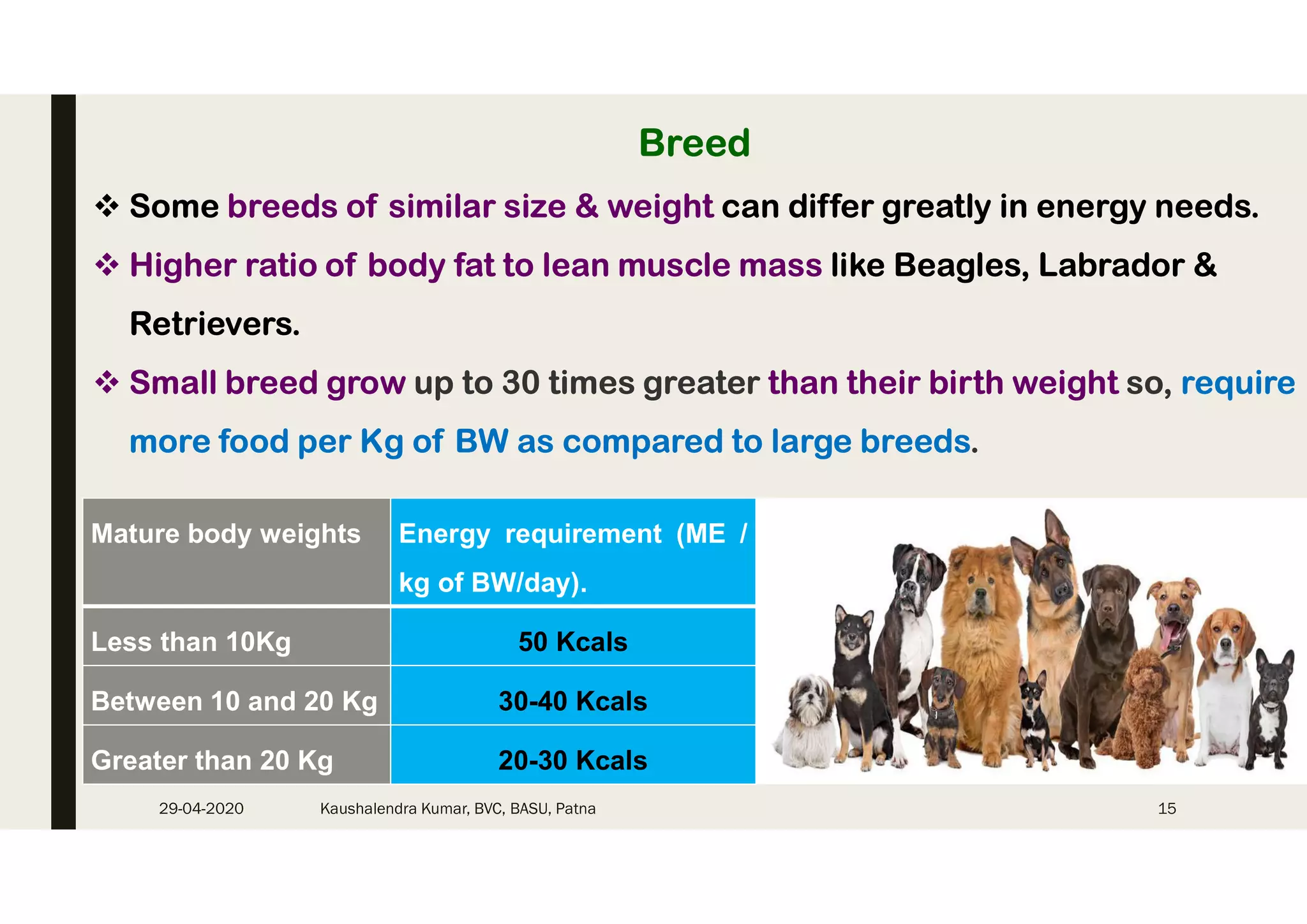
 Some breeds of similar size & weight can differ greatly in energy needs.
 Higher ratio of body fat to lean muscle mass like Beagles, Labrador &
Retrievers.
 Small breed grow up to 30 times greater than their birth weight so, require
more food per Kg of BW as compared to large breeds.
Mature body weights Energy requirement (ME /
kg of BW/day).
Less than 10Kg 50 Kcals
Between 10 and 20 Kg 30-40 Kcals
Greater than 20 Kg 20-30 Kcals
29-04-2020 Kaushalendra Kumar, BVC, BASU, Patna 16
Age
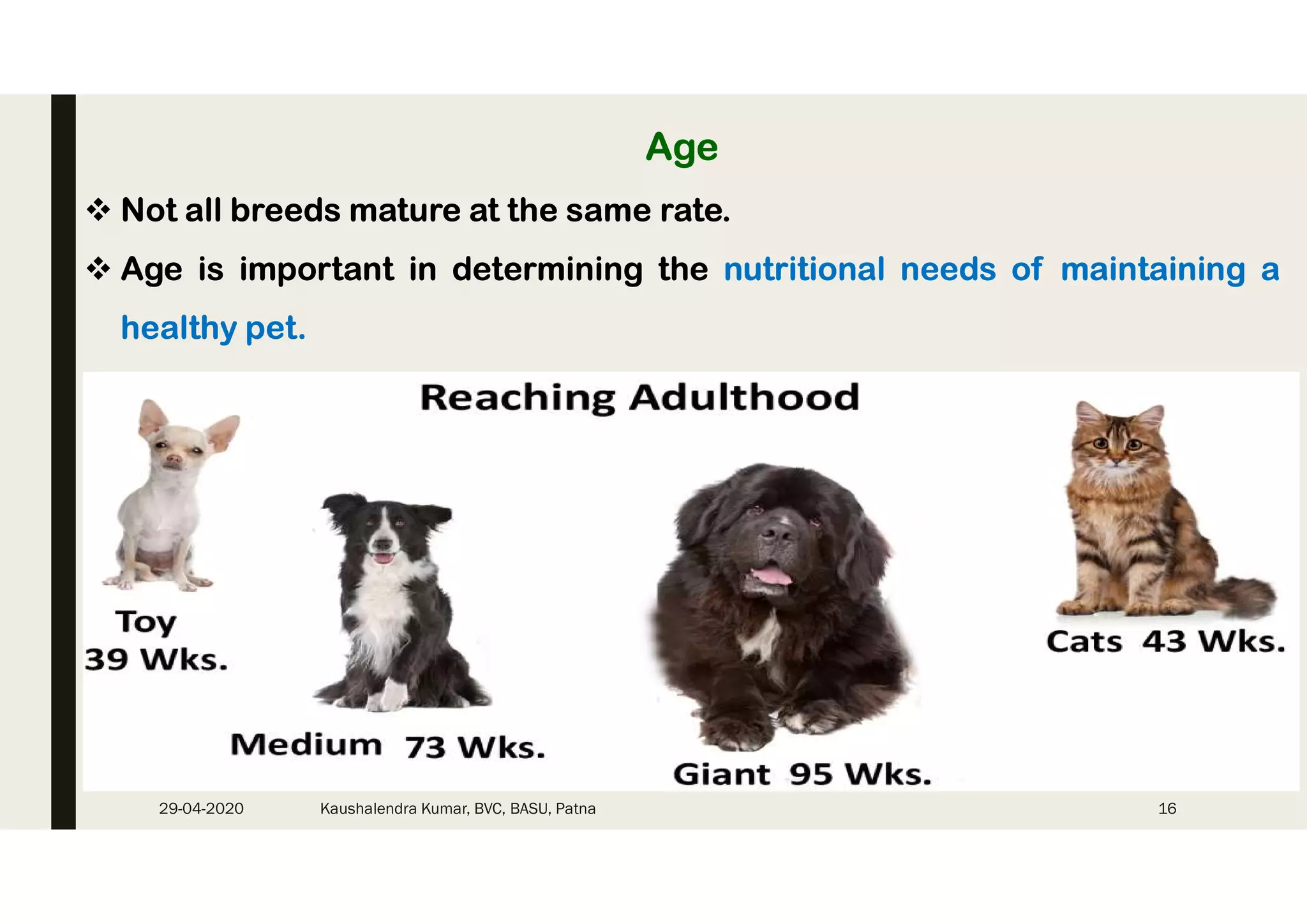
 Not all breeds mature at the same rate.
 Age is important in determining the nutritional needs of maintaining a
healthy pet.
29-04-2020 Kaushalendra Kumar, BVC, BASU, Patna 17
Gender
 Males usually have a greater amount of muscle mass than female.
 Male expend more energy per kg BW & have a lesser tendency to
become overweight or obese.
 Spaying or neutering a pet may lead to its gaining weight.
29-04-2020 Kaushalendra Kumar, BVC, BASU, Patna 18
Physiological Stage
 Compared to adult dog, growing puppies require 2 to 4 times more
energy per Kg BW.
 As the puppy approaches adulthood, energy requirement is reduced.
 Similarly for reproducing females, energy requirements at the end of
gestation & during early lactation is 2 to 4 times greater than adult
maintenance requirements.
29-04-2020 Kaushalendra Kumar, BVC, BASU, Patna 19
Body Weight & Composition
 BW is the primary factor to determining the base level of energy required.
 Body composition decides the amount of fat tissue carrying by animal.
 Greater the ratio of fat to muscle, lower the amount of calories needed
per kg of BW.
 Health status of dog or cat can be determine by its Body Condition Score.
29-04-2020 Kaushalendra Kumar, BVC, BASU, Patna 20
Activity Level
 Activity is the second most important factor in determining dietary
needs for a healthy pet.
 Overweight dogs and cats today indicates that inadequate exercise,
which results health problems.
 When exceeding routine exercise, energy needs can rise rapidly.
29-04-2020 Kaushalendra Kumar, BVC, BASU, Patna 21
Stress
 Stress is a set of responses to any extra demand either physical or
emotional.
 Early physiological responses are an increased heart rate, stomach
constriction, and energy or fuel mobilization.
 Stress stimulate the release of adrenalin, dilating pupils & readying an
animal for “Fight or Flight”.
 Protein stores are rapidly converted to glucose, rise blood sugar levels
and deplete protein reserves, causes diminishing antibody production.
 Over time stress suppresses normal immune function so, increasing
susceptibility to infectious agents.
29-04-2020 Kaushalendra Kumar, BVC, BASU, Patna 22
 Physical signs of good stress are enhanced physical condition and
performance
 Bad stress include diminished activity, poor performance, dehydration,
weight loss, anemia, disease and slowed recovery.
 During stress, many vitamins and minerals are rapidly depleted.
 Important minerals are excreted in the urine and blood levels of FE, Cu,
Zn & vitamin A, E & C are markedly decreased.
Environment
 Dogs housed outdoors & exposed to extreme weather have changes
in their caloric requirements.
 During hot weather, energy needs decreases & less food may be
required.
 During cold weather, energy needs increases to maintain body
temperature & more food may be required.
29-04-2020 Kaushalendra Kumar, BVC, BASU, Patna 23
COMMON FEEDSTUFF USED FOR DOGS
Meat and meat by-products
 Raw lean meat: Contain water 70-67%, protein 20-22% & fat 2-9%, it is also
a good source of minerals.
 Offal meat: Include liver, kidney and spleen, meat but nutrient content is
variable, low in calcium, adverse Ca:P ratio (1:15 to 1:30) however, liver is
a good source of Vitamin A, D & B Complex with good quality protein.
 Fish: fish has 5-18% fat & has good quality protein, high iodine content &
better Ca:P ratio.
29-04-2020 Kaushalendra Kumar, BVC, BASU, Patna 24
Other animal by-products
 Includes blood meal, meat meal, meat-cum-bone meal but protein quality
is variable depending upon the raw material & extent of heat treatment.
 Ash and mineral content are also variable, sterilized bone meal is
commonly used & contains 32% Ca and 14% P.
Dairy products
 Includes cream, skimmed milk, whey, cheese, etc.
 Lactose present in dairy products are not well digested due to less
enzyme lactase activity.
 Hence dairy products in dog & cat food should not be included at high
level & are also poor in Fe and vitamin D.
29-04-2020 Kaushalendra Kumar, BVC, BASU, Patna 25
Eggs
 Good source of Fe, B2, folic acid, B12, vit. A & D but do not have vit. C &
less carbohydrate.
 Eggs are also poor source of Niacin and raw egg white contains Avidin.
Cereals and cereal by-products
 Includes rice, barley, oats, wheat and corn.
 Contains 9-14% CP, 2-5% fat and about 70-80% carbohydrate as starch.
 Cereals are rich in thiamine and niacin.
Fat and oils
 Fats & oils have high energy & animal fats are liked by cats and dogs.
 Add flavour & palatability & vegetable oils are rich in vitamin E.
29-04-2020 Kaushalendra Kumar, BVC, BASU, Patna 26
Vegetables
o Green leafy vegetables: Like Cabbage, cauliflower have high water and
fibre content, are good source of B vitamin, however cooking destroys it.
o Roots and tubers: Includes potatoes, carrots, turnip, tapioca, rich in
starch and can be cooked and fed.
o Leguminous vegetables: Rich in protein, good source of B complex
vitamin but anti nutritional factors like Trypsin inhibitors, Heamagglutinin
are present in some of them but are destroyed by heat treatment.
29-04-2020 Kaushalendra Kumar, BVC, BASU, Patna 27
TYPES OF DOG FOOD
 Prepared foods are some times fed to companion animals & can be
classified on the basis of its moisture percent such as;
o Dry food (5-12%)
o Semi-moist food (15-30%)
o Canned food (70-85%).
29-04-2020 Kaushalendra Kumar, BVC, BASU, Patna 28
Dry food
 Dry foods (biscuits, mixtures & meal or flakes) are available for different
physiological status.
 May be complete food or complementary food, formulated as mixers for
feeding as a part of diet with protein rich foods such as meats, fish.
 They are generally rich in carbohydrates.
 Crude fat content is 5-10% on dry basis.
 Cats may accept extruded biscuit forms but not meals or flakes.
29-04-2020 Kaushalendra Kumar, BVC, BASU, Patna 29
29-04-2020 Kaushalendra Kumar, BVC, BASU, Patna 30
 Mixtures are generally cereal based with very little protein concentrates
may or may not be supplemented with minerals / vitamins.
 Have long shelf- life provided properly stored.
 The concentration of nutrients is high and feed intake is less.
 Digestibility is acceptable but less than semi-moist or canned foods.
 The main disadvantage of the dry food is that they are much less
palatable than moist foods.
Semi-moist food
 Has good digestibility (80-85%).
 Protected from spoilage with addition of glycerol or propylene glycol.
 Most acceptable to dogs and cats.
 It can be stored for several months with reduced water activity.
 Meat, meat by-products, soya, vegetable protein concentrates, cereals,
fats and sugars are used in these type of products.
29-04-2020 Kaushalendra Kumar, BVC, BASU, Patna 31
Canned food
 Most convenient to use, highly attractive for dogs and cat.
 These food are reliable, safe and convenient to serve.
 Highly palatable, particularly when carbohydrate is less.
 Separate foods for dog and cat are available.
 Cat foods can be given to dogs but not vice-versa.
 Most canned foods are balanced foods.
 Digestibility is good but nutrient density is low due to high moisture content.
 Generally not given as a sole food but given mixed with biscuits or mixtures.
 Safe and have long shelf life.
 Meat, meat by-product, vegetable protein, cereals, are the main ingredients.
29-04-2020 Kaushalendra Kumar, BVC, BASU, Patna 32
Home made foods
 Feeding of pet animals with commercial foods are not much popular for
economic reasons in developing countries.
 When pets are fed with home made foods then, essential to ensure that
the dietary nutrient requirements are met through such feeding practice.
 Judicious inclusion of supplemental nutrients, deficit in the home made
can over come nutritional deficiency disorders & support healthier life.
29-04-2020 Kaushalendra Kumar, BVC, BASU, Patna 33
Example of home made food for dog
Food item Body diet
20kg 25kg 30 kg
Egg 2 2 2
Milk (ml) 200 250 300
Beef (g) 200 300 400
Rice (g) 150 200 200
Vitamin A, D + + +
B complex + + +
Salt iodized (g) 2.5 2.5 2.5
29-04-2020 Kaushalendra Kumar, BVC, BASU, Patna 34
Home made vegetarian Dog food
• A 100 % vegetarian dog food may be prepared provided it satisfies all the
essential nutrient requirement for the dog.
Food item Quantity
Soy protein meal / pulses (g) 200
Milk (ml) 200
Rice (g) 200
Vitamin A, D +
B complex +
Salt iodized (g) 2.5
29-04-2020 Kaushalendra Kumar, BVC, BASU, Patna 35
Classification of pet food based on the nutrient content
 Complete food: is a food that provides all the nutrients required to the
animal for 24 hours.
 Complementary food: is a food that provides only a part of the nutrients
required to the animal for 24 hours & rest is met from additional
supplement.
 Mixer biscuit: Mixer biscuit provides only essential nutrients.
 Snack / treat: Snack / treat are foods to entertain / reward pet animals.
29-04-2020 Kaushalendra Kumar, BVC, BASU, Patna 36
FEEDING SCHEDULE OF PETS
Puppy feeding schedule
 Puppies may get enough nutrients from milk during first 3 or 4 wk of life.
 Cows milk is not a substitute as the composition varies.
 But orphan puppy or kitten, or under insufficient mother’s milk, cow milk
can be used with appropriate modification to simulate mother’s milk.
 Young puppies should be fed 4 or 6 times daily at equal time intervals.
29-04-2020 Kaushalendra Kumar, BVC, BASU, Patna 37
Age in
days
Frequency of
feeding
Milk (g / day) as per body weight in Kg
0.5 1 2 3 4 5
1-7 Once in 2 hours 45 90 180 270 360 450
7-14 Once in 3 hours 60 120 240 330 480 570
14-21 Once in 3 hours till
evening
75 150 300 450 600 750
21 and
above
Once in 3 hours
omit evening
feeding
75 150 300 450 600 750
29-04-2020 Kaushalendra Kumar, BVC, BASU, Patna 38
Milk substitute
Cow milk 800 ml
Cream 200 ml
Egg yolk 1 no.
Steamed bone meal 6 gram
Vitamin A 2000 IU
Vitamin D 500 IU
Citric acid 4 gram
29-04-2020 Kaushalendra Kumar, BVC, BASU, Patna 39
Calculating the volume of milk to feed an orphan pup
Age Volume to
feed per 100g
of body
weight
Body
Weight
Volum
e / day
No of
feedings
/day
Volume
per
feeding
10
days
15 ml/100 g X 200 g = 30 ml 5 = 6 ml
20
days
20 ml/100 g X 300 g = 60 ml 5 = 12 ml
29-04-2020 Kaushalendra Kumar, BVC, BASU, Patna 40
FEEDING OF DOGS
Weight of Dogs Frequency of Feeding/day Feed offered
2-5 kg Twice a day 100 gm cereals (cooked)
100 gm meat (cooked)
100 ml milk + biscuits
5-10 kg Twice a day 200 gm cereals (cooked)
200 gm meat (cooked)
150 ml milk + biscuits
10-20 kg Twice a day 500 gm cereals (cooked)
500 gm meat (cooked)
300 ml milk + biscuits
Puppies
After weaning
3-4 ½ Adult feed
Older pups 2 ½ Adult feed (gradually increase
frequency of feeding)
Cereals: Cooked rice, bread, chapathi
Meat: Beef, mutton, chicken, fish or egg
Pregnant, lactating bitches: Increase cereals 100-200 gm/ day
29-04-2020 Kaushalendra Kumar, BVC, BASU, Patna 41
Feeding frequency
3 weeks to 3 months 4-5 times feeding/day
3-5 months 3 times a day
5-10 months 2 times a day
Adult dogs Once a day for maintenance
Lactating animal Increased energy, protein, etc.
Old dogs
Digestion is poor, improve the
quality of feed, decreased
quantity
29-04-2020 Kaushalendra Kumar, BVC, BASU, Patna 42
Average daily consumption of food by dogs
Body weight Dry matter
2.5–5 kg 3–3.5 %
5– 10 kg 2.5–3%
10 kg and above 2–2.5%
29-04-2020 Kaushalendra Kumar, BVC, BASU, Patna 43
FEEDING MANAGEMENT OF DOGS
 Make sure that puppies consume colostrum within the first 36 to 48
hours after birth.
 Feed at same place, by same person at same time.
 Left over should be removed after half an hour.
 Water should be available throughout the feeding time.
 No snack is to be fed.
 Young and lactating should be fed separately.
 Avoid sudden changes in food.
 Feeding and watering vessels should be clean.
29-04-2020 Kaushalendra Kumar, BVC, BASU, Patna 44
 If the dog has a special dietary requirement that can’t be met by
commercial foods, consider feeding homemade diets.
 Feed the dog according to correct body weight and condition, and
consider factors such as growth, adult maintenance, level of activity,
gestation, lactation, and age.
 When changing foods, mix 1/4 of the new food to 3/4 of the old food,
and increase gradually to prevent gastric upsets.
 Watch the dog's stool, and coat while changing foods.
 Store food in a sealed container in a cool, dry place.
29-04-2020 Kaushalendra Kumar, BVC, BASU, Patna 45
Cat –an obligate carnivores?
• An obligate carnivore is a predator that eats meat out of biological
necessity.
• Although cats can digest plant material safely, but are unable to meet all of
their nutritional needs on a strictly plant-based diet.
• Cats have the shortest digestive tract to body size ratio, which result, less
fermenting bacteria to help them break down plant material and derive
nutrients from it.
• Cats, cannot make beta-carotene conversion due to lack of enzyme, hence,
require vitamin A from animal source.
• Plant sources are deficiency in taurine and cat require taurine (dark meat
rich in taurine) to support eyesight, nerve function, immune system etc.
29-04-2020 Kaushalendra Kumar, BVC, BASU, Patna 46
• Cats have a limited delta-6-desaturase activity, enzyme is necessary for
conversion of linoleic acid and alfa-linolenic acid to arachidonic acid, EPA
and DHA.
• Diets deficient in preformed long-chain PUFA but containing linoleic acid
and alfa-linolenic acid results in symptoms such as a dry coat, changes
in platelet aggregation and an enlarged fatty liver.
• The limited delta-6-desaturase activity can be sufficient for maintenance
and conception in adult cats, but for gestation, lactation and growth a
dietary supply of arachidonic acid (meat source) is required.
29-04-2020 Kaushalendra Kumar, BVC, BASU, Patna 47
Some Important differences between Dog & Cat Nutrition
• Cat food contains a higher level of protein as compared to dog food.
• Cats need more protein because they use proteins as an energy source.
• Cats have 12 essential amino acids while dogs only have 11.
• Taurine is EAA for cats but non-essential for dogs.
• Dogs can convert beta carotene into vitamin A within their bodies but
cats can’t.
• Cats also require five times more thiamine in their diets than do dogs.
• Arachidonic acid is an EFA that cats can’t synthesized but dogs are able.
29-04-2020 Kaushalendra Kumar, BVC, BASU, Patna 48
THANKS
29-04-2020 Kaushalendra Kumar, BVC, BASU, Patna 49
Discussions……………….…………..
Questions, if any…………………??

Dog and Cat Nutrition

  • 1.
    FEEDING OF DOGS& CATS Dr. Kaushalendra Kumar, Assistant Professor Bihar Veterinary College, Bihar Animal Sciences University, Patna E-mail ID: drkaushalbvc@gmail.com
  • 2.
    Objective……………………….. 29-04-2020 Kaushalendra Kumar,BVC, BASU, Patna 2  Learn about the nutrient requirements and feeding of dogs and cats.
  • 3.
    NUTRIENT REQUIREMENTS The requirementsof various nutrients discussed here are as follows; o Carbohydrate o Protein o Fat o Minerals o Vitamins o Water 29-04-2020 Kaushalendra Kumar, BVC, BASU, Patna 3
  • 4.
    Carbohydrates  CHO aresugars, starches and dietary fibres (not completely digestible).  Supplied in the diet by cereal grains, sugars, milk, beet pulp etc.  Excess carbohydrate energy is stored in the form of glycogen in the liver & muscles and are converted to fat & stored in adipose tissues.  During fasting, stress, or exercise, glycogen is broken down to glucose & delivered to the bloodstream where it is distributed to all body tissues. 29-04-2020 Kaushalendra Kumar, BVC, BASU, Patna 4
  • 5.
    Fibres  Dietary fibreshas numerous effects within the GI tract.  Fibres has high water-holding capacity leads to easy passage of digesta.  Due to bulkiness, cause stomach distention, which reduce feed intake.  Decreases digestion and absorption of fat, vitamins and minerals.  Fibre can bind to some toxins and prevent their absorption.  Excessive dietary fibre is associated with loose stools, flatulence, increased stool volume & frequency & decreased dietary caloric density. 29-04-2020 Kaushalendra Kumar, BVC, BASU, Patna 5
  • 6.
    Protein  Dietary proteins,digested in stomach & SI, to form free AA, then absorbed into the blood stream and are utilized to build body tissue.  Out of the 22 amino acids 10 are essential for dogs which included arginine, histidine, isoleucine, leucine, lysine, methionine, phenylalanine, threonine , tryptophan & valine.  In cat, taurine is also essential. 29-04-2020 Kaushalendra Kumar, BVC, BASU, Patna 6
  • 7.
    Protein Requirements  Proteinrequirement depends on stage of life and their activity.  Puppies need more protein than adult dogs.  Severe protein deficiency in dogs results in poor food intake, growth retardation or weight loss, muscle wasting, emaciation & death.  Less severe deficiency, causes a rough & dull hair coat, compromised immune system & poor milk production in reproducing bitches.  During stress, the protein requirement may be increased.  If diets containing more protein than required, extra protein metabolized & used for energy. 29-04-2020 Kaushalendra Kumar, BVC, BASU, Patna 7
  • 8.
    Fat  Fats areconcentrated forms of energy.  Fat digestion is more complex than protein or carbohydrates.  Healthy dogs & cats can digest fats with great efficiency, approx. 90-95%. Fat Requirement  Three EFA such as linoleic, linolenic and arachidonic acid.  Fat is the source of linoleic acid which is essential for dogs to maintain healthy skin, haircoat & serves as a carrier for fat-soluble vitamins.  Fat also contributes to the palatability and too low fat in the diet may develop coarse hair, dry thick skin, itching, cell damage, skin lesion etc. 29-04-2020 Kaushalendra Kumar, BVC, BASU, Patna 8
  • 9.
    Water  Water requirementis depends on the amount of food consumes.  Generally, animals require 1 ml of water for each kcal of energy.  If a dog requires 1000 kcals/day, then it requires 1000 ml of water.  As food intake increases, water intake also increases.  When the water content of a diet increases, animal drinks less water.  Water assist in maintaining body temperature, blood formation, body fluid, prevent dehydration etc.  Provide clean and fresh water all the time to pets. 29-04-2020 Kaushalendra Kumar, BVC, BASU, Patna 9
  • 10.
    DOG Energy density 3.5kcal ME/g DM CAT Energy density 4.0 kcal ME/g DM Nutrients (%) Growth & Reproduction (Min) Adult Maintenance (Min) Growth & Reproduction (Min) Adult Maintenance (Min) Protein 22 18 30 26 Fat 8 5 9 9 Linoleic acid 1 1 0.5 0.5 Arachidonic acid - - 0.02 0.02 Vitamin A IU 5000 5000 9000 5000 Taurine - - 0.10 - 0.20 0.10 - 0.20 Calcium 1.1 0.6 1 0.6 Phosphorous 0.9 0.5 0.8 0.5 29-04-2020 Kaushalendra Kumar, BVC, BASU, Patna 10 NUTRIENT REQUIREMENT FOR DOG & CAT (As per Association of American Feed Control Officials)
  • 11.
    NUTRIENT CONTENT FORDOG FOODS (As per Association of American Feed Control Officials) Nutrients DM Basis Growth Reproduction Mantenance Units Protein % 22 18 Fat % 8.0 5.0 Linoleic Acid 18:2 % 1 1 Arginine % 0.62 0.51 Histidine % 0.22 0.18 Isoleucine % 0.45 0.37 Leucine % 0.72 0.59 Lysine % 0.77 0.63 Methionine + Cystine % 0.53 0.43 Phenylalanine + Tyrosine % 0.89 0.73 Threonine % 0.58 0.48 Tryptophan % 0.20 0.16 Valine % 0.48 0.39 29-04-2020 Kaushalendra Kumar, BVC, BASU, Patna 11
  • 12.
    Nutrients DM BasisGrowth Reproduction Mantenance Units Minerals Calcium % 1.0 0.6 Phosphorus % 0.8 0.5 Ca:P Ratio 1 to 1 1 to 1 Potassium % 0.6 0.6 Sodium % 0.3 0.06 Chloride % 0.45 0.09 Magnesium % 0.04 0.04 Iron mg/kg 80 80 Copper mg/kg 7.3 7.3 Manganese mg/kg 5 5 Zinc mg/kg 120 120 Iodine mg/kg 1.5 1.5 Selenium mg/kg 0.11 0.11 29-04-2020 Kaushalendra Kumar, BVC, BASU, Patna 12
  • 13.
    Nutrients DM BasisGrowth Reproduction Mantenance Units Vitamins Vitamin A IU/kg 5000 5000 Vitamin D IU/kg 500 500 Vitamin E IU/kg 50 50 Vitamin B1 (Thiamine) mg/kg 1.0 1 Vitamin B2 (Riboflavin) mg/kg 2.2 2.2 Pantothenic Acid mg/kg 10 10 Niacin mg mg/kg 11.4 11.4 Vitamin B6 Pyridoxine) mg/kg 1.0 1.0 Folic Acid mg/kg 0.18 0.18 Vitamin B12 mg/kg 0.022 0.022 Choline mg/kg 1200 1200 29-04-2020 Kaushalendra Kumar, BVC, BASU, Patna 13
  • 14.
    29-04-2020 Kaushalendra Kumar,BVC, BASU, Patna 14 Factors Affecting Nutritional Requirement in Pets  Optimum nutrition is a key element in raising a healthy dog or cat.  Many factors affecting pet nutritional requirements includes;  Breed  Age  Gender o Intact o Spayed or Neutered  Physiological State o Growth o Adult  Pregnancy  Lactation o Senior o Geriatric  Body weight & composition  Activity level / Environment  Show Dogs  Guard Dogs  Agility Dogs  Working Dogs  Hunting Dogs  Racing Dogs  Stress &  Health status
  • 15.
    29-04-2020 Kaushalendra Kumar,BVC, BASU, Patna 15 Breed  Some breeds of similar size & weight can differ greatly in energy needs.  Higher ratio of body fat to lean muscle mass like Beagles, Labrador & Retrievers.  Small breed grow up to 30 times greater than their birth weight so, require more food per Kg of BW as compared to large breeds. Mature body weights Energy requirement (ME / kg of BW/day). Less than 10Kg 50 Kcals Between 10 and 20 Kg 30-40 Kcals Greater than 20 Kg 20-30 Kcals
  • 16.
    29-04-2020 Kaushalendra Kumar,BVC, BASU, Patna 16 Age  Not all breeds mature at the same rate.  Age is important in determining the nutritional needs of maintaining a healthy pet.
  • 17.
    29-04-2020 Kaushalendra Kumar,BVC, BASU, Patna 17 Gender  Males usually have a greater amount of muscle mass than female.  Male expend more energy per kg BW & have a lesser tendency to become overweight or obese.  Spaying or neutering a pet may lead to its gaining weight.
  • 18.
    29-04-2020 Kaushalendra Kumar,BVC, BASU, Patna 18 Physiological Stage  Compared to adult dog, growing puppies require 2 to 4 times more energy per Kg BW.  As the puppy approaches adulthood, energy requirement is reduced.  Similarly for reproducing females, energy requirements at the end of gestation & during early lactation is 2 to 4 times greater than adult maintenance requirements.
  • 19.
    29-04-2020 Kaushalendra Kumar,BVC, BASU, Patna 19 Body Weight & Composition  BW is the primary factor to determining the base level of energy required.  Body composition decides the amount of fat tissue carrying by animal.  Greater the ratio of fat to muscle, lower the amount of calories needed per kg of BW.  Health status of dog or cat can be determine by its Body Condition Score.
  • 20.
    29-04-2020 Kaushalendra Kumar,BVC, BASU, Patna 20 Activity Level  Activity is the second most important factor in determining dietary needs for a healthy pet.  Overweight dogs and cats today indicates that inadequate exercise, which results health problems.  When exceeding routine exercise, energy needs can rise rapidly.
  • 21.
    29-04-2020 Kaushalendra Kumar,BVC, BASU, Patna 21 Stress  Stress is a set of responses to any extra demand either physical or emotional.  Early physiological responses are an increased heart rate, stomach constriction, and energy or fuel mobilization.  Stress stimulate the release of adrenalin, dilating pupils & readying an animal for “Fight or Flight”.  Protein stores are rapidly converted to glucose, rise blood sugar levels and deplete protein reserves, causes diminishing antibody production.  Over time stress suppresses normal immune function so, increasing susceptibility to infectious agents.
  • 22.
    29-04-2020 Kaushalendra Kumar,BVC, BASU, Patna 22  Physical signs of good stress are enhanced physical condition and performance  Bad stress include diminished activity, poor performance, dehydration, weight loss, anemia, disease and slowed recovery.  During stress, many vitamins and minerals are rapidly depleted.  Important minerals are excreted in the urine and blood levels of FE, Cu, Zn & vitamin A, E & C are markedly decreased.
  • 23.
    Environment  Dogs housedoutdoors & exposed to extreme weather have changes in their caloric requirements.  During hot weather, energy needs decreases & less food may be required.  During cold weather, energy needs increases to maintain body temperature & more food may be required. 29-04-2020 Kaushalendra Kumar, BVC, BASU, Patna 23
  • 24.
    COMMON FEEDSTUFF USEDFOR DOGS Meat and meat by-products  Raw lean meat: Contain water 70-67%, protein 20-22% & fat 2-9%, it is also a good source of minerals.  Offal meat: Include liver, kidney and spleen, meat but nutrient content is variable, low in calcium, adverse Ca:P ratio (1:15 to 1:30) however, liver is a good source of Vitamin A, D & B Complex with good quality protein.  Fish: fish has 5-18% fat & has good quality protein, high iodine content & better Ca:P ratio. 29-04-2020 Kaushalendra Kumar, BVC, BASU, Patna 24
  • 25.
    Other animal by-products Includes blood meal, meat meal, meat-cum-bone meal but protein quality is variable depending upon the raw material & extent of heat treatment.  Ash and mineral content are also variable, sterilized bone meal is commonly used & contains 32% Ca and 14% P. Dairy products  Includes cream, skimmed milk, whey, cheese, etc.  Lactose present in dairy products are not well digested due to less enzyme lactase activity.  Hence dairy products in dog & cat food should not be included at high level & are also poor in Fe and vitamin D. 29-04-2020 Kaushalendra Kumar, BVC, BASU, Patna 25
  • 26.
    Eggs  Good sourceof Fe, B2, folic acid, B12, vit. A & D but do not have vit. C & less carbohydrate.  Eggs are also poor source of Niacin and raw egg white contains Avidin. Cereals and cereal by-products  Includes rice, barley, oats, wheat and corn.  Contains 9-14% CP, 2-5% fat and about 70-80% carbohydrate as starch.  Cereals are rich in thiamine and niacin. Fat and oils  Fats & oils have high energy & animal fats are liked by cats and dogs.  Add flavour & palatability & vegetable oils are rich in vitamin E. 29-04-2020 Kaushalendra Kumar, BVC, BASU, Patna 26
  • 27.
    Vegetables o Green leafyvegetables: Like Cabbage, cauliflower have high water and fibre content, are good source of B vitamin, however cooking destroys it. o Roots and tubers: Includes potatoes, carrots, turnip, tapioca, rich in starch and can be cooked and fed. o Leguminous vegetables: Rich in protein, good source of B complex vitamin but anti nutritional factors like Trypsin inhibitors, Heamagglutinin are present in some of them but are destroyed by heat treatment. 29-04-2020 Kaushalendra Kumar, BVC, BASU, Patna 27
  • 28.
    TYPES OF DOGFOOD  Prepared foods are some times fed to companion animals & can be classified on the basis of its moisture percent such as; o Dry food (5-12%) o Semi-moist food (15-30%) o Canned food (70-85%). 29-04-2020 Kaushalendra Kumar, BVC, BASU, Patna 28
  • 29.
    Dry food  Dryfoods (biscuits, mixtures & meal or flakes) are available for different physiological status.  May be complete food or complementary food, formulated as mixers for feeding as a part of diet with protein rich foods such as meats, fish.  They are generally rich in carbohydrates.  Crude fat content is 5-10% on dry basis.  Cats may accept extruded biscuit forms but not meals or flakes. 29-04-2020 Kaushalendra Kumar, BVC, BASU, Patna 29
  • 30.
    29-04-2020 Kaushalendra Kumar,BVC, BASU, Patna 30  Mixtures are generally cereal based with very little protein concentrates may or may not be supplemented with minerals / vitamins.  Have long shelf- life provided properly stored.  The concentration of nutrients is high and feed intake is less.  Digestibility is acceptable but less than semi-moist or canned foods.  The main disadvantage of the dry food is that they are much less palatable than moist foods.
  • 31.
    Semi-moist food  Hasgood digestibility (80-85%).  Protected from spoilage with addition of glycerol or propylene glycol.  Most acceptable to dogs and cats.  It can be stored for several months with reduced water activity.  Meat, meat by-products, soya, vegetable protein concentrates, cereals, fats and sugars are used in these type of products. 29-04-2020 Kaushalendra Kumar, BVC, BASU, Patna 31
  • 32.
    Canned food  Mostconvenient to use, highly attractive for dogs and cat.  These food are reliable, safe and convenient to serve.  Highly palatable, particularly when carbohydrate is less.  Separate foods for dog and cat are available.  Cat foods can be given to dogs but not vice-versa.  Most canned foods are balanced foods.  Digestibility is good but nutrient density is low due to high moisture content.  Generally not given as a sole food but given mixed with biscuits or mixtures.  Safe and have long shelf life.  Meat, meat by-product, vegetable protein, cereals, are the main ingredients. 29-04-2020 Kaushalendra Kumar, BVC, BASU, Patna 32
  • 33.
    Home made foods Feeding of pet animals with commercial foods are not much popular for economic reasons in developing countries.  When pets are fed with home made foods then, essential to ensure that the dietary nutrient requirements are met through such feeding practice.  Judicious inclusion of supplemental nutrients, deficit in the home made can over come nutritional deficiency disorders & support healthier life. 29-04-2020 Kaushalendra Kumar, BVC, BASU, Patna 33
  • 34.
    Example of homemade food for dog Food item Body diet 20kg 25kg 30 kg Egg 2 2 2 Milk (ml) 200 250 300 Beef (g) 200 300 400 Rice (g) 150 200 200 Vitamin A, D + + + B complex + + + Salt iodized (g) 2.5 2.5 2.5 29-04-2020 Kaushalendra Kumar, BVC, BASU, Patna 34
  • 35.
    Home made vegetarianDog food • A 100 % vegetarian dog food may be prepared provided it satisfies all the essential nutrient requirement for the dog. Food item Quantity Soy protein meal / pulses (g) 200 Milk (ml) 200 Rice (g) 200 Vitamin A, D + B complex + Salt iodized (g) 2.5 29-04-2020 Kaushalendra Kumar, BVC, BASU, Patna 35
  • 36.
    Classification of petfood based on the nutrient content  Complete food: is a food that provides all the nutrients required to the animal for 24 hours.  Complementary food: is a food that provides only a part of the nutrients required to the animal for 24 hours & rest is met from additional supplement.  Mixer biscuit: Mixer biscuit provides only essential nutrients.  Snack / treat: Snack / treat are foods to entertain / reward pet animals. 29-04-2020 Kaushalendra Kumar, BVC, BASU, Patna 36
  • 37.
    FEEDING SCHEDULE OFPETS Puppy feeding schedule  Puppies may get enough nutrients from milk during first 3 or 4 wk of life.  Cows milk is not a substitute as the composition varies.  But orphan puppy or kitten, or under insufficient mother’s milk, cow milk can be used with appropriate modification to simulate mother’s milk.  Young puppies should be fed 4 or 6 times daily at equal time intervals. 29-04-2020 Kaushalendra Kumar, BVC, BASU, Patna 37
  • 38.
    Age in days Frequency of feeding Milk(g / day) as per body weight in Kg 0.5 1 2 3 4 5 1-7 Once in 2 hours 45 90 180 270 360 450 7-14 Once in 3 hours 60 120 240 330 480 570 14-21 Once in 3 hours till evening 75 150 300 450 600 750 21 and above Once in 3 hours omit evening feeding 75 150 300 450 600 750 29-04-2020 Kaushalendra Kumar, BVC, BASU, Patna 38
  • 39.
    Milk substitute Cow milk800 ml Cream 200 ml Egg yolk 1 no. Steamed bone meal 6 gram Vitamin A 2000 IU Vitamin D 500 IU Citric acid 4 gram 29-04-2020 Kaushalendra Kumar, BVC, BASU, Patna 39
  • 40.
    Calculating the volumeof milk to feed an orphan pup Age Volume to feed per 100g of body weight Body Weight Volum e / day No of feedings /day Volume per feeding 10 days 15 ml/100 g X 200 g = 30 ml 5 = 6 ml 20 days 20 ml/100 g X 300 g = 60 ml 5 = 12 ml 29-04-2020 Kaushalendra Kumar, BVC, BASU, Patna 40
  • 41.
    FEEDING OF DOGS Weightof Dogs Frequency of Feeding/day Feed offered 2-5 kg Twice a day 100 gm cereals (cooked) 100 gm meat (cooked) 100 ml milk + biscuits 5-10 kg Twice a day 200 gm cereals (cooked) 200 gm meat (cooked) 150 ml milk + biscuits 10-20 kg Twice a day 500 gm cereals (cooked) 500 gm meat (cooked) 300 ml milk + biscuits Puppies After weaning 3-4 ½ Adult feed Older pups 2 ½ Adult feed (gradually increase frequency of feeding) Cereals: Cooked rice, bread, chapathi Meat: Beef, mutton, chicken, fish or egg Pregnant, lactating bitches: Increase cereals 100-200 gm/ day 29-04-2020 Kaushalendra Kumar, BVC, BASU, Patna 41
  • 42.
    Feeding frequency 3 weeksto 3 months 4-5 times feeding/day 3-5 months 3 times a day 5-10 months 2 times a day Adult dogs Once a day for maintenance Lactating animal Increased energy, protein, etc. Old dogs Digestion is poor, improve the quality of feed, decreased quantity 29-04-2020 Kaushalendra Kumar, BVC, BASU, Patna 42
  • 43.
    Average daily consumptionof food by dogs Body weight Dry matter 2.5–5 kg 3–3.5 % 5– 10 kg 2.5–3% 10 kg and above 2–2.5% 29-04-2020 Kaushalendra Kumar, BVC, BASU, Patna 43
  • 44.
    FEEDING MANAGEMENT OFDOGS  Make sure that puppies consume colostrum within the first 36 to 48 hours after birth.  Feed at same place, by same person at same time.  Left over should be removed after half an hour.  Water should be available throughout the feeding time.  No snack is to be fed.  Young and lactating should be fed separately.  Avoid sudden changes in food.  Feeding and watering vessels should be clean. 29-04-2020 Kaushalendra Kumar, BVC, BASU, Patna 44
  • 45.
     If thedog has a special dietary requirement that can’t be met by commercial foods, consider feeding homemade diets.  Feed the dog according to correct body weight and condition, and consider factors such as growth, adult maintenance, level of activity, gestation, lactation, and age.  When changing foods, mix 1/4 of the new food to 3/4 of the old food, and increase gradually to prevent gastric upsets.  Watch the dog's stool, and coat while changing foods.  Store food in a sealed container in a cool, dry place. 29-04-2020 Kaushalendra Kumar, BVC, BASU, Patna 45
  • 46.
    Cat –an obligatecarnivores? • An obligate carnivore is a predator that eats meat out of biological necessity. • Although cats can digest plant material safely, but are unable to meet all of their nutritional needs on a strictly plant-based diet. • Cats have the shortest digestive tract to body size ratio, which result, less fermenting bacteria to help them break down plant material and derive nutrients from it. • Cats, cannot make beta-carotene conversion due to lack of enzyme, hence, require vitamin A from animal source. • Plant sources are deficiency in taurine and cat require taurine (dark meat rich in taurine) to support eyesight, nerve function, immune system etc. 29-04-2020 Kaushalendra Kumar, BVC, BASU, Patna 46
  • 47.
    • Cats havea limited delta-6-desaturase activity, enzyme is necessary for conversion of linoleic acid and alfa-linolenic acid to arachidonic acid, EPA and DHA. • Diets deficient in preformed long-chain PUFA but containing linoleic acid and alfa-linolenic acid results in symptoms such as a dry coat, changes in platelet aggregation and an enlarged fatty liver. • The limited delta-6-desaturase activity can be sufficient for maintenance and conception in adult cats, but for gestation, lactation and growth a dietary supply of arachidonic acid (meat source) is required. 29-04-2020 Kaushalendra Kumar, BVC, BASU, Patna 47
  • 48.
    Some Important differencesbetween Dog & Cat Nutrition • Cat food contains a higher level of protein as compared to dog food. • Cats need more protein because they use proteins as an energy source. • Cats have 12 essential amino acids while dogs only have 11. • Taurine is EAA for cats but non-essential for dogs. • Dogs can convert beta carotene into vitamin A within their bodies but cats can’t. • Cats also require five times more thiamine in their diets than do dogs. • Arachidonic acid is an EFA that cats can’t synthesized but dogs are able. 29-04-2020 Kaushalendra Kumar, BVC, BASU, Patna 48
  • 49.
    THANKS 29-04-2020 Kaushalendra Kumar,BVC, BASU, Patna 49 Discussions……………….………….. Questions, if any…………………??