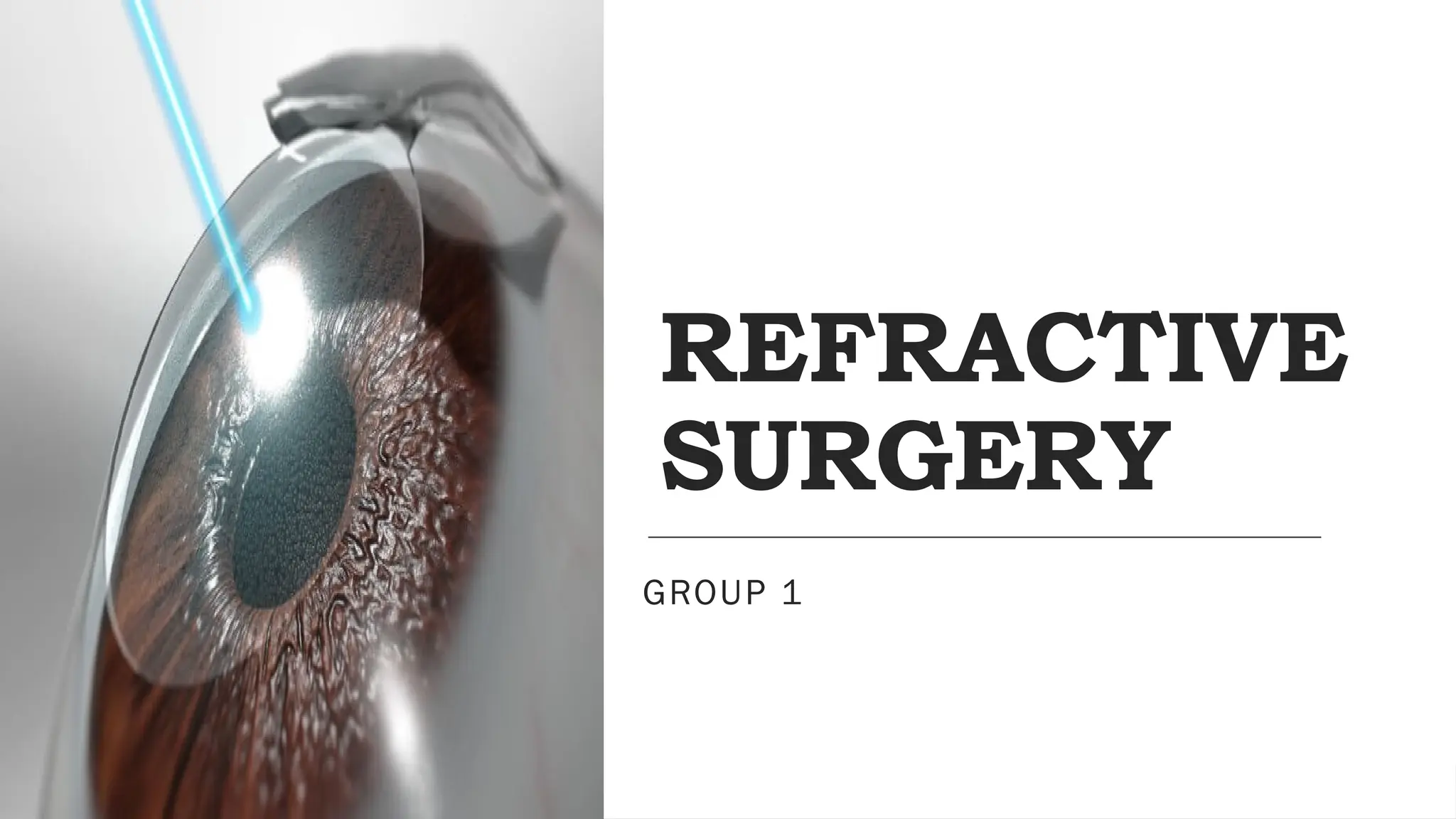
REFRACTIVE
SURGERY
GROUP 1
Overview
Refractive surgery corrects vision problems like myopia, hyperopia,
and astigmatism.
Reduces or eliminates the need for glasses or contact lenses.
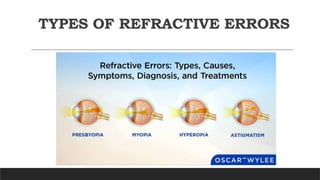
TYPES OF REFRACTIVE ERRORS
MAIN TYPES OF REFRACTIVE
SURGERY
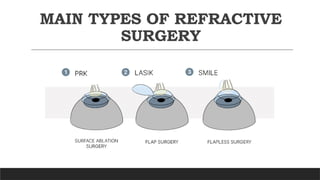
1. LASIK (Laser-Assisted In Situ Keratomileusis)
2. PRK (Photorefractive Keratectomy)
3. LASEK (Laser Epithelial Keratomileusis)
4. SMILE (Small Incision Lenticule Extraction):.
5. RK (Radial Keratotomy) – Rarely used today
6. ALK (Automated Lamellar Keratoplasty) – Largely replaced by LASIK
7. Phakic Intraocular Lens (IOL) Implantation
8. Refractive Lens Exchange (RLE)
MAIN TYPES OF REFRACTIVE
SURGERY
1. LASIK (Laser-Assisted In Situ Keratomileusis)
Most common refractive surgery. A flap is created in the cornea, and a laser reshapes the underlying
tissue. Quick recovery and minimal discomfort. It treats: Myopia, hyperopia, astigmatism.
2. PRK (Photorefractive Keratectomy)
The surface layer of the cornea (epithelium) is removed, and then the cornea is reshaped with a laser. No
flap is created (unlike LASIK). Longer recovery time, but good for patients with thin corneas. It treats:
Myopia, hyperopia, astigmatism.
3. LASEK (Laser Epithelial Keratomileusis)
A variation of PRK. The epithelial layer is loosened with alcohol and moved aside rather than removed, then
replaced after laser reshaping. Suitable for patients with thinner corneas or higher risk of trauma . It treats:
Myopia, hyperopia, astigmatism.
4. SMILE (Small Incision Lenticule Extraction): A minimally invasive procedure where a femtosecond laser
creates a lenticule (a small piece of corneal tissue) that is removed through a tiny incision. No flap creation.
Fast recovery, less dry eye. Mainly treats: Myopia and mild astigmatism.
5. RK (Radial Keratotomy) – Rarely used today
Small incisions are made in the cornea to flatten it and correct myopia . Outdated due to better
precision with lasers. It treats Myopia.
6. ALK (Automated Lamellar Keratoplasty) – Largely replaced by LASIKUsed for severe myopia or
astigmatism.Similar to LASIK but without laser reshaping.
7. Phakic Intraocular Lens (IOL) Implantation
A lens is implanted inside the eye without removing the natural lens. Good for patients with very high
myopia or thin corneas. It treats: High myopia and some hyperopia.
8. Refractive Lens Exchange (RLE)
Natural lens is removed and replaced with an artificial intraocular lens (similar to cataract surgery).
Often used to correct presbyopia or high hyperopia. It treats: Presbyopia, high hyperopia, early
cataracts.
9. Conductive Keratoplasty (CK) – Less common
Uses radiofrequency energy to reshape the cornea. Primarily used for mild presbyopia or hyperopia
PATIENT SELECTION
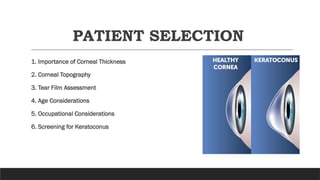
1. Importance of Corneal Thickness
2. Corneal Topography
3. Tear Film Assessment
4. Age Considerations
5. Occupational Considerations
6. Screening for Keratoconus
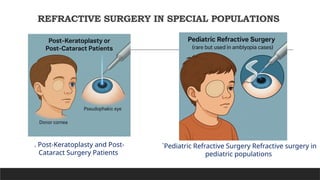
REFRACTIVE SURGERY IN SPECIAL POPULATIONS
`Pediatric Refractive Surgery Refractive surgery in
pediatric populations
. Post-Keratoplasty and Post-
Cataract Surgery Patients
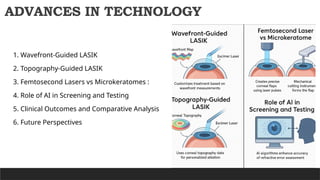
ADVANCES IN TECHNOLOGY
1. Wavefront-Guided LASIK
2. Topography-Guided LASIK
3. Femtosecond Lasers vs Microkeratomes :
4. Role of AI in Screening and Testing
5. Clinical Outcomes and Comparative Analysis
6. Future Perspectives
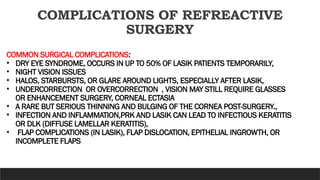
COMMON SURGICAL COMPLICATIONS:
• DRY EYE SYNDROME, OCCURS IN UP TO 50% OF LASIK PATIENTS TEMPORARILY,
• NIGHT VISION ISSUES
• HALOS, STARBURSTS, OR GLARE AROUND LIGHTS, ESPECIALLY AFTER LASIK,
• UNDERCORRECTION OR OVERCORRECTION , VISION MAY STILL REQUIRE GLASSES
OR ENHANCEMENT SURGERY, CORNEAL ECTASIA
• A RARE BUT SERIOUS THINNING AND BULGING OF THE CORNEA POST-SURGERY.,
• INFECTION AND INFLAMMATION,PRK AND LASIK CAN LEAD TO INFECTIOUS KERATITIS
OR DLK (DIFFUSE LAMELLAR KERATITIS),
• FLAP COMPLICATIONS (IN LASIK), FLAP DISLOCATION, EPITHELIAL INGROWTH, OR
INCOMPLETE FLAPS
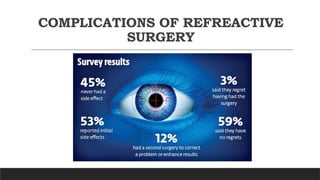
COMPLICATIONS OF REFREACTIVE
SURGERY
COMPLICATIONS OF REFREACTIVE
SURGERY
CONCLUSION
Refractive errors, while common and often correctable, pose a significant burden on
individuals’ quality of life and daily functioning. Through this research, we explored the
full spectrum of refractive error management—from understanding the different types
and their impact, to the wide range of surgical options now available.
Laser-based procedures like LASIK, PRK, and SMILE have revolutionized vision
correction with high precision and fast recovery, while lens-based surgeries such as ICLs
and RLE offer alternatives for cases unsuitable for corneal procedures.

REFRACTIVE SURGERY presentation (lasik-)

  • 1.
  • 2.
    Overview Refractive surgery correctsvision problems like myopia, hyperopia, and astigmatism. Reduces or eliminates the need for glasses or contact lenses.
  • 3.
  • 4.
    MAIN TYPES OFREFRACTIVE SURGERY 1. LASIK (Laser-Assisted In Situ Keratomileusis) 2. PRK (Photorefractive Keratectomy) 3. LASEK (Laser Epithelial Keratomileusis) 4. SMILE (Small Incision Lenticule Extraction):. 5. RK (Radial Keratotomy) – Rarely used today 6. ALK (Automated Lamellar Keratoplasty) – Largely replaced by LASIK 7. Phakic Intraocular Lens (IOL) Implantation 8. Refractive Lens Exchange (RLE)
  • 5.
    MAIN TYPES OFREFRACTIVE SURGERY
  • 6.
    1. LASIK (Laser-AssistedIn Situ Keratomileusis) Most common refractive surgery. A flap is created in the cornea, and a laser reshapes the underlying tissue. Quick recovery and minimal discomfort. It treats: Myopia, hyperopia, astigmatism. 2. PRK (Photorefractive Keratectomy) The surface layer of the cornea (epithelium) is removed, and then the cornea is reshaped with a laser. No flap is created (unlike LASIK). Longer recovery time, but good for patients with thin corneas. It treats: Myopia, hyperopia, astigmatism. 3. LASEK (Laser Epithelial Keratomileusis) A variation of PRK. The epithelial layer is loosened with alcohol and moved aside rather than removed, then replaced after laser reshaping. Suitable for patients with thinner corneas or higher risk of trauma . It treats: Myopia, hyperopia, astigmatism. 4. SMILE (Small Incision Lenticule Extraction): A minimally invasive procedure where a femtosecond laser creates a lenticule (a small piece of corneal tissue) that is removed through a tiny incision. No flap creation. Fast recovery, less dry eye. Mainly treats: Myopia and mild astigmatism.
  • 7.
    5. RK (RadialKeratotomy) – Rarely used today Small incisions are made in the cornea to flatten it and correct myopia . Outdated due to better precision with lasers. It treats Myopia. 6. ALK (Automated Lamellar Keratoplasty) – Largely replaced by LASIKUsed for severe myopia or astigmatism.Similar to LASIK but without laser reshaping. 7. Phakic Intraocular Lens (IOL) Implantation A lens is implanted inside the eye without removing the natural lens. Good for patients with very high myopia or thin corneas. It treats: High myopia and some hyperopia. 8. Refractive Lens Exchange (RLE) Natural lens is removed and replaced with an artificial intraocular lens (similar to cataract surgery). Often used to correct presbyopia or high hyperopia. It treats: Presbyopia, high hyperopia, early cataracts. 9. Conductive Keratoplasty (CK) – Less common Uses radiofrequency energy to reshape the cornea. Primarily used for mild presbyopia or hyperopia
  • 8.
    PATIENT SELECTION 1. Importanceof Corneal Thickness 2. Corneal Topography 3. Tear Film Assessment 4. Age Considerations 5. Occupational Considerations 6. Screening for Keratoconus
  • 9.
    REFRACTIVE SURGERY INSPECIAL POPULATIONS `Pediatric Refractive Surgery Refractive surgery in pediatric populations . Post-Keratoplasty and Post- Cataract Surgery Patients
  • 10.
    ADVANCES IN TECHNOLOGY 1.Wavefront-Guided LASIK 2. Topography-Guided LASIK 3. Femtosecond Lasers vs Microkeratomes : 4. Role of AI in Screening and Testing 5. Clinical Outcomes and Comparative Analysis 6. Future Perspectives
  • 11.
    COMMON SURGICAL COMPLICATIONS: •DRY EYE SYNDROME, OCCURS IN UP TO 50% OF LASIK PATIENTS TEMPORARILY, • NIGHT VISION ISSUES • HALOS, STARBURSTS, OR GLARE AROUND LIGHTS, ESPECIALLY AFTER LASIK, • UNDERCORRECTION OR OVERCORRECTION , VISION MAY STILL REQUIRE GLASSES OR ENHANCEMENT SURGERY, CORNEAL ECTASIA • A RARE BUT SERIOUS THINNING AND BULGING OF THE CORNEA POST-SURGERY., • INFECTION AND INFLAMMATION,PRK AND LASIK CAN LEAD TO INFECTIOUS KERATITIS OR DLK (DIFFUSE LAMELLAR KERATITIS), • FLAP COMPLICATIONS (IN LASIK), FLAP DISLOCATION, EPITHELIAL INGROWTH, OR INCOMPLETE FLAPS COMPLICATIONS OF REFREACTIVE SURGERY
  • 12.
  • 13.
    CONCLUSION Refractive errors, whilecommon and often correctable, pose a significant burden on individuals’ quality of life and daily functioning. Through this research, we explored the full spectrum of refractive error management—from understanding the different types and their impact, to the wide range of surgical options now available. Laser-based procedures like LASIK, PRK, and SMILE have revolutionized vision correction with high precision and fast recovery, while lens-based surgeries such as ICLs and RLE offer alternatives for cases unsuitable for corneal procedures.