1
RAGHU INSTITUTE OF TECHNOLOGY
AUTONOMOUS
DEPARTMENT OF ELECTRONICS & COMMUNICATION
ENGINEERING
II BTECH II SEMESTER
ELECTRONIC CIRCUIT ANALYSIS
UNIT IV
Prepared By:
Mrs. SUSHMI NAIDU,
Mr. M. PAVAN KUMAR,
Assistant Professors
SUSHMINAIDU, M.PAVAN ECA Dept of ECE RIT‖ ‖ ‖
2
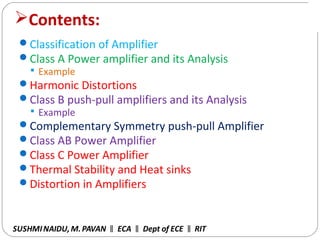
Contents:
Classification of Amplifier
Class A Power amplifier and its Analysis
 Example
Harmonic Distortions
Class B push-pull amplifiers and its Analysis
 Example
Complementary Symmetry push-pull Amplifier
Class AB Power Amplifier
Class C Power Amplifier
Thermal Stability and Heat sinks
Distortion in Amplifiers
SUSHMINAIDU, M.PAVAN ECA Dept of ECE RIT‖ ‖ ‖
3
 References
• “Integrated Electronics”, J. Milliman and C.C. Halkias, Tata
McGraw Hill, 1972
• “Electronic Circuit Analysis- B.V. Rao, K.R.Rjeswari,
P.C.R.Pantulu- Pearson publication
• “Electronic Devices and Circuits” – Salivahanan, Suresh Kumar,
A.Vallavaraj, TATA McGraw Hill
• www.nptel.ac.in
• www.nesoacademy.org
• www.tutorialspoint.com
SUSHMINAIDU, M.PAVAN ECA Dept of ECE RIT‖ ‖ ‖
IntroductionIntroduction
Power amplifiers are used to deliver a relatively high amount of
power, usually to a low resistance load.
Typical load values range from 300W (for transmission antennas)
to 8W (for audio speaker).
Although these load values do not cover every possibility, they do
illustrate the fact that power amplifiers usually drive low-
resistance loads.
Typical output power rating of a power amplifier will be 1W or
higher.
Ideal power amplifier will deliver 100% of the power it draws
from the supply to load. In practice, this can never occur.
The reason for this is the fact that the components in the amplifier
will all dissipate some of the power that is being drawn form the
supply.
SUSHMINAIDU, M.PAVAN ECA Dept of ECE RIT‖ ‖ ‖
Concept of Power AmplifierConcept of Power Amplifier
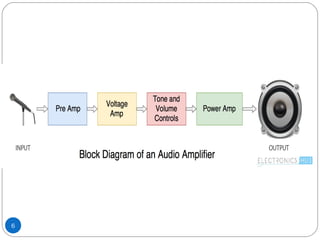
Provide sufficient power to an output load to
drive other power device.
To deliver a large current to a small load resistance
e.g. audio speaker;
To deliver a large voltage to a large load resistance
e.g. switching power supply;
To provide a low output resistance in order to avoid
loss of gain and to maintain linearity (to minimize
harmonic distortion)
To deliver power to the load efficiently
SUSHMINAIDU, M.PAVAN ECA Dept of ECE RIT‖ ‖ ‖
6
Power Amplifier Power DissipationPower Amplifier Power Dissipation
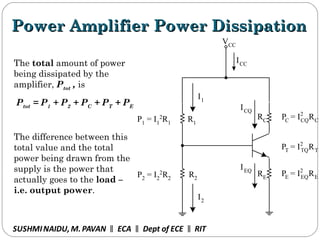
P1
= I1
2R1
P2 = I2
2R2
ICQ
RC
RE
R1
R2
VCC
I1
I2
ICC
PC = ICQ
2
RC
PT = ITQ
2
RT
PE = IEQ
2
RE
IEQ
The total amount of power
being dissipated by the
amplifier, Ptot
, is
Ptot
= P1
+ P2
+ PC
+ PT
+ PE
The difference between this
total value and the total
power being drawn from the
supply is the power that
actually goes to the load –
i.e. output power.
SUSHMINAIDU, M.PAVAN ECA Dept of ECE RIT‖ ‖ ‖
Power Amplifier EfficiencyPower Amplifier Efficiency ηη
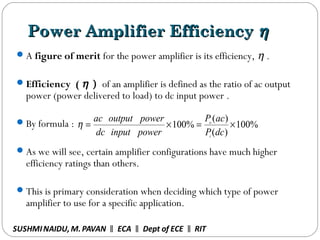
A figure of merit for the power amplifier is its efficiency, η .
Efficiency ( η ) of an amplifier is defined as the ratio of ac output
power (power delivered to load) to dc input power .
By formula :
As we will see, certain amplifier configurations have much higher
efficiency ratings than others.
This is primary consideration when deciding which type of power
amplifier to use for a specific application.
%100
)(
)(
%100 ×=×=
dcP
acP
powerinputdc
poweroutputac
i
o
η
SUSHMINAIDU, M.PAVAN ECA Dept of ECE RIT‖ ‖ ‖
“AUDIO AMPLIFIERS” – Unit-5
“RADIO FREQUENCY AMPLIFIERS” – Unit-6
DC POWER AMPLIFIERS
9
Power Amplifiers ClassificationPower Amplifiers Classification
(Depending on Type of output load)(Depending on Type of output load)
Power Amplifiers ClassificationPower Amplifiers Classification
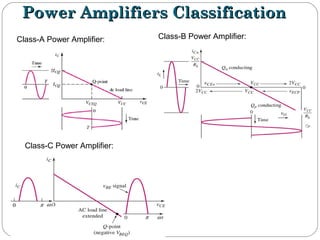
Class-A Power Amplifier: Class-B Power Amplifier:
Class-C Power Amplifier:
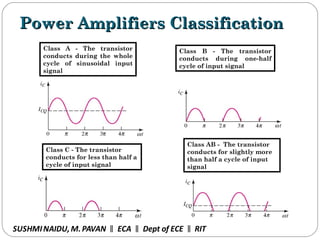
Power Amplifiers ClassificationPower Amplifiers Classification
Class A - The transistor
conducts during the whole
cycle of sinusoidal input
signal
Class B - The transistor
conducts during one-half
cycle of input signal
Class AB - The transistor
conducts for slightly more
than half a cycle of input
signal
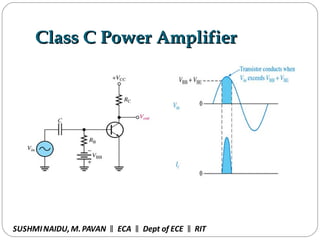
Class C - The transistor
conducts for less than half a
cycle of input signal
SUSHMINAIDU, M.PAVAN ECA Dept of ECE RIT‖ ‖ ‖
12
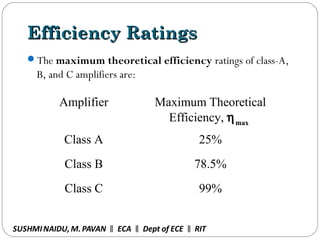
Efficiency RatingsEfficiency Ratings
The maximum theoretical efficiency ratings of class-A,
B, and C amplifiers are:
Amplifier Maximum Theoretical
Efficiency, ηmax
Class A 25%
Class B 78.5%
Class C 99%
SUSHMINAIDU, M.PAVAN ECA Dept of ECE RIT‖ ‖ ‖
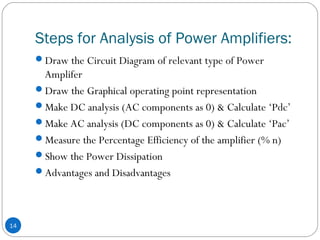
Steps for Analysis of Power Amplifiers:
Draw the Circuit Diagram of relevant type of Power
Amplifer
Draw the Graphical operating point representation
Make DC analysis (AC components as 0) & Calculate ‘Pdc’
Make AC analysis (DC components as 0) & Calculate ‘Pac’
Measure the Percentage Efficiency of the amplifier (% n)
Show the Power Dissipation
Advantages and Disadvantages
14
Class A AmplifierClass A Amplifier
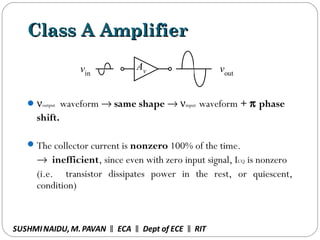
νoutput waveform → same shape → νinput waveform + π phase
shift.
The collector current is nonzero 100% of the time.
→ inefficient, since even with zero input signal, ICQ is nonzero
(i.e. transistor dissipates power in the rest, or quiescent,
condition)
vin vout
Av
SUSHMINAIDU, M.PAVAN ECA Dept of ECE RIT‖ ‖ ‖
Class A Amplifier ClassificationClass A Amplifier Classification
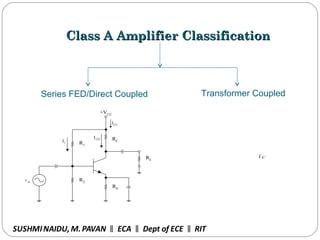
Series FED/Direct Coupled Transformer Coupled
RC
+VCC
RE
R1
R2
RL
v in
ICQ
I1
ICC
i C
SUSHMINAIDU, M.PAVAN ECA Dept of ECE RIT‖ ‖ ‖
 Series FED/Direct Coupled Class A PowerSeries FED/Direct Coupled Class A Power
Amplifier AnalysisAmplifier Analysis
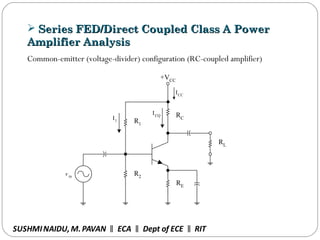
Common-emitter (voltage-divider) configuration (RC-coupled amplifier)
RC
+VCC
RE
R1
R2
RL
vin
ICQ
I1
ICC
SUSHMINAIDU, M.PAVAN ECA Dept of ECE RIT‖ ‖ ‖
 Typical Characteristic Curves forTypical Characteristic Curves for Class AClass A
OperationOperation
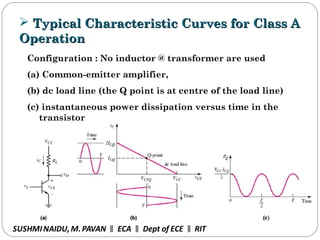
Configuration : No inductor @ transformer are used
(a) Common-emitter amplifier,
(b) dc load line (the Q point is at centre of the load line)
(c) instantaneous power dissipation versus time in the
transistor
SUSHMINAIDU, M.PAVAN ECA Dept of ECE RIT‖ ‖ ‖
 DC Input PowerDC Input Power
RC
+VCC
RE
R1
R2
RL
vin
ICQ
I1
ICC
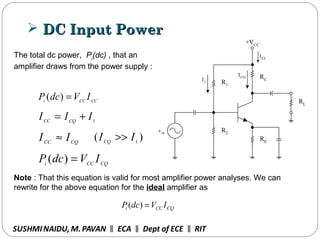
The total dc power, Pi
(dc) , that an
amplifier draws from the power supply :
CCCCi
IVdcP =)(
1
III CQCC
+=
CQCC
II ≈ )( 1
IICQ
>>
CQCCi
IVdcP =)(
Note : That this equation is valid for most amplifier power analyses. We can
rewrite for the above equation for the ideal amplifier as
CQCCi IVdcP =)(
SUSHMINAIDU, M.PAVAN ECA Dept of ECE RIT‖ ‖ ‖
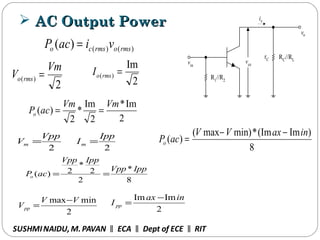
 AC Output PowerAC Output Power
R1//R2
vcevin
vo
ic
RC
//RL
rC
)()()( rmsormsco viacP =
SUSHMINAIDU, M.PAVAN ECA Dept of ECE RIT‖ ‖ ‖
2
)(
Vm
V rmso =
2
Im
)( =rmsoI
2
Vpp
Vm =
2
Ipp
Im =
2
minmax VV
Vpp
−
= 2
ImIm inax
I pp
−
=
2
Im*
2
Im
*
2
)(
VmVm
acPo ==
8
*
2
2
*
2)(
IppVpp
IppVpp
acPo ==
8
)Im(Im*min)max(
)(
inaxVV
acPo
−−
=
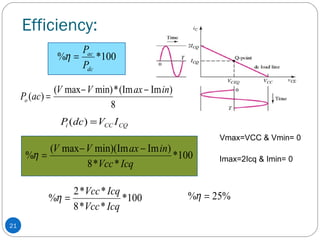
Efficiency:
21
8
)Im(Im*min)max(
)(
inaxVV
acPo
−−
=
CQCCi IVdcP =)(
100*%
dc
ac
P
P
=η
100*
**8
**2
%
IcqVcc
IcqVcc
=η
Vmax=VCC & Vmin= 0
Imax=2Icq & Imin= 0100*
**8
)Immin)(Immax(
%
IcqVcc
inaxVV −−
=η
%25% =η
22
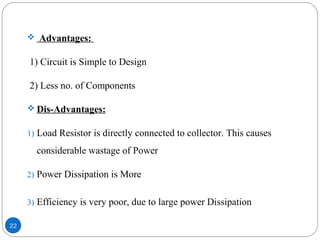
 Advantages:
1) Circuit is Simple to Design
2) Less no. of Components
 Dis-Advantages:
1) Load Resistor is directly connected to collector. This causes
considerable wastage of Power
2) Power Dissipation is More
3) Efficiency is very poor, due to large power Dissipation
Transformer Coupled AmplifierTransformer Coupled Amplifier
• The theoretical maximum efficiency of a basic RC-coupled
class-A amplifier is limited to 25%.
• In practical circuit, the efficiency is less than 25%.
• Used for output power of about 1 W only.
• Transformer coupling can increase the maximum
efficiency to 50%
• Disadvantage of transformer coupling – expensive &
bulky.
SUSHMINAIDU, M.PAVAN ECA Dept of ECE RIT‖ ‖ ‖
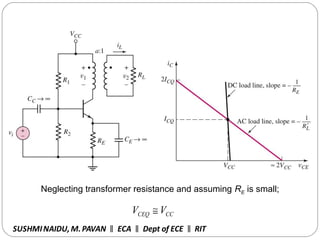
Neglecting transformer resistance and assuming RE is small;
CCCEQ VV ≅
SUSHMINAIDU, M.PAVAN ECA Dept of ECE RIT‖ ‖ ‖
25
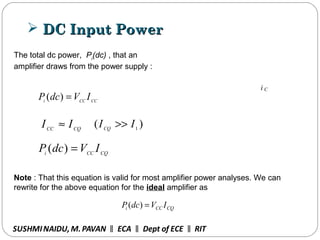
 DC Input PowerDC Input Power
The total dc power, Pi
(dc) , that an
amplifier draws from the power supply :
CCCCi
IVdcP =)(
CQCC
II ≈ )( 1
IICQ
>>
CQCCi
IVdcP =)(
Note : That this equation is valid for most amplifier power analyses. We can
rewrite for the above equation for the ideal amplifier as
CQCCi IVdcP =)(
SUSHMINAIDU, M.PAVAN ECA Dept of ECE RIT‖ ‖ ‖
i C
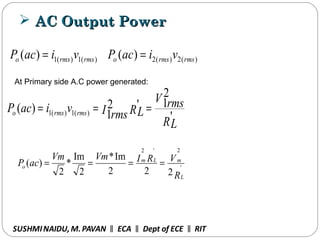
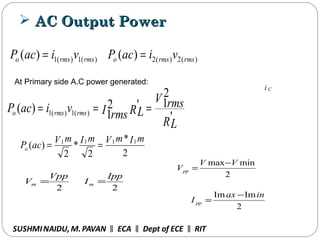
 AC Output PowerAC Output Power
SUSHMINAIDU, M.PAVAN ECA Dept of ECE RIT‖ ‖ ‖
2
minmax VV
Vpp
−
=
)(1)(1)( rmsrmso viacP =
i C
)(2)(2)( rmsrmso viacP =
At Primary side A.C power generated:
RL
V rms
RLI rmsviacP rmsrmso
'
2
1'2
1)( )(1)(1 ===
2
*
2
*
2
)( 1111 mImVmImV
acPo ==
2
Vpp
Vm =
2
Ipp
Im =
2
ImIm inax
I pp
−
=
SUSHMINAIDU, M.PAVAN ECA Dept of ECE RIT‖ ‖ ‖
8
*
2
2
*
2)(
IppVpp
IppVpp
acPo ==
8
)Im(Im*min)max(
)(
inaxVV
acPo
−−
=
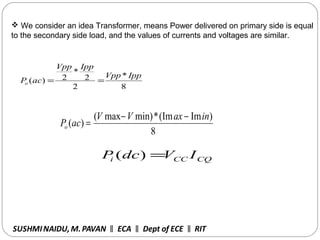
 We consider an idea Transformer, means Power delivered on primary side is equal
to the secondary side load, and the values of currents and voltages are similar.
CQCCi IVdcP =)(
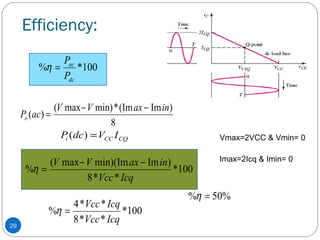
Efficiency:
29
8
)Im(Im*min)max(
)(
inaxVV
acPo
−−
=
CQCCi IVdcP =)(
100*%
dc
ac
P
P
=η
100*
**8
**4
%
IcqVcc
IcqVcc
=η
Vmax=2VCC & Vmin= 0
Imax=2Icq & Imin= 0
100*
**8
)Immin)(Immax(
%
IcqVcc
inaxVV −−
=η
%50% =η
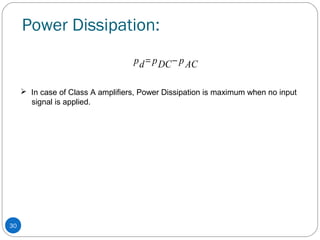
30
Power Dissipation:
pACpDCpd −=
 In case of Class A amplifiers, Power Dissipation is maximum when no input
signal is applied.
31
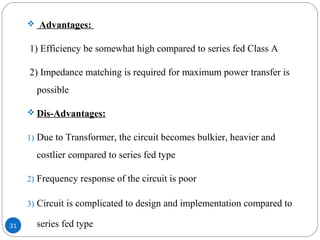
 Advantages:
1) Efficiency be somewhat high compared to series fed Class A
2) Impedance matching is required for maximum power transfer is
possible
 Dis-Advantages:
1) Due to Transformer, the circuit becomes bulkier, heavier and
costlier compared to series fed type
2) Frequency response of the circuit is poor
3) Circuit is complicated to design and implementation compared to
series fed type
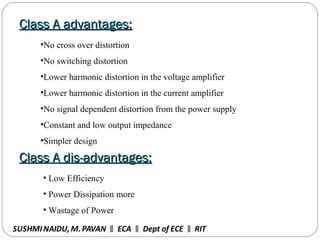
•No cross over distortion
•No switching distortion
•Lower harmonic distortion in the voltage amplifier
•Lower harmonic distortion in the current amplifier
•No signal dependent distortion from the power supply
•Constant and low output impedance
•Simpler design
Class A advantages:Class A advantages:
Class A dis-advantages:Class A dis-advantages:
• Low Efficiency
• Power Dissipation more
• Wastage of Power
SUSHMINAIDU, M.PAVAN ECA Dept of ECE RIT‖ ‖ ‖
ExampleExample
Calculate the input power [Pi
(dc)], output power
[Po
(ac)], and efficiency [η] of the amplifier circuit for
an input voltage that results in a base current of
10mA peak.
RC
RB
+VCC = 20V
IC
Vi
25=β
Ω20
Ωk1
Vo
( )
%5.6%100
6.9)48.0)(20(
625.0)20(
2
10250
2
250)10(25
20
11000
20
20
4.10)20)(48.0(20
48.05.482)3.19(25
3.19
1
7.020
)(
)(
)(
232
)(
)(
)(
)()(
)(
=×=
===
=Ω
×
==
===
==
==
Ω
==
=Ω−=−=
≅===
=
Ω
−
=
−
=
−
dci
aco
CQCCdci
C
peakC
aco
C
CC
satc
B
P
P
WAVIVP
W
A
R
I
P
peakmApeakmAII
VVV
AmA
V
R
V
I
VAVRIVV
AmAmAII
mA
k
VV
R
VV
I
peakbpeakC
CCcutoffCE
CCCCCEQ
CQ
B
BECC
BQ
η
β
β
Class B Power AmplifierClass B Power Amplifier
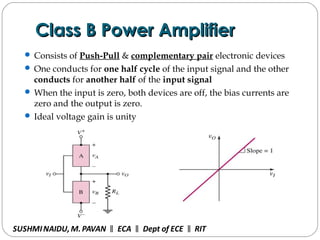
 Consists of Push-Pull & complementary pair electronic devices
 One conducts for one half cycle of the input signal and the other
conducts for another half of the input signal
 When the input is zero, both devices are off, the bias currents are
zero and the output is zero.
 Ideal voltage gain is unity
SUSHMINAIDU, M.PAVAN ECA Dept of ECE RIT‖ ‖ ‖
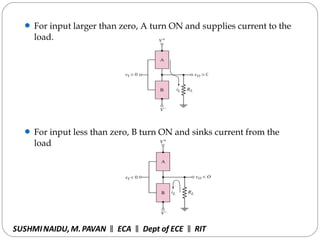
 For input larger than zero, A turn ON and supplies current to the
load.
 For input less than zero, B turn ON and sinks current from the
load
SUSHMINAIDU, M.PAVAN ECA Dept of ECE RIT‖ ‖ ‖
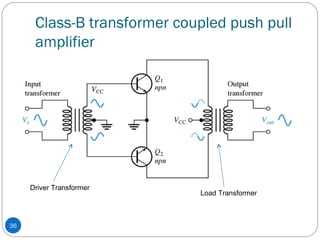
Class-B transformer coupled push pull
amplifier
36
Driver Transformer
Load Transformer
 DC Input PowerDC Input Power
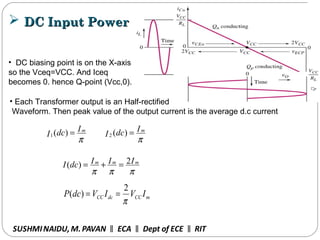
• DC biasing point is on the X-axis
so the Vceq=VCC. And Iceq
becomes 0. hence Q-point (Vcc,0).
mCCdcCC IVIVdcP
π
2
)( ==
π
IdcI
m
=)(1
SUSHMINAIDU, M.PAVAN ECA Dept of ECE RIT‖ ‖ ‖
• Each Transformer output is an Half-rectified
Waveform. Then peak value of the output current is the average d.c current
π
IdcI
m
=)(2
πππ
IIIdcI mmm 2)( =+=
 AC Output PowerAC Output Power
SUSHMINAIDU, M.PAVAN ECA Dept of ECE RIT‖ ‖ ‖
)(1)(1)( rmsrmso viacP = )(2)(2)( rmsrmso viacP =
At Primary side A.C power generated:
RL
V rms
RLI rmsviacP rmsrmso
'
2
1'2
1)( )(1)(1 ===
R
VRIVmVm
acP
L
mLm
o '
2'2
222
Im*
2
Im
*
2
)( ====
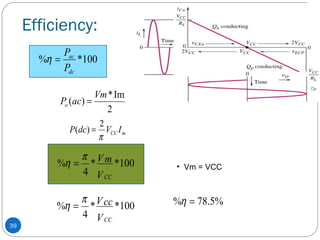
Efficiency:
39
100*%
dc
ac
P
P
=η
• Vm = VCC100**
4
%
V
Vm
CC
π
η =
%5.78% =η
2
Im*
)(
Vm
acPo =
mCC IVdcP
π
2
)( =
100**
4
%
V
Vcc
CC
π
η =
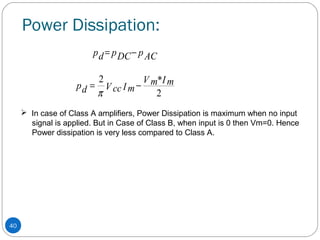
40
Power Dissipation:
pACpDCpd −=
2
*2 ImV m
ImV ccpd −=
π
 In case of Class A amplifiers, Power Dissipation is maximum when no input
signal is applied. But in Case of Class B, when input is 0 then Vm=0. Hence
Power dissipation is very less compared to Class A.
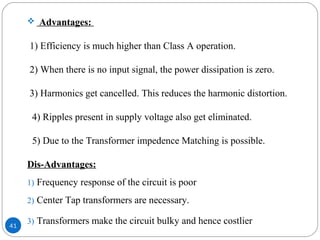
41
 Advantages:
1) Efficiency is much higher than Class A operation.
2) When there is no input signal, the power dissipation is zero.
3) Harmonics get cancelled. This reduces the harmonic distortion.
4) Ripples present in supply voltage also get eliminated.
5) Due to the Transformer impedence Matching is possible.
Dis-Advantages:
1) Frequency response of the circuit is poor
2) Center Tap transformers are necessary.
3) Transformers make the circuit bulky and hence costlier
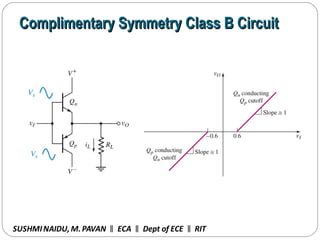
Complimentary Symmetry Class B CircuitComplimentary Symmetry Class B Circuit
SUSHMINAIDU, M.PAVAN ECA Dept of ECE RIT‖ ‖ ‖
43
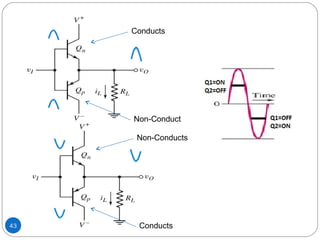
Conducts
Non-Conduct
Non-Conducts
Conducts
44
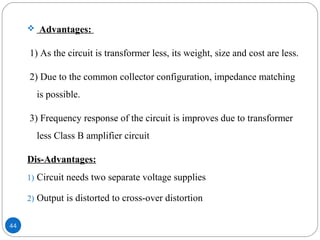
 Advantages:
1) As the circuit is transformer less, its weight, size and cost are less.
2) Due to the common collector configuration, impedance matching
is possible.
3) Frequency response of the circuit is improves due to transformer
less Class B amplifier circuit
Dis-Advantages:
1) Circuit needs two separate voltage supplies
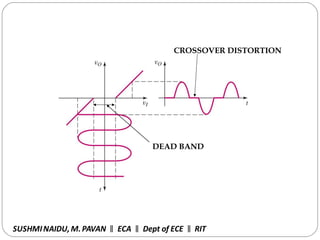
2) Output is distorted to cross-over distortion
DEAD BAND
CROSSOVER DISTORTION
SUSHMINAIDU, M.PAVAN ECA Dept of ECE RIT‖ ‖ ‖
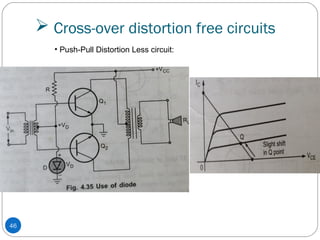
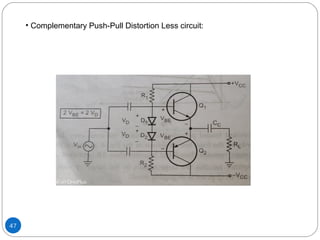
 Cross-over distortion free circuits
46
• Push-Pull Distortion Less circuit:
47
• Complementary Push-Pull Distortion Less circuit:
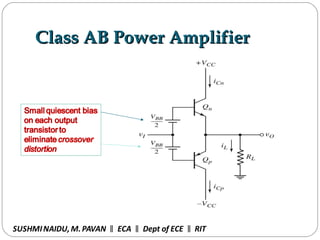
Class AB Power AmplifierClass AB Power Amplifier
SUSHMINAIDU, M.PAVAN ECA Dept of ECE RIT‖ ‖ ‖
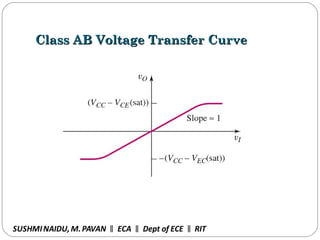
Class AB Voltage Transfer CurveClass AB Voltage Transfer Curve
SUSHMINAIDU, M.PAVAN ECA Dept of ECE RIT‖ ‖ ‖
Class C Power AmplifierClass C Power Amplifier
SUSHMINAIDU, M.PAVAN ECA Dept of ECE RIT‖ ‖ ‖
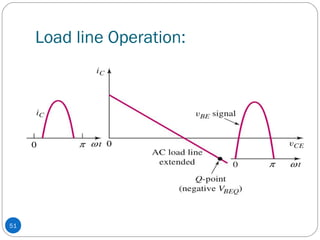
Load line Operation:
51
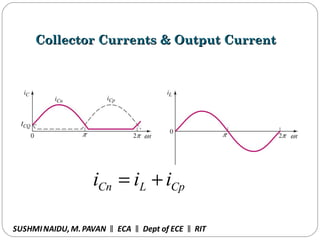
Collector Currents & Output CurrentCollector Currents & Output Current
CpLCn iii +=
SUSHMINAIDU, M.PAVAN ECA Dept of ECE RIT‖ ‖ ‖
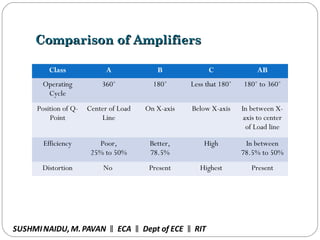
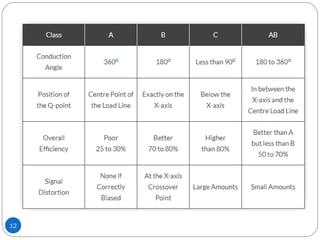
Comparison of AmplifiersComparison of Amplifiers
Class A B C AB
Operating
Cycle
360˚ 180˚ Less that 180˚ 180˚ to 360˚
Position of Q-
Point
Center of Load
Line
On X-axis Below X-axis In between X-
axis to center
of Load line
Efficiency Poor,
25% to 50%
Better,
78.5%
High In between
78.5% to 50%
Distortion No Present Highest Present
SUSHMINAIDU, M.PAVAN ECA Dept of ECE RIT‖ ‖ ‖
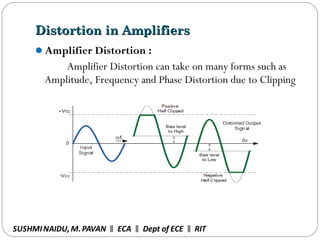
Amplifier Distortion :
Amplifier Distortion can take on many forms such as
Amplitude, Frequency and Phase Distortion due to Clipping
Distortion in AmplifiersDistortion in Amplifiers
SUSHMINAIDU, M.PAVAN ECA Dept of ECE RIT‖ ‖ ‖
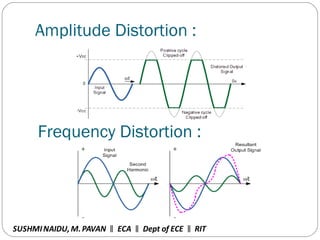
Amplitude Distortion :
Frequency Distortion :
SUSHMINAIDU, M.PAVAN ECA Dept of ECE RIT‖ ‖ ‖
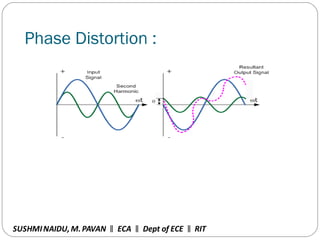
Phase Distortion :
SUSHMINAIDU, M.PAVAN ECA Dept of ECE RIT‖ ‖ ‖
57
Thank you
58

Eca unit 5

  • 1.
    1 RAGHU INSTITUTE OFTECHNOLOGY AUTONOMOUS DEPARTMENT OF ELECTRONICS & COMMUNICATION ENGINEERING II BTECH II SEMESTER ELECTRONIC CIRCUIT ANALYSIS UNIT IV Prepared By: Mrs. SUSHMI NAIDU, Mr. M. PAVAN KUMAR, Assistant Professors SUSHMINAIDU, M.PAVAN ECA Dept of ECE RIT‖ ‖ ‖
  • 2.
    2 Contents: Classification of Amplifier ClassA Power amplifier and its Analysis  Example Harmonic Distortions Class B push-pull amplifiers and its Analysis  Example Complementary Symmetry push-pull Amplifier Class AB Power Amplifier Class C Power Amplifier Thermal Stability and Heat sinks Distortion in Amplifiers SUSHMINAIDU, M.PAVAN ECA Dept of ECE RIT‖ ‖ ‖
  • 3.
    3  References • “IntegratedElectronics”, J. Milliman and C.C. Halkias, Tata McGraw Hill, 1972 • “Electronic Circuit Analysis- B.V. Rao, K.R.Rjeswari, P.C.R.Pantulu- Pearson publication • “Electronic Devices and Circuits” – Salivahanan, Suresh Kumar, A.Vallavaraj, TATA McGraw Hill • www.nptel.ac.in • www.nesoacademy.org • www.tutorialspoint.com SUSHMINAIDU, M.PAVAN ECA Dept of ECE RIT‖ ‖ ‖
  • 4.
    IntroductionIntroduction Power amplifiers areused to deliver a relatively high amount of power, usually to a low resistance load. Typical load values range from 300W (for transmission antennas) to 8W (for audio speaker). Although these load values do not cover every possibility, they do illustrate the fact that power amplifiers usually drive low- resistance loads. Typical output power rating of a power amplifier will be 1W or higher. Ideal power amplifier will deliver 100% of the power it draws from the supply to load. In practice, this can never occur. The reason for this is the fact that the components in the amplifier will all dissipate some of the power that is being drawn form the supply. SUSHMINAIDU, M.PAVAN ECA Dept of ECE RIT‖ ‖ ‖
  • 5.
    Concept of PowerAmplifierConcept of Power Amplifier Provide sufficient power to an output load to drive other power device. To deliver a large current to a small load resistance e.g. audio speaker; To deliver a large voltage to a large load resistance e.g. switching power supply; To provide a low output resistance in order to avoid loss of gain and to maintain linearity (to minimize harmonic distortion) To deliver power to the load efficiently SUSHMINAIDU, M.PAVAN ECA Dept of ECE RIT‖ ‖ ‖
  • 6.
  • 7.
    Power Amplifier PowerDissipationPower Amplifier Power Dissipation P1 = I1 2R1 P2 = I2 2R2 ICQ RC RE R1 R2 VCC I1 I2 ICC PC = ICQ 2 RC PT = ITQ 2 RT PE = IEQ 2 RE IEQ The total amount of power being dissipated by the amplifier, Ptot , is Ptot = P1 + P2 + PC + PT + PE The difference between this total value and the total power being drawn from the supply is the power that actually goes to the load – i.e. output power. SUSHMINAIDU, M.PAVAN ECA Dept of ECE RIT‖ ‖ ‖
  • 8.
    Power Amplifier EfficiencyPowerAmplifier Efficiency ηη A figure of merit for the power amplifier is its efficiency, η . Efficiency ( η ) of an amplifier is defined as the ratio of ac output power (power delivered to load) to dc input power . By formula : As we will see, certain amplifier configurations have much higher efficiency ratings than others. This is primary consideration when deciding which type of power amplifier to use for a specific application. %100 )( )( %100 ×=×= dcP acP powerinputdc poweroutputac i o η SUSHMINAIDU, M.PAVAN ECA Dept of ECE RIT‖ ‖ ‖
  • 9.
    “AUDIO AMPLIFIERS” –Unit-5 “RADIO FREQUENCY AMPLIFIERS” – Unit-6 DC POWER AMPLIFIERS 9 Power Amplifiers ClassificationPower Amplifiers Classification (Depending on Type of output load)(Depending on Type of output load)
  • 10.
    Power Amplifiers ClassificationPowerAmplifiers Classification Class-A Power Amplifier: Class-B Power Amplifier: Class-C Power Amplifier:
  • 11.
    Power Amplifiers ClassificationPowerAmplifiers Classification Class A - The transistor conducts during the whole cycle of sinusoidal input signal Class B - The transistor conducts during one-half cycle of input signal Class AB - The transistor conducts for slightly more than half a cycle of input signal Class C - The transistor conducts for less than half a cycle of input signal SUSHMINAIDU, M.PAVAN ECA Dept of ECE RIT‖ ‖ ‖
  • 12.
  • 13.
    Efficiency RatingsEfficiency Ratings Themaximum theoretical efficiency ratings of class-A, B, and C amplifiers are: Amplifier Maximum Theoretical Efficiency, ηmax Class A 25% Class B 78.5% Class C 99% SUSHMINAIDU, M.PAVAN ECA Dept of ECE RIT‖ ‖ ‖
  • 14.
    Steps for Analysisof Power Amplifiers: Draw the Circuit Diagram of relevant type of Power Amplifer Draw the Graphical operating point representation Make DC analysis (AC components as 0) & Calculate ‘Pdc’ Make AC analysis (DC components as 0) & Calculate ‘Pac’ Measure the Percentage Efficiency of the amplifier (% n) Show the Power Dissipation Advantages and Disadvantages 14
  • 15.
    Class A AmplifierClassA Amplifier νoutput waveform → same shape → νinput waveform + π phase shift. The collector current is nonzero 100% of the time. → inefficient, since even with zero input signal, ICQ is nonzero (i.e. transistor dissipates power in the rest, or quiescent, condition) vin vout Av SUSHMINAIDU, M.PAVAN ECA Dept of ECE RIT‖ ‖ ‖
  • 16.
    Class A AmplifierClassificationClass A Amplifier Classification Series FED/Direct Coupled Transformer Coupled RC +VCC RE R1 R2 RL v in ICQ I1 ICC i C SUSHMINAIDU, M.PAVAN ECA Dept of ECE RIT‖ ‖ ‖
  • 17.
     Series FED/DirectCoupled Class A PowerSeries FED/Direct Coupled Class A Power Amplifier AnalysisAmplifier Analysis Common-emitter (voltage-divider) configuration (RC-coupled amplifier) RC +VCC RE R1 R2 RL vin ICQ I1 ICC SUSHMINAIDU, M.PAVAN ECA Dept of ECE RIT‖ ‖ ‖
  • 18.
     Typical CharacteristicCurves forTypical Characteristic Curves for Class AClass A OperationOperation Configuration : No inductor @ transformer are used (a) Common-emitter amplifier, (b) dc load line (the Q point is at centre of the load line) (c) instantaneous power dissipation versus time in the transistor SUSHMINAIDU, M.PAVAN ECA Dept of ECE RIT‖ ‖ ‖
  • 19.
     DC InputPowerDC Input Power RC +VCC RE R1 R2 RL vin ICQ I1 ICC The total dc power, Pi (dc) , that an amplifier draws from the power supply : CCCCi IVdcP =)( 1 III CQCC += CQCC II ≈ )( 1 IICQ >> CQCCi IVdcP =)( Note : That this equation is valid for most amplifier power analyses. We can rewrite for the above equation for the ideal amplifier as CQCCi IVdcP =)( SUSHMINAIDU, M.PAVAN ECA Dept of ECE RIT‖ ‖ ‖
  • 20.
     AC OutputPowerAC Output Power R1//R2 vcevin vo ic RC //RL rC )()()( rmsormsco viacP = SUSHMINAIDU, M.PAVAN ECA Dept of ECE RIT‖ ‖ ‖ 2 )( Vm V rmso = 2 Im )( =rmsoI 2 Vpp Vm = 2 Ipp Im = 2 minmax VV Vpp − = 2 ImIm inax I pp − = 2 Im* 2 Im * 2 )( VmVm acPo == 8 * 2 2 * 2)( IppVpp IppVpp acPo == 8 )Im(Im*min)max( )( inaxVV acPo −− =
  • 21.
  • 22.
    22  Advantages: 1) Circuitis Simple to Design 2) Less no. of Components  Dis-Advantages: 1) Load Resistor is directly connected to collector. This causes considerable wastage of Power 2) Power Dissipation is More 3) Efficiency is very poor, due to large power Dissipation
  • 23.
    Transformer Coupled AmplifierTransformerCoupled Amplifier • The theoretical maximum efficiency of a basic RC-coupled class-A amplifier is limited to 25%. • In practical circuit, the efficiency is less than 25%. • Used for output power of about 1 W only. • Transformer coupling can increase the maximum efficiency to 50% • Disadvantage of transformer coupling – expensive & bulky. SUSHMINAIDU, M.PAVAN ECA Dept of ECE RIT‖ ‖ ‖
  • 24.
    Neglecting transformer resistanceand assuming RE is small; CCCEQ VV ≅ SUSHMINAIDU, M.PAVAN ECA Dept of ECE RIT‖ ‖ ‖
  • 25.
  • 26.
     DC InputPowerDC Input Power The total dc power, Pi (dc) , that an amplifier draws from the power supply : CCCCi IVdcP =)( CQCC II ≈ )( 1 IICQ >> CQCCi IVdcP =)( Note : That this equation is valid for most amplifier power analyses. We can rewrite for the above equation for the ideal amplifier as CQCCi IVdcP =)( SUSHMINAIDU, M.PAVAN ECA Dept of ECE RIT‖ ‖ ‖ i C
  • 27.
     AC OutputPowerAC Output Power SUSHMINAIDU, M.PAVAN ECA Dept of ECE RIT‖ ‖ ‖ 2 minmax VV Vpp − = )(1)(1)( rmsrmso viacP = i C )(2)(2)( rmsrmso viacP = At Primary side A.C power generated: RL V rms RLI rmsviacP rmsrmso ' 2 1'2 1)( )(1)(1 === 2 * 2 * 2 )( 1111 mImVmImV acPo == 2 Vpp Vm = 2 Ipp Im = 2 ImIm inax I pp − =
  • 28.
    SUSHMINAIDU, M.PAVAN ECADept of ECE RIT‖ ‖ ‖ 8 * 2 2 * 2)( IppVpp IppVpp acPo == 8 )Im(Im*min)max( )( inaxVV acPo −− =  We consider an idea Transformer, means Power delivered on primary side is equal to the secondary side load, and the values of currents and voltages are similar. CQCCi IVdcP =)(
  • 29.
    Efficiency: 29 8 )Im(Im*min)max( )( inaxVV acPo −− = CQCCi IVdcP =)( 100*% dc ac P P =η 100* **8 **4 % IcqVcc IcqVcc =η Vmax=2VCC& Vmin= 0 Imax=2Icq & Imin= 0 100* **8 )Immin)(Immax( % IcqVcc inaxVV −− =η %50% =η
  • 30.
    30 Power Dissipation: pACpDCpd −= In case of Class A amplifiers, Power Dissipation is maximum when no input signal is applied.
  • 31.
    31  Advantages: 1) Efficiencybe somewhat high compared to series fed Class A 2) Impedance matching is required for maximum power transfer is possible  Dis-Advantages: 1) Due to Transformer, the circuit becomes bulkier, heavier and costlier compared to series fed type 2) Frequency response of the circuit is poor 3) Circuit is complicated to design and implementation compared to series fed type
  • 32.
    •No cross overdistortion •No switching distortion •Lower harmonic distortion in the voltage amplifier •Lower harmonic distortion in the current amplifier •No signal dependent distortion from the power supply •Constant and low output impedance •Simpler design Class A advantages:Class A advantages: Class A dis-advantages:Class A dis-advantages: • Low Efficiency • Power Dissipation more • Wastage of Power SUSHMINAIDU, M.PAVAN ECA Dept of ECE RIT‖ ‖ ‖
  • 33.
    ExampleExample Calculate the inputpower [Pi (dc)], output power [Po (ac)], and efficiency [η] of the amplifier circuit for an input voltage that results in a base current of 10mA peak. RC RB +VCC = 20V IC Vi 25=β Ω20 Ωk1 Vo ( ) %5.6%100 6.9)48.0)(20( 625.0)20( 2 10250 2 250)10(25 20 11000 20 20 4.10)20)(48.0(20 48.05.482)3.19(25 3.19 1 7.020 )( )( )( 232 )( )( )( )()( )( =×= === =Ω × == === == == Ω == =Ω−=−= ≅=== = Ω − = − = − dci aco CQCCdci C peakC aco C CC satc B P P WAVIVP W A R I P peakmApeakmAII VVV AmA V R V I VAVRIVV AmAmAII mA k VV R VV I peakbpeakC CCcutoffCE CCCCCEQ CQ B BECC BQ η β β
  • 34.
    Class B PowerAmplifierClass B Power Amplifier  Consists of Push-Pull & complementary pair electronic devices  One conducts for one half cycle of the input signal and the other conducts for another half of the input signal  When the input is zero, both devices are off, the bias currents are zero and the output is zero.  Ideal voltage gain is unity SUSHMINAIDU, M.PAVAN ECA Dept of ECE RIT‖ ‖ ‖
  • 35.
     For inputlarger than zero, A turn ON and supplies current to the load.  For input less than zero, B turn ON and sinks current from the load SUSHMINAIDU, M.PAVAN ECA Dept of ECE RIT‖ ‖ ‖
  • 36.
    Class-B transformer coupledpush pull amplifier 36 Driver Transformer Load Transformer
  • 37.
     DC InputPowerDC Input Power • DC biasing point is on the X-axis so the Vceq=VCC. And Iceq becomes 0. hence Q-point (Vcc,0). mCCdcCC IVIVdcP π 2 )( == π IdcI m =)(1 SUSHMINAIDU, M.PAVAN ECA Dept of ECE RIT‖ ‖ ‖ • Each Transformer output is an Half-rectified Waveform. Then peak value of the output current is the average d.c current π IdcI m =)(2 πππ IIIdcI mmm 2)( =+=
  • 38.
     AC OutputPowerAC Output Power SUSHMINAIDU, M.PAVAN ECA Dept of ECE RIT‖ ‖ ‖ )(1)(1)( rmsrmso viacP = )(2)(2)( rmsrmso viacP = At Primary side A.C power generated: RL V rms RLI rmsviacP rmsrmso ' 2 1'2 1)( )(1)(1 === R VRIVmVm acP L mLm o ' 2'2 222 Im* 2 Im * 2 )( ====
  • 39.
    Efficiency: 39 100*% dc ac P P =η • Vm =VCC100** 4 % V Vm CC π η = %5.78% =η 2 Im* )( Vm acPo = mCC IVdcP π 2 )( = 100** 4 % V Vcc CC π η =
  • 40.
    40 Power Dissipation: pACpDCpd −= 2 *2ImV m ImV ccpd −= π  In case of Class A amplifiers, Power Dissipation is maximum when no input signal is applied. But in Case of Class B, when input is 0 then Vm=0. Hence Power dissipation is very less compared to Class A.
  • 41.
    41  Advantages: 1) Efficiencyis much higher than Class A operation. 2) When there is no input signal, the power dissipation is zero. 3) Harmonics get cancelled. This reduces the harmonic distortion. 4) Ripples present in supply voltage also get eliminated. 5) Due to the Transformer impedence Matching is possible. Dis-Advantages: 1) Frequency response of the circuit is poor 2) Center Tap transformers are necessary. 3) Transformers make the circuit bulky and hence costlier
  • 42.
    Complimentary Symmetry ClassB CircuitComplimentary Symmetry Class B Circuit SUSHMINAIDU, M.PAVAN ECA Dept of ECE RIT‖ ‖ ‖
  • 43.
  • 44.
    44  Advantages: 1) Asthe circuit is transformer less, its weight, size and cost are less. 2) Due to the common collector configuration, impedance matching is possible. 3) Frequency response of the circuit is improves due to transformer less Class B amplifier circuit Dis-Advantages: 1) Circuit needs two separate voltage supplies 2) Output is distorted to cross-over distortion
  • 45.
    DEAD BAND CROSSOVER DISTORTION SUSHMINAIDU,M.PAVAN ECA Dept of ECE RIT‖ ‖ ‖
  • 46.
     Cross-over distortionfree circuits 46 • Push-Pull Distortion Less circuit:
  • 47.
    47 • Complementary Push-PullDistortion Less circuit:
  • 48.
    Class AB PowerAmplifierClass AB Power Amplifier SUSHMINAIDU, M.PAVAN ECA Dept of ECE RIT‖ ‖ ‖
  • 49.
    Class AB VoltageTransfer CurveClass AB Voltage Transfer Curve SUSHMINAIDU, M.PAVAN ECA Dept of ECE RIT‖ ‖ ‖
  • 50.
    Class C PowerAmplifierClass C Power Amplifier SUSHMINAIDU, M.PAVAN ECA Dept of ECE RIT‖ ‖ ‖
  • 51.
  • 52.
    Collector Currents &Output CurrentCollector Currents & Output Current CpLCn iii += SUSHMINAIDU, M.PAVAN ECA Dept of ECE RIT‖ ‖ ‖
  • 53.
    Comparison of AmplifiersComparisonof Amplifiers Class A B C AB Operating Cycle 360˚ 180˚ Less that 180˚ 180˚ to 360˚ Position of Q- Point Center of Load Line On X-axis Below X-axis In between X- axis to center of Load line Efficiency Poor, 25% to 50% Better, 78.5% High In between 78.5% to 50% Distortion No Present Highest Present SUSHMINAIDU, M.PAVAN ECA Dept of ECE RIT‖ ‖ ‖
  • 54.
    Amplifier Distortion : AmplifierDistortion can take on many forms such as Amplitude, Frequency and Phase Distortion due to Clipping Distortion in AmplifiersDistortion in Amplifiers SUSHMINAIDU, M.PAVAN ECA Dept of ECE RIT‖ ‖ ‖
  • 55.
    Amplitude Distortion : FrequencyDistortion : SUSHMINAIDU, M.PAVAN ECA Dept of ECE RIT‖ ‖ ‖
  • 56.
    Phase Distortion : SUSHMINAIDU,M.PAVAN ECA Dept of ECE RIT‖ ‖ ‖
  • 57.
  • 58.