Unit –II
High Power Amplifiers
Power Amplifier
• The function of a power amplifier is to raise the power
level of input signal.
• It is required to deliver a large amount of power and has
to handle large current.
• The base of transistor is made thicken to handle large
currents.
Difference between Voltage and Power Amplifier
Voltage amplifier increases the magnitude of voltage of the input
signal, while a power amplifier raises the power level of the input
signal.
Applications
The Voltage amplifiers are used in wireless communication &
broadcasting of signals
Power amplifiers are used in the output stages of audio amplifier systems
to drive a loudspeaker load
The main factors are:
• Efficiency
• Maximum Power Capability
• Impedance matching to the output device
4
Amplifier Types
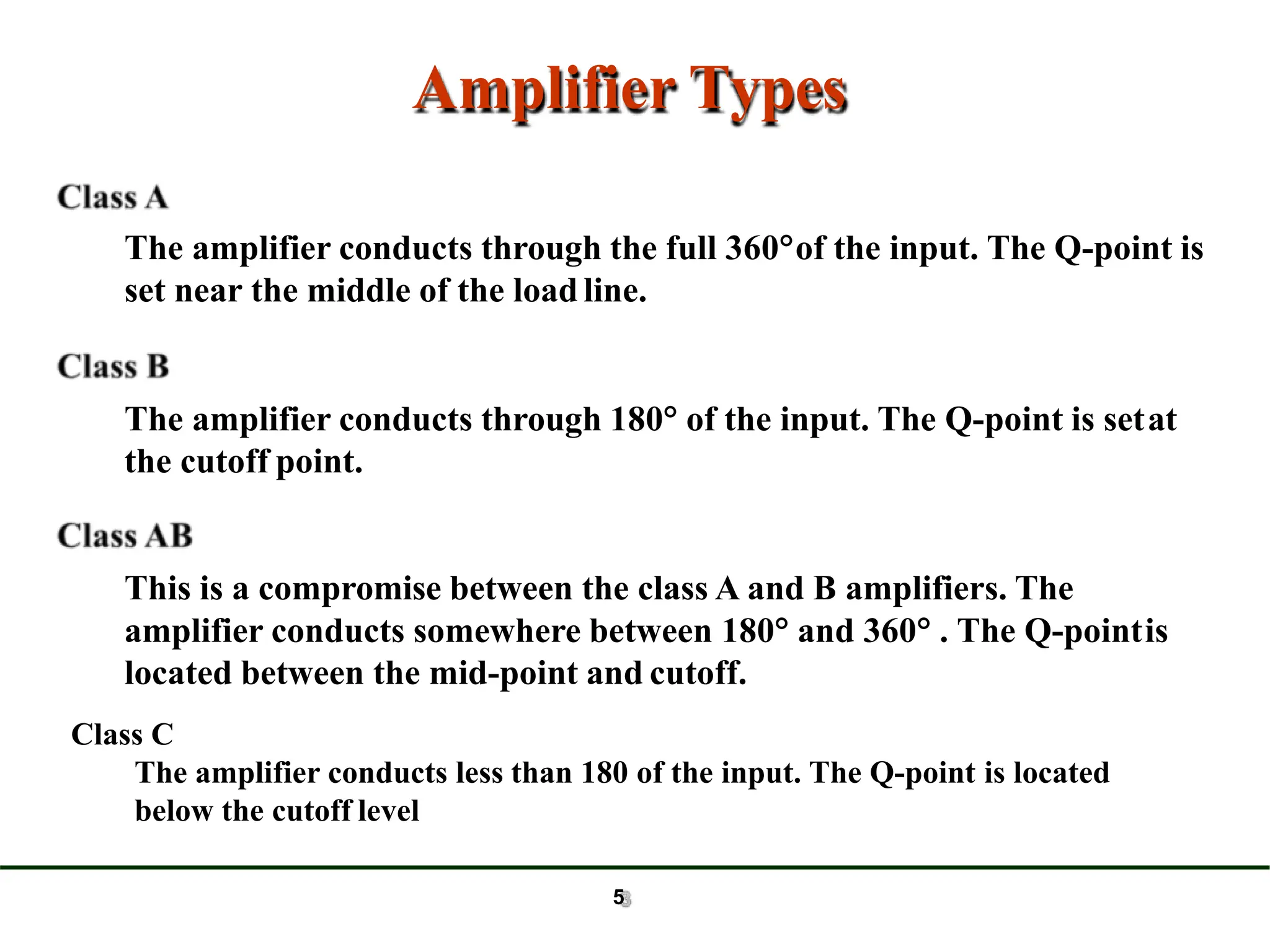
The amplifier conducts through the full 360of the input. The Q-point is
set near the middle of the load line.
The amplifier conducts through 180 of the input. The Q-point is setat
the cutoff point.
This is a compromise between the class A and B amplifiers. The
amplifier conducts somewhere between 180 and 360 . The Q-pointis
located between the mid-point and cutoff.
5
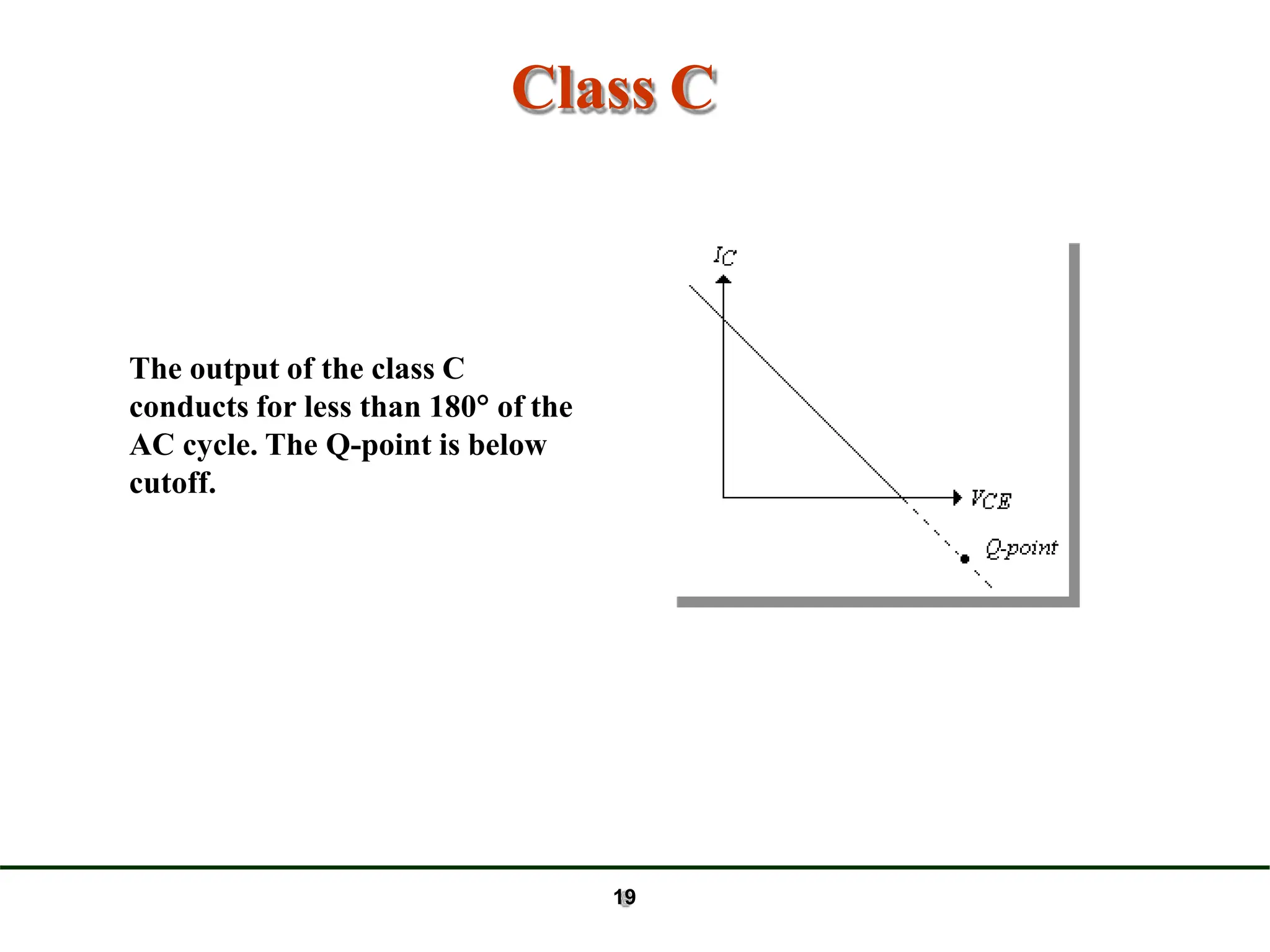
Class C
The amplifier conducts less than 180 of the input. The Q-point is located
below the cutoff level
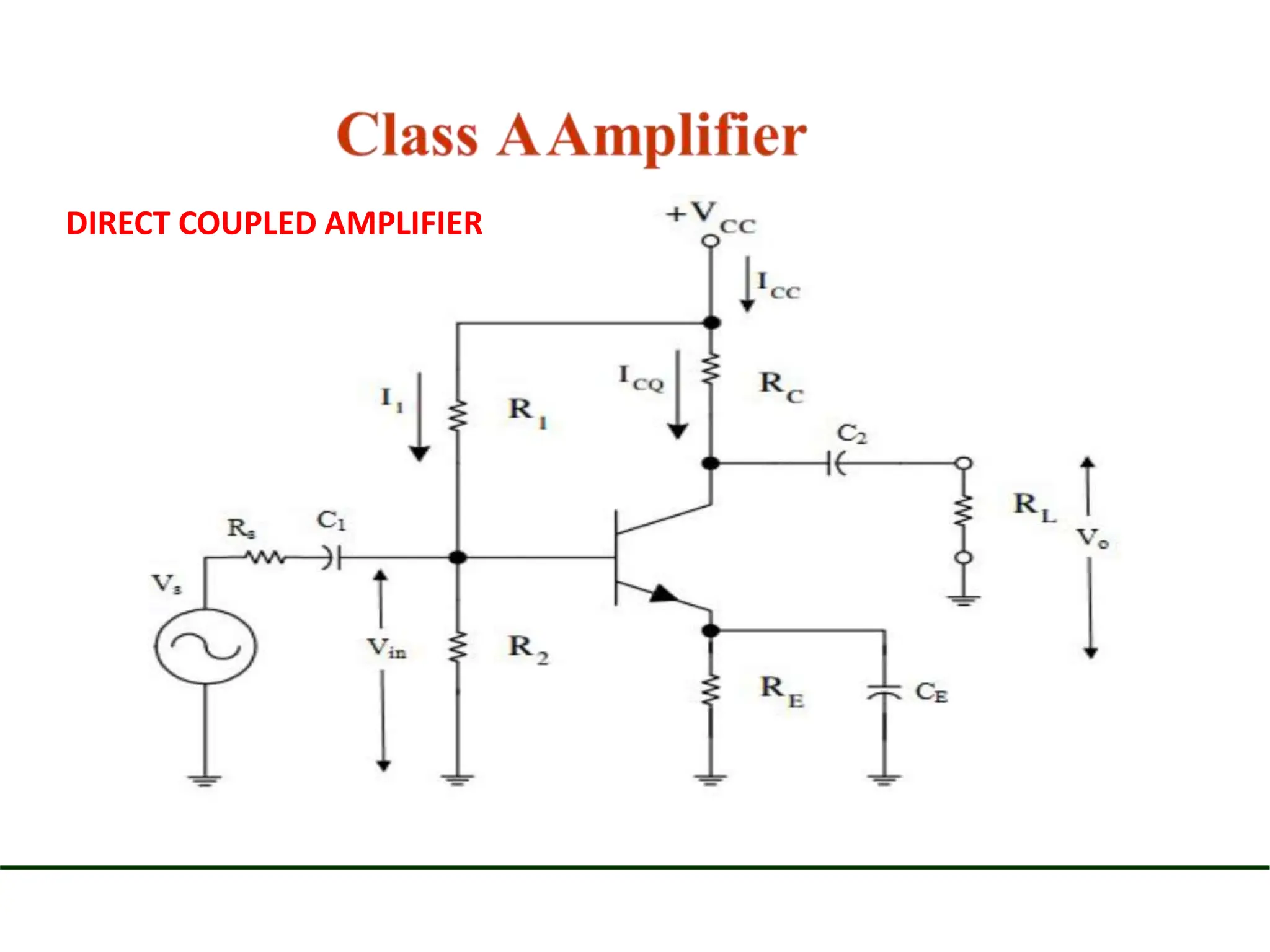
DIRECT COUPLED AMPLIFIER
Class AAmplifier
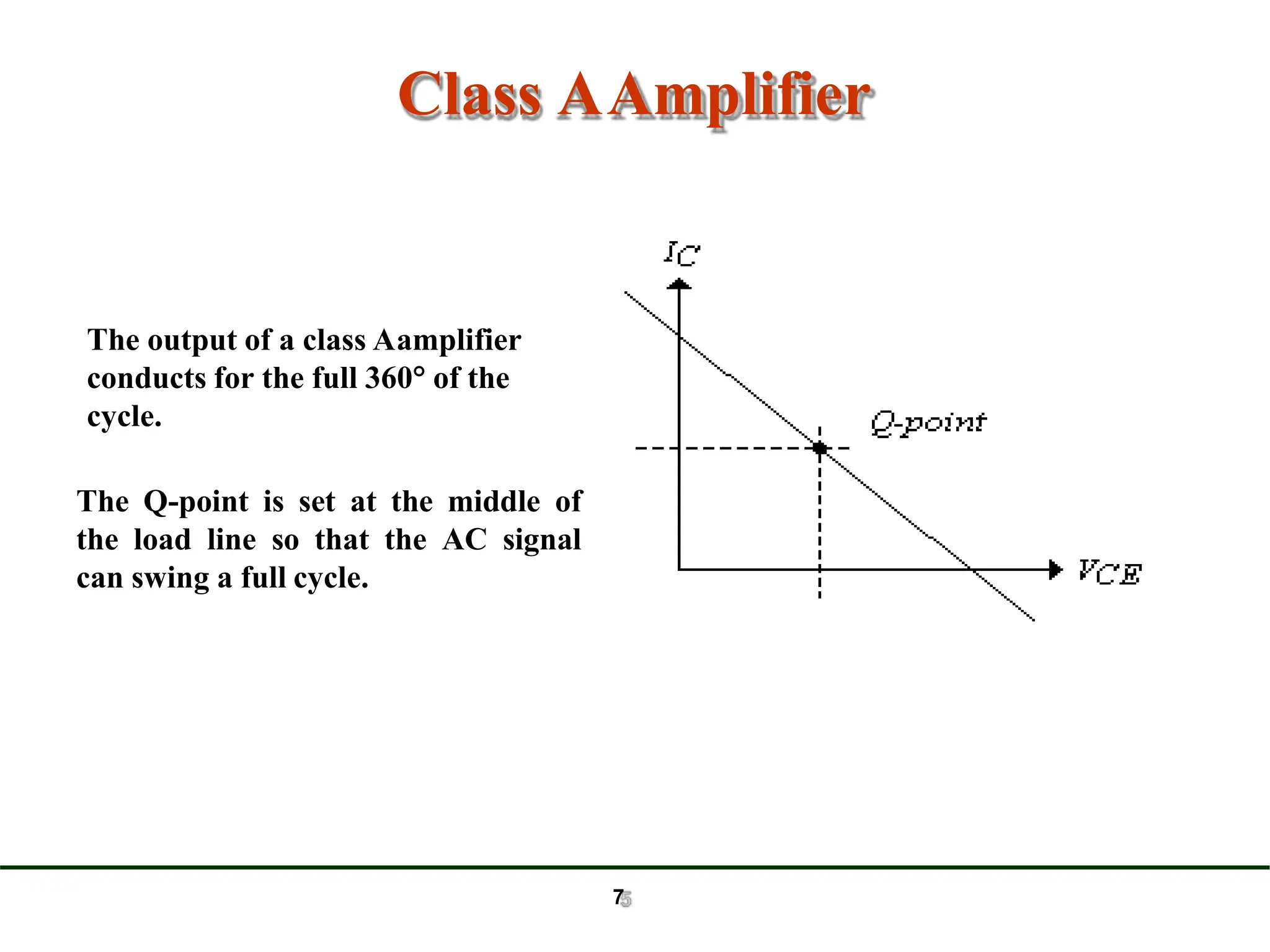
The output of a class Aamplifier
conducts for the full 360 of the
cycle.
The Q-point is set at the middle of
the load line so that the AC signal
can swing a full cycle.
7
Working
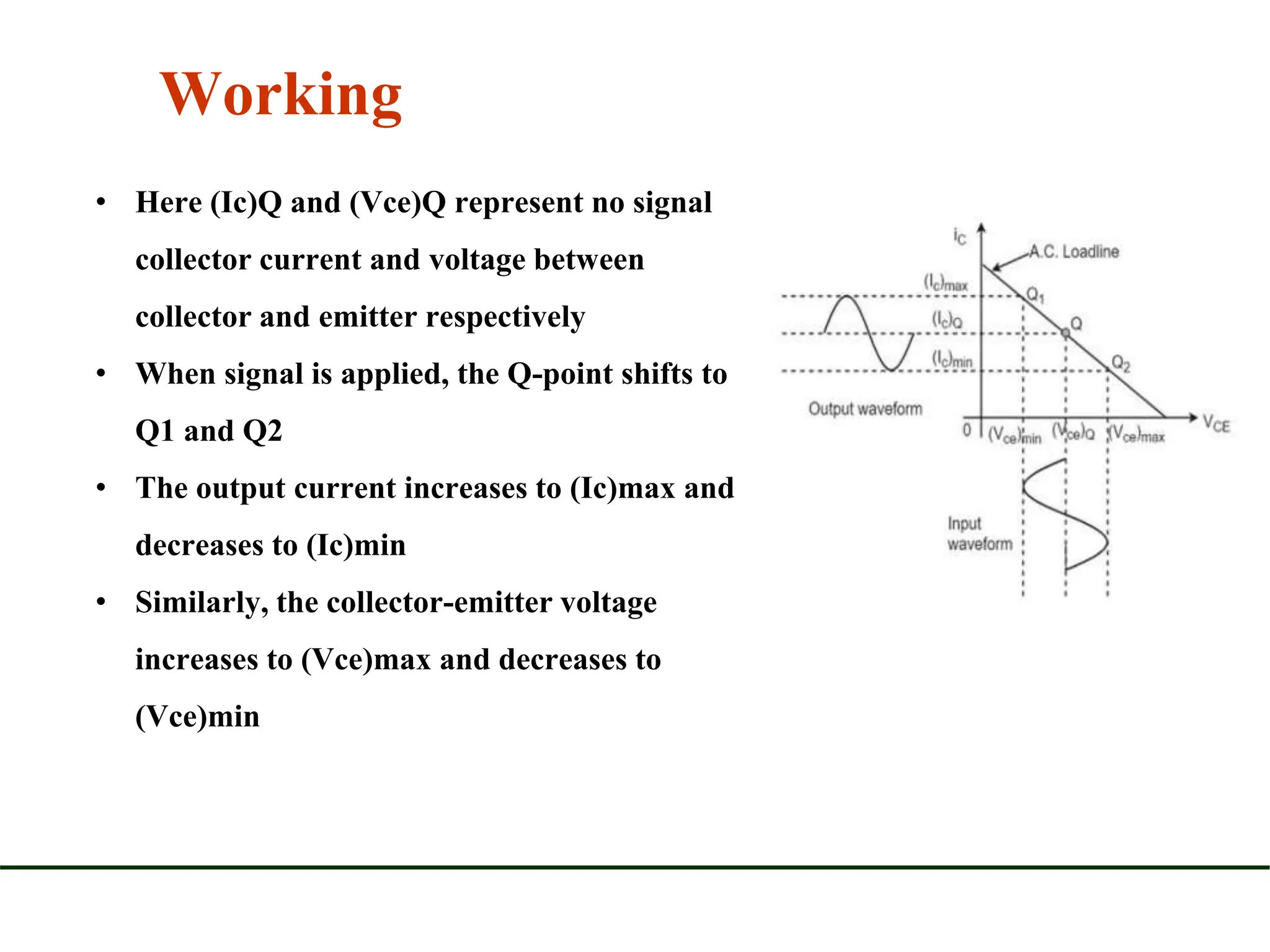
• Here (Ic)Q and (Vce)Q represent no signal
collector current and voltage between
collector and emitter respectively
• When signal is applied, the Q-point shifts to
Q1 and Q2
• The output current increases to (Ic)max and
decreases to (Ic)min
• Similarly, the collector-emitter voltage
increases to (Vce)max and decreases to
(Vce)min
Advantages
(1) simple construction
(2) Distortion less output voltage
Disadvantage
(1) very low efficiency (25%)
(2) Large power dissipation in the transistors.
(3) Output Impedance is very large.
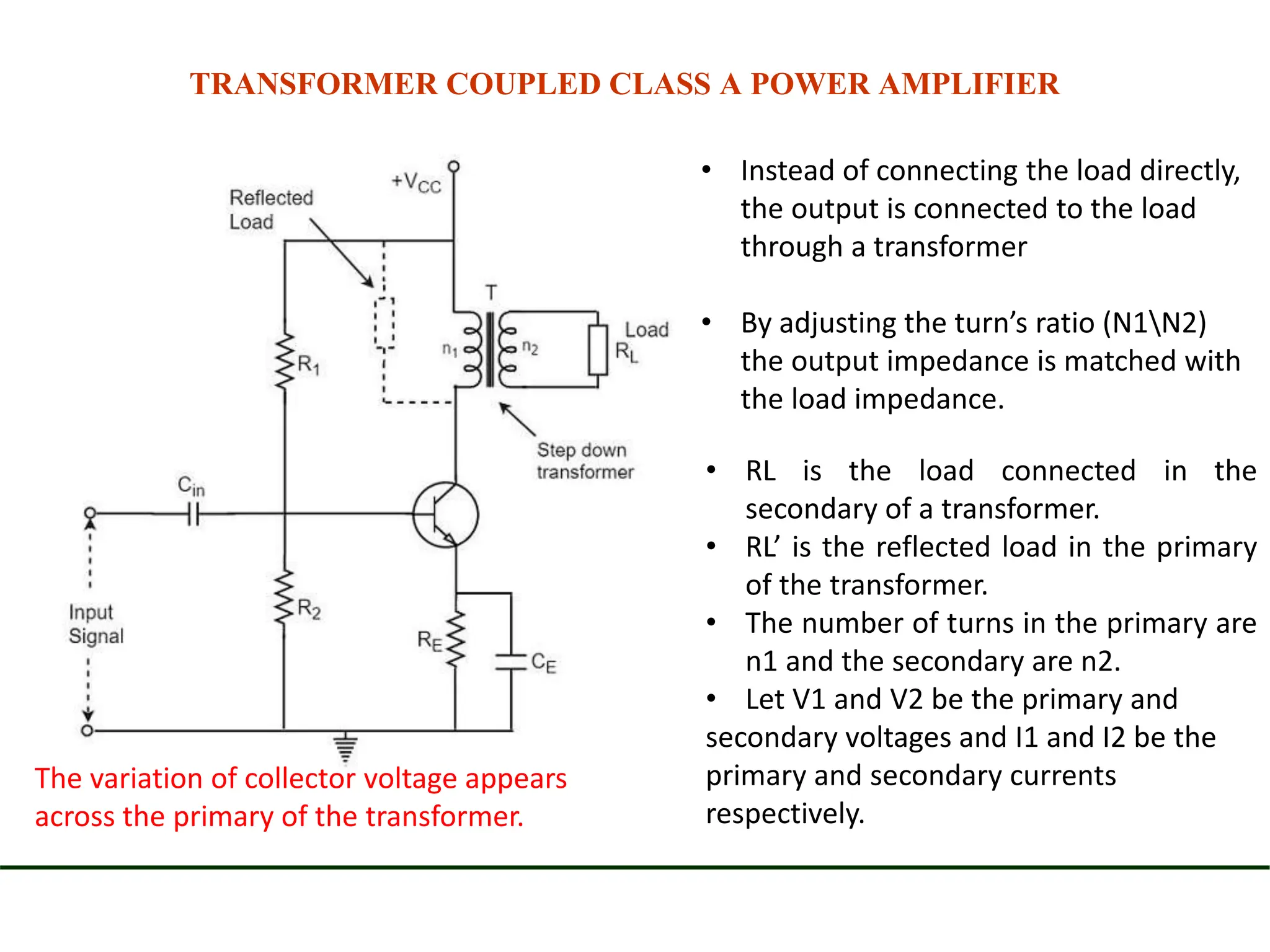
TRANSFORMER COUPLED CLASS A POWER AMPLIFIER
• Instead of connecting the load directly,
the output is connected to the load
through a transformer
• By adjusting the turn’s ratio (N1N2)
the output impedance is matched with
the load impedance.
• RL is the load connected in the
secondary of a transformer.
• RL’ is the reflected load in the primary
of the transformer.
• The number of turns in the primary are
n1 and the secondary are n2.
• Let V1 and V2 be the primary and
secondary voltages and I1 and I2 be the
primary and secondary currents
respectively.
The variation of collector voltage appears
across the primary of the transformer.
Class B Amplifier
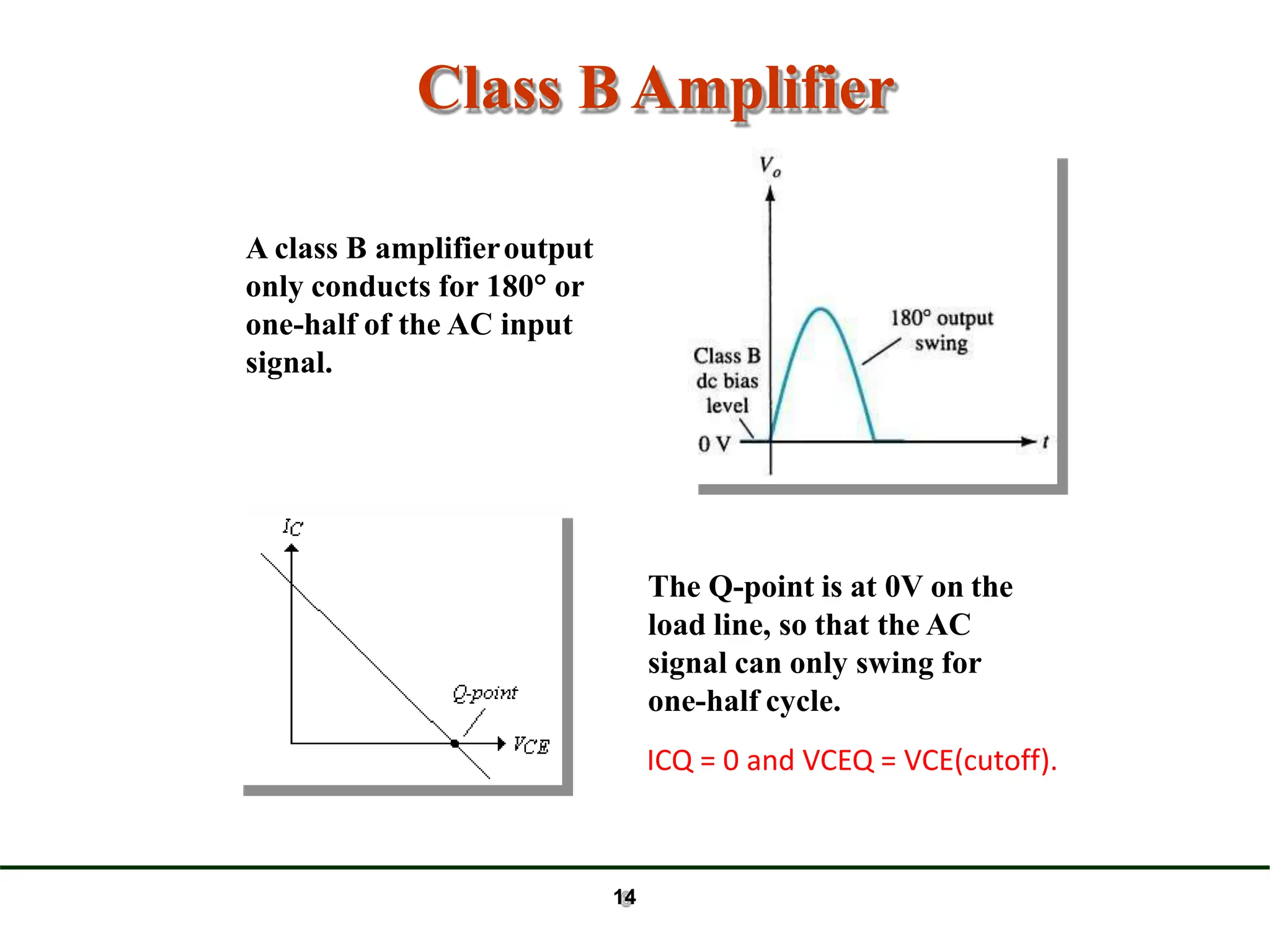
A class B amplifieroutput
only conducts for 180 or
one-half of the AC input
signal.
The Q-point is at 0V on the
load line, so that the AC
signal can only swing for
one-half cycle.
14
ICQ = 0 and VCEQ = VCE(cutoff).
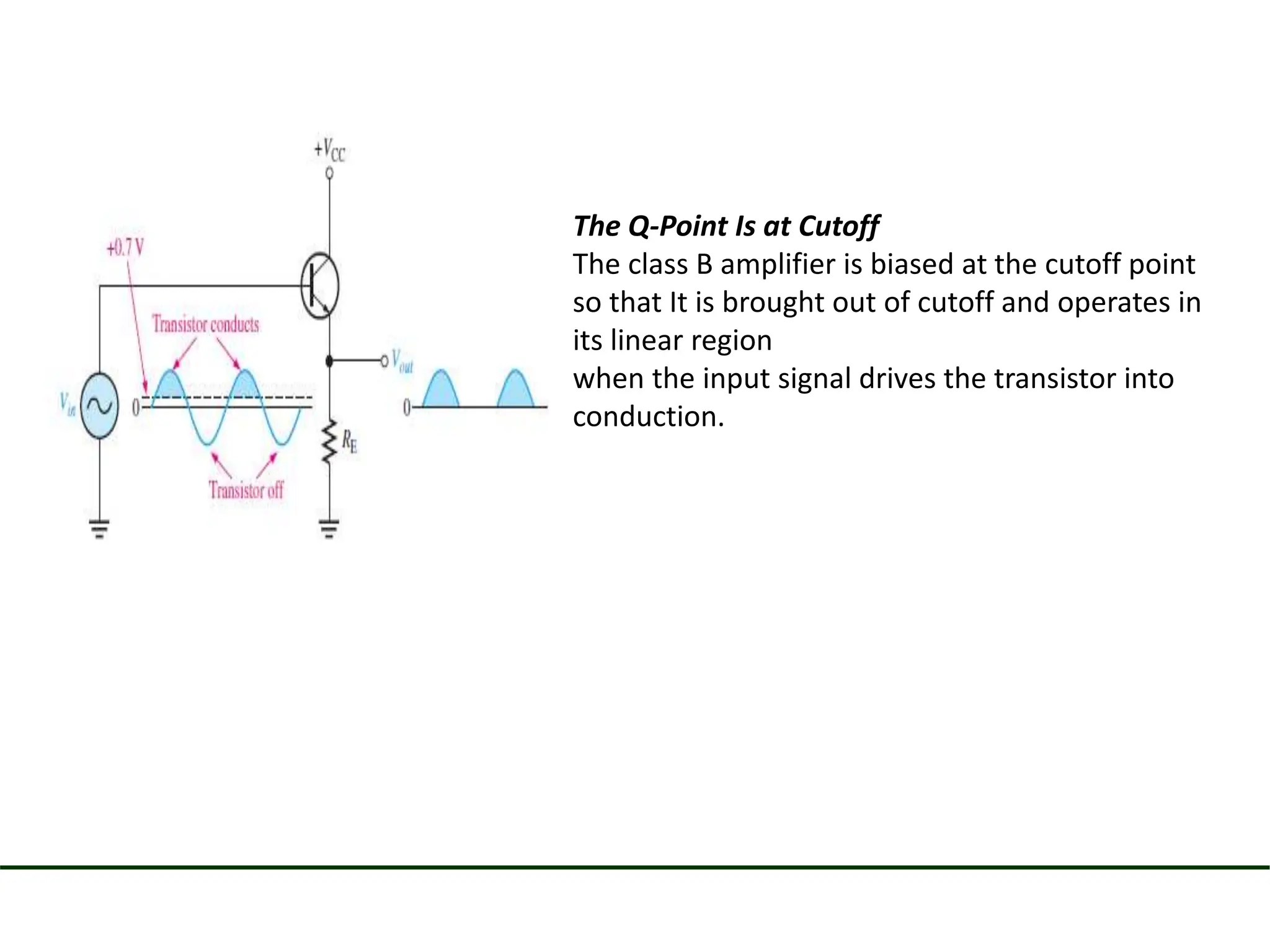
The Q-Point Is at Cutoff
The class B amplifier is biased at the cutoff point
so that It is brought out of cutoff and operates in
its linear region
when the input signal drives the transistor into
conduction.
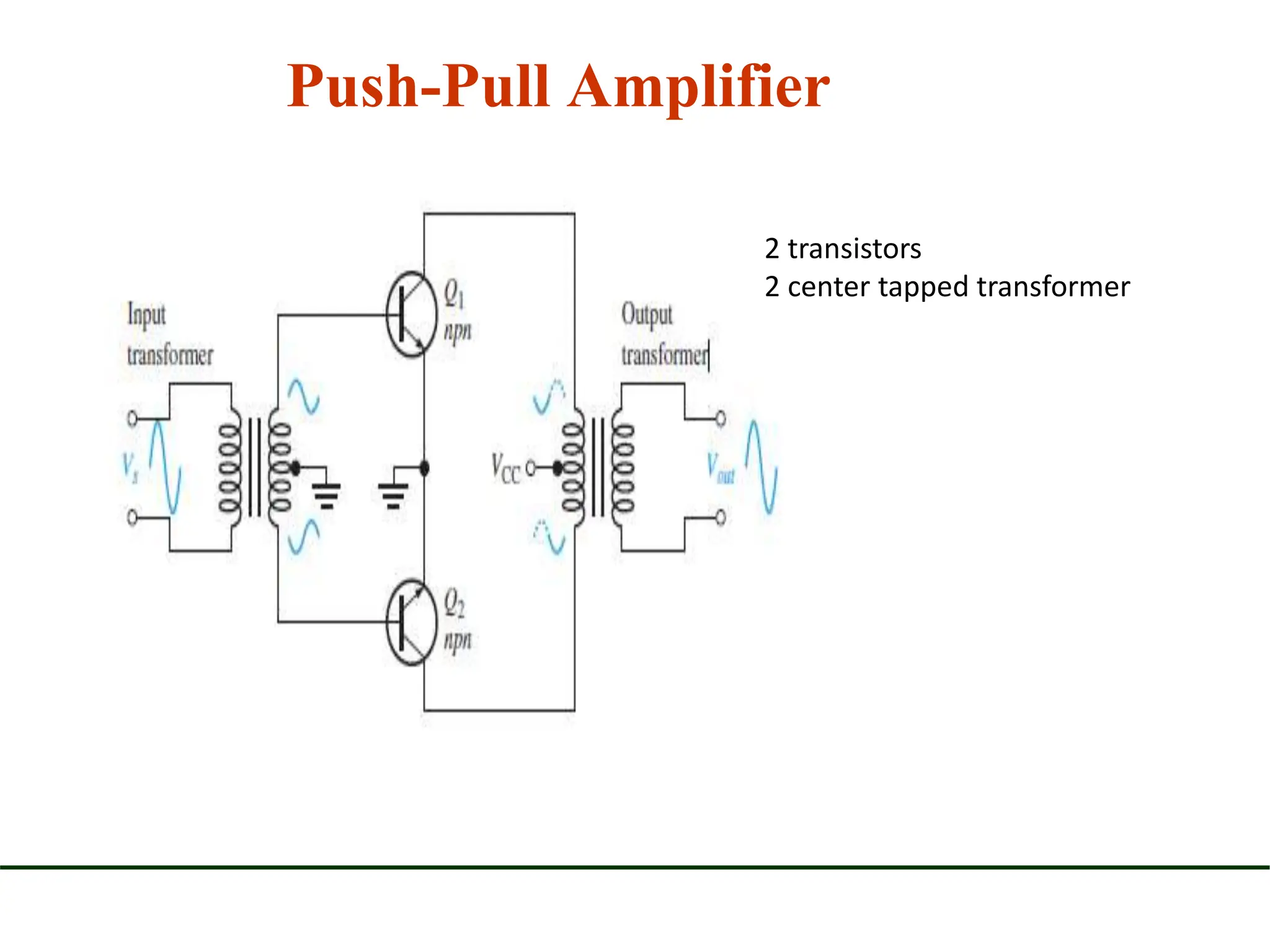
Push-Pull Amplifier
2 transistors
2 center tapped transformer
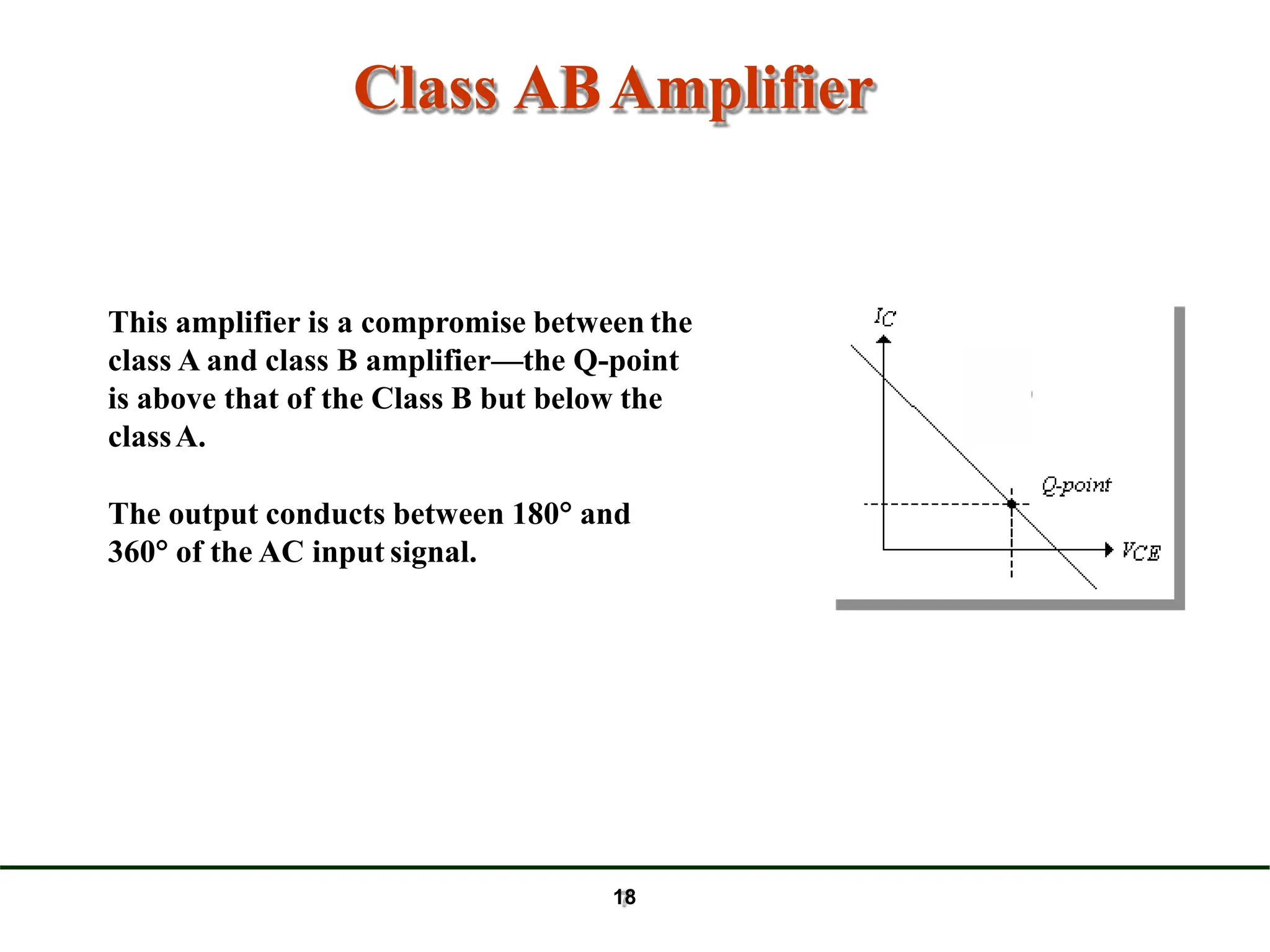
Class ABAmplifier
This amplifier is a compromise between the
class A and class B amplifier—the Q-point
is above that of the Class B but below the
classA.
The output conducts between 180 and
360 of the AC input signal.
18
Class C
The output of the class C
conducts for less than 180 of the
AC cycle. The Q-point is below
cutoff.
19
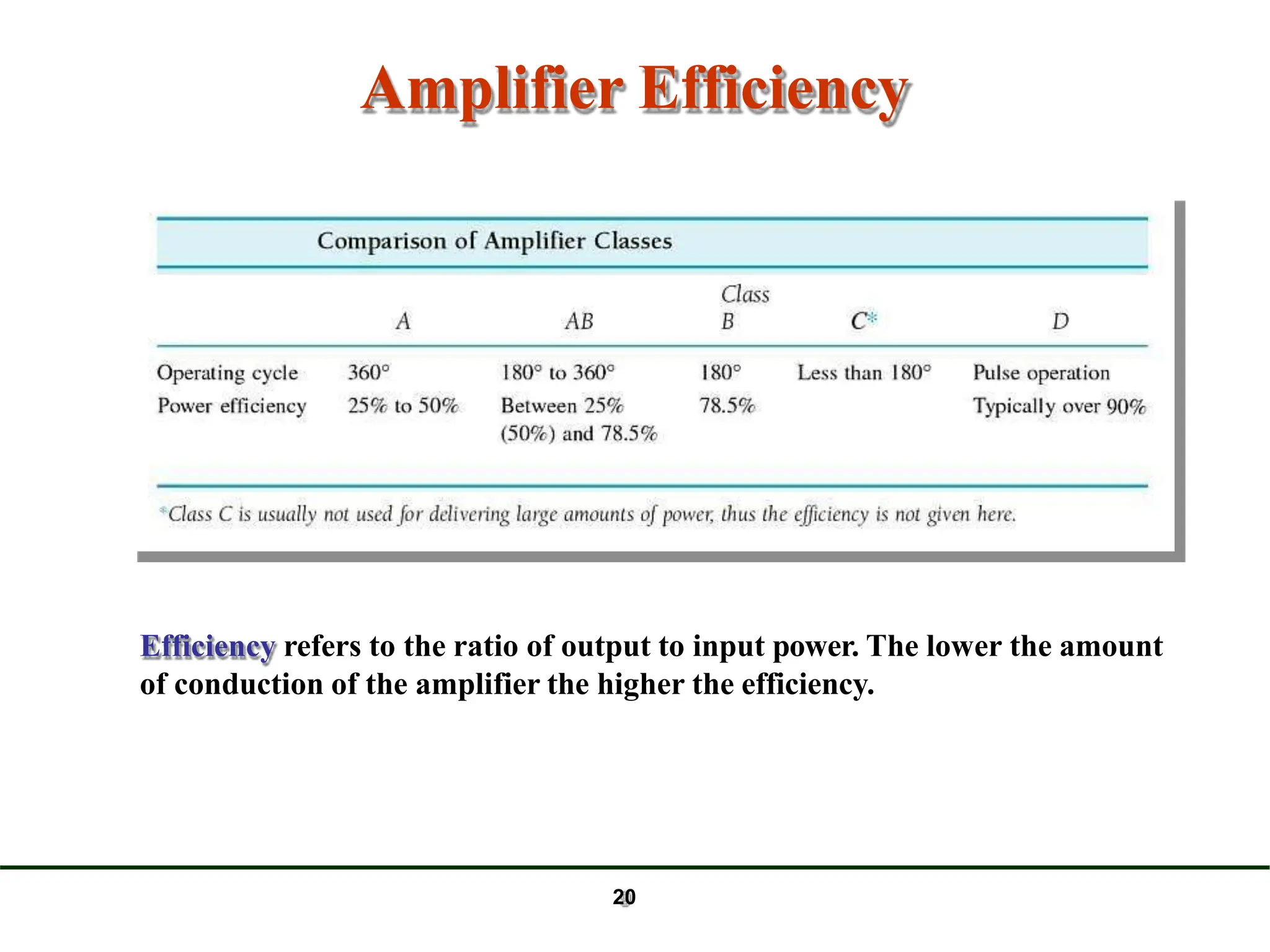
Amplifier Efficiency
Efficiency refers to the ratio of output to input power. The lower the amount
of conduction of the amplifier the higher the efficiency.
20
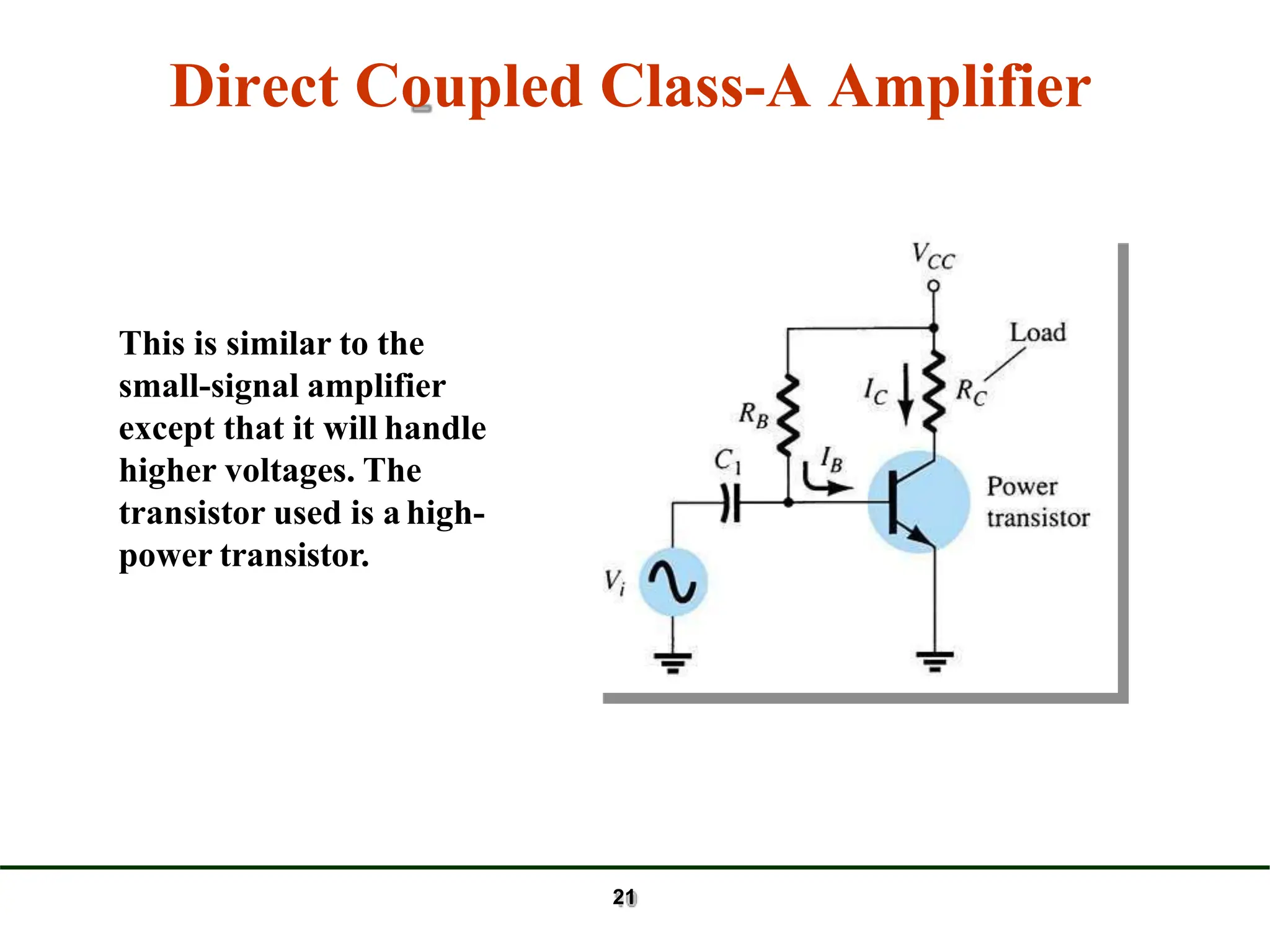
This is similar to the
small-signal amplifier
except that it will handle
higher voltages. The
transistor used is a high-
power transistor.
21
Direct Coupled Class-A Amplifier
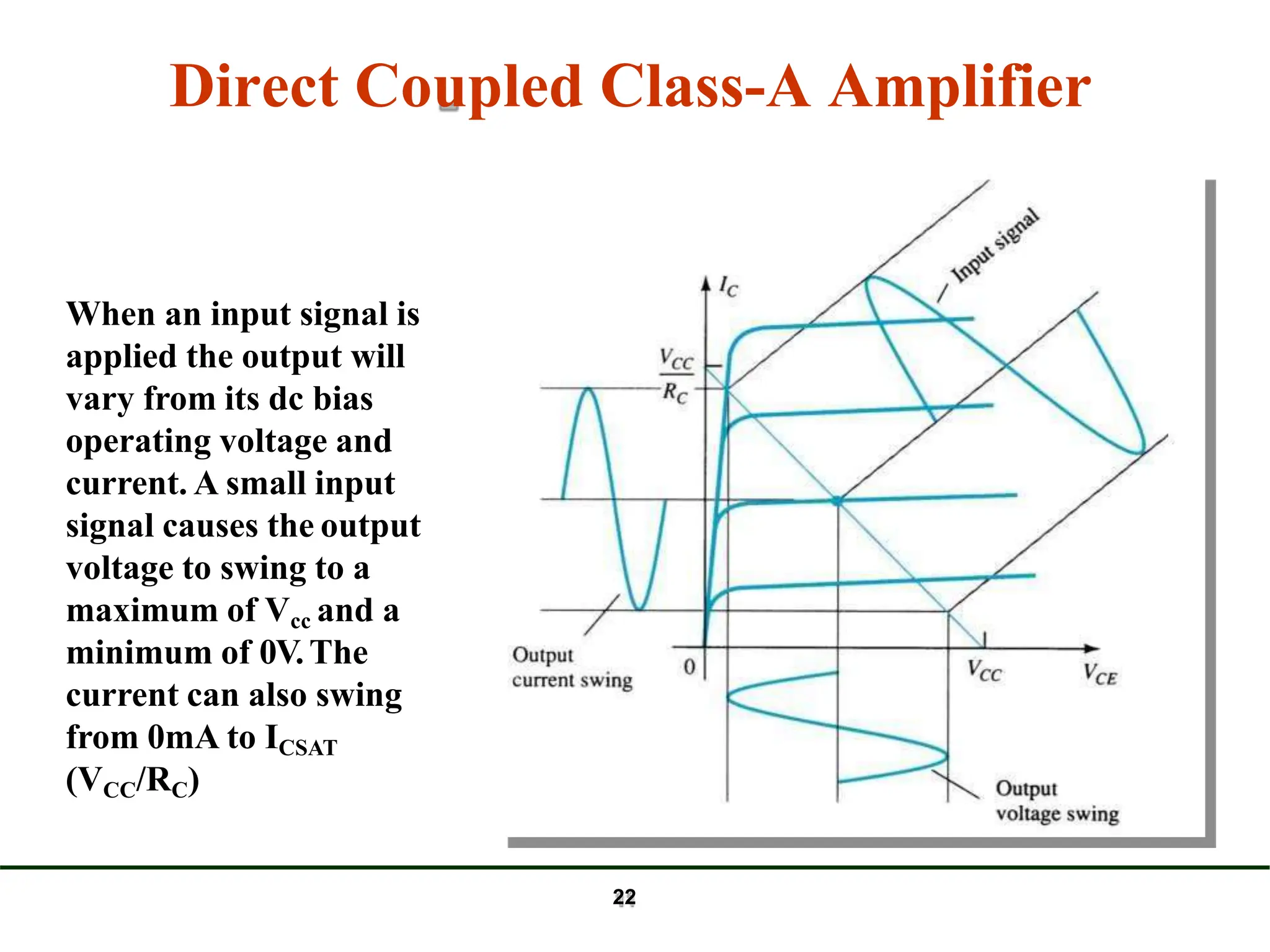
When an input signal is
applied the output will
vary from its dc bias
operating voltage and
current. A small input
signal causes the output
voltage to swing to a
maximum of Vcc and a
minimum of 0V.The
current can also swing
from 0mA to ICSAT
(VCC/RC)
22
Direct Coupled Class-A Amplifier
C
R
V2
C(rms)
Po(ac) 
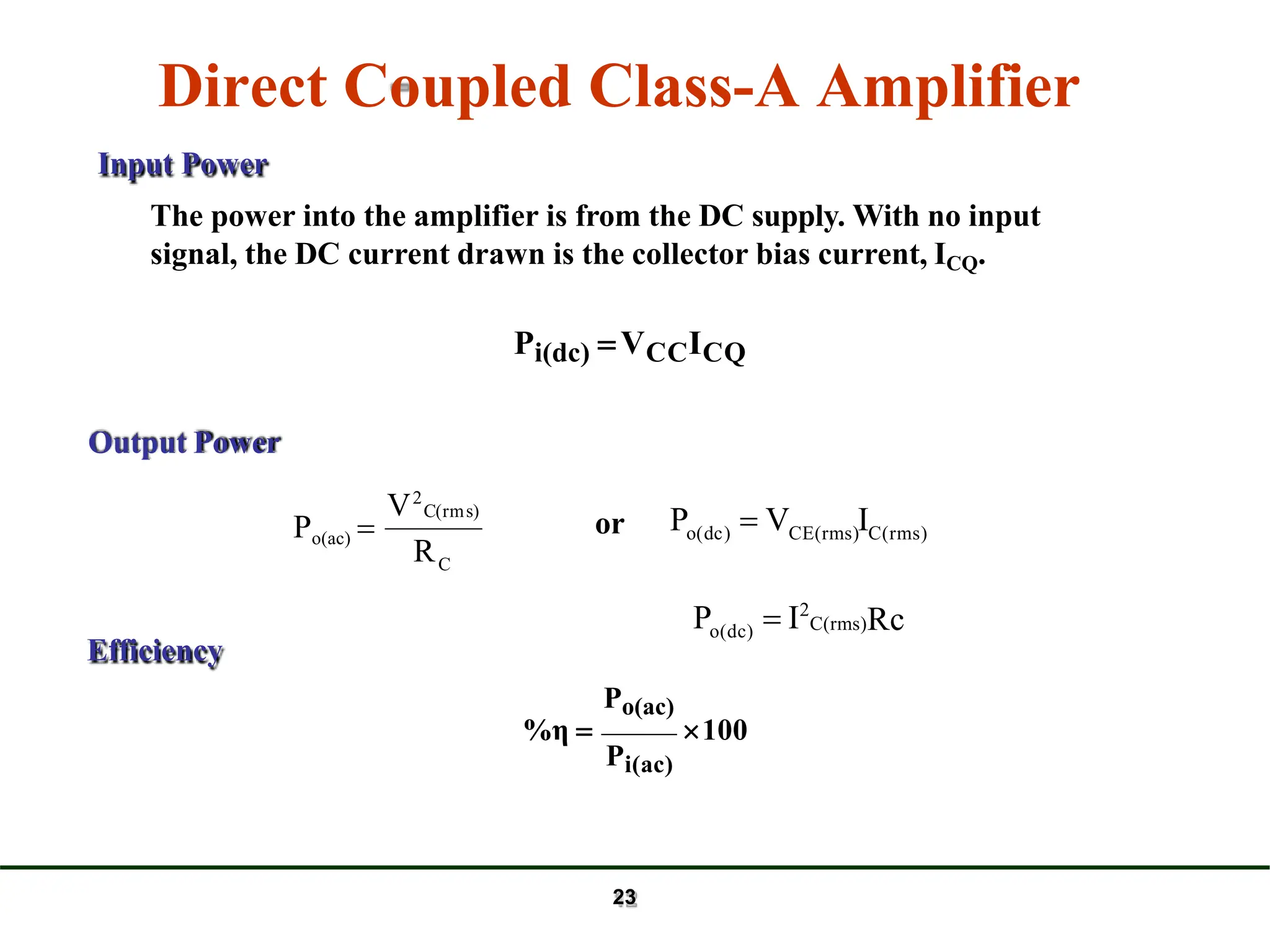
Input Power
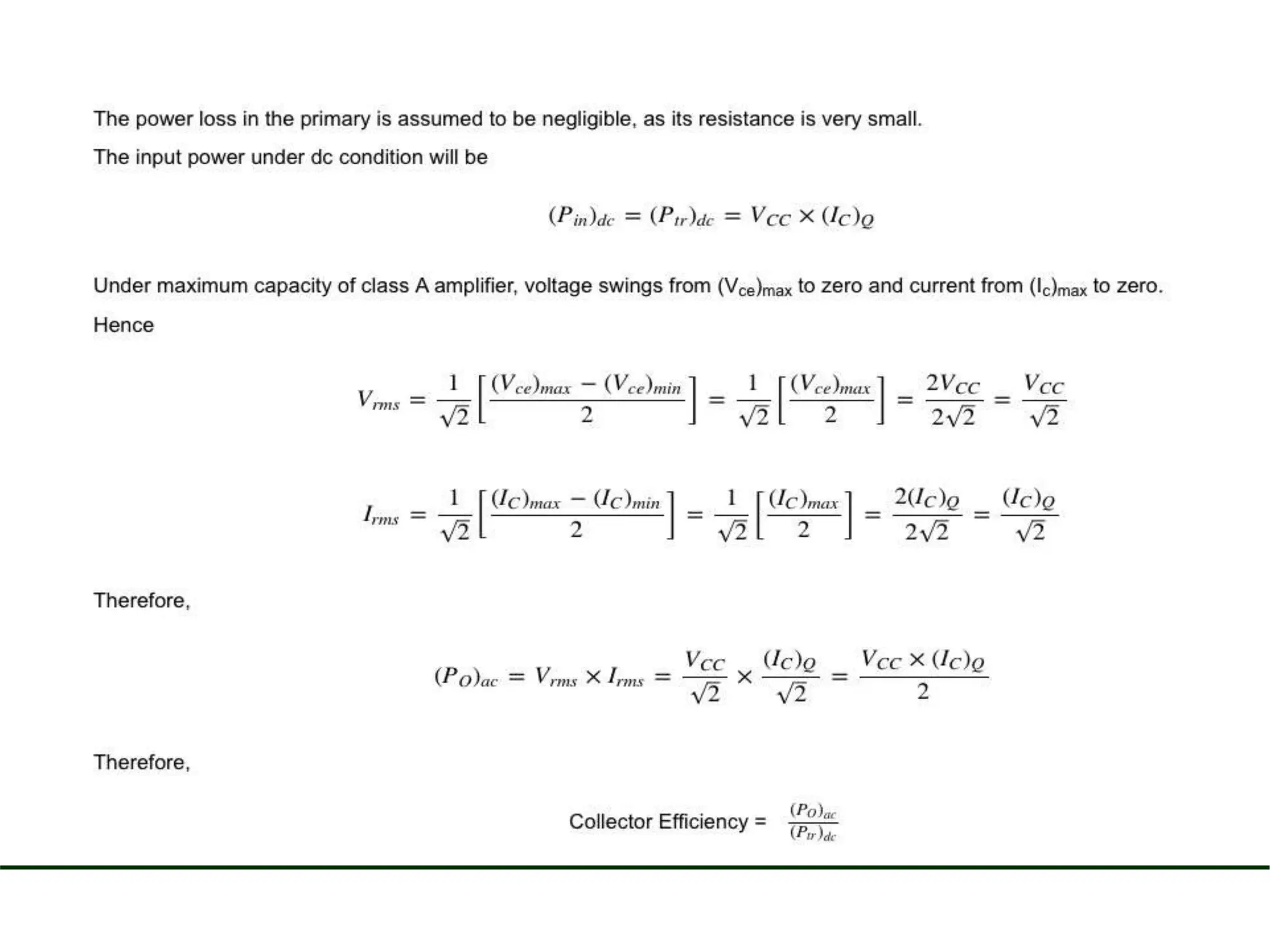
The power into the amplifier is from the DC supply. With no input
signal, the DC current drawn is the collector bias current, ICQ.
Pi(dc) VCCICQ
Output Power
or
Po(ac)
%η  100
Pi(ac)
Efficiency
CE(rms) C(rms)
23
o(dc)
P  V I
Po(dc)  I2
C(rms)Rc
Direct Coupled Class-A Amplifier
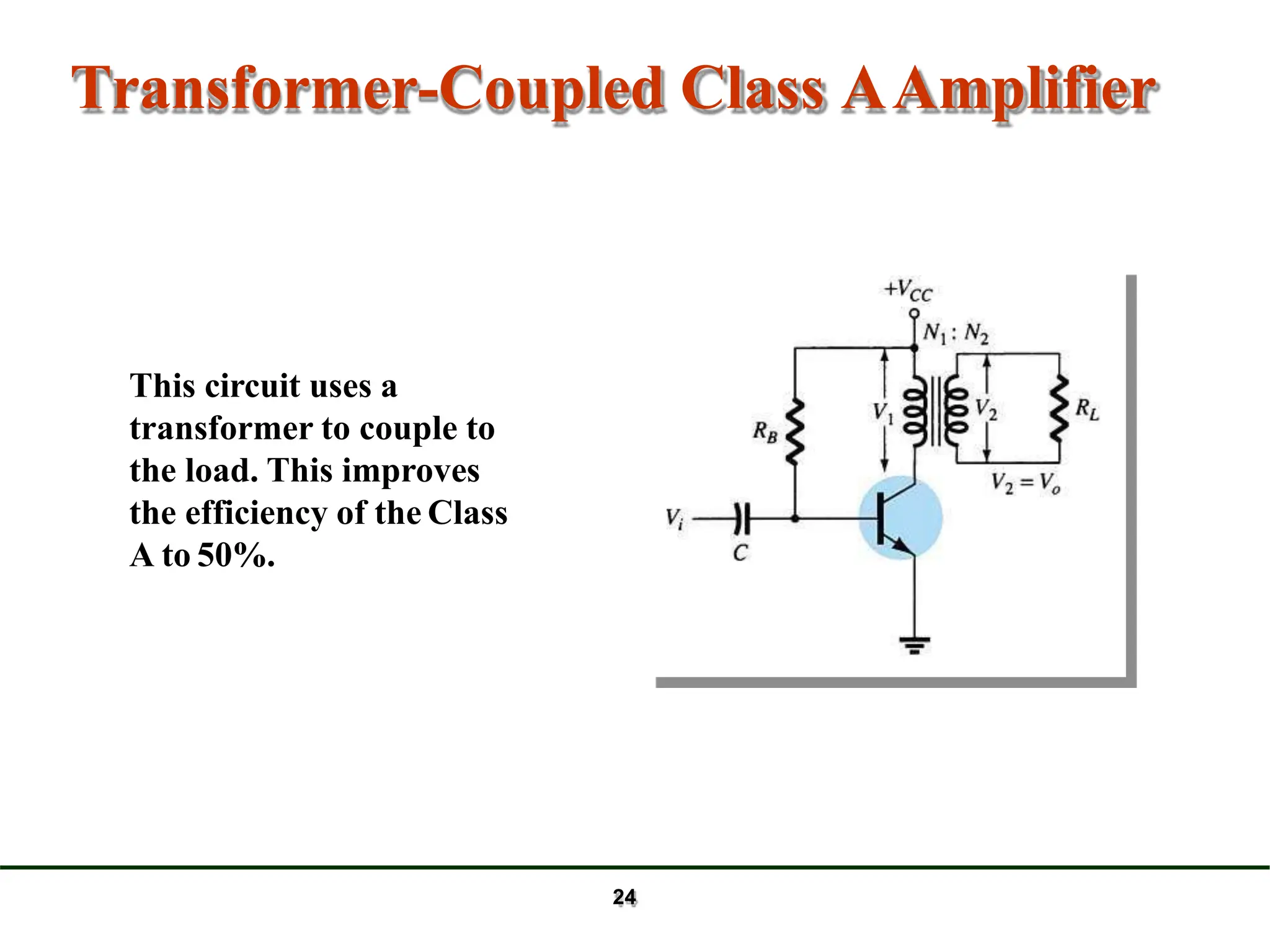
Transformer-Coupled Class AAmplifier
This circuit uses a
transformer to couple to
the load. This improves
the efficiency of the Class
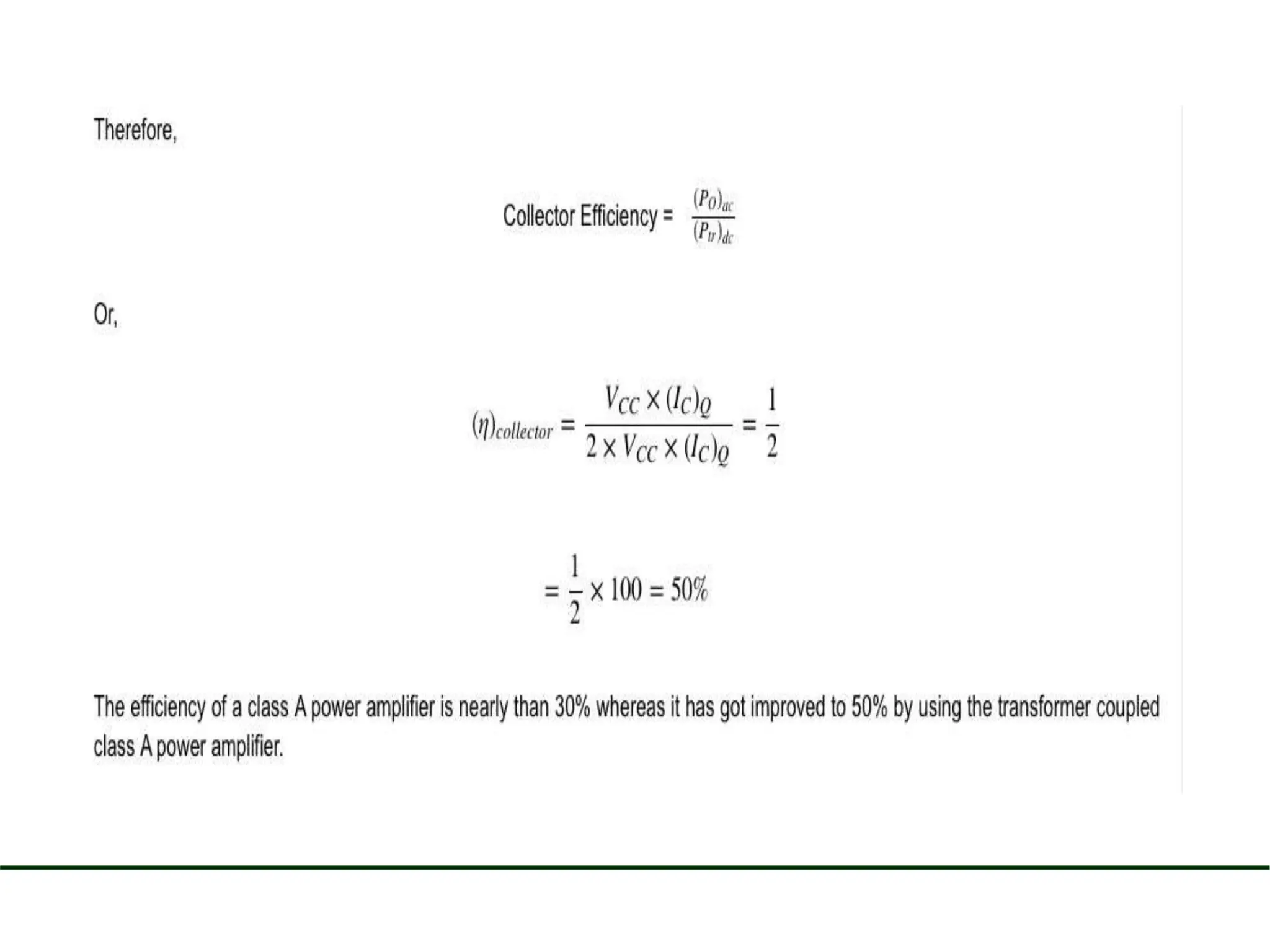
A to 50%.
24
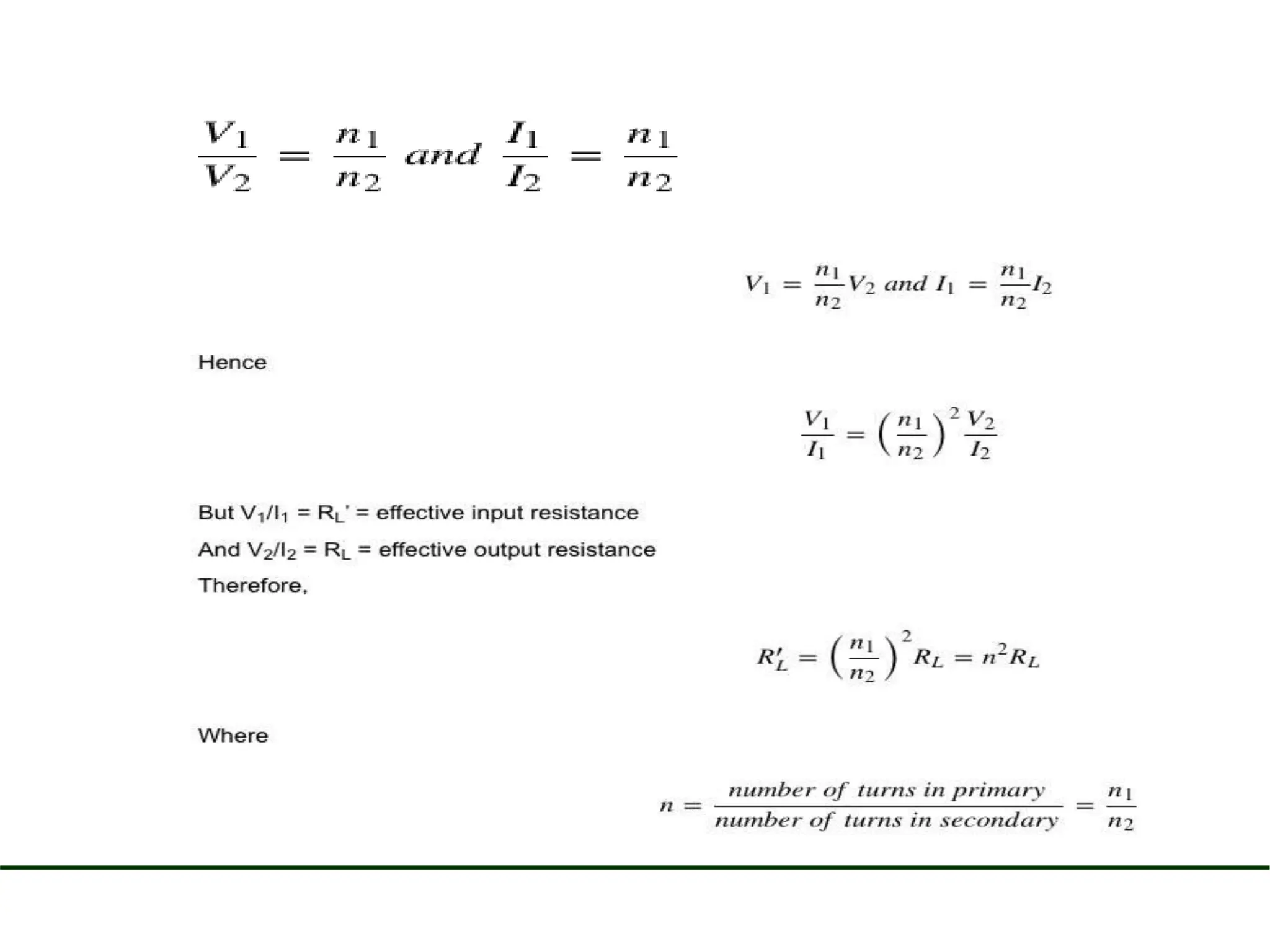
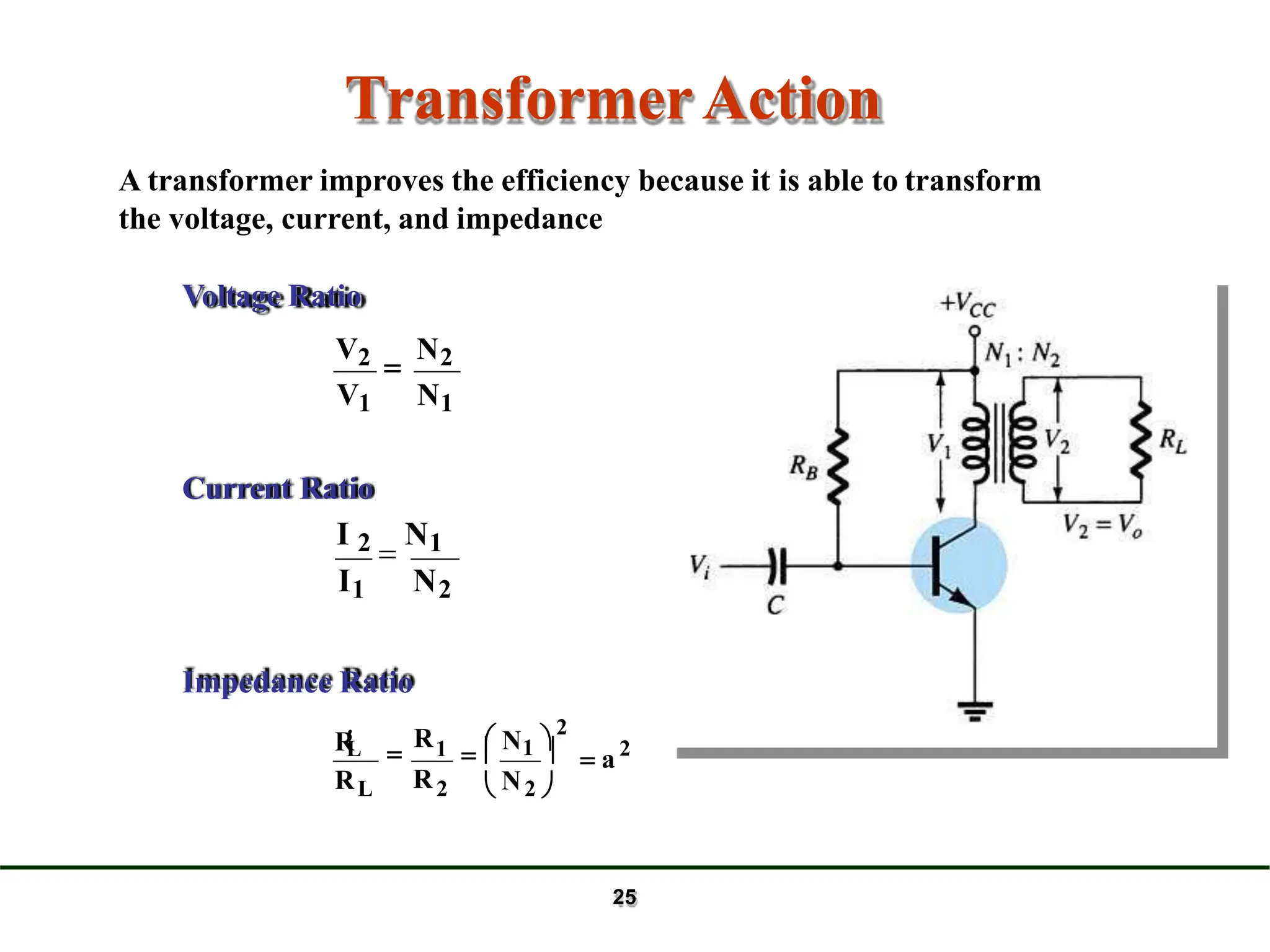
TransformerAction
A transformer improves the efficiency because it is able to transform
the voltage, current, and impedance
Voltage Ratio
V2 
N2
V1 N1
Current Ratio
I 2 
N1
I1 N2
Impedance Ratio
2
L
R
 a
2  2 
 N1 
2
  
N

R
R

L R1
25
Transformer-Coupled Class AAmplifier
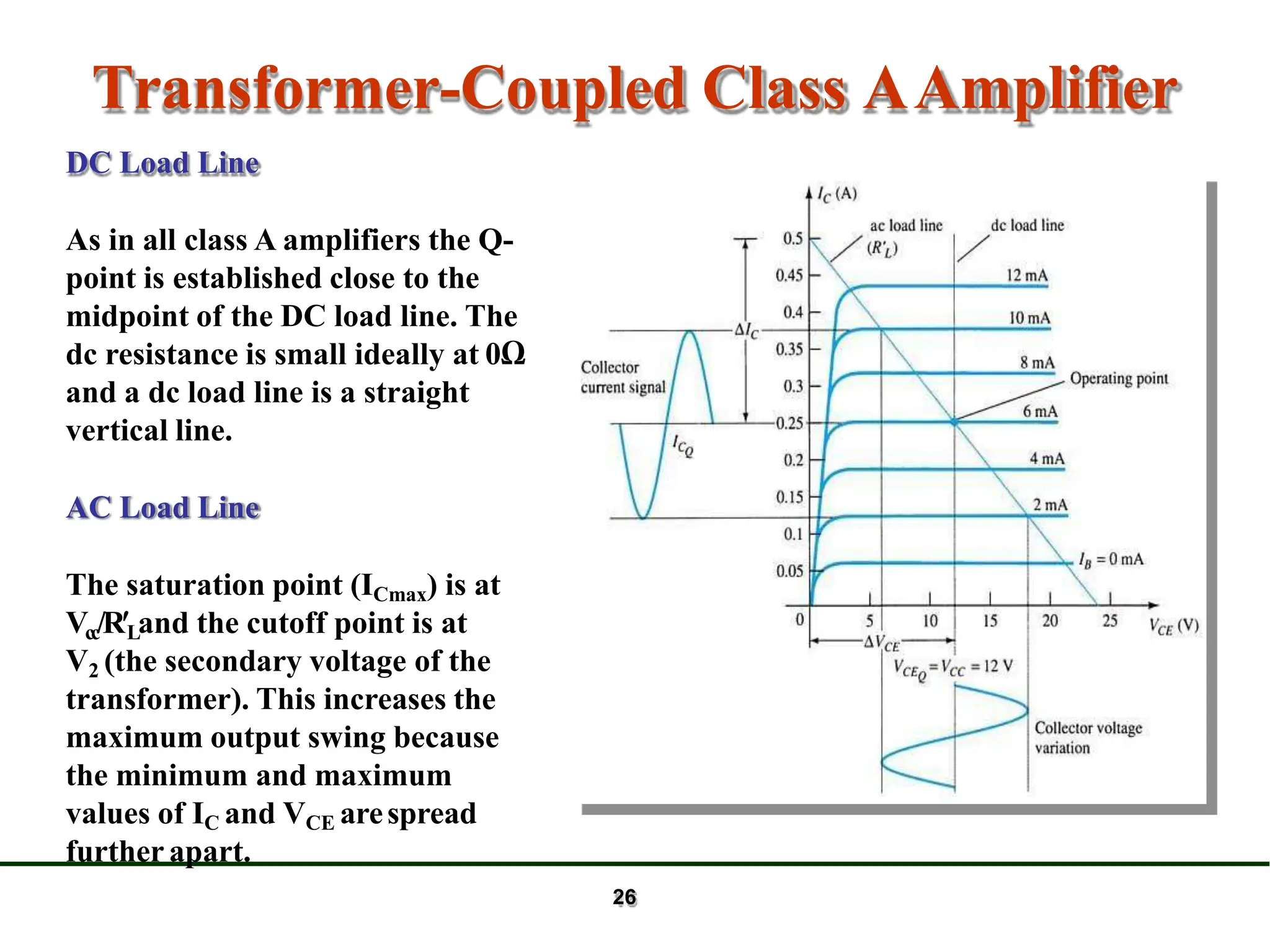
DC Load Line
As in all class A amplifiers the Q-
point is established close to the
midpoint of the DC load line. The
dc resistance is small ideally at 0Ω
and a dc load line is a straight
vertical line.
AC Load Line
The saturation point (ICmax) is at
Vcc/RLand the cutoff point is at
V2 (the secondary voltage of the
transformer). This increases the
maximum output swing because
the minimum and maximum
values of IC and VCE arespread
furtherapart.
26
Transformer-Coupled Class AAmplifier
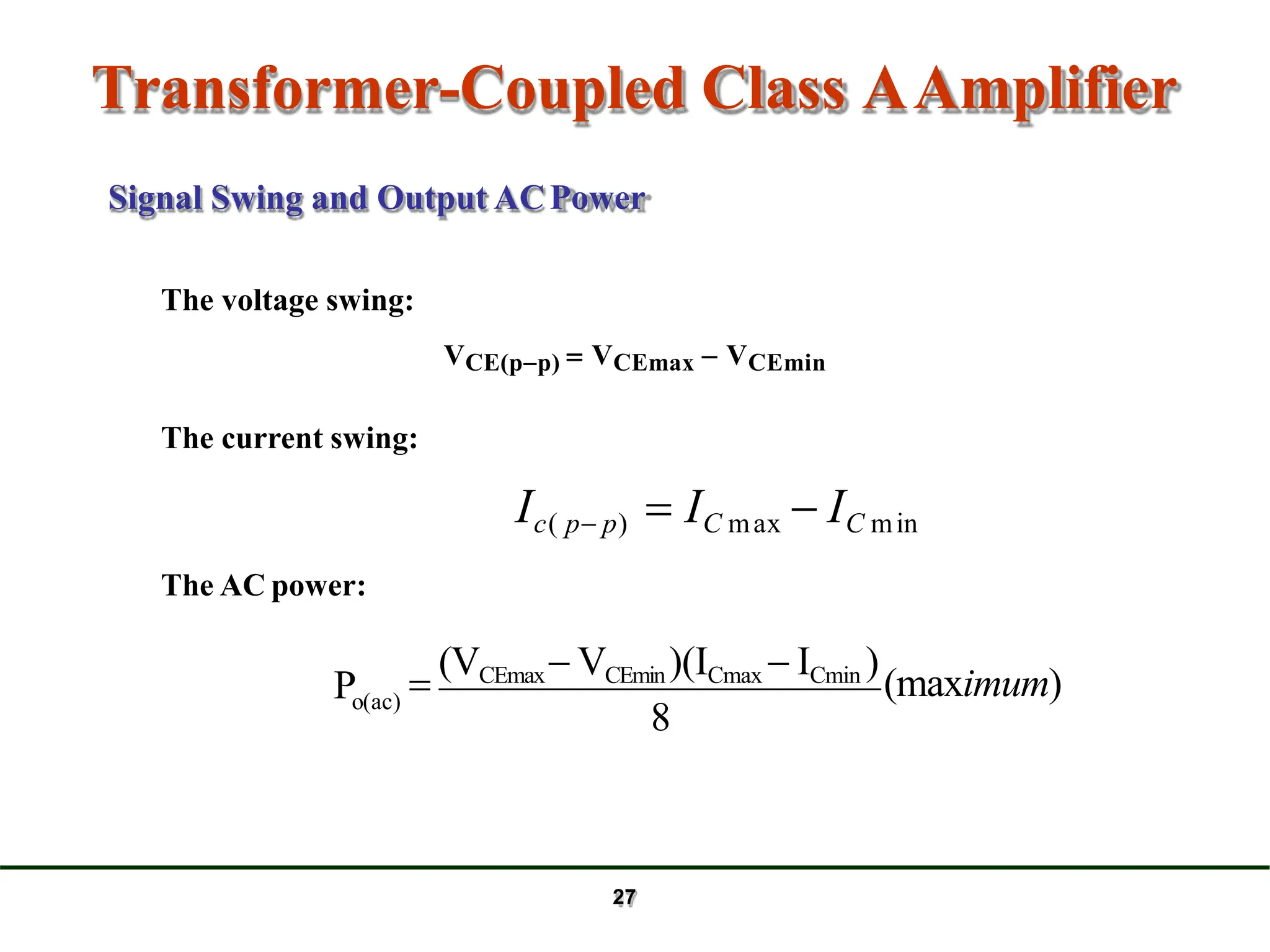
8
Po(ac)

(VCEmax VCEmin)(ICmax  ICmin )
(maximum)
Signal Swing and Output ACPower
The voltage swing:
VCE(pp)  VCEmax  VCEmin
The current swing:
Ic( p p)  IC max  IC min
The AC power:
27
Transformer-Coupled Class AAmplifier
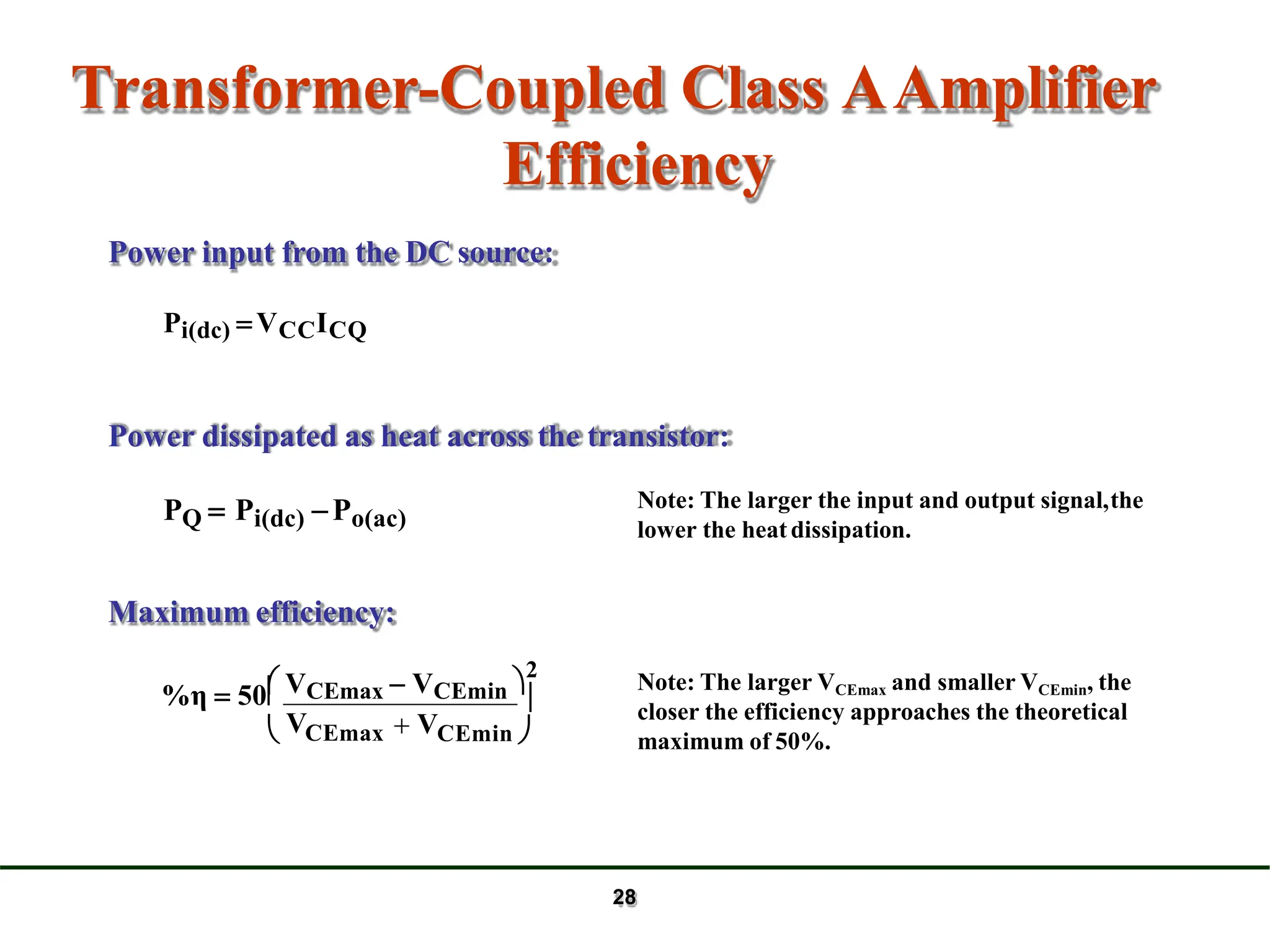
Efficiency
PQ  Pi(dc) Po(ac)

CEmin 
 CEmax  V
 VCEmax  VCEmin 
2
%η  50
V
Maximum efficiency:
Power input from the DC source:
Pi(dc) VCCICQ
Power dissipated as heat across the transistor:
Note: The larger the input and output signal,the
lower the heatdissipation.
Note: The larger VCEmax and smaller VCEmin, the
closer the efficiency approaches the theoretical
maximum of 50%.
28
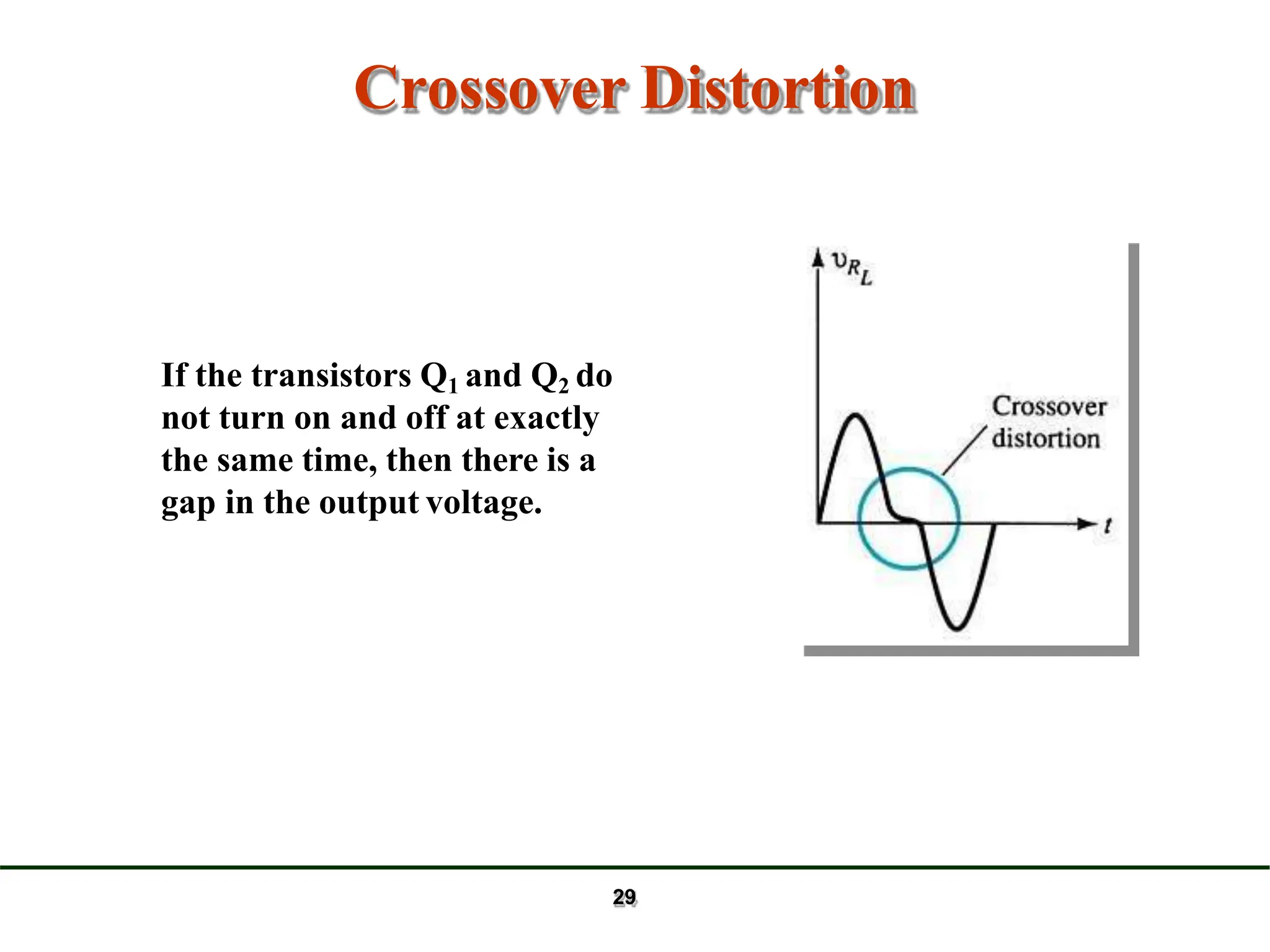
Crossover Distortion
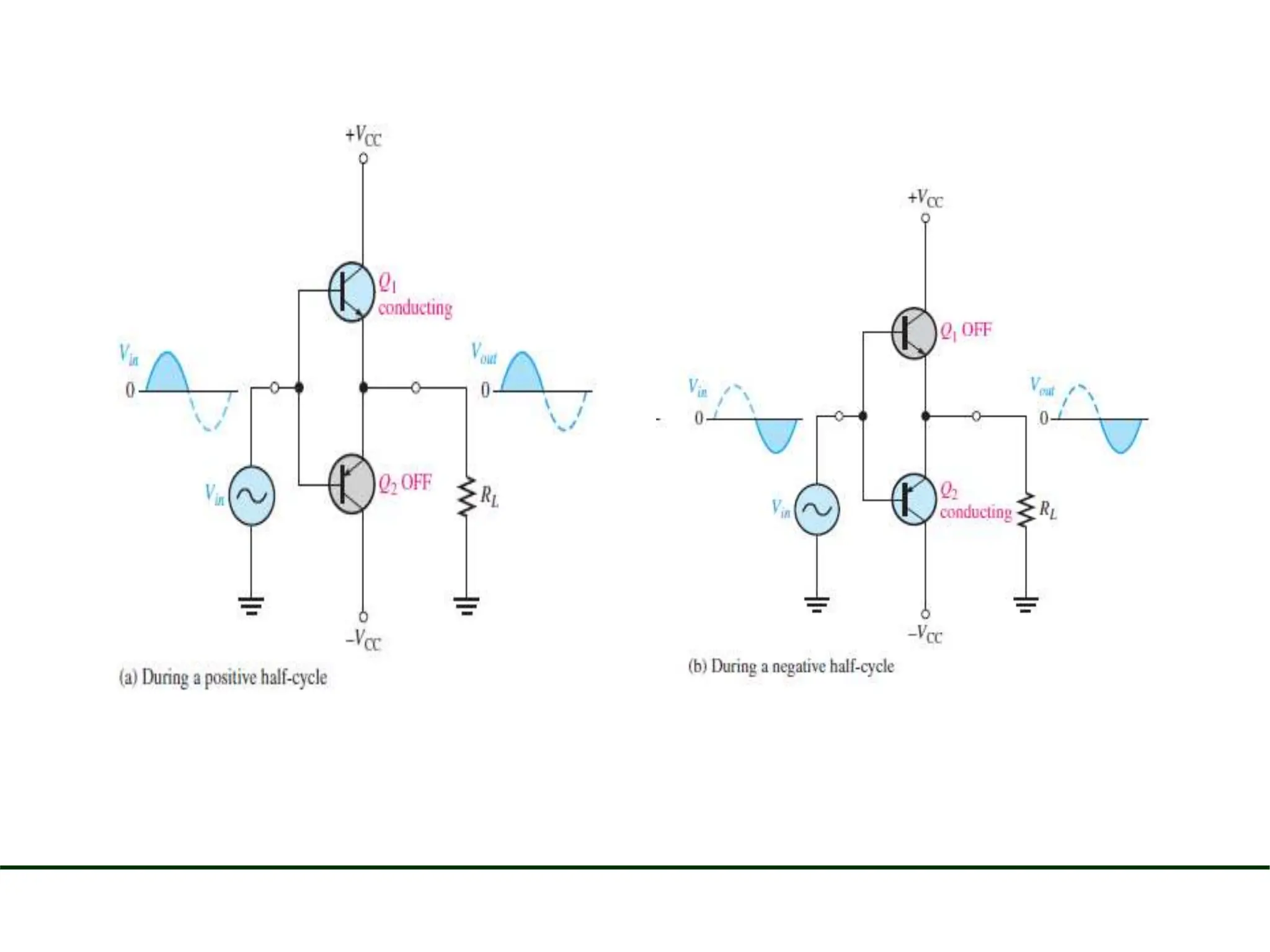
If the transistors Q1 and Q2 do
not turn on and off at exactly
the same time, then there is a
gap in the output voltage.
29
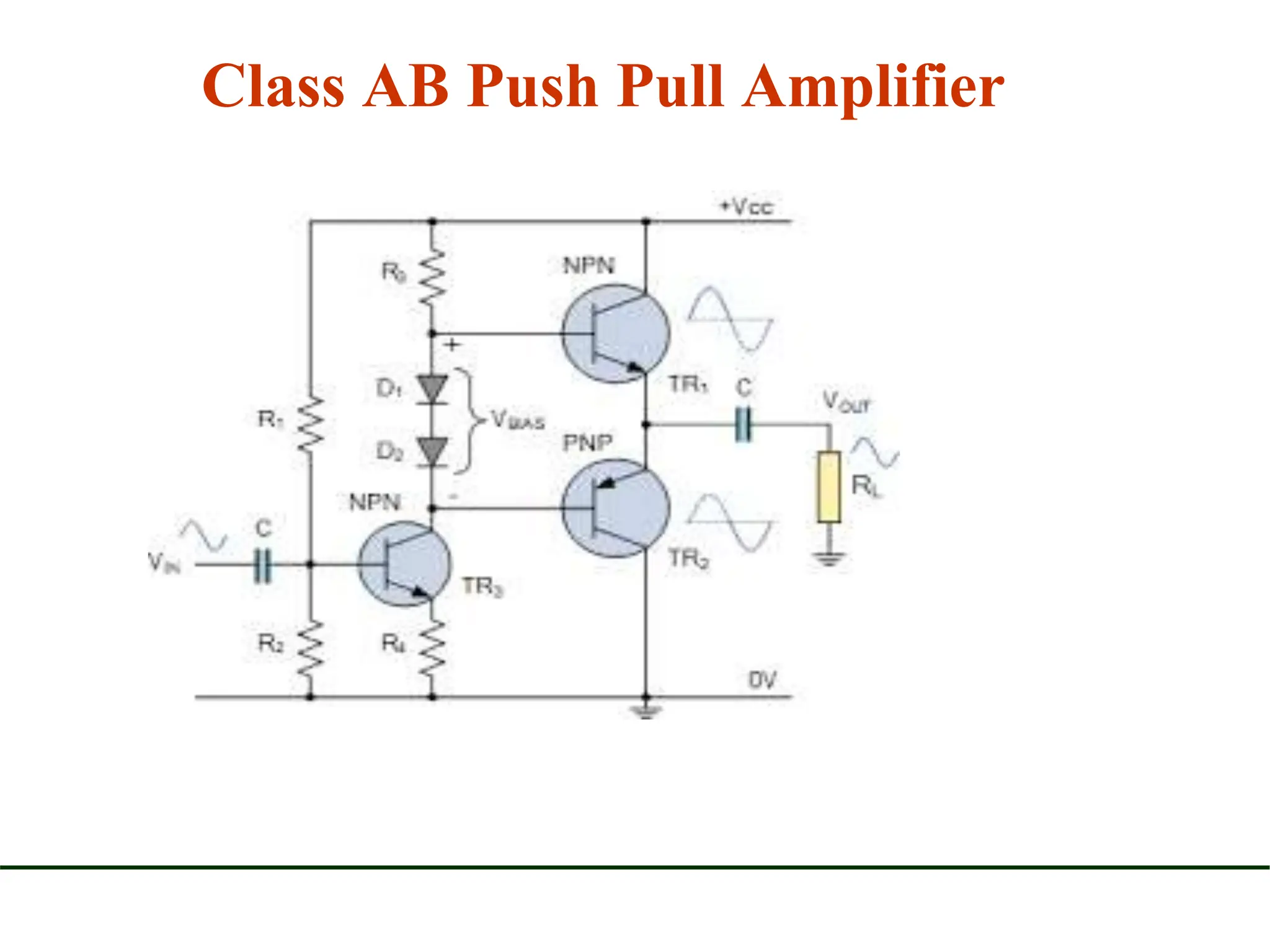
Class AB Push Pull Amplifier
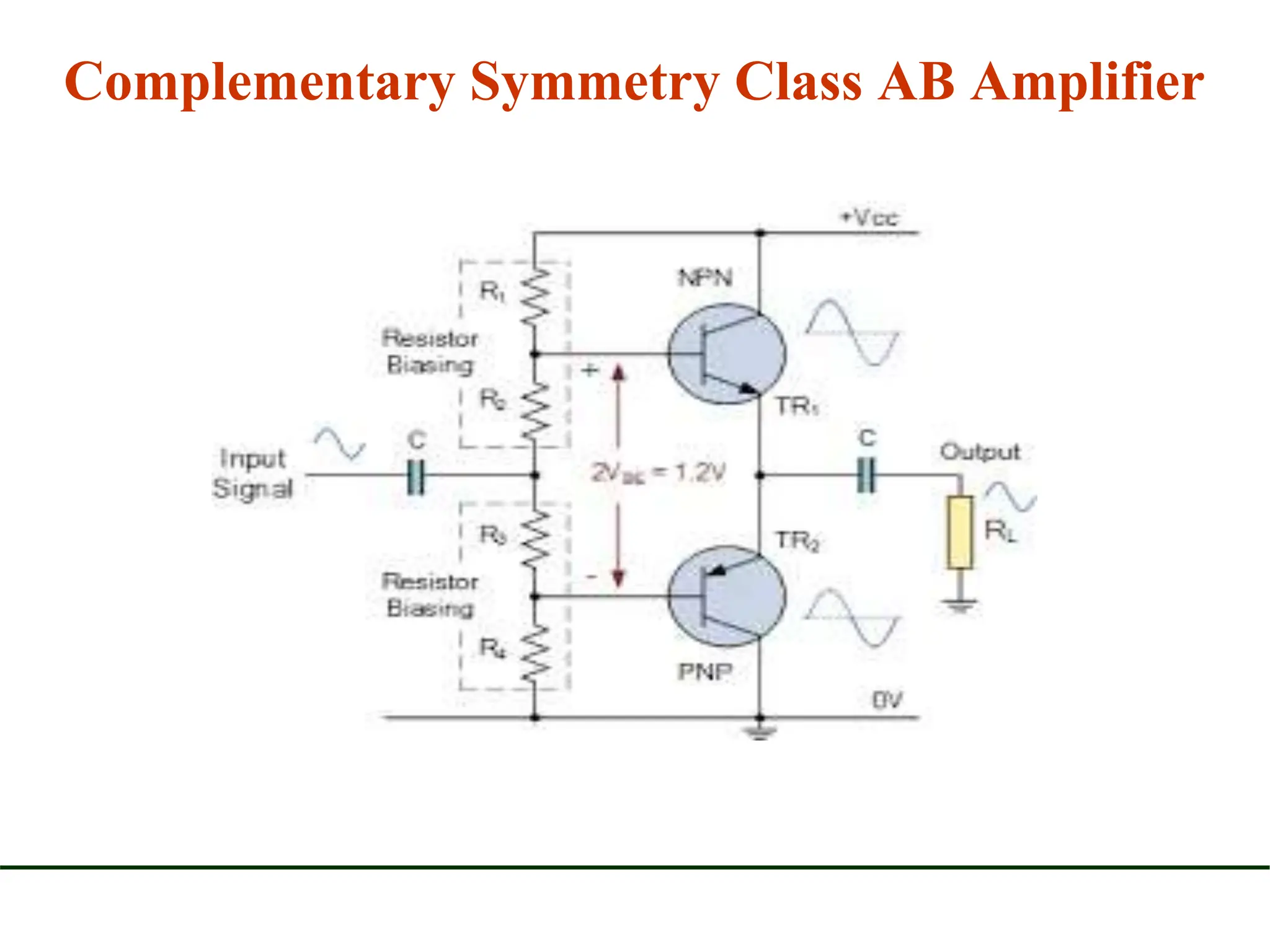
Complementary Symmetry Class AB Amplifier
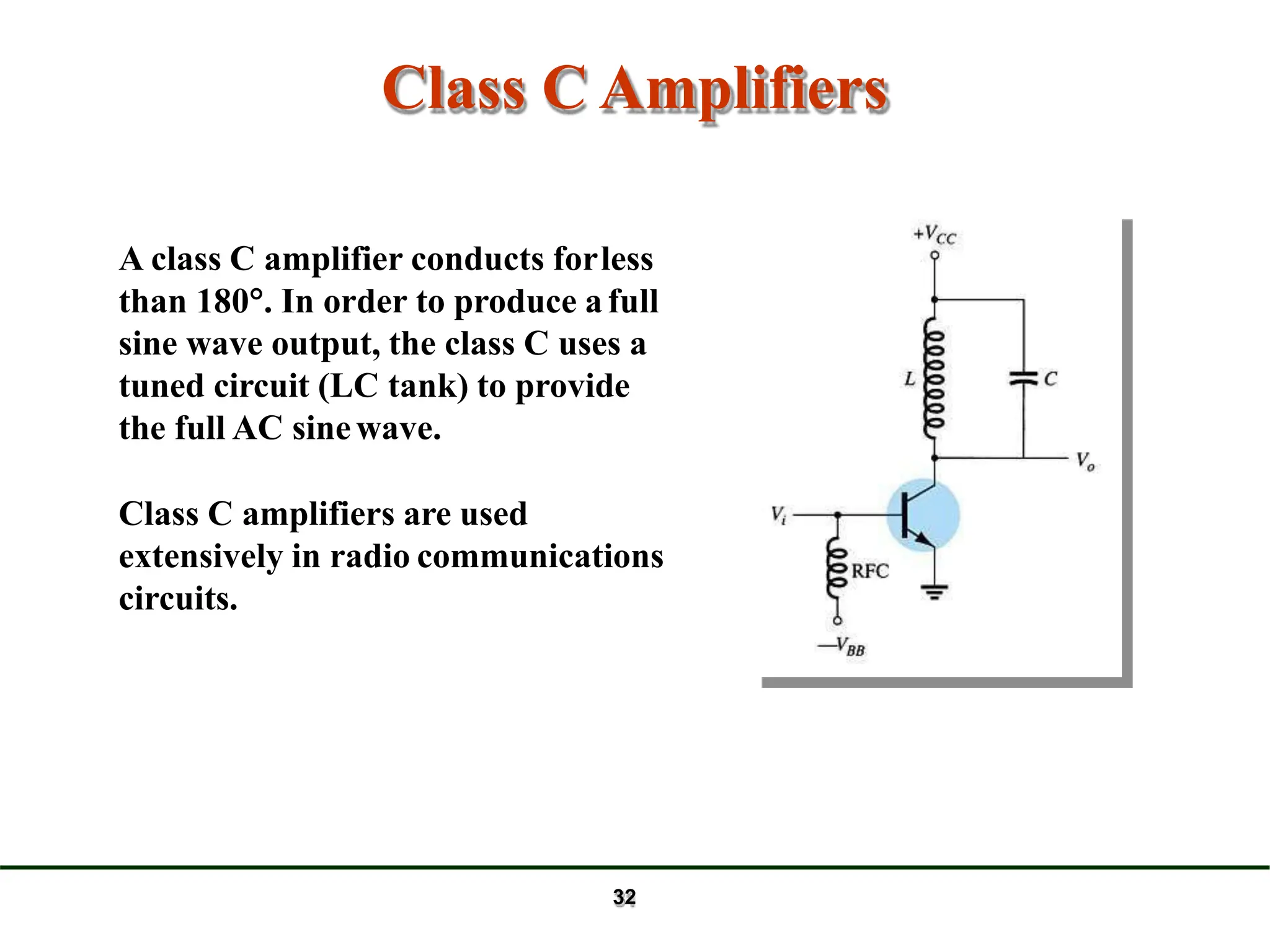
Class C Amplifiers
A class C amplifier conducts forless
than 180. In order to produce afull
sine wave output, the class C uses a
tuned circuit (LC tank) to provide
the full AC sinewave.
Class C amplifiers are used
extensively in radio communications
circuits.
32

power amplifier -IT IS ONE OF THE AMPLIFIER WHICH CAN HANDLE LARGER SIGNALS

  • 1.
  • 2.
    Power Amplifier • Thefunction of a power amplifier is to raise the power level of input signal. • It is required to deliver a large amount of power and has to handle large current. • The base of transistor is made thicken to handle large currents.
  • 3.
    Difference between Voltageand Power Amplifier Voltage amplifier increases the magnitude of voltage of the input signal, while a power amplifier raises the power level of the input signal. Applications The Voltage amplifiers are used in wireless communication & broadcasting of signals Power amplifiers are used in the output stages of audio amplifier systems to drive a loudspeaker load
  • 4.
    The main factorsare: • Efficiency • Maximum Power Capability • Impedance matching to the output device 4
  • 5.
    Amplifier Types The amplifierconducts through the full 360of the input. The Q-point is set near the middle of the load line. The amplifier conducts through 180 of the input. The Q-point is setat the cutoff point. This is a compromise between the class A and B amplifiers. The amplifier conducts somewhere between 180 and 360 . The Q-pointis located between the mid-point and cutoff. 5 Class C The amplifier conducts less than 180 of the input. The Q-point is located below the cutoff level
  • 6.
  • 7.
    Class AAmplifier The outputof a class Aamplifier conducts for the full 360 of the cycle. The Q-point is set at the middle of the load line so that the AC signal can swing a full cycle. 7
  • 8.
    Working • Here (Ic)Qand (Vce)Q represent no signal collector current and voltage between collector and emitter respectively • When signal is applied, the Q-point shifts to Q1 and Q2 • The output current increases to (Ic)max and decreases to (Ic)min • Similarly, the collector-emitter voltage increases to (Vce)max and decreases to (Vce)min
  • 9.
    Advantages (1) simple construction (2)Distortion less output voltage Disadvantage (1) very low efficiency (25%) (2) Large power dissipation in the transistors. (3) Output Impedance is very large.
  • 10.
    TRANSFORMER COUPLED CLASSA POWER AMPLIFIER • Instead of connecting the load directly, the output is connected to the load through a transformer • By adjusting the turn’s ratio (N1N2) the output impedance is matched with the load impedance. • RL is the load connected in the secondary of a transformer. • RL’ is the reflected load in the primary of the transformer. • The number of turns in the primary are n1 and the secondary are n2. • Let V1 and V2 be the primary and secondary voltages and I1 and I2 be the primary and secondary currents respectively. The variation of collector voltage appears across the primary of the transformer.
  • 14.
    Class B Amplifier Aclass B amplifieroutput only conducts for 180 or one-half of the AC input signal. The Q-point is at 0V on the load line, so that the AC signal can only swing for one-half cycle. 14 ICQ = 0 and VCEQ = VCE(cutoff).
  • 15.
    The Q-Point Isat Cutoff The class B amplifier is biased at the cutoff point so that It is brought out of cutoff and operates in its linear region when the input signal drives the transistor into conduction.
  • 16.
    Push-Pull Amplifier 2 transistors 2center tapped transformer
  • 18.
    Class ABAmplifier This amplifieris a compromise between the class A and class B amplifier—the Q-point is above that of the Class B but below the classA. The output conducts between 180 and 360 of the AC input signal. 18
  • 19.
    Class C The outputof the class C conducts for less than 180 of the AC cycle. The Q-point is below cutoff. 19
  • 20.
    Amplifier Efficiency Efficiency refersto the ratio of output to input power. The lower the amount of conduction of the amplifier the higher the efficiency. 20
  • 21.
    This is similarto the small-signal amplifier except that it will handle higher voltages. The transistor used is a high- power transistor. 21 Direct Coupled Class-A Amplifier
  • 22.
    When an inputsignal is applied the output will vary from its dc bias operating voltage and current. A small input signal causes the output voltage to swing to a maximum of Vcc and a minimum of 0V.The current can also swing from 0mA to ICSAT (VCC/RC) 22 Direct Coupled Class-A Amplifier
  • 23.
    C R V2 C(rms) Po(ac)  Input Power Thepower into the amplifier is from the DC supply. With no input signal, the DC current drawn is the collector bias current, ICQ. Pi(dc) VCCICQ Output Power or Po(ac) %η  100 Pi(ac) Efficiency CE(rms) C(rms) 23 o(dc) P  V I Po(dc)  I2 C(rms)Rc Direct Coupled Class-A Amplifier
  • 24.
    Transformer-Coupled Class AAmplifier Thiscircuit uses a transformer to couple to the load. This improves the efficiency of the Class A to 50%. 24
  • 25.
    TransformerAction A transformer improvesthe efficiency because it is able to transform the voltage, current, and impedance Voltage Ratio V2  N2 V1 N1 Current Ratio I 2  N1 I1 N2 Impedance Ratio 2 L R  a 2  2   N1  2    N  R R  L R1 25
  • 26.
    Transformer-Coupled Class AAmplifier DCLoad Line As in all class A amplifiers the Q- point is established close to the midpoint of the DC load line. The dc resistance is small ideally at 0Ω and a dc load line is a straight vertical line. AC Load Line The saturation point (ICmax) is at Vcc/RLand the cutoff point is at V2 (the secondary voltage of the transformer). This increases the maximum output swing because the minimum and maximum values of IC and VCE arespread furtherapart. 26
  • 27.
    Transformer-Coupled Class AAmplifier 8 Po(ac)  (VCEmaxVCEmin)(ICmax  ICmin ) (maximum) Signal Swing and Output ACPower The voltage swing: VCE(pp)  VCEmax  VCEmin The current swing: Ic( p p)  IC max  IC min The AC power: 27
  • 28.
    Transformer-Coupled Class AAmplifier Efficiency PQ Pi(dc) Po(ac)  CEmin   CEmax  V  VCEmax  VCEmin  2 %η  50 V Maximum efficiency: Power input from the DC source: Pi(dc) VCCICQ Power dissipated as heat across the transistor: Note: The larger the input and output signal,the lower the heatdissipation. Note: The larger VCEmax and smaller VCEmin, the closer the efficiency approaches the theoretical maximum of 50%. 28
  • 29.
    Crossover Distortion If thetransistors Q1 and Q2 do not turn on and off at exactly the same time, then there is a gap in the output voltage. 29
  • 30.
    Class AB PushPull Amplifier
  • 31.
  • 32.
    Class C Amplifiers Aclass C amplifier conducts forless than 180. In order to produce afull sine wave output, the class C uses a tuned circuit (LC tank) to provide the full AC sinewave. Class C amplifiers are used extensively in radio communications circuits. 32