Tanveer Saeed
Assistant Professor
AKU-SoNaM
A joint or place of articulation
and is formed where 2 or more
bones come in close contact in
the body and are attached to
each other by ligaments or
cartilage.
Tanveer Saeed
Tanveer Saeed
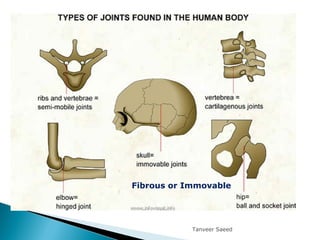
Fibrous or Immovable
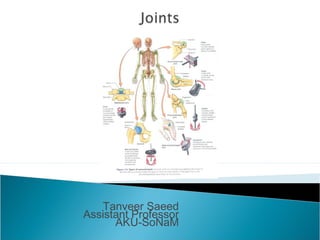
There are three types of joints
classified by the amount of
movement they allow:
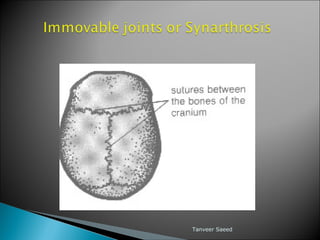
 Fibrous or Immovable----
synarthrosis
 Cartilaginous or slightly movable---
Amphiarthrosis
 Synovial or freely movable----
diathrosis
Tanveer Saeed
Tanveer Saeed
 Amphiarthrosis or Cartilaginous Joints
 This type of joint is characterized by bones
that are connected by hyaline cartilage (fibro
cartilage) and  ligaments which allow only
a limited degree of movement.
Examples are
 the vertebrae
  cartilage in the symphysis which binds the
pubic bones together
 cartilage in the joint between the sacrum
and the hip bone.
 The ribs that connect to the sternum.
Tanveer Saeed
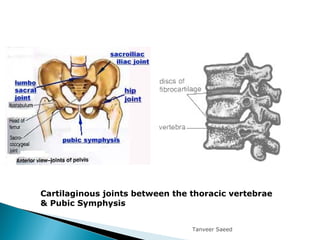
Cartilaginous joints between the thoracic vertebrae
& Pubic Symphysis
Tanveer Saeed
Most of the joints in the adult human
body are freely movable joints.
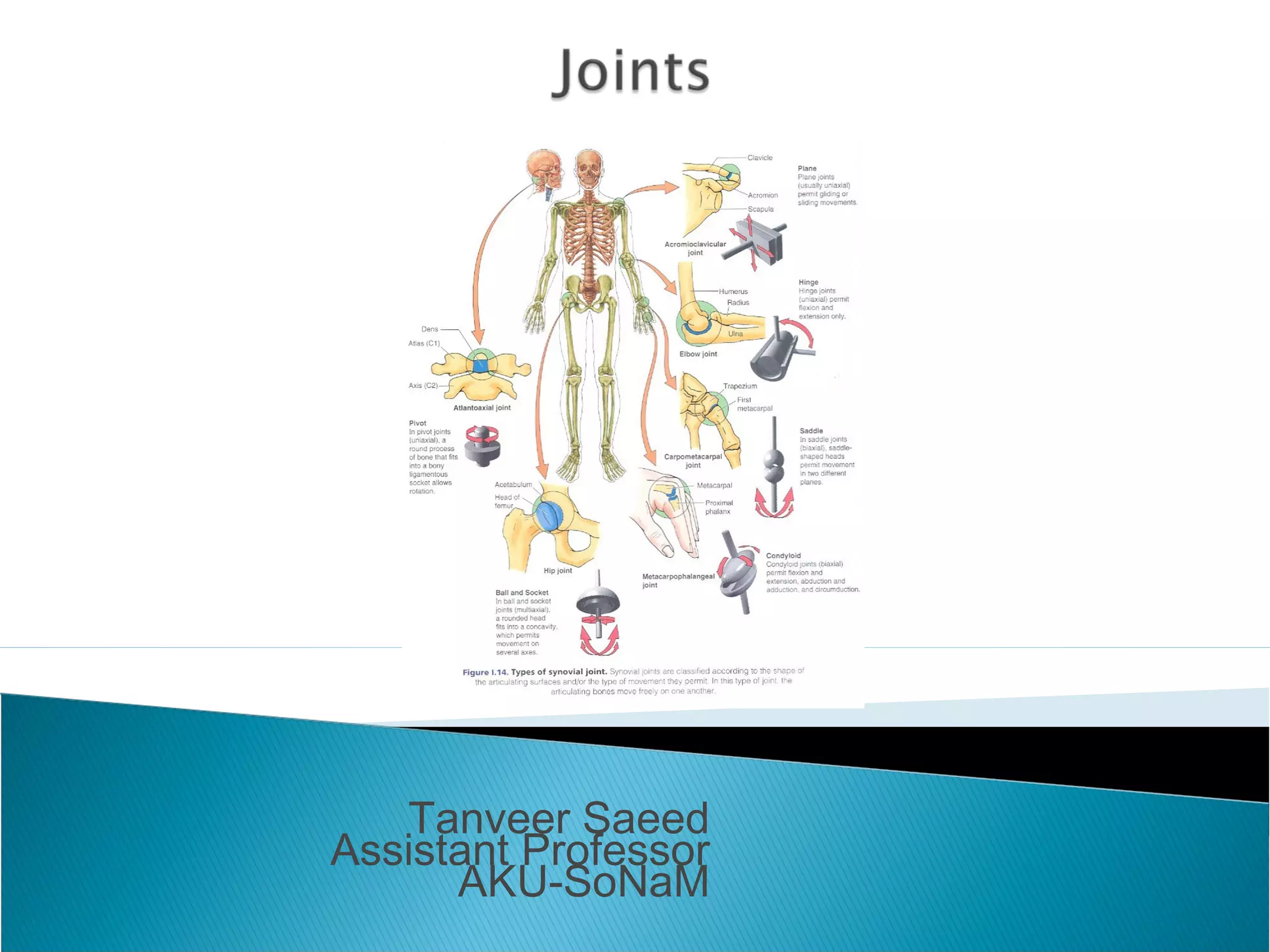
There are six types of diarthroses joints:
 Ball-and-Socket
 Condyloid
 Saddle
 Pivot
 Hinge
 Gliding
Tanveer Saeed
Tanveer Saeed
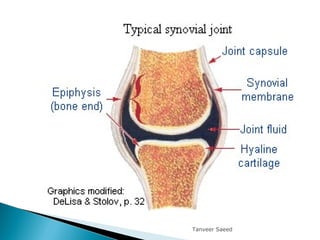
Articulating bones
hyaline cartilage---- articular
cartilage
capsular ligament.
Synovial Membrane
Synovial Cavity
  Synovial fluid
Tanveer Saeed
 The capsular ligament is lined with
a synovial membrane.
 This membrane secretes synovial fluid into
the synovial cavity
  acts as a seal, waterproofing the
joint,lubricates the joint.
 In addition to the capsule, the bones are
also attached and held together by strong,
tough ligaments made of dense connective
tissue. These ligaments prevent
dislocation during normal movement.
Tanveer Saeed
 Synovial joints can be subdivided into the
following groups according to the type of
movement they carry out.
 All combinations of movements, including
circumduction and rotationcan be
performed.
Tanveer Saeed
Tanveer Saeed+
Directions of movement ( ROM)
Flexion - brings a body part forward.
Extension - moves a body part to the rear.
Abduction - moves an appendage laterally from
the midline.
Adduction - moves an appendage toward the
midline.
Circumduction - movement of an appendage in a
circle around a joint.
Pronation - rotating the palm of the hand
downward.
Supination - rotating the palm of the hand
upward.
Inversion - turning the toes of the foot inward.
Eversion - turning the toes of the foot outward.
Tanveer Saeed
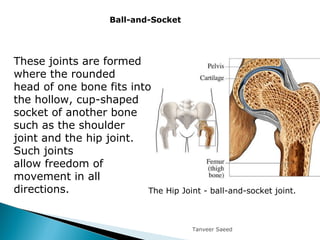
These joints are formed
where the rounded
head of one bone fits into
the hollow, cup-shaped
socket of another bone
such as the shoulder
joint and the hip joint.
Such joints
allow freedom of
movement in all
directions.
Ball-and-Socket
The Hip Joint - ball-and-socket joint.
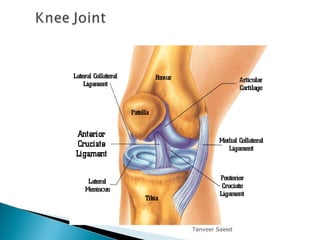
. These joints occur where the convex
surface of one bone fits into the concave
surface of another bone, so making
movement possible in one plane only e.g.
flexion and extension as in the elbow and
knee joints.
 Examples of these joints are the :
 knee ,ankle and the elbow joints.
 Hinge joints have ligaments mainly at the
sides of the joints.
Tanveer Saeed
Tanveer Saeed
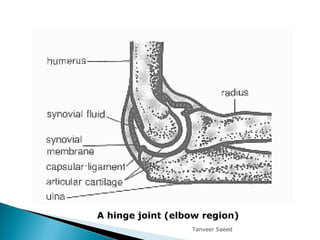
A hinge joint (elbow region)
Tanveer Saeed
 Oval shaped condyle fits into oval cup
shaped end of another bone allowing
angular motion but not rotation.
 Flexion,extension,adduction,abduction
and circumduction but no axial rotation.
Examples include:
 wrist joint
 Metacarpophalangeal joints(Knuckles)
 Meta tarsophalangeal joints (toes)
Tanveer Saeed
 This type of joint occurs when the
touching surfaces of two bones have
both concave and convex regions
allowing rotation in two directions.
 The only saddle joint in the body is in
the thumb.
Tanveer Saeed
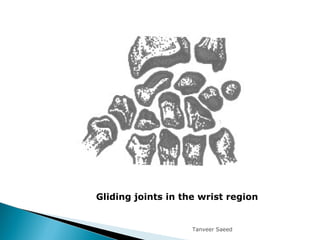
 This type of joint allows for gliding
movements between flat surfaces as the
surfaces slide over one another. Only
a limited amount of movement is allowed
such as the joints between,
 clavicles and the sternum
 the carpal bones
 the joints between the tarsal bones 
Tanveer Saeed
Gliding joints in the wrist region
Tanveer Saeed
These joints occur where:
◦ a bony ring rotates round the
pivot (axis) of another bone such
as the ring-like atlas rotating
around the odontoid process of
the axis, allowing the head to
turn from side to side.
◦ the end of one
bone rotates round the axis of
another bone such as the end of
the radius rotating around the
ulna as the palm of the hand isTanveer Saeed
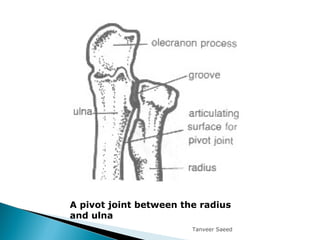
A pivot joint between the radius
and ulna
Tanveer Saeed
Tanveer Saeed
Self quiz to check what you have learned.
1.A point where one or two bones meet is__________.
2. Ball and socket, hinge, gliding and pivot joints are
example of _______.
3. Elbows, knees and fingers use what type of
joints________.
4. What type of joint can be found between
vertebrae________.
5. What type of movement is possible at Joint between
atlas and axis___________.
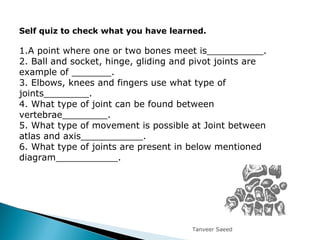
6. What type of joints are present in below mentioned
diagram___________.
Joints (2)

  • 1.
  • 2.
    A joint orplace of articulation and is formed where 2 or more bones come in close contact in the body and are attached to each other by ligaments or cartilage. Tanveer Saeed
  • 3.
  • 4.
    There are threetypes of joints classified by the amount of movement they allow:  Fibrous or Immovable---- synarthrosis  Cartilaginous or slightly movable--- Amphiarthrosis  Synovial or freely movable---- diathrosis Tanveer Saeed
  • 5.
  • 6.
     Amphiarthrosis orCartilaginous Joints  This type of joint is characterized by bones that are connected by hyaline cartilage (fibro cartilage) and  ligaments which allow only a limited degree of movement. Examples are  the vertebrae   cartilage in the symphysis which binds the pubic bones together  cartilage in the joint between the sacrum and the hip bone.  The ribs that connect to the sternum. Tanveer Saeed
  • 7.
    Cartilaginous joints betweenthe thoracic vertebrae & Pubic Symphysis Tanveer Saeed
  • 8.
    Most of thejoints in the adult human body are freely movable joints. There are six types of diarthroses joints:  Ball-and-Socket  Condyloid  Saddle  Pivot  Hinge  Gliding Tanveer Saeed
  • 9.
  • 10.
    Articulating bones hyaline cartilage----articular cartilage capsular ligament. Synovial Membrane Synovial Cavity   Synovial fluid Tanveer Saeed
  • 11.
     The capsular ligament islined with a synovial membrane.  This membrane secretes synovial fluid into the synovial cavity   acts as a seal, waterproofing the joint,lubricates the joint.  In addition to the capsule, the bones are also attached and held together by strong, tough ligaments made of dense connective tissue. These ligaments prevent dislocation during normal movement. Tanveer Saeed
  • 12.
     Synovial jointscan be subdivided into the following groups according to the type of movement they carry out.  All combinations of movements, including circumduction and rotationcan be performed. Tanveer Saeed
  • 13.
    Tanveer Saeed+ Directions ofmovement ( ROM) Flexion - brings a body part forward. Extension - moves a body part to the rear. Abduction - moves an appendage laterally from the midline. Adduction - moves an appendage toward the midline. Circumduction - movement of an appendage in a circle around a joint. Pronation - rotating the palm of the hand downward. Supination - rotating the palm of the hand upward. Inversion - turning the toes of the foot inward. Eversion - turning the toes of the foot outward.
  • 14.
    Tanveer Saeed These jointsare formed where the rounded head of one bone fits into the hollow, cup-shaped socket of another bone such as the shoulder joint and the hip joint. Such joints allow freedom of movement in all directions. Ball-and-Socket The Hip Joint - ball-and-socket joint.
  • 15.
    . These jointsoccur where the convex surface of one bone fits into the concave surface of another bone, so making movement possible in one plane only e.g. flexion and extension as in the elbow and knee joints.  Examples of these joints are the :  knee ,ankle and the elbow joints.  Hinge joints have ligaments mainly at the sides of the joints. Tanveer Saeed
  • 16.
  • 17.
    A hinge joint(elbow region) Tanveer Saeed
  • 18.
     Oval shapedcondyle fits into oval cup shaped end of another bone allowing angular motion but not rotation.  Flexion,extension,adduction,abduction and circumduction but no axial rotation. Examples include:  wrist joint  Metacarpophalangeal joints(Knuckles)  Meta tarsophalangeal joints (toes) Tanveer Saeed
  • 19.
     This typeof joint occurs when the touching surfaces of two bones have both concave and convex regions allowing rotation in two directions.  The only saddle joint in the body is in the thumb. Tanveer Saeed
  • 20.
     This typeof joint allows for gliding movements between flat surfaces as the surfaces slide over one another. Only a limited amount of movement is allowed such as the joints between,  clavicles and the sternum  the carpal bones  the joints between the tarsal bones  Tanveer Saeed
  • 21.
    Gliding joints inthe wrist region Tanveer Saeed
  • 22.
    These joints occurwhere: ◦ a bony ring rotates round the pivot (axis) of another bone such as the ring-like atlas rotating around the odontoid process of the axis, allowing the head to turn from side to side. ◦ the end of one bone rotates round the axis of another bone such as the end of the radius rotating around the ulna as the palm of the hand isTanveer Saeed
  • 23.
    A pivot jointbetween the radius and ulna Tanveer Saeed
  • 24.
    Tanveer Saeed Self quizto check what you have learned. 1.A point where one or two bones meet is__________. 2. Ball and socket, hinge, gliding and pivot joints are example of _______. 3. Elbows, knees and fingers use what type of joints________. 4. What type of joint can be found between vertebrae________. 5. What type of movement is possible at Joint between atlas and axis___________. 6. What type of joints are present in below mentioned diagram___________.