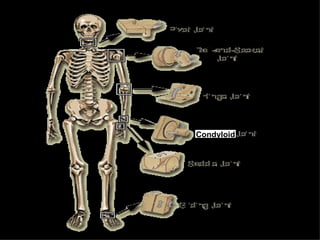
STARTER… List 10 bones of the skeleton.  Start with the head and work down. Use the labelled skeleton from last lesson and circle where you think there is a joint. What is a joint?
WALT Identify the 6 types of freely moveable joint. Provide examples of sporting movements for each type of joint. Describe the movement allowed at each joint. WILF Use of good terminology Work to the best of your ability Provide sporting examples.
PE HOME WORK (Last lesson) Complete the work sheet – identify the types of bones (long, short, flat, irregular) 2. Research question… How does the skeleton provide movement? What is a joint? Types of joints? Movement that occurs at each joint? Hand in next lesson to be marked for assessment.
Condyloid
A JOINT “  A place where two or more bones meet.” Movement  Flexion Extension Abduction Adduction Rotation TASK: What movement occurs at a ball and socket joint and a hinge joint. Provide 3 sporting examples of the joints in action.
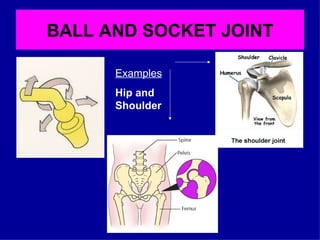
BALL AND SOCKET JOINT Examples Hip and Shoulder
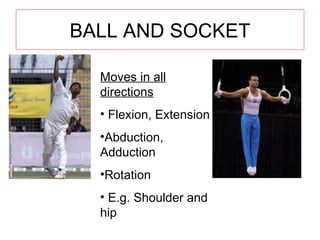
BALL AND SOCKET Moves in all directions Flexion, Extension Abduction, Adduction Rotation E.g. Shoulder and hip
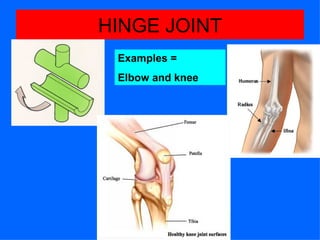
HINGE JOINT Examples =  Elbow and knee
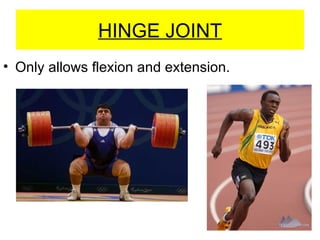
HINGE JOINT Only allows flexion and extension.
Movements at joints A task with the text books  1)You need to write a  DEFINITION  (in your own words) for the following  movements at joints: FLEXION / EXTENSION / ROTATION / ADDUCTION / ABDUCTION 2) You need to think of a  sporting movement  that uses this movement Use p.32 so …  FLEXION  Definition … Sporting movement …
Parts of a SYNOVIAL JOINT: Cartilage - this covers the  end of a bone  forming a tough layer to  protect  them and stop them rubbing together (friction) Joint Capsule  – this is joined to the bones and is a thick tissue that  protects  the joint Synovial Membrane  – this is a layer on the inside of the joint capsule that  produces synovial fluid Synovial Fluid  – is inside the joint and  lubricates  the joint to stop friction Ligament  – Attaches bone to bone and keeps the bone in place.

Joints and sporting actions

  • 1.
    STARTER… List 10bones of the skeleton. Start with the head and work down. Use the labelled skeleton from last lesson and circle where you think there is a joint. What is a joint?
  • 2.
    WALT Identify the6 types of freely moveable joint. Provide examples of sporting movements for each type of joint. Describe the movement allowed at each joint. WILF Use of good terminology Work to the best of your ability Provide sporting examples.
  • 3.
    PE HOME WORK(Last lesson) Complete the work sheet – identify the types of bones (long, short, flat, irregular) 2. Research question… How does the skeleton provide movement? What is a joint? Types of joints? Movement that occurs at each joint? Hand in next lesson to be marked for assessment.
  • 4.
  • 5.
    A JOINT “ A place where two or more bones meet.” Movement Flexion Extension Abduction Adduction Rotation TASK: What movement occurs at a ball and socket joint and a hinge joint. Provide 3 sporting examples of the joints in action.
  • 6.
    BALL AND SOCKETJOINT Examples Hip and Shoulder
  • 7.
    BALL AND SOCKETMoves in all directions Flexion, Extension Abduction, Adduction Rotation E.g. Shoulder and hip
  • 8.
    HINGE JOINT Examples= Elbow and knee
  • 9.
    HINGE JOINT Onlyallows flexion and extension.
  • 10.
    Movements at jointsA task with the text books 1)You need to write a DEFINITION (in your own words) for the following movements at joints: FLEXION / EXTENSION / ROTATION / ADDUCTION / ABDUCTION 2) You need to think of a sporting movement that uses this movement Use p.32 so … FLEXION Definition … Sporting movement …
  • 11.
    Parts of aSYNOVIAL JOINT: Cartilage - this covers the end of a bone forming a tough layer to protect them and stop them rubbing together (friction) Joint Capsule – this is joined to the bones and is a thick tissue that protects the joint Synovial Membrane – this is a layer on the inside of the joint capsule that produces synovial fluid Synovial Fluid – is inside the joint and lubricates the joint to stop friction Ligament – Attaches bone to bone and keeps the bone in place.