Scaling Twitter
John Adams
Twitter Operations


                     “Talk Cloudy to Me” 2011
John Adams / @netik
•   Early Twitter employee

•   Operations + Security Team

•   Keynote Speaker: O’Reilly Velocity 2009, 2010

•   O’Reilly Web 2.0 Speaker (2008, 2010)

•   Previous companies: Inktomi, Apple, c|net
Operations

•   Support the site and the developers

•   Make it performant

•   Capacity Planning (metrics-driven)

•   Configuration Management

•   Improve existing architecture
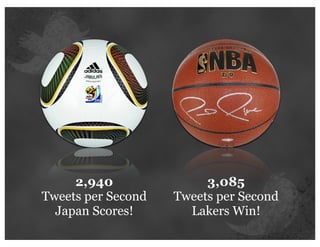
2,940               3,085
Tweets per Second   Tweets per Second
  Japan Scores!       Lakers Win!
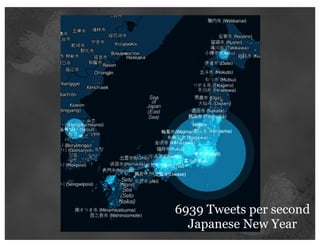
6939 Tweets per second
  Japanese New Year
Where’s the cloud?
•   Amazon S3 for Avatar, Background, and Asset
    Storage. Few if any EC2 instances (test only.)

•   Direct S3 is expensive

    •   Cost for data in, data out, data stored

•   Cloudfront is cheaper than direct S3

    •   Cloudfront to S3 origins = free

    •   Use International CDNs on top of Cloudfront
CDNs and Versioning
•   Hard to purge quickly from CDNs

•   DMCA, image takedowns, emergency changes

•   CDN images, javascript, and other static files
    get long-lived expire times from origin

•   Version entire static asset store on deploys

     •   /static/NNNNNN/directory/file...
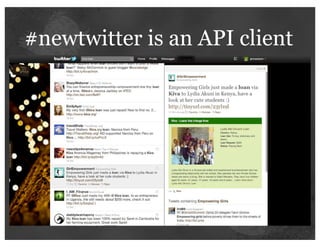
#newtwitter is an API client
Nothing works the
first time.
•   Scale site using best available technologies

•   Plan to build everything more than once.

•   Most solutions work to a certain level of scale,
    and then you must re-evaluate to grow.

•   This is a continual process.
UNIX friends fail at scale
•   Cron

    •   Add NTP, and many machines executing the
        same thing cause “micro” outages across the site.

•   Syslog

    •   Truncation, data loss, aggregation issues

•   RRD

    •   Data rounding over time
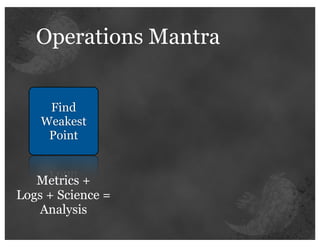
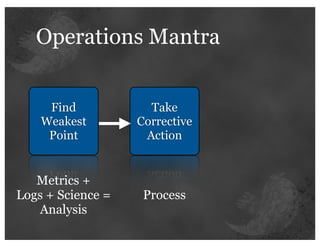
Operations Mantra


     Find
    Weakest
     Point


   Metrics +
Logs + Science =
   Analysis
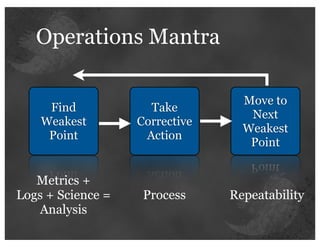
Operations Mantra


     Find            Take
    Weakest        Corrective
     Point          Action


   Metrics +
Logs + Science =    Process
   Analysis
Operations Mantra

                                  Move to
     Find            Take
                                   Next
    Weakest        Corrective
                                  Weakest
     Point          Action
                                   Point


   Metrics +
Logs + Science =    Process     Repeatability
   Analysis
MTTD
MTTR
Sysadmin 2.0 (Devops)
•   Don’t be a just a sysadmin anymore.

•   Think of Systems management as a
    programming task (puppet, chef, cfengine...)

•   No more silos, or lobbing things over the wall

•   We’re all on the same side. Work Together!
Monitoring
•   Twitter graphs and reports critical metrics in
    as near to real time as possible

•   If you build tools against our API, you should
    too.

•   Use this data to inform the public

    •   dev.twitter.com - API availability

    •   status.twitter.com
Data Analysis
•   Instrumenting the world pays off.

•   “Data analysis, visualization, and other
    techniques for seeing patterns in data are
    going to be an increasingly valuable skill set.
    Employers take notice!”
          “Web Squared: Web 2.0 Five Years On”, Tim O’Reilly, Web 2.0 Summit, 2009
Profiling
•   Low-level

•   Identify bottlenecks inside of core tools

    •   Latency, Network Usage, Memory leaks

•   Methods

    •   Network services:

        •   tcpdump + tcpdstat, yconalyzer

    •   Introspect with Google perftools
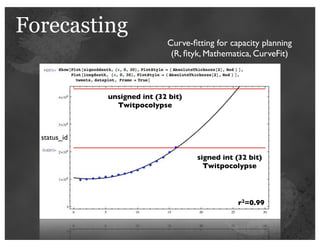
Forecasting
                              Curve-fitting for capacity planning
                               (R, fityk, Mathematica, CurveFit)


              unsigned int (32 bit)
                Twitpocolypse


  status_id

                                      signed int (32 bit)
                                        Twitpocolypse


                                                  r2=0.99
Loony (tool)
•   Accesses central machine database (MySQL)

    •   Python, Django, Paraminko SSH

    •   Ties into LDAP

•   Filter and list machines, find asset data

•   On demand changes across machines
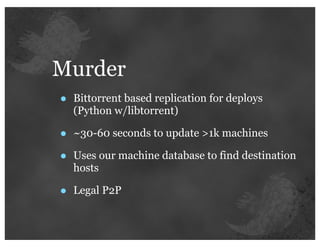
Murder
•   Bittorrent based replication for deploys
    (Python w/libtorrent)

•   ~30-60 seconds to update >1k machines

•   Uses our machine database to find destination
    hosts

•   Legal P2P
Configuration Management

  •   Start automated configuration management
      EARLY in your company.
  •   Don’t wait until it’s too late.

  •   Twitter started within the first few months.
Virtualization
•   A great start, but...

    •   Images are not a stable way to replicate
        configuration

    •   Changes made to deployed images cannot be
        easily detected and repaired

    •   Typically the only solution is to redeploy
Puppet
•   Puppet + SVN

    •   Hundreds of modules

    •   Runs constantly

    •   Post-Commit hooks for config+sanity chceks

•   No one logs into machines

•   Centralized Change
Issues with Centralized
Management
•   Complex Environment

•   Multiple Admins

•   Unknown Interactions

•   Solution: 2nd set of eyes.
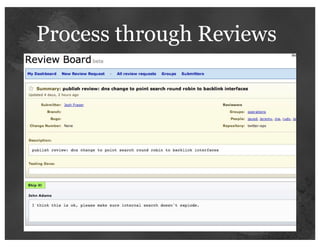
Process through Reviews
Logging
•   Syslog doesn’t work at high traffic rates

    •   No redundancy, no ability to recover from
        daemon failure

•   Moving large files around is painful

•   Solution:

    •   Scribe
Scribe
•   Fault-tolerant data transmission

•   Simple data model, easy to extend

•   Log locally, then scribe to aggregation nodes

•   Slow-start recovery when aggregator goes down

•   Twitter patches

    •   LZO compression and direct HDFS
Hadoop for Ops
•   Once the data’s scribed to HDFS you can:

    •   Aggregate reports across thousands of
        servers

    •   Produce application level metrics

    •   Use map-reduce to gain insight into your
        systems.
Analyze
•   Turn data into information

    •   Where is the code base going?

    •   Are things worse than they were?

        •   Understand the impact of the last software
            deploy

        •   Run check scripts during and after deploys

•   Capacity Planning, not Fire Fighting!
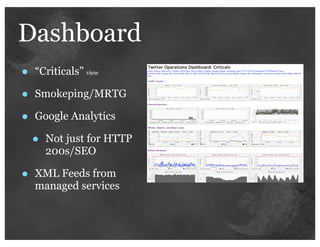
Dashboard
•   “Criticals” view

•   Smokeping/MRTG

•   Google Analytics

    •   Not just for HTTP
        200s/SEO

•   XML Feeds from
    managed services
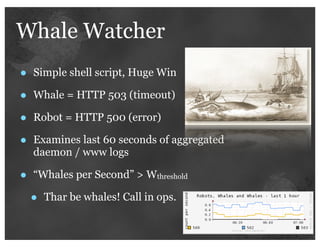
Whale Watcher
•   Simple shell script, Huge Win

•   Whale = HTTP 503 (timeout)

•   Robot = HTTP 500 (error)

•   Examines last 60 seconds of aggregated
    daemon / www logs

•   “Whales per Second” > Wthreshold

    •   Thar be whales! Call in ops.
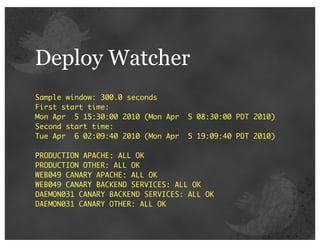
Deploy Watcher
Sample window: 300.0 seconds
First start time:
Mon Apr 5 15:30:00 2010 (Mon Apr   5 08:30:00 PDT 2010)
Second start time:
Tue Apr 6 02:09:40 2010 (Mon Apr   5 19:09:40 PDT 2010)

PRODUCTION APACHE: ALL OK
PRODUCTION OTHER: ALL OK
WEB049 CANARY APACHE: ALL OK
WEB049 CANARY BACKEND SERVICES: ALL OK
DAEMON031 CANARY BACKEND SERVICES: ALL OK
DAEMON031 CANARY OTHER: ALL OK
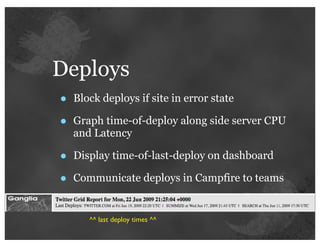
Deploys
•   Block deploys if site in error state

•   Graph time-of-deploy along side server CPU
    and Latency

•   Display time-of-last-deploy on dashboard

•   Communicate deploys in Campfire to teams


       ^^ last deploy times ^^
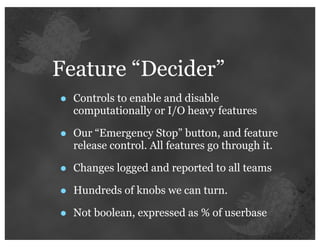
Feature “Decider”
•   Controls to enable and disable
    computationally or I/O heavy features

•   Our “Emergency Stop” button, and feature
    release control. All features go through it.

•   Changes logged and reported to all teams

•   Hundreds of knobs we can turn.

•   Not boolean, expressed as % of userbase
subsystems
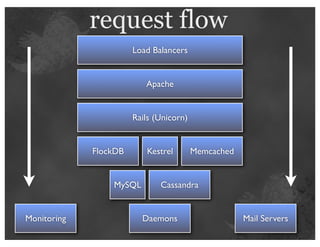
request flow
                       Load Balancers


                          Apache


                       Rails (Unicorn)


             FlockDB      Kestrel        Memcached


                 MySQL        Cassandra


Monitoring               Daemons                     Mail Servers
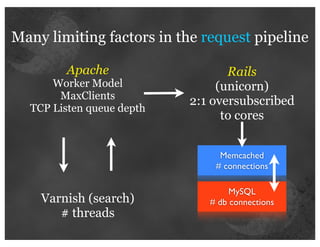
Many limiting factors in the request pipeline

        Apache                    Rails
      Worker Model              (unicorn)
       MaxClients
                           2:1 oversubscribed
  TCP Listen queue depth
                                 to cores


                                Memcached
                               # connections

                                   MySQL
    Varnish (search)          # db connections
       # threads
Unicorn Rails Server
•   Connection push to socket polling model

•   Deploys without Downtime

•   Less memory and 30% less CPU

•   Shift from ProxyPass to Proxy Balancer

    •   mod_proxy_balancer lies about usage

    •   Race condition in counters patched
Rails
•   Front-end (Scala/Java back-end)

•   Not to blame for our issues. Analysis found:

    •   Caching + Cache invalidation problems

    •   Bad queries generated by ActiveRecord,
        resulting in slow queries against the db

    •   Garbage Collection issues (20-25%)

•   Replication Lag
memcached
•   Network Memory Bus isn’t infinite

•   Evictions make the cache unreliable for
    important configuration data
    (loss of darkmode flags, for example)

•   Segmented into pools for better performance

•   Examine slab allocation and watch for high
    use/eviction rates on individual slabs using
    peep. Adjust slab factors and size accordingly.
Decomposition

•   SOA: Service Orientated Architecture

•   Take application and decompose into services

•   Admin the services as separate units

•   Decouple the services from each other
Asynchronous Requests
•   Executing work during the web request is
    expensive

•   The request pipeline should not be used to
    handle 3rd party communications or
    back-end work.

    •   Move work to queues

    •   Run daemons against queues
Thrift
•   Cross-language services framework

•   Originally developed at Facebook

•   Now an Apache project

•   Seamless operation between C++, Java,
    Python, PHP, Ruby, Erlang, Perl, Haskell, C#,
    Cocoa, Smalltalk, OCaml (phew!)
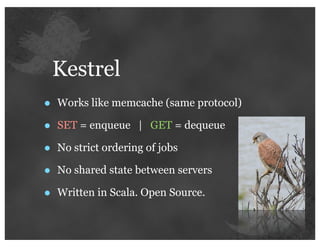
Kestrel
•   Works like memcache (same protocol)

•   SET = enqueue | GET = dequeue

•   No strict ordering of jobs

•   No shared state between servers

•   Written in Scala. Open Source.
Daemons
•   Many different types at Twitter.

•   # of daemons have to match the workload

•   Early Kestrel would crash if queues filled

•   “Seppaku” patch

    •   Kill daemons after n requests

    •   Long-running leaky daemons = low memory
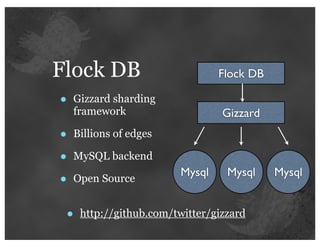
Flock DB                         Flock DB

•   Gizzard sharding
    framework                    Gizzard
•   Billions of edges

•   MySQL backend
                         Mysql    Mysql     Mysql
•   Open Source


 •   http://github.com/twitter/gizzard
Disk is the new Tape.
•   Social Networking application profile has
    many O(ny) operations.

•   Page requests have to happen in < 500mS or
    users start to notice. Goal: 250-300mS

•   Web 2.0 isn’t possible without lots of RAM

•   What to do?
Caching
•   We’re “real time”, but still lots of caching
    opportunity

•   Most caching strategies rely on long TTLs (>60 s)

•   Separate memcache pools for different data types
    to prevent eviction

•   Optimize Ruby Gem to libmemcached + FNV
    Hash instead of Ruby + MD5

•   Twitter largest contributor to libmemcached
Caching
•   “Cache Everything!” not the best policy, as

•   Invalidating caches at the right time is
    difficult.

•   Cold Cache problem; What happens after
    power or system failure?

•   Use cache to augment db, not to replace
MySQL
•   We have many MySQL servers

•   Increasingly used more and more as key/value
    store

•   Many instances spread out through the
    Gizzard sharding framework
MySQL Challenges
•   Replication Delay

    •   Single threaded replication = pain.

•   Social Networking not good for RDBMS

    •   N x N relationships and social graph / tree
        traversal - we have FlockDB for that

    •   Disk issues

        •   FS Choice, noatime, scheduling algorithm
Database Replication
•   Major issues around users and statuses tables

•   Multiple functional masters (FRP, FWP)

•   Make sure your code reads and writes to the
    write DBs. Reading from master = slow death

    •   Monitor the DB. Find slow / poorly designed
        queries

•   Kill long running queries before they kill you
    (mkill)
Key Points
•   Use cloud where necessary

•   Instrument everything.

•   Use metrics to make decisions, not intuition.

•   Decompose your app and remove
    dependencies between services

•   Process asynchronously when possible
Questions?
Thanks!
•   We support and use Open Source

    •   http://twitter.com/about/opensource

•   Work at scale - We’re hiring.

    •   @jointheflock

John adams talk cloudy

  • 1.
    Scaling Twitter John Adams TwitterOperations “Talk Cloudy to Me” 2011
  • 2.
    John Adams /@netik • Early Twitter employee • Operations + Security Team • Keynote Speaker: O’Reilly Velocity 2009, 2010 • O’Reilly Web 2.0 Speaker (2008, 2010) • Previous companies: Inktomi, Apple, c|net
  • 3.
    Operations • Support the site and the developers • Make it performant • Capacity Planning (metrics-driven) • Configuration Management • Improve existing architecture
  • 4.
    2,940 3,085 Tweets per Second Tweets per Second Japan Scores! Lakers Win!
  • 5.
    6939 Tweets persecond Japanese New Year
  • 6.
    Where’s the cloud? • Amazon S3 for Avatar, Background, and Asset Storage. Few if any EC2 instances (test only.) • Direct S3 is expensive • Cost for data in, data out, data stored • Cloudfront is cheaper than direct S3 • Cloudfront to S3 origins = free • Use International CDNs on top of Cloudfront
  • 7.
    CDNs and Versioning • Hard to purge quickly from CDNs • DMCA, image takedowns, emergency changes • CDN images, javascript, and other static files get long-lived expire times from origin • Version entire static asset store on deploys • /static/NNNNNN/directory/file...
  • 8.
  • 9.
    Nothing works the firsttime. • Scale site using best available technologies • Plan to build everything more than once. • Most solutions work to a certain level of scale, and then you must re-evaluate to grow. • This is a continual process.
  • 10.
    UNIX friends failat scale • Cron • Add NTP, and many machines executing the same thing cause “micro” outages across the site. • Syslog • Truncation, data loss, aggregation issues • RRD • Data rounding over time
  • 11.
    Operations Mantra Find Weakest Point Metrics + Logs + Science = Analysis
  • 12.
    Operations Mantra Find Take Weakest Corrective Point Action Metrics + Logs + Science = Process Analysis
  • 13.
    Operations Mantra Move to Find Take Next Weakest Corrective Weakest Point Action Point Metrics + Logs + Science = Process Repeatability Analysis
  • 14.
  • 15.
  • 16.
    Sysadmin 2.0 (Devops) • Don’t be a just a sysadmin anymore. • Think of Systems management as a programming task (puppet, chef, cfengine...) • No more silos, or lobbing things over the wall • We’re all on the same side. Work Together!
  • 17.
    Monitoring • Twitter graphs and reports critical metrics in as near to real time as possible • If you build tools against our API, you should too. • Use this data to inform the public • dev.twitter.com - API availability • status.twitter.com
  • 18.
    Data Analysis • Instrumenting the world pays off. • “Data analysis, visualization, and other techniques for seeing patterns in data are going to be an increasingly valuable skill set. Employers take notice!” “Web Squared: Web 2.0 Five Years On”, Tim O’Reilly, Web 2.0 Summit, 2009
  • 19.
    Profiling • Low-level • Identify bottlenecks inside of core tools • Latency, Network Usage, Memory leaks • Methods • Network services: • tcpdump + tcpdstat, yconalyzer • Introspect with Google perftools
  • 20.
    Forecasting Curve-fitting for capacity planning (R, fityk, Mathematica, CurveFit) unsigned int (32 bit) Twitpocolypse status_id signed int (32 bit) Twitpocolypse r2=0.99
  • 21.
    Loony (tool) • Accesses central machine database (MySQL) • Python, Django, Paraminko SSH • Ties into LDAP • Filter and list machines, find asset data • On demand changes across machines
  • 22.
    Murder • Bittorrent based replication for deploys (Python w/libtorrent) • ~30-60 seconds to update >1k machines • Uses our machine database to find destination hosts • Legal P2P
  • 23.
    Configuration Management • Start automated configuration management EARLY in your company. • Don’t wait until it’s too late. • Twitter started within the first few months.
  • 24.
    Virtualization • A great start, but... • Images are not a stable way to replicate configuration • Changes made to deployed images cannot be easily detected and repaired • Typically the only solution is to redeploy
  • 25.
    Puppet • Puppet + SVN • Hundreds of modules • Runs constantly • Post-Commit hooks for config+sanity chceks • No one logs into machines • Centralized Change
  • 26.
    Issues with Centralized Management • Complex Environment • Multiple Admins • Unknown Interactions • Solution: 2nd set of eyes.
  • 27.
  • 28.
    Logging • Syslog doesn’t work at high traffic rates • No redundancy, no ability to recover from daemon failure • Moving large files around is painful • Solution: • Scribe
  • 29.
    Scribe • Fault-tolerant data transmission • Simple data model, easy to extend • Log locally, then scribe to aggregation nodes • Slow-start recovery when aggregator goes down • Twitter patches • LZO compression and direct HDFS
  • 30.
    Hadoop for Ops • Once the data’s scribed to HDFS you can: • Aggregate reports across thousands of servers • Produce application level metrics • Use map-reduce to gain insight into your systems.
  • 31.
    Analyze • Turn data into information • Where is the code base going? • Are things worse than they were? • Understand the impact of the last software deploy • Run check scripts during and after deploys • Capacity Planning, not Fire Fighting!
  • 32.
    Dashboard • “Criticals” view • Smokeping/MRTG • Google Analytics • Not just for HTTP 200s/SEO • XML Feeds from managed services
  • 33.
    Whale Watcher • Simple shell script, Huge Win • Whale = HTTP 503 (timeout) • Robot = HTTP 500 (error) • Examines last 60 seconds of aggregated daemon / www logs • “Whales per Second” > Wthreshold • Thar be whales! Call in ops.
  • 34.
    Deploy Watcher Sample window:300.0 seconds First start time: Mon Apr 5 15:30:00 2010 (Mon Apr 5 08:30:00 PDT 2010) Second start time: Tue Apr 6 02:09:40 2010 (Mon Apr 5 19:09:40 PDT 2010) PRODUCTION APACHE: ALL OK PRODUCTION OTHER: ALL OK WEB049 CANARY APACHE: ALL OK WEB049 CANARY BACKEND SERVICES: ALL OK DAEMON031 CANARY BACKEND SERVICES: ALL OK DAEMON031 CANARY OTHER: ALL OK
  • 35.
    Deploys • Block deploys if site in error state • Graph time-of-deploy along side server CPU and Latency • Display time-of-last-deploy on dashboard • Communicate deploys in Campfire to teams ^^ last deploy times ^^
  • 36.
    Feature “Decider” • Controls to enable and disable computationally or I/O heavy features • Our “Emergency Stop” button, and feature release control. All features go through it. • Changes logged and reported to all teams • Hundreds of knobs we can turn. • Not boolean, expressed as % of userbase
  • 37.
  • 38.
    request flow Load Balancers Apache Rails (Unicorn) FlockDB Kestrel Memcached MySQL Cassandra Monitoring Daemons Mail Servers
  • 39.
    Many limiting factorsin the request pipeline Apache Rails Worker Model (unicorn) MaxClients 2:1 oversubscribed TCP Listen queue depth to cores Memcached # connections MySQL Varnish (search) # db connections # threads
  • 40.
    Unicorn Rails Server • Connection push to socket polling model • Deploys without Downtime • Less memory and 30% less CPU • Shift from ProxyPass to Proxy Balancer • mod_proxy_balancer lies about usage • Race condition in counters patched
  • 41.
    Rails • Front-end (Scala/Java back-end) • Not to blame for our issues. Analysis found: • Caching + Cache invalidation problems • Bad queries generated by ActiveRecord, resulting in slow queries against the db • Garbage Collection issues (20-25%) • Replication Lag
  • 42.
    memcached • Network Memory Bus isn’t infinite • Evictions make the cache unreliable for important configuration data (loss of darkmode flags, for example) • Segmented into pools for better performance • Examine slab allocation and watch for high use/eviction rates on individual slabs using peep. Adjust slab factors and size accordingly.
  • 43.
    Decomposition • SOA: Service Orientated Architecture • Take application and decompose into services • Admin the services as separate units • Decouple the services from each other
  • 44.
    Asynchronous Requests • Executing work during the web request is expensive • The request pipeline should not be used to handle 3rd party communications or back-end work. • Move work to queues • Run daemons against queues
  • 45.
    Thrift • Cross-language services framework • Originally developed at Facebook • Now an Apache project • Seamless operation between C++, Java, Python, PHP, Ruby, Erlang, Perl, Haskell, C#, Cocoa, Smalltalk, OCaml (phew!)
  • 46.
    Kestrel • Works like memcache (same protocol) • SET = enqueue | GET = dequeue • No strict ordering of jobs • No shared state between servers • Written in Scala. Open Source.
  • 47.
    Daemons • Many different types at Twitter. • # of daemons have to match the workload • Early Kestrel would crash if queues filled • “Seppaku” patch • Kill daemons after n requests • Long-running leaky daemons = low memory
  • 48.
    Flock DB Flock DB • Gizzard sharding framework Gizzard • Billions of edges • MySQL backend Mysql Mysql Mysql • Open Source • http://github.com/twitter/gizzard
  • 49.
    Disk is thenew Tape. • Social Networking application profile has many O(ny) operations. • Page requests have to happen in < 500mS or users start to notice. Goal: 250-300mS • Web 2.0 isn’t possible without lots of RAM • What to do?
  • 50.
    Caching • We’re “real time”, but still lots of caching opportunity • Most caching strategies rely on long TTLs (>60 s) • Separate memcache pools for different data types to prevent eviction • Optimize Ruby Gem to libmemcached + FNV Hash instead of Ruby + MD5 • Twitter largest contributor to libmemcached
  • 51.
    Caching • “Cache Everything!” not the best policy, as • Invalidating caches at the right time is difficult. • Cold Cache problem; What happens after power or system failure? • Use cache to augment db, not to replace
  • 52.
    MySQL • We have many MySQL servers • Increasingly used more and more as key/value store • Many instances spread out through the Gizzard sharding framework
  • 53.
    MySQL Challenges • Replication Delay • Single threaded replication = pain. • Social Networking not good for RDBMS • N x N relationships and social graph / tree traversal - we have FlockDB for that • Disk issues • FS Choice, noatime, scheduling algorithm
  • 54.
    Database Replication • Major issues around users and statuses tables • Multiple functional masters (FRP, FWP) • Make sure your code reads and writes to the write DBs. Reading from master = slow death • Monitor the DB. Find slow / poorly designed queries • Kill long running queries before they kill you (mkill)
  • 55.
    Key Points • Use cloud where necessary • Instrument everything. • Use metrics to make decisions, not intuition. • Decompose your app and remove dependencies between services • Process asynchronously when possible
  • 56.
  • 57.
    Thanks! • We support and use Open Source • http://twitter.com/about/opensource • Work at scale - We’re hiring. • @jointheflock