Adams/Jefferson
Adams
 An accomplished diplomat
 Peace of Paris (1783), ambassador to the Dutch
Republic & Great Britain, VP
 Accused of favoring British (Jay’s Treaty was too
kind)
 Not a great speaker, not good at resolving conflicts,
temper
 Some of the reasons that he served only one term
 *On committee w/ Jefferson that wrote Declaration
Jefferson
 Also, an est. diplomat
 Sec. of State, Minister to France, Governor of VA
 Declaration of Independence
 Accused of being too pro-French
 Connected to violence of the French Revolution
Election of 1796
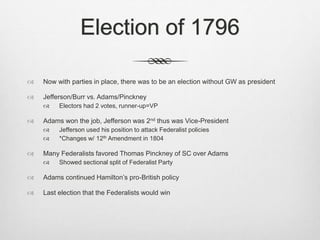
 Now with parties in place, there was to be an election without GW as president
 Jefferson/Burr vs. Adams/Pinckney
 Electors had 2 votes, runner-up=VP
 Adams won the job, Jefferson was 2nd thus was Vice-President
 Jefferson used his position to attack Federalist policies
 *Changes w/ 12th Amendment in 1804
 Many Federalists favored Thomas Pinckney of SC over Adams
 Showed sectional split of Federalist Party
 Adams continued Hamilton’s pro-British policy
 Last election that the Federalists would win
Election of 1796
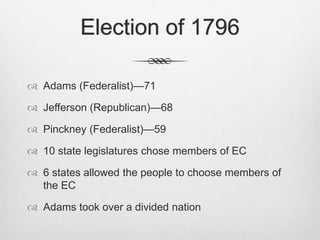
 Adams (Federalist)—71
 Jefferson (Republican)—68
 Pinckney (Federalist)—59
 10 state legislatures chose members of EC
 6 states allowed the people to choose members of
the EC
 Adams took over a divided nation
12th Amendment
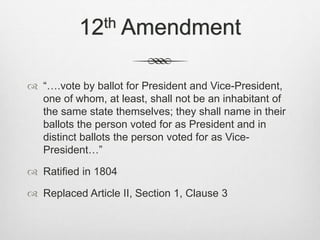
 “….vote by ballot for President and Vice-President,
one of whom, at least, shall not be an inhabitant of
the same state themselves; they shall name in their
ballots the person voted for as President and in
distinct ballots the person voted for as Vice-
President…”
 Ratified in 1804
 Replaced Article II, Section 1, Clause 3
GW’s Farewell Speech
 What are the key
ideas/advice?
 Did Americans listen to
his advice?
GW’s Farewell Speech
 A letter partially written by Hamilton!
 Warned against international conflicts
 Also against FACTIONS & overgrown military
GW’s Farewell Address
 Washington warns specifically of the destructive potential
of parties or causes that "now and then answer popular
ends," but that over time can "become potent engines by
which cunning, ambitious and unprincipled men will be
enabled to subvert the power of the people, and to usurp
for themselves the reins of government."
 Taken from:
http://www.pbs.org/georgewashington/milestones/farewell_a
ddress_about.html
Adams as President
 Took over a split party
 Not the most influential Federalist (Hamilton)
 Republican opposition was growing stronger
Quasi War/XYZ Affair
 U.S.-French relations crumble
 French vessels capture American ships
 Many favored war (Hamilton), but Adams instead
negotiated
 1798-XYZ Affair: American officials sent to Paris to
negotiate a treaty that would replace old alliance of 1778
 French officials presented Am. diplomats w/ demand for
bribes before negotiations started
 Adams called his agents X, Y, and Z: cut off trade with
France in 1798 and seized French ships
Quasi War/XYZ Affair
 French Foreign Minister Talleyrand tried to bribe American officials before
negotiating
 Outrage at France’s actions
 Strong support of the Federalist response
 Increased Federalist power in Congress in 1798
 Undeclared naval war
 Adams had Congress cut off all trade with France
 Authorized American vessels to capture French ships
 Department of Navy created in 1798
 Minimal casualties on both sides
 British became an ally with U.S.
 Britain/France @ war @ this time
 Quasi War ended in 1800 with peace in Paris
By the way, Louisiana!
 By the end of the 18th century, Napoleon had grabbed
the French throne and was looking westward to increase
his empire. The secret Treaty of San Ildefonso between
Spain and France, signed in 1800, gave the King of
Spain's son-in-law power over Tuscany in trade for
returning the Louisiana Territory to French control. For
the Spanish, New Orleans had been a mixed blessing:
Spain brought in great wealth from its expensive tariffs,
but suffered from dealing with the otherwise troublesome
city, which was completely waterlogged, with hordes of
mosquitoes and yellow fever. Both leaders were
somewhat pleased by the deal.
Setting the Scene:
 An attempt by Federalists to increase their strength
and eliminate Republican opposition
 Remember, Washington did not favor political
parties!
 Alien and Sedition Acts are among most
controversial legislation ever in American History!
Alien and Sedition Acts
 Alien Act: Placed obstacles in the way of foreigners
who wished to become American citizens
 Gave president more power in dealing with “aliens”
 Could deport those that seemed “dangerous”
 Naturalization process now took 14 yrs., had been only 5
 Sedition Act: allowed gov’t to prosecute those who
engaged in sedition against the gov’t
 Main target was Republican pres
 Laws made it possible to stop any opposition!
Action/Reaction
 D-R’s saw these as a Federalist campaign to
destroy them
 Adams hesitated but signed them
How Used:
 Alien Act: discouraged immigration
 Encouraged foreigners already in U.S. to leave
 Sedition Act: arrested and convicted 10 men, most
D-R newspaper editors whose only crime had been
to criticize the Federalists
 Which constitutional amendment was being
violated?
Lyon-Griswold Brawl
 Matthew Lyon, from VT, member of Congress &
editor of a Republican newspaper
 Received a sentence of 4 months & $1,000 fine
Virginia and Kentucky
Resolutions
 1798-1799
 Jefferson wrote resolution adopted in KY legislature
 Madison wrote resolution adopted in VA legislature
 Used the ideas of John Locke
 Said federal gov’t formed by a compact or contract
among the states
Virginia and Kentucky
Resolutions
 Nat’l gov’t only possessed certain delegated powers
 When feds used un-delegated powers, the acts were
“un-authoritative, void, and of no force”
 This should give states the right to nullify the
appropriate laws
Outcome
 The dispute between the parties became a national
one, despite the resolutions not working
 Major political division in states
 Violent disagreements in Congress at times
 Fighting between Lyon & Griswold, see cartoon on
p. 179
 Spitting & hitting
More on this tomorrow…
Judiciary Act of 1801
 Federalists reduced the number of S.C. justices by
one
 Increased the number of federal justiceships as a
whole
 Adams appointed Federalists to these new
positions— “midnight appointments”

President John Adams

  • 2.
  • 3.
    Adams  An accomplisheddiplomat  Peace of Paris (1783), ambassador to the Dutch Republic & Great Britain, VP  Accused of favoring British (Jay’s Treaty was too kind)  Not a great speaker, not good at resolving conflicts, temper  Some of the reasons that he served only one term  *On committee w/ Jefferson that wrote Declaration
  • 4.
    Jefferson  Also, anest. diplomat  Sec. of State, Minister to France, Governor of VA  Declaration of Independence  Accused of being too pro-French  Connected to violence of the French Revolution
  • 5.
    Election of 1796 Now with parties in place, there was to be an election without GW as president  Jefferson/Burr vs. Adams/Pinckney  Electors had 2 votes, runner-up=VP  Adams won the job, Jefferson was 2nd thus was Vice-President  Jefferson used his position to attack Federalist policies  *Changes w/ 12th Amendment in 1804  Many Federalists favored Thomas Pinckney of SC over Adams  Showed sectional split of Federalist Party  Adams continued Hamilton’s pro-British policy  Last election that the Federalists would win
  • 7.
    Election of 1796 Adams (Federalist)—71  Jefferson (Republican)—68  Pinckney (Federalist)—59  10 state legislatures chose members of EC  6 states allowed the people to choose members of the EC  Adams took over a divided nation
  • 8.
    12th Amendment  “….voteby ballot for President and Vice-President, one of whom, at least, shall not be an inhabitant of the same state themselves; they shall name in their ballots the person voted for as President and in distinct ballots the person voted for as Vice- President…”  Ratified in 1804  Replaced Article II, Section 1, Clause 3
  • 9.
    GW’s Farewell Speech What are the key ideas/advice?  Did Americans listen to his advice?
  • 10.
    GW’s Farewell Speech A letter partially written by Hamilton!  Warned against international conflicts  Also against FACTIONS & overgrown military
  • 11.
    GW’s Farewell Address Washington warns specifically of the destructive potential of parties or causes that "now and then answer popular ends," but that over time can "become potent engines by which cunning, ambitious and unprincipled men will be enabled to subvert the power of the people, and to usurp for themselves the reins of government."  Taken from: http://www.pbs.org/georgewashington/milestones/farewell_a ddress_about.html
  • 12.
    Adams as President Took over a split party  Not the most influential Federalist (Hamilton)  Republican opposition was growing stronger
  • 13.
    Quasi War/XYZ Affair U.S.-French relations crumble  French vessels capture American ships  Many favored war (Hamilton), but Adams instead negotiated  1798-XYZ Affair: American officials sent to Paris to negotiate a treaty that would replace old alliance of 1778  French officials presented Am. diplomats w/ demand for bribes before negotiations started  Adams called his agents X, Y, and Z: cut off trade with France in 1798 and seized French ships
  • 15.
    Quasi War/XYZ Affair French Foreign Minister Talleyrand tried to bribe American officials before negotiating  Outrage at France’s actions  Strong support of the Federalist response  Increased Federalist power in Congress in 1798  Undeclared naval war  Adams had Congress cut off all trade with France  Authorized American vessels to capture French ships  Department of Navy created in 1798  Minimal casualties on both sides  British became an ally with U.S.  Britain/France @ war @ this time  Quasi War ended in 1800 with peace in Paris
  • 16.
    By the way,Louisiana!  By the end of the 18th century, Napoleon had grabbed the French throne and was looking westward to increase his empire. The secret Treaty of San Ildefonso between Spain and France, signed in 1800, gave the King of Spain's son-in-law power over Tuscany in trade for returning the Louisiana Territory to French control. For the Spanish, New Orleans had been a mixed blessing: Spain brought in great wealth from its expensive tariffs, but suffered from dealing with the otherwise troublesome city, which was completely waterlogged, with hordes of mosquitoes and yellow fever. Both leaders were somewhat pleased by the deal.
  • 17.
    Setting the Scene: An attempt by Federalists to increase their strength and eliminate Republican opposition  Remember, Washington did not favor political parties!  Alien and Sedition Acts are among most controversial legislation ever in American History!
  • 18.
    Alien and SeditionActs  Alien Act: Placed obstacles in the way of foreigners who wished to become American citizens  Gave president more power in dealing with “aliens”  Could deport those that seemed “dangerous”  Naturalization process now took 14 yrs., had been only 5  Sedition Act: allowed gov’t to prosecute those who engaged in sedition against the gov’t  Main target was Republican pres  Laws made it possible to stop any opposition!
  • 19.
    Action/Reaction  D-R’s sawthese as a Federalist campaign to destroy them  Adams hesitated but signed them
  • 20.
    How Used:  AlienAct: discouraged immigration  Encouraged foreigners already in U.S. to leave  Sedition Act: arrested and convicted 10 men, most D-R newspaper editors whose only crime had been to criticize the Federalists  Which constitutional amendment was being violated?
  • 22.
    Lyon-Griswold Brawl  MatthewLyon, from VT, member of Congress & editor of a Republican newspaper  Received a sentence of 4 months & $1,000 fine
  • 23.
    Virginia and Kentucky Resolutions 1798-1799  Jefferson wrote resolution adopted in KY legislature  Madison wrote resolution adopted in VA legislature  Used the ideas of John Locke  Said federal gov’t formed by a compact or contract among the states
  • 24.
    Virginia and Kentucky Resolutions Nat’l gov’t only possessed certain delegated powers  When feds used un-delegated powers, the acts were “un-authoritative, void, and of no force”  This should give states the right to nullify the appropriate laws
  • 25.
    Outcome  The disputebetween the parties became a national one, despite the resolutions not working  Major political division in states  Violent disagreements in Congress at times  Fighting between Lyon & Griswold, see cartoon on p. 179  Spitting & hitting
  • 26.
    More on thistomorrow…
  • 27.
    Judiciary Act of1801  Federalists reduced the number of S.C. justices by one  Increased the number of federal justiceships as a whole  Adams appointed Federalists to these new positions— “midnight appointments”