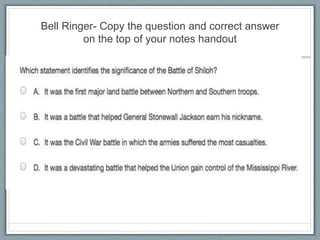
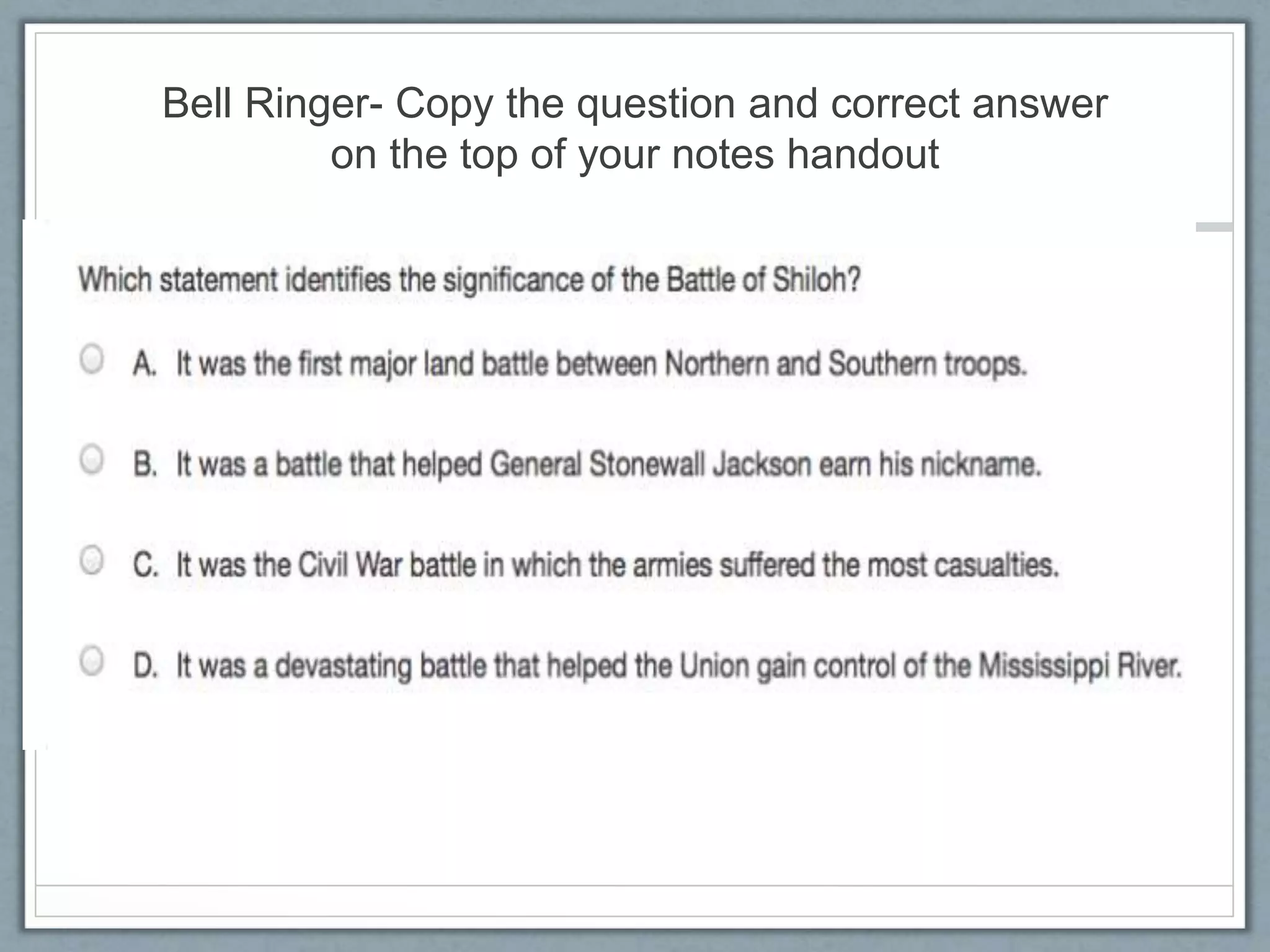
Bell Ringer- Copy the question and correct answer
on the top of your notes handout
Reconstruction (1865-
1877)
EQ: What are the lasting consequences of Reconstruction?
Reconstruction Amendments
13th Amendment
• Abolished slavery and
involuntary servitude
except for in punishment
of a crime
• Many slaves were already
set free by the
Emancipation
Proclamation
• This amendment
OFFICIALLY makes
slavery unconstitutional
Reconstruction Amendments
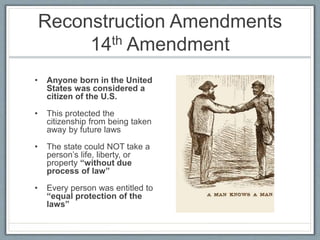
14th Amendment
• Anyone born in the United
States was considered a
citizen of the U.S.
• This protected the
citizenship from being taken
away by future laws
• The state could NOT take a
person’s life, liberty, or
property “without due
process of law”
• Every person was entitled to
“equal protection of the
laws”
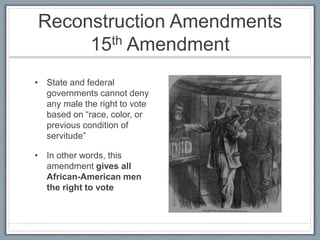
Reconstruction Amendments
15th Amendment
• State and federal
governments cannot deny
any male the right to vote
based on “race, color, or
previous condition of
servitude”
• In other words, this
amendment gives all
African-American men
the right to vote
Lincoln’s 10 Percent Plan vs Wade-Davis Bill
(Radical Republicans)
• Lincoln’s 10 Percent Plan
• Southern voters in each
state had to take an oath of
loyalty to the Union
• When 10% of voters had
taken the oath, the state
could form a new state
government
• New state governments had
to write a new constitution
that outlawed slavery
• Lincoln offered amnesty to
all Southerners except
Confederate leaders
• Radical Republicans
(Wade-Davis Bill)
• Radicals believed Lincoln
was being too easy on the
South
• A majority of state’s white
male adults had to pledge
loyalty to the Union
• Only the white males who
swore they had not fought
against the Union could vote
for delegates to a state
constitutional convention
• All new state constitutions
had to ban slavery
• Former Confederates could
not hold office
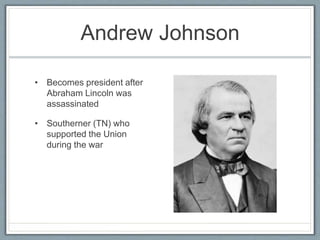
Andrew Johnson
• Becomes president after
Abraham Lincoln was
assassinated
• Southerner (TN) who
supported the Union
during the war
Johnson’s Plan for
Reconstruction
• Give amnesty to most Southerners who swore loyalty
to the Union
• High-ranking Confederate officers could receive
pardons by appealing to the president (meant to
humiliate the leaders)
• Southern states had to outlaw slavery before they
could re-enter the Union but he believed African-
Americans should not have equal rights (“White men
alone must manage the South”)
• All states would have to ratify the 13th Amendment
Johnson vs. The Radical
Republicans
• Radical Republicans believed
Johnson was being too easy on
the South
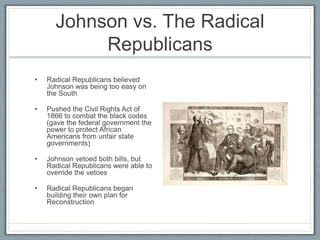
• Pushed the Civil Rights Act of
1866 to combat the black codes
(gave the federal government the
power to protect African
Americans from unfair state
governments)
• Johnson vetoed both bills, but
Radical Republicans were able to
override the vetoes
• Radical Republicans began
building their own plan for
Reconstruction
Black Codes
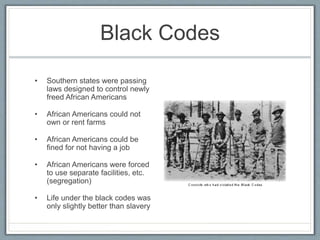
• Southern states were passing
laws designed to control newly
freed African Americans
• African Americans could not
own or rent farms
• African Americans could be
fined for not having a job
• African Americans were forced
to use separate facilities, etc.
(segregation)
• Life under the black codes was
only slightly better than slavery
Freedman’s Bureau
• Founded by Lincoln and
others
• Helped freed slaves adjust
to life after slavery
• Provided food, clothing,
medicine, etc.
• Set up schools
• Fought for fair pay
• Set up special courts to try
those who violated African
American rights
Johnson vs. The Radical
Republicans
• In the election of 1866,
Johnson campaigned
against the 14th
Amendment
• Radical Republicans won
an overwhelming majority
in Congress
• Radical Republicans
passed the Reconstruction
Acts
Johnson’s Impeachment
• Because Johnson strongly opposes the Reconstruction Acts, Congress
passes laws to limit his power
• The Tenure of Office Act stated that the president could not remove
government officials, even those in his own cabinet
• Johnson deliberately violated the Tenure of Office Act by firing Secretary of
War Edwin Stanton
• The House of Representatives voted to impeach the president
• Johnson’s defenders argued that Congress was impeaching for political
reasons
• Some moderate Republicans supported Johnson in the trial and the Senate
failed to get the 2/3 majority needed to remove the president
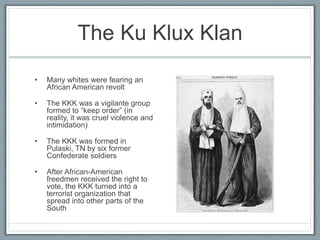
The Ku Klux Klan
• Many whites were fearing an
African American revolt
• The KKK was a vigilante group
formed to “keep order” (in
reality, it was cruel violence and
intimidation)
• The KKK was formed in
Pulaski, TN by six former
Confederate soldiers
• After African-American
freedmen received the right to
vote, the KKK turned into a
terrorist organization that
spread into other parts of the
South
Carpetbaggers and
Scalawags
• Southern whites who
supported the Republican
party were called
“scalawags” (“scoundrel” or
“worthless rascal”)
• Carpetbaggers- Northern
whites who moved to the
South after the war
• White southerners were
suspicious
• Some were dishonest people
looking to take advantage of
the South
• Most were honest people
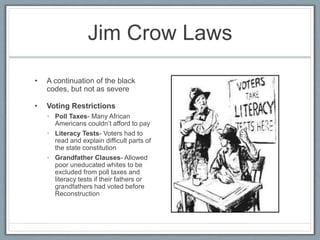
Jim Crow Laws
• A continuation of the black
codes, but not as severe
• Voting Restrictions
• Poll Taxes- Many African
Americans couldn’t afford to pay
• Literacy Tests- Voters had to
read and explain difficult parts of
the state constitution
• Grandfather Clauses- Allowed
poor uneducated whites to be
excluded from poll taxes and
literacy tests if their fathers or
grandfathers had voted before
Reconstruction
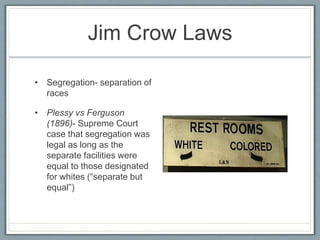
Jim Crow Laws
• Segregation- separation of
races
• Plessy vs Ferguson
(1896)- Supreme Court
case that segregation was
legal as long as the
separate facilities were
equal to those designated
for whites (“separate but
equal”)
Election of 1876
• Republicans were wanting to keep control of the White House and chose
Ruthorford B. Hayes as their nominee
• Hayes was a moderate who appealed to voters in both the North and the
South
• Democrats nominated Samuel Tilden
• Neither received a majority of electoral votes because of confusing election
returns
• Republicans claimed that votes in Florida, South Carolina, and Louisiana
had not been counted
• Congress named a commission to decide who should get the disputed
votes. All votes went to Hayes
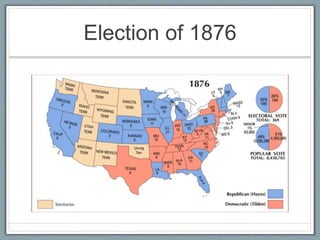
• Hayes won by one electoral vote
Election of 1876
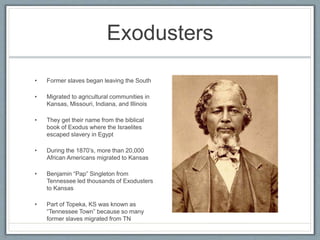
Exodusters
• Former slaves began leaving the South
• Migrated to agricultural communities in
Kansas, Missouri, Indiana, and Illinois
• They get their name from the biblical
book of Exodus where the Israelites
escaped slavery in Egypt
• During the 1870’s, more than 20,000
African Americans migrated to Kansas
• Benjamin “Pap” Singleton from
Tennessee led thousands of Exodusters
to Kansas
• Part of Topeka, KS was known as
“Tennessee Town” because so many
former slaves migrated from TN
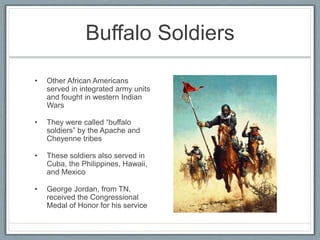
Buffalo Soldiers
• Other African Americans
served in integrated army units
and fought in western Indian
Wars
• They were called “buffalo
soldiers” by the Apache and
Cheyenne tribes
• These soldiers also served in
Cuba, the Philippines, Hawaii,
and Mexico
• George Jordan, from TN,
received the Congressional
Medal of Honor for his service
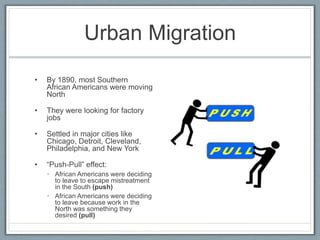
Urban Migration
• By 1890, most Southern
African Americans were moving
North
• They were looking for factory
jobs
• Settled in major cities like
Chicago, Detroit, Cleveland,
Philadelphia, and New York
• “Push-Pull” effect:
• African Americans were deciding
to leave to escape mistreatment
in the South (push)
• African Americans were deciding
to leave because work in the
North was something they
desired (pull)
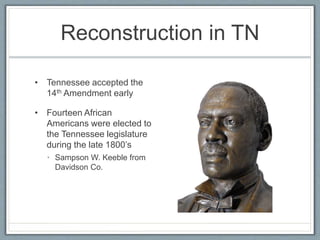
Reconstruction in TN
• Tennessee accepted the
14th Amendment early
• Fourteen African
Americans were elected to
the Tennessee legislature
during the late 1800’s
• Sampson W. Keeble from
Davidson Co.
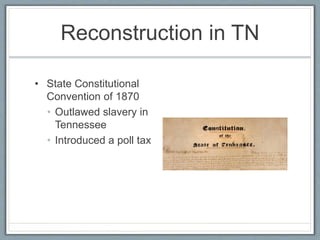
Reconstruction in TN
• State Constitutional
Convention of 1870
• Outlawed slavery in
Tennessee
• Introduced a poll tax
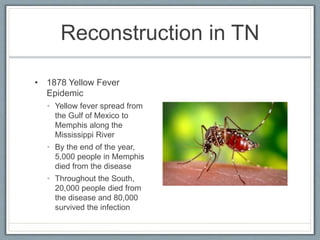
Reconstruction in TN
• 1878 Yellow Fever
Epidemic
• Yellow fever spread from
the Gulf of Mexico to
Memphis along the
Mississippi River
• By the end of the year,
5,000 people in Memphis
died from the disease
• Throughout the South,
20,000 people died from
the disease and 80,000
survived the infection
Acrostic
• Create an acrostic using the term, “reconstruction” that describes the time
period.
• R
• E
• C
• O
• N
• S
• T
• R
• U
• C
• T
• I
• O
• N
Review Option- Class 4B
Only
• Create a 10 question quiz (multiple choice) using
your notes over Reconstruction
• If you complete this, you will be able to use these
questions to help you with your quiz tomorrow!
Reconstruction Partner
Activity
• Paper Slide Video- With your assigned partner,
you will perform research on a Reconstruction
topic of your choice. You will create a paper slide
video detailing what you have learned.
• You will submit the following: a digital copy of the
paper slide video (we will discuss options for this)
• A copy of the script for your video
Reconstruction Partner
Activity
• You may choose one of the following as a topic:
• The impact of the Reconstruction Amendments
• The conflict between Andrew Johnson and the
Radical Republicans
• Comparing Lincoln’s 10 Percent Plan to the Radical
Republican Plan for Reconstruction
• The Freedmen’s Bureau and the impact of Jim Crow
laws.
• Carpetbaggers and Scalawags
• The controversy of the 1876 Election

Reconstruction

  • 1.
    Bell Ringer- Copythe question and correct answer on the top of your notes handout
  • 2.
    Reconstruction (1865- 1877) EQ: Whatare the lasting consequences of Reconstruction?
  • 3.
    Reconstruction Amendments 13th Amendment •Abolished slavery and involuntary servitude except for in punishment of a crime • Many slaves were already set free by the Emancipation Proclamation • This amendment OFFICIALLY makes slavery unconstitutional
  • 4.
    Reconstruction Amendments 14th Amendment •Anyone born in the United States was considered a citizen of the U.S. • This protected the citizenship from being taken away by future laws • The state could NOT take a person’s life, liberty, or property “without due process of law” • Every person was entitled to “equal protection of the laws”
  • 5.
    Reconstruction Amendments 15th Amendment •State and federal governments cannot deny any male the right to vote based on “race, color, or previous condition of servitude” • In other words, this amendment gives all African-American men the right to vote
  • 6.
    Lincoln’s 10 PercentPlan vs Wade-Davis Bill (Radical Republicans) • Lincoln’s 10 Percent Plan • Southern voters in each state had to take an oath of loyalty to the Union • When 10% of voters had taken the oath, the state could form a new state government • New state governments had to write a new constitution that outlawed slavery • Lincoln offered amnesty to all Southerners except Confederate leaders • Radical Republicans (Wade-Davis Bill) • Radicals believed Lincoln was being too easy on the South • A majority of state’s white male adults had to pledge loyalty to the Union • Only the white males who swore they had not fought against the Union could vote for delegates to a state constitutional convention • All new state constitutions had to ban slavery • Former Confederates could not hold office
  • 7.
    Andrew Johnson • Becomespresident after Abraham Lincoln was assassinated • Southerner (TN) who supported the Union during the war
  • 8.
    Johnson’s Plan for Reconstruction •Give amnesty to most Southerners who swore loyalty to the Union • High-ranking Confederate officers could receive pardons by appealing to the president (meant to humiliate the leaders) • Southern states had to outlaw slavery before they could re-enter the Union but he believed African- Americans should not have equal rights (“White men alone must manage the South”) • All states would have to ratify the 13th Amendment
  • 9.
    Johnson vs. TheRadical Republicans • Radical Republicans believed Johnson was being too easy on the South • Pushed the Civil Rights Act of 1866 to combat the black codes (gave the federal government the power to protect African Americans from unfair state governments) • Johnson vetoed both bills, but Radical Republicans were able to override the vetoes • Radical Republicans began building their own plan for Reconstruction
  • 10.
    Black Codes • Southernstates were passing laws designed to control newly freed African Americans • African Americans could not own or rent farms • African Americans could be fined for not having a job • African Americans were forced to use separate facilities, etc. (segregation) • Life under the black codes was only slightly better than slavery
  • 11.
    Freedman’s Bureau • Foundedby Lincoln and others • Helped freed slaves adjust to life after slavery • Provided food, clothing, medicine, etc. • Set up schools • Fought for fair pay • Set up special courts to try those who violated African American rights
  • 12.
    Johnson vs. TheRadical Republicans • In the election of 1866, Johnson campaigned against the 14th Amendment • Radical Republicans won an overwhelming majority in Congress • Radical Republicans passed the Reconstruction Acts
  • 13.
    Johnson’s Impeachment • BecauseJohnson strongly opposes the Reconstruction Acts, Congress passes laws to limit his power • The Tenure of Office Act stated that the president could not remove government officials, even those in his own cabinet • Johnson deliberately violated the Tenure of Office Act by firing Secretary of War Edwin Stanton • The House of Representatives voted to impeach the president • Johnson’s defenders argued that Congress was impeaching for political reasons • Some moderate Republicans supported Johnson in the trial and the Senate failed to get the 2/3 majority needed to remove the president
  • 14.
    The Ku KluxKlan • Many whites were fearing an African American revolt • The KKK was a vigilante group formed to “keep order” (in reality, it was cruel violence and intimidation) • The KKK was formed in Pulaski, TN by six former Confederate soldiers • After African-American freedmen received the right to vote, the KKK turned into a terrorist organization that spread into other parts of the South
  • 15.
    Carpetbaggers and Scalawags • Southernwhites who supported the Republican party were called “scalawags” (“scoundrel” or “worthless rascal”) • Carpetbaggers- Northern whites who moved to the South after the war • White southerners were suspicious • Some were dishonest people looking to take advantage of the South • Most were honest people
  • 16.
    Jim Crow Laws •A continuation of the black codes, but not as severe • Voting Restrictions • Poll Taxes- Many African Americans couldn’t afford to pay • Literacy Tests- Voters had to read and explain difficult parts of the state constitution • Grandfather Clauses- Allowed poor uneducated whites to be excluded from poll taxes and literacy tests if their fathers or grandfathers had voted before Reconstruction
  • 17.
    Jim Crow Laws •Segregation- separation of races • Plessy vs Ferguson (1896)- Supreme Court case that segregation was legal as long as the separate facilities were equal to those designated for whites (“separate but equal”)
  • 18.
    Election of 1876 •Republicans were wanting to keep control of the White House and chose Ruthorford B. Hayes as their nominee • Hayes was a moderate who appealed to voters in both the North and the South • Democrats nominated Samuel Tilden • Neither received a majority of electoral votes because of confusing election returns • Republicans claimed that votes in Florida, South Carolina, and Louisiana had not been counted • Congress named a commission to decide who should get the disputed votes. All votes went to Hayes • Hayes won by one electoral vote
  • 19.
  • 20.
    Exodusters • Former slavesbegan leaving the South • Migrated to agricultural communities in Kansas, Missouri, Indiana, and Illinois • They get their name from the biblical book of Exodus where the Israelites escaped slavery in Egypt • During the 1870’s, more than 20,000 African Americans migrated to Kansas • Benjamin “Pap” Singleton from Tennessee led thousands of Exodusters to Kansas • Part of Topeka, KS was known as “Tennessee Town” because so many former slaves migrated from TN
  • 21.
    Buffalo Soldiers • OtherAfrican Americans served in integrated army units and fought in western Indian Wars • They were called “buffalo soldiers” by the Apache and Cheyenne tribes • These soldiers also served in Cuba, the Philippines, Hawaii, and Mexico • George Jordan, from TN, received the Congressional Medal of Honor for his service
  • 22.
    Urban Migration • By1890, most Southern African Americans were moving North • They were looking for factory jobs • Settled in major cities like Chicago, Detroit, Cleveland, Philadelphia, and New York • “Push-Pull” effect: • African Americans were deciding to leave to escape mistreatment in the South (push) • African Americans were deciding to leave because work in the North was something they desired (pull)
  • 23.
    Reconstruction in TN •Tennessee accepted the 14th Amendment early • Fourteen African Americans were elected to the Tennessee legislature during the late 1800’s • Sampson W. Keeble from Davidson Co.
  • 24.
    Reconstruction in TN •State Constitutional Convention of 1870 • Outlawed slavery in Tennessee • Introduced a poll tax
  • 25.
    Reconstruction in TN •1878 Yellow Fever Epidemic • Yellow fever spread from the Gulf of Mexico to Memphis along the Mississippi River • By the end of the year, 5,000 people in Memphis died from the disease • Throughout the South, 20,000 people died from the disease and 80,000 survived the infection
  • 26.
    Acrostic • Create anacrostic using the term, “reconstruction” that describes the time period. • R • E • C • O • N • S • T • R • U • C • T • I • O • N
  • 27.
    Review Option- Class4B Only • Create a 10 question quiz (multiple choice) using your notes over Reconstruction • If you complete this, you will be able to use these questions to help you with your quiz tomorrow!
  • 28.
    Reconstruction Partner Activity • PaperSlide Video- With your assigned partner, you will perform research on a Reconstruction topic of your choice. You will create a paper slide video detailing what you have learned. • You will submit the following: a digital copy of the paper slide video (we will discuss options for this) • A copy of the script for your video
  • 29.
    Reconstruction Partner Activity • Youmay choose one of the following as a topic: • The impact of the Reconstruction Amendments • The conflict between Andrew Johnson and the Radical Republicans • Comparing Lincoln’s 10 Percent Plan to the Radical Republican Plan for Reconstruction • The Freedmen’s Bureau and the impact of Jim Crow laws. • Carpetbaggers and Scalawags • The controversy of the 1876 Election