CHILD HEALTH NURSINGCHILD HEALTH NURSING
IMNCIIMNCI
INTRODUCTIONINTRODUCTION
WHO/UNICEF have developed a new approach toWHO/UNICEF have developed a new approach to
tackling the major diseases of early childhood called thetackling the major diseases of early childhood called the
Integrated Management of Childhood Illnesses (IMCI).Integrated Management of Childhood Illnesses (IMCI).
Studies show that children presenting with any illnessStudies show that children presenting with any illness
often suffer from more than one disease. For instance, aoften suffer from more than one disease. For instance, a
child presenting with diarrhoea may also bechild presenting with diarrhoea may also be
malnourished and may not have received themalnourished and may not have received the
immunization as per the National Immunizationimmunization as per the National Immunization
schedule. The integrated approach ensures that allschedule. The integrated approach ensures that all
relevant needs of the child are looked at and attended torelevant needs of the child are looked at and attended to
during the contact of the child with the health workers.during the contact of the child with the health workers.
Integrated management of childhood illness strategyIntegrated management of childhood illness strategy
developed by WHO in collaboration with UNICEF anddeveloped by WHO in collaboration with UNICEF and
many other agencies in mid 1990s,combinesmany other agencies in mid 1990s,combines
improved management of common childhood illnessimproved management of common childhood illness
as well as prevention of diseases and promotion ofas well as prevention of diseases and promotion of
health by dealing with counseling on feeding andhealth by dealing with counseling on feeding and
immunization. This strategy has been adapted andimmunization. This strategy has been adapted and
expanded in India to include neonatal care at homeexpanded in India to include neonatal care at home
as well as in the facilities and renamed asas well as in the facilities and renamed as
IMNCI.IMNCI.
COMPONENTS OF THE INTEGRATEDCOMPONENTS OF THE INTEGRATED
APPROACHAPPROACH
The strategy includes three main components:The strategy includes three main components:
? Improvements in the case-management skills of health staff through? Improvements in the case-management skills of health staff through
the provision of locally-adapted guidelines on Integrated Managementthe provision of locally-adapted guidelines on Integrated Management
of Neonatal and Childhood Illness and activities to promote their use;of Neonatal and Childhood Illness and activities to promote their use;
? Improvements in the overall health system required for effective? Improvements in the overall health system required for effective
management of neonatal and childhood illness;management of neonatal and childhood illness;
? Improvements in family and community health care practices.? Improvements in family and community health care practices.
THE PRINCIPLES OF INTEGRATED CARETHE PRINCIPLES OF INTEGRATED CARE
Depending on a child’s age, various clinical signs and symptoms differDepending on a child’s age, various clinical signs and symptoms differ
in their degrees of reliability and diagnostic value and importance.in their degrees of reliability and diagnostic value and importance.
Therefore, the IMNCI guidelines recommend case managementTherefore, the IMNCI guidelines recommend case management
procedures based on two age categories:procedures based on two age categories:
? Young infants age up to 2 months? Young infants age up to 2 months
? Children age 2 months up to 5 years? Children age 2 months up to 5 years
The IMNCI guidelines are based on the following principles:The IMNCI guidelines are based on the following principles:
? All sick young infants up to 2 months of age7 must be assessed? All sick young infants up to 2 months of age7 must be assessed
forfor “possible bacterial infection / jaundice”.“possible bacterial infection / jaundice”. Then they must beThen they must be
routinely assessed for the major symptomroutinely assessed for the major symptom “diarrhoea”.“diarrhoea”.
? All sick children age 2 months up to 5 years must be examined for? All sick children age 2 months up to 5 years must be examined for
““general danger signsgeneral danger signs” which indicate the need for immediate” which indicate the need for immediate
referral or admission to a hospital. They must then bereferral or admission to a hospital. They must then be routinelyroutinely
assessed for major symptoms:assessed for major symptoms: cough or difficult breathing,cough or difficult breathing,
diarrhoea, fever and ear problems.diarrhoea, fever and ear problems.
THE PRINCIPLES OF INTEGRATED CARETHE PRINCIPLES OF INTEGRATED CARE
All sick young infants and children 2 months up to 5 years must alsoAll sick young infants and children 2 months up to 5 years must also
be routinely assessed forbe routinely assessed for nutritional and immunization statusnutritional and immunization status,,
feeding problemsfeeding problems,, and other potential problemsand other potential problems..
Only aOnly a limited number of carefully selected clinical signslimited number of carefully selected clinical signs areare
usedused ,, based on evidence of their sensitivity and specificity to detectbased on evidence of their sensitivity and specificity to detect
disease. These signs were selected considering the conditions anddisease. These signs were selected considering the conditions and
realities of first-level health facilities.realities of first-level health facilities.
A combination of individual signs leads to an infant’s or a child’sA combination of individual signs leads to an infant’s or a child’s
classification(s) rather than a diagnosis.classification(s) rather than a diagnosis. Classification(s) indicateClassification(s) indicate
the severity of condition(s). They call for specific actions based onthe severity of condition(s). They call for specific actions based on
whether the infant or child (a) should be urgently referred to a higherwhether the infant or child (a) should be urgently referred to a higher
level of care, (b) requires specific treatments (such as antibiotics orlevel of care, (b) requires specific treatments (such as antibiotics or
antimalarial treatment), or (c) may be safely managed at home. Theantimalarial treatment), or (c) may be safely managed at home. The
classifications are colour codedclassifications are colour coded : “pink” suggests hospital referral: “pink” suggests hospital referral
or admission, “yellow” indicates initiation of specific treatment, andor admission, “yellow” indicates initiation of specific treatment, and
“green” calls for home management.“green” calls for home management.
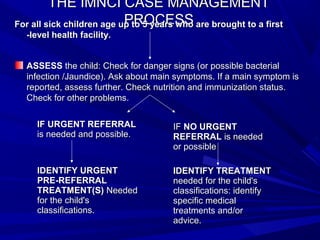
THE IMNCI CASE MANAGEMENTTHE IMNCI CASE MANAGEMENT
PROCESSPROCESSFor all sick children age up to 5 years who are brought to a firstFor all sick children age up to 5 years who are brought to a first
-level health facility.-level health facility.
ASSESSASSESS the child: Check for danger signs (or possible bacterialthe child: Check for danger signs (or possible bacterial
infection /Jaundice). Ask about main symptoms. If a main symptom isinfection /Jaundice). Ask about main symptoms. If a main symptom is
reported, assess further. Check nutrition and immunization status.reported, assess further. Check nutrition and immunization status.
Check for other problems.Check for other problems.
IFIF NO URGENTNO URGENT
REFERRALREFERRAL is neededis needed
or possibleor possible
IDENTIFY TREATMENTIDENTIFY TREATMENT
needed for the child'sneeded for the child's
classifications: identifyclassifications: identify
specific medicalspecific medical
treatments and/ortreatments and/or
advice.advice.
IF URGENT REFERRALIF URGENT REFERRAL
is needed and possible.is needed and possible.
IDENTIFY URGENTIDENTIFY URGENT
PRE-REFERRALPRE-REFERRAL
TREATMENT(S)TREATMENT(S) NeededNeeded
for the child'sfor the child's
classifications.classifications.
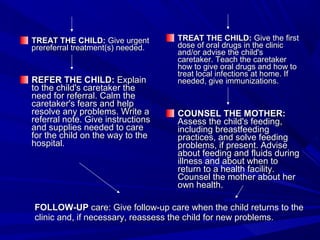
TREAT THE CHILD:TREAT THE CHILD: Give urgentGive urgent
prereferral treatment(s) needed.prereferral treatment(s) needed.
REFER THE CHILD:REFER THE CHILD: ExplainExplain
to the child's caretaker theto the child's caretaker the
need for referral. Calm theneed for referral. Calm the
caretaker's fears and helpcaretaker's fears and help
resolve any problems. Write aresolve any problems. Write a
referral note. Give instructionsreferral note. Give instructions
and supplies needed to careand supplies needed to care
for the child on the way to thefor the child on the way to the
hospital.hospital.
TREAT THE CHILD:TREAT THE CHILD: Give the firstGive the first
dose of oral drugs in the clinicdose of oral drugs in the clinic
and/or advise the child'sand/or advise the child's
caretaker. Teach the caretakercaretaker. Teach the caretaker
how to give oral drugs and how tohow to give oral drugs and how to
treat local infections at home. Iftreat local infections at home. If
needed, give immunizations.needed, give immunizations.
COUNSEL THE MOTHER:COUNSEL THE MOTHER:
Assess the child's feeding,Assess the child's feeding,
including breastfeedingincluding breastfeeding
practices, and solve feedingpractices, and solve feeding
problems, if present. Adviseproblems, if present. Advise
about feeding and fluids duringabout feeding and fluids during
illness and about when toillness and about when to
return to a health facility.return to a health facility.
Counsel the mother about herCounsel the mother about her
own health.own health.
FOLLOW-UPFOLLOW-UP care: Give follow-up care when the child returns to thecare: Give follow-up care when the child returns to the
clinic and, if necessary, reassess the child for new problems.clinic and, if necessary, reassess the child for new problems.
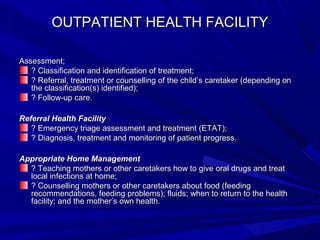
OUTPATIENT HEALTH FACILITYOUTPATIENT HEALTH FACILITY
Assessment;Assessment;
? Classification and identification of treatment;? Classification and identification of treatment;
? Referral, treatment or counselling of the child’s caretaker (depending on? Referral, treatment or counselling of the child’s caretaker (depending on
the classification(s) identified);the classification(s) identified);
? Follow-up care.? Follow-up care.
Referral Health FacilityReferral Health Facility
? Emergency triage assessment and treatment (ETAT);? Emergency triage assessment and treatment (ETAT);
? Diagnosis, treatment and monitoring of patient progress.? Diagnosis, treatment and monitoring of patient progress.
Appropriate Home ManagementAppropriate Home Management
? Teaching mothers or other caretakers how to give oral drugs and treat? Teaching mothers or other caretakers how to give oral drugs and treat
local infections at home;local infections at home;
? Counselling mothers or other caretakers about food (feeding? Counselling mothers or other caretakers about food (feeding
recommendations, feeding problems); fluids; when to return to the healthrecommendations, feeding problems); fluids; when to return to the health
facility; and the mother’s own health.facility; and the mother’s own health.
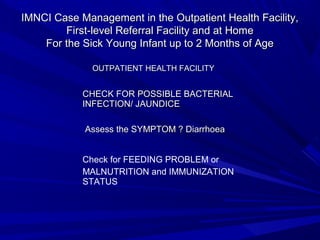
IMNCI Case Management in the Outpatient Health Facility,IMNCI Case Management in the Outpatient Health Facility,
First-level Referral Facility and at HomeFirst-level Referral Facility and at Home
For the Sick Young Infant up to 2 Months of AgeFor the Sick Young Infant up to 2 Months of Age
CHECK FOR POSSIBLE BACTERIALCHECK FOR POSSIBLE BACTERIAL
INFECTION/ JAUNDICEINFECTION/ JAUNDICE
Assess the SYMPTOM ? DiarrhoeaAssess the SYMPTOM ? Diarrhoea
Check for FEEDING PROBLEM or
MALNUTRITION and IMMUNIZATION
STATUS
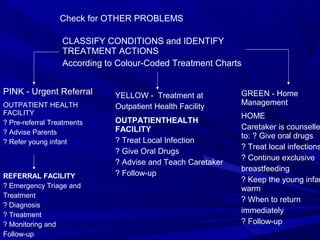
OUTPATIENT HEALTH FACILITYOUTPATIENT HEALTH FACILITY
Check for OTHER PROBLEMS
CLASSIFY CONDITIONS and IDENTIFY
TREATMENT ACTIONS
According to Colour-Coded Treatment Charts
PINK - Urgent Referral
OUTPATIENT HEALTH
FACILITY
? Pre-referral Treatments
? Advise Parents
? Refer young infant
YELLOW - Treatment at
Outpatient Health Facility
OUTPATIENTHEALTH
FACILITY
? Treat Local Infection
? Give Oral Drugs
? Advise and Teach Caretaker
? Follow-up
GREEN - Home
Management
HOME
Caretaker is counselle
to: ? Give oral drugs
? Treat local infections
? Continue exclusive
breastfeeding
? Keep the young infan
warm
? When to return
immediately
? Follow-up
REFERRAL FACILITY
? Emergency Triage and
Treatment
? Diagnosis
? Treatment
? Monitoring and
Follow-up
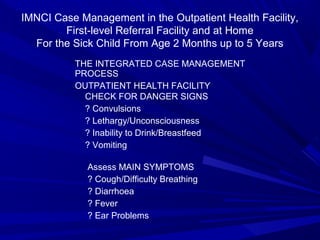
IMNCI Case Management in the Outpatient Health Facility,
First-level Referral Facility and at Home
For the Sick Child From Age 2 Months up to 5 Years
THE INTEGRATED CASE MANAGEMENT
PROCESS
OUTPATIENT HEALTH FACILITY
CHECK FOR DANGER SIGNS
? Convulsions
? Lethargy/Unconsciousness
? Inability to Drink/Breastfeed
? Vomiting
Assess MAIN SYMPTOMS
? Cough/Difficulty Breathing
? Diarrhoea
? Fever
? Ear Problems
OUTPATIENT MANAGEMENT OF YOUNG
INFANTS
UP TO 2 MONTHS OF AGE
The assessment procedure for this age group includes a
number of important steps that must be taken by the
health care provider, including:
(1) history taking and communicating with the caretaker
about the young infant’s problem;
(2) checking for possible bacterial infection / jaundice;
(3) checking for diarrhoea;
(4) checking for feeding problem or malnutrition;
(5) checking immunization status; and
(6) assessing other problems.
COMMUNICATING WITH THE
CARETAKER
1. Communicating- History Taking
2. Possible Bacterial Infection / Jaundice
3. Diarrhoea
4. Feeding Problem or Malnutrition
5. Immunization Status
6. Other Problems
STEPS TO GOOD COMMUNICATION
The steps to good communication are:
? Listen carefully to what the caretaker says. This will show them
that you take their concerns seriously.
? Use words the caretaker understands. Try to use local words.
Avoid medical terminology and unfamiliar words.
? Give the caretaker time to answer questions. S/he may need
time to reflect and decide if a clinical sign is present.
? Ask additional questions when the caretaker is not sure
about the answer. A caretaker may not be sure if a symptom or
clinical sign is present. Ask additional questions to help her/him give
clear answers.
1. COMMUNICATING - HISTORY TAKING
When you see the mother and her sick infant:
* Greet the mother appropriately and ask her to sit
with her infant.
You need to know the infant's age so you can choose
the right case management chart. Look at the infant's
record to find the infant's age.
- If the infant is up to 2 months, assess and classify the
young infant according to the steps on the ASSESS AND
CLASSIFY THE SICK YOUNG INFANT chart.
- If the child is age 2 months up to 5 years, assess and
classify the child according to the steps on the ASSESS
AND CLASSIFY THE SICK CHILD
COMMUNICATING - HISTORY
TAKING
Ask the mother what the young infant's problems
are:
Record what the mother tells you about the
infant's problems.
An important reason for asking this question is
to open good communication with the mother.
Using good communication helps to reassure
the mother that her infant will receive good care.
COMMUNICATING - HISTORY
TAKING
Determine if this is an initial or follow-up visit for this
problem.
If this is the infant's first visit for this episode of an illness
or problem, then this is An initial visit.
If the young infant was seen a few days ago for the
same illness, this is a follow –up visit. A follow-up visit
has a different purpose than an initial visit. During a
follow-up visit, the doctor finds out if the treatment he
gave during the initial visit has helped the infant. If the
young infant is not improving or is getting worse after a
few days, the doctor refers the infant to a hospital or
changes the infant's treatment.
COMMUNICATING - HISTORY
TAKING
INITIAL VISIT:
If it is an initial visit, follow the sequence of steps on the chart to
assess and classify a sick young infant:
* Check for signs of possible bacterial infection and jaundice. Then
classify the young infant based on the signs found.
* Ask about diarrhoea. If the infant has diarrhoea, assess the related
signs.
Classify the young infant for dehydration. Also classify for persistent
diarrhoea and dysentery if present.
* Check for feeding problem or malnutrition. This may include
assessment for breastfeeding.
* Check the young infant's immunization status.
* Assess any other problems.
COMMUNICATING - HISTORY
TAKING
Using the Young Infant Recording Form
Record the information on Young Infant
Recording Form.
The top lines are for recording name, age,
weight, temperature, the infant’s problems and
whether this is an initial or follow up visit.
COMMUNICATING - HISTORY
TAKING
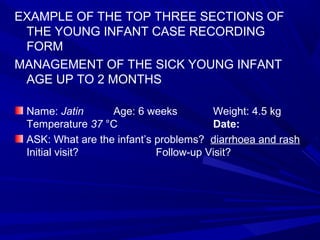
An example of completing the top of the Recording
Form for Jatin is shown as follows:
CASE: Jatin is 6 weeks old. He weights 4.5 kg.
His temperature is 37°C. The physician asked
“What are the infant’s problem?” The mother
said “Jatin has diarrhoea and a skin rash for the
last 3days”. This is the initial visit for this illness.
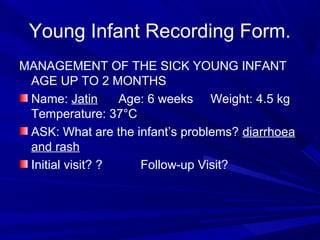
Young Infant Recording Form.
MANAGEMENT OF THE SICK YOUNG INFANT
AGE UP TO 2 MONTHS
Name: Jatin Age: 6 weeks Weight: 4.5 kg
Temperature: 37°C
ASK: What are the infant’s problems? diarrhoea
and rash
Initial visit? ? Follow-up Visit?
2. CHECKING FOR POSSIBLE BACTERIAL
INFECTION / JAUNDICE
While the signs of pneumonia and other serious bacterial infections
cannot be easily distinguished in this age group, it is recommended
that all sick young infants be assessed first for signs of possible
bacterial infection and jaundice.
In this step you are looking for signs of bacterial infection, especially
a serious infection.
A young infant can become sick and die very quickly from serious
bacterial infections such as pneumonia, sepsis and meningitis.
It is important to assess the signs in the order on the chart, and to
keep the young infant calm. The young infant must be calm and
may be asleep while you assess the first five signs, that is, count
breathing and look for chest indrawing, nasal flaring, grunting and
bulging fontanelle.
CHECKING FOR POSSIBLE BACTERIAL
INFECTION / JAUNDICE - Clinical Assessment
1. Convulsions (as part of the current illness).
Convulsions may be associated with meningitis
or other life-threatening conditions. All young
infants who have had convulsions during the
present illness should be considered seriously
ill. Convulsion in young infants may not be
characterized by tonic-clonic movements and up
rolling of eyeballs, they may instead present as
repetitive jerky movements of the eyes, lip or a
staring look.
CHECKING FOR POSSIBLE BACTERIAL
INFECTION / JAUNDICE - Clinical Assessment
Fast breathing.
Young infants usually breathe faster than older children
do. The cut-off rate to identify fast breathing in this age
group is 60 breaths per minute or more. If the count is 60
breaths or more, the count should be repeated, because
the breathing rate of a young infant is often irregular. The
young infant may occasionally stop breathing for a few
seconds, followed by a period of faster breathing. If the
second count is also 60 breaths or more, the young
infant has fast breathing.
CHECKING FOR POSSIBLE BACTERIAL
INFECTION / JAUNDICE - Clinical Assessment
LOOK for severe chest indrawing.
The young infant has chest indrawing if the
lower chest wall goes IN when the infant
breathes IN. Chest indrawing occurs when the
effort the young infant needs to breathe in is
much greater than normal. In normal breathing,
the whole chest wall (upper and lower) and the
abdomen move OUT when the young infant
breathes IN. When chest indrawing is present,
the lower chest wall goes IN when the young
infant breathes IN.
CHECKING FOR POSSIBLE BACTERIAL
INFECTION / JAUNDICE - Clinical Assessment
If only the soft tissue between the ribs goes in when the
infant breathes in (also called intercostal indrawing or
intercostal retractions), the infant does not have chest
indrawing.
In this assessment, chest indrawing is lower chest wall
indrawing. It does not include "intercostal indrawing."
Mild chest indrawing is normal in a young infant because
the chest wall is soft. Severe chest indrawing is very
deep and easy to see. Severe chest indrawing is a sign
of pneumonia and is serious in a young infant.
CHECKING FOR POSSIBLE BACTERIAL
INFECTION / JAUNDICE - Clinical Assessment
Nasal flaring. Nasal flaring is widening of the nostrils
when the young infant breathes in.
Grunting . Grunting is the soft, short sounds a young
infant makes when breathing out. Grunting occurs when
an infant is having difficulty in breathing.
Bulging fontanelle. Look at and feel the anterior
fontanelle when the infant is not crying and held in an
upright position. A bulging fontanelle may indicate that
the young infant has meningitis, a possible serious
bacterial infection.
Pus draining from the ear. Look for pus draining from
either of the ears.
CHECKING FOR POSSIBLE BACTERIAL
INFECTION / JAUNDICE - Clinical Assessment
Umbilicus red or draining pus. There may be some redness of the
end of the umbilicus or the umbilicus may be draining pus (The cord
usually drops from the umbilicus by one week of age).
Skin pustules. Examine the skin on the entire body. Skin pustules
are red spots or blisters that contain pus. Presence of 10 or more
skin pustules or a large boil indicate a possible serious bacterial
infection.
Temperature. A thermometer that measures to a minimum of 35?C
can be used to measure temperature. Keep the bulb of the
thermometer high in the axilla and then hold the young infant’s arm
against his body for 5 minutes before reading the temperature. If
you do not have a thermometer, feel the infant's abdomen or axilla
(underarm) and determine if it feels hot or cold to touch.
CHECKING FOR POSSIBLE BACTERIAL
INFECTION / JAUNDICE - Clinical Assessment
Fever or hypothermia may both indicate bacterial infection. Fever (axillary
temperature more than 37.5°C) is uncommon in the first two months of life.
Fever in a young infant may indicate a serious bacterial infection, and may
be the only sign of a serious bacterial infection. Young infants can also
respond to infection by dropping their axillary temperature to below 35.5°C.
Lethargy or unconsciousness. Young infants often sleep most of the
time, and this is not a sign of illness. Even when awake, a healthy young
infant will usually not watch his mother and a physician/health worker while
they talk, as an older infant or young child would. A lethargic young infant is
not awake and alert when he should be. He may be drowsy and may not
stay awake after a disturbance. If a young infant does not wake up during
the assessment, flick the sole 2-3 times. Look to see if the child wakens and
whether he stays awake. If the young infant shows no response or does not
stay awake after some response, he is lethargic or unconscious.
CHECKING FOR POSSIBLE BACTERIAL
INFECTION / JAUNDICE - Clinical Assessment
Less than normal movement also indicates a serious condition. Observe
the infant's movements . An awake young infant will normally move his arms
or legs or turn his head several times in a minute if you watch him closely.
Jaundice is the visible manifestation of chemical bilirubinemia. Yellow
discolouration of skin is visible in a neonate when serum bilirubin is more
than 5 mg/dl. Almost all neonates may have ‘physiological jaundice’ during
the first week of life due to several physiological changes taking place after
birth. Physiological jaundice usually appears between 48-72 hours of age,
maximum intensity is seen on 4-5th day in term and 7th day in preterm
neonates. Physiological jaundice does not extend to palms and soles, and
does not need any treatment.
To look for jaundice, press the infant’s skin over the forehead with your
fingers to blanch, remove your fingers and immediately look for yellow
discolouration under natural light. If there is yellow discoloration, the infant
has jaundice.
CHECKING FOR POSSIBLE BACTERIAL
INFECTION / JAUNDICE - Clinical Assessment
Yellow palms and soles. Press the infant’s
palms with your fingers to blanch, remove your
fingers and look for yellow discolouration under
natural light. Repeat the process to look for
yellow soles.
Occurrence of jaundice in the first 24 hours of
life and yellow discolouration of palms and soles
at any time is always pathological and requires
urgent referral. Severe jaundice beyond the first
week may be a result of cholestasis.
CLASSIFICATION OF POSSIBLE
BACTERIAL INFECTION/ JAUNDICE
All sick young infants are classified for Possible Bacterial
Infection as follows :
There are two possible classifications for Possible Bacterial Infection
? A sick young infant with POSSIBLE SERIOUS BACTERIAL
INFECTION is one with any of the following signs: convulsions, fast
breathing, severe chest indrawing, nasal flaring, grunting, bulging
fontanel, 10 or more many skin pustules or a big boil, fever,
hypothermia, lethargy or unconsciousness, or less than normal
movements. This infant should be referred urgently to the hospital
after being given the first dose of intramuscular ampicillin plus
gentamicin, treatment to prevent hypoglycemia, and advice to the
mother on keeping the young infant warm while arranging referral,
and on the way to the hospital.
CLASSIFICATION OF POSSIBLE
BACTERIAL INFECTION/ JAUNDICE
1. Convulsions or
2. Fast breathing (60 breaths per minute or more) or
3. Severe chest indrawing or
4. Nasal flaring or
5. Grunting or
6. Bulging fontanelle or
7. 10 or more skin pustules or a big boil or
8. If axillary temperature 37.5OC or above (or feels
hot to touch) or temperature less than 35. 5 O C
(or feels cold to touch)) or
9. Lethargy or unconsciousness or
10. Less than normal movement
POSSIBLE
SERIOUS
BACTERIAL
INFECTION
CLASSIFICATION OF POSSIBLE
BACTERIAL INFECTION/ JAUNDICE
A sick young infant with LOCAL BACTERIAL
INFECTION is the one with umbilicus red or
draining pus or pus discharge from ear or less
than 10 skin pustules . This infant may be
treated at home with oral antibiotics but should
be seen in follow -up after two days.
? Umbilicus red or draining pus or
? Pus discharge from the ear or
? < 10 skin pustules.
LOCAL BACTERIAL
INFECTION
CLASSIFICATION OF POSSIBLE
BACTERIAL INFECTION/ JAUNDICE
Additionally if the sick young infant has Jaundice, classify as follows:
There are two possible classifications for jaundice.
? A sick young infant with SEVERE JAUNDICE is one who has
yellow palms and soles or has jaundice at age < 24 hours or at age
14 days or more . This infant should be referred urgently to the
hospital after being given treatment to prevent hypoglycemia and
advice to the mother on keeping the young infant warm while
arranging referral.
Yellow Palms and soles or
? Age <24 hours
? Age 14 days or more
SEVERE JAUNDICE
CLASSIFICATION OF POSSIBLE
BACTERIAL INFECTION/ JAUNDICE
A sick young infant with JAUNDICE is one who has
jaundice but the palms and soles are not yellow and the
age of the infant is 1-13 days . This infant should be
given home care , but mother should be advised when to
return immediately and should be seen in follow-up in
two days.
Palms and soles not
yellow and
? Age 1-13 days
JAUNDICE
CLASSIFICATION OF POSSIBLE
BACTERIAL INFECTION/ JAUNDICE
Additionally, sick young infants who have axillary temperature
between 35.5 - 36.4 C (both inclusive) should also be classified as
follows:
There is only one classification.
? A sick young infant with LOW BODY TEMPERATURE is one who
has temperature less than 36.5oC but above 35.4oC. This could be
the due to inadequate clothing in cold weather or be a sign of
bacterial infection. This infant should be warmed using
skin-to-skin contact (Kangaroo Mother Care) for 1 hour
and then reassessed. If the temperature is below 36.5oC
even after 1 hour, the infant should be referred to the
hospital. If the temperature becomes normal, this infant
should be sent home after advising the mother on how to
keep the young infant warm.
3. DIARRHOEA
A young infant with diarrhoea can be placed in one of the following 3
categories: (1) acute watery diarrhoea; (2) dysentery (bloody
diarrhoea); and (3) persistent diarrhoea (diarrhoea that lasts more
than 14 days). All young infants with diarrhoea should be assessed
for: (a) signs of dehydration; (b) duration of diarrhoea; and (c) blood
in the stool.
Clinical Assessment
All infants with diarrhoea should be assessed to determine the
duration of diarrhoea, if blood is present in the stool and if
dehydration is present. A number of clinical signs are used to
determine the level of dehydration:
Infant’s general condition . Depending on the degree of
dehydration, an infant with diarrhoea may be lethargic or
unconscious or look restless/irritable. Only infants who cannot be
consoled and calmed should be considered restless or irritable.
Clinical Assessment for dehydration
Sunken eyes. The eyes of a dehydrated infant may look sunken. In
a severely malnourished infant who is visibly wasted, the eyes may
always look sunken, even if the infant is not dehydrated. Even
though the sign “sunken eyes” is less reliable in a visibly wasted
infant, it can still be used to classify the infant's dehydration.
Elasticity of skin . Check elasticity of skin using the skin pinch test.
When released, the skin pinch goes back either very slowly (longer
than 2 seconds), or slowly (skin stays up even for a brief instant), or
immediately. In an infant with severe malnutrition, the skin may go
back slowly even if the infant is not dehydrated. In an overweight
infant, or an infant with oedema, the skin may go back immediately
even if the infant is dehydrated.
Clinical Assessment for
dehydration
After the infant is assessed for dehydration, the
caretaker of an infant with diarrhoea should be asked
how long the infant has had diarrhoea and if there is
blood in the stool.
This will allow identification of infants with persistent
diarrhoea and dysentery.
CLASSIFICATION OF DEHYDRATION
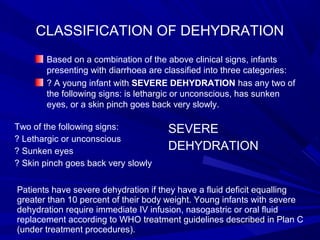
Based on a combination of the above clinical signs, infants
presenting with diarrhoea are classified into three categories:
? A young infant with SEVERE DEHYDRATION has any two of
the following signs: is lethargic or unconscious, has sunken
eyes, or a skin pinch goes back very slowly.
Two of the following signs:
? Lethargic or unconscious
? Sunken eyes
? Skin pinch goes back very slowly
SEVERE
DEHYDRATION
Patients have severe dehydration if they have a fluid deficit equalling
greater than 10 percent of their body weight. Young infants with severe
dehydration require immediate IV infusion, nasogastric or oral fluid
replacement according to WHO treatment guidelines described in Plan C
(under treatment procedures).
CLASSIFICATION OF DEHYDRATION
Those with SOME DEHYDRATION have any
combination of two of the following signs:
restless/irritable, sunken eyes, skin pinch goes back
slowly.
Infants with some dehydration have a fluid deficit
equalling 5 to 10 percent of their body weight and require
active oral treatment with ORS solution according to
WHO treatment guidelines described in Plan B (under
treatment procedures).
Two of the following signs:
? Restless, irritable
? Sunken eyes
? Skin pinch goes back slowly
SOME
DEHYDRATION
CLASSIFICATION OF DEHYDRATION
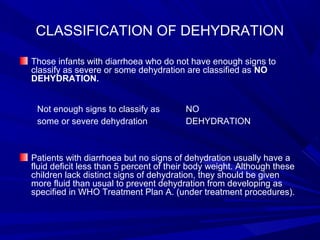
Those infants with diarrhoea who do not have enough signs to
classify as severe or some dehydration are classified as NO
DEHYDRATION.
Patients with diarrhoea but no signs of dehydration usually have a
fluid deficit less than 5 percent of their body weight. Although these
children lack distinct signs of dehydration, they should be given
more fluid than usual to prevent dehydration from developing as
specified in WHO Treatment Plan A. (under treatment procedures).
Not enough signs to classify as
some or severe dehydration
NO
DEHYDRATION
ANTI-DIARRHOEAL DRUGS
Note: Anti-diarrhoeal drugs — including anti-
motility agents (e.g., loperamide, diphenoxylate,
codeine, tincture of opium), adsorbents (e.g.,
kaolin), live bacterial cultures (e.g.,
Lactobacillus, Streptococcus faecium), and
charcoal — do not provide practical benefits for
infants and children with acute diarrhoea, and
some may have dangerous side effects. These
drugs should never be given to children less
than 5 years old.
CLASSIFICATION OF PERSISTENT DIARRHOEA
Persistent diarrhoea is an episode of diarrhoea, with or
without blood, which begins acutely and lasts at least 14
days. It accounts for up to 15 percent of all episodes of
diarrhoea but is associated with 30 to 50 percent of
deaths.
Persistent diarrhoea is usually associated with weight
loss and often with serious non-intestinal infections.
Many infants and children who develop persistent
diarrhoea are malnourished, greatly increasing the risk of
death. Persistent diarrhoea is uncommon in infants who
are exclusively breast-fed.
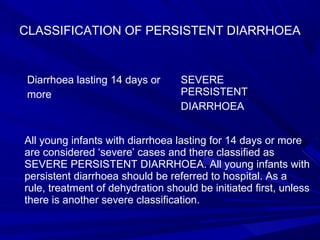
CLASSIFICATION OF PERSISTENT DIARRHOEA
Diarrhoea lasting 14 days or
more
SEVERE
PERSISTENT
DIARRHOEA
All young infants with diarrhoea lasting for 14 days or more
are considered ‘severe’ cases and there classified as
SEVERE PERSISTENT DIARRHOEA. All young infants with
persistent diarrhoea should be referred to hospital. As a
rule, treatment of dehydration should be initiated first, unless
there is another severe classification.
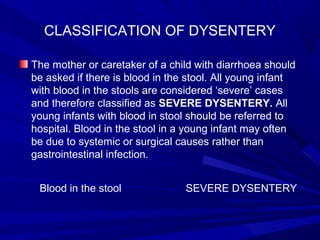
CLASSIFICATION OF DYSENTERY
The mother or caretaker of a child with diarrhoea should
be asked if there is blood in the stool. All young infant
with blood in the stools are considered ‘severe’ cases
and therefore classified as SEVERE DYSENTERY. All
young infants with blood in stool should be referred to
hospital. Blood in the stool in a young infant may often
be due to systemic or surgical causes rather than
gastrointestinal infection.
Blood in the stool SEVERE DYSENTERY
4. FEEDING PROBLEMS &
MALNUTRITION
Assessment of feeding and malnutrition.
Assessment of feeding in young infants has two parts. In the first
part you ask the mother questions to determine if she is having
difficulty feeding the infant, what the young infant is fed and how
often. You also determine weight for age.
In the second part, if an infant has difficulty feeding, or is breastfed
less than 8 times in 24 hours, or being given other foods or drinks,
or low weight for age, then breastfeeding should be assessed.
Assessment of breastfeeding in young infants includes checking if
the infant is able to attach, if the infant is suckling effectively (slow,
deep sucks, with some pausing), and if there are ulcers or white
patches in the mouth (thrush).
Is there any feeding difficulty? Any difficulty mentioned
by the mother is important. This mother may need
counselling or specific help with a difficulty. If a mother
says that the infant is not able to feed, assess
breastfeeding or watch her try to feed the infant with a cup
to see what she means by this. An infant who is not able
to feed may have a serious infection or other life-
threatening problem and should be referred urgently to
hospital.
Is the infant breastfed? If yes, how many times in 24
hours? The recommendation is that the young infant be
breastfed as often and for as long as the infant wants, day
and night. This should be 8 or more times in 24 hours.
Does the infant usually receive any other
foods or drinks? If yes, how often? A young
infant should be exclusively breastfed. Find out if
the young infant is receiving any other foods or
drinks such as other milk, juice, tea, thin porridge,
dilute cereal, or even water.
Ask how often he receives it and the amount. You
need to know if the infant is mostly fed on other
foods.
What do you use to feed the infant? If an infant
takes other foods or drinks, find out if the mother
uses a feeding bottle or cup.
Infants who are Very Low Weight for Age should
be referred to a hospital. Infants who are Low
Weight for Age need special attention to how they
are fed and on keeping them warm.
How to assess breastfeeding
First decide whether to assess the infant’s breastfeeding.
Do not assess Breastfeeding, if the young infant :
is exclusively breastfed without difficulty and is not low
weight for age
is not breastfed at all.
has a serious problem requiring urgent referral to a
hospital
In these situations, classify that feeding based on the
information that you already have.
If the mother’s answers or the infant’s weight indicates a
difficulty, observe a breastfeed as descried below. Low
weight for age is often due to low birth weight. Low birth
weight infants are particularly likely to have a problem with
breastfeeding. Assessing breastfeeding requires careful
observation.
Ulcers or white patches in the mouth (thrush)
Look inside the mouth at the tongue and inside of the
cheek. Thrush looks like milk curds on the inside of the
cheek, or a thick white coating of the tongue. Try to wipe
the white off.
The white patches of thrush will remain.
5. CHECKING IMMUNIZATION STATUS
Immunization status should be checked in
all sick young infants. A young infant who
is not sick enough to be referred to a
hospital should be given the necessary
immunizations before s/he is sent home.
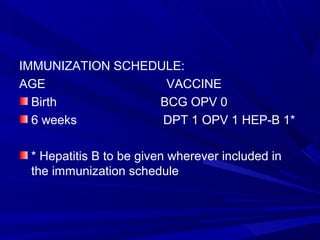
IMMUNIZATION SCHEDULE:
AGE VACCINE
Birth BCG OPV 0
6 weeks DPT 1 OPV 1 HEP-B 1*
* Hepatitis B to be given wherever included in
the immunization schedule
6. ASSESSING OTHER PROBLEMS
All sick young infants need to be assessed for other potential problems
mentioned by the mother or observed during the examination. If a potentially
serious problem is found or there is no means in the clinic to help the infant,
s/he should be referred to hospital.
A recording form for sick young infants age up to 2 months is shown on the
next page.
CASE: Jatin is 6 weeks old. He weighs 4.5 kg. His temperature is 37°C. The
physician asked “What are the infant’s problem?” The mother said “Jatin
has diarrhea and a skin rash for the last 3days”. This is the initial visit for
this illness. The physician checks the young infant for signs of possible
bacterial infection/jaundice. His mother says that Jatin has not had
convulsions. The physician counts 55 breaths per minute. He finds no chest
indrawing or nasal flaring. Jatin has no grunting. The fontanelle does not
bulge. There is no pus in his ears. The umbilicus is normal. The body
temperature is normal. There are 6 skin pustules. Jatin is not lethargic or
unconscious, and his movements are normal. He does not have jaundice.
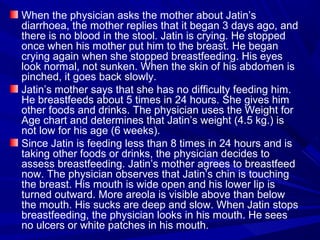
When the physician asks the mother about Jatin’s
diarrhoea, the mother replies that it began 3 days ago, and
there is no blood in the stool. Jatin is crying. He stopped
once when his mother put him to the breast. He began
crying again when she stopped breastfeeding. His eyes
look normal, not sunken. When the skin of his abdomen is
pinched, it goes back slowly.
Jatin’s mother says that she has no difficulty feeding him.
He breastfeeds about 5 times in 24 hours. She gives him
other foods and drinks. The physician uses the Weight for
Age chart and determines that Jatin’s weight (4.5 kg.) is
not low for his age (6 weeks).
Since Jatin is feeding less than 8 times in 24 hours and is
taking other foods or drinks, the physician decides to
assess breastfeeding. Jatin’s mother agrees to breastfeed
now. The physician observes that Jatin’s chin is touching
the breast. His mouth is wide open and his lower lip is
turned outward. More areola is visible above than below
the mouth. His sucks are deep and slow. When Jatin stops
breastfeeding, the physician looks in his mouth. He sees
no ulcers or white patches in his mouth.
EXAMPLE OF THE TOP THREE SECTIONS OF
THE YOUNG INFANT CASE RECORDING
FORM
MANAGEMENT OF THE SICK YOUNG INFANT
AGE UP TO 2 MONTHS
Name: Jatin Age: 6 weeks Weight: 4.5 kg
Temperature 37 °C Date:
ASK: What are the infant’s problems? diarrhoea and rash
Initial visit? Follow-up Visit?
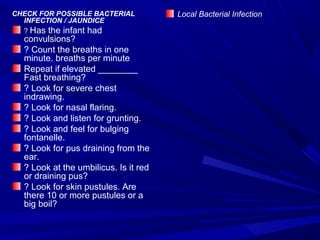
CHECK FOR POSSIBLE BACTERIAL
INFECTION / JAUNDICE
? Has the infant had
convulsions?
? Count the breaths in one
minute. breaths per minute
Repeat if elevated ________
Fast breathing?
? Look for severe chest
indrawing.
? Look for nasal flaring.
? Look and listen for grunting.
? Look and feel for bulging
fontanelle.
? Look for pus draining from the
ear.
? Look at the umbilicus. Is it red
or draining pus?
? Look for skin pustules. Are
there 10 or more pustules or a
big boil?
Local Bacterial Infection
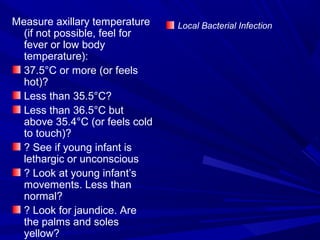
Measure axillary temperature
(if not possible, feel for
fever or low body
temperature):
37.5°C or more (or feels
hot)?
Less than 35.5°C?
Less than 36.5°C but
above 35.4°C (or feels cold
to touch)?
? See if young infant is
lethargic or unconscious
? Look at young infant’s
movements. Less than
normal?
? Look for jaundice. Are
the palms and soles
yellow?
Local Bacterial Infection
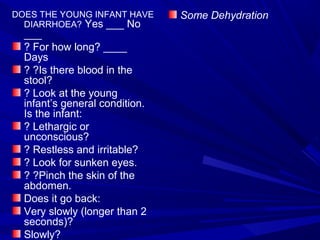
DOES THE YOUNG INFANT HAVE
DIARRHOEA? Yes ___ No
___
? For how long? ____
Days
? ?Is there blood in the
stool?
? Look at the young
infant’s general condition.
Is the infant:
? Lethargic or
unconscious?
? Restless and irritable?
? Look for sunken eyes.
? ?Pinch the skin of the
abdomen.
Does it go back:
Very slowly (longer than 2
seconds)?
Slowly?
Some Dehydration
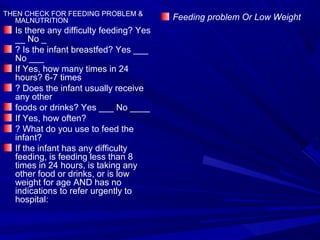
THEN CHECK FOR FEEDING PROBLEM &
MALNUTRITION
Is there any difficulty feeding? Yes
__ No _
? Is the infant breastfed? Yes ___
No ___
If Yes, how many times in 24
hours? 6-7 times
? Does the infant usually receive
any other
foods or drinks? Yes ___ No ____
If Yes, how often?
? What do you use to feed the
infant?
If the infant has any difficulty
feeding, is feeding less than 8
times in 24 hours, is taking any
other food or drinks, or is low
weight for age AND has no
indications to refer urgently to
hospital:
Feeding problem Or Low Weight
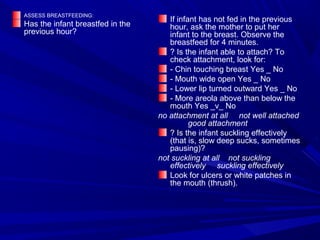
ASSESS BREASTFEEDING:
Has the infant breastfed in the
previous hour?
If infant has not fed in the previous
hour, ask the mother to put her
infant to the breast. Observe the
breastfeed for 4 minutes.
? Is the infant able to attach? To
check attachment, look for:
- Chin touching breast Yes _ No
- Mouth wide open Yes _ No
- Lower lip turned outward Yes _ No
- More areola above than below the
mouth Yes _v_ No
no attachment at all not well attached
good attachment
? Is the infant suckling effectively
(that is, slow deep sucks, sometimes
pausing)?
not suckling at all not suckling
effectively suckling effectively
Look for ulcers or white patches in
the mouth (thrush).
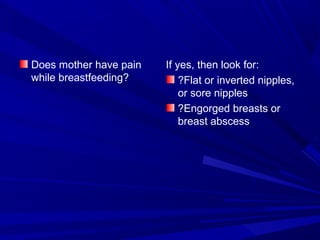
Does mother have pain
while breastfeeding?
If yes, then look for:
?Flat or inverted nipples,
or sore nipples
?Engorged breasts or
breast abscess
TREATMENT OF SICK YOUNG INFANTS
The first step is to IDENTIFY TREATMENT required for the young
infant according to the classification. All the treatments required are
listed in the "Identify Treatment" column of the ASSESS &
CLASSIFY THE SICK YOUNG INFANT chart. If a sick young infant
has more than one classification, treatment required for all the
classifications must be identified.
For some young infants, the ASSESS & CLASSIFY THE SICK
YOUNG INFANT chart says "Refer URGENTLY to hospital." By
hospital, we mean a health facility with inpatient beds, supplies and
expertise to treat a very sick young infant. Referral may mean
admission to the inpatient department of the same facility where the
young infant has been examined as an outpatient.
REFERRAL OF YOUNG INFANTS UP TO 2
MONTHS OF AGE
All infants and children with a severe classification (pink) are
referred to a hospital as soon as assessment is completed and
necessary pre-referral treatment is administered.
Note: If an infant only has severe dehydration and no other severe
classification, and IV infusion is available in the outpatient clinic, an
attempt should be made to rehydrate the sick infant.
Successful referral of severely ill infants to the hospital depends on
effective counselling of the caretaker. If s/he does not accept
referral, available options (to treat the infant by repeated clinic or
home visits) should be considered. If the caretaker accepts referral,
s/he should be given a short, clear referral note, and should get
information on what to do during referral transport, particularly if the
hospital is distant.
The first step is to give urgent pre-referral treatment(s).
Possible pre-referral treatments include:
? First dose of intramuscular or oral antibiotics
? Keeping the infant warm on the way to the hospital
? Prevention of hypoglycemia with breastmilk or sugar
water
? Frequent sips of ORS solution on the way to the hospital
Non-urgent treatments, e.g., wicking a draining ear or
applying gentian violet paint on skin pustules, should be
deferred to avoid delaying referral or confusing the
caretaker.
If an infant does not need urgent referral, check to see if
the infant needs non-urgent referral for further
assessment. These referrals are not as urgent. Other
necessary treatments may be done before referral.
URGENT PRE-REFERRAL TREATMENTS FOR SICK
YOUNG INFANTS UP TO 2 MONTHS
OF AGE
TREATMENT
For all infants before referral:
Prevent low blood sugar by
giving breastmilk or sugar
water. Warm the young infant
by skin to skin contact if
temperature is less than
36.5oC while arranging
referral.
Advise mother how to keep the
infant warm on the way to the
hospital.
CONVULSIONS If the infant is convulsing,
give diazepam (10 mg/2
ml solution) in dose 0.2
mg/kg (0.05 ml/kg) IV or
rectally; if convulsions
continue after 10 minutes,
give a second dose of
diazepam. Use
Phenobarbital (200 mg/ml
solution) in a dose of 20
mg/kg IM to control
convulsions in infants
less than 2 weeks of age.
POSSIBLE SERIOUS
BACTERIAL INFECTION
AND/OR SEVERE
DEHYDRATION OR SOME
DEHYDRATION WITH LOW
WEIGHT AND/OR SEVERE
PERSISTENT DIARRHOEA /
DYSENTERY WITH LOW
WEIGHT OR DEHYDRATION
AND/OR NOT ABLE TO
FEED – POSSIBLE SERIOUS
BACTERIAL INFECTION OR
SEVERE MALNUTRITION
Give first dose of intramuscular
antibiotics.
The recommended choices are
gentamicin (5 mg/kg) plus
ampicillin (100 mg per kg),
OR ceftriaxone (100 mg per
kg) OR cefotaxime (50 mg per
kg).
TREATMENT IN OUTPATIENT CLINICS
1. ORAL DRUGS
The first dose of oral drugs for a young infant should
always be given in the clinic.
In addition, the mother or caretaker should be taught
how to give an oral antibiotic at home. That is, teaching
how to measure a single dose, showing how to crush a
tablet and mix it with breastmilk, and teaching the
treatment schedule.
Note: Avoid giving cotrimoxazole to a young infant less
than 1 month of age who is premature or jaundiced. Give
this infant amoxycillin or ampicillin instead.
2. TREATMENT OF LOCAL INFECTIONS
There are three types of local infections in a
sick young infant that a caretaker can
treat at home: an umbilicus that is red or
draining pus, skin pustules, or thrush.
These local infections are treated with
gentian violet.
COUNSELLING A MOTHER OR CARETAKER
USE GOOD COMMUNICATION SKILLS
It is important to have good communication with the
infant’s mother or caretaker from the beginning of the
visit.
? Ask and Listen to find out what the infant’s problems
are and what the mother is already doing for the infant.
? Praise the mother for what she has done well.
? Advise her how to care for her infant at home.
? Check the mother’s understanding.
ASK AND LISTEN TO FIND OUT WHAT THE INFANT’S
PROBLEMS ARE AND WHAT THE MOTHER IS
ALREADY DOING FOR HER CHILD
You have already learned the importance of asking
questions to assess the infant’s problems. Listen carefully
to find out what the infant ’s problems are and what the
mother is already doing for her child. Then you will know
what she is doing well, and what practices need to be
changed.
PRAISE THE MOTHER FOR WHAT SHE HAS DONE
WELL
It is likely that the mother is doing something helpful for
the infant, for example, breastfeeding. Praise the mother
for something helpful she has done. Be sure that the
praise is genuine, and only praise actions that are indeed
helpful to the infant.
ADVICE THE MOTHER HOW TO CARE FOR HER
CHILD AT HOME
Limit your advice to what is relevant to the mother at this
time. Use language that the mother will understand. If
possible, use pictures or real objects to help explain.
For example, show amounts of fluid in a cup or container.
Advice against any harmful practices that the mother may
have used. When correcting a harmful practice, be clear,
but also be careful not to make the mother feel guilty or
incompetent. Explain why the practice is harmful.
Some advice is simple. For example, you may only need to
tell the mother to return with the infant for follow-up in 2
days. Other advice requires that you teach the mother how
to do a task. Teaching how to do a task requires several
steps.
Think about how you learned to write, cook
or do any other task that involved special
skills. You were probably first given
instruction. Then you may have watched
someone else. Finally you tried doing it
yourself.
When you teach a mother how to treat an
infant , use 3 basic teaching steps:
1. Give information.
2. Show an example.
3. Let her practice.
Give information: Explain to the mother
how to do the task. For example, explain to
the mother how to prepare ORS
Show an example: Show how to do the
task. For example, show the mother a
packet of ORS and how to mix the right
amount of water with ORS
Let her practice: Ask the mother to do the
task while you watch. For example, have
the mother mix ORS solution. It may be
enough to ask the mother to describe how
she will do the task at home.
Letting a mother practice is the most important part of
teaching a task. If a mother does a task while you observe,
you will know what she understands and what is difficult.
You can then help her do it better. The mother is more
likely to remember something that she has practiced than
something that she has heard.
When teaching the mother:
? Use words that she understands.
? Use teaching aids that are familiar, such as common
containers for mixing ORS solution.
? Give feedback when she practices. Praise what was
done well and make corrections.
? Allow more practice, if needed.
? Encourage the mother to ask questions. Answer all
questions.
CHECK THE MOTHER’S UNDERSTANDING
Ask questions to find out what the mother
understands and what needs further explanation.
Avoid asking leading questions (that is, questions
which suggest the right answer) and questions
that can be answered with a simple yes or no.
Examples of good checking questions are: “What
foods will you give your child?”
“How often will you give them?” If you get an
unclear response, ask another checking question.
Praise the mother for correct understanding or
clarify your advice as necessary.
After you teach a mother how to treat her
child, you want to be sure that she
understands how to give the treatment
correctly. Checking questions find out what a
mother has learned.
An important communication skill is knowing
how to ask good checking questions.
A checking question must be phrased so that
the mother answers more than “yes” or “no”.
good checking questions require that she
describe why, how or when she will give a
treatment.
From her answer you can tell if she has
understood you and learned what you taught her
about the treatment. If she cannot answer
correctly, give more information or clarify your
instructions. For example, you taught a mother
how to give an antibiotic. Then you ask:
“Do you know how to give your infant his
medicine?”
The mother would probably answer “yes” whether
she understands or not. She may be embarrassed
to say she does not understand. However, if you
ask a few good checking questions, such as:
“When will you give your infant the medicine?”
“How many tablets will you give each time?”
“For how many days will you give the tablets?”
You are asking the mother to repeat back to you
instructions that you have given her. Asking good checking
questions helps you make sure that the mother learns and
remembers how to treat her infant.
The following questions check a mother’s understanding.
“Good checking questions” require the mother to describe
how she will treat her child. They begin with question
words, such as why, what, how, when, how many, and
how much. The “poor questions”, answered with a “yes”
or “no”, do not show you how much a mother knows.
After you ask a question, pause. Give the
mother a chance to think and then answer.
Do not answer the question for her. Do not
quickly ask a different question.
Asking checking questions requires
patience. The mother may know the
answer, but she may be slow to speak. She
may be surprised that you really expect her
to answer. She may fear her answer will be
wrong. She may feel shy to talk to an
authority figure. Wait for her to answer. Give
her encouragement.
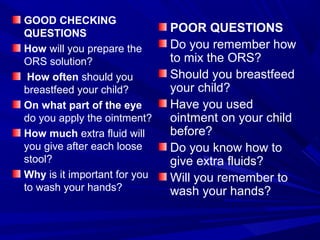
GOOD CHECKING
QUESTIONS
How will you prepare the
ORS solution?
How often should you
breastfeed your child?
On what part of the eye
do you apply the ointment?
How much extra fluid will
you give after each loose
stool?
Why is it important for you
to wash your hands?
POOR QUESTIONS
Do you remember how
to mix the ORS?
Should you breastfeed
your child?
Have you used
ointment on your child
before?
Do you know how to
give extra fluids?
Will you remember to
wash your hands?
If the mother answers incorrectly or says
she does not remember, be careful not to
make her feel uncomfortable. Teach her to
give the treatment again. Give more
information, examples or practice to make
sure she understands. Then ask her good
checking questions again.
A mother may understand but may say that she
cannot do as you ask. She may have a problem
or objection. Common problems are lack of time
or resources to give the treatment. A mother may
object that her sick infant was given a n oral drug
rather than an injection, or a home remedy rather
than a drug.
Help the mother think of possible solutions to her
problems and respond to her objections. For
example , if you ask: “What container will you use
to measure 1 litre of water for mixing ORS?”
The mother may answer that she does not have a 1-litre
container at home.
Ask her what containers she does have at home. Show
her how to measure 1 litre of water in her container.
Explain how to mark the container at 1 litre with an
appropriate tool or how to measure 1 litre using several
smaller containers.
When checking the mother’s understanding:
? Ask questions that require the mother to explain what,
how, how much, how many, when, or why. Do not ask
questions that can be answered with just a “yes” or “no”.
? Give the mother time to think and then answer.
? Praise the mother for correct answers.
? If she needs it, give more information, examples or
practice
Counselling the mother or caretaker of a sick
young infant includes the following essential
elements:
? Teach how to give oral drugs
? Teach how to treat local infection.
? Teach how to manage breast or nipple problem
? Teach correct positioning and attachment for
breastfeeding.
? Counsel on other feeding problems.
? Advise when to return.
? Counsel the mother about her own health
Teach how to give oral drugs
Oral drugs are given for different reasons, in
different doses and on different schedules.
However, the way to give each drug is similar.
This section will give you the basic steps for
teaching mothers to give oral drugs. If a mother
learns how to give a drug correctly, then the child
will be treated properly. Follow the instructions
below for every oral drug you give to the mother.
DETERMINE THE APPROPRIATE DRUGS AND
DOSAGE FOR THE CHILD’S AGE OR WEIGHT
Use the TREAT THE YOUNG INFANT pages of
the chart book to determine the appropriate drug
and dosage to give the infant.
TELL THE MOTHER THE REASON FOR GIVING THE
DRUG TO THE CHILD, INCLUDING:
- why you are giving the oral drug to her child, and
- what problem it is treating.
DEMONSTRATE HOW TO MEASURE A DOSE.
Collect a container of the drug and check its expiry date.
Do not use expired drugs.
Count out the amount needed for the child. Close the
container.
If you are giving the mother tablets:
Show the mother the amount to give per dose. If needed,
show her how to divide a tablet. If a tablet has to be
crushed before it is given to an infant , add a few drops of
clean water and wait a minute or so. The water will soften
the tablet and make it easier to crush.
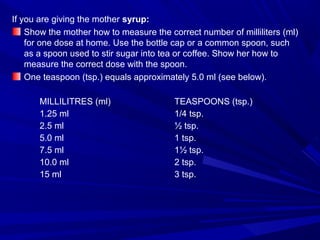
If you are giving the mother syrup:
Show the mother how to measure the correct number of milliliters (ml)
for one dose at home. Use the bottle cap or a common spoon, such
as a spoon used to stir sugar into tea or coffee. Show her how to
measure the correct dose with the spoon.
One teaspoon (tsp.) equals approximately 5.0 ml (see below).
MILLILITRES (ml)
1.25 ml
2.5 ml
5.0 ml
7.5 ml
10.0 ml
15 ml
TEASPOONS (tsp.)
1/4 tsp.
½ tsp.
1 tsp.
1½ tsp.
2 tsp.
3 tsp.
WATCH THE MOTHER PRACTICE MEASURING A
DOSE BY HERSELF
Ask the mother to measure a dose by herself. If the dose is
in tablet form and the infant cannot swallow a tablet, tell
the mother to crush the tablet. Watch her as she practices.
Tell her what she has done correctly. If she measured the
dose incorrectly, show her again how to measure it.
ASK THE MOTHER TO GIVE THE FIRST DOSE TO HER
INFANT
Explain that if an infant is vomiting, give the drug even
though the infant may vomit it up. Tell the mother to watch
the infant for 30 minutes. If the infant vomits within the 30
minutes (the tablet or syrup may be seen in the vomit),
give another dose. If the infant is dehydrated and vomiting,
wait until the child is rehydrated before giving the dose
again.
EXPLAIN CAREFULLY HOW TO GIVE THE DRUG, THEN LABEL
AND PACKAGE THE DRUG
Tell the mother how much of the drug to give her infant . Tell her
how many times per day to give the dose. Tell her when to give it
(such as early morning, lunch, dinner, before going to bed) and for
how many days.
Follow the steps below:
a. Write the full name of the drug and the total amount of
tablets, capsules or syrup to complete the course of
treatment.
b. Write the correct dose for the patient to take (number of
tablets, capsules, squirts or spoonfuls, that is, ½, 1, 1
½…). Write when to give the dose (early morning, lunch,
dinner, before going to bed).
c. Write the daily dose and schedule, such as ½ tablet
twice daily for 5 days
Write the instructions clearly so that a literate person is
able to read and understand them. Put the total amount of
each drug into its own labelled drug container (an
envelope, paper, tube or bottle). Keep drugs clean. Use
clean containers. After you have labelled and packaged
the drug, give it to the mother. Ask checking questions to
make sure she understands how to treat her infant.
IF MORE THAN ONE DRUG WILL BE GIVEN, COLLECT, COUNT
AND PACKAGE EACH DRUG
Collect one drug at a time. Write the instructions on the label. Count
out the amount needed. Put enough of the drug into its own, labelled,
package. Finish packaging the drug before you open another drug
container.
Explain to the mother that her child is getting more than one drug
because he had more than one illness. Show the mother the different
drugs. Explain how to give each drug. If necessary, draw a summary
of the drugs and times to give each drug during the day.
EXPLAIN THAT ALL THE ORAL DRUG TABLETS OR SYRUPS
MUST BE USED TO FINISH THE COURSE OF TREATMENT,
EVEN IF THE INFANT GETS BETTER
Explain to the mother that if the infant seems better, she should
continue to treat the infant. This is important because the bacteria
may still be present even though the signs of disease are gone.
Advise the mother to keep all medicines out of the reach of children.
Also tell her to store drugs in a dry and dark place that is free of mice
and insects.
CHECK THE MOTHER’s UNDERSTANDING BEFORE
SHE LEAVES THE CLINIC.
Ask the mother checking questions, such as:
“How much will you give each time?”
“When will you give it?” “For how many days?”
“How will you prepare this tablet?”
“Which drug will you give 3 times per day?”
If you feel that the mother is likely to have problems when
she gives her infant the drug(s) at home, offer more
information, examples and practice. A child needs to be
treated correctly to get better.
In some clinics, a drug dispenser has the task of teaching
the mother to give treatment and checking the mother’s
understanding. If this is your situation, teach the skills you
are learning in this section to that dispenser.
Teach the caretaker to treat local infections at
home
Local infections include thrush, an umbilicus that
is red or draining pus, skin pustules, and ear
infection.
When teaching a mother or caretaker, explain
what the treatment is and why it should be given
and describe the treatment steps. Watch the
mother as she does the first treatment in the clinic
and tell her how often to do the treatment at
home. If needed for treatment at home, give
mother a small bottle of gentian violet. Check the
mother’s understanding before she leaves the
clinic.
Dry the ear by wicking. To teach a mother how
to dry the ear by wicking, first tell her it is
important to keep an infected ear dry to allow it to
heal. Then show her how to wick her child’s ear.
As you wick the child’s ear, tell the mother to use
clean, absorbent cotton cloth or soft strong tissue
paper for making a wick. Do not use a cotton-
tipped applicator, a stick or flimsy paper that will
fall apart in the ear. Place the wick in the child’s
ear until the wick is wet. Replace the wet wick
with a clean one. Repeat these steps until the
wick stays dry. Then the ear is dry.
Observe the mother as she practices. Give
feedback. When she is finished, give her the
information on frequency and duration of
treatment.
Treat Skin Pustules or Umbilical Infection. For
umbilical or skin infection, use 0.5% gentian violet twice
each day. Explain and demonstrate the treatment to the
mother. Then watch her and guide her as needed while
she gives the treatment. Ask her checking questions to be
sure that she knows to give the treatment twice daily and
when to return.
Teach correct positioning and attachment for
breastfeeding
There are several reasons that an infant may be poorly
attached or not able to suckle effectively. He may have
had bottle feeds, especially in the first few days after
delivery. His mother may be inexperienced. She may have
had some difficulty and nobody to help or advise her. For
example, perhaps the infant was small and weak, the
mother's nipples were flat or there was a delay starting to
breastfeed.
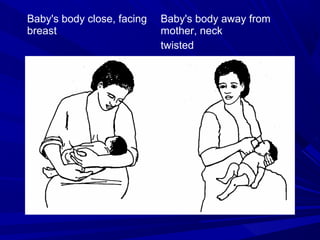
The infant may be poorly positioned at the breast.
Positioning is important because poor positioning often
results in poor attachment, especially in younger infants. If
the infant is positioned well, the attachment is likely to be
good.
Good positioning is recognized by the following signs:
- Infant's neck is straight or bent slightly back,
- Infant's body is turned towards the mother,
- Infant's body is close to the mother, and
- Infant's whole body is supported.
Poor positioning is recognized by any of the following signs:
- Infant's neck is twisted or bent forward,
- Infant's body is turned away from mother,
- Infant's body is not close to mother, or
- Only the infant's head and neck are supported
Baby's body close, facing
breast
Baby's body away from
mother, neck
twisted
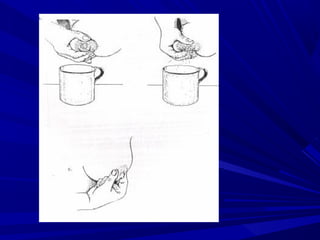
Teach the mother to express breast milk and feed with a cup and
spoon
Expression of breast milk is usually required for feeding infants who do
not suck effectively but are able to swallow effectively (as in the case of
low birth weight babies) or when there are breast or nipple problems.
The expressed breast milk is usually fed with a cup and spoon.
The mother is made to sit comfortably and hold the cup near her breast
with one hand. With the other hand, the mother is asked to place her
thumb above and her first finger below the nipple and areola. Then she
is asked to push her thumb and finger slightly inwards towards the chest
wall and then press the nipple between the thumb and finger. She must
repeatedly press and release. This repeated action would allow to milk
to drip out. She must repeat this action also from the sides of the areola
to make sure that milk is expressed from all quadrants.
Expression must be continued for 3-5 minutes until the milk flow slows
down.
The mother must perform the expression form both breasts and it may
take her about 15-20 minutes to express both breasts completely.
Treat thrush with gentian violet.
Teach the mother to treat thrush with half –strength
gentian violet (0.25%). Tell the mother that her infant will
start feeding normally sooner if she paints the mouth
ulcers in her infant’s mouth. Ask her to use a clean cloth or
a cotton-tipped stick to paint gentian violet on the mouth
ulcers and put a small amount of gentian violet on the cloth
or stick. Tell the mother the frequency and duration of
treatment.
Show the mother how to paint half of the infant’s mouth
with half -strength gentian violet. Ask the mother to
practice. Watch her paint the rest of the mouth with gentian
violet. Comment on the steps she did well and those that
need to be improved.
Give the mother a bottle of half-strength gentian violet to
take home. Before the mother leaves, ask checking
questions. If she anticipates any problems providing the
treatment, help her to solve them.
Teach the mother to manage breast and nipple problems
During the first few weeks after birth, breast and nipple
problems can be important causes of feeding problems
and poor growth in young infants. Some of the common
problems are flat or inverted nipples, sore nipples or breast
abscess in the mother.
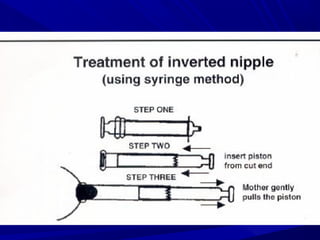
Flat or inverted nipples: If the mother has flat or inverted
nipples, the baby can have difficulty in attaching to the
breast, which can result in decreased lactation and poor
weight gain in the infant. The nipple should be everted with
fingers before the infant is put to breast during a feed. This
will help the infant to attach well onto the breast.
After a few days the nipples will remain everted.
Sore nipples: Sore nipples are almost always due to faulty attachment of
the infant onto the mother’s breast. The mother should be helped to
ensure that attachment and position are correct. To alleviate the
discomfort due to soreness, the mother should be advised to apply
breast milk on the affected nipple. If the baby’s sucking causes a lot of
discomfort to the mother inspite of correct positioning, the mother
should be advised to express the breast milk and feed it with a cup and
spoon to the infant, till she is able once again able to breast feed the
infant without much discomfort (this would usually take about 1-2
days).
Engorged breasts and Breast abscess: Engorged breasts are swollen,
hard and tender.
Breast abscess is often due to breast engorgement and rarely due to
primary infection of the breast. The mother should be encouraged to
feed from the unaffected breast and referred to a health facility for
treatment of the abscess. If the amount of milk from a single breast is
inadequate, then undiluted animal milk with added sugar can be fed
with cup and spoon.
Counselling about Other Feeding Problems
* If a mother is breastfeeding her infant less than 8 times in 24 hours,
advise her to increase the frequency of breastfeeding. Breastfeed as
often and for as long as the infant wants, day and night.
* If the infant receives other foods or drinks, counsel the mother about
breastfeeding more, reducing the amount of the other foods or drinks,
and if possible, stopping altogether. Advise her to feed the infant any
other drinks from a cup, and not from a feeding bottle.
* If the mother does not breastfeed at all, consider referring her for
breastfeeding counselling and possible re-lactation. If the mother is
interested, a breastfeeding counsellor may be able to help her to
overcome difficulties and begin breastfeeding again.
Advise a mother who does not breastfeed about choosing and
correctly preparing dairy/locally appropriate animal milk. Also advise
her to feed the young infant with a cup, and not from a feeding bottle.
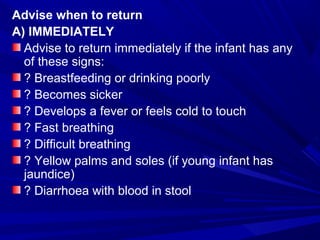
Advise when to return
A) IMMEDIATELY
Advise to return immediately if the infant has any
of these signs:
? Breastfeeding or drinking poorly
? Becomes sicker
? Develops a fever or feels cold to touch
? Fast breathing
? Difficult breathing
? Yellow palms and soles (if young infant has
jaundice)
? Diarrhoea with blood in stool
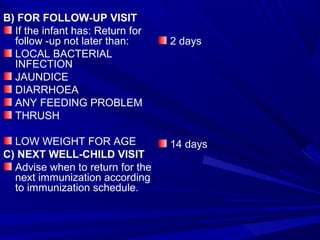
B) FOR FOLLOW-UP VISIT
If the infant has: Return for
follow -up not later than:
LOCAL BACTERIAL
INFECTION
JAUNDICE
DIARRHOEA
ANY FEEDING PROBLEM
THRUSH
LOW WEIGHT FOR AGE
C) NEXT WELL-CHILD VISIT
Advise when to return for the
next immunization according
to immunization schedule.
2 days
14 days
FOLLOW-UP CARE
If the child does not have a new problem, use the IMNCI
follow-up instructions for each specific problem:
? Assess the child according to the instructions;
? Use the information about the child's signs to select the
appropriate treatment;
? Give the treatment.
Follow-up visits are recommended for young infants who are
classified as:
? Local bacterial infection
? Feeding problem or low weight (including thrush)
COUNSEL THE MOTHER ABOUT HER
OWN HEALTH
During a sick infant visit, listen for any problems that the
mother herself may be having. The mother may need
treatment or referral for her own health problems. If the
mother is sick, provide care for her, or refer her for help.
Advise her to eat well to keep up her own strength and
health. Check the mother’s immunization status and give
her tetanus toxoid if needed. Give the mother iron folic
acid tablets if she is not already taken them. Make sure
she has access to family planning and counselling on
STD and AIDS prevention.
OUTPATIENT MANAGEMENT OF
CHILDREN AGE
2 MONTHS UP TO 5 YEARS
ASSESSMENT OF SICK CHILDREN
The assessment procedure for this age group includes a
number of important steps that must be taken by the
health care provider, including: (1) history taking and
communicating with the caretaker about the child’s
problem; (2) checking for general danger signs; (3)
checking main symptoms; (4) checking for malnutrition;
(5) checking for anaemia; (6) assessing the child’s
feeding; (7) checking immunization status; and (8)
assessing other problems.
DANGER SIGNS
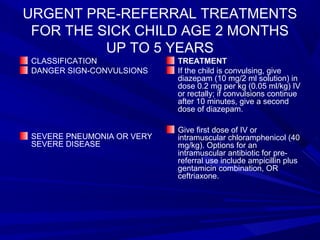
1. CONVULSIONS
2. INABILITY TO DRINK OR BREASTFEED
3. VOMITING
4. LETHARGY
5. UNCONSCIOUSNESS
The following danger signs should be routinely checked in all
children.
? The child has had convulsions during the present illness.
Convulsions may be associated with meningitis, cerebral malaria or
other life-threatening conditions. On the other hand, convulsions may
be the result of fever and in this instance, they do little harm beyond
frightening the mother. All children who have had convulsions during
the present illness should be considered seriously ill because the more
serious causes of convulsions cannot be differentiated from febrile
convulsions without investigations conducted in a hospital.
? The child is unconscious or lethargic. An unconscious child is
likely to be seriously ill. A lethargic child, who is awake but does not
take any notice of his or her surroundings or does not respond
normally to sounds or movement, may also be very sick. These signs
may be associated with many conditions.
? The child is unable to drink or breastfeed. A child may be unable
to drink either because s/he is too weak or because s/he cannot
swallow. Do not rely completely on the mother's evidence for this, but
observe while she tries to breastfeed or to give the child something to
drink.
? The child vomits everything. The vomiting itself may be a sign of
serious illness, but it is also important to note because such a child will
not be able to take medication or fluids for rehydration.
CHECKING MAIN SYMPTOMS
After checking for general danger signs, the
health care provider must check for the following
main symptoms : (1) cough or difficult breathing;
(2) diarrhoea; (3) fever; and (4) ear problems.
The first three symptoms are included because
they often result in death. Ear problems are
included because they are considered one of the
main causes of childhood disability.
Respiratory infections can occur in any part of the
respiratory tract such as the nose, throat, larynx, trachea,
air passages or lungs. A child with cough or difficult
breathing may have pneumonia or another severe
respiratory infection. Pneumonia is an infection of the
lungs. Both bacteria and viruses can cause pneumonia. In
developing countries, pneumonia is often due to bacteria.
The most common are Streptococcus pneumoniae and
Hemophilus influenzae. Children with bacterial pneumonia
may die from hypoxia (too little oxygen) or sepsis
(generalized infection).
Many children are brought to the clinic with less serious
respiratory infections. Most children with cough or difficult
breathing have only a mild infection. For example, a child
who has a cold may cough because nasal discharge drips
down the back of the throat. Or the child may have a viral
infection of the bronchi called bronchitis. These children
are not seriously ill. They do not need treatment with
antibiotics. Their families can manage them at home.
When children develop pneumonia, their lungs
become stiff. One of the body’s responses to stiff
lungs and hypoxia (too little oxygen) is fast
breathing. When the pneumonia becomes more
severe, the lungs become even stiffer. Chest
indrawing may develop. Chest indrawing is a sign
of severe pneumonia.
A child presenting with cough or difficult breathing
should first be assessed for general danger signs.
This child may have pneumonia or another severe
respiratory infection.
CLINICAL ASSESSMENT
Three key clinical signs are used to assess a sick
child with cough or difficult breathing:
? Respiratory rate, which distinguishes children
who have pneumonia from those who do not;
? Lower chest wall indrawing, which indicates
severe pneumonia; and
? Stridor , which indicates those with severe
pneumonia who require hospital admission.
Cut-off rates for fast breathing (the point at
which breathing is considered to be fast)
depend on the child’s age. Normal
breathing rates are higher in children age 2
months up to 12 months than in children
age 12 months up to 5 years.
Child’s Age Cut-off Rate for Fast Breathing
2 months up to 12
months
12 months up to 5 years
50 breaths per minute
or more
40 breaths per minute
or more
Lower chest wall indrawing, defined as the
inward movement of the bony structure of the chest
wall with inspiration, is a useful indicator of severe
pneumonia. It is more specific than “intercostal
indrawing,” which concerns the soft tissue between
the ribs without involvement of the bony structure of
the chest wall. Chest indrawing should only be
considered present if it is consistently present in a
calm child. Agitation, a blocked nose or
breastfeeding can all cause temporary chest
indrawing. Any chest indrawing, even if it is not
severe, is an indicator of severe pneumonia in a
child age 2 months up to 5 years.
Stridor is a harsh noise made when the child breathes IN.
Stridor happens when there is a swelling of the larynx,
trachea or epiglottis. These conditions are often called
croup. This swelling interferes with air entering the lungs. It
can be life threatening when the welling causes the child’s
airway to be blocked. A child who has stridor when calm
has a dangerous condition.
To look and listen for stridor, look to see when the child
breathes IN. Then listen for stridor by putting your ear near
the child’s mouth because stridor can be difficult to hear.
Sometimes you will hear a wet noise if the child’s nose is
blocked. Clear the nose, and listen again. A child who is
not very ill may have stridor only when he is crying or
upset. Be sure to look and listen for stridor when the child
is calm. You may hear a wheezing noise when the child
breathes OUT. This is not stridor.
Classification of Cough or Difficult Breathing
Based on a combination of the above clinical signs,
children presenting with cough or difficult breathing can
be classified into three categories:
Those who require referral for possible SEVERE
PNEUMONIA OR VERY SEVERE DISEASE.
This group includes children with any general danger
sign, or lower chest indrawing or stridor when calm.
Children with SEVERE PNEUMONIA OR VERY
SEVERE DISEASE most likely will have invasive
bacterial organisms and diseases that may be life-
threatening. This warrants the use of injectable
antibiotics.
DIARRHOEADIARRHOEA
Diarrhoea is the next symptom that should be routinely checked in
every child brought to the clinic. Diarrhoea occurs when stools
contain more water than normal.
It is common in children, especially those between 6 months and 2
years of age. It is more common in babies under 6 months who are
drinking cow’s milk or infant formulas. Frequent passing of normal
stools in not diarrhoea. The number of stools normally passed in a
day varies with the diet and age of the child. In many regions
diarrhoea is defined as three or more loose or watery stools in a 24-
hour period.
Mothers usually know when their children have diarrhoea. They may
say that the child’s stools are loose or watery. Mothers may use a
local word for diarrhoea.
Babies who are exclusively breastfed often have stools that
are soft; this is not diarrhoea. The mother of a breastfed
baby can recognize diarrhoea because the consistency or
frequency of the stools is different than normal.
A child presenting with diarrhoea should first be assessed
for general danger signs and the child's caretaker should
be asked if the child has cough or difficult breathing.
A child with diarrhoea may have three potentially lethal
conditions: (1) acute watery diarrhoea (including cholera);
(2) dysentery (bloody diarrhoea); and (3) persistent
diarrhoea (diarrhoea that lasts 14 days or more). All
children with diarrhoea should be assessed for: (a) signs
of dehydration; (b) how long the child has had diarrhoea;
and (c) blood in the stool to determine if the child has
dysentery.
CLINICAL ASSESSMENT
All children with diarrhoea should be checked to determine the duration of
diarrhoea, if blood is present in the stool and if dehydration is present. A
number of clinical signs are used to determine the level of dehydration:
Child’s general condition. Assess if the child is lethargic or unconscious or is
restless /irritable.
Sunken eyes.
Child’s reaction when offered to drink . A child is not able to drink if s/he
is not able to take fluid in his/her mouth and swallow it. For example, a child
may not be able to drink because s/he is lethargic or unconscious. A child is
drinking poorly if the child is weak and cannot drink without help. S/he may
be able to swallow only if fluid is put in his/her mouth. A child has the sign
drinking eagerly, thirsty if it is clear that the child wants to drink. Notice if the
child reaches out for the cup or spoon when you offer him/her water. When
the water is taken away, see if the child is unhappy because s/he wants to
drink more. If the child takes a drink only with encouragement and does not
want to drink more, s/he does not have the sign “drinking eagerly, thirsty.”
Elasticity of skin. Check elasticity of skin using
the skin pinch test. When released, the skin pinch
goes back either very slowly (longer than 2
seconds), or slowly (skin stays up even for a brief
instant), or immediately . In a child with marasmus
(severe malnutrition), the skin may go back slowly
even if the child is not dehydrated. In an
overweight child, or a child with oedema, the skin
may go back immediately even if the child is
dehydrated.
After the child is assessed for dehydration, the
caretaker of a child with diarrhoea should be
asked how long the child has had diarrhoea and if
there is blood in the stool. This will allow
identification of children with persistent diarrhoea
and dysentery.
CLASSIFICATION OF DEHYDRATION
Based on a combination of the above clinical signs,
children presenting with diarrhoea are classified into
three categories:
1. SEVERE DEHYDRATION. A child is severely
dehydrated if he/she has any combination of two of the
following signs: is lethargic or unconscious, is not able
to drink or is drinking poorly, has sunken eyes, or a skin
pinch goes back very slowly. Patients have severe
dehydration if they have a fluid deficit greater than 10
percent of their body weight.
Children who have SEVERE DEHYDRATION require
immediate IV infusion, nasogastric or oral fluid
replacement according to the WHO treatment
guidelines described in Plan C
CLASSIFICATION OF DEHYDRATION
2. SOME DEHYDRATION. Children who have any
combination of the following two signs are included in
this group: restless/irritable, sunken eyes, drinks
eagerly/thirsty, skin pinch goes back slowly. Children
with some dehydration have a fluid deficit equalling 5 to
10 percent of their body weight.
This classification includes both "mild" and "moderate”
dehydration, which are descriptive terms used in most
paediatric textbooks.
Children who have SOME DEHYDRATION require
active oral treatment with ORS solution according to
WHO treatment guidelines described in Plan B.
CLASSIFICATION OF DEHYDRATION
3. NO DEHYDRATION.
Patients with diarrhoea but no signs of dehydration usually have a
fluid deficit, but equal to less than 5 percent of their body weight.
Although these children lack distinct signs of dehydration, they
should be given more fluid than usual to prevent dehydration from
developing as specified in WHO Treatment Plan A
Note: Anti-diarrhoeal drugs — including anti-motility agents (e.g.,
loperamide, diphenoxylate, codeine, tincture of opium), adsorbents
(e.g., kaolin ), live bacterial cultures (e.g., Lactobacillus,
Streptococcus faecium), and charcoal — do not provide practical
benefits for children with acute diarrhoea, and some may have
dangerous side effects. These drugs should never be given to
children less than 5 years old.
Classification of Persistent Diarrhoea
Persistent diarrhoea is an episode of diarrhoea, with or
without blood, which begins acutely and lasts at least 14
days. It accounts for up to 15 percent of all episodes of
diarrhoea but is associated with 30 to 50 percent of
deaths. Persistent diarrhoea is usually associated with
weight loss and often with serious non-intestinal
infections. Many children who develop persistent
diarrhoea are malnourished, greatly increasing the risk of
death. Persistent diarrhoea is uncommon in infants who
are exclusively breast-fed.
All children with diarrhoea for 14 days or more
should be classified based on the presence or
absence of any dehydration:
Children with SEVERE PERSISTENT
DIARRHOEA who also have any degree of
dehydration require special treatment and should
not be managed at the outpatient health facility.
Referral to a hospital is required. As a rule,
treatment of dehydration should be initiated first,
unless there is another severe classification.
Children with PERSISTENT DIARRHOEA and no
signs of dehydration can be safely managed in
the outpatient clinic, at least initially.
Proper feeding is the most important aspect of treatment
for most children with persistent diarrhoea. The goals of
nutritional therapy are to: (a) temporarily reduce the
amount of animal milk (or lactose) in the diet; (b) provide a
sufficient intake of energy, protein, vitamins and minerals
to facilitate the repair process in the damaged gut mucus
and improve nutritional status; (c) avoid giving foods or
drinks that may aggravate the diarrhoea; and (d) ensure
adequate food intake during convalescence to correct any
malnutrition.
Routine treatment of persistent diarrhoea with
antimicrobials is not effective.
Some children, however, have non-intestinal (or intestinal)
infections that require specific antimicrobial therapy. The
persistent diarrhoea of such children will not improve until
these infections are diagnosed and treated correctly.
CLASSIFICATION OF DYSENTERY
The mother or caretaker of a child with diarrhoea should
be asked if there is blood in the stool.
? A child is classified as having DYSENTERY if the
mother or caretaker reports blood in the child’s stool.
It is not necessary to examine the stool or perform
laboratory tests to diagnose dysentery. Stool culture to
detect pathogenic bacteria is rarely possible. Moreover,
at least two days are required to obtain the results of a
culture. Although “dysentery” is often described as a
syndrome of bloody diarrhoea with fever, abdominal
cramps, rectal pain and mucoid stools, these features do
not always accompany bloody diarrhoea, nor do they
necessarily define its aetiology or determine appropriate
treatment.
Bloody diarrhoea in young children is usually a sign of
invasive enteric infection that carries a substantial risk of
serious morbidity and death. About 10 percent of all
diarrhoea episodes in children under 5 years old are
dysenteric, but these cause up to 15 percent of all
diarrhoeal deaths.
Dysentery is especially severe in infants and in children
who are undernourished, who develop clinically evident
dehydration during their illness, or who are not breast -fed.
It also has a more harmful effect on nutritional status than
acute watery diarrhoea. Dysentery occurs with increased
frequency and severity in children who have measles or
have had measles in the preceding month, and diarrhoeal
episodes that begin with dysentery are more likely to
become persistent than those that start without blood in
the stool.
All children with dysentery (bloody diarrhoea)
should be treated promptly with an antibiotic
effective against Shigella because: (a) bloody
diarrhoea in children under 5 is caused much
more frequently by Shigella than by any other
pathogen; (b) shigellosis is more likely than other
causes of diarrhoea to result in complications and
death if effective antimicrobial therapy is not
begun promptly; and (c) early treatment of
shigellosis with an effective antibiotic substantially
reduces the risk of severe morbidity or death.
FEVERFEVER
All sick children should be checked for fever. Fever is a
very common condition and is often the main reason for
bringing children to the health centre. It may be caused
by minor infections, but may also be the most obvious
sign of a life-threatening illness, particularly malaria
(especially lethal malaria P.falciparum), or other severe
infections, including meningitis, typhoid fever, or
measles. When diagnostic capacity is limited, it is
important first to identify those children who need urgent
referral with appropriate pre-referral treatment
(antimalarial or antibacterial).
Clinical Assessment
Body temperature should be checked in all sick children
brought to an outpatient clinic. Children are considered
to have fever if their body temperature is above 37.5°C
axillary (38°C rectal). In the absence of a thermometer,
children are considered to have fever if they feel hot.
Fever also may be recognised based on a history of
fever.
A child presenting with fever should be assessed for:
Risk of malaria . In situations where routine microscopy
is not available or the results may be delayed, the risk of
malaria transmission must be defined. The National Anti-
Malaria Program has defined areas of high and low
malaria risk in the country.
Duration of fever. Most fevers due to viral illnesses go
away within a few days. A fever that has been present
every day for more than seven days can mean that the
child has a more severe disease such as typhoid fever. If
the fever has been present for more than seven days, it is
important to check whether the fever has been present
every day.
Bulging fontanelle. The anterior fontanelle is open for
most of the period of infancy before it is closed by the
growth of the surrounding bones. If open, feel for bulging
of the fontanelle just as you did for young infants.
Stiff neck. A stiff neck may be a sign of meningitis,
cerebral malaria or another very severe febrile disease. If
the child is conscious and alert, check stiffness by tickling
the feet, asking the child to bend his/her neck to look
down or by very gently bending the child’s head forward. It
should move freely.
Runny nose. When malaria risk is low, a child with fever
and a runny nose does not need an antimalarial. This
child's fever is probably due to a common cold.
Measles. Considering the high risk of complications and
death due to measles, children with fever should be
assessed for signs of current or previous measles (within
the last three months). Measles deaths occur from
pneumonia and laryngotracheitis (67 percent), diarrhoea
(25 percent), measles alone, and a few from encephalitis.
Other complications (usually non fatal) include
conjunctivitis, otitis media, and mouth ulcers. Significant
disability can result from measles including blindness,
severe malnutrition, chronic lung disease (bronchiectasis
and recurrent infection), and neurologic dysfunction.
In measles, a red rash begins behind the ears and on the
neck. It spreads to the face.
During the next day, the rash spreads to the rest of the
body, arms and legs. After 4 to 5 days, the rash starts to
fade and the skin may peel. Some children with severe
infection may have mor e rash spread over more of the
body. The rash becomes more discolored (dark brown or
blackish), and there is more peeling of the skin. A measles
rash does not have vesicles (blisters) or pustules. The
rash does not itch. Do not confuse measles with other
common childhood rashes such as chicken pox, scabies
or heat rash. (The chicken pox rash is a generalized rash
with vesicles.
Scabies occurs on the hands, feet, ankles, elbows,
buttocks and axilla. It also itches.
Heat rash can be a generalized rash with small bumps
and vesicles that itch. A child with heat rash is not sick).
If the child has measles currently or within the last three
months, s/he should be assessed for possible
complications. Measles damages the epithelial surfaces
and the immune system, and lowers vitamin A levels. This
results in increased susceptibility to infections caused by
pneumococcus, gram-negative bacteria, and adenovirus.
Recrudescence of herpes virus, Candida, and malaria can
also occur during measles infection. It is important to
check every child with recent or current measles for
possible mouth or eye complications. Clouding of the
cornea is a dangerous eye complication. It may be due to
vitamin A deficiency that has been made worse by
measles. If not treated, cornea can ulcerate and cause
blindness. An infant with corneal clouding needs urgent
treatment with vitamin A. Other possible complications
such as pneumonia, stridor in a calm child, diarrhoea,
malnutrition and ear infection are assessed in relevant
sections of the se guidelines.
CLASSIFICATION OF FEVER
All children with fever and any general danger
sign or stiff neck are classified as having VERY
SEVERE FEBRILE DISEASE and should be
urgently referred to a hospital after pre-referral
treatment with antibiotics (the same choice as
for severe pneumonia or very severe disease).
Further classifications will depend on the level of
malaria risk in the area.
In a high malaria risk area, children with fever
and no general danger sign or stiff neck should
be classified as having MALARIA.
Presumptive treatment for malaria should be given to all
children who present with fever in the clinic, or who have a
history of fever during this illness.
Although a substantial number of children will be treated
for malaria when in fact they have another febrile illness,
presumptive treatment for malaria is justified in this
category given the high rate of malaria risk and the
possibility that another illness might cause the malaria
infection to progress. This recommendation is intended to
maximise sensitivity, ensuring that as many true cases as
possible receive proper antimalarial treatment.
? In a low malarial risk area, children with fever (or
history of fever) and no general danger sign or stiff neck
are classified as having MALARIA and given an
antimalarial only if they have no runny nose (a sign of
ARI), no measles, and no other obvious cause of fever
(pneumonia, sore throat,etc.)
In a low malaria risk area, children with runny
nose, measles or clinical signs of other possible
infection are classified as having FEVER —
MALARIA UNLIKELY. These children need
follow-up. If their fever lasts more than five days,
they should be referred for further assessment to
determine causes of prolonged pyrexia. If
possible, in low malaria risk settings, a simple
malaria laboratory test is highly advisable.
Children with high fever, defined as an axillary
temperature greater than 38.5°C or a rectal
greater than 39°C, should be given a single dose
of paracetamol.
CLASSIFICATION OF MEASLES
All children with fever should be checked for signs of current or
recent measles (within the last three months) and measles
complications.
SEVERE COMPLICATED MEASLES is present when a child with
measles displays any general danger sign, or has severe stomatitis
with deep and extensive mouth ulcers or severe eye complications,
such as clouding of the cornea. These children should be urgently
referred to a hospital.
Children with less severe measles complications, such as pus
draining from the eye (a sign of conjunctivitis) or non-deep and non-
extensive mouth ulcers, are classified as MEASLES WITH EYE OR
MOUTH COMPLICATIONS. These children can be safely treated at
the outpatient facility. This treatment includes oral vitamin A,
tetracyclin e ointment for children with pus draining from the eye,
and gentian violet for children with mouth ulcers.
Ear problems
Ear problems are the next condition that should be
checked in all children brought to the outpatient health
facility. A child with an ear problem may have an ear
infection.
When a child has an ear infection, pus collects behind
the eardrum and causes pain and often fever. If the
infection is not treated, the eardrum may burst. The pus
discharges, and the child feels less pain. The fever and
other symptoms may stop, but the child suffers from
poor hearing because the eardrum has a hole in it.
Usually the eardrum heals by itself. At other times the
discharge continues, the eardrum does not heal and the
child becomes deaf in that ear.
Sometimes the infection can spread from the ear to the
bone behind the ear (the mastoid) causing mastoiditis.
Infection can also spread from the ear to the brain causing
meningitis. These are severe diseases. They need urgent
attention and referral.
Ear infections rarely cause death. However, they cause
many days of illness in children. Ear infections are the
main cause of deafness in developing countries, and
deafness causes learning problems in school.
A child presenting with an ear problem should first be
assessed for general danger signs, cough or difficult
breathing, diarrhoea and fever. A child with an ear
problem may have an ear infection. Although ear
infections rarely cause death, they are the main cause of
deafness in low -income areas, which in turn leads to
learning problems.
Clinical Assessment
Tender swelling behind the ear. The most serious complication of
an ear infection is a deep infection in the mastoid bone. It usually
manifests with tender swelling behind one of the child’s ears. In
infants, this tender swelling also may be above the ear. When both
tenderness and swelling are present, the sign is considered positive
and should not be mistaken for swollen lymph nodes.
Ear pain. In the early stages of acute otitis, a child may have ear
pain, which usually causes the child to become irritable and rub the
ear frequently.
Ear discharge or pus. This is another important sign of an ear
infection. When a mother reports an ear discharge, the health care
provider should check for pus drainage from the ears and find out
how long the discharge has been present.
Classification of Ear Problems
Children presenting with tenderness and swelling of the
mastoid bone are classified as having MASTOIDITIS
and should be referred to the hospital for treatment.
Before referral, these children first should receive a dose
of antibiotic and a single dose of paracetamol for pain.
Children with ear pain or ear discharge (or pus) for fewer
than 14 days are classified as having ACUTE EAR
INFECTION and should be treated for five days with the
same first-line antibiotic as for pneumonia.
If there is ear discharge (or pus) for more
then 14 days, the child’s classification is
CHRONIC EAR INFECTION. Dry the ear
by wicking. Generally, antibiotics are not
recommended because they are expensive
and their efficacy is not proven.
CHECKING FOR MALNUTRITION
A mother may bring her child to clinic because the child has an
acute illness. The child may not have specific complaints that point
to malnutrition. A sick child can be malnourished, but you or the
child’s family may not notice the problem. A child with malnutrition
has a higher risk of many types of disease and death. Even children
with mild and moderate malnutrition have an increased risk of death.
Identifying children with malnutrition and treating them can help
prevent many severe diseases and death. Some malnutrition cases
can be treated at home. Severe cases need referral to hospital for
systemic antibiotic therapy, treatment and prevention of
complications, special feeding or specific treatment of a disease
contributing to malnutrition (such as tuberculosis).
After assessing for general danger signs and the
four main symptoms, all children should be
assessed for malnutrition. There are two main
reasons for routine assessment of nutritional
status in sick children: (1) to identify child ren with
severe malnutrition who are at increased risk of
mortality and need urgent referral to provide
active treatment; and (2) to identify children with
sub-optimal growth (stunting) resulting from
ongoing deficits in dietary intake plus repeated
episodes of infection and who may benefit from
nutritional counselling and resolution of feeding
problems.
Clinical Assessment
Visible severe wasting. This is defined as severe wasting of the
shoulders, arms, buttocks, and legs, with ribs easily seen, and
indicates presence of marasmus.
To look for visible severe wasting, remove the child's clothes. Look
for severe wasting of the muscles of the shoulders, arms, buttocks
and legs. Look to see if the outline of the child's ribs is easily seen.
Look at the child's hips. They may look small when you compare
them with the chest and abdomen. Look at the child from the side to
see if the fat of the buttocks is missing. When wasting is extreme,
there are many folds of skin on the buttocks and thigh. It looks as if
the child is wearing baggy pants. The face of a child with visible
severe wasting may still look normal.
The child's abdomen may be large or distended.
Oedema of both feet. The presence of oedema
(accumulation of fluid) in both feet may signal
kwashiorkor. Children with oedema of both feet
may have other diseases like nephrotic
syndrome. There is a need, however, to
differentiate these other conditions in the
outpatient settings because referral is necessary
in any case.
Weight for age. When height boards are not
available in outpatient settings, a weight for age
indicator (a standard WHO growth chart) helps to
identify children with low (Z score less than –2) or
very low (Z score less than –3) weight for age,
who are at increased risk of infection and poor
growth and development.
CLASSIFICATION OF
NUTRITIONAL STATUS
Children with SEVERE MALNUTRITION exhibiting
visible severe wasting or oedema of both feet are at high
risk of death from various severe diseases and need
urgent referral to a hospital where their treatment can be
carefully monitored.
Children with VERY LOW WEIGHT for age also have a
higher risk of severe disease and should be assessed for
feeding problems. This assessment should identify
common, important problems with feeding that can be
corrected if the caretaker is provided effective
counselling and acceptable feeding recommendations
based on the child’s age.
ANAEMIAANAEMIA
All children also should be assessed for
anaemia. The most common cause of
anaemia in young children in developing
countries is nutritional or because of
parasitic or helminthic infections.
However, there may be other more
serious causes of anaemia such as
haemolytic anaemia, aplastic anaemia or
leukaemia .
Clinical assessment
To see if the child has palmar pallor, look at the
skin of the child's palm. Hold the child's palm
open by grasping it gently from the side. Do not
stretch the fingers backwards. This may cause
pallor by blocking the blood supply. Compare the
colour of the child's palm with your own palm
and with the palms of other children.
If the skin of the child's palm is pale, the child
has some palmar pallor. If the skin of the palm is
very pale or so pale that it looks white, the child
has severe palmar pallor.
CLASSIFICATION OF ANAEMIA
Children can be classified in one of the following
categories:
Children with SEVERE ANAEMIA who have severe
palmar pallor need urgent referral to a hospital for blood
transfusion.
Children with some palmar pallor have ANAEMIA and
should be assessed for feeding problems. This
assessment should identify common, important
problems with feeding that can be corrected if the
caretaker is provided effective counselling and
acceptable feeding recommendations based on the
child’s age.
Identify feeding problems
It is important to complete the assessment of
feeding and identify all the feeding problems
before giving advice. Based on the mother’s
answers to the feeding questions, identify any
differences between the child’s actual feeding
and the feeding recommendations. These
differences are problems. Some examples of
feeding problems are listed below.
EXAMPLES OF FEEDING PROBLEMS
CHILD’S ACTUAL FEEDING
A 3-month-old is given sugar
water as well as breast milk.
A 2-year-old fed only 3 times
each day.
An 8-month-old is still
exclusively breastfed.
RECOMMENDED FEEDING
A 3-month-old should be given
only breast milk and no
another food or fluid.
A 2-year-old should receive 2
extra feedings between meals,
as well as 3 meals a day.
A breastfed 8-month-old
should also be given adequate
servings of a nutritious
complementary food 3 times a
day.
OTHER COMMON FEEDING
PROBLEMS
Difficulty breastfeeding
The mother may mention that breastfeeding is
uncomfortable for her, or that her child seems to have
difficulty breastfeeding. If so, you will need to assess
breastfeeding as described on the YOUNG INFANT
chart. You may find that infant’s positioning and
attachment could be improved.
Use of feeding bottle
Feeding bottles should not be used. They are often dirty,
and germs easily grow in them. Fluids tend to be left in
them and soon become spoiled or sour. The child may
drink the spoiled fluid and become ill. Also, sucking on a
bottle may interfere with the child’s desire to breastfeed.
Lack of active feeding
Young children often need to be encouraged and assisted
to eat. This is especially true if a child has very low weight.
If a young child is left to feed himself, or if he has to
compete with siblings for food, he may not get enough to
eat. By asking, “Who feeds the child and how?” you
should be able to find out if the child is actively being
encouraged to eat.
Not feeding well during illness
The child may be eating much less, or eating different
foods during illness. Children often lose their appetite
during illness. However, they should still be encouraged to
eat the types of food recommended for their age, as often
as recommended, even if they do not eat much. They
should be offered their favourite nutritious foods, if
possible, to encourage eating.
IMMUNIZATION STATUS
The immunization status of every sick child
brought to a health facility should be checked.
Illness is not a contraindication to immunization.
In practice, sick children may be even more in
need of protection provided by immunization
than well children. A vaccine’s ability to protect is
not diminished in sick children.
As a rule, there are only four common situations
that are contraindications to immunization of sick
children:
Children who are being referred urgently to the
hospital should not be immunized. There is no
medical contraindication, but if the child dies, the
vaccine may be incorrectly blamed for the death.
Live vaccines (BCG, measles, polio) should not
be given to children with immunodeficiency
diseases, or to children who are
immunosuppressed due to malignant disease,
therapy with immunosuppressive agents or
irradiation. However, all the vaccines, including
BCG and yellow fever, can be given to children
who have, or are suspected of having, HIV
infection but are not yet symptomatic.
DPT2/ DPT3 should not be given to children who
have had convulsions or shock within three days
of a previous dose of DPT. DT can be
administered instead of DPT.
DPT should not be given to children with
recurrent convulsions or another active
neurological disease of the central nervous
system. DT can be administered instead of DPT.
BCG, if not given at birth, can be given in the
next visit.
After checking immunization status, determine if
the child needs vitamin A supplementation and/or
prophylactic iron folic acid supplementation.
The IMNCI clinical guidelines focus on five main
symptoms. In addition, the assessment steps within each
main symptom take into account several other common
problems. For example, conditions such as meningitis,
sepsis, tuberculosis, conjunctivitis, and different causes
of fever such as ear infection and sore throat are
routinely assessed within the IMNCI case management
process. If the guidelines are correctly applied, children
with these conditions will receive presumptive treatment
or urgent referral.
TREATMENT PROCEDURES FOR
SICK CHILDREN
IMNCI classifications are not necessarily specific
diagnoses, but they indicate what action needs
to be taken. In the IMNCI guidelines, all
classifications are colour coded: pink calls for
hospital referral or admission, yellow for initiation
of treatment, and green means that the child can
be sent home with careful advice on when to
return. After completion of the assessment and
classification procedure, the next step is to
identify treatment.
URGENT PRE-REFERRAL TREATMENTS
FOR THE SICK CHILD AGE 2 MONTHS
UP TO 5 YEARS
CLASSIFICATION
DANGER SIGN-CONVULSIONS
SEVERE PNEUMONIA OR VERY
SEVERE DISEASE
TREATMENT
If the child is convulsing, give
diazepam (10 mg/2 ml solution) in
dose 0.2 mg per kg (0.05 ml/kg) IV
or rectally; if convulsions continue
after 10 minutes, give a second
dose of diazepam.
Give first dose of IV or
intramuscular chloramphenicol (40
mg/kg). Options for an
intramuscular antibiotic for pre-
referral use include ampicillin plus
gentamicin combination, OR
ceftriaxone.
VERY SEVERE FEBRILE
DISEASE
SEVERE COMPLICATED
MEASLES
Give one dose of
paracetamol for high fever
(38.5°C or above).
Give first dose of
intramuscular quinine for
severe malaria unless no
malaria risk.
Give first dose of an
appropriate antibiotic.
Give first dose of
appropriate antibiotic.
Give vitamin A.
If there is clouding of the
cornea or pus draining from
the eye, apply tetracycline
eye ointment.
SEVERE DEHYDRATION
WHO Treatment Plan C
If there is no other severe
classification, IV fluids should be
given in the outpatient clinic
according to WHO Treatment Plan C
(see page 17 of the chartbooklet).
Give 100 ml/kg IV fluids. Ringer's
lactate solution is the preferred
commercially available solution.
Normal saline does not correct
acidosis or replace potassium
losses, but can be used. Plain
glucose or dextrose solutions are not
acceptable for the treatment of
severe dehydration.
If IV infusion is not possible, urgent
referral to the hospital for IV
treatment is recommended. When
referral takes more than 30 minutes,
fluids should be given by nasogastric
tube. If none of these are possible
and the child can drink, ORS must
be given by mouth.
P
Population
I
Intervention
C
Comparison
O
Outcome
Integrated Manage
ment of Neonatal a
nd Childhood Illnes
s (IMNCI): skill
assessment of
health
and Integrated Chil
d Development
Scheme (ICDS)
workers to classify
sick under-five
children.
The cross-sectional
study was conducted in
Raipurrani in the
outpatient departments
of the community
health centre and one
primary health centre in
2010. Workers from
health department
and Integrated Child
Development Scheme
(ICDS) were assessed
in this study. They
received IMNCI training
in 2006, with 1 day
refreshertraining in
2009. Investigator
noted his observations
using a skill
assessment checklist.
Under-five child
observations were the
unit of study.
There is no any
comparison used
for these study
Sixteen IMNCI
trained workers
made 128 child
observations.
Considering color-
coded categorization
under IMNCI,
agreement with
investigator (Kappa)
was intermediate;
red and yellow
categorizations had
poor agreement.
Morbidity-wise
agreement (Kappa)
was poor for
possible serious
bacterial infection,
feeding problem,

IMNCI

  • 1.
    CHILD HEALTH NURSINGCHILDHEALTH NURSING IMNCIIMNCI
  • 2.
    INTRODUCTIONINTRODUCTION WHO/UNICEF have developeda new approach toWHO/UNICEF have developed a new approach to tackling the major diseases of early childhood called thetackling the major diseases of early childhood called the Integrated Management of Childhood Illnesses (IMCI).Integrated Management of Childhood Illnesses (IMCI). Studies show that children presenting with any illnessStudies show that children presenting with any illness often suffer from more than one disease. For instance, aoften suffer from more than one disease. For instance, a child presenting with diarrhoea may also bechild presenting with diarrhoea may also be malnourished and may not have received themalnourished and may not have received the immunization as per the National Immunizationimmunization as per the National Immunization schedule. The integrated approach ensures that allschedule. The integrated approach ensures that all relevant needs of the child are looked at and attended torelevant needs of the child are looked at and attended to during the contact of the child with the health workers.during the contact of the child with the health workers.
  • 3.
    Integrated management ofchildhood illness strategyIntegrated management of childhood illness strategy developed by WHO in collaboration with UNICEF anddeveloped by WHO in collaboration with UNICEF and many other agencies in mid 1990s,combinesmany other agencies in mid 1990s,combines improved management of common childhood illnessimproved management of common childhood illness as well as prevention of diseases and promotion ofas well as prevention of diseases and promotion of health by dealing with counseling on feeding andhealth by dealing with counseling on feeding and immunization. This strategy has been adapted andimmunization. This strategy has been adapted and expanded in India to include neonatal care at homeexpanded in India to include neonatal care at home as well as in the facilities and renamed asas well as in the facilities and renamed as IMNCI.IMNCI.
  • 4.
    COMPONENTS OF THEINTEGRATEDCOMPONENTS OF THE INTEGRATED APPROACHAPPROACH The strategy includes three main components:The strategy includes three main components: ? Improvements in the case-management skills of health staff through? Improvements in the case-management skills of health staff through the provision of locally-adapted guidelines on Integrated Managementthe provision of locally-adapted guidelines on Integrated Management of Neonatal and Childhood Illness and activities to promote their use;of Neonatal and Childhood Illness and activities to promote their use; ? Improvements in the overall health system required for effective? Improvements in the overall health system required for effective management of neonatal and childhood illness;management of neonatal and childhood illness; ? Improvements in family and community health care practices.? Improvements in family and community health care practices.
  • 5.
    THE PRINCIPLES OFINTEGRATED CARETHE PRINCIPLES OF INTEGRATED CARE Depending on a child’s age, various clinical signs and symptoms differDepending on a child’s age, various clinical signs and symptoms differ in their degrees of reliability and diagnostic value and importance.in their degrees of reliability and diagnostic value and importance. Therefore, the IMNCI guidelines recommend case managementTherefore, the IMNCI guidelines recommend case management procedures based on two age categories:procedures based on two age categories: ? Young infants age up to 2 months? Young infants age up to 2 months ? Children age 2 months up to 5 years? Children age 2 months up to 5 years The IMNCI guidelines are based on the following principles:The IMNCI guidelines are based on the following principles: ? All sick young infants up to 2 months of age7 must be assessed? All sick young infants up to 2 months of age7 must be assessed forfor “possible bacterial infection / jaundice”.“possible bacterial infection / jaundice”. Then they must beThen they must be routinely assessed for the major symptomroutinely assessed for the major symptom “diarrhoea”.“diarrhoea”. ? All sick children age 2 months up to 5 years must be examined for? All sick children age 2 months up to 5 years must be examined for ““general danger signsgeneral danger signs” which indicate the need for immediate” which indicate the need for immediate referral or admission to a hospital. They must then bereferral or admission to a hospital. They must then be routinelyroutinely assessed for major symptoms:assessed for major symptoms: cough or difficult breathing,cough or difficult breathing, diarrhoea, fever and ear problems.diarrhoea, fever and ear problems.
  • 6.
    THE PRINCIPLES OFINTEGRATED CARETHE PRINCIPLES OF INTEGRATED CARE All sick young infants and children 2 months up to 5 years must alsoAll sick young infants and children 2 months up to 5 years must also be routinely assessed forbe routinely assessed for nutritional and immunization statusnutritional and immunization status,, feeding problemsfeeding problems,, and other potential problemsand other potential problems.. Only aOnly a limited number of carefully selected clinical signslimited number of carefully selected clinical signs areare usedused ,, based on evidence of their sensitivity and specificity to detectbased on evidence of their sensitivity and specificity to detect disease. These signs were selected considering the conditions anddisease. These signs were selected considering the conditions and realities of first-level health facilities.realities of first-level health facilities. A combination of individual signs leads to an infant’s or a child’sA combination of individual signs leads to an infant’s or a child’s classification(s) rather than a diagnosis.classification(s) rather than a diagnosis. Classification(s) indicateClassification(s) indicate the severity of condition(s). They call for specific actions based onthe severity of condition(s). They call for specific actions based on whether the infant or child (a) should be urgently referred to a higherwhether the infant or child (a) should be urgently referred to a higher level of care, (b) requires specific treatments (such as antibiotics orlevel of care, (b) requires specific treatments (such as antibiotics or antimalarial treatment), or (c) may be safely managed at home. Theantimalarial treatment), or (c) may be safely managed at home. The classifications are colour codedclassifications are colour coded : “pink” suggests hospital referral: “pink” suggests hospital referral or admission, “yellow” indicates initiation of specific treatment, andor admission, “yellow” indicates initiation of specific treatment, and “green” calls for home management.“green” calls for home management.
  • 7.
    THE IMNCI CASEMANAGEMENTTHE IMNCI CASE MANAGEMENT PROCESSPROCESSFor all sick children age up to 5 years who are brought to a firstFor all sick children age up to 5 years who are brought to a first -level health facility.-level health facility. ASSESSASSESS the child: Check for danger signs (or possible bacterialthe child: Check for danger signs (or possible bacterial infection /Jaundice). Ask about main symptoms. If a main symptom isinfection /Jaundice). Ask about main symptoms. If a main symptom is reported, assess further. Check nutrition and immunization status.reported, assess further. Check nutrition and immunization status. Check for other problems.Check for other problems. IFIF NO URGENTNO URGENT REFERRALREFERRAL is neededis needed or possibleor possible IDENTIFY TREATMENTIDENTIFY TREATMENT needed for the child'sneeded for the child's classifications: identifyclassifications: identify specific medicalspecific medical treatments and/ortreatments and/or advice.advice. IF URGENT REFERRALIF URGENT REFERRAL is needed and possible.is needed and possible. IDENTIFY URGENTIDENTIFY URGENT PRE-REFERRALPRE-REFERRAL TREATMENT(S)TREATMENT(S) NeededNeeded for the child'sfor the child's classifications.classifications.
  • 8.
    TREAT THE CHILD:TREATTHE CHILD: Give urgentGive urgent prereferral treatment(s) needed.prereferral treatment(s) needed. REFER THE CHILD:REFER THE CHILD: ExplainExplain to the child's caretaker theto the child's caretaker the need for referral. Calm theneed for referral. Calm the caretaker's fears and helpcaretaker's fears and help resolve any problems. Write aresolve any problems. Write a referral note. Give instructionsreferral note. Give instructions and supplies needed to careand supplies needed to care for the child on the way to thefor the child on the way to the hospital.hospital. TREAT THE CHILD:TREAT THE CHILD: Give the firstGive the first dose of oral drugs in the clinicdose of oral drugs in the clinic and/or advise the child'sand/or advise the child's caretaker. Teach the caretakercaretaker. Teach the caretaker how to give oral drugs and how tohow to give oral drugs and how to treat local infections at home. Iftreat local infections at home. If needed, give immunizations.needed, give immunizations. COUNSEL THE MOTHER:COUNSEL THE MOTHER: Assess the child's feeding,Assess the child's feeding, including breastfeedingincluding breastfeeding practices, and solve feedingpractices, and solve feeding problems, if present. Adviseproblems, if present. Advise about feeding and fluids duringabout feeding and fluids during illness and about when toillness and about when to return to a health facility.return to a health facility. Counsel the mother about herCounsel the mother about her own health.own health. FOLLOW-UPFOLLOW-UP care: Give follow-up care when the child returns to thecare: Give follow-up care when the child returns to the clinic and, if necessary, reassess the child for new problems.clinic and, if necessary, reassess the child for new problems.
  • 9.
    OUTPATIENT HEALTH FACILITYOUTPATIENTHEALTH FACILITY Assessment;Assessment; ? Classification and identification of treatment;? Classification and identification of treatment; ? Referral, treatment or counselling of the child’s caretaker (depending on? Referral, treatment or counselling of the child’s caretaker (depending on the classification(s) identified);the classification(s) identified); ? Follow-up care.? Follow-up care. Referral Health FacilityReferral Health Facility ? Emergency triage assessment and treatment (ETAT);? Emergency triage assessment and treatment (ETAT); ? Diagnosis, treatment and monitoring of patient progress.? Diagnosis, treatment and monitoring of patient progress. Appropriate Home ManagementAppropriate Home Management ? Teaching mothers or other caretakers how to give oral drugs and treat? Teaching mothers or other caretakers how to give oral drugs and treat local infections at home;local infections at home; ? Counselling mothers or other caretakers about food (feeding? Counselling mothers or other caretakers about food (feeding recommendations, feeding problems); fluids; when to return to the healthrecommendations, feeding problems); fluids; when to return to the health facility; and the mother’s own health.facility; and the mother’s own health.
  • 10.
    IMNCI Case Managementin the Outpatient Health Facility,IMNCI Case Management in the Outpatient Health Facility, First-level Referral Facility and at HomeFirst-level Referral Facility and at Home For the Sick Young Infant up to 2 Months of AgeFor the Sick Young Infant up to 2 Months of Age CHECK FOR POSSIBLE BACTERIALCHECK FOR POSSIBLE BACTERIAL INFECTION/ JAUNDICEINFECTION/ JAUNDICE Assess the SYMPTOM ? DiarrhoeaAssess the SYMPTOM ? Diarrhoea Check for FEEDING PROBLEM or MALNUTRITION and IMMUNIZATION STATUS OUTPATIENT HEALTH FACILITYOUTPATIENT HEALTH FACILITY
  • 11.
    Check for OTHERPROBLEMS CLASSIFY CONDITIONS and IDENTIFY TREATMENT ACTIONS According to Colour-Coded Treatment Charts PINK - Urgent Referral OUTPATIENT HEALTH FACILITY ? Pre-referral Treatments ? Advise Parents ? Refer young infant YELLOW - Treatment at Outpatient Health Facility OUTPATIENTHEALTH FACILITY ? Treat Local Infection ? Give Oral Drugs ? Advise and Teach Caretaker ? Follow-up GREEN - Home Management HOME Caretaker is counselle to: ? Give oral drugs ? Treat local infections ? Continue exclusive breastfeeding ? Keep the young infan warm ? When to return immediately ? Follow-up REFERRAL FACILITY ? Emergency Triage and Treatment ? Diagnosis ? Treatment ? Monitoring and Follow-up
  • 12.
    IMNCI Case Managementin the Outpatient Health Facility, First-level Referral Facility and at Home For the Sick Child From Age 2 Months up to 5 Years THE INTEGRATED CASE MANAGEMENT PROCESS OUTPATIENT HEALTH FACILITY CHECK FOR DANGER SIGNS ? Convulsions ? Lethargy/Unconsciousness ? Inability to Drink/Breastfeed ? Vomiting Assess MAIN SYMPTOMS ? Cough/Difficulty Breathing ? Diarrhoea ? Fever ? Ear Problems
  • 13.
    OUTPATIENT MANAGEMENT OFYOUNG INFANTS UP TO 2 MONTHS OF AGE The assessment procedure for this age group includes a number of important steps that must be taken by the health care provider, including: (1) history taking and communicating with the caretaker about the young infant’s problem; (2) checking for possible bacterial infection / jaundice; (3) checking for diarrhoea; (4) checking for feeding problem or malnutrition; (5) checking immunization status; and (6) assessing other problems.
  • 14.
    COMMUNICATING WITH THE CARETAKER 1.Communicating- History Taking 2. Possible Bacterial Infection / Jaundice 3. Diarrhoea 4. Feeding Problem or Malnutrition 5. Immunization Status 6. Other Problems
  • 15.
    STEPS TO GOODCOMMUNICATION The steps to good communication are: ? Listen carefully to what the caretaker says. This will show them that you take their concerns seriously. ? Use words the caretaker understands. Try to use local words. Avoid medical terminology and unfamiliar words. ? Give the caretaker time to answer questions. S/he may need time to reflect and decide if a clinical sign is present. ? Ask additional questions when the caretaker is not sure about the answer. A caretaker may not be sure if a symptom or clinical sign is present. Ask additional questions to help her/him give clear answers.
  • 16.
    1. COMMUNICATING -HISTORY TAKING When you see the mother and her sick infant: * Greet the mother appropriately and ask her to sit with her infant. You need to know the infant's age so you can choose the right case management chart. Look at the infant's record to find the infant's age. - If the infant is up to 2 months, assess and classify the young infant according to the steps on the ASSESS AND CLASSIFY THE SICK YOUNG INFANT chart. - If the child is age 2 months up to 5 years, assess and classify the child according to the steps on the ASSESS AND CLASSIFY THE SICK CHILD
  • 17.
    COMMUNICATING - HISTORY TAKING Askthe mother what the young infant's problems are: Record what the mother tells you about the infant's problems. An important reason for asking this question is to open good communication with the mother. Using good communication helps to reassure the mother that her infant will receive good care.
  • 18.
    COMMUNICATING - HISTORY TAKING Determineif this is an initial or follow-up visit for this problem. If this is the infant's first visit for this episode of an illness or problem, then this is An initial visit. If the young infant was seen a few days ago for the same illness, this is a follow –up visit. A follow-up visit has a different purpose than an initial visit. During a follow-up visit, the doctor finds out if the treatment he gave during the initial visit has helped the infant. If the young infant is not improving or is getting worse after a few days, the doctor refers the infant to a hospital or changes the infant's treatment.
  • 19.
    COMMUNICATING - HISTORY TAKING INITIALVISIT: If it is an initial visit, follow the sequence of steps on the chart to assess and classify a sick young infant: * Check for signs of possible bacterial infection and jaundice. Then classify the young infant based on the signs found. * Ask about diarrhoea. If the infant has diarrhoea, assess the related signs. Classify the young infant for dehydration. Also classify for persistent diarrhoea and dysentery if present. * Check for feeding problem or malnutrition. This may include assessment for breastfeeding. * Check the young infant's immunization status. * Assess any other problems.
  • 20.
    COMMUNICATING - HISTORY TAKING Usingthe Young Infant Recording Form Record the information on Young Infant Recording Form. The top lines are for recording name, age, weight, temperature, the infant’s problems and whether this is an initial or follow up visit.
  • 21.
    COMMUNICATING - HISTORY TAKING Anexample of completing the top of the Recording Form for Jatin is shown as follows: CASE: Jatin is 6 weeks old. He weights 4.5 kg. His temperature is 37°C. The physician asked “What are the infant’s problem?” The mother said “Jatin has diarrhoea and a skin rash for the last 3days”. This is the initial visit for this illness.
  • 22.
    Young Infant RecordingForm. MANAGEMENT OF THE SICK YOUNG INFANT AGE UP TO 2 MONTHS Name: Jatin Age: 6 weeks Weight: 4.5 kg Temperature: 37°C ASK: What are the infant’s problems? diarrhoea and rash Initial visit? ? Follow-up Visit?
  • 23.
    2. CHECKING FORPOSSIBLE BACTERIAL INFECTION / JAUNDICE While the signs of pneumonia and other serious bacterial infections cannot be easily distinguished in this age group, it is recommended that all sick young infants be assessed first for signs of possible bacterial infection and jaundice. In this step you are looking for signs of bacterial infection, especially a serious infection. A young infant can become sick and die very quickly from serious bacterial infections such as pneumonia, sepsis and meningitis. It is important to assess the signs in the order on the chart, and to keep the young infant calm. The young infant must be calm and may be asleep while you assess the first five signs, that is, count breathing and look for chest indrawing, nasal flaring, grunting and bulging fontanelle.
  • 24.
    CHECKING FOR POSSIBLEBACTERIAL INFECTION / JAUNDICE - Clinical Assessment 1. Convulsions (as part of the current illness). Convulsions may be associated with meningitis or other life-threatening conditions. All young infants who have had convulsions during the present illness should be considered seriously ill. Convulsion in young infants may not be characterized by tonic-clonic movements and up rolling of eyeballs, they may instead present as repetitive jerky movements of the eyes, lip or a staring look.
  • 25.
    CHECKING FOR POSSIBLEBACTERIAL INFECTION / JAUNDICE - Clinical Assessment Fast breathing. Young infants usually breathe faster than older children do. The cut-off rate to identify fast breathing in this age group is 60 breaths per minute or more. If the count is 60 breaths or more, the count should be repeated, because the breathing rate of a young infant is often irregular. The young infant may occasionally stop breathing for a few seconds, followed by a period of faster breathing. If the second count is also 60 breaths or more, the young infant has fast breathing.
  • 26.
    CHECKING FOR POSSIBLEBACTERIAL INFECTION / JAUNDICE - Clinical Assessment LOOK for severe chest indrawing. The young infant has chest indrawing if the lower chest wall goes IN when the infant breathes IN. Chest indrawing occurs when the effort the young infant needs to breathe in is much greater than normal. In normal breathing, the whole chest wall (upper and lower) and the abdomen move OUT when the young infant breathes IN. When chest indrawing is present, the lower chest wall goes IN when the young infant breathes IN.
  • 27.
    CHECKING FOR POSSIBLEBACTERIAL INFECTION / JAUNDICE - Clinical Assessment If only the soft tissue between the ribs goes in when the infant breathes in (also called intercostal indrawing or intercostal retractions), the infant does not have chest indrawing. In this assessment, chest indrawing is lower chest wall indrawing. It does not include "intercostal indrawing." Mild chest indrawing is normal in a young infant because the chest wall is soft. Severe chest indrawing is very deep and easy to see. Severe chest indrawing is a sign of pneumonia and is serious in a young infant.
  • 28.
    CHECKING FOR POSSIBLEBACTERIAL INFECTION / JAUNDICE - Clinical Assessment Nasal flaring. Nasal flaring is widening of the nostrils when the young infant breathes in. Grunting . Grunting is the soft, short sounds a young infant makes when breathing out. Grunting occurs when an infant is having difficulty in breathing. Bulging fontanelle. Look at and feel the anterior fontanelle when the infant is not crying and held in an upright position. A bulging fontanelle may indicate that the young infant has meningitis, a possible serious bacterial infection. Pus draining from the ear. Look for pus draining from either of the ears.
  • 29.
    CHECKING FOR POSSIBLEBACTERIAL INFECTION / JAUNDICE - Clinical Assessment Umbilicus red or draining pus. There may be some redness of the end of the umbilicus or the umbilicus may be draining pus (The cord usually drops from the umbilicus by one week of age). Skin pustules. Examine the skin on the entire body. Skin pustules are red spots or blisters that contain pus. Presence of 10 or more skin pustules or a large boil indicate a possible serious bacterial infection. Temperature. A thermometer that measures to a minimum of 35?C can be used to measure temperature. Keep the bulb of the thermometer high in the axilla and then hold the young infant’s arm against his body for 5 minutes before reading the temperature. If you do not have a thermometer, feel the infant's abdomen or axilla (underarm) and determine if it feels hot or cold to touch.
  • 30.
    CHECKING FOR POSSIBLEBACTERIAL INFECTION / JAUNDICE - Clinical Assessment Fever or hypothermia may both indicate bacterial infection. Fever (axillary temperature more than 37.5°C) is uncommon in the first two months of life. Fever in a young infant may indicate a serious bacterial infection, and may be the only sign of a serious bacterial infection. Young infants can also respond to infection by dropping their axillary temperature to below 35.5°C. Lethargy or unconsciousness. Young infants often sleep most of the time, and this is not a sign of illness. Even when awake, a healthy young infant will usually not watch his mother and a physician/health worker while they talk, as an older infant or young child would. A lethargic young infant is not awake and alert when he should be. He may be drowsy and may not stay awake after a disturbance. If a young infant does not wake up during the assessment, flick the sole 2-3 times. Look to see if the child wakens and whether he stays awake. If the young infant shows no response or does not stay awake after some response, he is lethargic or unconscious.
  • 31.
    CHECKING FOR POSSIBLEBACTERIAL INFECTION / JAUNDICE - Clinical Assessment Less than normal movement also indicates a serious condition. Observe the infant's movements . An awake young infant will normally move his arms or legs or turn his head several times in a minute if you watch him closely. Jaundice is the visible manifestation of chemical bilirubinemia. Yellow discolouration of skin is visible in a neonate when serum bilirubin is more than 5 mg/dl. Almost all neonates may have ‘physiological jaundice’ during the first week of life due to several physiological changes taking place after birth. Physiological jaundice usually appears between 48-72 hours of age, maximum intensity is seen on 4-5th day in term and 7th day in preterm neonates. Physiological jaundice does not extend to palms and soles, and does not need any treatment. To look for jaundice, press the infant’s skin over the forehead with your fingers to blanch, remove your fingers and immediately look for yellow discolouration under natural light. If there is yellow discoloration, the infant has jaundice.
  • 32.
    CHECKING FOR POSSIBLEBACTERIAL INFECTION / JAUNDICE - Clinical Assessment Yellow palms and soles. Press the infant’s palms with your fingers to blanch, remove your fingers and look for yellow discolouration under natural light. Repeat the process to look for yellow soles. Occurrence of jaundice in the first 24 hours of life and yellow discolouration of palms and soles at any time is always pathological and requires urgent referral. Severe jaundice beyond the first week may be a result of cholestasis.
  • 33.
    CLASSIFICATION OF POSSIBLE BACTERIALINFECTION/ JAUNDICE All sick young infants are classified for Possible Bacterial Infection as follows : There are two possible classifications for Possible Bacterial Infection ? A sick young infant with POSSIBLE SERIOUS BACTERIAL INFECTION is one with any of the following signs: convulsions, fast breathing, severe chest indrawing, nasal flaring, grunting, bulging fontanel, 10 or more many skin pustules or a big boil, fever, hypothermia, lethargy or unconsciousness, or less than normal movements. This infant should be referred urgently to the hospital after being given the first dose of intramuscular ampicillin plus gentamicin, treatment to prevent hypoglycemia, and advice to the mother on keeping the young infant warm while arranging referral, and on the way to the hospital.
  • 34.
    CLASSIFICATION OF POSSIBLE BACTERIALINFECTION/ JAUNDICE 1. Convulsions or 2. Fast breathing (60 breaths per minute or more) or 3. Severe chest indrawing or 4. Nasal flaring or 5. Grunting or 6. Bulging fontanelle or 7. 10 or more skin pustules or a big boil or 8. If axillary temperature 37.5OC or above (or feels hot to touch) or temperature less than 35. 5 O C (or feels cold to touch)) or 9. Lethargy or unconsciousness or 10. Less than normal movement POSSIBLE SERIOUS BACTERIAL INFECTION
  • 35.
    CLASSIFICATION OF POSSIBLE BACTERIALINFECTION/ JAUNDICE A sick young infant with LOCAL BACTERIAL INFECTION is the one with umbilicus red or draining pus or pus discharge from ear or less than 10 skin pustules . This infant may be treated at home with oral antibiotics but should be seen in follow -up after two days. ? Umbilicus red or draining pus or ? Pus discharge from the ear or ? < 10 skin pustules. LOCAL BACTERIAL INFECTION
  • 36.
    CLASSIFICATION OF POSSIBLE BACTERIALINFECTION/ JAUNDICE Additionally if the sick young infant has Jaundice, classify as follows: There are two possible classifications for jaundice. ? A sick young infant with SEVERE JAUNDICE is one who has yellow palms and soles or has jaundice at age < 24 hours or at age 14 days or more . This infant should be referred urgently to the hospital after being given treatment to prevent hypoglycemia and advice to the mother on keeping the young infant warm while arranging referral. Yellow Palms and soles or ? Age <24 hours ? Age 14 days or more SEVERE JAUNDICE
  • 37.
    CLASSIFICATION OF POSSIBLE BACTERIALINFECTION/ JAUNDICE A sick young infant with JAUNDICE is one who has jaundice but the palms and soles are not yellow and the age of the infant is 1-13 days . This infant should be given home care , but mother should be advised when to return immediately and should be seen in follow-up in two days. Palms and soles not yellow and ? Age 1-13 days JAUNDICE
  • 38.
    CLASSIFICATION OF POSSIBLE BACTERIALINFECTION/ JAUNDICE Additionally, sick young infants who have axillary temperature between 35.5 - 36.4 C (both inclusive) should also be classified as follows: There is only one classification. ? A sick young infant with LOW BODY TEMPERATURE is one who has temperature less than 36.5oC but above 35.4oC. This could be the due to inadequate clothing in cold weather or be a sign of bacterial infection. This infant should be warmed using skin-to-skin contact (Kangaroo Mother Care) for 1 hour and then reassessed. If the temperature is below 36.5oC even after 1 hour, the infant should be referred to the hospital. If the temperature becomes normal, this infant should be sent home after advising the mother on how to keep the young infant warm.
  • 39.
    3. DIARRHOEA A younginfant with diarrhoea can be placed in one of the following 3 categories: (1) acute watery diarrhoea; (2) dysentery (bloody diarrhoea); and (3) persistent diarrhoea (diarrhoea that lasts more than 14 days). All young infants with diarrhoea should be assessed for: (a) signs of dehydration; (b) duration of diarrhoea; and (c) blood in the stool. Clinical Assessment All infants with diarrhoea should be assessed to determine the duration of diarrhoea, if blood is present in the stool and if dehydration is present. A number of clinical signs are used to determine the level of dehydration: Infant’s general condition . Depending on the degree of dehydration, an infant with diarrhoea may be lethargic or unconscious or look restless/irritable. Only infants who cannot be consoled and calmed should be considered restless or irritable.
  • 40.
    Clinical Assessment fordehydration Sunken eyes. The eyes of a dehydrated infant may look sunken. In a severely malnourished infant who is visibly wasted, the eyes may always look sunken, even if the infant is not dehydrated. Even though the sign “sunken eyes” is less reliable in a visibly wasted infant, it can still be used to classify the infant's dehydration. Elasticity of skin . Check elasticity of skin using the skin pinch test. When released, the skin pinch goes back either very slowly (longer than 2 seconds), or slowly (skin stays up even for a brief instant), or immediately. In an infant with severe malnutrition, the skin may go back slowly even if the infant is not dehydrated. In an overweight infant, or an infant with oedema, the skin may go back immediately even if the infant is dehydrated.
  • 41.
    Clinical Assessment for dehydration Afterthe infant is assessed for dehydration, the caretaker of an infant with diarrhoea should be asked how long the infant has had diarrhoea and if there is blood in the stool. This will allow identification of infants with persistent diarrhoea and dysentery.
  • 42.
    CLASSIFICATION OF DEHYDRATION Basedon a combination of the above clinical signs, infants presenting with diarrhoea are classified into three categories: ? A young infant with SEVERE DEHYDRATION has any two of the following signs: is lethargic or unconscious, has sunken eyes, or a skin pinch goes back very slowly. Two of the following signs: ? Lethargic or unconscious ? Sunken eyes ? Skin pinch goes back very slowly SEVERE DEHYDRATION Patients have severe dehydration if they have a fluid deficit equalling greater than 10 percent of their body weight. Young infants with severe dehydration require immediate IV infusion, nasogastric or oral fluid replacement according to WHO treatment guidelines described in Plan C (under treatment procedures).
  • 43.
    CLASSIFICATION OF DEHYDRATION Thosewith SOME DEHYDRATION have any combination of two of the following signs: restless/irritable, sunken eyes, skin pinch goes back slowly. Infants with some dehydration have a fluid deficit equalling 5 to 10 percent of their body weight and require active oral treatment with ORS solution according to WHO treatment guidelines described in Plan B (under treatment procedures). Two of the following signs: ? Restless, irritable ? Sunken eyes ? Skin pinch goes back slowly SOME DEHYDRATION
  • 44.
    CLASSIFICATION OF DEHYDRATION Thoseinfants with diarrhoea who do not have enough signs to classify as severe or some dehydration are classified as NO DEHYDRATION. Patients with diarrhoea but no signs of dehydration usually have a fluid deficit less than 5 percent of their body weight. Although these children lack distinct signs of dehydration, they should be given more fluid than usual to prevent dehydration from developing as specified in WHO Treatment Plan A. (under treatment procedures). Not enough signs to classify as some or severe dehydration NO DEHYDRATION
  • 45.
    ANTI-DIARRHOEAL DRUGS Note: Anti-diarrhoealdrugs — including anti- motility agents (e.g., loperamide, diphenoxylate, codeine, tincture of opium), adsorbents (e.g., kaolin), live bacterial cultures (e.g., Lactobacillus, Streptococcus faecium), and charcoal — do not provide practical benefits for infants and children with acute diarrhoea, and some may have dangerous side effects. These drugs should never be given to children less than 5 years old.
  • 46.
    CLASSIFICATION OF PERSISTENTDIARRHOEA Persistent diarrhoea is an episode of diarrhoea, with or without blood, which begins acutely and lasts at least 14 days. It accounts for up to 15 percent of all episodes of diarrhoea but is associated with 30 to 50 percent of deaths. Persistent diarrhoea is usually associated with weight loss and often with serious non-intestinal infections. Many infants and children who develop persistent diarrhoea are malnourished, greatly increasing the risk of death. Persistent diarrhoea is uncommon in infants who are exclusively breast-fed.
  • 47.
    CLASSIFICATION OF PERSISTENTDIARRHOEA Diarrhoea lasting 14 days or more SEVERE PERSISTENT DIARRHOEA All young infants with diarrhoea lasting for 14 days or more are considered ‘severe’ cases and there classified as SEVERE PERSISTENT DIARRHOEA. All young infants with persistent diarrhoea should be referred to hospital. As a rule, treatment of dehydration should be initiated first, unless there is another severe classification.
  • 48.
    CLASSIFICATION OF DYSENTERY Themother or caretaker of a child with diarrhoea should be asked if there is blood in the stool. All young infant with blood in the stools are considered ‘severe’ cases and therefore classified as SEVERE DYSENTERY. All young infants with blood in stool should be referred to hospital. Blood in the stool in a young infant may often be due to systemic or surgical causes rather than gastrointestinal infection. Blood in the stool SEVERE DYSENTERY
  • 49.
    4. FEEDING PROBLEMS& MALNUTRITION Assessment of feeding and malnutrition. Assessment of feeding in young infants has two parts. In the first part you ask the mother questions to determine if she is having difficulty feeding the infant, what the young infant is fed and how often. You also determine weight for age. In the second part, if an infant has difficulty feeding, or is breastfed less than 8 times in 24 hours, or being given other foods or drinks, or low weight for age, then breastfeeding should be assessed. Assessment of breastfeeding in young infants includes checking if the infant is able to attach, if the infant is suckling effectively (slow, deep sucks, with some pausing), and if there are ulcers or white patches in the mouth (thrush).
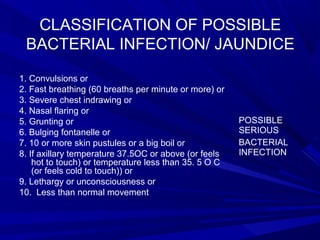
  • 50.
    Is there anyfeeding difficulty? Any difficulty mentioned by the mother is important. This mother may need counselling or specific help with a difficulty. If a mother says that the infant is not able to feed, assess breastfeeding or watch her try to feed the infant with a cup to see what she means by this. An infant who is not able to feed may have a serious infection or other life- threatening problem and should be referred urgently to hospital. Is the infant breastfed? If yes, how many times in 24 hours? The recommendation is that the young infant be breastfed as often and for as long as the infant wants, day and night. This should be 8 or more times in 24 hours.
  • 51.
    Does the infantusually receive any other foods or drinks? If yes, how often? A young infant should be exclusively breastfed. Find out if the young infant is receiving any other foods or drinks such as other milk, juice, tea, thin porridge, dilute cereal, or even water. Ask how often he receives it and the amount. You need to know if the infant is mostly fed on other foods. What do you use to feed the infant? If an infant takes other foods or drinks, find out if the mother uses a feeding bottle or cup.
  • 52.
    Infants who areVery Low Weight for Age should be referred to a hospital. Infants who are Low Weight for Age need special attention to how they are fed and on keeping them warm.
  • 53.
    How to assessbreastfeeding First decide whether to assess the infant’s breastfeeding. Do not assess Breastfeeding, if the young infant : is exclusively breastfed without difficulty and is not low weight for age is not breastfed at all. has a serious problem requiring urgent referral to a hospital In these situations, classify that feeding based on the information that you already have. If the mother’s answers or the infant’s weight indicates a difficulty, observe a breastfeed as descried below. Low weight for age is often due to low birth weight. Low birth weight infants are particularly likely to have a problem with breastfeeding. Assessing breastfeeding requires careful observation.
  • 54.
    Ulcers or whitepatches in the mouth (thrush) Look inside the mouth at the tongue and inside of the cheek. Thrush looks like milk curds on the inside of the cheek, or a thick white coating of the tongue. Try to wipe the white off. The white patches of thrush will remain.
  • 55.
    5. CHECKING IMMUNIZATIONSTATUS Immunization status should be checked in all sick young infants. A young infant who is not sick enough to be referred to a hospital should be given the necessary immunizations before s/he is sent home.
  • 56.
    IMMUNIZATION SCHEDULE: AGE VACCINE BirthBCG OPV 0 6 weeks DPT 1 OPV 1 HEP-B 1* * Hepatitis B to be given wherever included in the immunization schedule
  • 57.
    6. ASSESSING OTHERPROBLEMS All sick young infants need to be assessed for other potential problems mentioned by the mother or observed during the examination. If a potentially serious problem is found or there is no means in the clinic to help the infant, s/he should be referred to hospital. A recording form for sick young infants age up to 2 months is shown on the next page. CASE: Jatin is 6 weeks old. He weighs 4.5 kg. His temperature is 37°C. The physician asked “What are the infant’s problem?” The mother said “Jatin has diarrhea and a skin rash for the last 3days”. This is the initial visit for this illness. The physician checks the young infant for signs of possible bacterial infection/jaundice. His mother says that Jatin has not had convulsions. The physician counts 55 breaths per minute. He finds no chest indrawing or nasal flaring. Jatin has no grunting. The fontanelle does not bulge. There is no pus in his ears. The umbilicus is normal. The body temperature is normal. There are 6 skin pustules. Jatin is not lethargic or unconscious, and his movements are normal. He does not have jaundice.
  • 58.
    When the physicianasks the mother about Jatin’s diarrhoea, the mother replies that it began 3 days ago, and there is no blood in the stool. Jatin is crying. He stopped once when his mother put him to the breast. He began crying again when she stopped breastfeeding. His eyes look normal, not sunken. When the skin of his abdomen is pinched, it goes back slowly. Jatin’s mother says that she has no difficulty feeding him. He breastfeeds about 5 times in 24 hours. She gives him other foods and drinks. The physician uses the Weight for Age chart and determines that Jatin’s weight (4.5 kg.) is not low for his age (6 weeks). Since Jatin is feeding less than 8 times in 24 hours and is taking other foods or drinks, the physician decides to assess breastfeeding. Jatin’s mother agrees to breastfeed now. The physician observes that Jatin’s chin is touching the breast. His mouth is wide open and his lower lip is turned outward. More areola is visible above than below the mouth. His sucks are deep and slow. When Jatin stops breastfeeding, the physician looks in his mouth. He sees no ulcers or white patches in his mouth.
  • 59.
    EXAMPLE OF THETOP THREE SECTIONS OF THE YOUNG INFANT CASE RECORDING FORM MANAGEMENT OF THE SICK YOUNG INFANT AGE UP TO 2 MONTHS Name: Jatin Age: 6 weeks Weight: 4.5 kg Temperature 37 °C Date: ASK: What are the infant’s problems? diarrhoea and rash Initial visit? Follow-up Visit?
  • 60.
    CHECK FOR POSSIBLEBACTERIAL INFECTION / JAUNDICE ? Has the infant had convulsions? ? Count the breaths in one minute. breaths per minute Repeat if elevated ________ Fast breathing? ? Look for severe chest indrawing. ? Look for nasal flaring. ? Look and listen for grunting. ? Look and feel for bulging fontanelle. ? Look for pus draining from the ear. ? Look at the umbilicus. Is it red or draining pus? ? Look for skin pustules. Are there 10 or more pustules or a big boil? Local Bacterial Infection
  • 61.
    Measure axillary temperature (ifnot possible, feel for fever or low body temperature): 37.5°C or more (or feels hot)? Less than 35.5°C? Less than 36.5°C but above 35.4°C (or feels cold to touch)? ? See if young infant is lethargic or unconscious ? Look at young infant’s movements. Less than normal? ? Look for jaundice. Are the palms and soles yellow? Local Bacterial Infection
  • 62.
    DOES THE YOUNGINFANT HAVE DIARRHOEA? Yes ___ No ___ ? For how long? ____ Days ? ?Is there blood in the stool? ? Look at the young infant’s general condition. Is the infant: ? Lethargic or unconscious? ? Restless and irritable? ? Look for sunken eyes. ? ?Pinch the skin of the abdomen. Does it go back: Very slowly (longer than 2 seconds)? Slowly? Some Dehydration
  • 63.
    THEN CHECK FORFEEDING PROBLEM & MALNUTRITION Is there any difficulty feeding? Yes __ No _ ? Is the infant breastfed? Yes ___ No ___ If Yes, how many times in 24 hours? 6-7 times ? Does the infant usually receive any other foods or drinks? Yes ___ No ____ If Yes, how often? ? What do you use to feed the infant? If the infant has any difficulty feeding, is feeding less than 8 times in 24 hours, is taking any other food or drinks, or is low weight for age AND has no indications to refer urgently to hospital: Feeding problem Or Low Weight
  • 64.
    ASSESS BREASTFEEDING: Has theinfant breastfed in the previous hour? If infant has not fed in the previous hour, ask the mother to put her infant to the breast. Observe the breastfeed for 4 minutes. ? Is the infant able to attach? To check attachment, look for: - Chin touching breast Yes _ No - Mouth wide open Yes _ No - Lower lip turned outward Yes _ No - More areola above than below the mouth Yes _v_ No no attachment at all not well attached good attachment ? Is the infant suckling effectively (that is, slow deep sucks, sometimes pausing)? not suckling at all not suckling effectively suckling effectively Look for ulcers or white patches in the mouth (thrush).
  • 65.
    Does mother havepain while breastfeeding? If yes, then look for: ?Flat or inverted nipples, or sore nipples ?Engorged breasts or breast abscess
  • 66.
    TREATMENT OF SICKYOUNG INFANTS The first step is to IDENTIFY TREATMENT required for the young infant according to the classification. All the treatments required are listed in the "Identify Treatment" column of the ASSESS & CLASSIFY THE SICK YOUNG INFANT chart. If a sick young infant has more than one classification, treatment required for all the classifications must be identified. For some young infants, the ASSESS & CLASSIFY THE SICK YOUNG INFANT chart says "Refer URGENTLY to hospital." By hospital, we mean a health facility with inpatient beds, supplies and expertise to treat a very sick young infant. Referral may mean admission to the inpatient department of the same facility where the young infant has been examined as an outpatient.
  • 67.
    REFERRAL OF YOUNGINFANTS UP TO 2 MONTHS OF AGE All infants and children with a severe classification (pink) are referred to a hospital as soon as assessment is completed and necessary pre-referral treatment is administered. Note: If an infant only has severe dehydration and no other severe classification, and IV infusion is available in the outpatient clinic, an attempt should be made to rehydrate the sick infant. Successful referral of severely ill infants to the hospital depends on effective counselling of the caretaker. If s/he does not accept referral, available options (to treat the infant by repeated clinic or home visits) should be considered. If the caretaker accepts referral, s/he should be given a short, clear referral note, and should get information on what to do during referral transport, particularly if the hospital is distant.
  • 68.
    The first stepis to give urgent pre-referral treatment(s). Possible pre-referral treatments include: ? First dose of intramuscular or oral antibiotics ? Keeping the infant warm on the way to the hospital ? Prevention of hypoglycemia with breastmilk or sugar water ? Frequent sips of ORS solution on the way to the hospital Non-urgent treatments, e.g., wicking a draining ear or applying gentian violet paint on skin pustules, should be deferred to avoid delaying referral or confusing the caretaker. If an infant does not need urgent referral, check to see if the infant needs non-urgent referral for further assessment. These referrals are not as urgent. Other necessary treatments may be done before referral.
  • 69.
    URGENT PRE-REFERRAL TREATMENTSFOR SICK YOUNG INFANTS UP TO 2 MONTHS OF AGE TREATMENT For all infants before referral: Prevent low blood sugar by giving breastmilk or sugar water. Warm the young infant by skin to skin contact if temperature is less than 36.5oC while arranging referral. Advise mother how to keep the infant warm on the way to the hospital.
  • 70.
    CONVULSIONS If theinfant is convulsing, give diazepam (10 mg/2 ml solution) in dose 0.2 mg/kg (0.05 ml/kg) IV or rectally; if convulsions continue after 10 minutes, give a second dose of diazepam. Use Phenobarbital (200 mg/ml solution) in a dose of 20 mg/kg IM to control convulsions in infants less than 2 weeks of age.
  • 71.
    POSSIBLE SERIOUS BACTERIAL INFECTION AND/ORSEVERE DEHYDRATION OR SOME DEHYDRATION WITH LOW WEIGHT AND/OR SEVERE PERSISTENT DIARRHOEA / DYSENTERY WITH LOW WEIGHT OR DEHYDRATION AND/OR NOT ABLE TO FEED – POSSIBLE SERIOUS BACTERIAL INFECTION OR SEVERE MALNUTRITION Give first dose of intramuscular antibiotics. The recommended choices are gentamicin (5 mg/kg) plus ampicillin (100 mg per kg), OR ceftriaxone (100 mg per kg) OR cefotaxime (50 mg per kg).
  • 72.
    TREATMENT IN OUTPATIENTCLINICS 1. ORAL DRUGS The first dose of oral drugs for a young infant should always be given in the clinic. In addition, the mother or caretaker should be taught how to give an oral antibiotic at home. That is, teaching how to measure a single dose, showing how to crush a tablet and mix it with breastmilk, and teaching the treatment schedule. Note: Avoid giving cotrimoxazole to a young infant less than 1 month of age who is premature or jaundiced. Give this infant amoxycillin or ampicillin instead.
  • 73.
    2. TREATMENT OFLOCAL INFECTIONS There are three types of local infections in a sick young infant that a caretaker can treat at home: an umbilicus that is red or draining pus, skin pustules, or thrush. These local infections are treated with gentian violet.
  • 74.
    COUNSELLING A MOTHEROR CARETAKER USE GOOD COMMUNICATION SKILLS It is important to have good communication with the infant’s mother or caretaker from the beginning of the visit. ? Ask and Listen to find out what the infant’s problems are and what the mother is already doing for the infant. ? Praise the mother for what she has done well. ? Advise her how to care for her infant at home. ? Check the mother’s understanding.
  • 75.
    ASK AND LISTENTO FIND OUT WHAT THE INFANT’S PROBLEMS ARE AND WHAT THE MOTHER IS ALREADY DOING FOR HER CHILD You have already learned the importance of asking questions to assess the infant’s problems. Listen carefully to find out what the infant ’s problems are and what the mother is already doing for her child. Then you will know what she is doing well, and what practices need to be changed. PRAISE THE MOTHER FOR WHAT SHE HAS DONE WELL It is likely that the mother is doing something helpful for the infant, for example, breastfeeding. Praise the mother for something helpful she has done. Be sure that the praise is genuine, and only praise actions that are indeed helpful to the infant.
  • 76.
    ADVICE THE MOTHERHOW TO CARE FOR HER CHILD AT HOME Limit your advice to what is relevant to the mother at this time. Use language that the mother will understand. If possible, use pictures or real objects to help explain. For example, show amounts of fluid in a cup or container. Advice against any harmful practices that the mother may have used. When correcting a harmful practice, be clear, but also be careful not to make the mother feel guilty or incompetent. Explain why the practice is harmful. Some advice is simple. For example, you may only need to tell the mother to return with the infant for follow-up in 2 days. Other advice requires that you teach the mother how to do a task. Teaching how to do a task requires several steps.
  • 77.
    Think about howyou learned to write, cook or do any other task that involved special skills. You were probably first given instruction. Then you may have watched someone else. Finally you tried doing it yourself. When you teach a mother how to treat an infant , use 3 basic teaching steps: 1. Give information. 2. Show an example. 3. Let her practice.
  • 78.
    Give information: Explainto the mother how to do the task. For example, explain to the mother how to prepare ORS Show an example: Show how to do the task. For example, show the mother a packet of ORS and how to mix the right amount of water with ORS Let her practice: Ask the mother to do the task while you watch. For example, have the mother mix ORS solution. It may be enough to ask the mother to describe how she will do the task at home.
  • 79.
    Letting a motherpractice is the most important part of teaching a task. If a mother does a task while you observe, you will know what she understands and what is difficult. You can then help her do it better. The mother is more likely to remember something that she has practiced than something that she has heard. When teaching the mother: ? Use words that she understands. ? Use teaching aids that are familiar, such as common containers for mixing ORS solution. ? Give feedback when she practices. Praise what was done well and make corrections. ? Allow more practice, if needed. ? Encourage the mother to ask questions. Answer all questions.
  • 80.
    CHECK THE MOTHER’SUNDERSTANDING Ask questions to find out what the mother understands and what needs further explanation. Avoid asking leading questions (that is, questions which suggest the right answer) and questions that can be answered with a simple yes or no. Examples of good checking questions are: “What foods will you give your child?” “How often will you give them?” If you get an unclear response, ask another checking question. Praise the mother for correct understanding or clarify your advice as necessary.
  • 81.
    After you teacha mother how to treat her child, you want to be sure that she understands how to give the treatment correctly. Checking questions find out what a mother has learned. An important communication skill is knowing how to ask good checking questions. A checking question must be phrased so that the mother answers more than “yes” or “no”. good checking questions require that she describe why, how or when she will give a treatment.
  • 82.
    From her answeryou can tell if she has understood you and learned what you taught her about the treatment. If she cannot answer correctly, give more information or clarify your instructions. For example, you taught a mother how to give an antibiotic. Then you ask: “Do you know how to give your infant his medicine?” The mother would probably answer “yes” whether she understands or not. She may be embarrassed to say she does not understand. However, if you ask a few good checking questions, such as:
  • 83.
    “When will yougive your infant the medicine?” “How many tablets will you give each time?” “For how many days will you give the tablets?” You are asking the mother to repeat back to you instructions that you have given her. Asking good checking questions helps you make sure that the mother learns and remembers how to treat her infant. The following questions check a mother’s understanding. “Good checking questions” require the mother to describe how she will treat her child. They begin with question words, such as why, what, how, when, how many, and how much. The “poor questions”, answered with a “yes” or “no”, do not show you how much a mother knows.
  • 84.
    After you aska question, pause. Give the mother a chance to think and then answer. Do not answer the question for her. Do not quickly ask a different question. Asking checking questions requires patience. The mother may know the answer, but she may be slow to speak. She may be surprised that you really expect her to answer. She may fear her answer will be wrong. She may feel shy to talk to an authority figure. Wait for her to answer. Give her encouragement.
  • 85.
    GOOD CHECKING QUESTIONS How willyou prepare the ORS solution? How often should you breastfeed your child? On what part of the eye do you apply the ointment? How much extra fluid will you give after each loose stool? Why is it important for you to wash your hands? POOR QUESTIONS Do you remember how to mix the ORS? Should you breastfeed your child? Have you used ointment on your child before? Do you know how to give extra fluids? Will you remember to wash your hands?
  • 86.
    If the motheranswers incorrectly or says she does not remember, be careful not to make her feel uncomfortable. Teach her to give the treatment again. Give more information, examples or practice to make sure she understands. Then ask her good checking questions again.
  • 87.
    A mother mayunderstand but may say that she cannot do as you ask. She may have a problem or objection. Common problems are lack of time or resources to give the treatment. A mother may object that her sick infant was given a n oral drug rather than an injection, or a home remedy rather than a drug. Help the mother think of possible solutions to her problems and respond to her objections. For example , if you ask: “What container will you use to measure 1 litre of water for mixing ORS?”
  • 88.
    The mother mayanswer that she does not have a 1-litre container at home. Ask her what containers she does have at home. Show her how to measure 1 litre of water in her container. Explain how to mark the container at 1 litre with an appropriate tool or how to measure 1 litre using several smaller containers. When checking the mother’s understanding: ? Ask questions that require the mother to explain what, how, how much, how many, when, or why. Do not ask questions that can be answered with just a “yes” or “no”. ? Give the mother time to think and then answer. ? Praise the mother for correct answers. ? If she needs it, give more information, examples or practice
  • 89.
    Counselling the motheror caretaker of a sick young infant includes the following essential elements: ? Teach how to give oral drugs ? Teach how to treat local infection. ? Teach how to manage breast or nipple problem ? Teach correct positioning and attachment for breastfeeding. ? Counsel on other feeding problems. ? Advise when to return. ? Counsel the mother about her own health
  • 90.
    Teach how togive oral drugs Oral drugs are given for different reasons, in different doses and on different schedules. However, the way to give each drug is similar. This section will give you the basic steps for teaching mothers to give oral drugs. If a mother learns how to give a drug correctly, then the child will be treated properly. Follow the instructions below for every oral drug you give to the mother. DETERMINE THE APPROPRIATE DRUGS AND DOSAGE FOR THE CHILD’S AGE OR WEIGHT Use the TREAT THE YOUNG INFANT pages of the chart book to determine the appropriate drug and dosage to give the infant.
  • 91.
    TELL THE MOTHERTHE REASON FOR GIVING THE DRUG TO THE CHILD, INCLUDING: - why you are giving the oral drug to her child, and - what problem it is treating. DEMONSTRATE HOW TO MEASURE A DOSE. Collect a container of the drug and check its expiry date. Do not use expired drugs. Count out the amount needed for the child. Close the container. If you are giving the mother tablets: Show the mother the amount to give per dose. If needed, show her how to divide a tablet. If a tablet has to be crushed before it is given to an infant , add a few drops of clean water and wait a minute or so. The water will soften the tablet and make it easier to crush.
  • 92.
    If you aregiving the mother syrup: Show the mother how to measure the correct number of milliliters (ml) for one dose at home. Use the bottle cap or a common spoon, such as a spoon used to stir sugar into tea or coffee. Show her how to measure the correct dose with the spoon. One teaspoon (tsp.) equals approximately 5.0 ml (see below). MILLILITRES (ml) 1.25 ml 2.5 ml 5.0 ml 7.5 ml 10.0 ml 15 ml TEASPOONS (tsp.) 1/4 tsp. ½ tsp. 1 tsp. 1½ tsp. 2 tsp. 3 tsp.
  • 93.
    WATCH THE MOTHERPRACTICE MEASURING A DOSE BY HERSELF Ask the mother to measure a dose by herself. If the dose is in tablet form and the infant cannot swallow a tablet, tell the mother to crush the tablet. Watch her as she practices. Tell her what she has done correctly. If she measured the dose incorrectly, show her again how to measure it. ASK THE MOTHER TO GIVE THE FIRST DOSE TO HER INFANT Explain that if an infant is vomiting, give the drug even though the infant may vomit it up. Tell the mother to watch the infant for 30 minutes. If the infant vomits within the 30 minutes (the tablet or syrup may be seen in the vomit), give another dose. If the infant is dehydrated and vomiting, wait until the child is rehydrated before giving the dose again.
  • 94.
    EXPLAIN CAREFULLY HOWTO GIVE THE DRUG, THEN LABEL AND PACKAGE THE DRUG Tell the mother how much of the drug to give her infant . Tell her how many times per day to give the dose. Tell her when to give it (such as early morning, lunch, dinner, before going to bed) and for how many days.
  • 95.
    Follow the stepsbelow: a. Write the full name of the drug and the total amount of tablets, capsules or syrup to complete the course of treatment. b. Write the correct dose for the patient to take (number of tablets, capsules, squirts or spoonfuls, that is, ½, 1, 1 ½…). Write when to give the dose (early morning, lunch, dinner, before going to bed). c. Write the daily dose and schedule, such as ½ tablet twice daily for 5 days Write the instructions clearly so that a literate person is able to read and understand them. Put the total amount of each drug into its own labelled drug container (an envelope, paper, tube or bottle). Keep drugs clean. Use clean containers. After you have labelled and packaged the drug, give it to the mother. Ask checking questions to make sure she understands how to treat her infant.
  • 96.
    IF MORE THANONE DRUG WILL BE GIVEN, COLLECT, COUNT AND PACKAGE EACH DRUG Collect one drug at a time. Write the instructions on the label. Count out the amount needed. Put enough of the drug into its own, labelled, package. Finish packaging the drug before you open another drug container. Explain to the mother that her child is getting more than one drug because he had more than one illness. Show the mother the different drugs. Explain how to give each drug. If necessary, draw a summary of the drugs and times to give each drug during the day. EXPLAIN THAT ALL THE ORAL DRUG TABLETS OR SYRUPS MUST BE USED TO FINISH THE COURSE OF TREATMENT, EVEN IF THE INFANT GETS BETTER Explain to the mother that if the infant seems better, she should continue to treat the infant. This is important because the bacteria may still be present even though the signs of disease are gone. Advise the mother to keep all medicines out of the reach of children. Also tell her to store drugs in a dry and dark place that is free of mice and insects.
  • 97.
    CHECK THE MOTHER’sUNDERSTANDING BEFORE SHE LEAVES THE CLINIC. Ask the mother checking questions, such as: “How much will you give each time?” “When will you give it?” “For how many days?” “How will you prepare this tablet?” “Which drug will you give 3 times per day?” If you feel that the mother is likely to have problems when she gives her infant the drug(s) at home, offer more information, examples and practice. A child needs to be treated correctly to get better. In some clinics, a drug dispenser has the task of teaching the mother to give treatment and checking the mother’s understanding. If this is your situation, teach the skills you are learning in this section to that dispenser.
  • 98.
    Teach the caretakerto treat local infections at home Local infections include thrush, an umbilicus that is red or draining pus, skin pustules, and ear infection. When teaching a mother or caretaker, explain what the treatment is and why it should be given and describe the treatment steps. Watch the mother as she does the first treatment in the clinic and tell her how often to do the treatment at home. If needed for treatment at home, give mother a small bottle of gentian violet. Check the mother’s understanding before she leaves the clinic.
  • 99.
    Dry the earby wicking. To teach a mother how to dry the ear by wicking, first tell her it is important to keep an infected ear dry to allow it to heal. Then show her how to wick her child’s ear. As you wick the child’s ear, tell the mother to use clean, absorbent cotton cloth or soft strong tissue paper for making a wick. Do not use a cotton- tipped applicator, a stick or flimsy paper that will fall apart in the ear. Place the wick in the child’s ear until the wick is wet. Replace the wet wick with a clean one. Repeat these steps until the wick stays dry. Then the ear is dry. Observe the mother as she practices. Give feedback. When she is finished, give her the information on frequency and duration of treatment.
  • 100.
    Treat Skin Pustulesor Umbilical Infection. For umbilical or skin infection, use 0.5% gentian violet twice each day. Explain and demonstrate the treatment to the mother. Then watch her and guide her as needed while she gives the treatment. Ask her checking questions to be sure that she knows to give the treatment twice daily and when to return. Teach correct positioning and attachment for breastfeeding There are several reasons that an infant may be poorly attached or not able to suckle effectively. He may have had bottle feeds, especially in the first few days after delivery. His mother may be inexperienced. She may have had some difficulty and nobody to help or advise her. For example, perhaps the infant was small and weak, the mother's nipples were flat or there was a delay starting to breastfeed.
  • 101.
    The infant maybe poorly positioned at the breast. Positioning is important because poor positioning often results in poor attachment, especially in younger infants. If the infant is positioned well, the attachment is likely to be good. Good positioning is recognized by the following signs: - Infant's neck is straight or bent slightly back, - Infant's body is turned towards the mother, - Infant's body is close to the mother, and - Infant's whole body is supported. Poor positioning is recognized by any of the following signs: - Infant's neck is twisted or bent forward, - Infant's body is turned away from mother, - Infant's body is not close to mother, or - Only the infant's head and neck are supported
  • 102.
    Baby's body close,facing breast Baby's body away from mother, neck twisted
  • 103.
    Teach the motherto express breast milk and feed with a cup and spoon Expression of breast milk is usually required for feeding infants who do not suck effectively but are able to swallow effectively (as in the case of low birth weight babies) or when there are breast or nipple problems. The expressed breast milk is usually fed with a cup and spoon. The mother is made to sit comfortably and hold the cup near her breast with one hand. With the other hand, the mother is asked to place her thumb above and her first finger below the nipple and areola. Then she is asked to push her thumb and finger slightly inwards towards the chest wall and then press the nipple between the thumb and finger. She must repeatedly press and release. This repeated action would allow to milk to drip out. She must repeat this action also from the sides of the areola to make sure that milk is expressed from all quadrants. Expression must be continued for 3-5 minutes until the milk flow slows down. The mother must perform the expression form both breasts and it may take her about 15-20 minutes to express both breasts completely.
  • 105.
    Treat thrush withgentian violet. Teach the mother to treat thrush with half –strength gentian violet (0.25%). Tell the mother that her infant will start feeding normally sooner if she paints the mouth ulcers in her infant’s mouth. Ask her to use a clean cloth or a cotton-tipped stick to paint gentian violet on the mouth ulcers and put a small amount of gentian violet on the cloth or stick. Tell the mother the frequency and duration of treatment. Show the mother how to paint half of the infant’s mouth with half -strength gentian violet. Ask the mother to practice. Watch her paint the rest of the mouth with gentian violet. Comment on the steps she did well and those that need to be improved. Give the mother a bottle of half-strength gentian violet to take home. Before the mother leaves, ask checking questions. If she anticipates any problems providing the treatment, help her to solve them.
  • 106.
    Teach the motherto manage breast and nipple problems During the first few weeks after birth, breast and nipple problems can be important causes of feeding problems and poor growth in young infants. Some of the common problems are flat or inverted nipples, sore nipples or breast abscess in the mother. Flat or inverted nipples: If the mother has flat or inverted nipples, the baby can have difficulty in attaching to the breast, which can result in decreased lactation and poor weight gain in the infant. The nipple should be everted with fingers before the infant is put to breast during a feed. This will help the infant to attach well onto the breast. After a few days the nipples will remain everted.
  • 108.
    Sore nipples: Sorenipples are almost always due to faulty attachment of the infant onto the mother’s breast. The mother should be helped to ensure that attachment and position are correct. To alleviate the discomfort due to soreness, the mother should be advised to apply breast milk on the affected nipple. If the baby’s sucking causes a lot of discomfort to the mother inspite of correct positioning, the mother should be advised to express the breast milk and feed it with a cup and spoon to the infant, till she is able once again able to breast feed the infant without much discomfort (this would usually take about 1-2 days). Engorged breasts and Breast abscess: Engorged breasts are swollen, hard and tender. Breast abscess is often due to breast engorgement and rarely due to primary infection of the breast. The mother should be encouraged to feed from the unaffected breast and referred to a health facility for treatment of the abscess. If the amount of milk from a single breast is inadequate, then undiluted animal milk with added sugar can be fed with cup and spoon.
  • 109.
    Counselling about OtherFeeding Problems * If a mother is breastfeeding her infant less than 8 times in 24 hours, advise her to increase the frequency of breastfeeding. Breastfeed as often and for as long as the infant wants, day and night. * If the infant receives other foods or drinks, counsel the mother about breastfeeding more, reducing the amount of the other foods or drinks, and if possible, stopping altogether. Advise her to feed the infant any other drinks from a cup, and not from a feeding bottle. * If the mother does not breastfeed at all, consider referring her for breastfeeding counselling and possible re-lactation. If the mother is interested, a breastfeeding counsellor may be able to help her to overcome difficulties and begin breastfeeding again. Advise a mother who does not breastfeed about choosing and correctly preparing dairy/locally appropriate animal milk. Also advise her to feed the young infant with a cup, and not from a feeding bottle.
  • 110.
    Advise when toreturn A) IMMEDIATELY Advise to return immediately if the infant has any of these signs: ? Breastfeeding or drinking poorly ? Becomes sicker ? Develops a fever or feels cold to touch ? Fast breathing ? Difficult breathing ? Yellow palms and soles (if young infant has jaundice) ? Diarrhoea with blood in stool
  • 111.
    B) FOR FOLLOW-UPVISIT If the infant has: Return for follow -up not later than: LOCAL BACTERIAL INFECTION JAUNDICE DIARRHOEA ANY FEEDING PROBLEM THRUSH LOW WEIGHT FOR AGE C) NEXT WELL-CHILD VISIT Advise when to return for the next immunization according to immunization schedule. 2 days 14 days
  • 112.
    FOLLOW-UP CARE If thechild does not have a new problem, use the IMNCI follow-up instructions for each specific problem: ? Assess the child according to the instructions; ? Use the information about the child's signs to select the appropriate treatment; ? Give the treatment. Follow-up visits are recommended for young infants who are classified as: ? Local bacterial infection ? Feeding problem or low weight (including thrush)
  • 113.
    COUNSEL THE MOTHERABOUT HER OWN HEALTH During a sick infant visit, listen for any problems that the mother herself may be having. The mother may need treatment or referral for her own health problems. If the mother is sick, provide care for her, or refer her for help. Advise her to eat well to keep up her own strength and health. Check the mother’s immunization status and give her tetanus toxoid if needed. Give the mother iron folic acid tablets if she is not already taken them. Make sure she has access to family planning and counselling on STD and AIDS prevention.
  • 114.
    OUTPATIENT MANAGEMENT OF CHILDRENAGE 2 MONTHS UP TO 5 YEARS ASSESSMENT OF SICK CHILDREN The assessment procedure for this age group includes a number of important steps that must be taken by the health care provider, including: (1) history taking and communicating with the caretaker about the child’s problem; (2) checking for general danger signs; (3) checking main symptoms; (4) checking for malnutrition; (5) checking for anaemia; (6) assessing the child’s feeding; (7) checking immunization status; and (8) assessing other problems.
  • 115.
    DANGER SIGNS 1. CONVULSIONS 2.INABILITY TO DRINK OR BREASTFEED 3. VOMITING 4. LETHARGY 5. UNCONSCIOUSNESS
  • 116.
    The following dangersigns should be routinely checked in all children. ? The child has had convulsions during the present illness. Convulsions may be associated with meningitis, cerebral malaria or other life-threatening conditions. On the other hand, convulsions may be the result of fever and in this instance, they do little harm beyond frightening the mother. All children who have had convulsions during the present illness should be considered seriously ill because the more serious causes of convulsions cannot be differentiated from febrile convulsions without investigations conducted in a hospital. ? The child is unconscious or lethargic. An unconscious child is likely to be seriously ill. A lethargic child, who is awake but does not take any notice of his or her surroundings or does not respond normally to sounds or movement, may also be very sick. These signs may be associated with many conditions. ? The child is unable to drink or breastfeed. A child may be unable to drink either because s/he is too weak or because s/he cannot swallow. Do not rely completely on the mother's evidence for this, but observe while she tries to breastfeed or to give the child something to drink. ? The child vomits everything. The vomiting itself may be a sign of serious illness, but it is also important to note because such a child will not be able to take medication or fluids for rehydration.
  • 117.
    CHECKING MAIN SYMPTOMS Afterchecking for general danger signs, the health care provider must check for the following main symptoms : (1) cough or difficult breathing; (2) diarrhoea; (3) fever; and (4) ear problems. The first three symptoms are included because they often result in death. Ear problems are included because they are considered one of the main causes of childhood disability.
  • 118.
    Respiratory infections canoccur in any part of the respiratory tract such as the nose, throat, larynx, trachea, air passages or lungs. A child with cough or difficult breathing may have pneumonia or another severe respiratory infection. Pneumonia is an infection of the lungs. Both bacteria and viruses can cause pneumonia. In developing countries, pneumonia is often due to bacteria. The most common are Streptococcus pneumoniae and Hemophilus influenzae. Children with bacterial pneumonia may die from hypoxia (too little oxygen) or sepsis (generalized infection). Many children are brought to the clinic with less serious respiratory infections. Most children with cough or difficult breathing have only a mild infection. For example, a child who has a cold may cough because nasal discharge drips down the back of the throat. Or the child may have a viral infection of the bronchi called bronchitis. These children are not seriously ill. They do not need treatment with antibiotics. Their families can manage them at home.
  • 119.
    When children developpneumonia, their lungs become stiff. One of the body’s responses to stiff lungs and hypoxia (too little oxygen) is fast breathing. When the pneumonia becomes more severe, the lungs become even stiffer. Chest indrawing may develop. Chest indrawing is a sign of severe pneumonia. A child presenting with cough or difficult breathing should first be assessed for general danger signs. This child may have pneumonia or another severe respiratory infection.
  • 120.
    CLINICAL ASSESSMENT Three keyclinical signs are used to assess a sick child with cough or difficult breathing: ? Respiratory rate, which distinguishes children who have pneumonia from those who do not; ? Lower chest wall indrawing, which indicates severe pneumonia; and ? Stridor , which indicates those with severe pneumonia who require hospital admission.
  • 121.
    Cut-off rates forfast breathing (the point at which breathing is considered to be fast) depend on the child’s age. Normal breathing rates are higher in children age 2 months up to 12 months than in children age 12 months up to 5 years. Child’s Age Cut-off Rate for Fast Breathing 2 months up to 12 months 12 months up to 5 years 50 breaths per minute or more 40 breaths per minute or more
  • 122.
    Lower chest wallindrawing, defined as the inward movement of the bony structure of the chest wall with inspiration, is a useful indicator of severe pneumonia. It is more specific than “intercostal indrawing,” which concerns the soft tissue between the ribs without involvement of the bony structure of the chest wall. Chest indrawing should only be considered present if it is consistently present in a calm child. Agitation, a blocked nose or breastfeeding can all cause temporary chest indrawing. Any chest indrawing, even if it is not severe, is an indicator of severe pneumonia in a child age 2 months up to 5 years.
  • 123.
    Stridor is aharsh noise made when the child breathes IN. Stridor happens when there is a swelling of the larynx, trachea or epiglottis. These conditions are often called croup. This swelling interferes with air entering the lungs. It can be life threatening when the welling causes the child’s airway to be blocked. A child who has stridor when calm has a dangerous condition. To look and listen for stridor, look to see when the child breathes IN. Then listen for stridor by putting your ear near the child’s mouth because stridor can be difficult to hear. Sometimes you will hear a wet noise if the child’s nose is blocked. Clear the nose, and listen again. A child who is not very ill may have stridor only when he is crying or upset. Be sure to look and listen for stridor when the child is calm. You may hear a wheezing noise when the child breathes OUT. This is not stridor.
  • 124.
    Classification of Coughor Difficult Breathing Based on a combination of the above clinical signs, children presenting with cough or difficult breathing can be classified into three categories: Those who require referral for possible SEVERE PNEUMONIA OR VERY SEVERE DISEASE. This group includes children with any general danger sign, or lower chest indrawing or stridor when calm. Children with SEVERE PNEUMONIA OR VERY SEVERE DISEASE most likely will have invasive bacterial organisms and diseases that may be life- threatening. This warrants the use of injectable antibiotics.
  • 125.
    DIARRHOEADIARRHOEA Diarrhoea is thenext symptom that should be routinely checked in every child brought to the clinic. Diarrhoea occurs when stools contain more water than normal. It is common in children, especially those between 6 months and 2 years of age. It is more common in babies under 6 months who are drinking cow’s milk or infant formulas. Frequent passing of normal stools in not diarrhoea. The number of stools normally passed in a day varies with the diet and age of the child. In many regions diarrhoea is defined as three or more loose or watery stools in a 24- hour period. Mothers usually know when their children have diarrhoea. They may say that the child’s stools are loose or watery. Mothers may use a local word for diarrhoea.
  • 126.
    Babies who areexclusively breastfed often have stools that are soft; this is not diarrhoea. The mother of a breastfed baby can recognize diarrhoea because the consistency or frequency of the stools is different than normal. A child presenting with diarrhoea should first be assessed for general danger signs and the child's caretaker should be asked if the child has cough or difficult breathing. A child with diarrhoea may have three potentially lethal conditions: (1) acute watery diarrhoea (including cholera); (2) dysentery (bloody diarrhoea); and (3) persistent diarrhoea (diarrhoea that lasts 14 days or more). All children with diarrhoea should be assessed for: (a) signs of dehydration; (b) how long the child has had diarrhoea; and (c) blood in the stool to determine if the child has dysentery.
  • 127.
    CLINICAL ASSESSMENT All childrenwith diarrhoea should be checked to determine the duration of diarrhoea, if blood is present in the stool and if dehydration is present. A number of clinical signs are used to determine the level of dehydration: Child’s general condition. Assess if the child is lethargic or unconscious or is restless /irritable. Sunken eyes. Child’s reaction when offered to drink . A child is not able to drink if s/he is not able to take fluid in his/her mouth and swallow it. For example, a child may not be able to drink because s/he is lethargic or unconscious. A child is drinking poorly if the child is weak and cannot drink without help. S/he may be able to swallow only if fluid is put in his/her mouth. A child has the sign drinking eagerly, thirsty if it is clear that the child wants to drink. Notice if the child reaches out for the cup or spoon when you offer him/her water. When the water is taken away, see if the child is unhappy because s/he wants to drink more. If the child takes a drink only with encouragement and does not want to drink more, s/he does not have the sign “drinking eagerly, thirsty.”
  • 128.
    Elasticity of skin.Check elasticity of skin using the skin pinch test. When released, the skin pinch goes back either very slowly (longer than 2 seconds), or slowly (skin stays up even for a brief instant), or immediately . In a child with marasmus (severe malnutrition), the skin may go back slowly even if the child is not dehydrated. In an overweight child, or a child with oedema, the skin may go back immediately even if the child is dehydrated. After the child is assessed for dehydration, the caretaker of a child with diarrhoea should be asked how long the child has had diarrhoea and if there is blood in the stool. This will allow identification of children with persistent diarrhoea and dysentery.
  • 129.
    CLASSIFICATION OF DEHYDRATION Basedon a combination of the above clinical signs, children presenting with diarrhoea are classified into three categories: 1. SEVERE DEHYDRATION. A child is severely dehydrated if he/she has any combination of two of the following signs: is lethargic or unconscious, is not able to drink or is drinking poorly, has sunken eyes, or a skin pinch goes back very slowly. Patients have severe dehydration if they have a fluid deficit greater than 10 percent of their body weight. Children who have SEVERE DEHYDRATION require immediate IV infusion, nasogastric or oral fluid replacement according to the WHO treatment guidelines described in Plan C
  • 130.
    CLASSIFICATION OF DEHYDRATION 2.SOME DEHYDRATION. Children who have any combination of the following two signs are included in this group: restless/irritable, sunken eyes, drinks eagerly/thirsty, skin pinch goes back slowly. Children with some dehydration have a fluid deficit equalling 5 to 10 percent of their body weight. This classification includes both "mild" and "moderate” dehydration, which are descriptive terms used in most paediatric textbooks. Children who have SOME DEHYDRATION require active oral treatment with ORS solution according to WHO treatment guidelines described in Plan B.
  • 131.
    CLASSIFICATION OF DEHYDRATION 3.NO DEHYDRATION. Patients with diarrhoea but no signs of dehydration usually have a fluid deficit, but equal to less than 5 percent of their body weight. Although these children lack distinct signs of dehydration, they should be given more fluid than usual to prevent dehydration from developing as specified in WHO Treatment Plan A Note: Anti-diarrhoeal drugs — including anti-motility agents (e.g., loperamide, diphenoxylate, codeine, tincture of opium), adsorbents (e.g., kaolin ), live bacterial cultures (e.g., Lactobacillus, Streptococcus faecium), and charcoal — do not provide practical benefits for children with acute diarrhoea, and some may have dangerous side effects. These drugs should never be given to children less than 5 years old.
  • 132.
    Classification of PersistentDiarrhoea Persistent diarrhoea is an episode of diarrhoea, with or without blood, which begins acutely and lasts at least 14 days. It accounts for up to 15 percent of all episodes of diarrhoea but is associated with 30 to 50 percent of deaths. Persistent diarrhoea is usually associated with weight loss and often with serious non-intestinal infections. Many children who develop persistent diarrhoea are malnourished, greatly increasing the risk of death. Persistent diarrhoea is uncommon in infants who are exclusively breast-fed.
  • 133.
    All children withdiarrhoea for 14 days or more should be classified based on the presence or absence of any dehydration: Children with SEVERE PERSISTENT DIARRHOEA who also have any degree of dehydration require special treatment and should not be managed at the outpatient health facility. Referral to a hospital is required. As a rule, treatment of dehydration should be initiated first, unless there is another severe classification. Children with PERSISTENT DIARRHOEA and no signs of dehydration can be safely managed in the outpatient clinic, at least initially.
  • 134.
    Proper feeding isthe most important aspect of treatment for most children with persistent diarrhoea. The goals of nutritional therapy are to: (a) temporarily reduce the amount of animal milk (or lactose) in the diet; (b) provide a sufficient intake of energy, protein, vitamins and minerals to facilitate the repair process in the damaged gut mucus and improve nutritional status; (c) avoid giving foods or drinks that may aggravate the diarrhoea; and (d) ensure adequate food intake during convalescence to correct any malnutrition. Routine treatment of persistent diarrhoea with antimicrobials is not effective. Some children, however, have non-intestinal (or intestinal) infections that require specific antimicrobial therapy. The persistent diarrhoea of such children will not improve until these infections are diagnosed and treated correctly.
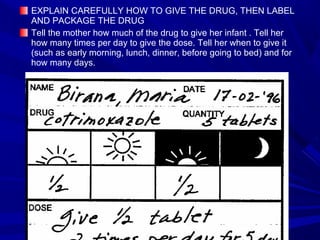
  • 135.
    CLASSIFICATION OF DYSENTERY Themother or caretaker of a child with diarrhoea should be asked if there is blood in the stool. ? A child is classified as having DYSENTERY if the mother or caretaker reports blood in the child’s stool. It is not necessary to examine the stool or perform laboratory tests to diagnose dysentery. Stool culture to detect pathogenic bacteria is rarely possible. Moreover, at least two days are required to obtain the results of a culture. Although “dysentery” is often described as a syndrome of bloody diarrhoea with fever, abdominal cramps, rectal pain and mucoid stools, these features do not always accompany bloody diarrhoea, nor do they necessarily define its aetiology or determine appropriate treatment.
  • 136.
    Bloody diarrhoea inyoung children is usually a sign of invasive enteric infection that carries a substantial risk of serious morbidity and death. About 10 percent of all diarrhoea episodes in children under 5 years old are dysenteric, but these cause up to 15 percent of all diarrhoeal deaths. Dysentery is especially severe in infants and in children who are undernourished, who develop clinically evident dehydration during their illness, or who are not breast -fed. It also has a more harmful effect on nutritional status than acute watery diarrhoea. Dysentery occurs with increased frequency and severity in children who have measles or have had measles in the preceding month, and diarrhoeal episodes that begin with dysentery are more likely to become persistent than those that start without blood in the stool.
  • 137.
    All children withdysentery (bloody diarrhoea) should be treated promptly with an antibiotic effective against Shigella because: (a) bloody diarrhoea in children under 5 is caused much more frequently by Shigella than by any other pathogen; (b) shigellosis is more likely than other causes of diarrhoea to result in complications and death if effective antimicrobial therapy is not begun promptly; and (c) early treatment of shigellosis with an effective antibiotic substantially reduces the risk of severe morbidity or death.
  • 138.
    FEVERFEVER All sick childrenshould be checked for fever. Fever is a very common condition and is often the main reason for bringing children to the health centre. It may be caused by minor infections, but may also be the most obvious sign of a life-threatening illness, particularly malaria (especially lethal malaria P.falciparum), or other severe infections, including meningitis, typhoid fever, or measles. When diagnostic capacity is limited, it is important first to identify those children who need urgent referral with appropriate pre-referral treatment (antimalarial or antibacterial).
  • 139.
    Clinical Assessment Body temperatureshould be checked in all sick children brought to an outpatient clinic. Children are considered to have fever if their body temperature is above 37.5°C axillary (38°C rectal). In the absence of a thermometer, children are considered to have fever if they feel hot. Fever also may be recognised based on a history of fever. A child presenting with fever should be assessed for: Risk of malaria . In situations where routine microscopy is not available or the results may be delayed, the risk of malaria transmission must be defined. The National Anti- Malaria Program has defined areas of high and low malaria risk in the country.
  • 140.
    Duration of fever.Most fevers due to viral illnesses go away within a few days. A fever that has been present every day for more than seven days can mean that the child has a more severe disease such as typhoid fever. If the fever has been present for more than seven days, it is important to check whether the fever has been present every day. Bulging fontanelle. The anterior fontanelle is open for most of the period of infancy before it is closed by the growth of the surrounding bones. If open, feel for bulging of the fontanelle just as you did for young infants. Stiff neck. A stiff neck may be a sign of meningitis, cerebral malaria or another very severe febrile disease. If the child is conscious and alert, check stiffness by tickling the feet, asking the child to bend his/her neck to look down or by very gently bending the child’s head forward. It should move freely.
  • 141.
    Runny nose. Whenmalaria risk is low, a child with fever and a runny nose does not need an antimalarial. This child's fever is probably due to a common cold. Measles. Considering the high risk of complications and death due to measles, children with fever should be assessed for signs of current or previous measles (within the last three months). Measles deaths occur from pneumonia and laryngotracheitis (67 percent), diarrhoea (25 percent), measles alone, and a few from encephalitis. Other complications (usually non fatal) include conjunctivitis, otitis media, and mouth ulcers. Significant disability can result from measles including blindness, severe malnutrition, chronic lung disease (bronchiectasis and recurrent infection), and neurologic dysfunction.
  • 142.
    In measles, ared rash begins behind the ears and on the neck. It spreads to the face. During the next day, the rash spreads to the rest of the body, arms and legs. After 4 to 5 days, the rash starts to fade and the skin may peel. Some children with severe infection may have mor e rash spread over more of the body. The rash becomes more discolored (dark brown or blackish), and there is more peeling of the skin. A measles rash does not have vesicles (blisters) or pustules. The rash does not itch. Do not confuse measles with other common childhood rashes such as chicken pox, scabies or heat rash. (The chicken pox rash is a generalized rash with vesicles. Scabies occurs on the hands, feet, ankles, elbows, buttocks and axilla. It also itches. Heat rash can be a generalized rash with small bumps and vesicles that itch. A child with heat rash is not sick).
  • 143.
    If the childhas measles currently or within the last three months, s/he should be assessed for possible complications. Measles damages the epithelial surfaces and the immune system, and lowers vitamin A levels. This results in increased susceptibility to infections caused by pneumococcus, gram-negative bacteria, and adenovirus. Recrudescence of herpes virus, Candida, and malaria can also occur during measles infection. It is important to check every child with recent or current measles for possible mouth or eye complications. Clouding of the cornea is a dangerous eye complication. It may be due to vitamin A deficiency that has been made worse by measles. If not treated, cornea can ulcerate and cause blindness. An infant with corneal clouding needs urgent treatment with vitamin A. Other possible complications such as pneumonia, stridor in a calm child, diarrhoea, malnutrition and ear infection are assessed in relevant sections of the se guidelines.
  • 144.
    CLASSIFICATION OF FEVER Allchildren with fever and any general danger sign or stiff neck are classified as having VERY SEVERE FEBRILE DISEASE and should be urgently referred to a hospital after pre-referral treatment with antibiotics (the same choice as for severe pneumonia or very severe disease). Further classifications will depend on the level of malaria risk in the area. In a high malaria risk area, children with fever and no general danger sign or stiff neck should be classified as having MALARIA.
  • 145.
    Presumptive treatment formalaria should be given to all children who present with fever in the clinic, or who have a history of fever during this illness. Although a substantial number of children will be treated for malaria when in fact they have another febrile illness, presumptive treatment for malaria is justified in this category given the high rate of malaria risk and the possibility that another illness might cause the malaria infection to progress. This recommendation is intended to maximise sensitivity, ensuring that as many true cases as possible receive proper antimalarial treatment. ? In a low malarial risk area, children with fever (or history of fever) and no general danger sign or stiff neck are classified as having MALARIA and given an antimalarial only if they have no runny nose (a sign of ARI), no measles, and no other obvious cause of fever (pneumonia, sore throat,etc.)
  • 146.
    In a lowmalaria risk area, children with runny nose, measles or clinical signs of other possible infection are classified as having FEVER — MALARIA UNLIKELY. These children need follow-up. If their fever lasts more than five days, they should be referred for further assessment to determine causes of prolonged pyrexia. If possible, in low malaria risk settings, a simple malaria laboratory test is highly advisable. Children with high fever, defined as an axillary temperature greater than 38.5°C or a rectal greater than 39°C, should be given a single dose of paracetamol.
  • 147.
    CLASSIFICATION OF MEASLES Allchildren with fever should be checked for signs of current or recent measles (within the last three months) and measles complications. SEVERE COMPLICATED MEASLES is present when a child with measles displays any general danger sign, or has severe stomatitis with deep and extensive mouth ulcers or severe eye complications, such as clouding of the cornea. These children should be urgently referred to a hospital. Children with less severe measles complications, such as pus draining from the eye (a sign of conjunctivitis) or non-deep and non- extensive mouth ulcers, are classified as MEASLES WITH EYE OR MOUTH COMPLICATIONS. These children can be safely treated at the outpatient facility. This treatment includes oral vitamin A, tetracyclin e ointment for children with pus draining from the eye, and gentian violet for children with mouth ulcers.
  • 148.
    Ear problems Ear problemsare the next condition that should be checked in all children brought to the outpatient health facility. A child with an ear problem may have an ear infection. When a child has an ear infection, pus collects behind the eardrum and causes pain and often fever. If the infection is not treated, the eardrum may burst. The pus discharges, and the child feels less pain. The fever and other symptoms may stop, but the child suffers from poor hearing because the eardrum has a hole in it. Usually the eardrum heals by itself. At other times the discharge continues, the eardrum does not heal and the child becomes deaf in that ear.
  • 149.
    Sometimes the infectioncan spread from the ear to the bone behind the ear (the mastoid) causing mastoiditis. Infection can also spread from the ear to the brain causing meningitis. These are severe diseases. They need urgent attention and referral. Ear infections rarely cause death. However, they cause many days of illness in children. Ear infections are the main cause of deafness in developing countries, and deafness causes learning problems in school. A child presenting with an ear problem should first be assessed for general danger signs, cough or difficult breathing, diarrhoea and fever. A child with an ear problem may have an ear infection. Although ear infections rarely cause death, they are the main cause of deafness in low -income areas, which in turn leads to learning problems.
  • 150.
    Clinical Assessment Tender swellingbehind the ear. The most serious complication of an ear infection is a deep infection in the mastoid bone. It usually manifests with tender swelling behind one of the child’s ears. In infants, this tender swelling also may be above the ear. When both tenderness and swelling are present, the sign is considered positive and should not be mistaken for swollen lymph nodes. Ear pain. In the early stages of acute otitis, a child may have ear pain, which usually causes the child to become irritable and rub the ear frequently. Ear discharge or pus. This is another important sign of an ear infection. When a mother reports an ear discharge, the health care provider should check for pus drainage from the ears and find out how long the discharge has been present.
  • 151.
    Classification of EarProblems Children presenting with tenderness and swelling of the mastoid bone are classified as having MASTOIDITIS and should be referred to the hospital for treatment. Before referral, these children first should receive a dose of antibiotic and a single dose of paracetamol for pain. Children with ear pain or ear discharge (or pus) for fewer than 14 days are classified as having ACUTE EAR INFECTION and should be treated for five days with the same first-line antibiotic as for pneumonia.
  • 152.
    If there isear discharge (or pus) for more then 14 days, the child’s classification is CHRONIC EAR INFECTION. Dry the ear by wicking. Generally, antibiotics are not recommended because they are expensive and their efficacy is not proven.
  • 153.
    CHECKING FOR MALNUTRITION Amother may bring her child to clinic because the child has an acute illness. The child may not have specific complaints that point to malnutrition. A sick child can be malnourished, but you or the child’s family may not notice the problem. A child with malnutrition has a higher risk of many types of disease and death. Even children with mild and moderate malnutrition have an increased risk of death. Identifying children with malnutrition and treating them can help prevent many severe diseases and death. Some malnutrition cases can be treated at home. Severe cases need referral to hospital for systemic antibiotic therapy, treatment and prevention of complications, special feeding or specific treatment of a disease contributing to malnutrition (such as tuberculosis).
  • 154.
    After assessing forgeneral danger signs and the four main symptoms, all children should be assessed for malnutrition. There are two main reasons for routine assessment of nutritional status in sick children: (1) to identify child ren with severe malnutrition who are at increased risk of mortality and need urgent referral to provide active treatment; and (2) to identify children with sub-optimal growth (stunting) resulting from ongoing deficits in dietary intake plus repeated episodes of infection and who may benefit from nutritional counselling and resolution of feeding problems.
  • 155.
    Clinical Assessment Visible severewasting. This is defined as severe wasting of the shoulders, arms, buttocks, and legs, with ribs easily seen, and indicates presence of marasmus. To look for visible severe wasting, remove the child's clothes. Look for severe wasting of the muscles of the shoulders, arms, buttocks and legs. Look to see if the outline of the child's ribs is easily seen. Look at the child's hips. They may look small when you compare them with the chest and abdomen. Look at the child from the side to see if the fat of the buttocks is missing. When wasting is extreme, there are many folds of skin on the buttocks and thigh. It looks as if the child is wearing baggy pants. The face of a child with visible severe wasting may still look normal. The child's abdomen may be large or distended.
  • 156.
    Oedema of bothfeet. The presence of oedema (accumulation of fluid) in both feet may signal kwashiorkor. Children with oedema of both feet may have other diseases like nephrotic syndrome. There is a need, however, to differentiate these other conditions in the outpatient settings because referral is necessary in any case. Weight for age. When height boards are not available in outpatient settings, a weight for age indicator (a standard WHO growth chart) helps to identify children with low (Z score less than –2) or very low (Z score less than –3) weight for age, who are at increased risk of infection and poor growth and development.
  • 157.
    CLASSIFICATION OF NUTRITIONAL STATUS Childrenwith SEVERE MALNUTRITION exhibiting visible severe wasting or oedema of both feet are at high risk of death from various severe diseases and need urgent referral to a hospital where their treatment can be carefully monitored. Children with VERY LOW WEIGHT for age also have a higher risk of severe disease and should be assessed for feeding problems. This assessment should identify common, important problems with feeding that can be corrected if the caretaker is provided effective counselling and acceptable feeding recommendations based on the child’s age.
  • 158.
    ANAEMIAANAEMIA All children alsoshould be assessed for anaemia. The most common cause of anaemia in young children in developing countries is nutritional or because of parasitic or helminthic infections. However, there may be other more serious causes of anaemia such as haemolytic anaemia, aplastic anaemia or leukaemia .
  • 159.
    Clinical assessment To seeif the child has palmar pallor, look at the skin of the child's palm. Hold the child's palm open by grasping it gently from the side. Do not stretch the fingers backwards. This may cause pallor by blocking the blood supply. Compare the colour of the child's palm with your own palm and with the palms of other children. If the skin of the child's palm is pale, the child has some palmar pallor. If the skin of the palm is very pale or so pale that it looks white, the child has severe palmar pallor.
  • 160.
    CLASSIFICATION OF ANAEMIA Childrencan be classified in one of the following categories: Children with SEVERE ANAEMIA who have severe palmar pallor need urgent referral to a hospital for blood transfusion. Children with some palmar pallor have ANAEMIA and should be assessed for feeding problems. This assessment should identify common, important problems with feeding that can be corrected if the caretaker is provided effective counselling and acceptable feeding recommendations based on the child’s age.
  • 161.
    Identify feeding problems Itis important to complete the assessment of feeding and identify all the feeding problems before giving advice. Based on the mother’s answers to the feeding questions, identify any differences between the child’s actual feeding and the feeding recommendations. These differences are problems. Some examples of feeding problems are listed below.
  • 162.
    EXAMPLES OF FEEDINGPROBLEMS CHILD’S ACTUAL FEEDING A 3-month-old is given sugar water as well as breast milk. A 2-year-old fed only 3 times each day. An 8-month-old is still exclusively breastfed. RECOMMENDED FEEDING A 3-month-old should be given only breast milk and no another food or fluid. A 2-year-old should receive 2 extra feedings between meals, as well as 3 meals a day. A breastfed 8-month-old should also be given adequate servings of a nutritious complementary food 3 times a day.
  • 163.
    OTHER COMMON FEEDING PROBLEMS Difficultybreastfeeding The mother may mention that breastfeeding is uncomfortable for her, or that her child seems to have difficulty breastfeeding. If so, you will need to assess breastfeeding as described on the YOUNG INFANT chart. You may find that infant’s positioning and attachment could be improved. Use of feeding bottle Feeding bottles should not be used. They are often dirty, and germs easily grow in them. Fluids tend to be left in them and soon become spoiled or sour. The child may drink the spoiled fluid and become ill. Also, sucking on a bottle may interfere with the child’s desire to breastfeed.
  • 164.
    Lack of activefeeding Young children often need to be encouraged and assisted to eat. This is especially true if a child has very low weight. If a young child is left to feed himself, or if he has to compete with siblings for food, he may not get enough to eat. By asking, “Who feeds the child and how?” you should be able to find out if the child is actively being encouraged to eat. Not feeding well during illness The child may be eating much less, or eating different foods during illness. Children often lose their appetite during illness. However, they should still be encouraged to eat the types of food recommended for their age, as often as recommended, even if they do not eat much. They should be offered their favourite nutritious foods, if possible, to encourage eating.
  • 165.
    IMMUNIZATION STATUS The immunizationstatus of every sick child brought to a health facility should be checked. Illness is not a contraindication to immunization. In practice, sick children may be even more in need of protection provided by immunization than well children. A vaccine’s ability to protect is not diminished in sick children. As a rule, there are only four common situations that are contraindications to immunization of sick children:
  • 166.
    Children who arebeing referred urgently to the hospital should not be immunized. There is no medical contraindication, but if the child dies, the vaccine may be incorrectly blamed for the death. Live vaccines (BCG, measles, polio) should not be given to children with immunodeficiency diseases, or to children who are immunosuppressed due to malignant disease, therapy with immunosuppressive agents or irradiation. However, all the vaccines, including BCG and yellow fever, can be given to children who have, or are suspected of having, HIV infection but are not yet symptomatic.
  • 167.
    DPT2/ DPT3 shouldnot be given to children who have had convulsions or shock within three days of a previous dose of DPT. DT can be administered instead of DPT. DPT should not be given to children with recurrent convulsions or another active neurological disease of the central nervous system. DT can be administered instead of DPT. BCG, if not given at birth, can be given in the next visit. After checking immunization status, determine if the child needs vitamin A supplementation and/or prophylactic iron folic acid supplementation.
  • 168.
    The IMNCI clinicalguidelines focus on five main symptoms. In addition, the assessment steps within each main symptom take into account several other common problems. For example, conditions such as meningitis, sepsis, tuberculosis, conjunctivitis, and different causes of fever such as ear infection and sore throat are routinely assessed within the IMNCI case management process. If the guidelines are correctly applied, children with these conditions will receive presumptive treatment or urgent referral.
  • 169.
    TREATMENT PROCEDURES FOR SICKCHILDREN IMNCI classifications are not necessarily specific diagnoses, but they indicate what action needs to be taken. In the IMNCI guidelines, all classifications are colour coded: pink calls for hospital referral or admission, yellow for initiation of treatment, and green means that the child can be sent home with careful advice on when to return. After completion of the assessment and classification procedure, the next step is to identify treatment.
  • 170.
    URGENT PRE-REFERRAL TREATMENTS FORTHE SICK CHILD AGE 2 MONTHS UP TO 5 YEARS CLASSIFICATION DANGER SIGN-CONVULSIONS SEVERE PNEUMONIA OR VERY SEVERE DISEASE TREATMENT If the child is convulsing, give diazepam (10 mg/2 ml solution) in dose 0.2 mg per kg (0.05 ml/kg) IV or rectally; if convulsions continue after 10 minutes, give a second dose of diazepam. Give first dose of IV or intramuscular chloramphenicol (40 mg/kg). Options for an intramuscular antibiotic for pre- referral use include ampicillin plus gentamicin combination, OR ceftriaxone.
  • 171.
    VERY SEVERE FEBRILE DISEASE SEVERECOMPLICATED MEASLES Give one dose of paracetamol for high fever (38.5°C or above). Give first dose of intramuscular quinine for severe malaria unless no malaria risk. Give first dose of an appropriate antibiotic. Give first dose of appropriate antibiotic. Give vitamin A. If there is clouding of the cornea or pus draining from the eye, apply tetracycline eye ointment.
  • 172.
    SEVERE DEHYDRATION WHO TreatmentPlan C If there is no other severe classification, IV fluids should be given in the outpatient clinic according to WHO Treatment Plan C (see page 17 of the chartbooklet). Give 100 ml/kg IV fluids. Ringer's lactate solution is the preferred commercially available solution. Normal saline does not correct acidosis or replace potassium losses, but can be used. Plain glucose or dextrose solutions are not acceptable for the treatment of severe dehydration. If IV infusion is not possible, urgent referral to the hospital for IV treatment is recommended. When referral takes more than 30 minutes, fluids should be given by nasogastric tube. If none of these are possible and the child can drink, ORS must be given by mouth.
  • 173.
    P Population I Intervention C Comparison O Outcome Integrated Manage ment ofNeonatal a nd Childhood Illnes s (IMNCI): skill assessment of health and Integrated Chil d Development Scheme (ICDS) workers to classify sick under-five children. The cross-sectional study was conducted in Raipurrani in the outpatient departments of the community health centre and one primary health centre in 2010. Workers from health department and Integrated Child Development Scheme (ICDS) were assessed in this study. They received IMNCI training in 2006, with 1 day refreshertraining in 2009. Investigator noted his observations using a skill assessment checklist. Under-five child observations were the unit of study. There is no any comparison used for these study Sixteen IMNCI trained workers made 128 child observations. Considering color- coded categorization under IMNCI, agreement with investigator (Kappa) was intermediate; red and yellow categorizations had poor agreement. Morbidity-wise agreement (Kappa) was poor for possible serious bacterial infection, feeding problem,