




Data preprocessing
Need
Importance
Major tasks in data preprocessing




Data preprocessing is a data mining technique that involves
transforming raw data into an understandable format.
Data in the real world is:
Incomplete : lacking attribute values, lacking certain attributes
of interest, or containing only aggregate data
 Noisy: containing errors or outliers
 Inconsistent: containing discrepancies in codes or names




No quality data, no quality mining results!
Quality decisions must be based on quality data

Data warehouse needs consistent integration of quality data



To get the required information from huge,
incomplete, noisy and inconsistent set of data
it is necessary to use data processing.


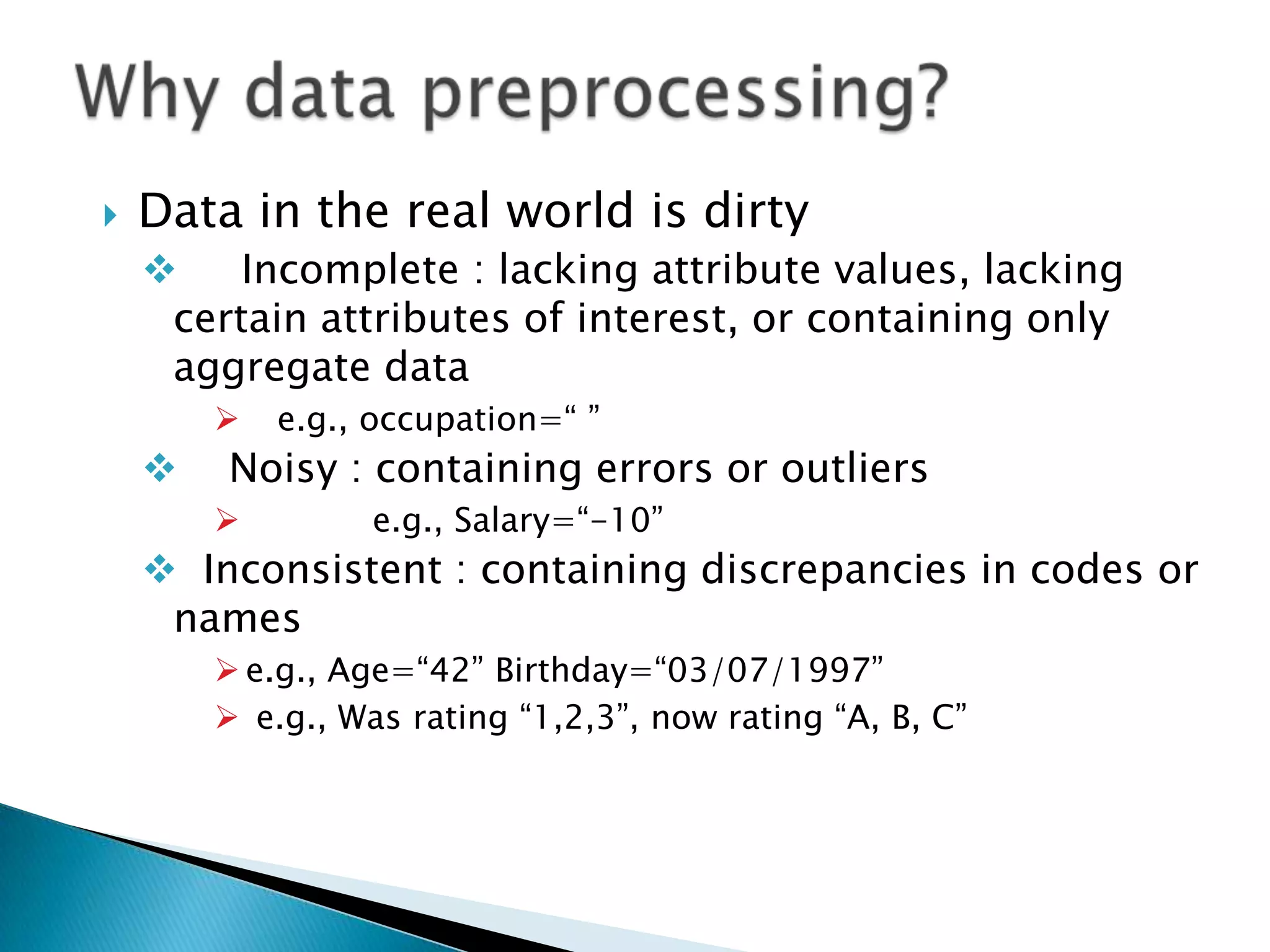
Data in the real world is dirty

Incomplete : lacking attribute values, lacking
certain attributes of interest, or containing only
aggregate data




e.g., occupation=“ ”

Noisy : containing errors or outliers


e.g., Salary=“-10”

 Inconsistent : containing discrepancies in codes or
names
 e.g., Age=“42” Birthday=“03/07/1997”
 e.g., Was rating “1,2,3”, now rating “A, B, C”
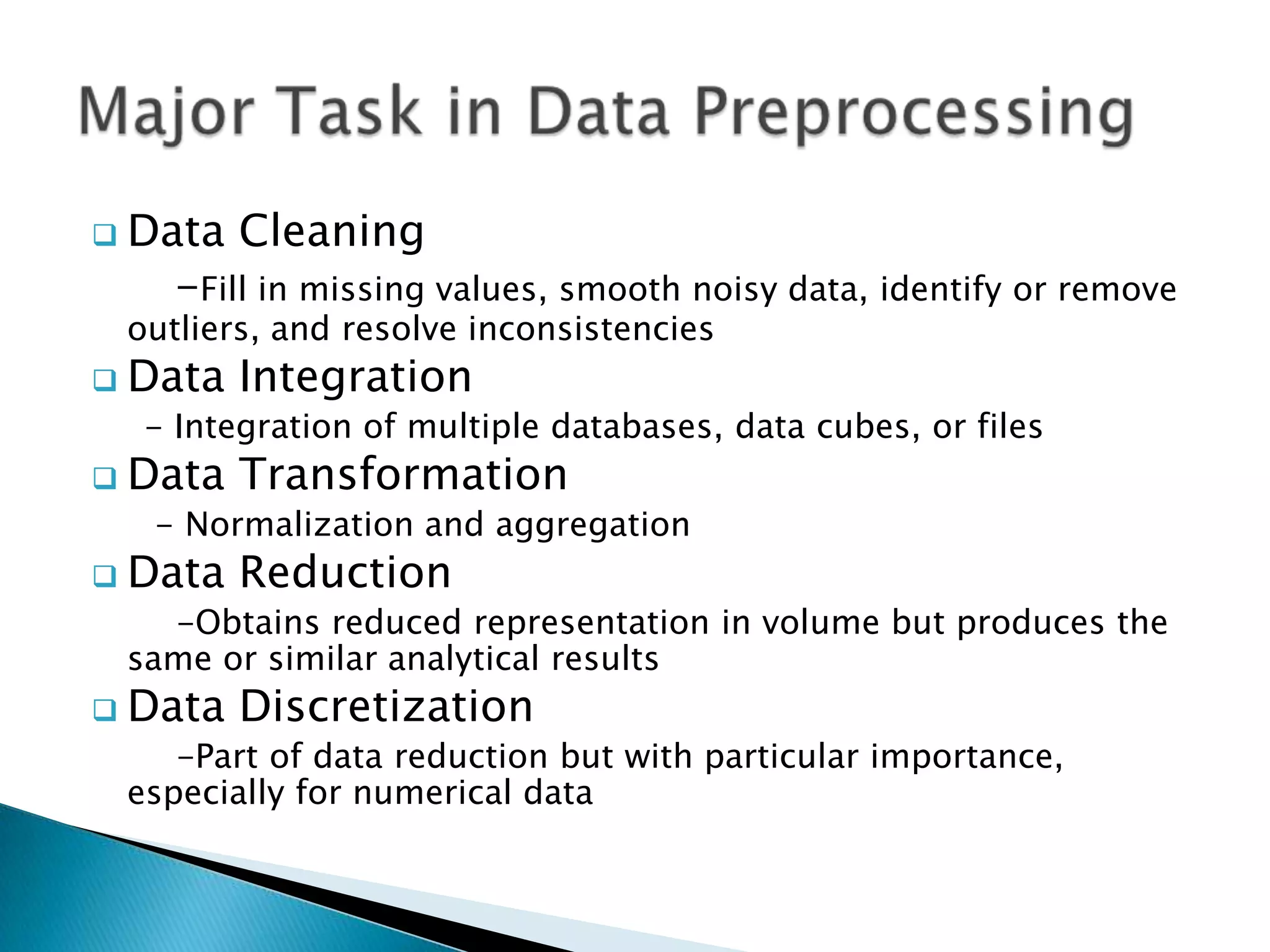
 Data

Cleaning

-Fill in missing values, smooth noisy data, identify or remove

outliers, and resolve inconsistencies

 Data

Integration

- Integration of multiple databases, data cubes, or files

 Data

Transformation

- Normalization and aggregation

 Data

Reduction

-Obtains reduced representation in volume but produces the
same or similar analytical results

 Data

Discretization

-Part of data reduction but with particular importance,
especially for numerical data


Data cleaning tasks :
• Fill in missing values
• Identify outliers and smooth out noisy data
• Correct inconsistent data




Ignore the tuple
Fill in the missing value manually
Fill in it automatically with
- a global constant : e.g., “unknown”, a
new class?!
- the attribute mean for all samples
belonging to the same class: smarter
- the most probable value: inferencebased such as Bayesian formula or regression








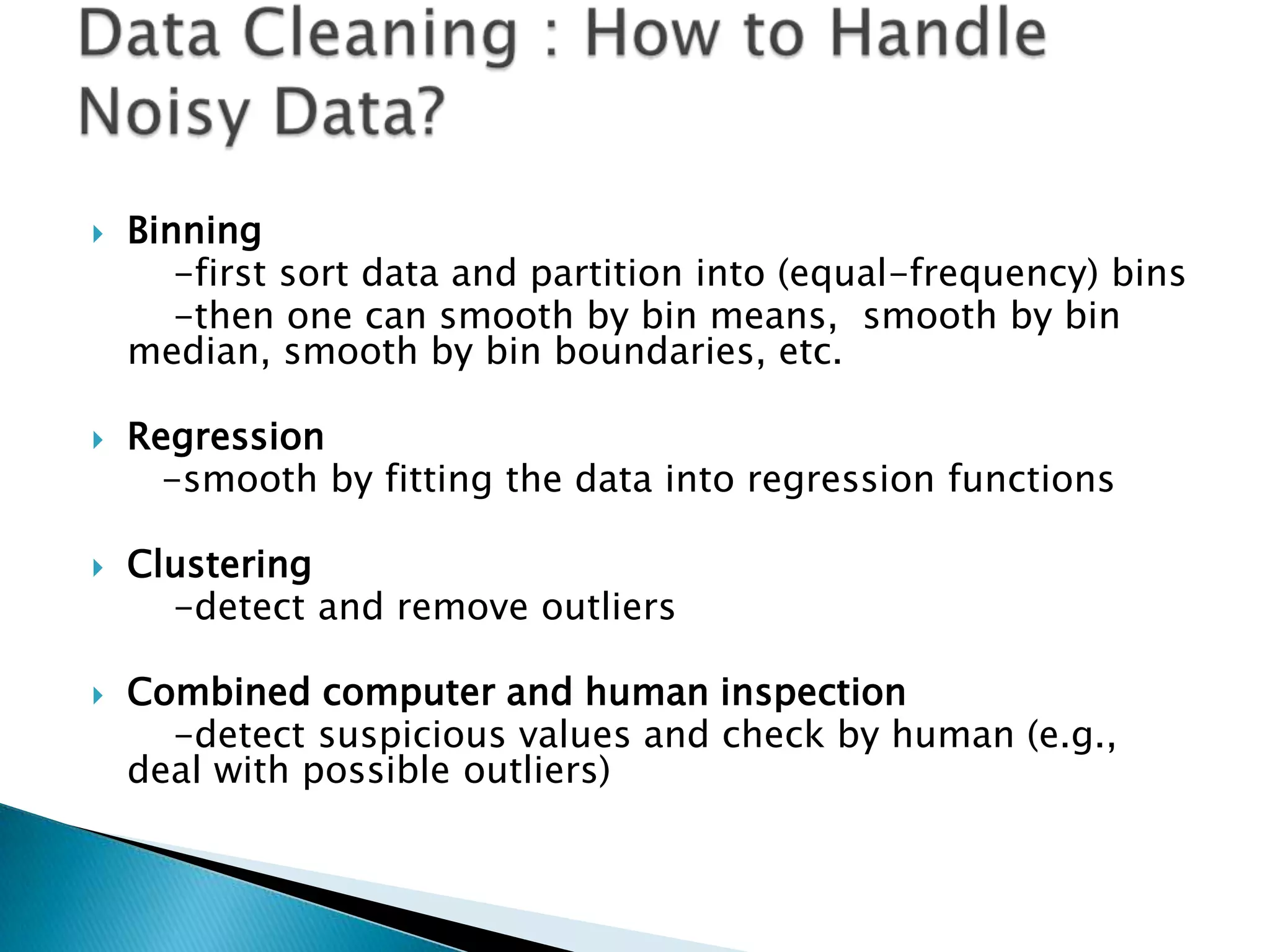
Binning
-first sort data and partition into (equal-frequency) bins
-then one can smooth by bin means, smooth by bin
median, smooth by bin boundaries, etc.
Regression
-smooth by fitting the data into regression functions
Clustering
-detect and remove outliers
Combined computer and human inspection
-detect suspicious values and check by human (e.g.,
deal with possible outliers)








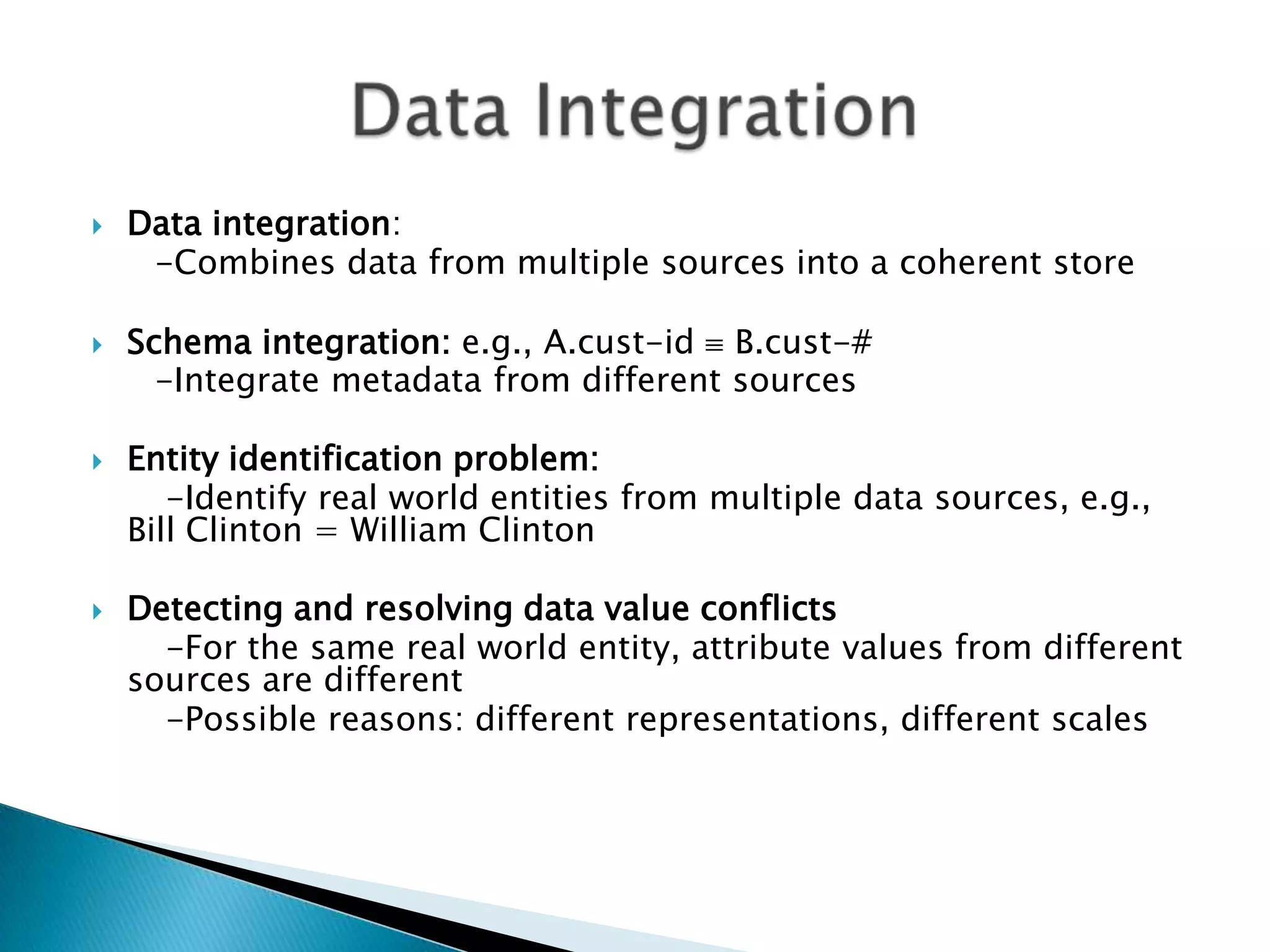
Data integration:
-Combines data from multiple sources into a coherent store
Schema integration: e.g., A.cust-id B.cust-#
-Integrate metadata from different sources
Entity identification problem:
-Identify real world entities from multiple data sources, e.g.,
Bill Clinton = William Clinton
Detecting and resolving data value conflicts
-For the same real world entity, attribute values from different
sources are different
-Possible reasons: different representations, different scales


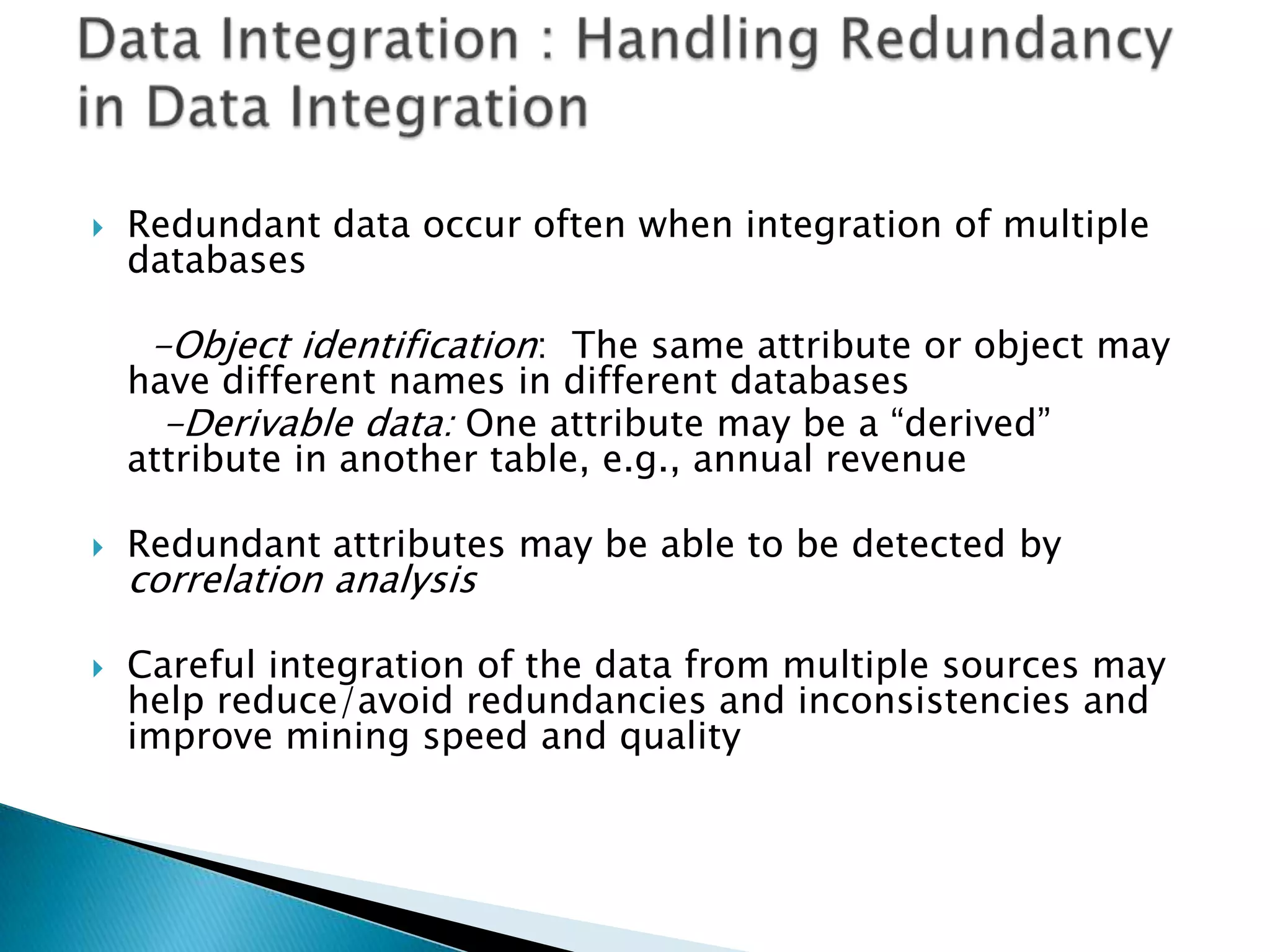
Redundant data occur often when integration of multiple
databases

-Object identification: The same attribute or object may

have different names in different databases
-Derivable data: One attribute may be a “derived”
attribute in another table, e.g., annual revenue




Redundant attributes may be able to be detected by

correlation analysis

Careful integration of the data from multiple sources may
help reduce/avoid redundancies and inconsistencies and
improve mining speed and quality


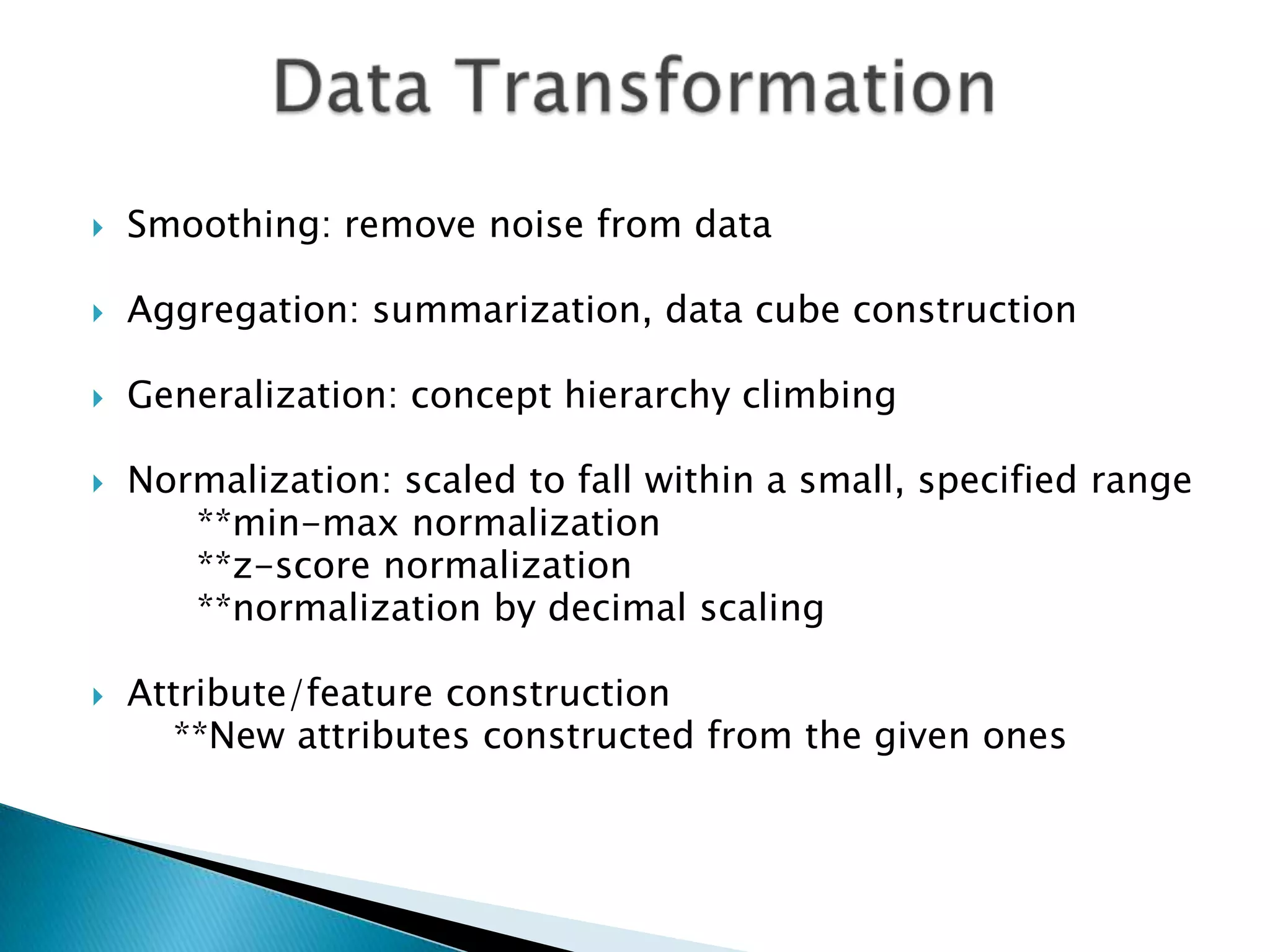
Smoothing: remove noise from data



Aggregation: summarization, data cube construction



Generalization: concept hierarchy climbing





Normalization: scaled to fall within a small, specified range
**min-max normalization
**z-score normalization
**normalization by decimal scaling
Attribute/feature construction
**New attributes constructed from the given ones


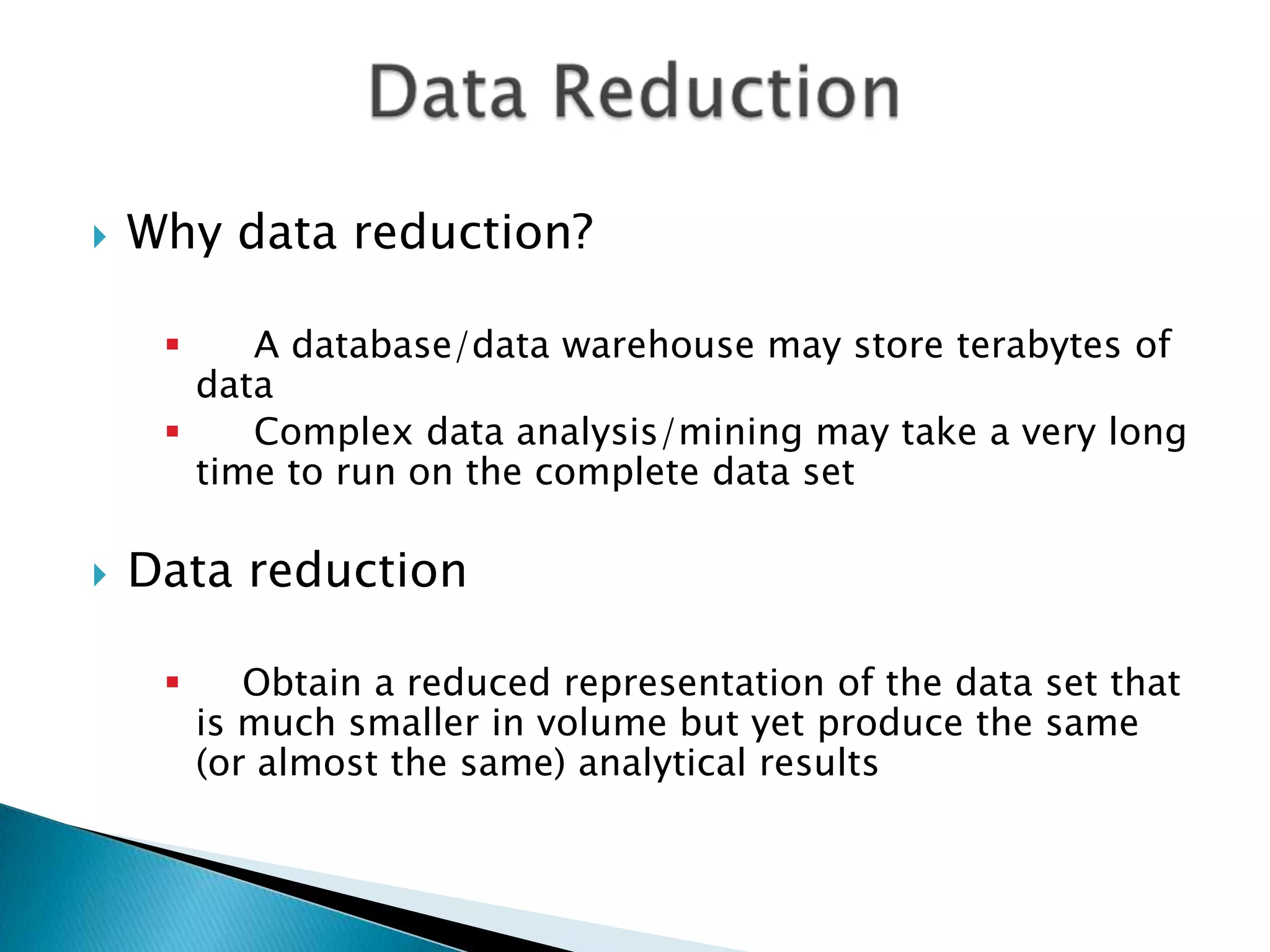
Why data reduction?
A database/data warehouse may store terabytes of
data

Complex data analysis/mining may take a very long
time to run on the complete data set




Data reduction


Obtain a reduced representation of the data set that
is much smaller in volume but yet produce the same
(or almost the same) analytical results
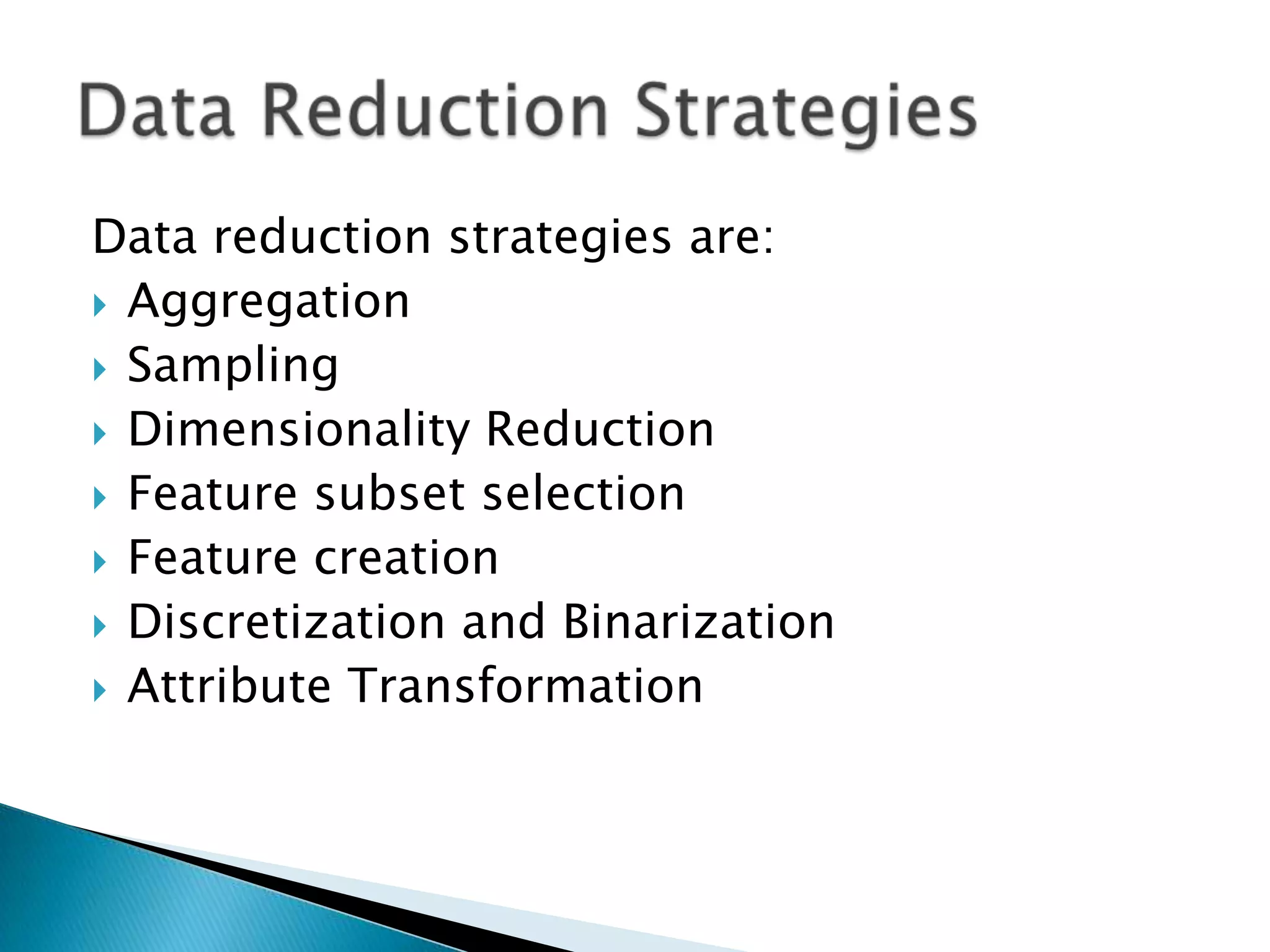
Data reduction strategies are:
 Aggregation
 Sampling
 Dimensionality Reduction
 Feature subset selection
 Feature creation
 Discretization and Binarization
 Attribute Transformation


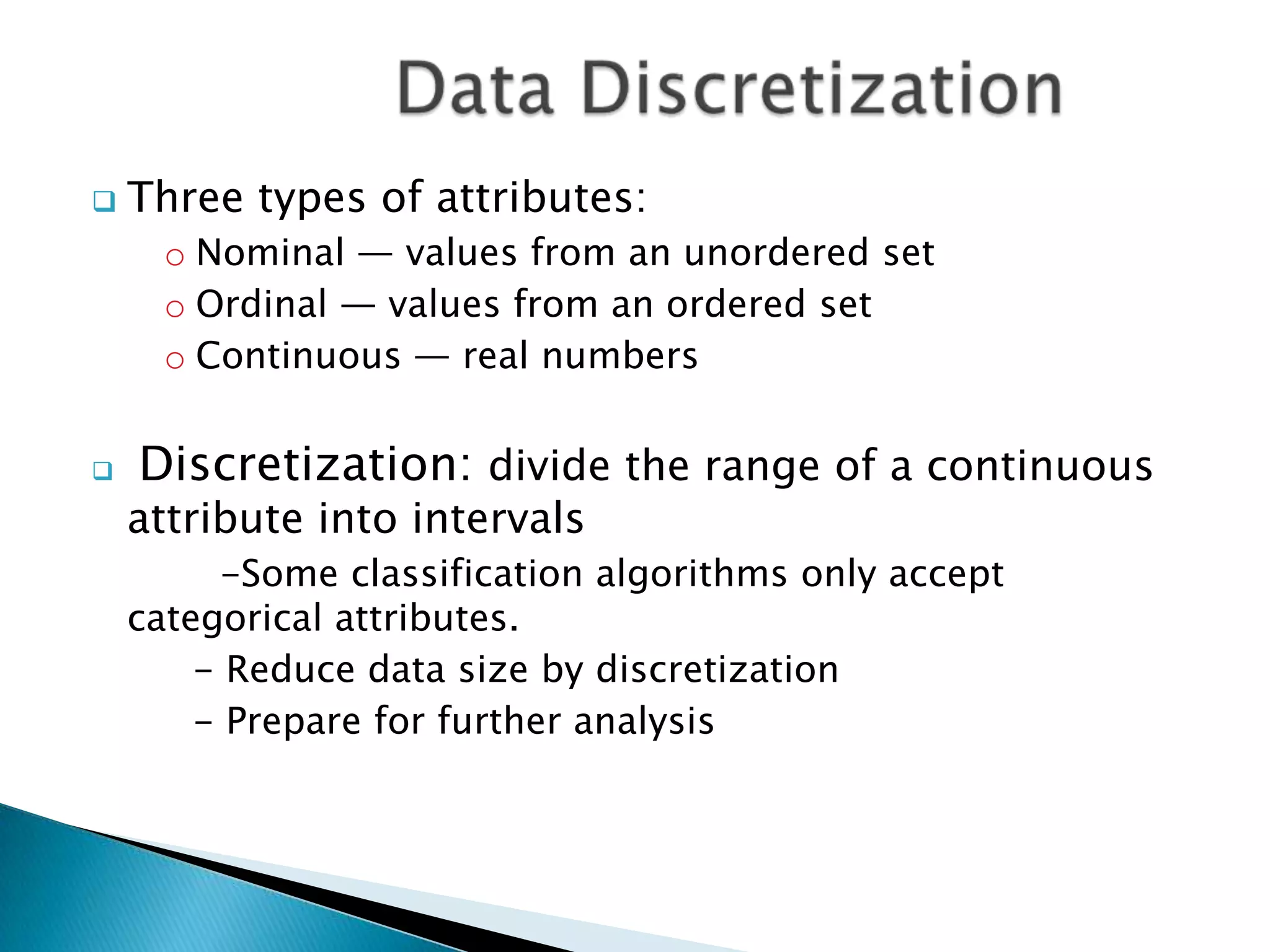
Three types of attributes:
o Nominal — values from an unordered set
o Ordinal — values from an ordered set
o Continuous — real numbers



Discretization: divide the range of a continuous

attribute into intervals

-Some classification algorithms only accept
categorical attributes.
- Reduce data size by discretization
- Prepare for further analysis
Good data preparation is
key to producing valid and
reliable models!


http://www.slideshare.net/dataminingtools/d
ata-processing-5005815

Datapreprocessing

  • 2.
  • 3.
      Data preprocessing isa data mining technique that involves transforming raw data into an understandable format. Data in the real world is: Incomplete : lacking attribute values, lacking certain attributes of interest, or containing only aggregate data  Noisy: containing errors or outliers  Inconsistent: containing discrepancies in codes or names   No quality data, no quality mining results! Quality decisions must be based on quality data  Data warehouse needs consistent integration of quality data 
  • 4.
     To get therequired information from huge, incomplete, noisy and inconsistent set of data it is necessary to use data processing.
  • 5.
     Data in thereal world is dirty  Incomplete : lacking attribute values, lacking certain attributes of interest, or containing only aggregate data   e.g., occupation=“ ” Noisy : containing errors or outliers  e.g., Salary=“-10”  Inconsistent : containing discrepancies in codes or names  e.g., Age=“42” Birthday=“03/07/1997”  e.g., Was rating “1,2,3”, now rating “A, B, C”
  • 6.
     Data Cleaning -Fill inmissing values, smooth noisy data, identify or remove outliers, and resolve inconsistencies  Data Integration - Integration of multiple databases, data cubes, or files  Data Transformation - Normalization and aggregation  Data Reduction -Obtains reduced representation in volume but produces the same or similar analytical results  Data Discretization -Part of data reduction but with particular importance, especially for numerical data
  • 7.
     Data cleaning tasks: • Fill in missing values • Identify outliers and smooth out noisy data • Correct inconsistent data
  • 8.
       Ignore the tuple Fillin the missing value manually Fill in it automatically with - a global constant : e.g., “unknown”, a new class?! - the attribute mean for all samples belonging to the same class: smarter - the most probable value: inferencebased such as Bayesian formula or regression
  • 9.
        Binning -first sort dataand partition into (equal-frequency) bins -then one can smooth by bin means, smooth by bin median, smooth by bin boundaries, etc. Regression -smooth by fitting the data into regression functions Clustering -detect and remove outliers Combined computer and human inspection -detect suspicious values and check by human (e.g., deal with possible outliers)
  • 10.
        Data integration: -Combines datafrom multiple sources into a coherent store Schema integration: e.g., A.cust-id B.cust-# -Integrate metadata from different sources Entity identification problem: -Identify real world entities from multiple data sources, e.g., Bill Clinton = William Clinton Detecting and resolving data value conflicts -For the same real world entity, attribute values from different sources are different -Possible reasons: different representations, different scales
  • 11.
     Redundant data occuroften when integration of multiple databases -Object identification: The same attribute or object may have different names in different databases -Derivable data: One attribute may be a “derived” attribute in another table, e.g., annual revenue   Redundant attributes may be able to be detected by correlation analysis Careful integration of the data from multiple sources may help reduce/avoid redundancies and inconsistencies and improve mining speed and quality
  • 12.
     Smoothing: remove noisefrom data  Aggregation: summarization, data cube construction  Generalization: concept hierarchy climbing   Normalization: scaled to fall within a small, specified range **min-max normalization **z-score normalization **normalization by decimal scaling Attribute/feature construction **New attributes constructed from the given ones
  • 13.
     Why data reduction? Adatabase/data warehouse may store terabytes of data  Complex data analysis/mining may take a very long time to run on the complete data set   Data reduction  Obtain a reduced representation of the data set that is much smaller in volume but yet produce the same (or almost the same) analytical results
  • 14.
    Data reduction strategiesare:  Aggregation  Sampling  Dimensionality Reduction  Feature subset selection  Feature creation  Discretization and Binarization  Attribute Transformation
  • 15.
     Three types ofattributes: o Nominal — values from an unordered set o Ordinal — values from an ordered set o Continuous — real numbers  Discretization: divide the range of a continuous attribute into intervals -Some classification algorithms only accept categorical attributes. - Reduce data size by discretization - Prepare for further analysis
  • 16.
    Good data preparationis key to producing valid and reliable models!
  • 17.