Chapter JOB ANALYSIS   EXCEL BOOKS 4-1 4
ANNOTATED OUTLINE 4-2 INTRODUCTION Job analysis is the process of gathering information about a job. It is, to be more specific, a systematic investigation of the tasks, duties and responsibilities necessary to do a job. Job Analysis
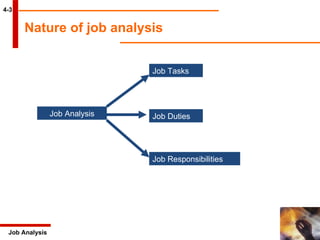
4-3 Nature of job analysis  Job Analysis Job Analysis Job Tasks Job Duties Job Responsibilities
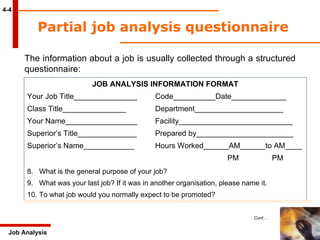
Partial job analysis questionnaire  4-4 The information about a job is usually collected through a structured questionnaire:   Job Analysis JOB ANALYSIS INFORMATION FORMAT Your Job Title_______________  Code__________Date_____________ Class Title_______________ Department_____________________ Your Name_________________ Facility___________________________ Superior’s Title______________ Prepared by_______________________ Superior’s Name____________ Hours Worked______AM______to AM____     PM   PM What is the general purpose of your job? What was your last job? If it was in another organisation, please name it.  To what job would you normally expect to be promoted? Cont…
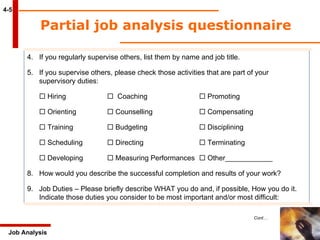
Partial job analysis questionnaire  4-5 Job Analysis 4. If you regularly supervise others, list them by name and job title. 5. If you supervise others, please check those activities that are part of your supervisory duties:    Hiring    Coaching   Promoting    Orienting   Counselling   Compensating    Training    Budgeting   Disciplining    Scheduling   Directing   Terminating    Developing   Measuring Performances    Other____________ How would you describe the successful completion and results of your work? Job Duties – Please briefly describe WHAT you do and, if possible, How you do it. Indicate those duties you consider to be most important and/or most difficult: Cont…
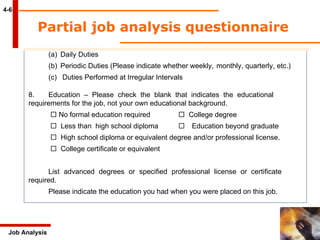
Partial job analysis questionnaire  4-6 Job Analysis (a) Daily Duties Periodic Duties (Please indicate whether weekly,  monthly, quarterly, etc.) Duties Performed at Irregular Intervals 8. Education – Please check the blank that indicates the educational  requirements for the job, not your own educational background.      No formal education required      College degree       Less than  high school diploma    Education beyond graduate       High school diploma or equivalent degree and/or professional license.       College certificate or equivalent List advanced degrees or specified professional license or certificate  required. Please indicate the education you had when you were placed on this job.
4-7 Job Analysis Benefits of Job analysis   Job analysis information is useful for a variety of organisation purposes ranging from human resource planning to career counselling
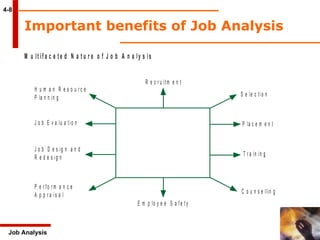
4-8 Job Analysis Important benefits of Job Analysis
Who should conduct job analysis? 4-9 Job Analysis Job incumbents themselves Supervisors External analysts
The process of Job analysis  4-10 The major steps involved in job analysis are: Organisational analysis Selection of representative positions to be analysed Collection of job analysis data Preparation of job description Preparation of job specification Job Analysis
The Competency Approach to Job Analysis  4-11 This approach encourages employees to develop role based competencies (knowledge, skills and abilities needed to play diverse roles ) that may be used in diverse work situations, instead of being boxed into a job.  Job Analysis
4-12 Methods Of Collecting Job Analysis Data   Job Analysis Seven general techniques are generally used to collect job analysis data; Job performance : the analyst actually performs the job in question  and collects the needed information Personal observation:  the analyst observes others doing the job  and writes a summary Critical incidents:  job incumbents describe several incidents  relating to work, based on past experience; the analyst collects,  analyses and classifies data.  Interview:  job incumbents and supervisors are interviewed to get the  most essential information about a job
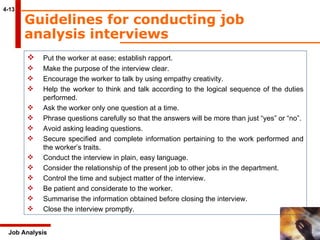
4-13 Guidelines for conducting job analysis interviews   Job Analysis Put the worker at ease; establish rapport. Make the purpose of the interview clear. Encourage the worker to talk by using empathy creativity. Help the worker to think and talk according to the logical sequence of the duties  performed. Ask the worker only one question at a time. Phrase questions carefully so that the answers will be more than just “yes” or “no”. Avoid asking leading questions. Secure specified and complete information pertaining to the work performed and  the worker’s traits. Conduct the interview in plain, easy language. Consider the relationship of the present job to other jobs in the department. Control the time and subject matter of the interview. Be patient and considerate to the worker. Summarise the information obtained before closing the interview. Close the interview promptly.
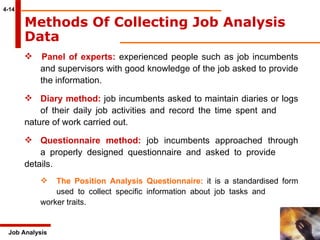
4-14 Job Analysis Panel of experts:  experienced people such as job incumbents  and supervisors with good knowledge of the job asked to provide  the information. Diary method:  job incumbents asked to maintain diaries or logs  of their daily job activities and record the time spent and  nature of work carried out.  Questionnaire method:  job incumbents approached through  a properly designed questionnaire and asked to provide  details.  The Position Analysis Questionnaire:  it is a standardised form  used to collect specific information about job tasks and  worker traits.  Methods Of Collecting Job Analysis Data
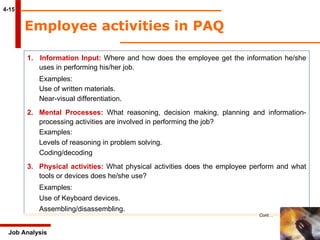
4-15 Employee activities in PAQ 1.  Information Input:  Where and how does the employee get the information he/she  uses in performing his/her job. Examples: Use of written materials. Near-visual differentiation. 2. Mental Processes:  What reasoning, decision making, planning and information- processing activities are involved in performing the job? Examples: Levels of reasoning in problem solving. Coding/decoding 3. Physical activities:  What physical activities does the employee perform and what  tools or devices does he/she use? Examples: Use of Keyboard devices. Assembling/disassembling. Job Analysis Cont…
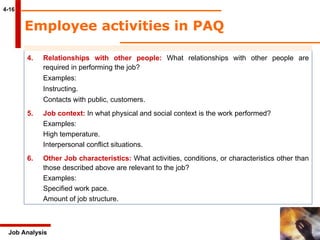
4-16 Job Analysis 4. Relationships with other people:  What relationships with other people are  required in performing the job? Examples: Instructing. Contacts with public, customers. 5. Job context:  In what physical and social context is the work performed? Examples: High temperature. Interpersonal conflict situations. 6. Other Job characteristics:  What activities, conditions, or characteristics other than  those described above are relevant to the job? Examples: Specified work pace. Amount of job structure. Employee activities in PAQ
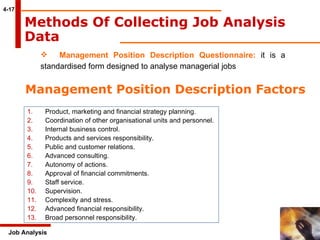
Management Position Description Factors  4-17 Product, marketing and financial strategy planning. Coordination of other organisational units and personnel. Internal business control. Products and services responsibility. Public and customer relations. Advanced consulting. Autonomy of actions. Approval of financial commitments. Staff service. Supervision. Complexity and stress. Advanced financial responsibility. Broad personnel responsibility. Job Analysis Management Position Description Questionnaire:  it is a  standardised form designed to analyse managerial jobs Methods Of Collecting Job Analysis Data
4-18 Job Analysis Functional job analysis:  it is a systematic process of  finding  what is done on a job by examining and analysing the  fundamental components of data, people and things.  Methods Of Collecting Job Analysis Data
4-19 Job Analysis Behavioural Factors Impacting Job Analysis The following behavioural factors must be taken care of while carrying out a job analysis:   Exaggerate the facts Employee anxieties Resistance to change Overemphasis on current efforts Management straight jacket
4-20 Job Analysis Job Description And Job Specification   The end products of job analysis are:  Job description:  this is a written statement of what the job holder does, how it is done, under what conditions it is done and why it is done.
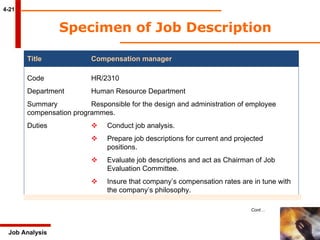
Specimen of Job Description 4-21 Job Analysis Title Compensation manager Code HR/2310 Department Human Resource Department  Summary  Responsible for the design and administration of employee  compensation programmes. Duties  Conduct job analysis.    Prepare job descriptions for current and projected  positions.    Evaluate job descriptions and act as Chairman of Job  Evaluation Committee.    Insure that company’s compensation rates are in tune with  the company’s philosophy.  Cont…
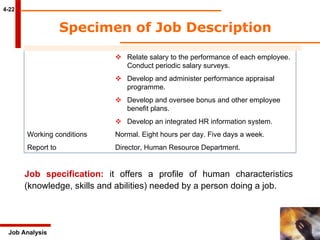
Specimen of Job Description 4-22 Job Analysis    Relate salary to the performance of each employee.  Conduct periodic salary surveys.    Develop and administer performance appraisal  programme.    Develop and oversee bonus and other employee  benefit plans.    Develop an integrated HR information system. Working conditions Normal. Eight hours per day. Five days a week. Report to Director, Human Resource Department. Job specification:  it offers a profile of human characteristics (knowledge, skills and abilities) needed by a person doing a job.
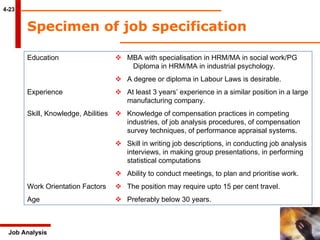
4-23 Job Analysis Specimen of job specification  Education  MBA with specialisation in HRM/MA in social work/PG  Diploma in HRM/MA in industrial psychology.    A degree or diploma in Labour Laws is desirable. Experience    At least 3 years’ experience in a similar position in a large  manufacturing company. Skill, Knowledge, Abilities    Knowledge of compensation practices in competing industries, of job analysis procedures, of compensation  survey techniques, of performance appraisal systems.    Skill in writing job descriptions, in conducting job analysis  interviews, in making group presentations, in performing  statistical computations     Ability to conduct meetings, to plan and prioritise work. Work Orientation Factors    The position may require upto 15 per cent travel. Age    Preferably below 30 years.
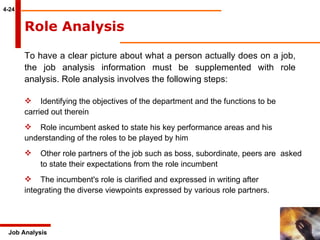
4-24 Job Analysis Role Analysis   To have a clear picture about what a person actually does on a job, the job analysis information must be supplemented with role analysis. Role analysis involves the following steps:   Identifying the objectives of the department and the functions to be  carried out therein Role incumbent asked to state his key performance areas and his  understanding of the roles to be played by him Other role partners of the job such as boss, subordinate, peers are  asked  to state their expectations from the role incumbent The incumbent's role is clarified and expressed in writing after  integrating the diverse viewpoints expressed by various role partners.
4-25 Job Analysis Job Analysis In A Jobless World   In recent times, the traditional way of jobs having a clearly-delineated set of duties and responsibilities is being increasingly questioned. For example, knowledge workers do not like standardised, routinised operations to be carried out in a fixed, predetermined time schedule. Talented ones, again, may require jobs with stretch pull and challenge. They may want to carry out their duties in a flexible manner.
4-26 Job Analysis A close look at the jobs inside India’s best work places Sasken Communication Technologies:  Employees enjoy considerable freedom  to think and innovate and work in their own style. There is absolutely no  monitoring of anybody. There are no attendance registers and there is no limit on  sick leaves. Every employee is trusted and management is transparent. There is  no perk that CEO Rajiv Mody enjoys that a junior employee does not. Hughes Software Systems:  HSS makes sure that all its employees get  interesting breaks - these may take the shape of personality development  programmes, cricket matches, literature clubs, or adventure activities. One of the  employees even commented "If I don't like my boss, I can change my section." Monsanto India:  Monsanto India is a flat organisation (three to four levels). Even  these levels are often cut short through an open culture. Everyone sits in an open  office. The workstations are the some size. The travel allowances are the same so  are the refreshments of course it sets stiff targets for employees, but trains them  with a rare rigour so that they get a fair shot at those. People identified as future  leaders are rolled over challenging positions. Cont…
Cadbury India:  Fun is serious business at Cadbury India. The HR manager's  statement sums up the company's philosophy: “We believe that the day you stop  enjoying work is the day you stop contributing. We make people stretch: but we  make them stretch with a smile." The company firmly believes that a smile a day  keeps the market blues away. Philips Software Centre:  The company's office in Bangalore, employees could  have all the comforts in the world: a variety of cuisines, a creche, a gymnasium,  bunker beds for naps, gym instructor, doctor, psychological counsellor, a dietician.  It is a whole  new world of work, play, study and rest. Not surprisingly, senior  executives remain glued to their seats even after office hours. The company had  to come out with an order recently stating that nobody should stay in the office  after 9 p.m. without sufficient reason! 4-27 Job Analysis A close look at the jobs inside India’s best work places
4-28 Job Analysis Flatter organisations Work teams Boundary less organisations Reengineering exercises  Job Analysis In A Jobless World

Job Analysis

  • 1.
    Chapter JOB ANALYSIS EXCEL BOOKS 4-1 4
  • 2.
    ANNOTATED OUTLINE 4-2INTRODUCTION Job analysis is the process of gathering information about a job. It is, to be more specific, a systematic investigation of the tasks, duties and responsibilities necessary to do a job. Job Analysis
  • 3.
    4-3 Nature ofjob analysis Job Analysis Job Analysis Job Tasks Job Duties Job Responsibilities
  • 4.
    Partial job analysisquestionnaire 4-4 The information about a job is usually collected through a structured questionnaire: Job Analysis JOB ANALYSIS INFORMATION FORMAT Your Job Title_______________ Code__________Date_____________ Class Title_______________ Department_____________________ Your Name_________________ Facility___________________________ Superior’s Title______________ Prepared by_______________________ Superior’s Name____________ Hours Worked______AM______to AM____ PM PM What is the general purpose of your job? What was your last job? If it was in another organisation, please name it. To what job would you normally expect to be promoted? Cont…
  • 5.
    Partial job analysisquestionnaire 4-5 Job Analysis 4. If you regularly supervise others, list them by name and job title. 5. If you supervise others, please check those activities that are part of your supervisory duties:  Hiring  Coaching  Promoting    Orienting   Counselling   Compensating    Training   Budgeting   Disciplining    Scheduling   Directing   Terminating    Developing   Measuring Performances   Other____________ How would you describe the successful completion and results of your work? Job Duties – Please briefly describe WHAT you do and, if possible, How you do it. Indicate those duties you consider to be most important and/or most difficult: Cont…
  • 6.
    Partial job analysisquestionnaire 4-6 Job Analysis (a) Daily Duties Periodic Duties (Please indicate whether weekly, monthly, quarterly, etc.) Duties Performed at Irregular Intervals 8. Education – Please check the blank that indicates the educational requirements for the job, not your own educational background.  No formal education required  College degree    Less than high school diploma  Education beyond graduate    High school diploma or equivalent degree and/or professional license.    College certificate or equivalent List advanced degrees or specified professional license or certificate required. Please indicate the education you had when you were placed on this job.
  • 7.
    4-7 Job AnalysisBenefits of Job analysis Job analysis information is useful for a variety of organisation purposes ranging from human resource planning to career counselling
  • 8.
    4-8 Job AnalysisImportant benefits of Job Analysis
  • 9.
    Who should conductjob analysis? 4-9 Job Analysis Job incumbents themselves Supervisors External analysts
  • 10.
    The process ofJob analysis 4-10 The major steps involved in job analysis are: Organisational analysis Selection of representative positions to be analysed Collection of job analysis data Preparation of job description Preparation of job specification Job Analysis
  • 11.
    The Competency Approachto Job Analysis 4-11 This approach encourages employees to develop role based competencies (knowledge, skills and abilities needed to play diverse roles ) that may be used in diverse work situations, instead of being boxed into a job. Job Analysis
  • 12.
    4-12 Methods OfCollecting Job Analysis Data Job Analysis Seven general techniques are generally used to collect job analysis data; Job performance : the analyst actually performs the job in question and collects the needed information Personal observation: the analyst observes others doing the job and writes a summary Critical incidents: job incumbents describe several incidents relating to work, based on past experience; the analyst collects, analyses and classifies data. Interview: job incumbents and supervisors are interviewed to get the most essential information about a job
  • 13.
    4-13 Guidelines forconducting job analysis interviews Job Analysis Put the worker at ease; establish rapport. Make the purpose of the interview clear. Encourage the worker to talk by using empathy creativity. Help the worker to think and talk according to the logical sequence of the duties performed. Ask the worker only one question at a time. Phrase questions carefully so that the answers will be more than just “yes” or “no”. Avoid asking leading questions. Secure specified and complete information pertaining to the work performed and the worker’s traits. Conduct the interview in plain, easy language. Consider the relationship of the present job to other jobs in the department. Control the time and subject matter of the interview. Be patient and considerate to the worker. Summarise the information obtained before closing the interview. Close the interview promptly.
  • 14.
    4-14 Job AnalysisPanel of experts: experienced people such as job incumbents and supervisors with good knowledge of the job asked to provide the information. Diary method: job incumbents asked to maintain diaries or logs of their daily job activities and record the time spent and nature of work carried out. Questionnaire method: job incumbents approached through a properly designed questionnaire and asked to provide details. The Position Analysis Questionnaire: it is a standardised form used to collect specific information about job tasks and worker traits. Methods Of Collecting Job Analysis Data
  • 15.
    4-15 Employee activitiesin PAQ 1. Information Input: Where and how does the employee get the information he/she uses in performing his/her job. Examples: Use of written materials. Near-visual differentiation. 2. Mental Processes: What reasoning, decision making, planning and information- processing activities are involved in performing the job? Examples: Levels of reasoning in problem solving. Coding/decoding 3. Physical activities: What physical activities does the employee perform and what tools or devices does he/she use? Examples: Use of Keyboard devices. Assembling/disassembling. Job Analysis Cont…
  • 16.
    4-16 Job Analysis4. Relationships with other people: What relationships with other people are required in performing the job? Examples: Instructing. Contacts with public, customers. 5. Job context: In what physical and social context is the work performed? Examples: High temperature. Interpersonal conflict situations. 6. Other Job characteristics: What activities, conditions, or characteristics other than those described above are relevant to the job? Examples: Specified work pace. Amount of job structure. Employee activities in PAQ
  • 17.
    Management Position DescriptionFactors 4-17 Product, marketing and financial strategy planning. Coordination of other organisational units and personnel. Internal business control. Products and services responsibility. Public and customer relations. Advanced consulting. Autonomy of actions. Approval of financial commitments. Staff service. Supervision. Complexity and stress. Advanced financial responsibility. Broad personnel responsibility. Job Analysis Management Position Description Questionnaire: it is a standardised form designed to analyse managerial jobs Methods Of Collecting Job Analysis Data
  • 18.
    4-18 Job AnalysisFunctional job analysis: it is a systematic process of finding what is done on a job by examining and analysing the fundamental components of data, people and things. Methods Of Collecting Job Analysis Data
  • 19.
    4-19 Job AnalysisBehavioural Factors Impacting Job Analysis The following behavioural factors must be taken care of while carrying out a job analysis: Exaggerate the facts Employee anxieties Resistance to change Overemphasis on current efforts Management straight jacket
  • 20.
    4-20 Job AnalysisJob Description And Job Specification The end products of job analysis are: Job description: this is a written statement of what the job holder does, how it is done, under what conditions it is done and why it is done.
  • 21.
    Specimen of JobDescription 4-21 Job Analysis Title Compensation manager Code HR/2310 Department Human Resource Department Summary Responsible for the design and administration of employee compensation programmes. Duties  Conduct job analysis.  Prepare job descriptions for current and projected positions.  Evaluate job descriptions and act as Chairman of Job Evaluation Committee.  Insure that company’s compensation rates are in tune with the company’s philosophy. Cont…
  • 22.
    Specimen of JobDescription 4-22 Job Analysis  Relate salary to the performance of each employee. Conduct periodic salary surveys.  Develop and administer performance appraisal programme.  Develop and oversee bonus and other employee benefit plans.  Develop an integrated HR information system. Working conditions Normal. Eight hours per day. Five days a week. Report to Director, Human Resource Department. Job specification: it offers a profile of human characteristics (knowledge, skills and abilities) needed by a person doing a job.
  • 23.
    4-23 Job AnalysisSpecimen of job specification Education  MBA with specialisation in HRM/MA in social work/PG Diploma in HRM/MA in industrial psychology.  A degree or diploma in Labour Laws is desirable. Experience  At least 3 years’ experience in a similar position in a large manufacturing company. Skill, Knowledge, Abilities  Knowledge of compensation practices in competing industries, of job analysis procedures, of compensation survey techniques, of performance appraisal systems.  Skill in writing job descriptions, in conducting job analysis interviews, in making group presentations, in performing statistical computations  Ability to conduct meetings, to plan and prioritise work. Work Orientation Factors  The position may require upto 15 per cent travel. Age  Preferably below 30 years.
  • 24.
    4-24 Job AnalysisRole Analysis To have a clear picture about what a person actually does on a job, the job analysis information must be supplemented with role analysis. Role analysis involves the following steps: Identifying the objectives of the department and the functions to be carried out therein Role incumbent asked to state his key performance areas and his understanding of the roles to be played by him Other role partners of the job such as boss, subordinate, peers are asked to state their expectations from the role incumbent The incumbent's role is clarified and expressed in writing after integrating the diverse viewpoints expressed by various role partners.
  • 25.
    4-25 Job AnalysisJob Analysis In A Jobless World In recent times, the traditional way of jobs having a clearly-delineated set of duties and responsibilities is being increasingly questioned. For example, knowledge workers do not like standardised, routinised operations to be carried out in a fixed, predetermined time schedule. Talented ones, again, may require jobs with stretch pull and challenge. They may want to carry out their duties in a flexible manner.
  • 26.
    4-26 Job AnalysisA close look at the jobs inside India’s best work places Sasken Communication Technologies: Employees enjoy considerable freedom to think and innovate and work in their own style. There is absolutely no monitoring of anybody. There are no attendance registers and there is no limit on sick leaves. Every employee is trusted and management is transparent. There is no perk that CEO Rajiv Mody enjoys that a junior employee does not. Hughes Software Systems: HSS makes sure that all its employees get interesting breaks - these may take the shape of personality development programmes, cricket matches, literature clubs, or adventure activities. One of the employees even commented "If I don't like my boss, I can change my section." Monsanto India: Monsanto India is a flat organisation (three to four levels). Even these levels are often cut short through an open culture. Everyone sits in an open office. The workstations are the some size. The travel allowances are the same so are the refreshments of course it sets stiff targets for employees, but trains them with a rare rigour so that they get a fair shot at those. People identified as future leaders are rolled over challenging positions. Cont…
  • 27.
    Cadbury India: Fun is serious business at Cadbury India. The HR manager's statement sums up the company's philosophy: “We believe that the day you stop enjoying work is the day you stop contributing. We make people stretch: but we make them stretch with a smile." The company firmly believes that a smile a day keeps the market blues away. Philips Software Centre: The company's office in Bangalore, employees could have all the comforts in the world: a variety of cuisines, a creche, a gymnasium, bunker beds for naps, gym instructor, doctor, psychological counsellor, a dietician. It is a whole new world of work, play, study and rest. Not surprisingly, senior executives remain glued to their seats even after office hours. The company had to come out with an order recently stating that nobody should stay in the office after 9 p.m. without sufficient reason! 4-27 Job Analysis A close look at the jobs inside India’s best work places
  • 28.
    4-28 Job AnalysisFlatter organisations Work teams Boundary less organisations Reengineering exercises Job Analysis In A Jobless World