Job Description Writing
PREPARED BY: MARWA ABDEL RAMAN – HR DEPARTMENT
Introduction
 The success of any organization depends on the performance of its
employees.
 All the jobs in an organization must interrelate to accomplish the
organization’s mission, goals and objectives.
 Job analysis is often used to gather information for use in personnel
selection, training, classification, and compensation.
Objectives
By the end of this topic, participants will be able to:
 Define Job Analysis and its elements.
 Identify the process, uses of Job analysis & its significance.
 Identify Job Descriptors (Types of information gathered).
 Identify Methods for gathering Job Analysis Information.
 Conduct an effective Job Analysis including Developing a Job
Description and a Job
 Specification based on DTRs and KSAs.
Topics
Job Analysis
 Job Analysis Definition
 Elements of a Job Analysis
 Uses Of Job Analysis
 Job Analysis :The Process ( Steps in doing a Job Analysis)
 Types of Information Gathered for a Job Analysis
 Methods of Gathering Information
Job Analysis Definition
Job Analysis is a Structured approach that
identifies the Job’s duties and responsibilities as
well as the skills and competencies needed to
perform the job.
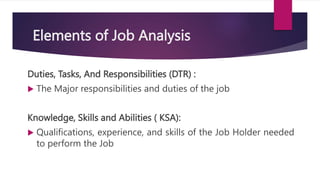
Elements of Job Analysis
Duties, Tasks, And Responsibilities (DTR) :
 The Major responsibilities and duties of the job
Knowledge, Skills and Abilities ( KSA):
 Qualifications, experience, and skills of the Job Holder needed
to perform the Job
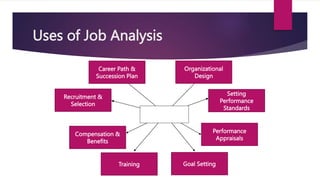
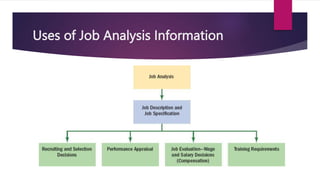
Uses of Job Analysis
Career Path &
Succession Plan
Organizational
Design
Setting
Performance
Standards
Recruitment &
Selection
Performance
Appraisals
Compensation &
Benefits
Goal Setting
Training
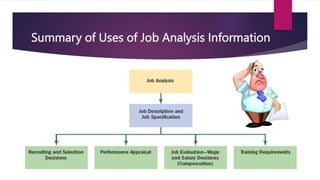
Summary of Uses of Job Analysis Information
The Nature of Job Analysis
Job Analysis
 The procedure for determining the duties and skill requirements of a job and the kind
of person who should be hired for it.
Job Description
 A list of a job’s duties, responsibilities, reporting relationships, working conditions, and
supervisory responsibilities—one product of a job analysis.
Job Specifications
 A list of a job’s “human requirements” that is, the requisite education, skills, personality,
and so on — another product of a job analysis.
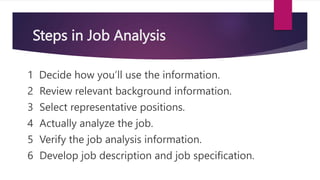
Steps in Job Analysis
1 Decide how you’ll use the information.
2 Review relevant background information.
3 Select representative positions.
4 Actually analyze the job.
5 Verify the job analysis information.
6 Develop job description and job specification.
Step 1:
Decide how you’ll use the information.
This will determine the data you collect and how you collect them:
Interviewing and questionnaire
Provide qualitative information which is good for writing job descriptions
and selecting employees for the job.
Position analysis questionnaire (PAQ)
Provides quantitative (numerical) information which is useful to compare
jobs for compensation purposes.
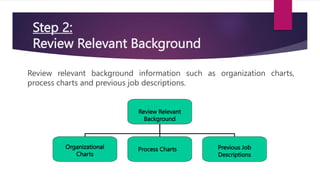
Step 2:
Review Relevant Background
Review relevant background information such as organization charts,
process charts and previous job descriptions.
Review Relevant
Background
Organizational
Charts
Process Charts Previous Job
Descriptions
Charting the Organization
Organization Chart
A chart that shows the organization-wide distribution of work,
with titles of each position and interconnecting lines that show
who reports to and communicates to whom.
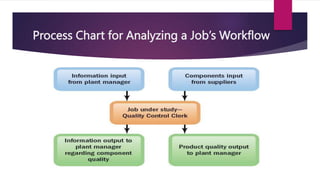
Process Chart
A work flow chart that shows the flow of inputs to and outputs
from a particular job.
Process Chart for Analyzing a Job’s Workflow
Step 3:
Select representative positions. Why?
Because there may be too many similar jobs to analyze.
For example, it is usually unnecessary to analyze the jobs
of 200 assembly workers when a sample of 10 jobs will
do.
Step 4:
Actually analyze the job.
By collecting data on job activities, required employee
behaviors, working conditions, and human traits and
abilities needed to perform the job.
Step 5:
Verify the job analysis information
With the worker performing the job and with his or her immediate
supervisor.
This will help confirm that the information is factually correct and
complete.
This review can also help gain the employee’s acceptance of the job
analysis data and conclusions, by giving that person a chance to
review and modify your description of the job activities.
Step 6:
Develop a job description and job specification.
Job description describes the activities and responsibilities of
the job, as well as its important features, such as working
conditions and safety hazards.
Job specification summarizes the personal qualities, traits,
skills, and background required for getting the job done; it may
be in a separate document or in the same document as the job
description.
Job Analysis Information
Job Descriptors:
(Types of information needed for an effective and complete Job Analysis)
 Job Context (A summary)
 Activities
 Responsibilities
 Qualifications Needed to perform the Job
 Human Behaviors
 Relationship with other jobs (Organizational Charts and Process Charts)
 Performance Standards
 Machines, tools, equipment and work aids.
Job Descriptors - Tips
 Obtain information directly from the job holder (additional input from
managers, subordinates)
 Collect data from multiple job holders
 Select a technique that allows information to be obtained, summarized
and processed.
 Select a technique that is easy to update with having to repeat the entire
process.
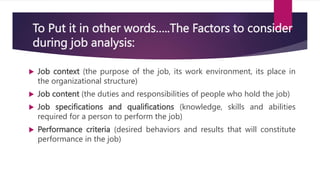
To Put it in other words…..The Factors to consider
during job analysis:
 Job context (the purpose of the job, its work environment, its place in
the organizational structure)
 Job content (the duties and responsibilities of people who hold the job)
 Job specifications and qualifications (knowledge, skills and abilities
required for a person to perform the job)
 Performance criteria (desired behaviors and results that will constitute
performance in the job)
Assignment #1
Prepare a Job Analysis for an HR Specialist
Use the Task sheet and you may select the
specialty.
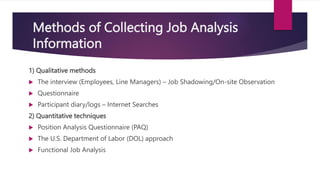
Methods of Collecting Job Analysis
Information
1) Qualitative methods
 The interview (Employees, Line Managers) – Job Shadowing/On-site Observation
 Questionnaire
 Participant diary/logs – Internet Searches
2) Quantitative techniques
 Position Analysis Questionnaire (PAQ)
 The U.S. Department of Labor (DOL) approach
 Functional Job Analysis
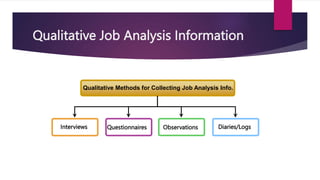
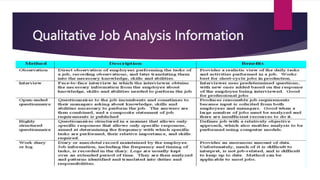
Qualitative Job Analysis Information
Qualitative Methods for Collecting Job Analysis Info.
Interviews Questionnaires Observations Diaries/Logs
Qualitative Job Analysis Information
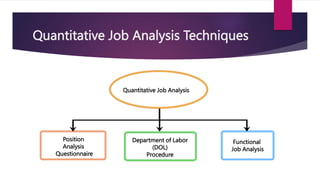
Quantitative Job Analysis Techniques
Position
Analysis
Questionnaire
Department of Labor
(DOL)
Procedure
Functional
Job Analysis
Quantitative Job Analysis
The position analysis questionnaire (PAQ)
The most popular Quantitative Job Analysis tool.
 A questionnaire used to collect quantifiable data concerning the duties
and responsibilities of various jobs.
 It contains 194 items “e.g written materials” the job analyst decides if
each item plays a role in the job and if so, to what extent.
The position analysis questionnaire (PAQ)
The most popular Quantitative Job Analysis tool.
 A questionnaire used to collect quantifiable data concerning the duties
and responsibilities of various jobs.
 It contains 194 items “e.g written materials” the job analyst decides if
each item plays a role in the job and if so, to what extent.
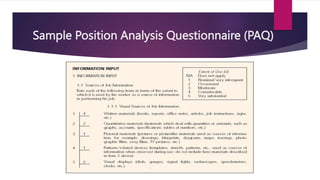
Sample Position Analysis Questionnaire (PAQ)
The position analysis questionnaire (PAQ)
Advantages of PAQ
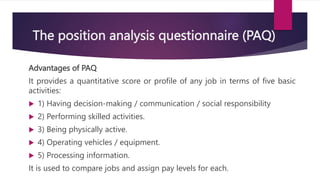
It provides a quantitative score or profile of any job in terms of five basic
activities:
 1) Having decision-making / communication / social responsibility
 2) Performing skilled activities.
 3) Being physically active.
 4) Operating vehicles / equipment.
 5) Processing information.
It is used to compare jobs and assign pay levels for each.
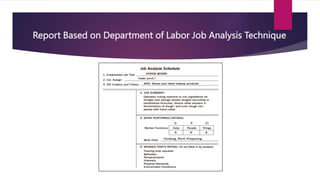
U.S. Department of Labor Procedure
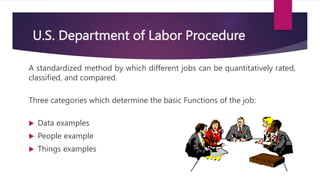
A standardized method by which different jobs can be quantitatively rated,
classified, and compared.
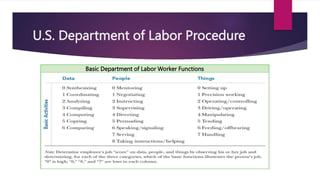
Three categories which determine the basic Functions of the job:
 Data examples
 People example
 Things examples
U.S. Department of Labor Procedure
Basic Department of Labor Worker Functions
Report Based on Department of Labor Job Analysis Technique
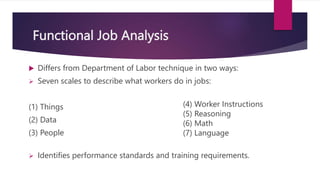
Functional Job Analysis
 Differs from Department of Labor technique in two ways:
 Seven scales to describe what workers do in jobs:
(1) Things
(2) Data
(3) People
 Identifies performance standards and training requirements.
(4) Worker Instructions
(5) Reasoning
(6) Math
(7) Language
Uses of Job Analysis Information
Definition of a Job Description
A written statement
of what the worker actually does,
how he or she does it,
and what the job’s working conditions are.
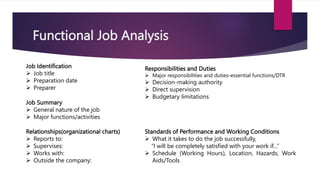
Functional Job Analysis
Job Identification
 Job title
 Preparation date
 Preparer
Responsibilities and Duties
 Major responsibilities and duties-essential functions/DTR
 Decision-making authority
 Direct supervision
 Budgetary limitations
Relationships(organizational charts)
 Reports to:
 Supervises:
 Works with:
 Outside the company:
Standards of Performance and Working Conditions
 What it takes to do the job successfully,
“I will be completely satisfied with your work if…”
 Schedule (Working Hours), Location, Hazards, Work
Aids/Tools
Job Summary
 General nature of the job
 Major functions/activities
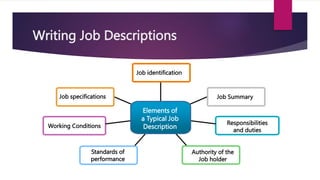
Writing Job Descriptions
Elements of
a Typical Job
Description
Job specifications
Job identification
Job Summary
Responsibilities
and duties
Authority of the
Job holder
Standards of
performance
Working Conditions
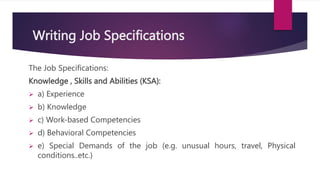
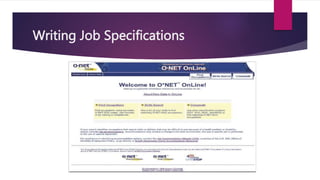
Writing Job Specifications
The Job Specifications:
Knowledge , Skills and Abilities (KSA):
 a) Experience
 b) Knowledge
 c) Work-based Competencies
 d) Behavioral Competencies
 e) Special Demands of the job (e.g. unusual hours, travel, Physical
conditions..etc.)
Writing Job Specifications
Specifications Based on Judgment
 Self-created judgments (common sense)
 List of competencies in Web-based job descriptions
(e.g., www.jobdescription.com, https://www.onetonline.org)
Specifications Based on Statistical Analysis
 Attempts to determine statistically the relationship between a predictor
or human trait (as height or intelligence) and an indicator or criterion of
job effectiveness (as performance)
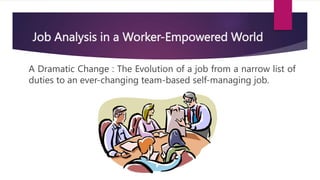
Job Analysis in a Worker-Empowered World
A Dramatic Change : The Evolution of a job from a narrow list of
duties to an ever-changing team-based self-managing job.
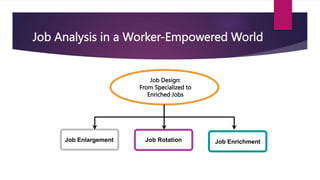
Job Analysis in a Worker-Empowered World
Job Design:
From Specialized to
Enriched Jobs
Job Enlargement Job Rotation Job Enrichment
From Specialized to Enlarged Jobs
Job Enlargement
 Assigning workers additional same level activities, thus
increasing the number of activities they perform.
Job Enrichment
 Redesigning jobs in a way that increases the opportunities for
the worker to experience feelings of responsibility,
achievement, growth, and recognition.
From Specialized to Enlarged Jobs
Job Rotation
 Moving a trainee from department to department to broaden
his or her experience and identify strong and weak points to
prepare the person for an enhanced role with the company
 Systematically moving workers from one job to another to
enhance work team performance.
Competency-Based Job Analysis
Competencies
 Demonstrable characteristics of a person that enable performance of a
job.
Competency-based job analysis
 Describing a job in terms of the measurable, observable, behavioral
competencies (knowledge, skills, and/or behaviors) an employee must
exhibit to do a job well.
 Traditional job analysis focuses on “what” are the job duties and
responsibilities whereas competency - based job analysis is more worker
focused ie. focuses on “how” the worker meets the job objectives.
Why Use Competency Analysis?
To support HPWS
 Traditional job descriptions (with their lists of specific duties) may
actually backfire if a high-performance work system is the goal.
Maintain a strategic focus
 Describing the job in terms of the skills, knowledge, and competencies
the worker needs is more strategic.
Measuring performance
 Measurable skills, knowledge, and competencies are the heart of any
company’s performance management process.
Types of competencies
General competencies
 Reading, writing, and mathematical reasoning.
Leadership competencies
 Leadership, strategic thinking, and teaching others.
Technical competencies
 Specific technical competencies required for specific types of jobs and/or
occupations.
End of Session
Thank You
PREPARED BY: MARWA ABDEL RAMAN – HR DEPARTMENT

Job.Description.Writing.Project.human.resources.pptx

  • 1.
    Job Description Writing PREPAREDBY: MARWA ABDEL RAMAN – HR DEPARTMENT
  • 2.
    Introduction  The successof any organization depends on the performance of its employees.  All the jobs in an organization must interrelate to accomplish the organization’s mission, goals and objectives.  Job analysis is often used to gather information for use in personnel selection, training, classification, and compensation.
  • 3.
    Objectives By the endof this topic, participants will be able to:  Define Job Analysis and its elements.  Identify the process, uses of Job analysis & its significance.  Identify Job Descriptors (Types of information gathered).  Identify Methods for gathering Job Analysis Information.  Conduct an effective Job Analysis including Developing a Job Description and a Job  Specification based on DTRs and KSAs.
  • 4.
    Topics Job Analysis  JobAnalysis Definition  Elements of a Job Analysis  Uses Of Job Analysis  Job Analysis :The Process ( Steps in doing a Job Analysis)  Types of Information Gathered for a Job Analysis  Methods of Gathering Information
  • 5.
    Job Analysis Definition JobAnalysis is a Structured approach that identifies the Job’s duties and responsibilities as well as the skills and competencies needed to perform the job.
  • 6.
    Elements of JobAnalysis Duties, Tasks, And Responsibilities (DTR) :  The Major responsibilities and duties of the job Knowledge, Skills and Abilities ( KSA):  Qualifications, experience, and skills of the Job Holder needed to perform the Job
  • 7.
    Uses of JobAnalysis Career Path & Succession Plan Organizational Design Setting Performance Standards Recruitment & Selection Performance Appraisals Compensation & Benefits Goal Setting Training
  • 8.
    Summary of Usesof Job Analysis Information
  • 9.
    The Nature ofJob Analysis Job Analysis  The procedure for determining the duties and skill requirements of a job and the kind of person who should be hired for it. Job Description  A list of a job’s duties, responsibilities, reporting relationships, working conditions, and supervisory responsibilities—one product of a job analysis. Job Specifications  A list of a job’s “human requirements” that is, the requisite education, skills, personality, and so on — another product of a job analysis.
  • 10.
    Steps in JobAnalysis 1 Decide how you’ll use the information. 2 Review relevant background information. 3 Select representative positions. 4 Actually analyze the job. 5 Verify the job analysis information. 6 Develop job description and job specification.
  • 11.
    Step 1: Decide howyou’ll use the information. This will determine the data you collect and how you collect them: Interviewing and questionnaire Provide qualitative information which is good for writing job descriptions and selecting employees for the job. Position analysis questionnaire (PAQ) Provides quantitative (numerical) information which is useful to compare jobs for compensation purposes.
  • 12.
    Step 2: Review RelevantBackground Review relevant background information such as organization charts, process charts and previous job descriptions. Review Relevant Background Organizational Charts Process Charts Previous Job Descriptions
  • 13.
    Charting the Organization OrganizationChart A chart that shows the organization-wide distribution of work, with titles of each position and interconnecting lines that show who reports to and communicates to whom. Process Chart A work flow chart that shows the flow of inputs to and outputs from a particular job.
  • 14.
    Process Chart forAnalyzing a Job’s Workflow
  • 15.
    Step 3: Select representativepositions. Why? Because there may be too many similar jobs to analyze. For example, it is usually unnecessary to analyze the jobs of 200 assembly workers when a sample of 10 jobs will do.
  • 16.
    Step 4: Actually analyzethe job. By collecting data on job activities, required employee behaviors, working conditions, and human traits and abilities needed to perform the job.
  • 17.
    Step 5: Verify thejob analysis information With the worker performing the job and with his or her immediate supervisor. This will help confirm that the information is factually correct and complete. This review can also help gain the employee’s acceptance of the job analysis data and conclusions, by giving that person a chance to review and modify your description of the job activities.
  • 18.
    Step 6: Develop ajob description and job specification. Job description describes the activities and responsibilities of the job, as well as its important features, such as working conditions and safety hazards. Job specification summarizes the personal qualities, traits, skills, and background required for getting the job done; it may be in a separate document or in the same document as the job description.
  • 20.
    Job Analysis Information JobDescriptors: (Types of information needed for an effective and complete Job Analysis)  Job Context (A summary)  Activities  Responsibilities  Qualifications Needed to perform the Job  Human Behaviors  Relationship with other jobs (Organizational Charts and Process Charts)  Performance Standards  Machines, tools, equipment and work aids.
  • 21.
    Job Descriptors -Tips  Obtain information directly from the job holder (additional input from managers, subordinates)  Collect data from multiple job holders  Select a technique that allows information to be obtained, summarized and processed.  Select a technique that is easy to update with having to repeat the entire process.
  • 22.
    To Put itin other words…..The Factors to consider during job analysis:  Job context (the purpose of the job, its work environment, its place in the organizational structure)  Job content (the duties and responsibilities of people who hold the job)  Job specifications and qualifications (knowledge, skills and abilities required for a person to perform the job)  Performance criteria (desired behaviors and results that will constitute performance in the job)
  • 23.
    Assignment #1 Prepare aJob Analysis for an HR Specialist Use the Task sheet and you may select the specialty.
  • 24.
    Methods of CollectingJob Analysis Information 1) Qualitative methods  The interview (Employees, Line Managers) – Job Shadowing/On-site Observation  Questionnaire  Participant diary/logs – Internet Searches 2) Quantitative techniques  Position Analysis Questionnaire (PAQ)  The U.S. Department of Labor (DOL) approach  Functional Job Analysis
  • 25.
    Qualitative Job AnalysisInformation Qualitative Methods for Collecting Job Analysis Info. Interviews Questionnaires Observations Diaries/Logs
  • 26.
  • 27.
    Quantitative Job AnalysisTechniques Position Analysis Questionnaire Department of Labor (DOL) Procedure Functional Job Analysis Quantitative Job Analysis
  • 28.
    The position analysisquestionnaire (PAQ) The most popular Quantitative Job Analysis tool.  A questionnaire used to collect quantifiable data concerning the duties and responsibilities of various jobs.  It contains 194 items “e.g written materials” the job analyst decides if each item plays a role in the job and if so, to what extent.
  • 29.
    The position analysisquestionnaire (PAQ) The most popular Quantitative Job Analysis tool.  A questionnaire used to collect quantifiable data concerning the duties and responsibilities of various jobs.  It contains 194 items “e.g written materials” the job analyst decides if each item plays a role in the job and if so, to what extent.

  • 30.
    Sample Position AnalysisQuestionnaire (PAQ)
  • 31.
    The position analysisquestionnaire (PAQ) Advantages of PAQ It provides a quantitative score or profile of any job in terms of five basic activities:  1) Having decision-making / communication / social responsibility  2) Performing skilled activities.  3) Being physically active.  4) Operating vehicles / equipment.  5) Processing information. It is used to compare jobs and assign pay levels for each.
  • 32.
    U.S. Department ofLabor Procedure A standardized method by which different jobs can be quantitatively rated, classified, and compared. Three categories which determine the basic Functions of the job:  Data examples  People example  Things examples
  • 33.
    U.S. Department ofLabor Procedure Basic Department of Labor Worker Functions
  • 34.
    Report Based onDepartment of Labor Job Analysis Technique
  • 35.
    Functional Job Analysis Differs from Department of Labor technique in two ways:  Seven scales to describe what workers do in jobs: (1) Things (2) Data (3) People  Identifies performance standards and training requirements. (4) Worker Instructions (5) Reasoning (6) Math (7) Language
  • 36.
    Uses of JobAnalysis Information
  • 38.
    Definition of aJob Description A written statement of what the worker actually does, how he or she does it, and what the job’s working conditions are.
  • 39.
    Functional Job Analysis JobIdentification  Job title  Preparation date  Preparer Responsibilities and Duties  Major responsibilities and duties-essential functions/DTR  Decision-making authority  Direct supervision  Budgetary limitations Relationships(organizational charts)  Reports to:  Supervises:  Works with:  Outside the company: Standards of Performance and Working Conditions  What it takes to do the job successfully, “I will be completely satisfied with your work if…”  Schedule (Working Hours), Location, Hazards, Work Aids/Tools Job Summary  General nature of the job  Major functions/activities
  • 40.
    Writing Job Descriptions Elementsof a Typical Job Description Job specifications Job identification Job Summary Responsibilities and duties Authority of the Job holder Standards of performance Working Conditions
  • 42.
    Writing Job Specifications TheJob Specifications: Knowledge , Skills and Abilities (KSA):  a) Experience  b) Knowledge  c) Work-based Competencies  d) Behavioral Competencies  e) Special Demands of the job (e.g. unusual hours, travel, Physical conditions..etc.)
  • 43.
  • 44.
    Writing Job Specifications SpecificationsBased on Judgment  Self-created judgments (common sense)  List of competencies in Web-based job descriptions (e.g., www.jobdescription.com, https://www.onetonline.org) Specifications Based on Statistical Analysis  Attempts to determine statistically the relationship between a predictor or human trait (as height or intelligence) and an indicator or criterion of job effectiveness (as performance)
  • 45.
    Job Analysis ina Worker-Empowered World A Dramatic Change : The Evolution of a job from a narrow list of duties to an ever-changing team-based self-managing job.
  • 46.
    Job Analysis ina Worker-Empowered World Job Design: From Specialized to Enriched Jobs Job Enlargement Job Rotation Job Enrichment
  • 47.
    From Specialized toEnlarged Jobs Job Enlargement  Assigning workers additional same level activities, thus increasing the number of activities they perform. Job Enrichment  Redesigning jobs in a way that increases the opportunities for the worker to experience feelings of responsibility, achievement, growth, and recognition.
  • 48.
    From Specialized toEnlarged Jobs Job Rotation  Moving a trainee from department to department to broaden his or her experience and identify strong and weak points to prepare the person for an enhanced role with the company  Systematically moving workers from one job to another to enhance work team performance.
  • 49.
    Competency-Based Job Analysis Competencies Demonstrable characteristics of a person that enable performance of a job. Competency-based job analysis  Describing a job in terms of the measurable, observable, behavioral competencies (knowledge, skills, and/or behaviors) an employee must exhibit to do a job well.  Traditional job analysis focuses on “what” are the job duties and responsibilities whereas competency - based job analysis is more worker focused ie. focuses on “how” the worker meets the job objectives.
  • 50.
    Why Use CompetencyAnalysis? To support HPWS  Traditional job descriptions (with their lists of specific duties) may actually backfire if a high-performance work system is the goal. Maintain a strategic focus  Describing the job in terms of the skills, knowledge, and competencies the worker needs is more strategic. Measuring performance  Measurable skills, knowledge, and competencies are the heart of any company’s performance management process.
  • 51.
    Types of competencies Generalcompetencies  Reading, writing, and mathematical reasoning. Leadership competencies  Leadership, strategic thinking, and teaching others. Technical competencies  Specific technical competencies required for specific types of jobs and/or occupations.
  • 52.
    End of Session ThankYou PREPARED BY: MARWA ABDEL RAMAN – HR DEPARTMENT