Chapter 1 Strategic Management
Chapter Topics The Nature and Value of Strategic Management Dimensions of Strategic Decisions Formality in Strategic Management Benefits of Strategic Management Risks of Strategic Management The Strategic Management Process Components of the Strategic Management Model Strategic Management as a Process
What is Strategic Management? The set of decisions and actions that result  in the formulation and implementation of plans designed to achieve a company’s  objectives.
Critical Tasks of Strategic Management Formulate the company’s mission Conduct internal analysis  Assess the company’s external environment Analyze company’s options Identify most desirable options Select long-term objectives and grand strategies Develop annual objectives and short-term strategies Implement the strategic choices Evaluate success of the strategic process
What is Strategy? Large-scale, future-oriented plan for interacting with the competitive environment to achieve objectives Company’s “game plan” Framework for managerial decisions
Dimensions of Strategic Decisions Strategic issues Require top-management decisions Require large amounts of the firm’s resources Often affect the firm’s long-term prosperity Are future oriented Usually have multifunctional or multibusiness consequences Require considering the firm’s external environment
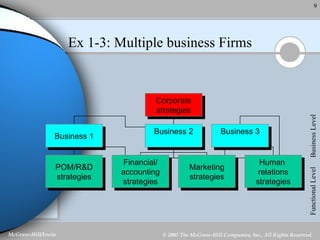
Three Levels of Strategy Corporate level Business level Functional level
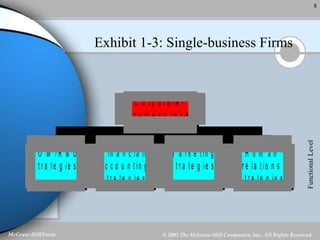
Exhibit 1-3: Single-business Firms Functional   Level
Ex 1-3: Multiple business Firms Business Level Functional Level Corporate strategies Business 1 Business 2 Business 3 POM/R&D strategies Financial/ accounting strategies Marketing strategies Human  relations strategies
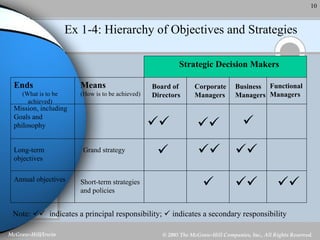
Ex 1-4: Hierarchy of Objectives and Strategies Ends (What is to be achieved) Means (How is to be achieved) Board of Directors Corporate Managers Business Managers Functional Managers Strategic Decision Makers Mission, including Goals and  philosophy Long-term objectives Annual objectives Grand strategy Short-term strategies and policies          Note:     indicates a principal responsibility;    indicates a secondary responsibility
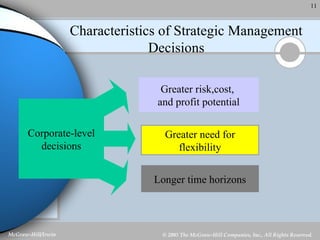
Characteristics of Strategic Management    Decisions Corporate-level decisions Greater risk,cost,  and profit potential Greater need for flexibility Longer time horizons
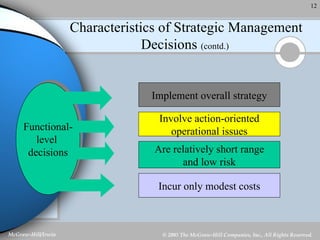
Characteristics of Strategic Management   Decisions  (contd.) Functional- level  decisions Implement overall strategy Involve action-oriented operational issues Are relatively short range and low risk Incur only modest costs
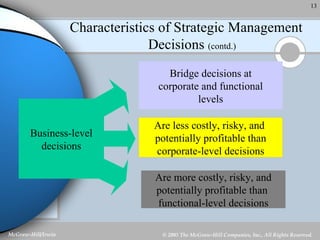
Characteristics of Strategic Management    Decisions  (contd.) Business-level decisions Bridge decisions at corporate and functional levels Are less costly, risky, and  potentially profitable than corporate-level decisions Are more costly, risky, and potentially profitable than  functional-level decisions
Formality in Strategic Management Definition Degree to which participants, responsibilities, authority, and discretion in decision making are specified Forces affecting degree of formality Size of organization Predominant management styles Complexity of environment Production process Problems Purpose of planning system
The Strategy Makers The ideal strategic management team includes Chief executive officer (CEO) Product managers Heads of functional areas The strategic management team obtains input from Planning staff Lower-level management and supervisors Role of CEO Provides long-term direction Assumes ultimate responsibility for firm’s success Solicits guidance from Board of Directors
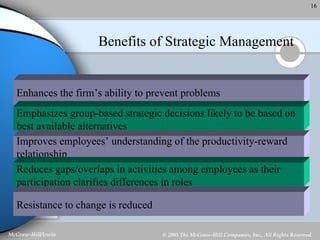
Benefits of Strategic Management Enhances the firm’s ability to prevent problems Emphasizes group-based strategic decisions likely to be based on  best available alternatives Improves employees’ understanding of the productivity-reward relationship Reduces gaps/overlaps in activities among employees as their participation clarifies differences in roles Resistance to change is reduced
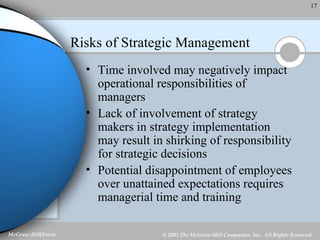
Risks of Strategic Management Time involved may negatively impact operational responsibilities of managers Lack of involvement of strategy makers in strategy implementation may result in shirking of responsibility for strategic decisions Potential disappointment of employees over unattained expectations requires managerial time and training
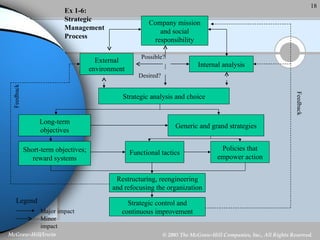
Company mission and social responsibility External environment Internal analysis Strategic analysis and choice Long-term objectives Generic and grand strategies Short-term objectives; reward systems Functional tactics Policies that empower action Restructuring, reengineering and refocusing the organization Strategic control and continuous improvement Possible? Desired? Feedback Feedback Legend Major impact Minor impact Ex 1-6: Strategic Management Process
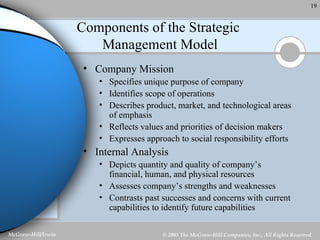
Components of the Strategic  Management Model Company Mission Specifies unique purpose of company Identifies scope of operations Describes product, market, and technological areas of emphasis Reflects values and priorities of decision makers Expresses approach to social responsibility efforts Internal Analysis Depicts quantity and quality of company’s financial, human, and physical resources Assesses company’s strengths and weaknesses Contrasts past successes and concerns with current capabilities to identify future capabilities
Components of the Strategic  Management Model  (contd.) External Environment Consists of all conditions and forces affecting firm’s strategic options and define its competitive situation Includes  three interactive segments – remote, industry, and operating environments Strategic Analysis and Choice Involves simultaneous assessment of external environment and company profile  Incorporates screening process based on mission to generate possible and desired opportunities Results in selection of options from which a strategic choice is made
Components of the Strategic Management Model  (contd.) Long-term Objectives Profitability Return on investment Competitive position Technological leadership Productivity Employee relations Public responsibility Employee development
Components of the Strategic Management Model  (contd.) Generic Strategies Low cost Differentiation Focus Grand Strategies Comprehensive, general plan of major actions through which the firm intends to achieve its long-term objectives in a dynamic environment
Components of the Strategic  Management Model  (contd.) Action Plans and Short-Term Objectives Translate generic and grand strategies into “action” Identify specific functional tactics to be taken in the near term Establish a clear time frame for completion Creates accountability Specify one or more immediate objectives as outcomes of the action
Components of the Strategic Management Model  (contd.) Functional Tactics Involve identifying activities unique to the function to help build competitive advantage Specify detailed statements of “means” to be used to achieve short-term objectives Policies that Empower Action Include broad, precedent-setting decisions that substitute for repetitive or time-sensitive decision making Often increase managerial effectiveness by empowering discretion of subordinates in implementing strategies
Components of the Strategic Management Model  (contd.) Restructuring, Reengineering, and Refocusing the Organization Involves an internal focus – getting work done efficiently and effectively to make the strategy work Downsizing, restructuring and reengineering reflect the critical stage in strategy implementation wherein managers attempt to recast their organization.
Components of the Strategic Management Model  (contd.) Strategic Control and Continuous Improvement Control Tracks a strategy during implementation Detects problems Involves making necessary adjustments Continuous improvement Provides another approach to strategic control Allows an organization to respond more proactively and timely to rapid developments
Implications of Viewing Strategic Management as a Process Changes in any one component will affect other components Strategy formulation and implementation are sequential Necessity of feedback from institutionalization, review, and evaluation to early stages of process Need to regard it as dynamic, involving constant changes in interdependent strategic activities

Chap001

  • 1.
  • 2.
    Chapter Topics TheNature and Value of Strategic Management Dimensions of Strategic Decisions Formality in Strategic Management Benefits of Strategic Management Risks of Strategic Management The Strategic Management Process Components of the Strategic Management Model Strategic Management as a Process
  • 3.
    What is StrategicManagement? The set of decisions and actions that result in the formulation and implementation of plans designed to achieve a company’s objectives.
  • 4.
    Critical Tasks ofStrategic Management Formulate the company’s mission Conduct internal analysis Assess the company’s external environment Analyze company’s options Identify most desirable options Select long-term objectives and grand strategies Develop annual objectives and short-term strategies Implement the strategic choices Evaluate success of the strategic process
  • 5.
    What is Strategy?Large-scale, future-oriented plan for interacting with the competitive environment to achieve objectives Company’s “game plan” Framework for managerial decisions
  • 6.
    Dimensions of StrategicDecisions Strategic issues Require top-management decisions Require large amounts of the firm’s resources Often affect the firm’s long-term prosperity Are future oriented Usually have multifunctional or multibusiness consequences Require considering the firm’s external environment
  • 7.
    Three Levels ofStrategy Corporate level Business level Functional level
  • 8.
    Exhibit 1-3: Single-businessFirms Functional Level
  • 9.
    Ex 1-3: Multiplebusiness Firms Business Level Functional Level Corporate strategies Business 1 Business 2 Business 3 POM/R&D strategies Financial/ accounting strategies Marketing strategies Human relations strategies
  • 10.
    Ex 1-4: Hierarchyof Objectives and Strategies Ends (What is to be achieved) Means (How is to be achieved) Board of Directors Corporate Managers Business Managers Functional Managers Strategic Decision Makers Mission, including Goals and philosophy Long-term objectives Annual objectives Grand strategy Short-term strategies and policies          Note:  indicates a principal responsibility;  indicates a secondary responsibility
  • 11.
    Characteristics of StrategicManagement Decisions Corporate-level decisions Greater risk,cost, and profit potential Greater need for flexibility Longer time horizons
  • 12.
    Characteristics of StrategicManagement Decisions (contd.) Functional- level decisions Implement overall strategy Involve action-oriented operational issues Are relatively short range and low risk Incur only modest costs
  • 13.
    Characteristics of StrategicManagement Decisions (contd.) Business-level decisions Bridge decisions at corporate and functional levels Are less costly, risky, and potentially profitable than corporate-level decisions Are more costly, risky, and potentially profitable than functional-level decisions
  • 14.
    Formality in StrategicManagement Definition Degree to which participants, responsibilities, authority, and discretion in decision making are specified Forces affecting degree of formality Size of organization Predominant management styles Complexity of environment Production process Problems Purpose of planning system
  • 15.
    The Strategy MakersThe ideal strategic management team includes Chief executive officer (CEO) Product managers Heads of functional areas The strategic management team obtains input from Planning staff Lower-level management and supervisors Role of CEO Provides long-term direction Assumes ultimate responsibility for firm’s success Solicits guidance from Board of Directors
  • 16.
    Benefits of StrategicManagement Enhances the firm’s ability to prevent problems Emphasizes group-based strategic decisions likely to be based on best available alternatives Improves employees’ understanding of the productivity-reward relationship Reduces gaps/overlaps in activities among employees as their participation clarifies differences in roles Resistance to change is reduced
  • 17.
    Risks of StrategicManagement Time involved may negatively impact operational responsibilities of managers Lack of involvement of strategy makers in strategy implementation may result in shirking of responsibility for strategic decisions Potential disappointment of employees over unattained expectations requires managerial time and training
  • 18.
    Company mission andsocial responsibility External environment Internal analysis Strategic analysis and choice Long-term objectives Generic and grand strategies Short-term objectives; reward systems Functional tactics Policies that empower action Restructuring, reengineering and refocusing the organization Strategic control and continuous improvement Possible? Desired? Feedback Feedback Legend Major impact Minor impact Ex 1-6: Strategic Management Process
  • 19.
    Components of theStrategic Management Model Company Mission Specifies unique purpose of company Identifies scope of operations Describes product, market, and technological areas of emphasis Reflects values and priorities of decision makers Expresses approach to social responsibility efforts Internal Analysis Depicts quantity and quality of company’s financial, human, and physical resources Assesses company’s strengths and weaknesses Contrasts past successes and concerns with current capabilities to identify future capabilities
  • 20.
    Components of theStrategic Management Model (contd.) External Environment Consists of all conditions and forces affecting firm’s strategic options and define its competitive situation Includes three interactive segments – remote, industry, and operating environments Strategic Analysis and Choice Involves simultaneous assessment of external environment and company profile Incorporates screening process based on mission to generate possible and desired opportunities Results in selection of options from which a strategic choice is made
  • 21.
    Components of theStrategic Management Model (contd.) Long-term Objectives Profitability Return on investment Competitive position Technological leadership Productivity Employee relations Public responsibility Employee development
  • 22.
    Components of theStrategic Management Model (contd.) Generic Strategies Low cost Differentiation Focus Grand Strategies Comprehensive, general plan of major actions through which the firm intends to achieve its long-term objectives in a dynamic environment
  • 23.
    Components of theStrategic Management Model (contd.) Action Plans and Short-Term Objectives Translate generic and grand strategies into “action” Identify specific functional tactics to be taken in the near term Establish a clear time frame for completion Creates accountability Specify one or more immediate objectives as outcomes of the action
  • 24.
    Components of theStrategic Management Model (contd.) Functional Tactics Involve identifying activities unique to the function to help build competitive advantage Specify detailed statements of “means” to be used to achieve short-term objectives Policies that Empower Action Include broad, precedent-setting decisions that substitute for repetitive or time-sensitive decision making Often increase managerial effectiveness by empowering discretion of subordinates in implementing strategies
  • 25.
    Components of theStrategic Management Model (contd.) Restructuring, Reengineering, and Refocusing the Organization Involves an internal focus – getting work done efficiently and effectively to make the strategy work Downsizing, restructuring and reengineering reflect the critical stage in strategy implementation wherein managers attempt to recast their organization.
  • 26.
    Components of theStrategic Management Model (contd.) Strategic Control and Continuous Improvement Control Tracks a strategy during implementation Detects problems Involves making necessary adjustments Continuous improvement Provides another approach to strategic control Allows an organization to respond more proactively and timely to rapid developments
  • 27.
    Implications of ViewingStrategic Management as a Process Changes in any one component will affect other components Strategy formulation and implementation are sequential Necessity of feedback from institutionalization, review, and evaluation to early stages of process Need to regard it as dynamic, involving constant changes in interdependent strategic activities