Job Analysis
1
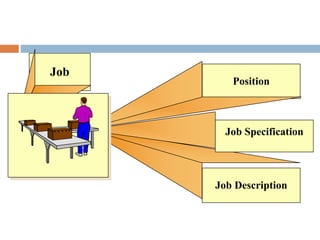
Job Description
Position
Job Specification
Job
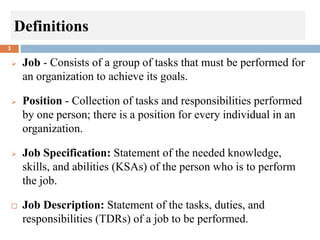
Definitions
3
 Job - Consists of a group of tasks that must be performed for
an organization to achieve its goals.
 Position - Collection of tasks and responsibilities performed
by one person; there is a position for every individual in an
organization.
 Job Specification: Statement of the needed knowledge,
skills, and abilities (KSAs) of the person who is to perform
the job.
 Job Description: Statement of the tasks, duties, and
responsibilities (TDRs) of a job to be performed.
Job Analysis
 Job Analysis:
 Systematic process of obtaining information about
the skills, duties, and knowledge required for
performing jobs in an organization.
 HR managers use the information to develop job
descriptions and job specifications that are the basis for
recruitment, training, employee performance appraisal
and career development.
 The ultimate purpose of job analysis is to improve
organizational performance and productivity.
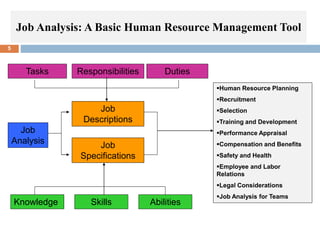
Job Analysis: A Basic Human Resource Management Tool
5
Tasks Responsibilities Duties
Job
Analysis
Job
Descriptions
Job
Specifications
Knowledge Skills Abilities
Human Resource Planning
Recruitment
Selection
Training and Development
Performance Appraisal
Compensation and Benefits
Safety and Health
Employee and Labor
Relations
Legal Considerations
Job Analysis for Teams
Reasons For Conducting Job Analysis
6
 Staffing : would be disorganized if recruiter did not know
qualifications needed for job.
 Training and Development : if specification lists a particular
knowledge, skill, or ability, and the person filling the position does
not possess all the necessary qualifications, training and/or
development is needed.
 Compensation and Benefits: value of job must be known before
dollar value can be placed on it.
 Safety and Health : helps identify safety and health
considerations.
Summary of Types of Data Collected Through
Job Analysis
7
 Work Activities – work activities and processes; activity
records ; procedures used; personal responsibility.
 Personal requirements for the job – personal
characteristics such as personality and interests; education
and training required; work experience.
 Machines, tools, equipment, and work aids used.
Conducting Job Analysis
8
 The people who participate in job analysis should
include, at a minimum:
1. The employee.
2. The employee’s immediate supervisor.
Performing Job Analysis
Step 1 : Select jobs to study.
Step 2 : Determine information to collect: Tasks, responsibilities,
skill requirements, etc.
Step 3 : Identify sources of data: Employees, supervisors/managers.
Step 4: Methods of data collection:
 Interviews
 Questionnaires
 Observation
 Diaries and Records
10
Step 5: Evaluate and validate data collection:
 Other employees
 Supervisors/managers
Step 6: Write job analysis report.
Performing Job Analysis
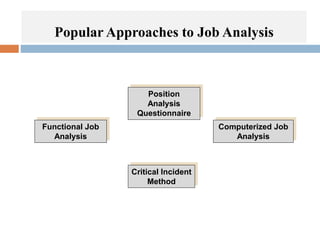
Functional Job
Analysis
Position
Analysis
Questionnaire
Critical Incident
Method
Computerized Job
Analysis
Popular Approaches to Job Analysis
12
1. Position Analysis Questionnaire (PAQ model) :
 is a structured questionnaire of job analysis to measure
job characteristics and relate them to human
characteristics.
 it consists of 195 job elements that describe common
human work behaviors.
Popular Approaches to Job Analysis
2. Critical Incident Method:
 Situation analysis technique in which actions or
behavior of an employee (during, for example, a
customer service event) is recorded and examined to
ascertain the actual requirements of a successful
operation.
 a method for improving an employee's performance
by writing down and examining examples of what
they did particularly well or badly and how it affected
their work.
13
Popular Approaches to Job Analysis
3. Functional Job Analysis (FJA):
 Quantitative approach to job analysis that uses a collected
list of the various functions or work activities that can
make up any job.
 FJA breaks down job roles into seven areas: things, data,
worker instructions, reasoning, people, maths and
language.
 Analysis of worker actions within these areas plays a key
part of the Functional Job Analysis process.
Popular Approaches to Job Analysis
Job Descriptions
Job Title
Job Identification
Job Specifications
Essential
Functions
1. Title.
2. Statement.
3. Essential Functions.
4. Specifications.
Job Description
1. XXX
2. XXX
3. XXX
4. XXX
1. XXX
2. XXX
3. XXX
4. XXX
Key Elements of a Job Description
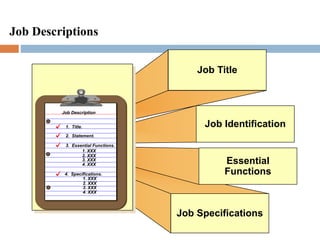
1. Job Title:
 Indicates job duties and organizational level.
2. Job Identification:
 Distinguishes job from all other jobs.
3. Essential Functions (Job Duties):
 Indicate responsibilities entailed and results to be.
accomplished
4. Job Specifications:
 Basic skills required to perform the job and physical
demands of the job.
Problems with Job Descriptions
1. If poorly written, they provide little guidance to the
jobholder.
2. They are not always updated as job duties or
specifications change.
3. They may break up the law by containing.
specifications not related to job success.
4. They can limit the scope of activities of the
jobholder, reducing organizational flexibility.
Job Design
 Job Design:
 An result of job analysis that improves jobs through
technological and human considerations in order to
enhance organization efficiency and employee job
satisfaction.
 Job Enrichment:
 Enhancing a job by adding more meaningful tasks and
duties to make the work more rewarding or satisfying.
 Providing opportunities for achievement, recognition,
growth, responsibility, and performance.
Job Enrichment Factors
1. Increasing the level of difficulty and responsibility of
the job.
2. Allowing employees to retain more authority and
control over work outcomes.
3. Providing unit or individual job performance reports
directly to employees.
4. Adding new tasks to the job that require training and
growth.
5. Assigning individuals specific tasks, thus enabling
them to become experts.

Job analysis hr tool

  • 1.
  • 2.
  • 3.
    Definitions 3  Job -Consists of a group of tasks that must be performed for an organization to achieve its goals.  Position - Collection of tasks and responsibilities performed by one person; there is a position for every individual in an organization.  Job Specification: Statement of the needed knowledge, skills, and abilities (KSAs) of the person who is to perform the job.  Job Description: Statement of the tasks, duties, and responsibilities (TDRs) of a job to be performed.
  • 4.
    Job Analysis  JobAnalysis:  Systematic process of obtaining information about the skills, duties, and knowledge required for performing jobs in an organization.  HR managers use the information to develop job descriptions and job specifications that are the basis for recruitment, training, employee performance appraisal and career development.  The ultimate purpose of job analysis is to improve organizational performance and productivity.
  • 5.
    Job Analysis: ABasic Human Resource Management Tool 5 Tasks Responsibilities Duties Job Analysis Job Descriptions Job Specifications Knowledge Skills Abilities Human Resource Planning Recruitment Selection Training and Development Performance Appraisal Compensation and Benefits Safety and Health Employee and Labor Relations Legal Considerations Job Analysis for Teams
  • 6.
    Reasons For ConductingJob Analysis 6  Staffing : would be disorganized if recruiter did not know qualifications needed for job.  Training and Development : if specification lists a particular knowledge, skill, or ability, and the person filling the position does not possess all the necessary qualifications, training and/or development is needed.  Compensation and Benefits: value of job must be known before dollar value can be placed on it.  Safety and Health : helps identify safety and health considerations.
  • 7.
    Summary of Typesof Data Collected Through Job Analysis 7  Work Activities – work activities and processes; activity records ; procedures used; personal responsibility.  Personal requirements for the job – personal characteristics such as personality and interests; education and training required; work experience.  Machines, tools, equipment, and work aids used.
  • 8.
    Conducting Job Analysis 8 The people who participate in job analysis should include, at a minimum: 1. The employee. 2. The employee’s immediate supervisor.
  • 9.
    Performing Job Analysis Step1 : Select jobs to study. Step 2 : Determine information to collect: Tasks, responsibilities, skill requirements, etc. Step 3 : Identify sources of data: Employees, supervisors/managers. Step 4: Methods of data collection:  Interviews  Questionnaires  Observation  Diaries and Records
  • 10.
    10 Step 5: Evaluateand validate data collection:  Other employees  Supervisors/managers Step 6: Write job analysis report. Performing Job Analysis
  • 11.
  • 12.
    12 1. Position AnalysisQuestionnaire (PAQ model) :  is a structured questionnaire of job analysis to measure job characteristics and relate them to human characteristics.  it consists of 195 job elements that describe common human work behaviors. Popular Approaches to Job Analysis
  • 13.
    2. Critical IncidentMethod:  Situation analysis technique in which actions or behavior of an employee (during, for example, a customer service event) is recorded and examined to ascertain the actual requirements of a successful operation.  a method for improving an employee's performance by writing down and examining examples of what they did particularly well or badly and how it affected their work. 13 Popular Approaches to Job Analysis
  • 14.
    3. Functional JobAnalysis (FJA):  Quantitative approach to job analysis that uses a collected list of the various functions or work activities that can make up any job.  FJA breaks down job roles into seven areas: things, data, worker instructions, reasoning, people, maths and language.  Analysis of worker actions within these areas plays a key part of the Functional Job Analysis process. Popular Approaches to Job Analysis
  • 15.
    Job Descriptions Job Title JobIdentification Job Specifications Essential Functions 1. Title. 2. Statement. 3. Essential Functions. 4. Specifications. Job Description 1. XXX 2. XXX 3. XXX 4. XXX 1. XXX 2. XXX 3. XXX 4. XXX
  • 16.
    Key Elements ofa Job Description 1. Job Title:  Indicates job duties and organizational level. 2. Job Identification:  Distinguishes job from all other jobs. 3. Essential Functions (Job Duties):  Indicate responsibilities entailed and results to be. accomplished 4. Job Specifications:  Basic skills required to perform the job and physical demands of the job.
  • 17.
    Problems with JobDescriptions 1. If poorly written, they provide little guidance to the jobholder. 2. They are not always updated as job duties or specifications change. 3. They may break up the law by containing. specifications not related to job success. 4. They can limit the scope of activities of the jobholder, reducing organizational flexibility.
  • 18.
    Job Design  JobDesign:  An result of job analysis that improves jobs through technological and human considerations in order to enhance organization efficiency and employee job satisfaction.  Job Enrichment:  Enhancing a job by adding more meaningful tasks and duties to make the work more rewarding or satisfying.  Providing opportunities for achievement, recognition, growth, responsibility, and performance.
  • 19.
    Job Enrichment Factors 1.Increasing the level of difficulty and responsibility of the job. 2. Allowing employees to retain more authority and control over work outcomes. 3. Providing unit or individual job performance reports directly to employees. 4. Adding new tasks to the job that require training and growth. 5. Assigning individuals specific tasks, thus enabling them to become experts.