Human Resources
Management
MBA Program
-2-
Job Analysis and Job
Design
Defining job analysis
 The procedure through which you determine
the duties of positions in the organisation and
the characteristics of the people to hire for
them
 A systematic way of determining which
employees are expected to perform a
particular function or task that must be
accomplished
Definition (cont….)
 A purposeful, systematic process for
collecting information on the important work
related aspects of a job
 Process to identify and determine in detail the
particular job duties and requirements and
the relative importance of these duties for a
given job.
 A process where judgments are made about
data collected on a job.
Definition (cont….)
 Job analysis is a systematic exploration of
the activities within a job.
 This analysis involves compiling a detailed
description of tasks, determining the
relationships of the job to technology and to
other jobs and examining the knowledge,
qualifications or employment standards,
accountabilities and other incumbent
requirement.
Definition (cont….)
 The job analysis indicates what activities and
accountabilities the job entails; it is an accurate
recording of the activities involved.
 It involves studying jobs to determine what tasks
and responsibilities they include, their
relationships to other jobs, and the conditions
under which work is performed, tools and
equipment used, and the personal capabilities
required for satisfactory performance.
Definition (cont….)
 Job analysis produces information for writing
job descriptions ( a list of what the job
entails and job specification ( what kind of
people to hire for that job)
Definition (cont….)
 Job description –the principal product of a
job analyses. It represents a written summary
of the job as an identifiable organization unit
 Job specification – a written explanation of
the knowledge, skills, abilities, traits and
other competencies (KSACs) necessary for
effective performance on a given job
When Job Analysis is carried out
1. When an organisation is started
2. When changes occur which require new
methods and procedures in performing the
job e.g. introduction of new technology
3. When a new job is created
Purpose of job analysis
1. Determining qualifications required of
jobholders
2. Providing guidance in recruitment and selection:
 Job analysis information helps recruiters seek and
find the right person for the organisation.
 And to hire the right person, the selection test
must access the most critical skills and abilities
needed to perform a job. This information comes
from a job analysis
Purpose of job analysis ( cont..)
3. Evaluating current employees for transfer or
promotion
4. Provide a basis for determining training
 Knowing the skills necessary for jobs is essential to
building effective training programmes.
 Moreover, helping people to move efficiently form one
career stage to another can only be accomplished with
information from job analysis
5. Providing clues for work methods simplification and
improvement
Purpose of job analysis
( cont..)
6. Setting compensation and maintaining fairness
in wage and salary administration:
 Compensation is usually tied to the duties and responsibilities of
a job.
 Proper compensation demands accurate assessment of what
various jobs entails
7. Judging the merits of grievances that question
assignments and compensation
8. Establishing responsibility, accountability, and
authority
Purpose of job analysis
( cont..)
9. Providing essential guidance for performance
management - in the establishment of
standards of performance and hence
performance appraisal
10. Strategic planning
 Effective job analysis can help organisations
to change, eliminate or otherwise restructure
work or work flow process to meet the
changing demands of uncertain environments
Purpose of job analysis
( cont..)
 In conclusion, it should be noted that job
analysis covers the entire domain of HRM as
it would be difficult to be effective in hiring,
training, appraising , compensation or utilize
HR without the information derived from job
analysis
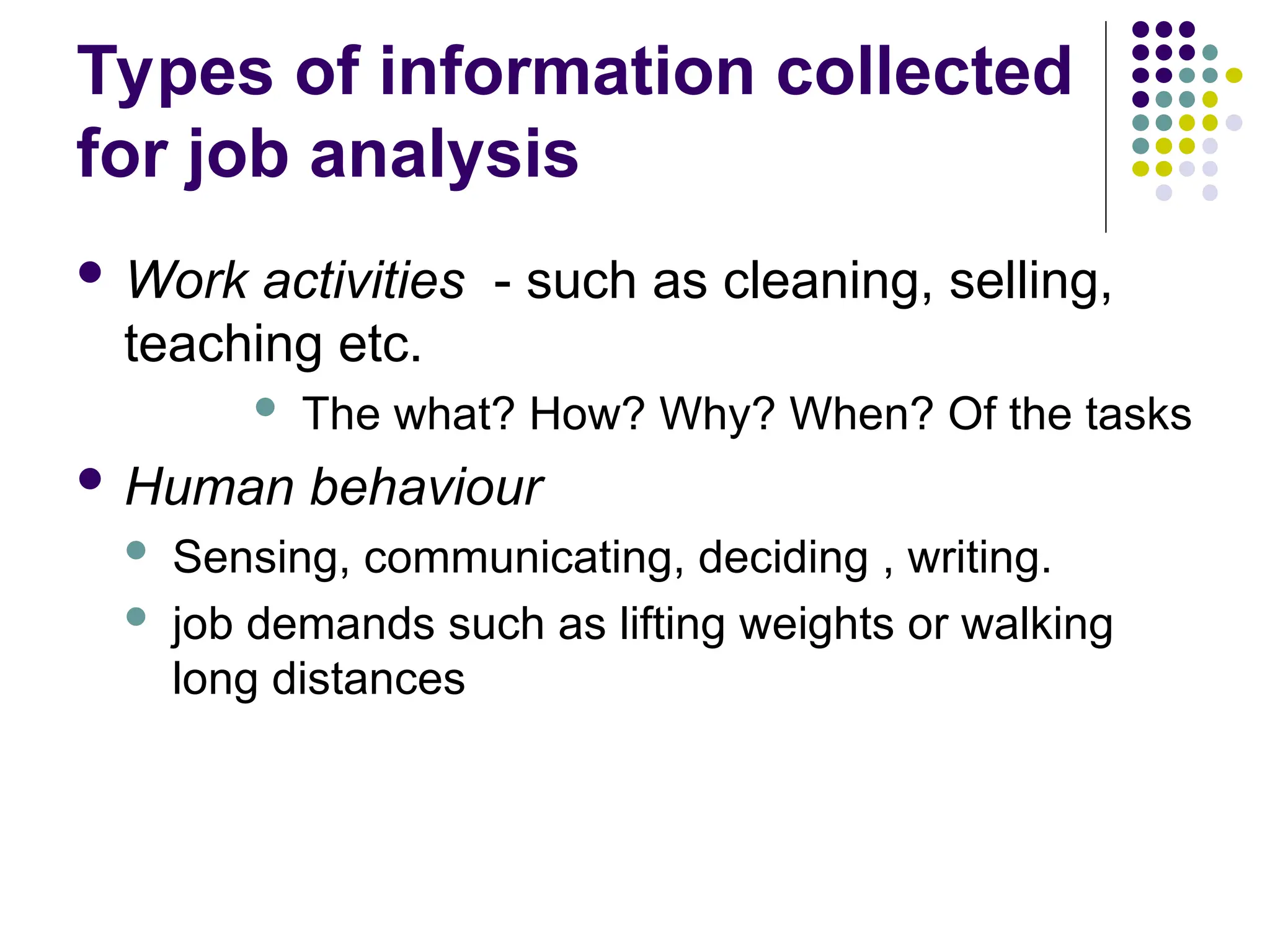
Types of information collected
for job analysis
 Work activities - such as cleaning, selling,
teaching etc.
 The what? How? Why? When? Of the tasks
 Human behaviour
 Sensing, communicating, deciding , writing.
 job demands such as lifting weights or walking
long distances
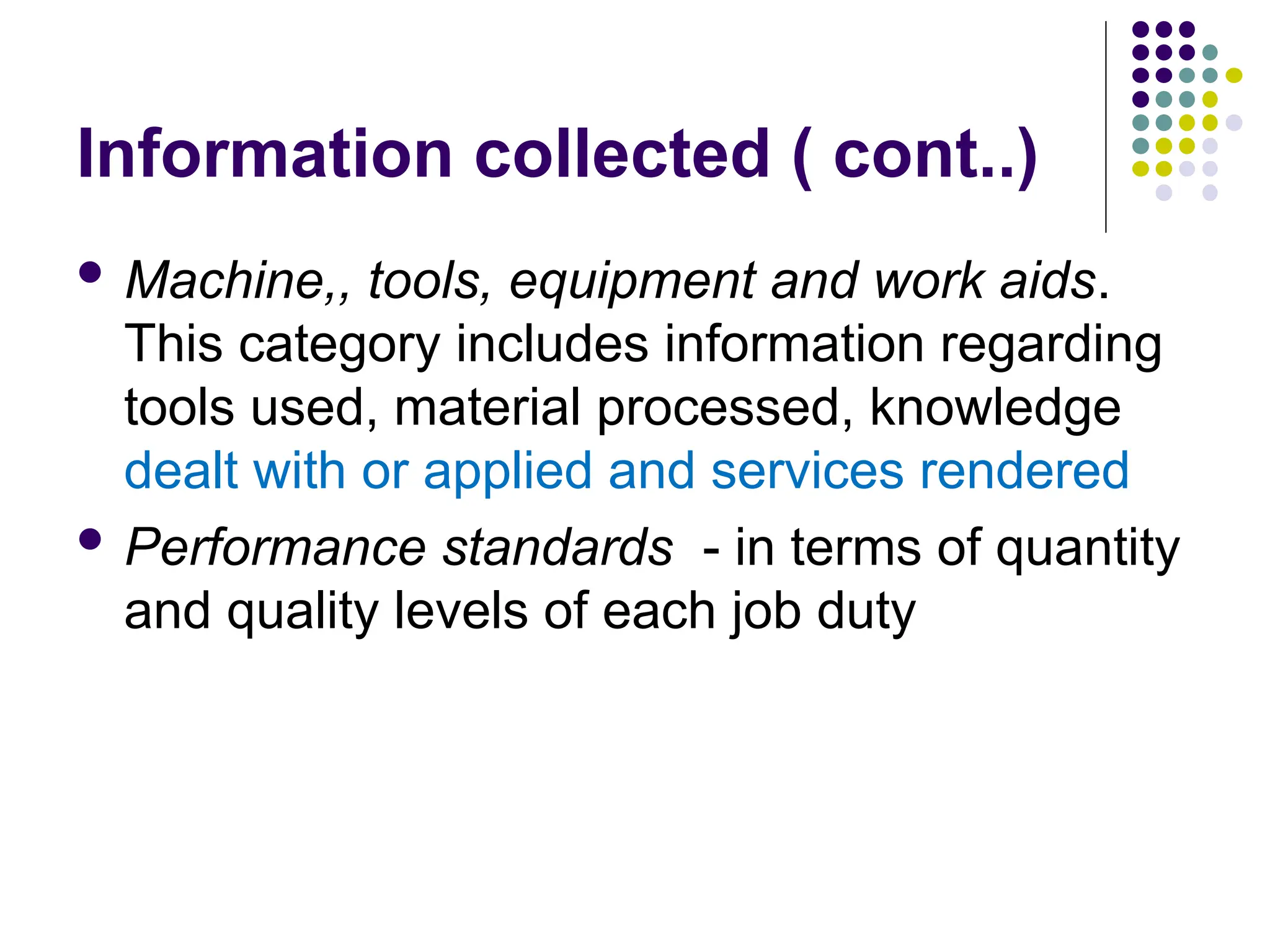
Information collected ( cont..)
 Machine,, tools, equipment and work aids.
This category includes information regarding
tools used, material processed, knowledge
dealt with or applied and services rendered
 Performance standards - in terms of quantity
and quality levels of each job duty
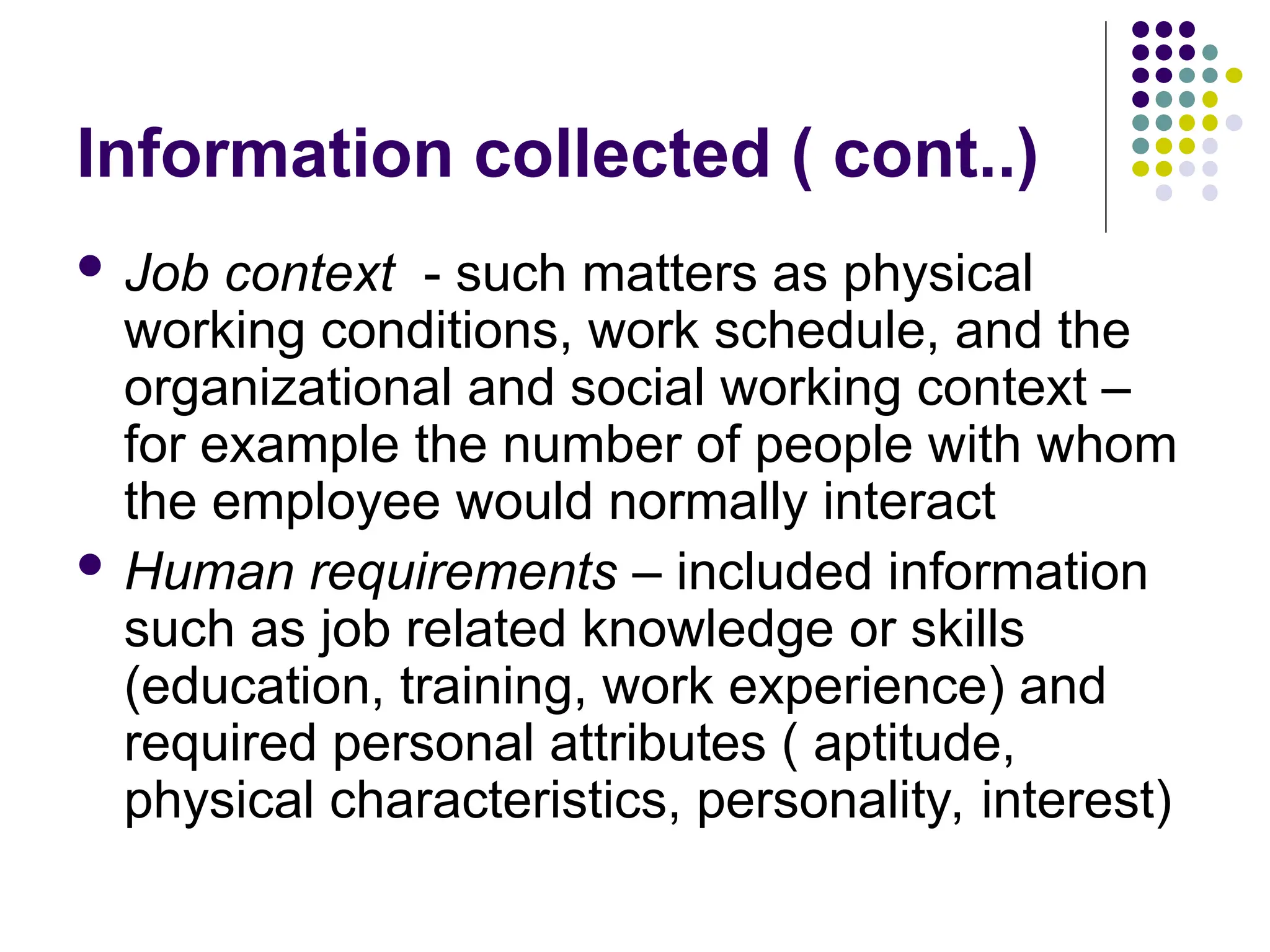
Information collected ( cont..)
 Job context - such matters as physical
working conditions, work schedule, and the
organizational and social working context –
for example the number of people with whom
the employee would normally interact
 Human requirements – included information
such as job related knowledge or skills
(education, training, work experience) and
required personal attributes ( aptitude,
physical characteristics, personality, interest)
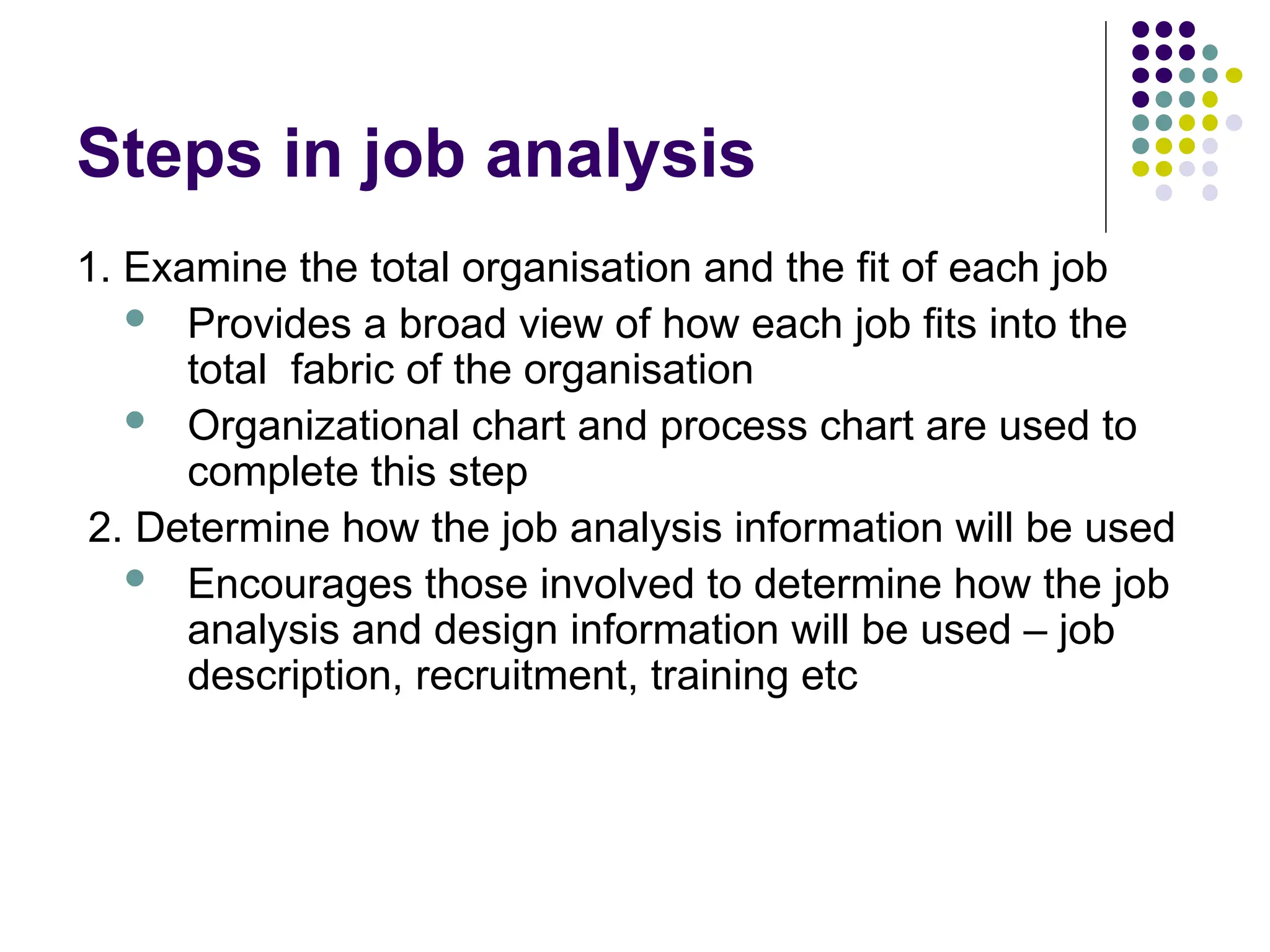
Steps in job analysis
1. Examine the total organisation and the fit of each job
 Provides a broad view of how each job fits into the
total fabric of the organisation
 Organizational chart and process chart are used to
complete this step
2. Determine how the job analysis information will be used
 Encourages those involved to determine how the job
analysis and design information will be used – job
description, recruitment, training etc
Steps (cont…)
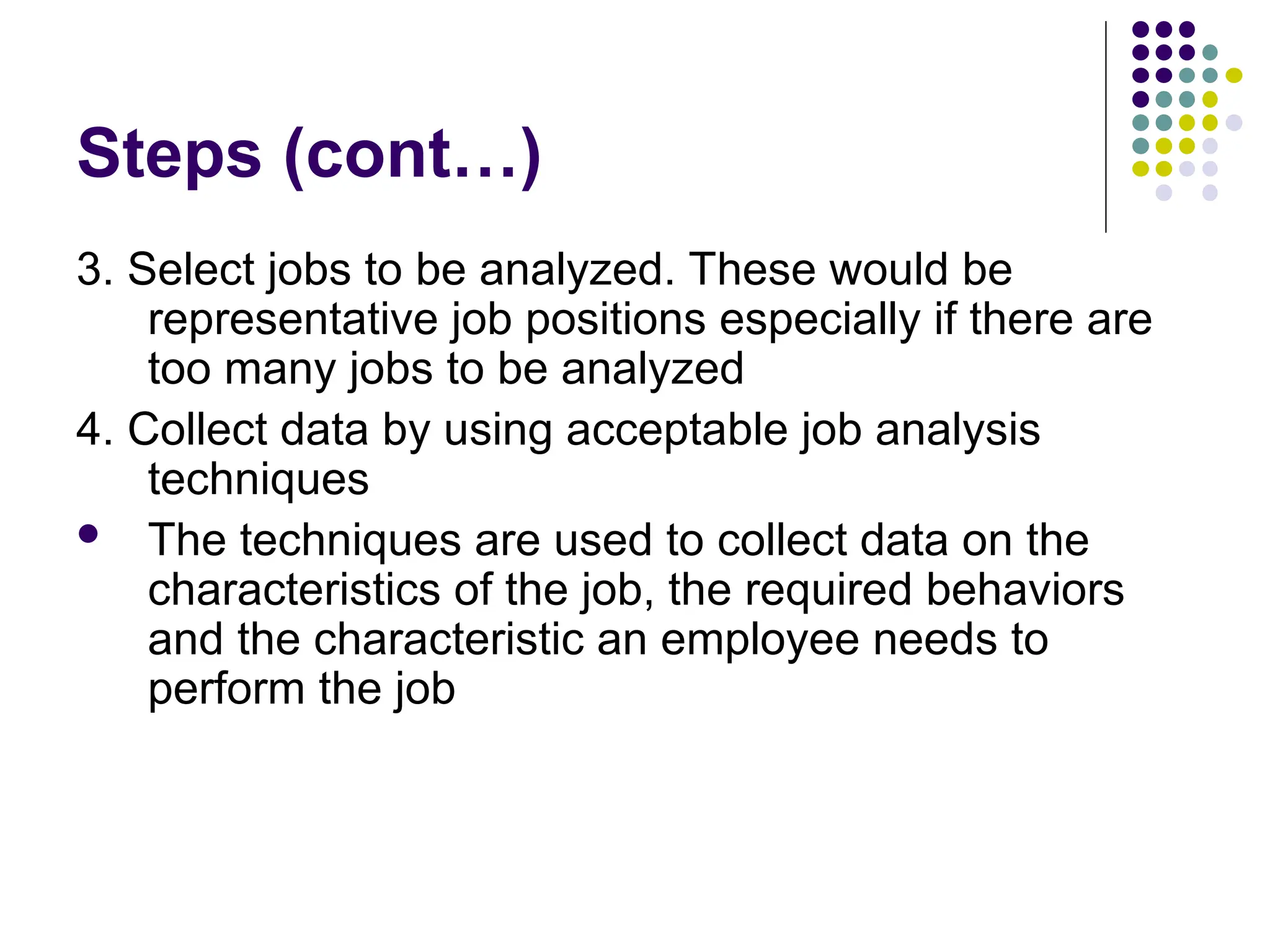
3. Select jobs to be analyzed. These would be
representative job positions especially if there are
too many jobs to be analyzed
4. Collect data by using acceptable job analysis
techniques
 The techniques are used to collect data on the
characteristics of the job, the required behaviors
and the characteristic an employee needs to
perform the job
Steps (cont..)
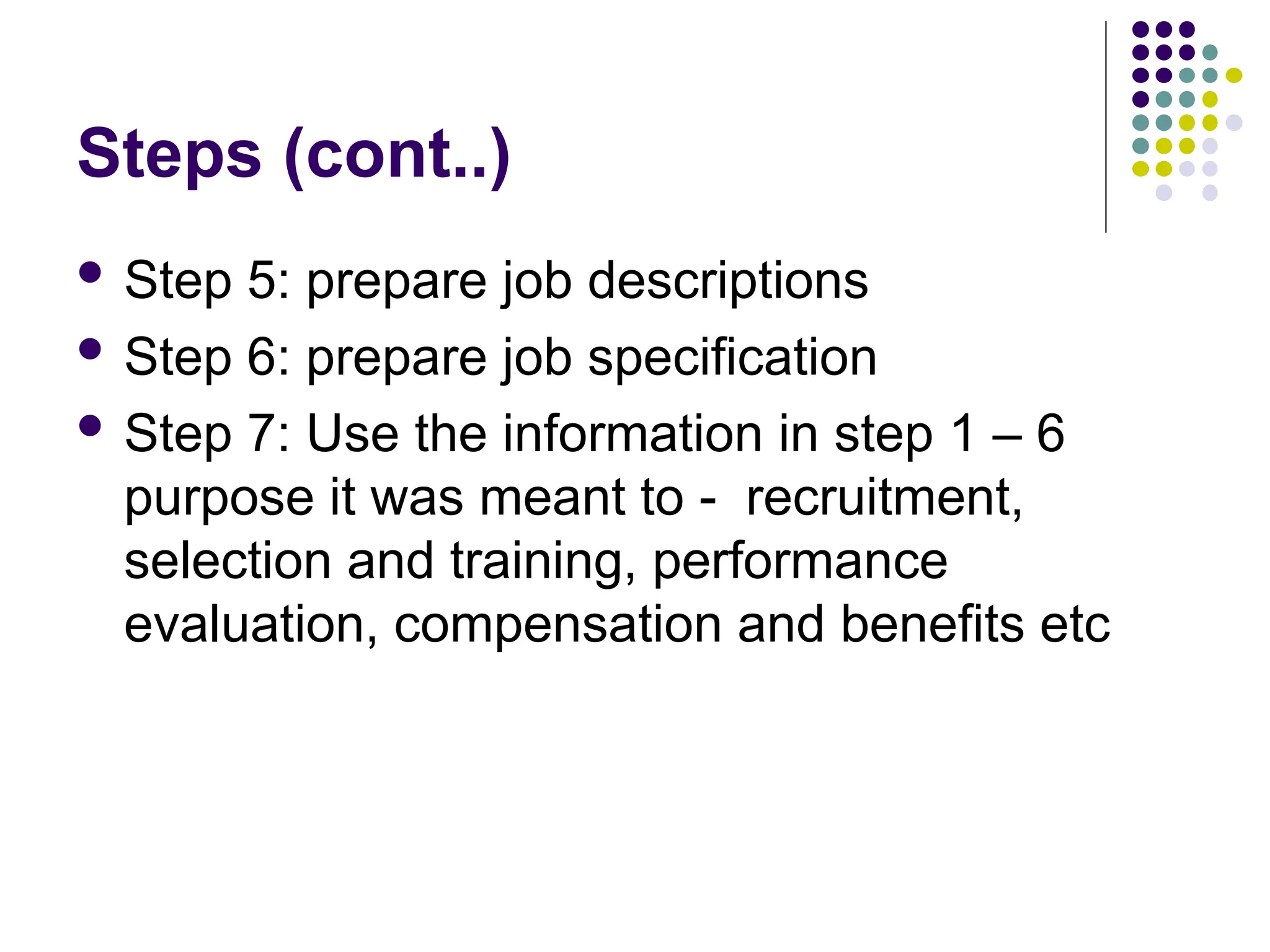
 Step 5: prepare job descriptions
 Step 6: prepare job specification
 Step 7: Use the information in step 1 – 6
purpose it was meant to - recruitment,
selection and training, performance
evaluation, compensation and benefits etc
Who should conduct job
analysis
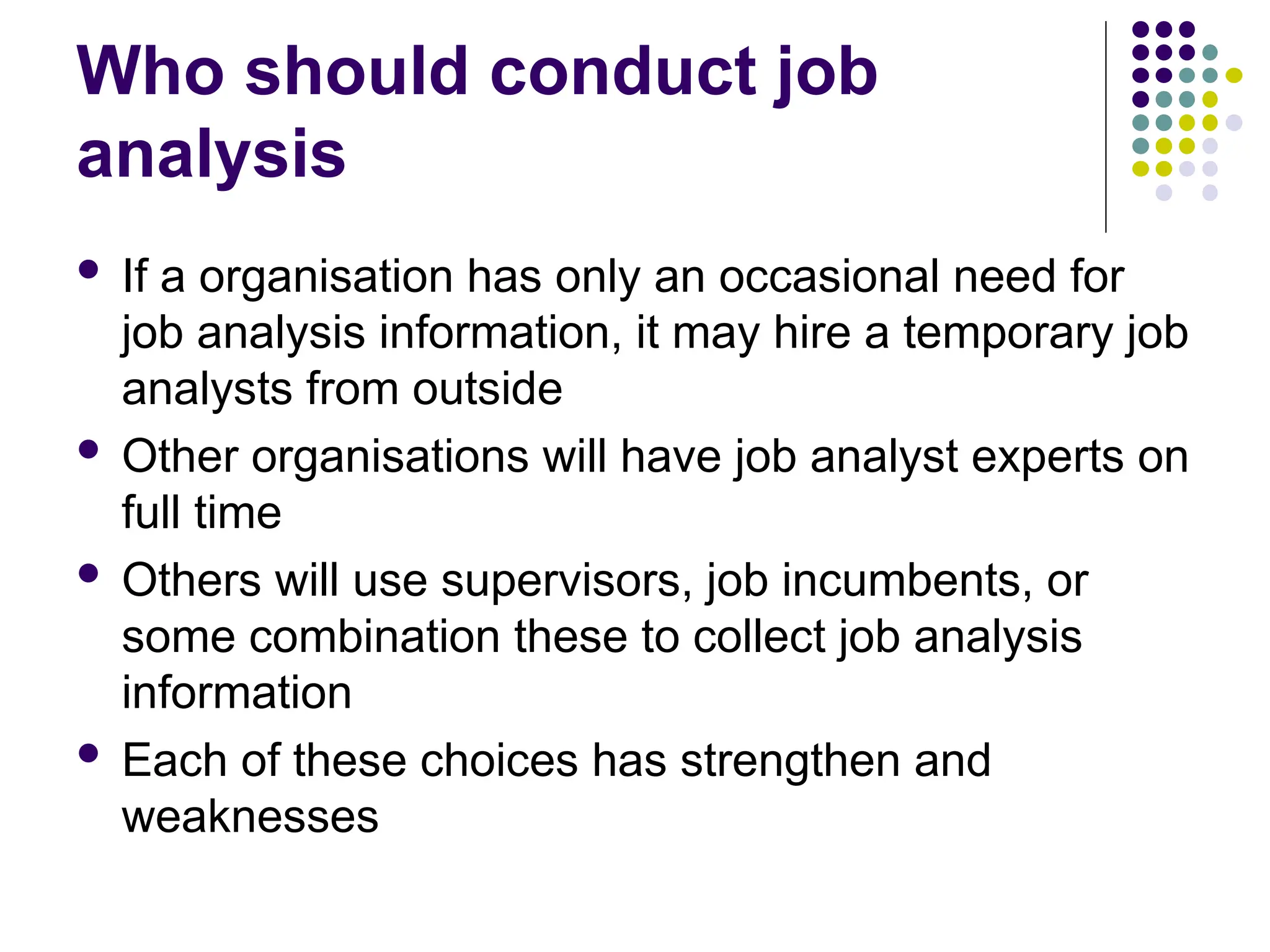
 If a organisation has only an occasional need for
job analysis information, it may hire a temporary job
analysts from outside
 Other organisations will have job analyst experts on
full time
 Others will use supervisors, job incumbents, or
some combination these to collect job analysis
information
 Each of these choices has strengthen and
weaknesses
Who should conduct job analysis
- use of incumbent (cont…)
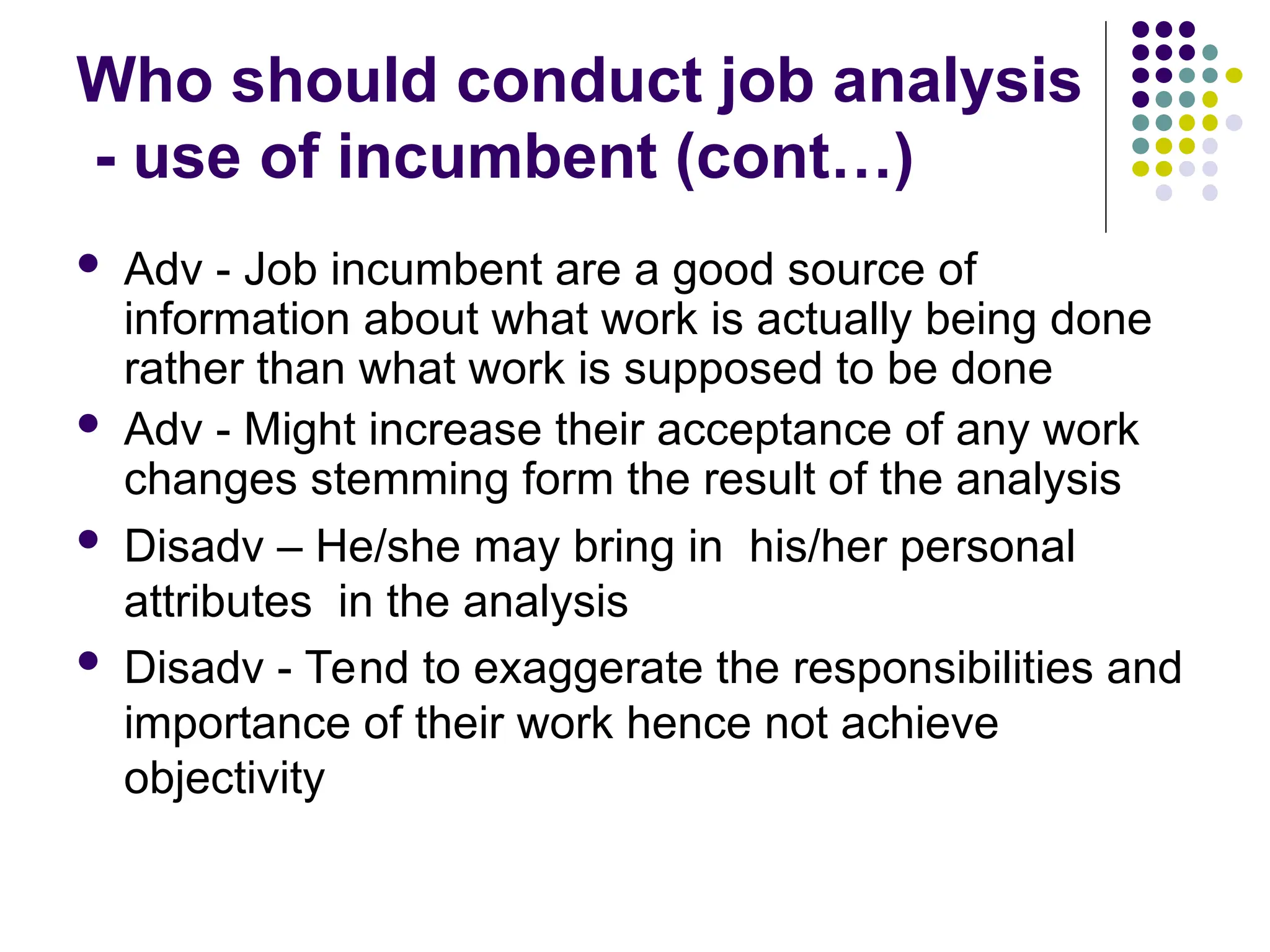
 Adv - Job incumbent are a good source of
information about what work is actually being done
rather than what work is supposed to be done
 Adv - Might increase their acceptance of any work
changes stemming form the result of the analysis
 Disadv – He/she may bring in his/her personal
attributes in the analysis
 Disadv - Tend to exaggerate the responsibilities and
importance of their work hence not achieve
objectivity
Who should conduct job
analysis (cont…)
 The choice of who should analyse a job
depends therefore on many factors:
 Location
 Complexity of the job
 How receptive incumbent might be to external
analysis
 The intents purpose of the result of the job
analysis
 ( read on advantages and disadvantages of each)
Methods of data collection
 There are four basic methods of data
collection which can be used separately or a
combination:
 Observation
 Interview
 Questionnaire
 Job incumbent diaries or logs
observation
 Direct observation is used for jobs that
require manual, standards, and shot-job cycle
activities e.g. job of a assembly line work, a
filing clerks,
 The job analysis observes a representative
sample of individuals performing the jobs
Limitations of observation
method
 Observation method is not appropriate where the
job involves significant mental activity such as work
of a research scientist, lawyer, teacher etc
 The observation method requires that the job
analyst be trained to observe relevant job
behaviours
 He/she must also keep out of the way so that work
must be performed
interviews
 Can be conducted with a single job
incumbent, or with group of individuals or
with a supervisor who is knowledgeable
about the job
 Involves face to face talk with the job
incumbents
 Must be structure in such a way that answers
from different individual can be compares
Advantages of interview
 Its relatively simple and quick way of collecting
information including information that might never
appear in written form
 A skilled interviewer can unearth important activities
that occur only occasionally, or informal contacts
that wouldn’t be obvious form the organizational
chart
 The interview also provide an opportunity to explain
the need for and functions of the job
 The employee might also vent frustration that might
otherwise go unnoticed by management
Limitations of interview
 However, it should be noted that interview guides
are difficult to standardize – different interviewers
many ask different questions and the same
interviewer might unintentionally ask different
questions of different respondents
 There is also possibility that the information
provided by the respondents will be unintentionally
distorted by the interviewer.
 Finally the cost of interviewing can be very high
Questionnaire method
 This is usually the least costly method of
collecting information
 It is an effective way to collect a large amount
of information in a short period of time
 The questionnaire includes:
 Specific questions about the job
 Job requirements
 Working conditions
 Equipment
Questionnaire method (cont..)
 A less structures, more open-ended
approach would be to ask job incumbents to
describe their jobs in their worn terms
 This open-ended format would permit job
incumbent to use their won words and ideas
to describe the job
Job incumbent dairy or log
 The diary or log is a record by job incumbent
of job duties. It includes:
 Frequency of the duties
 When the duties were accomplished
 This technique requires the job incumbent to
keep a diary or log
 Unfortunately, most individuals are not
disciplined enough to keep such a log a
diary.
Job incumbent dairy or log
(cont..)
 If a diary if kept up to date, it can provide good
information about a job
 Comparison on a daily, weekly or monthly basis can
be made
 This permits an examination of the routineness or
nonroutininess of the job duties
 A daily log is useful when attempting to analyse jobs
that are difficult to observe such as those performed
by engineers, senior executives etc
Which method to use
 Any or a or a combination - a multimethod
job analysis approach
 It is recommended a combination because
each of the method has its strengths and can
elicit more of some specific information
 The choice of method may also be
determined by circumstances such as the
purpose of the job analysis, and time and
budgetary constraints
Job description
 A job description, is a written description of what the job
entails
 Written statement of what the worker actually does, how
he does or she does it, and what the working conditions
are
 job description clarifies work functions and reporting
relationships, helping employees understand their jobs.
 Job descriptions aid in maintaining a consistent salary
structure.
 Performance evaluations may be based on job
descriptions
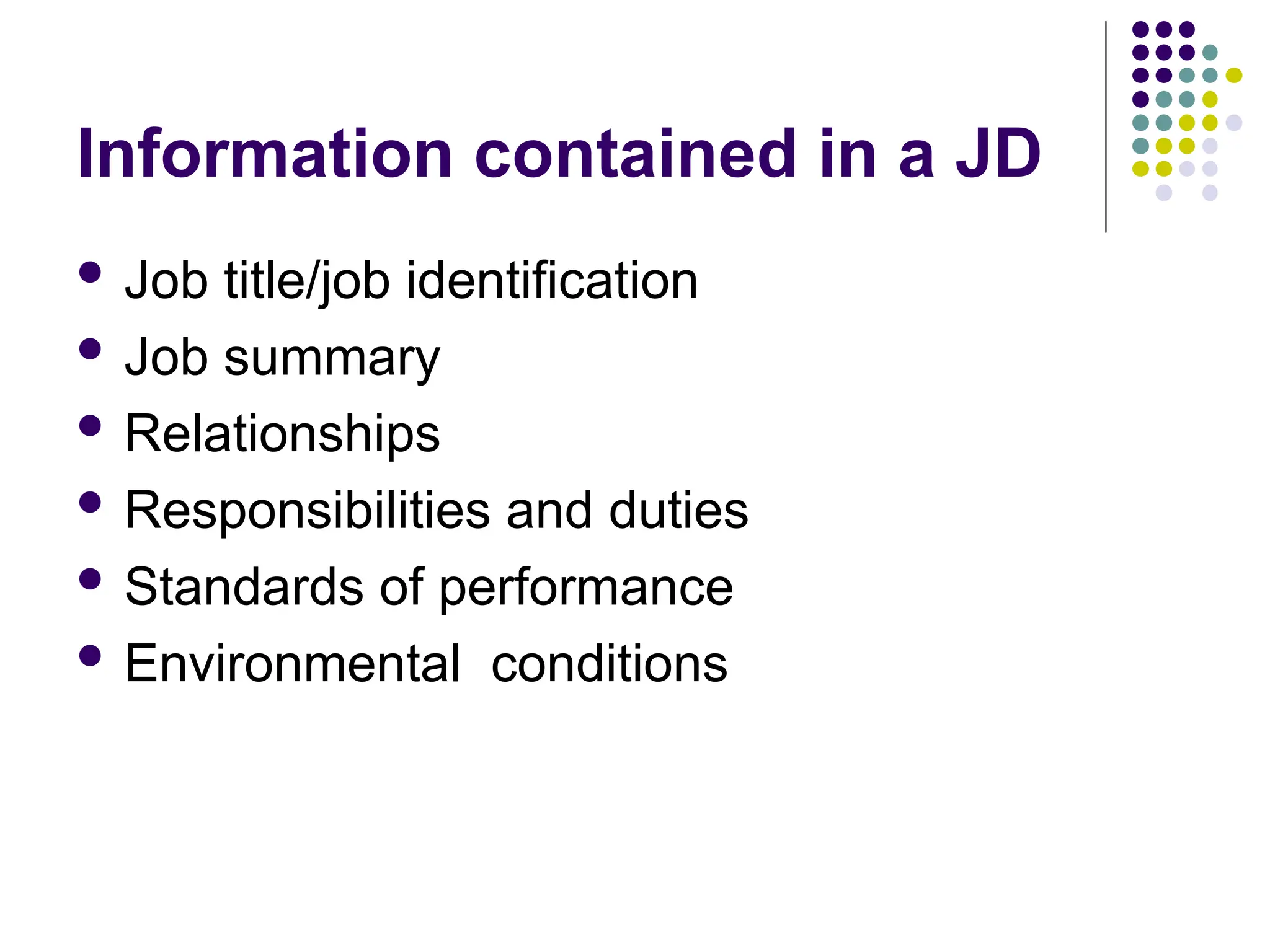
Information contained in a JD
 Job title/job identification
 Job summary
 Relationships
 Responsibilities and duties
 Standards of performance
 Environmental conditions
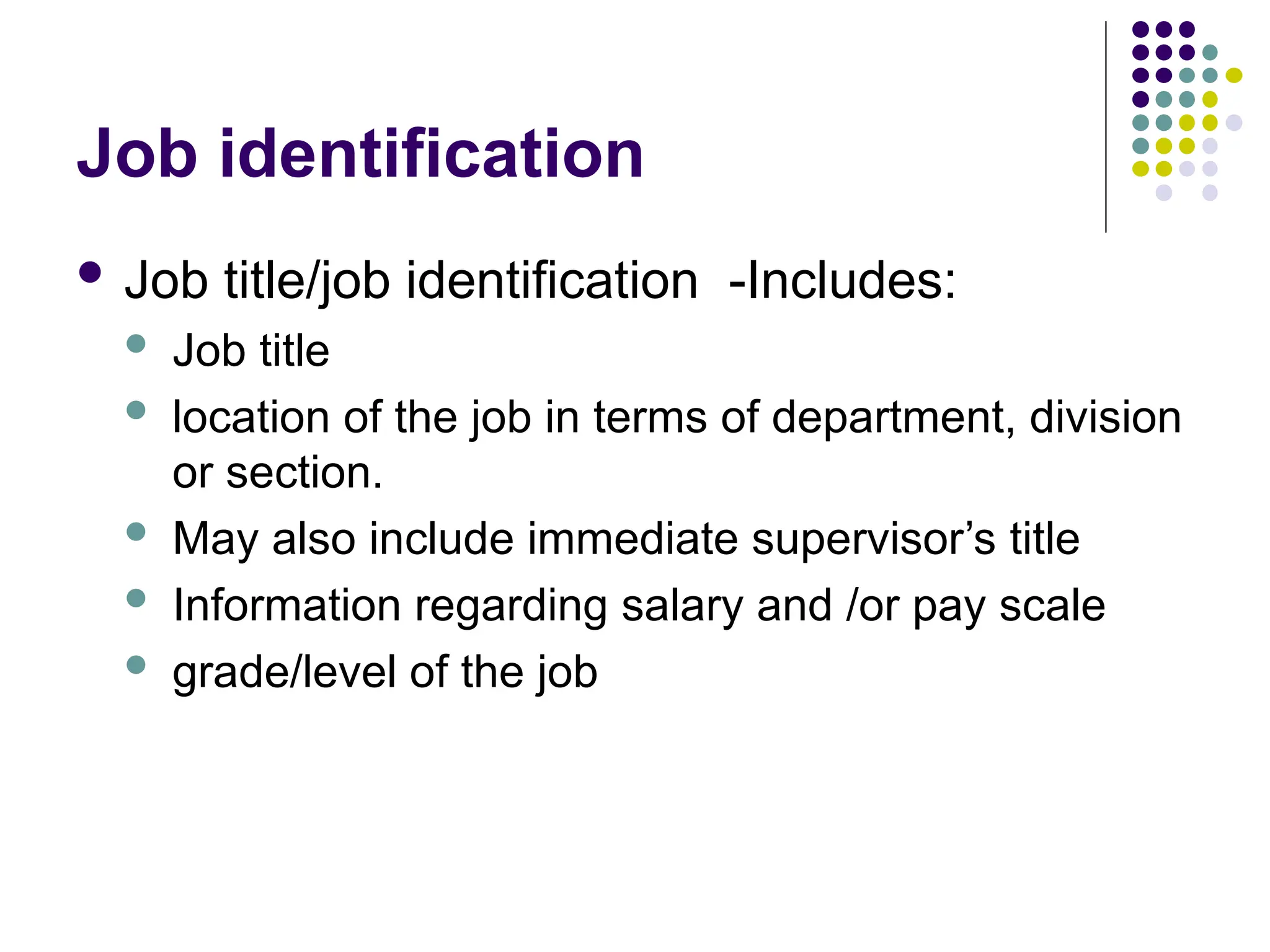
Job identification
 Job title/job identification -Includes:
 Job title
 location of the job in terms of department, division
or section.
 May also include immediate supervisor’s title
 Information regarding salary and /or pay scale
 grade/level of the job
Job summary
 Brief one or two sentence statements describing
the purpose of the job and what outputs are
expected from the incumbents
 Describes general nature of the job and includes
only the major functions of the job or activities e.g.
the marketing managers job is to plan, direct and
coordinate the marketing
Relationships
 Shows job holders relationship with others
inside and outside the company. Includes:
 reporting to
 Supervises
 Works with
 Outside the company
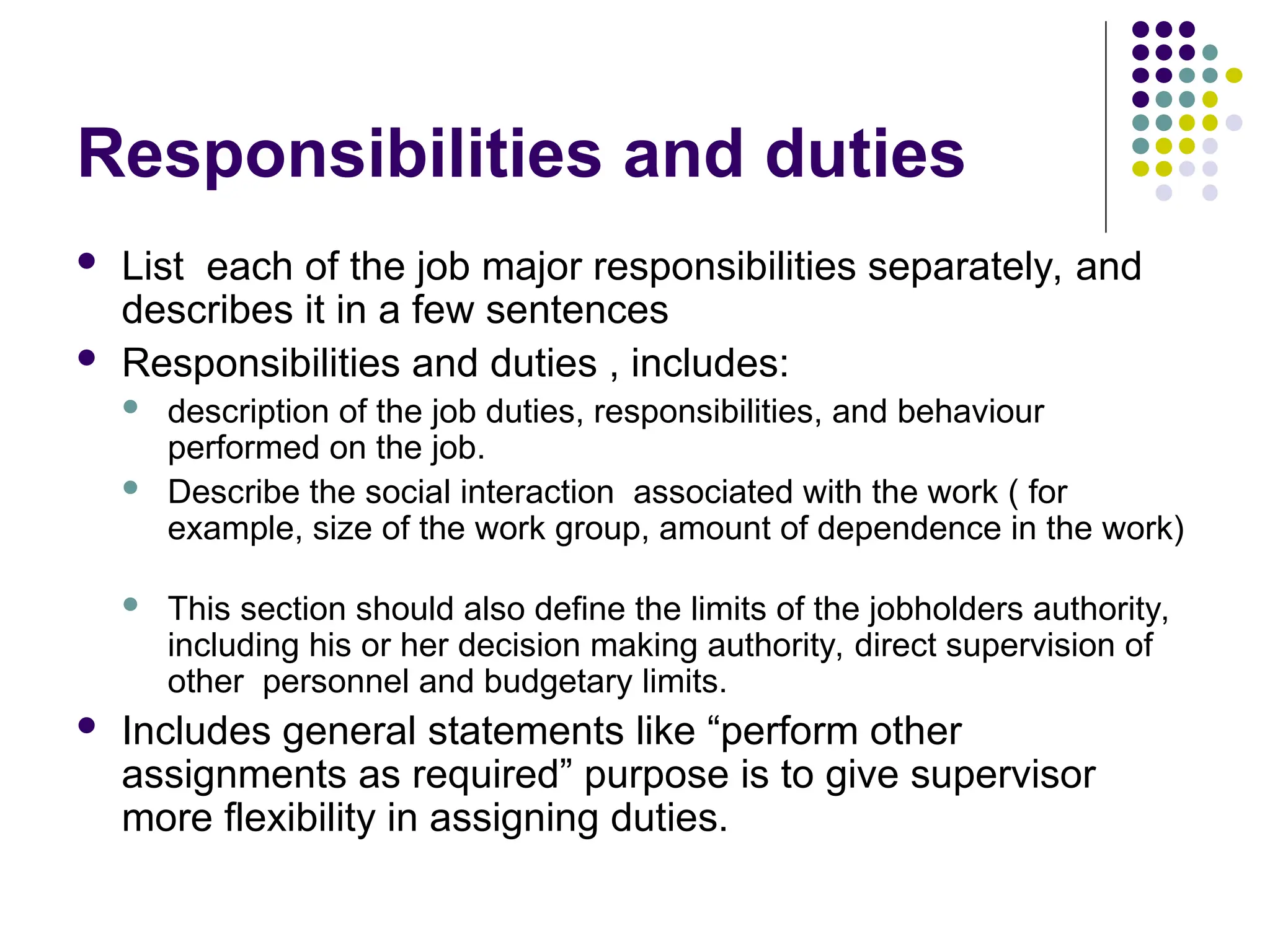
Responsibilities and duties
 List each of the job major responsibilities separately, and
describes it in a few sentences
 Responsibilities and duties , includes:
 description of the job duties, responsibilities, and behaviour
performed on the job.
 Describe the social interaction associated with the work ( for
example, size of the work group, amount of dependence in the work)
 This section should also define the limits of the jobholders authority,
including his or her decision making authority, direct supervision of
other personnel and budgetary limits.
 Includes general statements like “perform other
assignments as required” purpose is to give supervisor
more flexibility in assigning duties.
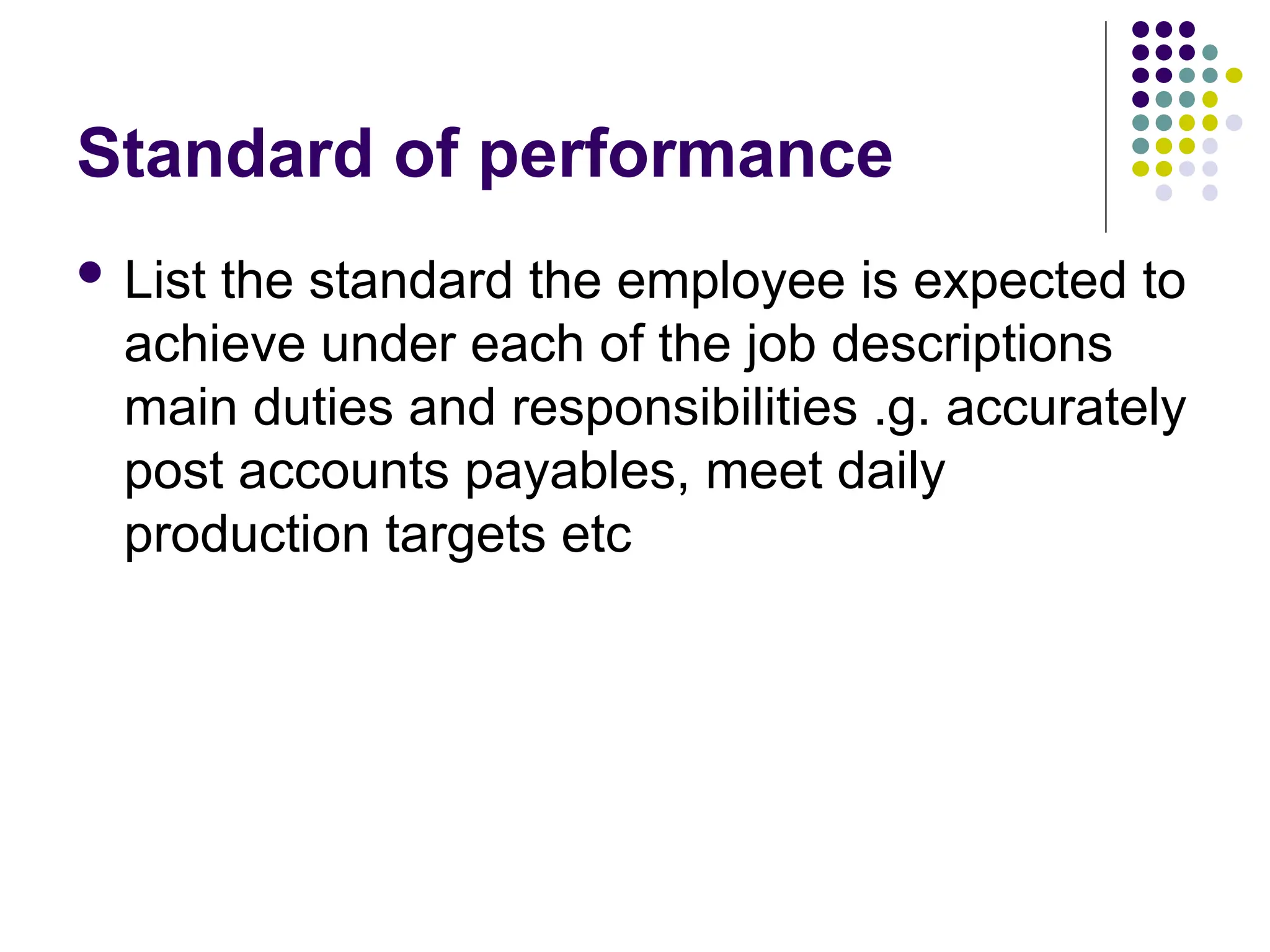
Standard of performance
 List the standard the employee is expected to
achieve under each of the job descriptions
main duties and responsibilities .g. accurately
post accounts payables, meet daily
production targets etc
Environmental conditions
 Environment/conditions – description of the
working conditions of the job, the location an
environment such as hazards and noise
levels
Job descriptions are important
because…….
1. Clarifies employer expectations for employee
2. Provides basis of measuring job performance
3. Provides clear description of role for job
candidates
4. Provides a structure for company to
understand and structure all jobs and ensure
necessary activities, duties and responsibilities
are covered by one job or another
Job descriptions are important
because…….
5. Provides continuity of role parameters
irrespective of manager interpretation
6. Enables pay and grading systems to be
structured fairly and logically
7. Prevents arbitrary interpretation of role
content and limit by employee and employer
and manager
8. Essential reference tool in issues of
employee/employer dispute
Job descriptions are important
because…….
9. Essential reference tool for discipline issues
10. Provides important reference points for
training and development areas
11. Provides neutral and objective (as opposed
to subjective or arbitrary) reference points for
appraisals, performance reviews and
counselling
12. Enables formulation of skill set and
behaviour set requirements per role
Job descriptions are important
because…….
13. Enables organization to structure and manage
roles in a uniform way, thus increasing efficiency
and effectiveness of recruitment, training and
development, organizational structure, work flow
and activities, customer service, etc
14. Enables factual view (as opposed to
instinctual) to be taken by employees and
managers in career progression and succession
planning
Job specification
 This evolves form the JD
 It is a statement of employees characteristics and
qualification required for satisfactory performance of
defined duties and tasks comprising a specific job or
function.
 It addresses the question “what personal traits and
experience are needed to perform the job effectively”
 the JS is specifically useful in offering guidance for
recruitment and selection e.g. the job for HR manager
would require a university degree, six year of experience
in HRM
Components of a Job
Specification
 Personal characteristics such as education, job
experience, age, sex, and extra co-curricular activities.
 Physical characteristics such as height, weight, chest,
vision, hearing, health, voice poise, and hand and foot
coordination, (for specific positions only).
Mental characteristics such as general intelligence,
memory, judgment, foresight, ability to concentrate, etc.
Social and psychological characteristics such as
emotional ability, flexibility, manners, drive,
conversational ability, interpersonal ability, attitude,
values, creativity etc.
Components of a Job
Specification
 Various contents of a job specification can be
prescribed in three terms:
 Essential qualities which a person must possess;
 Desirable qualities which a person may possess; and
 Contra-indicators which are likely to become a
handicap to successful job performance.

HUMAN RESOURCES MANAGEMENT Job_Analysis.ppt

  • 1.
  • 2.
    Job Analysis andJob Design
  • 3.
    Defining job analysis The procedure through which you determine the duties of positions in the organisation and the characteristics of the people to hire for them  A systematic way of determining which employees are expected to perform a particular function or task that must be accomplished
  • 4.
    Definition (cont….)  Apurposeful, systematic process for collecting information on the important work related aspects of a job  Process to identify and determine in detail the particular job duties and requirements and the relative importance of these duties for a given job.  A process where judgments are made about data collected on a job.
  • 5.
    Definition (cont….)  Jobanalysis is a systematic exploration of the activities within a job.  This analysis involves compiling a detailed description of tasks, determining the relationships of the job to technology and to other jobs and examining the knowledge, qualifications or employment standards, accountabilities and other incumbent requirement.
  • 6.
    Definition (cont….)  Thejob analysis indicates what activities and accountabilities the job entails; it is an accurate recording of the activities involved.  It involves studying jobs to determine what tasks and responsibilities they include, their relationships to other jobs, and the conditions under which work is performed, tools and equipment used, and the personal capabilities required for satisfactory performance.
  • 7.
    Definition (cont….)  Jobanalysis produces information for writing job descriptions ( a list of what the job entails and job specification ( what kind of people to hire for that job)
  • 8.
    Definition (cont….)  Jobdescription –the principal product of a job analyses. It represents a written summary of the job as an identifiable organization unit  Job specification – a written explanation of the knowledge, skills, abilities, traits and other competencies (KSACs) necessary for effective performance on a given job
  • 9.
    When Job Analysisis carried out 1. When an organisation is started 2. When changes occur which require new methods and procedures in performing the job e.g. introduction of new technology 3. When a new job is created
  • 10.
    Purpose of jobanalysis 1. Determining qualifications required of jobholders 2. Providing guidance in recruitment and selection:  Job analysis information helps recruiters seek and find the right person for the organisation.  And to hire the right person, the selection test must access the most critical skills and abilities needed to perform a job. This information comes from a job analysis
  • 11.
    Purpose of jobanalysis ( cont..) 3. Evaluating current employees for transfer or promotion 4. Provide a basis for determining training  Knowing the skills necessary for jobs is essential to building effective training programmes.  Moreover, helping people to move efficiently form one career stage to another can only be accomplished with information from job analysis 5. Providing clues for work methods simplification and improvement
  • 12.
    Purpose of jobanalysis ( cont..) 6. Setting compensation and maintaining fairness in wage and salary administration:  Compensation is usually tied to the duties and responsibilities of a job.  Proper compensation demands accurate assessment of what various jobs entails 7. Judging the merits of grievances that question assignments and compensation 8. Establishing responsibility, accountability, and authority
  • 13.
    Purpose of jobanalysis ( cont..) 9. Providing essential guidance for performance management - in the establishment of standards of performance and hence performance appraisal 10. Strategic planning  Effective job analysis can help organisations to change, eliminate or otherwise restructure work or work flow process to meet the changing demands of uncertain environments
  • 14.
    Purpose of jobanalysis ( cont..)  In conclusion, it should be noted that job analysis covers the entire domain of HRM as it would be difficult to be effective in hiring, training, appraising , compensation or utilize HR without the information derived from job analysis
  • 15.
    Types of informationcollected for job analysis  Work activities - such as cleaning, selling, teaching etc.  The what? How? Why? When? Of the tasks  Human behaviour  Sensing, communicating, deciding , writing.  job demands such as lifting weights or walking long distances
  • 16.
    Information collected (cont..)  Machine,, tools, equipment and work aids. This category includes information regarding tools used, material processed, knowledge dealt with or applied and services rendered  Performance standards - in terms of quantity and quality levels of each job duty
  • 17.
    Information collected (cont..)  Job context - such matters as physical working conditions, work schedule, and the organizational and social working context – for example the number of people with whom the employee would normally interact  Human requirements – included information such as job related knowledge or skills (education, training, work experience) and required personal attributes ( aptitude, physical characteristics, personality, interest)
  • 18.
    Steps in jobanalysis 1. Examine the total organisation and the fit of each job  Provides a broad view of how each job fits into the total fabric of the organisation  Organizational chart and process chart are used to complete this step 2. Determine how the job analysis information will be used  Encourages those involved to determine how the job analysis and design information will be used – job description, recruitment, training etc
  • 19.
    Steps (cont…) 3. Selectjobs to be analyzed. These would be representative job positions especially if there are too many jobs to be analyzed 4. Collect data by using acceptable job analysis techniques  The techniques are used to collect data on the characteristics of the job, the required behaviors and the characteristic an employee needs to perform the job
  • 20.
    Steps (cont..)  Step5: prepare job descriptions  Step 6: prepare job specification  Step 7: Use the information in step 1 – 6 purpose it was meant to - recruitment, selection and training, performance evaluation, compensation and benefits etc
  • 21.
    Who should conductjob analysis  If a organisation has only an occasional need for job analysis information, it may hire a temporary job analysts from outside  Other organisations will have job analyst experts on full time  Others will use supervisors, job incumbents, or some combination these to collect job analysis information  Each of these choices has strengthen and weaknesses
  • 22.
    Who should conductjob analysis - use of incumbent (cont…)  Adv - Job incumbent are a good source of information about what work is actually being done rather than what work is supposed to be done  Adv - Might increase their acceptance of any work changes stemming form the result of the analysis  Disadv – He/she may bring in his/her personal attributes in the analysis  Disadv - Tend to exaggerate the responsibilities and importance of their work hence not achieve objectivity
  • 23.
    Who should conductjob analysis (cont…)  The choice of who should analyse a job depends therefore on many factors:  Location  Complexity of the job  How receptive incumbent might be to external analysis  The intents purpose of the result of the job analysis  ( read on advantages and disadvantages of each)
  • 24.
    Methods of datacollection  There are four basic methods of data collection which can be used separately or a combination:  Observation  Interview  Questionnaire  Job incumbent diaries or logs
  • 25.
    observation  Direct observationis used for jobs that require manual, standards, and shot-job cycle activities e.g. job of a assembly line work, a filing clerks,  The job analysis observes a representative sample of individuals performing the jobs
  • 26.
    Limitations of observation method Observation method is not appropriate where the job involves significant mental activity such as work of a research scientist, lawyer, teacher etc  The observation method requires that the job analyst be trained to observe relevant job behaviours  He/she must also keep out of the way so that work must be performed
  • 27.
    interviews  Can beconducted with a single job incumbent, or with group of individuals or with a supervisor who is knowledgeable about the job  Involves face to face talk with the job incumbents  Must be structure in such a way that answers from different individual can be compares
  • 28.
    Advantages of interview Its relatively simple and quick way of collecting information including information that might never appear in written form  A skilled interviewer can unearth important activities that occur only occasionally, or informal contacts that wouldn’t be obvious form the organizational chart  The interview also provide an opportunity to explain the need for and functions of the job  The employee might also vent frustration that might otherwise go unnoticed by management
  • 29.
    Limitations of interview However, it should be noted that interview guides are difficult to standardize – different interviewers many ask different questions and the same interviewer might unintentionally ask different questions of different respondents  There is also possibility that the information provided by the respondents will be unintentionally distorted by the interviewer.  Finally the cost of interviewing can be very high
  • 30.
    Questionnaire method  Thisis usually the least costly method of collecting information  It is an effective way to collect a large amount of information in a short period of time  The questionnaire includes:  Specific questions about the job  Job requirements  Working conditions  Equipment
  • 31.
    Questionnaire method (cont..) A less structures, more open-ended approach would be to ask job incumbents to describe their jobs in their worn terms  This open-ended format would permit job incumbent to use their won words and ideas to describe the job
  • 32.
    Job incumbent dairyor log  The diary or log is a record by job incumbent of job duties. It includes:  Frequency of the duties  When the duties were accomplished  This technique requires the job incumbent to keep a diary or log  Unfortunately, most individuals are not disciplined enough to keep such a log a diary.
  • 33.
    Job incumbent dairyor log (cont..)  If a diary if kept up to date, it can provide good information about a job  Comparison on a daily, weekly or monthly basis can be made  This permits an examination of the routineness or nonroutininess of the job duties  A daily log is useful when attempting to analyse jobs that are difficult to observe such as those performed by engineers, senior executives etc
  • 34.
    Which method touse  Any or a or a combination - a multimethod job analysis approach  It is recommended a combination because each of the method has its strengths and can elicit more of some specific information  The choice of method may also be determined by circumstances such as the purpose of the job analysis, and time and budgetary constraints
  • 35.
    Job description  Ajob description, is a written description of what the job entails  Written statement of what the worker actually does, how he does or she does it, and what the working conditions are  job description clarifies work functions and reporting relationships, helping employees understand their jobs.  Job descriptions aid in maintaining a consistent salary structure.  Performance evaluations may be based on job descriptions
  • 36.
    Information contained ina JD  Job title/job identification  Job summary  Relationships  Responsibilities and duties  Standards of performance  Environmental conditions
  • 37.
    Job identification  Jobtitle/job identification -Includes:  Job title  location of the job in terms of department, division or section.  May also include immediate supervisor’s title  Information regarding salary and /or pay scale  grade/level of the job
  • 38.
    Job summary  Briefone or two sentence statements describing the purpose of the job and what outputs are expected from the incumbents  Describes general nature of the job and includes only the major functions of the job or activities e.g. the marketing managers job is to plan, direct and coordinate the marketing
  • 39.
    Relationships  Shows jobholders relationship with others inside and outside the company. Includes:  reporting to  Supervises  Works with  Outside the company
  • 40.
    Responsibilities and duties List each of the job major responsibilities separately, and describes it in a few sentences  Responsibilities and duties , includes:  description of the job duties, responsibilities, and behaviour performed on the job.  Describe the social interaction associated with the work ( for example, size of the work group, amount of dependence in the work)  This section should also define the limits of the jobholders authority, including his or her decision making authority, direct supervision of other personnel and budgetary limits.  Includes general statements like “perform other assignments as required” purpose is to give supervisor more flexibility in assigning duties.
  • 41.
    Standard of performance List the standard the employee is expected to achieve under each of the job descriptions main duties and responsibilities .g. accurately post accounts payables, meet daily production targets etc
  • 42.
    Environmental conditions  Environment/conditions– description of the working conditions of the job, the location an environment such as hazards and noise levels
  • 43.
    Job descriptions areimportant because……. 1. Clarifies employer expectations for employee 2. Provides basis of measuring job performance 3. Provides clear description of role for job candidates 4. Provides a structure for company to understand and structure all jobs and ensure necessary activities, duties and responsibilities are covered by one job or another
  • 44.
    Job descriptions areimportant because……. 5. Provides continuity of role parameters irrespective of manager interpretation 6. Enables pay and grading systems to be structured fairly and logically 7. Prevents arbitrary interpretation of role content and limit by employee and employer and manager 8. Essential reference tool in issues of employee/employer dispute
  • 45.
    Job descriptions areimportant because……. 9. Essential reference tool for discipline issues 10. Provides important reference points for training and development areas 11. Provides neutral and objective (as opposed to subjective or arbitrary) reference points for appraisals, performance reviews and counselling 12. Enables formulation of skill set and behaviour set requirements per role
  • 46.
    Job descriptions areimportant because……. 13. Enables organization to structure and manage roles in a uniform way, thus increasing efficiency and effectiveness of recruitment, training and development, organizational structure, work flow and activities, customer service, etc 14. Enables factual view (as opposed to instinctual) to be taken by employees and managers in career progression and succession planning
  • 47.
    Job specification  Thisevolves form the JD  It is a statement of employees characteristics and qualification required for satisfactory performance of defined duties and tasks comprising a specific job or function.  It addresses the question “what personal traits and experience are needed to perform the job effectively”  the JS is specifically useful in offering guidance for recruitment and selection e.g. the job for HR manager would require a university degree, six year of experience in HRM
  • 48.
    Components of aJob Specification  Personal characteristics such as education, job experience, age, sex, and extra co-curricular activities.  Physical characteristics such as height, weight, chest, vision, hearing, health, voice poise, and hand and foot coordination, (for specific positions only). Mental characteristics such as general intelligence, memory, judgment, foresight, ability to concentrate, etc. Social and psychological characteristics such as emotional ability, flexibility, manners, drive, conversational ability, interpersonal ability, attitude, values, creativity etc.
  • 49.
    Components of aJob Specification  Various contents of a job specification can be prescribed in three terms:  Essential qualities which a person must possess;  Desirable qualities which a person may possess; and  Contra-indicators which are likely to become a handicap to successful job performance.