Math Academy: Vectors Revision
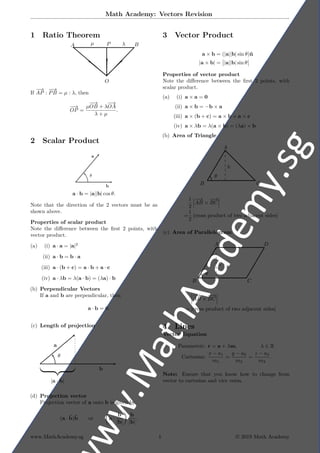
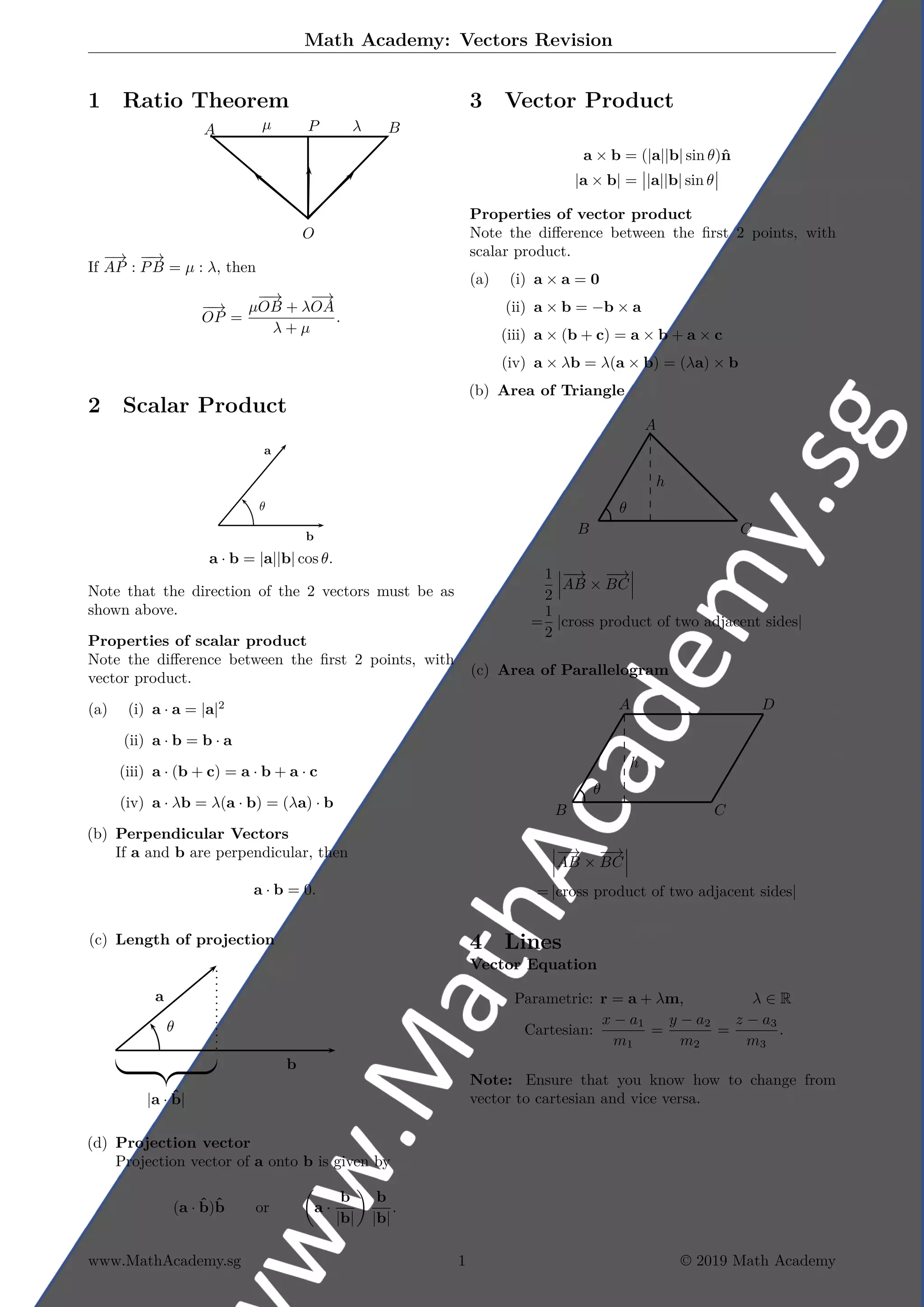
1 Ratio Theorem
µ λA P B
O
If
−→
AP :
−−→
PB = µ : λ, then
−−→
OP =
µ
−−→
OB + λ
−→
OA
λ + µ
.
2 Scalar Product
a
b
θ
a · b = |a||b| cos θ.
Note that the direction of the 2 vectors must be as
shown above.
Properties of scalar product
Note the difference between the first 2 points, with
vector product.
(a) (i) a · a = |a|2
(ii) a · b = b · a
(iii) a · (b + c) = a · b + a · c
(iv) a · λb = λ(a · b) = (λa) · b
(b) Perpendicular Vectors
If a and b are perpendicular, then
a · b = 0.
(c) Length of projection
θ
a
b
|a · ˆb|
(d) Projection vector
Projection vector of a onto b is given by
(a · ˆb)ˆb or
(
a ·
b
|b|
)
b
|b|
.
3 Vector Product
a × b = (|a||b| sin θ)ˆn
|a × b| = |a||b| sin θ
Properties of vector product
Note the difference between the first 2 points, with
scalar product.
(a) (i) a × a = 0
(ii) a × b = −b × a
(iii) a × (b + c) = a × b + a × c
(iv) a × λb = λ(a × b) = (λa) × b
(b) Area of Triangle
A
B C
h
θ
1
2
−−→
AB ×
−−→
BC
=
1
2
|cross product of two adjacent sides|
(c) Area of Parallelogram
A
B C
h
θ
D
−−→
AB ×
−−→
BC
= |cross product of two adjacent sides|
4 Lines
Vector Equation
Parametric: r = a + λm, λ ∈ R
Cartesian:
x − a1
m1
=
y − a2
m2
=
z − a3
m3
.
Note: Ensure that you know how to change from
vector to cartesian and vice versa.
www.MathAcademy.sg 1 © 2019 Math Academy
Math Academy: Vectors Revision
Relationship between two lines
l1 : r = a1 + λm1
l2 : r = a2 + µm2
a) Case 1: Parallel lines
Step 1: To check parallel: Check if m1 is a scalar
multiple of m2.
Step 2: If parallel, check if they are the same
line: Take a point from ℓ1 and see if it lies
on ℓ2.
(i) If the point is in ℓ2, they are the same
line.
(ii) Otherwise, they are parallel, non-
intersecting lines.
Make sure you know how to show the working! (re-
fer to main notes)
b) Case 2: Intersecting/Skew lines
Method 1:
Equate both equations together, use GC to solve.
No solution =⇒ Skew lines
Solution found for λ and µ =⇒ Intersecting lines
Method 2:
Step 1: Equate both equations together, solve for
the i and j - components.
Step 2: Sub into k- component. See if it satisfies
this component.
Satisfies =⇒ intersecting.
No satisfy =⇒ skew.
This is the same way to find point of intersection of
2 lines.
5 Planes
Parametric: r =
−→
OA + λm1 + µm2
Scalar-Product: r · n = a · n
Cartesian: ax + by + cz = D
Ensure you know how to switch from parametric to
scalar-prod to cartesian and cartesian to scalar-prod.
You DONT have to know how to switch from scalar-
prod/cartesian to parametric.
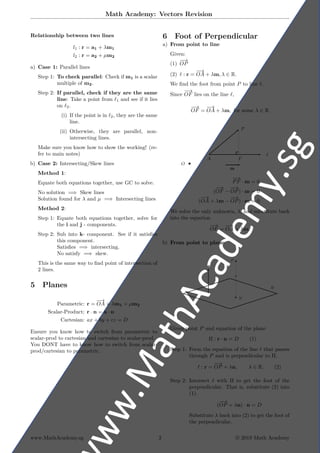
6 Foot of Perpendicular
a) From point to line
Given:
(1)
−−→
OP
(2) ℓ : r =
−→
OA + λm, λ ∈ R.
We find the foot from point P to line ℓ.
Since
−−→
OF lies on the line ℓ,
−−→
OF =
−→
OA + λm, for some λ ∈ R
A
P
F
ℓ
m
O
−−→
PF · m = 0
(
−−→
OF −
−−→
OP) · m = 0
(
−→
OA + λm −
−−→
OP) · m = 0.
We solve the only unknown, λ, and substitute back
into the equation
−−→
OF =
−→
OA + λm.
b) From point to plane
P
N
n
Π
Given point P and equation of the plane
Π : r · n = D (1)
Step 1: Form the equation of the line ℓ that passes
through P and is perpendicular to Π.
ℓ : r =
−−→
OP + λn, λ ∈ R. (2)
Step 2: Intersect ℓ with Π to get the foot of the
perpendicular. That is, substitute (2) into
(1).
(
−−→
OP + λn) · n = D
Substitute λ back into (2) to get the foot of
the perpendicular.
www.MathAcademy.sg 2 © 2019 Math Academy
Math Academy: Vectors Revision
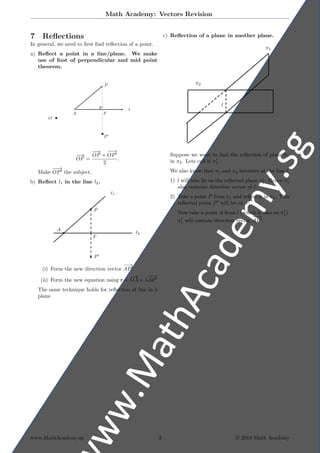
7 Reflections
In general, we need to first find reflection of a point.
a) Reflect a point in a line/plane. We make
use of foot of perpendicular and mid point
theorem.
A
P
P′
F
ℓ
O
−−→
OF =
−−→
OP +
−−→
OP′
2
.
Make
−−→
OP′
the subject.
b) Reflect l1 in the line l2.
ℓ2
P
F
P′
ℓ1
A
(i) Form the new direction vector
−−→
AP′
.
(ii) Form the new equation using r =
−→
OA + λ
−−→
AP′
The same technique holds for reflection of line in a
plane.
c) Reflection of a plane in another plane.
π1
π2
l
Suppose we want to find the reflection of plane π1
in π2. Lets call it π′
1.
We also know that π1 and π2 intersect at the line l.
1) l will also lie on the reflected plane π′
1. Hence π′
1
also contains direction vector of l.
2) Take a point P from π1 and reflect it in π2. This
reflected point P′
will be on π′
1.
Now take a point A from l (which is also on π′
1).
π′
1 will contain direction vector
−−→
AP′
.
www.MathAcademy.sg 3 © 2019 Math Academy
Math Academy: Vectors Revision
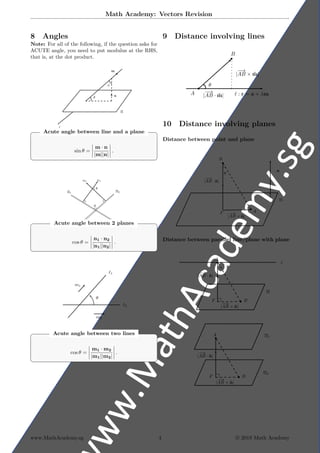
8 Angles
Note: For all of the following, if the question asks for
ACUTE angle, you need to put modulus at the RHS,
that is, at the dot product.
ϕ
θ
Π
ℓ
m
n
Acute angle between line and a plane
sin θ =
m · n
|m||n|
.
Π1 Π2
θ
θ
n2 n1
Acute angle between 2 planes
cos θ =
n1 · n2
|n1||n2|
.
θ
ℓ1
ℓ2
m1
m2
Acute angle between two lines
cos θ =
m1 · m2
|m1||m2|
.
9 Distance involving lines
ℓ : r = a + λmA
B
θ
|
−−→
AB × ˆm|
|
−−→
AB · ˆm|
10 Distance involving planes
Distance between point and plane
B
A
n
Π
F
θ
|
−−→
AB · ˆn|
|
−−→
AB × ˆn|
Distance between parallel line/plane with plane
A
B
|
−−→
AB · ˆn|
Π
F
ℓ
A
B
|
−−→
AB · ˆn|
Π2
F
Π1
|
−−→
AB × ˆn|
|
−−→
AB × ˆn|
www.MathAcademy.sg 4 © 2019 Math Academy
Math Academy: Vectors Revision
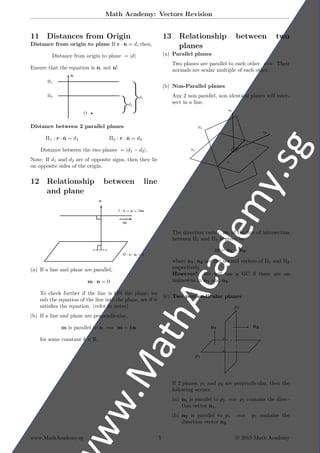
11 Distances from Origin
Distance from origin to plane If r · ˆn = d, then,
Distance from origin to plane = |d|
Ensure that the equation is ˆn, not n!
Π1
Π2
O
d1
d2
n
Distance between 2 parallel planes
Π1 : r · ˆn = d1 Π2 : r · ˆn = d2
Distance between the two planes = |d1 − d2|.
Note: If d1 and d2 are of opposite signs, then they lie
on opposite sides of the origin.
12 Relationship between line
and plane
n
ℓ : r = a + λm
m
Π : r · n = d
(a) If a line and plane are parallel,
m · n = 0
To check further if the line is ON the plane, we
sub the equation of the line into the plane, see if it
satisfies the equation. (refer to notes)
(b) If a line and plane are perpendicular,
m is parallel to n =⇒ m = kn
for some constant k ∈ R.
13 Relationship between two
planes
(a) Parallel planes
Two planes are parallel to each other ⇐⇒ Their
normals are scalar multiple of each other.
(b) Non-Parallel planes
Any 2 non parallel, non identical planes will inter-
sect in a line.
n1
n2
ℓ
Π1
Π2
The direction vector, m, of the line of intersection
between Π1 and Π2 is given by
m = n1 × n2,
where n1, n2 are the normal vectors of Π1 and Π2
respectively.
However! We will use a GC if there are no
unknowns in n1 and n2.
(c) Two perpendicular planes
p1
p2
n2n1
If 2 planes, p1 and p2 are perpendicular, then the
following occurs:
(a) n1 is parallel to p2 =⇒ p2 contains the direc-
tion vector n1,
(b) n2 is parallel to p1 =⇒ p1 contains the
direction vector n2.
www.MathAcademy.sg 5 © 2019 Math Academy
Math Academy: Vectors Revision
14 Directional Cosines
x
y
z


α
β
γ


Let the angles made with the x, y, and z-axes be θ, ϕ,
and ω respectively.
x-axis:
cos θ =
α
√
α2 + β2 + γ2
y-axis:
cos ϕ =
β
√
α2 + β2 + γ2
z-axis:
cos ω =
γ
√
α2 + β2 + γ2
15 On Geometrical Meanings
Recall the following diagram on projections:
b
a
|a · ˆb|
|a × ˆb|
θ
Lets now deal with geometrical interpretations.
(a) |a · ˆb|
(b) |a × ˆb|
(c) (a · ˆb)ˆb
Let b be any non-zero vector and c a unit vector, give
the geometrical meaning of |c · b|.
Let a, d be any 2 non-zero vectors.
(d) Give a geometrical meaning of |a × d|.
(e) Suppose we have,
(i) a · d = 0,
(ii) a × d = 0,
what can be said about the relationship between
a and d in each case?
(f) Interpret geometrically the vector equation r · n =
d, where n is a constant unit vector and d is a
constant scalar, stating what d represents. [3]
www.MathAcademy.sg 6 © 2019 Math Academy

JC Vectors summary

  • 1.
    Math Academy: VectorsRevision 1 Ratio Theorem µ λA P B O If −→ AP : −−→ PB = µ : λ, then −−→ OP = µ −−→ OB + λ −→ OA λ + µ . 2 Scalar Product a b θ a · b = |a||b| cos θ. Note that the direction of the 2 vectors must be as shown above. Properties of scalar product Note the difference between the first 2 points, with vector product. (a) (i) a · a = |a|2 (ii) a · b = b · a (iii) a · (b + c) = a · b + a · c (iv) a · λb = λ(a · b) = (λa) · b (b) Perpendicular Vectors If a and b are perpendicular, then a · b = 0. (c) Length of projection θ a b |a · ˆb| (d) Projection vector Projection vector of a onto b is given by (a · ˆb)ˆb or ( a · b |b| ) b |b| . 3 Vector Product a × b = (|a||b| sin θ)ˆn |a × b| = |a||b| sin θ Properties of vector product Note the difference between the first 2 points, with scalar product. (a) (i) a × a = 0 (ii) a × b = −b × a (iii) a × (b + c) = a × b + a × c (iv) a × λb = λ(a × b) = (λa) × b (b) Area of Triangle A B C h θ 1 2 −−→ AB × −−→ BC = 1 2 |cross product of two adjacent sides| (c) Area of Parallelogram A B C h θ D −−→ AB × −−→ BC = |cross product of two adjacent sides| 4 Lines Vector Equation Parametric: r = a + λm, λ ∈ R Cartesian: x − a1 m1 = y − a2 m2 = z − a3 m3 . Note: Ensure that you know how to change from vector to cartesian and vice versa. www.MathAcademy.sg 1 © 2019 Math Academy
  • 2.
    Math Academy: VectorsRevision Relationship between two lines l1 : r = a1 + λm1 l2 : r = a2 + µm2 a) Case 1: Parallel lines Step 1: To check parallel: Check if m1 is a scalar multiple of m2. Step 2: If parallel, check if they are the same line: Take a point from ℓ1 and see if it lies on ℓ2. (i) If the point is in ℓ2, they are the same line. (ii) Otherwise, they are parallel, non- intersecting lines. Make sure you know how to show the working! (re- fer to main notes) b) Case 2: Intersecting/Skew lines Method 1: Equate both equations together, use GC to solve. No solution =⇒ Skew lines Solution found for λ and µ =⇒ Intersecting lines Method 2: Step 1: Equate both equations together, solve for the i and j - components. Step 2: Sub into k- component. See if it satisfies this component. Satisfies =⇒ intersecting. No satisfy =⇒ skew. This is the same way to find point of intersection of 2 lines. 5 Planes Parametric: r = −→ OA + λm1 + µm2 Scalar-Product: r · n = a · n Cartesian: ax + by + cz = D Ensure you know how to switch from parametric to scalar-prod to cartesian and cartesian to scalar-prod. You DONT have to know how to switch from scalar- prod/cartesian to parametric. 6 Foot of Perpendicular a) From point to line Given: (1) −−→ OP (2) ℓ : r = −→ OA + λm, λ ∈ R. We find the foot from point P to line ℓ. Since −−→ OF lies on the line ℓ, −−→ OF = −→ OA + λm, for some λ ∈ R A P F ℓ m O −−→ PF · m = 0 ( −−→ OF − −−→ OP) · m = 0 ( −→ OA + λm − −−→ OP) · m = 0. We solve the only unknown, λ, and substitute back into the equation −−→ OF = −→ OA + λm. b) From point to plane P N n Π Given point P and equation of the plane Π : r · n = D (1) Step 1: Form the equation of the line ℓ that passes through P and is perpendicular to Π. ℓ : r = −−→ OP + λn, λ ∈ R. (2) Step 2: Intersect ℓ with Π to get the foot of the perpendicular. That is, substitute (2) into (1). ( −−→ OP + λn) · n = D Substitute λ back into (2) to get the foot of the perpendicular. www.MathAcademy.sg 2 © 2019 Math Academy
  • 3.
    Math Academy: VectorsRevision 7 Reflections In general, we need to first find reflection of a point. a) Reflect a point in a line/plane. We make use of foot of perpendicular and mid point theorem. A P P′ F ℓ O −−→ OF = −−→ OP + −−→ OP′ 2 . Make −−→ OP′ the subject. b) Reflect l1 in the line l2. ℓ2 P F P′ ℓ1 A (i) Form the new direction vector −−→ AP′ . (ii) Form the new equation using r = −→ OA + λ −−→ AP′ The same technique holds for reflection of line in a plane. c) Reflection of a plane in another plane. π1 π2 l Suppose we want to find the reflection of plane π1 in π2. Lets call it π′ 1. We also know that π1 and π2 intersect at the line l. 1) l will also lie on the reflected plane π′ 1. Hence π′ 1 also contains direction vector of l. 2) Take a point P from π1 and reflect it in π2. This reflected point P′ will be on π′ 1. Now take a point A from l (which is also on π′ 1). π′ 1 will contain direction vector −−→ AP′ . www.MathAcademy.sg 3 © 2019 Math Academy
  • 4.
    Math Academy: VectorsRevision 8 Angles Note: For all of the following, if the question asks for ACUTE angle, you need to put modulus at the RHS, that is, at the dot product. ϕ θ Π ℓ m n Acute angle between line and a plane sin θ = m · n |m||n| . Π1 Π2 θ θ n2 n1 Acute angle between 2 planes cos θ = n1 · n2 |n1||n2| . θ ℓ1 ℓ2 m1 m2 Acute angle between two lines cos θ = m1 · m2 |m1||m2| . 9 Distance involving lines ℓ : r = a + λmA B θ | −−→ AB × ˆm| | −−→ AB · ˆm| 10 Distance involving planes Distance between point and plane B A n Π F θ | −−→ AB · ˆn| | −−→ AB × ˆn| Distance between parallel line/plane with plane A B | −−→ AB · ˆn| Π F ℓ A B | −−→ AB · ˆn| Π2 F Π1 | −−→ AB × ˆn| | −−→ AB × ˆn| www.MathAcademy.sg 4 © 2019 Math Academy
  • 5.
    Math Academy: VectorsRevision 11 Distances from Origin Distance from origin to plane If r · ˆn = d, then, Distance from origin to plane = |d| Ensure that the equation is ˆn, not n! Π1 Π2 O d1 d2 n Distance between 2 parallel planes Π1 : r · ˆn = d1 Π2 : r · ˆn = d2 Distance between the two planes = |d1 − d2|. Note: If d1 and d2 are of opposite signs, then they lie on opposite sides of the origin. 12 Relationship between line and plane n ℓ : r = a + λm m Π : r · n = d (a) If a line and plane are parallel, m · n = 0 To check further if the line is ON the plane, we sub the equation of the line into the plane, see if it satisfies the equation. (refer to notes) (b) If a line and plane are perpendicular, m is parallel to n =⇒ m = kn for some constant k ∈ R. 13 Relationship between two planes (a) Parallel planes Two planes are parallel to each other ⇐⇒ Their normals are scalar multiple of each other. (b) Non-Parallel planes Any 2 non parallel, non identical planes will inter- sect in a line. n1 n2 ℓ Π1 Π2 The direction vector, m, of the line of intersection between Π1 and Π2 is given by m = n1 × n2, where n1, n2 are the normal vectors of Π1 and Π2 respectively. However! We will use a GC if there are no unknowns in n1 and n2. (c) Two perpendicular planes p1 p2 n2n1 If 2 planes, p1 and p2 are perpendicular, then the following occurs: (a) n1 is parallel to p2 =⇒ p2 contains the direc- tion vector n1, (b) n2 is parallel to p1 =⇒ p1 contains the direction vector n2. www.MathAcademy.sg 5 © 2019 Math Academy
  • 6.
    Math Academy: VectorsRevision 14 Directional Cosines x y z   α β γ   Let the angles made with the x, y, and z-axes be θ, ϕ, and ω respectively. x-axis: cos θ = α √ α2 + β2 + γ2 y-axis: cos ϕ = β √ α2 + β2 + γ2 z-axis: cos ω = γ √ α2 + β2 + γ2 15 On Geometrical Meanings Recall the following diagram on projections: b a |a · ˆb| |a × ˆb| θ Lets now deal with geometrical interpretations. (a) |a · ˆb| (b) |a × ˆb| (c) (a · ˆb)ˆb Let b be any non-zero vector and c a unit vector, give the geometrical meaning of |c · b|. Let a, d be any 2 non-zero vectors. (d) Give a geometrical meaning of |a × d|. (e) Suppose we have, (i) a · d = 0, (ii) a × d = 0, what can be said about the relationship between a and d in each case? (f) Interpret geometrically the vector equation r · n = d, where n is a constant unit vector and d is a constant scalar, stating what d represents. [3] www.MathAcademy.sg 6 © 2019 Math Academy