ENEM602 Spring 2007
Dr. Eng. Mohammad Tawfik
Roots of Nonlinear Equations
Open Methods
ENEM602 Spring 2007
Dr. Eng. Mohammad Tawfik
Objectives
• Be able to use the fixed point method to
find a root of an equation
• Be able to use the Newton Raphson
method to find a root of an equations
• Be able to use the Secant method to find a
root of an equations
• Write down an algorithm to outline the
method being used
ENEM602 Spring 2007
Dr. Eng. Mohammad Tawfik
Fixed Point Iterations
ENEM602 Spring 2007
Dr. Eng. Mohammad Tawfik
( )kk xgx =+1
Fixed Point Iterations
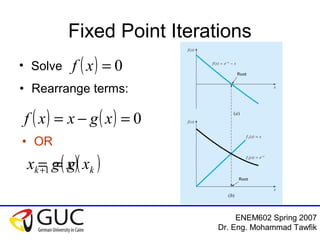
• Solve ( ) 0=xf
( ) ( ) 0=−= xgxxf
• Rearrange terms:
• OR
( )xgx =
ENEM602 Spring 2007
Dr. Eng. Mohammad Tawfik
In some cases you do not get a
solution!
ENEM602 Spring 2007
Dr. Eng. Mohammad Tawfik
Example
ENEM602 Spring 2007
Dr. Eng. Mohammad Tawfik
Example
( ) 22
−−= xxxf Which has the solutions -1 & 2
To get a fixed-point form, we may use:
( ) 22
−= xxg
( ) x
xg 21+=
( ) 2+= xxg
( )
12
22
−
+
=
x
x
xg
ENEM602 Spring 2007
Dr. Eng. Mohammad Tawfik
First trial!
• No matter how close
your initial guess is,
the solution diverges!
ENEM602 Spring 2007
Dr. Eng. Mohammad Tawfik
Second trial
• The solution converges
in this case!!
ENEM602 Spring 2007
Dr. Eng. Mohammad Tawfik
Condition of Convergence
• For the fixed point iteration to ensure
convergence of solution from point xk we should
ensure that
( ) 1' <kxg
ENEM602 Spring 2007
Dr. Eng. Mohammad Tawfik
Fixed Point Algorithm
1. Rearrange f(x) to get f(x)=x-g(x)
2. Start with a reasonable initial guess x0
3. If |g’(x0)|>=1, goto step 2
4. Evaluate xk+1=g(xk)
5. If (xk+1-xk)/xk+1< εs; end
6. Let xk=xk+1; goto step 4
ENEM602 Spring 2007
Dr. Eng. Mohammad Tawfik
Newton-Raphson Method
ENEM602 Spring 2007
Dr. Eng. Mohammad Tawfik
Newton’s Method: Line Equation
( )1
21
21
' xf
xx
yy
m =
−
−
=
The slope of the
line is given by:
ENEM602 Spring 2007
Dr. Eng. Mohammad Tawfik
Newton’s Method: Line equation
( ) ( )1
21
1
' xf
xx
xf
=
−
( )
( )1
1
12
' xf
xf
xx −=
( )
( )k
k
kk
xf
xf
xx
'
1 −=+
Newton-Raphson
Iterative method
ENEM602 Spring 2007
Dr. Eng. Mohammad Tawfik
Newton’s Method: Taylor’s Series
( ) ( ) ( )1121 ' xfxxxf −=−
( )
( )1
1
12
' xf
xf
xx −=
( )
( )k
k
kk
xf
xf
xx
'
1 −=+
Newton-Raphson
Iterative method
( ) ( ) ( ) ( )11212 ' xfxxxfxf −+≈
ENEM602 Spring 2007
Dr. Eng. Mohammad Tawfik
Example
ENEM602 Spring 2007
Dr. Eng. Mohammad Tawfik
Newton-Raphson Algorithm
1. From f(x) get f’(x)
2. Start with a reasonable initial guess x0
3. Evaluate xk+1=xk-f(xk)/f’(xk)
4. If (xk+1-xk)/xk+1< εs; end
5. Let xk=xk+1; goto step 4
ENEM602 Spring 2007
Dr. Eng. Mohammad Tawfik
Convergence condition!
• Try to derive a convergence conditions
similar to that of the fixed point iteration!
ENEM602 Spring 2007
Dr. Eng. Mohammad Tawfik
Secant Method
ENEM602 Spring 2007
Dr. Eng. Mohammad Tawfik
Secant Method
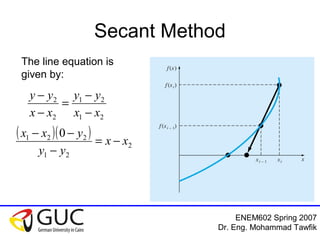
21
21
2
2
xx
yy
xx
yy
−
−
=
−
−
The line equation is
given by:
( )( )
2
21
221 0
xx
yy
yxx
−=
−
−−
ENEM602 Spring 2007
Dr. Eng. Mohammad Tawfik
Secant Method
( )( )
2
21
221 0
xx
yy
yxx
−=
−
−−
( )
21
212
2
yy
xxy
xx
−
−
−=
( )( )
( ) ( )kk
kkk
kk
xfxf
xxxf
xx
−
−
−=
−
−
+
1
1
1
ENEM602 Spring 2007
Dr. Eng. Mohammad Tawfik
Secant Algorithm
1. Select x1 and x2
2. Evaluate f(x1) and f(x2)
3. Evaluate xk+1
4. If (xk+1-xk)/xk+1< εs; end
5. Let xk=xk+1; goto step 3
ENEM602 Spring 2007
Dr. Eng. Mohammad Tawfik
Why Secant Method?
• The most important advantage over
Newton-Raphson method is that you do
not need to evaluate the derivative!
ENEM602 Spring 2007
Dr. Eng. Mohammad Tawfik
Comparing with False-Position
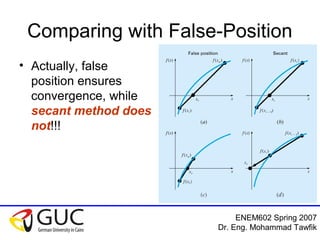
• Actually, false
position ensures
convergence, while
secant method does
not!!!
ENEM602 Spring 2007
Dr. Eng. Mohammad Tawfik
Conclusion
• The fixed point iteration, Newton-Raphson
method, and the secant method in general
converge faster than bisection and false position
methods
• On the other hand, these methods do not ensure
convergence!
• The secant method, in many cases, becomes
more practical than Newton-Raphson as
derivatives do not need to be evaluated
ENEM602 Spring 2007
Dr. Eng. Mohammad Tawfik
Homework #2
• Chapter 6, p 157, numbers:
6.1,6.2,6.3
• Homework due next week

03 open methods

  • 1.
    ENEM602 Spring 2007 Dr.Eng. Mohammad Tawfik Roots of Nonlinear Equations Open Methods
  • 2.
    ENEM602 Spring 2007 Dr.Eng. Mohammad Tawfik Objectives • Be able to use the fixed point method to find a root of an equation • Be able to use the Newton Raphson method to find a root of an equations • Be able to use the Secant method to find a root of an equations • Write down an algorithm to outline the method being used
  • 3.
    ENEM602 Spring 2007 Dr.Eng. Mohammad Tawfik Fixed Point Iterations
  • 4.
    ENEM602 Spring 2007 Dr.Eng. Mohammad Tawfik ( )kk xgx =+1 Fixed Point Iterations • Solve ( ) 0=xf ( ) ( ) 0=−= xgxxf • Rearrange terms: • OR ( )xgx =
  • 5.
    ENEM602 Spring 2007 Dr.Eng. Mohammad Tawfik In some cases you do not get a solution!
  • 6.
    ENEM602 Spring 2007 Dr.Eng. Mohammad Tawfik Example
  • 7.
    ENEM602 Spring 2007 Dr.Eng. Mohammad Tawfik Example ( ) 22 −−= xxxf Which has the solutions -1 & 2 To get a fixed-point form, we may use: ( ) 22 −= xxg ( ) x xg 21+= ( ) 2+= xxg ( ) 12 22 − + = x x xg
  • 8.
    ENEM602 Spring 2007 Dr.Eng. Mohammad Tawfik First trial! • No matter how close your initial guess is, the solution diverges!
  • 9.
    ENEM602 Spring 2007 Dr.Eng. Mohammad Tawfik Second trial • The solution converges in this case!!
  • 10.
    ENEM602 Spring 2007 Dr.Eng. Mohammad Tawfik Condition of Convergence • For the fixed point iteration to ensure convergence of solution from point xk we should ensure that ( ) 1' <kxg
  • 11.
    ENEM602 Spring 2007 Dr.Eng. Mohammad Tawfik Fixed Point Algorithm 1. Rearrange f(x) to get f(x)=x-g(x) 2. Start with a reasonable initial guess x0 3. If |g’(x0)|>=1, goto step 2 4. Evaluate xk+1=g(xk) 5. If (xk+1-xk)/xk+1< εs; end 6. Let xk=xk+1; goto step 4
  • 12.
    ENEM602 Spring 2007 Dr.Eng. Mohammad Tawfik Newton-Raphson Method
  • 13.
    ENEM602 Spring 2007 Dr.Eng. Mohammad Tawfik Newton’s Method: Line Equation ( )1 21 21 ' xf xx yy m = − − = The slope of the line is given by:
  • 14.
    ENEM602 Spring 2007 Dr.Eng. Mohammad Tawfik Newton’s Method: Line equation ( ) ( )1 21 1 ' xf xx xf = − ( ) ( )1 1 12 ' xf xf xx −= ( ) ( )k k kk xf xf xx ' 1 −=+ Newton-Raphson Iterative method
  • 15.
    ENEM602 Spring 2007 Dr.Eng. Mohammad Tawfik Newton’s Method: Taylor’s Series ( ) ( ) ( )1121 ' xfxxxf −=− ( ) ( )1 1 12 ' xf xf xx −= ( ) ( )k k kk xf xf xx ' 1 −=+ Newton-Raphson Iterative method ( ) ( ) ( ) ( )11212 ' xfxxxfxf −+≈
  • 16.
    ENEM602 Spring 2007 Dr.Eng. Mohammad Tawfik Example
  • 17.
    ENEM602 Spring 2007 Dr.Eng. Mohammad Tawfik Newton-Raphson Algorithm 1. From f(x) get f’(x) 2. Start with a reasonable initial guess x0 3. Evaluate xk+1=xk-f(xk)/f’(xk) 4. If (xk+1-xk)/xk+1< εs; end 5. Let xk=xk+1; goto step 4
  • 18.
    ENEM602 Spring 2007 Dr.Eng. Mohammad Tawfik Convergence condition! • Try to derive a convergence conditions similar to that of the fixed point iteration!
  • 19.
    ENEM602 Spring 2007 Dr.Eng. Mohammad Tawfik Secant Method
  • 20.
    ENEM602 Spring 2007 Dr.Eng. Mohammad Tawfik Secant Method 21 21 2 2 xx yy xx yy − − = − − The line equation is given by: ( )( ) 2 21 221 0 xx yy yxx −= − −−
  • 21.
    ENEM602 Spring 2007 Dr.Eng. Mohammad Tawfik Secant Method ( )( ) 2 21 221 0 xx yy yxx −= − −− ( ) 21 212 2 yy xxy xx − − −= ( )( ) ( ) ( )kk kkk kk xfxf xxxf xx − − −= − − + 1 1 1
  • 22.
    ENEM602 Spring 2007 Dr.Eng. Mohammad Tawfik Secant Algorithm 1. Select x1 and x2 2. Evaluate f(x1) and f(x2) 3. Evaluate xk+1 4. If (xk+1-xk)/xk+1< εs; end 5. Let xk=xk+1; goto step 3
  • 23.
    ENEM602 Spring 2007 Dr.Eng. Mohammad Tawfik Why Secant Method? • The most important advantage over Newton-Raphson method is that you do not need to evaluate the derivative!
  • 24.
    ENEM602 Spring 2007 Dr.Eng. Mohammad Tawfik Comparing with False-Position • Actually, false position ensures convergence, while secant method does not!!!
  • 25.
    ENEM602 Spring 2007 Dr.Eng. Mohammad Tawfik Conclusion • The fixed point iteration, Newton-Raphson method, and the secant method in general converge faster than bisection and false position methods • On the other hand, these methods do not ensure convergence! • The secant method, in many cases, becomes more practical than Newton-Raphson as derivatives do not need to be evaluated
  • 26.
    ENEM602 Spring 2007 Dr.Eng. Mohammad Tawfik Homework #2 • Chapter 6, p 157, numbers: 6.1,6.2,6.3 • Homework due next week