VECTOR ANALYSIS- 2
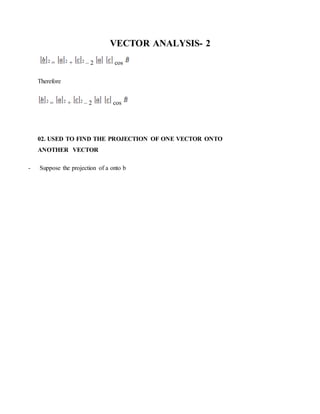
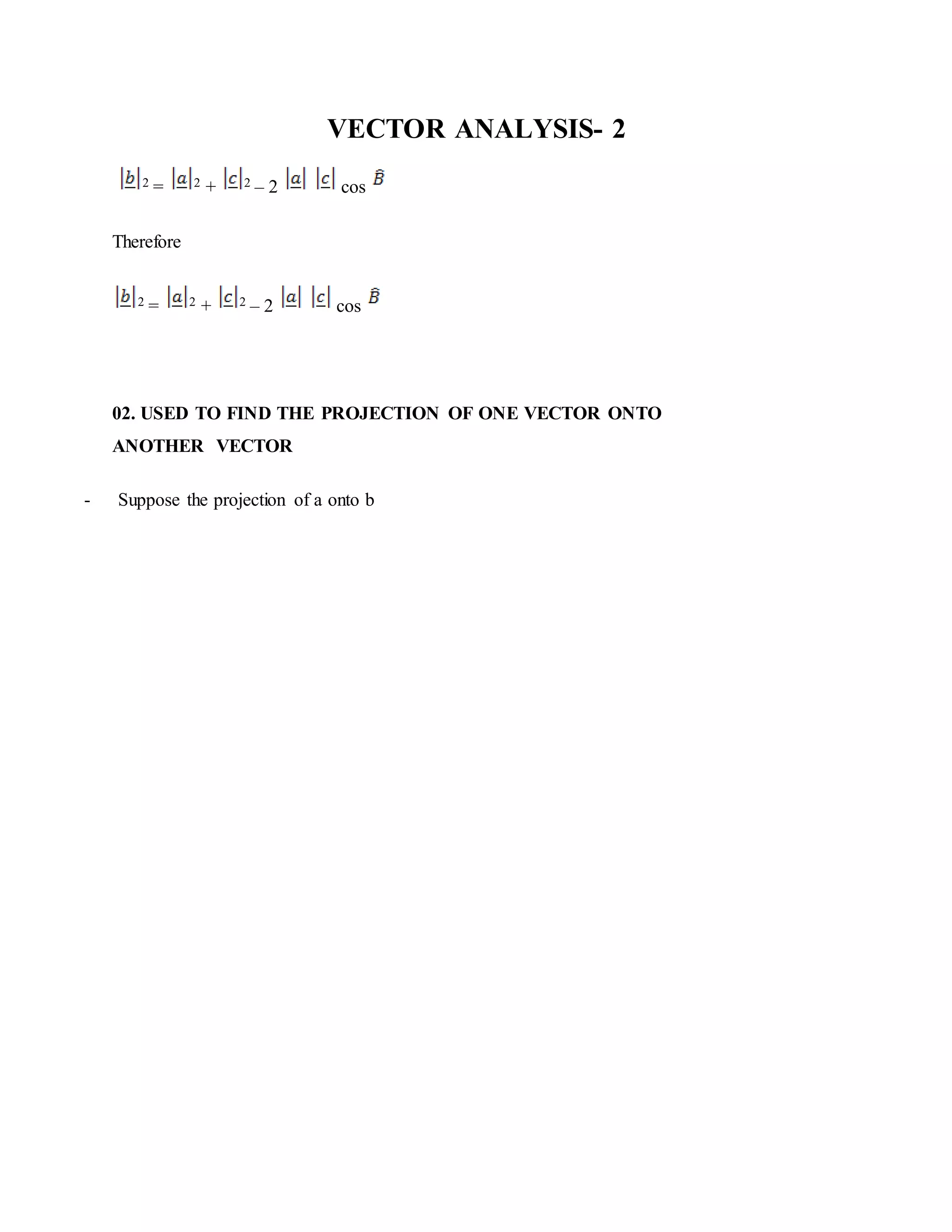
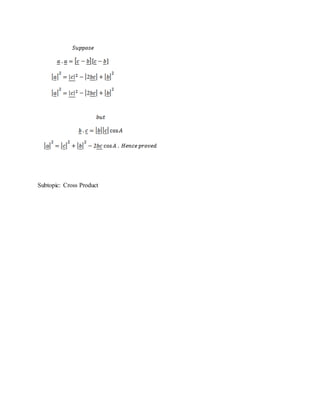
2 = 2 + 2 – 2 cos
Therefore
2 = 2 + 2 – 2 cos
02. USED TO FIND THE PROJECTION OF ONE VECTOR ONTO
ANOTHER VECTOR
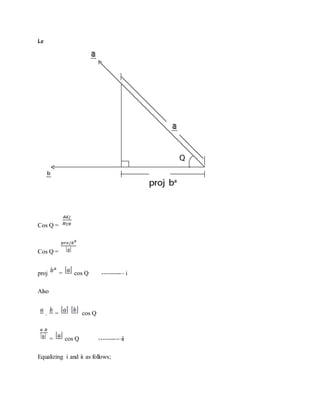
- Suppose the projection of a onto b
i.e
Cos Q =
Cos Q =
proj = cos Q ---------– i
Also
. = cos Q
= cos Q ---------–ii
Equalizing i and ii as follows;
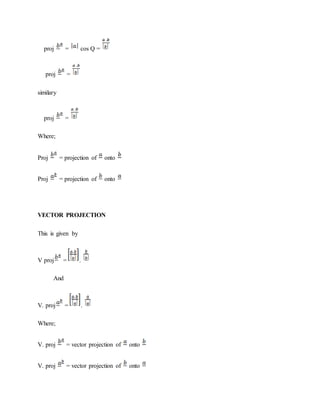
proj = cos Q =
proj =
similary
proj =
Where;
Proj = projection of onto
VECTOR PROJECTION
This is given by
V proj = .
And
V. proj = .
Where;
V. proj = vector projection of onto
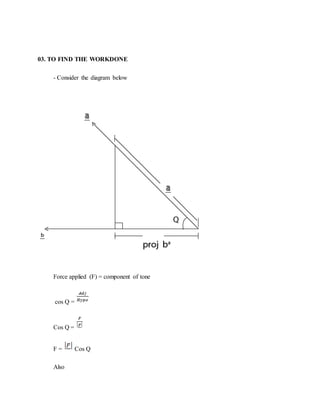
03. TO FIND THE WORKDONE
- Consider the diagram below
Force applied (F) = component of tone
cos Q =
Cos Q =
F = Cos Q
Also
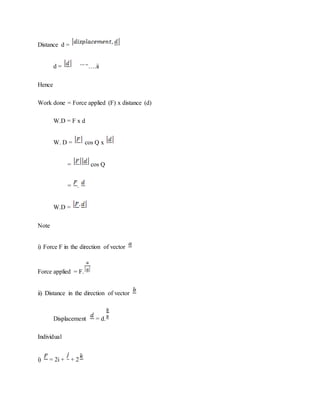
Distance d =
d = ….ii
Hence
Work done = Force applied (F) x distance (d)
W.D = F x d
W. D = cos Q x
= cos Q
= .
W.D =
Note
i) Force F in the direction of vector
Force applied = F.
ii) Distance in the direction of vector
Displacement = d.
Individual
i) = 2i + + 2
= i + +
W.D =
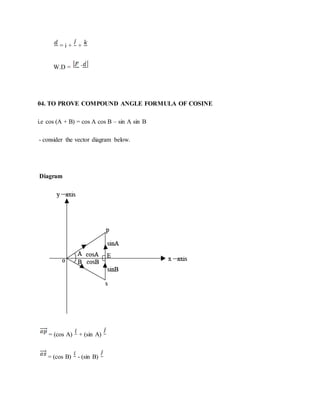
04. TO PROVE COMPOUND ANGLE FORMULA OF COSINE
i.e cos (A + B) = cos A cos B – sin A sin B
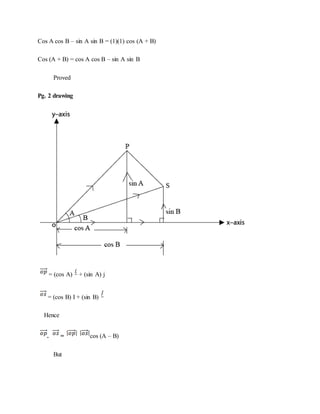
- consider the vector diagram below.
Diagram
= (cos A) + (sin A)
= (cos B) - (sin B)
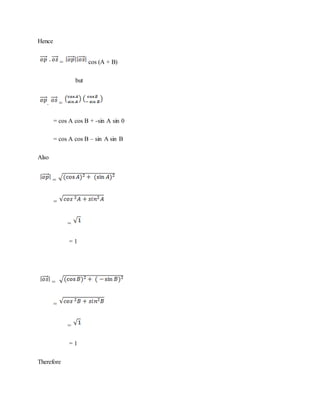
Hence
= cos (A + B)
but
. =
= cos A cos B + -sin A sin 0
= cos A cos B – sin A sin B
Also
=
=
=
= 1
=
=
=
= 1
Therefore
Cos A cos B – sin A sin B = (1)(1) cos (A + B)
Cos (A + B) = cos A cos B – sin A sin B
Proved
Pg. 2 drawing
= (cos A) + (sin A) j
= (cos B) I + (sin B)
Hence
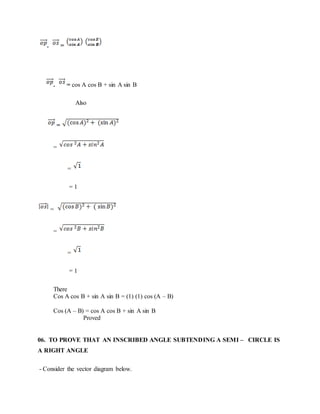
. = cos (A – B)
But
. =
. = cos A cos B + sin A sin B
Also
=
=
=
= 1
=
=
=
= 1
There
Cos A cos B + sin A sin B = (1) (1) cos (A – B)
Cos (A – B) = cos A cos B + sin A sin B
Proved
06. TO PROVE THAT AN INSCRIBED ANGLE SUBTENDING A SEMI – CIRCLE IS
A RIGHT ANGLE
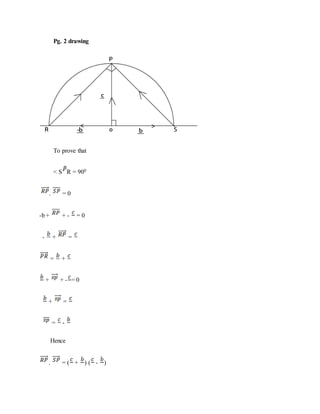
- Consider the vector diagram below.
Pg. 2 drawing
To prove that
< S R = 900
. = 0
-b + + - = 0
- + =
= +
+ + - = 0
+ =
= -
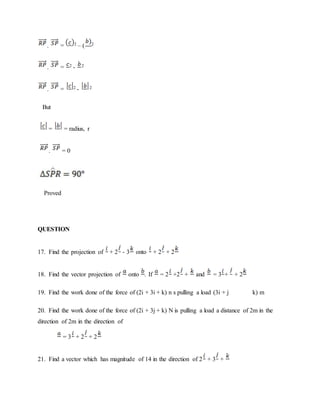
Hence
. = ( + ) ( - )
. = 2 – ( 2
. = 2 - 2
. = 2 - 2
But
= = radius, r
. = 0
Proved
QUESTION
17. Find the projection of + 2 - 3 onto + 2 + 2
18. Find the vector projection of onto . If = 2 +2 + and = 3 + + 2
19. Find the work done of the force of (2i + 3i + k) n s pulling a load (3i + j k) m
20. Find the work done of the force of (2i + 3j + k) N is pulling a load a distance of 2m in the
direction of 2m in the direction of
= 3 + 2 + 2
21. Find a vector which has magnitude of 14 in the direction of 2 + 3 +
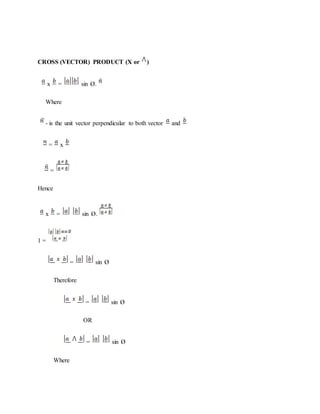
CROSS (VECTOR) PRODUCT (X or )
x = sin Ø.
Where
- is the unit vector perpendicular to both vector and
= x
=
Hence
x = sin Ø.
1 =
= sin Ø
Therefore
= sin Ø
OR
= sin Ø
Where
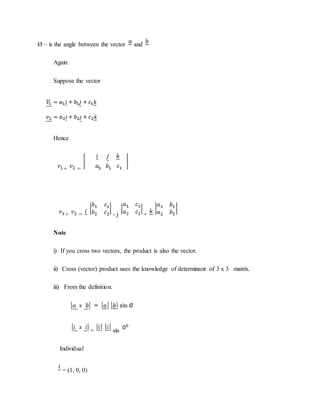
Ø – is the angle between the vector and
Again
Suppose the vector
Hence
+ =
+ = - j +
Note
i) If you cross two vectors, the product is also the vector.
ii) Cross (vector) product uses the knowledge of determinant of 3 x 3 matrix.
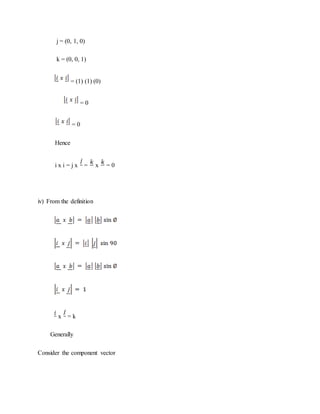
iii) From the definition.
= sin
Individual
= (1, 0, 0)
j = (0, 1, 0)
k = (0, 0, 1)
= (1) (1) (0)
= 0
= 0
Hence
i x i = j x = x = 0
iv) From the definition
x = k
Generally
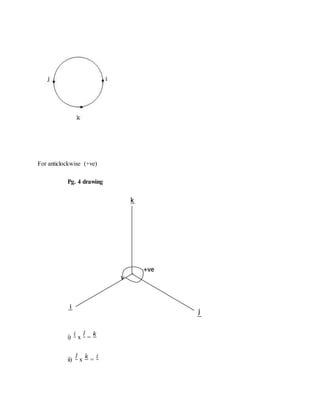
Consider the component vector
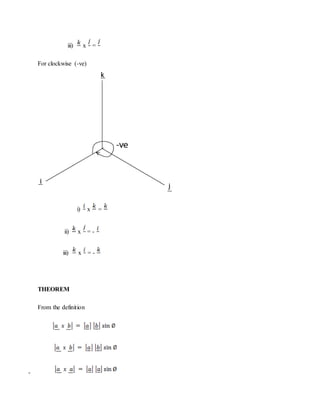
For anticlockwise (+ve)
Pg. 4 drawing
i) x =
ii) x =
iii) x =
For clockwise (-ve)
i) x =
ii) x = -
iii) x = -
THEOREM
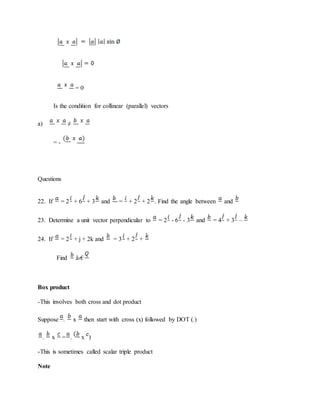
From the definition
-
= 0
Is the condition for collinear (parallel) vectors
a) ≠
= -
Questions
22. If = 2 + 6 + 3 and = + 2 + 2 . Find the angle between and
23. Determine a unit vector perpendicular to = 2 - 6 - 3 and = 4 + 3 –
24. If = 2 + j + 2k and = 3 + 2 +
Find â‹€
Box product
-This involves both cross and dot product
Suppose . x then start with cross (x) followed by DOT (.)
. x = . x )
-This is sometimes called scalar triple product
Note
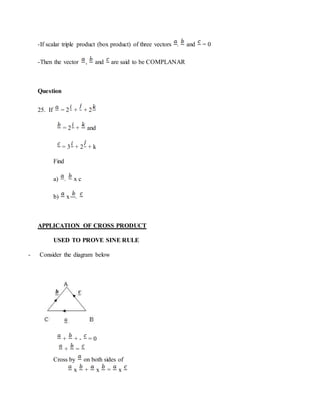
-If scalar triple product (box product) of three vectors . and = 0
-Then the vector , and are said to be COMPLANAR
Question
25. If = 2 + + 2
= 2 + and
= 3 + 2 + k
Find
a) . x c
b) x .
APPLICATION OF CROSS PRODUCT
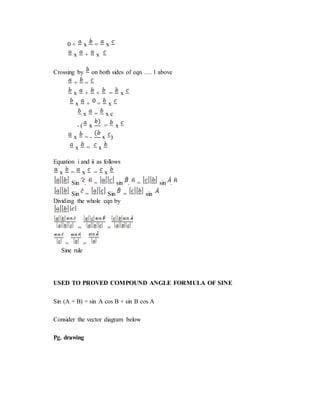
USED TO PROVE SINE RULE
- Consider the diagram below
+ + - = 0
+ =
Cross by on both sides of
x + x = x
0 + x = x
x + x
Crossing by on both sides of eqn …. 1 above
+ =
x + + = x
x + = x
x = x c
- ( x = x
x = - x )
x = x
Equation i and ii as follows
x = x = x
Sin . = sin . = sin .
Sin = Sin = sin
Dividing the whole eqn by
= =
= =
Sine rule
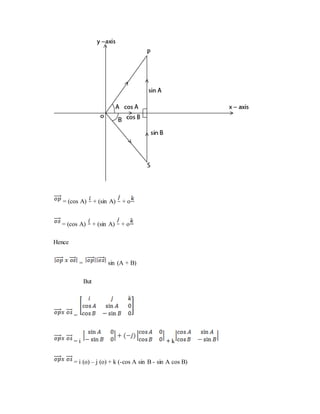
USED TO PROVED COMPOUND ANGLE FORMULA OF SINE
Sin (A + B) = sin A cos B + sin B cos A
Consider the vector diagram below
Pg. drawing
= (cos A) + (sin A) + o
Hence
= sin (A + B)
But
=
= i + k
= i (o) – j (o) + k (-cos A sin B - sin A cos B)
= -k [sin A cos B + cos A sin B]
= 2
= 2
= sin A cos B + cos A sin B
Also
=
= 2
2 = 2 B
= 1
Therefore
Sin A cos B + cos A sin B = (1) (1) sin (A+B)
Sin (A + B) = Sin A cos B + cos A sin B
Proved
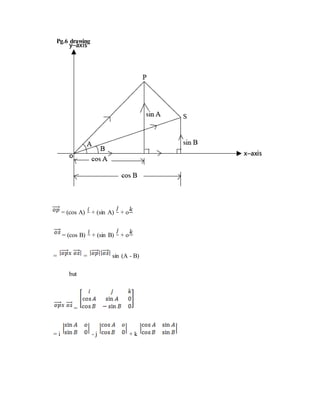
USED TO DETERMINE/ TO PROVE COMPOUND AND FORMULA OF SINE
Sin (A – B) = sin A cos B – Cos A sin B
- Consider the vector diagram below
Pg.6 drawing
= (cos A) + (sin A) + o
= (cos B) + (sin B) + o
= = sin (A - B)
but
=
= i - j + k
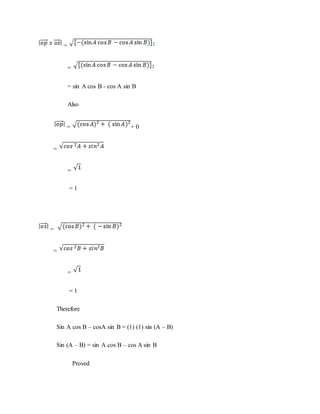
= 2
= 2
= sin A cos B - cos A sin B
Also
= + 0
=
=
= 1
=
=
=
= 1
Therefore
Sin A cos B – cosA sin B = (1) (1) sin (A – B)
Sin (A – B) = sin A cos B – cos A sin B
Proved
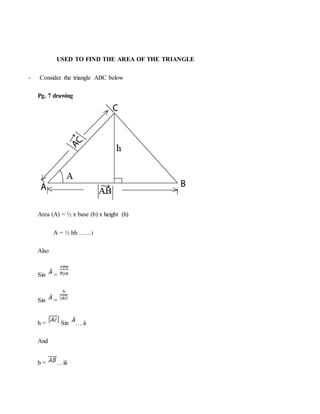
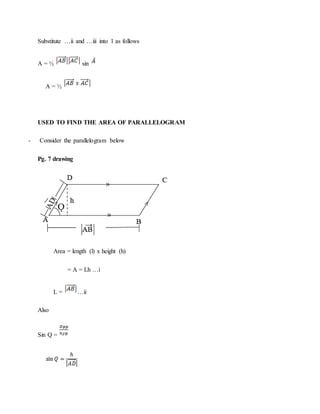
USED TO FIND THE AREA OF THE TRIANGLE
- Consider the triangle ABC below
Pg. 7 drawing
Area (A) = ½ x base (b) x height (h)
A = ½ bh ……i
Also
Sin =
Sin =
h = Sin ….ii
And
b = …iii
Substitute …ii and …iii into 1 as follows
A = ½ sin
A = ½
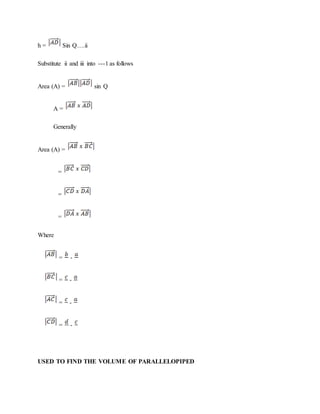
USED TO FIND THE AREA OF PARALLELOGRAM
- Consider the parallelogram below
Pg. 7 drawing
Area = length (l) x height (h)
= A = Lh …i
L = …ii
Also
Sin Q =
h = Sin Q….ii
Substitute ii and iii into ---1 as follows
Area (A) = sin Q
A =
Generally
Area (A) =
=
=
=
Where
= -
= -
= -
= -
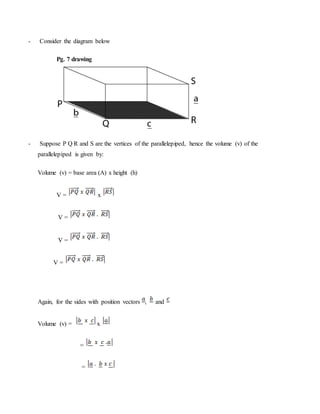
USED TO FIND THE VOLUME OF PARALLELOPIPED
- Consider the diagram below
Pg. 7 drawing
- Suppose P Q R and S are the vertices of the parallelepiped, hence the volume (v) of the
parallelepiped is given by:
Volume (v) = base area (A) x height (h)
V = x
V =
V =
V =
Again, for the sides with position vectors , and
Volume (v) = x
=
=
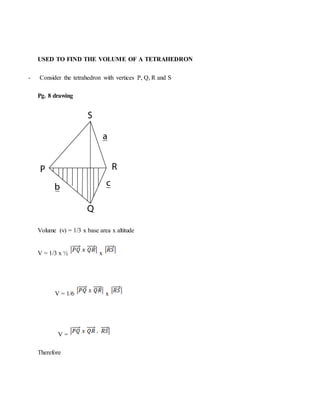
USED TO FIND THE VOLUME OF A TETRAHEDRON
- Consider the tetrahedron with vertices P, Q, R and S
Pg. 8 drawing
Volume (v) = 1/3 x base area x altitude
V = 1/3 x ½ x
V = 1/6 x
V =
Therefore
Volume = 1/6
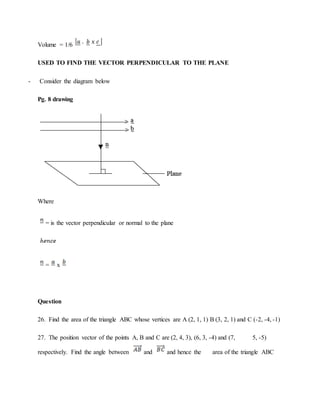
USED TO FIND THE VECTOR PERPENDICULAR TO THE PLANE
- Consider the diagram below
Pg. 8 drawing
Where
= is the vector perpendicular or normal to the plane
= x
Question
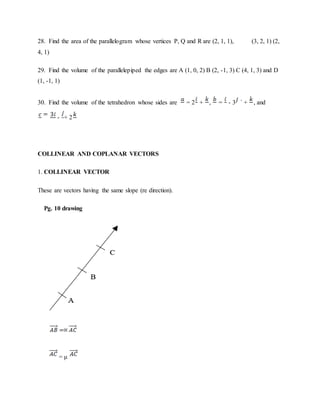
26. Find the area of the triangle ABC whose vertices are A (2, 1, 1) B (3, 2, 1) and C (-2, -4, -1)
27. The position vector of the points A, B and C are (2, 4, 3), (6, 3, -4) and (7, 5, -5)
respectively. Find the angle between and and hence the area of the triangle ABC
28. Find the area of the parallelogram whose vertices P, Q and R are (2, 1, 1), (3, 2, 1) (2,
4, 1)
29. Find the volume of the parallelepiped the edges are A (1, 0, 2) B (2, -1, 3) C (4, 1, 3) and D
(1, -1, 1)
30. Find the volume of the tetrahedron whose sides are = 2 + , = - 3 ` + , and
- + 2
COLLINEAR AND COPLANAR VECTORS
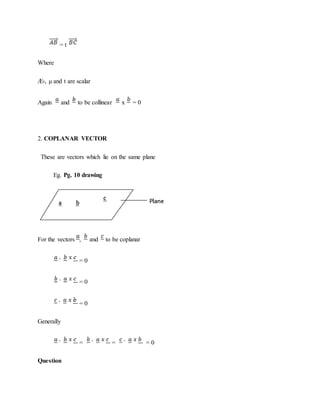
1. COLLINEAR VECTOR
These are vectors having the same slope (re direction).
Pg. 10 drawing
= μ
= t
Where
Æ›, μ and t are scalar
Again and to be collinear x = 0
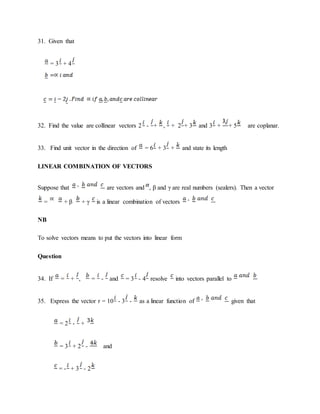
2. COPLANAR VECTOR
These are vectors which lie on the same plane
Eg. Pg. 10 drawing
For the vectors , and to be coplanar
= 0
= 0
= 0
Generally
= = = 0
Question
31. Given that
= 3 + 4
32. Find the value are collinear vectors 2 - + , + 2 + 3 and 3 + + 5 are coplanar.
33. Find unit vector in the direction of = 6 + 3 + and state its length
LINEAR COMBINATION OF VECTORS
Suppose that are vectors and , β and γ are real numbers (sealers). Then a vector
= + β + γ is a linear combination of vectors
NB
To solve vectors means to put the vectors into linear form
Question
34. If = + , = - and = 3 - 4 resolve into vectors parallel to
35. Express the vector r = 10 - 3 - as a linear function of given that
= 2 - +
= 3 + 2 - and
= - + 3 - 2
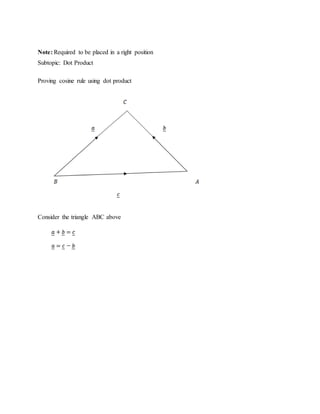
Note: Required to be placed in a right position
Subtopic: Dot Product
Proving cosine rule using dot product
Consider the triangle ABC above
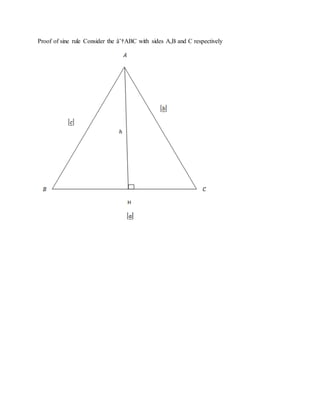
Subtopic: Cross Product
Proof of sine rule Consider the ∆ABC with sides A,B and C respectively
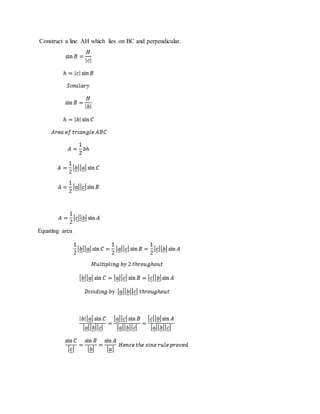
Construct a line AH which lies on BC and perpendicular.
Equating area

VECTOR ANALYSIS- 2

  • 1.
    VECTOR ANALYSIS- 2 2= 2 + 2 – 2 cos Therefore 2 = 2 + 2 – 2 cos 02. USED TO FIND THE PROJECTION OF ONE VECTOR ONTO ANOTHER VECTOR - Suppose the projection of a onto b
  • 2.
    i.e Cos Q = CosQ = proj = cos Q ---------– i Also . = cos Q = cos Q ---------–ii Equalizing i and ii as follows;
  • 3.
    proj = cosQ = proj = similary proj = Where; Proj = projection of onto Proj = projection of onto VECTOR PROJECTION This is given by V proj = . And V. proj = . Where; V. proj = vector projection of onto V. proj = vector projection of onto
  • 4.
    03. TO FINDTHE WORKDONE - Consider the diagram below Force applied (F) = component of tone cos Q = Cos Q = F = Cos Q Also
  • 5.
    Distance d = d= ….ii Hence Work done = Force applied (F) x distance (d) W.D = F x d W. D = cos Q x = cos Q = . W.D = Note i) Force F in the direction of vector Force applied = F. ii) Distance in the direction of vector Displacement = d. Individual i) = 2i + + 2
  • 6.
    = i ++ W.D = 04. TO PROVE COMPOUND ANGLE FORMULA OF COSINE i.e cos (A + B) = cos A cos B – sin A sin B - consider the vector diagram below. Diagram = (cos A) + (sin A) = (cos B) - (sin B)
  • 7.
    Hence = cos (A+ B) but . = = cos A cos B + -sin A sin 0 = cos A cos B – sin A sin B Also = = = = 1 = = = = 1 Therefore
  • 8.
    Cos A cosB – sin A sin B = (1)(1) cos (A + B) Cos (A + B) = cos A cos B – sin A sin B Proved Pg. 2 drawing = (cos A) + (sin A) j = (cos B) I + (sin B) Hence . = cos (A – B) But
  • 9.
    . = . =cos A cos B + sin A sin B Also = = = = 1 = = = = 1 There Cos A cos B + sin A sin B = (1) (1) cos (A – B) Cos (A – B) = cos A cos B + sin A sin B Proved 06. TO PROVE THAT AN INSCRIBED ANGLE SUBTENDING A SEMI – CIRCLE IS A RIGHT ANGLE - Consider the vector diagram below.
  • 10.
    Pg. 2 drawing Toprove that < S R = 900 . = 0 -b + + - = 0 - + = = + + + - = 0 + = = - Hence . = ( + ) ( - )
  • 11.
    . = 2– ( 2 . = 2 - 2 . = 2 - 2 But = = radius, r . = 0 Proved QUESTION 17. Find the projection of + 2 - 3 onto + 2 + 2 18. Find the vector projection of onto . If = 2 +2 + and = 3 + + 2 19. Find the work done of the force of (2i + 3i + k) n s pulling a load (3i + j k) m 20. Find the work done of the force of (2i + 3j + k) N is pulling a load a distance of 2m in the direction of 2m in the direction of = 3 + 2 + 2 21. Find a vector which has magnitude of 14 in the direction of 2 + 3 +
  • 12.
    CROSS (VECTOR) PRODUCT(X or ) x = sin Ø. Where - is the unit vector perpendicular to both vector and = x = Hence x = sin Ø. 1 = = sin Ø Therefore = sin Ø OR = sin Ø Where
  • 13.
    Ø – isthe angle between the vector and Again Suppose the vector Hence + = + = - j + Note i) If you cross two vectors, the product is also the vector. ii) Cross (vector) product uses the knowledge of determinant of 3 x 3 matrix. iii) From the definition. = sin Individual = (1, 0, 0)
  • 14.
    j = (0,1, 0) k = (0, 0, 1) = (1) (1) (0) = 0 = 0 Hence i x i = j x = x = 0 iv) From the definition x = k Generally Consider the component vector
  • 15.
    For anticlockwise (+ve) Pg.4 drawing i) x = ii) x =
  • 16.
    iii) x = Forclockwise (-ve) i) x = ii) x = - iii) x = - THEOREM From the definition -
  • 17.
    = 0 Is thecondition for collinear (parallel) vectors a) ≠ = - Questions 22. If = 2 + 6 + 3 and = + 2 + 2 . Find the angle between and 23. Determine a unit vector perpendicular to = 2 - 6 - 3 and = 4 + 3 – 24. If = 2 + j + 2k and = 3 + 2 + Find â‹€ Box product -This involves both cross and dot product Suppose . x then start with cross (x) followed by DOT (.) . x = . x ) -This is sometimes called scalar triple product Note
  • 18.
    -If scalar tripleproduct (box product) of three vectors . and = 0 -Then the vector , and are said to be COMPLANAR Question 25. If = 2 + + 2 = 2 + and = 3 + 2 + k Find a) . x c b) x . APPLICATION OF CROSS PRODUCT USED TO PROVE SINE RULE - Consider the diagram below + + - = 0 + = Cross by on both sides of x + x = x
  • 19.
    0 + x= x x + x Crossing by on both sides of eqn …. 1 above + = x + + = x x + = x x = x c - ( x = x x = - x ) x = x Equation i and ii as follows x = x = x Sin . = sin . = sin . Sin = Sin = sin Dividing the whole eqn by = = = = Sine rule USED TO PROVED COMPOUND ANGLE FORMULA OF SINE Sin (A + B) = sin A cos B + sin B cos A Consider the vector diagram below Pg. drawing
  • 20.
    = (cos A)+ (sin A) + o = (cos A) + (sin A) + o Hence = sin (A + B) But = = i + k = i (o) – j (o) + k (-cos A sin B - sin A cos B)
  • 21.
    = -k [sinA cos B + cos A sin B] = 2 = 2 = sin A cos B + cos A sin B Also = = 2 2 = 2 B = 1 Therefore Sin A cos B + cos A sin B = (1) (1) sin (A+B) Sin (A + B) = Sin A cos B + cos A sin B Proved USED TO DETERMINE/ TO PROVE COMPOUND AND FORMULA OF SINE Sin (A – B) = sin A cos B – Cos A sin B - Consider the vector diagram below
  • 22.
    Pg.6 drawing = (cosA) + (sin A) + o = (cos B) + (sin B) + o = = sin (A - B) but = = i - j + k
  • 23.
    = 2 = 2 =sin A cos B - cos A sin B Also = + 0 = = = 1 = = = = 1 Therefore Sin A cos B – cosA sin B = (1) (1) sin (A – B) Sin (A – B) = sin A cos B – cos A sin B Proved
  • 24.
    USED TO FINDTHE AREA OF THE TRIANGLE - Consider the triangle ABC below Pg. 7 drawing Area (A) = ½ x base (b) x height (h) A = ½ bh ……i Also Sin = Sin = h = Sin ….ii And b = …iii
  • 25.
    Substitute …ii and…iii into 1 as follows A = ½ sin A = ½ USED TO FIND THE AREA OF PARALLELOGRAM - Consider the parallelogram below Pg. 7 drawing Area = length (l) x height (h) = A = Lh …i L = …ii Also Sin Q =
  • 26.
    h = SinQ….ii Substitute ii and iii into ---1 as follows Area (A) = sin Q A = Generally Area (A) = = = = Where = - = - = - = - USED TO FIND THE VOLUME OF PARALLELOPIPED
  • 27.
    - Consider thediagram below Pg. 7 drawing - Suppose P Q R and S are the vertices of the parallelepiped, hence the volume (v) of the parallelepiped is given by: Volume (v) = base area (A) x height (h) V = x V = V = V = Again, for the sides with position vectors , and Volume (v) = x = =
  • 28.
    USED TO FINDTHE VOLUME OF A TETRAHEDRON - Consider the tetrahedron with vertices P, Q, R and S Pg. 8 drawing Volume (v) = 1/3 x base area x altitude V = 1/3 x ½ x V = 1/6 x V = Therefore
  • 29.
    Volume = 1/6 USEDTO FIND THE VECTOR PERPENDICULAR TO THE PLANE - Consider the diagram below Pg. 8 drawing Where = is the vector perpendicular or normal to the plane = x Question 26. Find the area of the triangle ABC whose vertices are A (2, 1, 1) B (3, 2, 1) and C (-2, -4, -1) 27. The position vector of the points A, B and C are (2, 4, 3), (6, 3, -4) and (7, 5, -5) respectively. Find the angle between and and hence the area of the triangle ABC
  • 30.
    28. Find thearea of the parallelogram whose vertices P, Q and R are (2, 1, 1), (3, 2, 1) (2, 4, 1) 29. Find the volume of the parallelepiped the edges are A (1, 0, 2) B (2, -1, 3) C (4, 1, 3) and D (1, -1, 1) 30. Find the volume of the tetrahedron whose sides are = 2 + , = - 3 ` + , and - + 2 COLLINEAR AND COPLANAR VECTORS 1. COLLINEAR VECTOR These are vectors having the same slope (re direction). Pg. 10 drawing = μ
  • 31.
    = t Where Æ›, μand t are scalar Again and to be collinear x = 0 2. COPLANAR VECTOR These are vectors which lie on the same plane Eg. Pg. 10 drawing For the vectors , and to be coplanar = 0 = 0 = 0 Generally = = = 0 Question
  • 32.
    31. Given that =3 + 4 32. Find the value are collinear vectors 2 - + , + 2 + 3 and 3 + + 5 are coplanar. 33. Find unit vector in the direction of = 6 + 3 + and state its length LINEAR COMBINATION OF VECTORS Suppose that are vectors and , β and γ are real numbers (sealers). Then a vector = + β + γ is a linear combination of vectors NB To solve vectors means to put the vectors into linear form Question 34. If = + , = - and = 3 - 4 resolve into vectors parallel to 35. Express the vector r = 10 - 3 - as a linear function of given that = 2 - + = 3 + 2 - and = - + 3 - 2
  • 33.
    Note: Required tobe placed in a right position Subtopic: Dot Product Proving cosine rule using dot product Consider the triangle ABC above
  • 34.
  • 35.
    Proof of sinerule Consider the ∆ABC with sides A,B and C respectively
  • 36.
    Construct a lineAH which lies on BC and perpendicular. Equating area