1Jarrar © 2014
Mustafa Jarrar
Sina Institute, University of Birzeit
mjarrar@birzeit.edu
www.jarrar.info
Lecture Notes on Lexical Semantics and Multilingualism,
University of Birzeit, Palestine
Fall Semester, 2014
Lexical Semantics
and Multilingualism
2Jarrar © 2014
Watch this lecture and download the slides from
http://jarrar-courses.blogspot.com/2011/11/artificial-intelligence-fall-2011.html
3Jarrar © 2014
Outline
• Linguistic Ontologies vs. Application Ontologies
• Lexical Semantics
• The Semantic Triangle
• Polysemy and Synonymy
• Multilingualism
Lecture Keywords:
‫االنطولوجيا‬‫و‬ ‫تطبيق‬ ‫انطولوجيا‬ ‫بين‬ ‫الفرق‬ ،‫للغة‬ ‫انطولوجيا‬ ،‫تطبيق‬ ‫انطولوجيا‬ ،
‫انطولوجيا‬،‫للغة‬،‫اللغات‬ ‫تعدد‬ ،‫الماصدق‬ ،‫المفهوم‬ ،‫المعنى‬ ،‫الداللة‬ ،‫الداللة‬ ‫علم‬‫الترادف‬
‫المعاني‬ ‫تعدد‬ ،‫اللغوي‬
Application Ontologies, Linguistic Ontologies, Lexical Semantics, Semantics, Meaning, Concept, Instance,
Multilingualism, Synonymy, Polysemy
4Jarrar © 2014
Application ontology vs. Linguistic Ontology
• The importance of linguistic ontologies is growing rapidly.
• An application ontology is a representation of the semantics of a
certain domain/application. Such as, the FOAF ontology, the Palestinian e-
government ontology, the CContology, etc.
 Each word convey one concept (no polysemy).
 Represents application’s knowledge and data structure.
 Used only by a certain application, or a class of applications.
• A linguistic ontology is a representation the semantics of all words of
a human language, independently of a particular application. Such as
WordNet for English.
 Each word may convey several concepts (Polysemy).
 Represents common-sense knowledge (lexical semantics).
 Can be used for general purposes.
 Let’s first understand the relations between a word and its meaning(s).
5Jarrar © 2014
Lexical Semantics and Multilingualism
• Application Ontologies vs. Linguistic Ontologies
• Lexical Semantics
• The Semantic Triangle
• Polysemy and Synonymy
• Multilingualism
6Jarrar © 2014
What is Lexical Semantics?
The study of how and what the words of a language denote.
• Whether the meaning of a lexical unit is established by looking at its
neighborhood in the semantic net (by looking at the other words it
occurs with in natural sentences), or if the meaning is already locally
contained in the lexical unit?
• There are several theories of the classification and decomposition of
word meaning, the differences and similarities in lexical semantic
structure between different languages, and the relationship of word
meaning to sentence meaning and syntax.
Lexical Semantics  focuses on the mapping of words to concepts.
Lexical item: a single word or chain of words that forms the basic elements of a
language's lexicon (vocabulary). E.g., "cat", "traffic light", "take care of", "by-the-way“, etc.
7Jarrar © 2014
What is Lexical Semantics?
• There are different theories and approaches in defining the relation
between a lexical unit and its meaning. For example: can we
understand the meaning independently of a sentence? can we
understand the meaning independently of the grammar (morphology)?
and so on.
• Such theories and approaches are: Prestructuralist semantics,
Structuralist and nostructuralist semantics, interpretative semantics
and generative semantics, Cognitive semantics.
• In this lecture, we don’t investigate these theories, but rather, we
study the “meaning” from a computational and engineering viewpoints,
so to enable computer applications.
8Jarrar © 2014
Lexical Semantics and Multilingualism
• Linguistic Ontologies vs. Application Ontologies
• Lexical Semantics
• The Semantic Triangle
• Polysemy and Synonymy
• Multilingually
9Jarrar © 2014
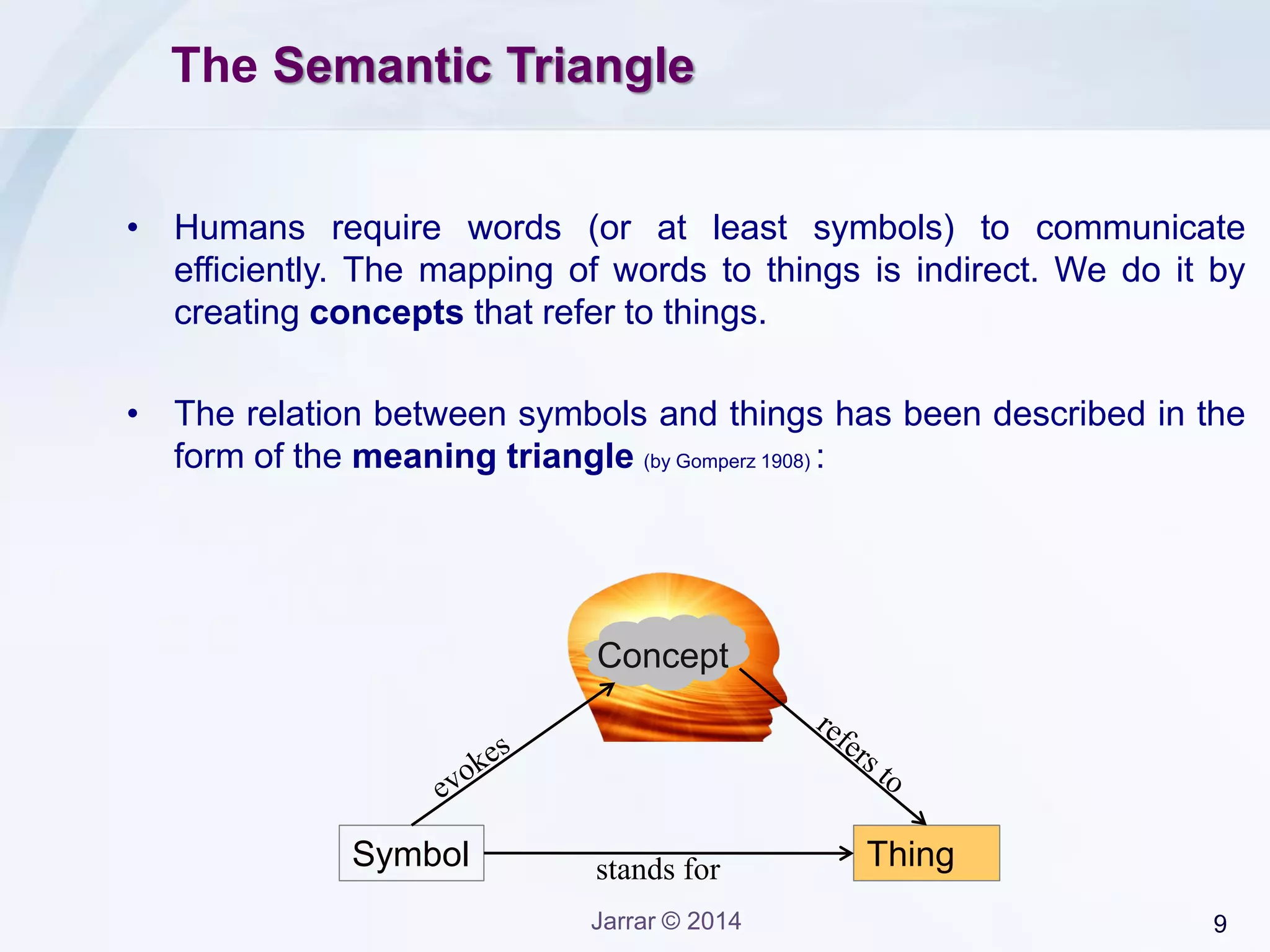
The Semantic Triangle
Symbol Thingstands for
• Humans require words (or at least symbols) to communicate
efficiently. The mapping of words to things is indirect. We do it by
creating concepts that refer to things.
• The relation between symbols and things has been described in the
form of the meaning triangle (by Gomperz 1908) :
Concept
10Jarrar © 2014
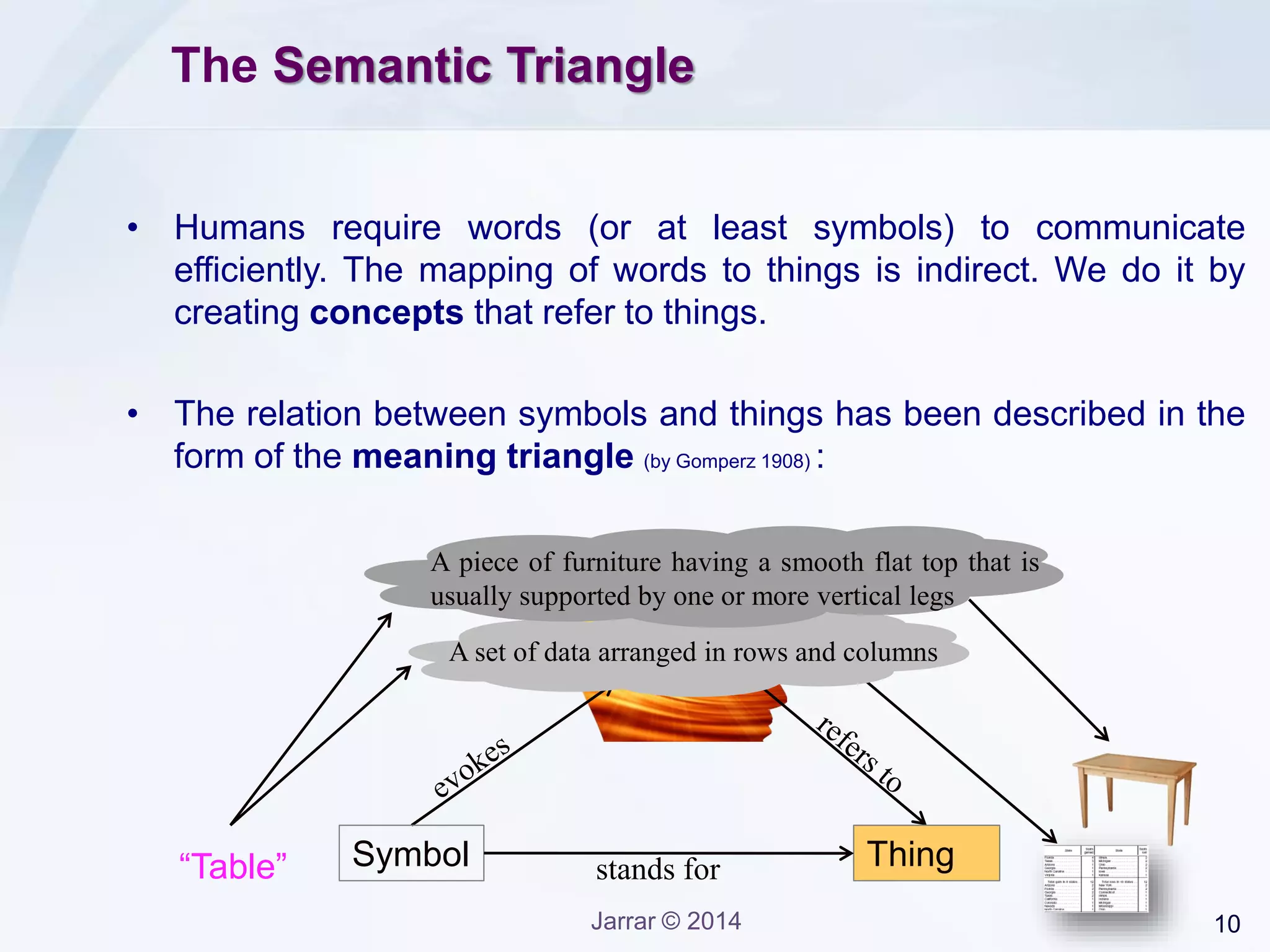
Concept
The Semantic Triangle
Symbol Thing“Table” stands for
A set of data arranged in rows and columns
A piece of furniture having a smooth flat top that is
usually supported by one or more vertical legs
• Humans require words (or at least symbols) to communicate
efficiently. The mapping of words to things is indirect. We do it by
creating concepts that refer to things.
• The relation between symbols and things has been described in the
form of the meaning triangle (by Gomperz 1908) :
11Jarrar © 2014
Concept
The Semantic Triangle
Symbol Thing“Table” stands for
A set of data arranged in rows and columns
A piece of furniture having a smooth flat top that is
usually supported by one or more vertical legs
Concept: a set of rules we
have in mind to distinguish
similar things in reality[J05].
An instance of a concept ( )
‫الماصد‬
‫ق‬
• Meaning/ = Concept/ = Semantics
• The meaning/semantics of a term is its concepts.
‫معنى‬
‫مفهو‬
‫م‬
12Jarrar © 2014
Concept
The Semantic Triangle
Symbol Thing“Table” stands for
A set of data arranged in rows and columns
• A concept might not be agreed among all people (i.e., not exactly the
same set of rules/properties are agreed by all people).
• Thus, “most common properties” are used within:
 a community of practice (e.g., professions, or language communities).
 Large community & less interactions  less concepts are shared.
A piece of furniture having a smooth flat top that is
usually supported by one or more vertical legs
An instance of a concept ( )
Concept: a set of rules we
have in mind to distinguish
similar things in reality[J05].
‫الماصدق‬
13Jarrar © 2014
Number of Terms vs Concepts in a Language
‫قرفصاء‬ ‫سجود‬
Why there is no word
in Arabic to describe
this situation?
??
We give names to the concepts we use more.
Some societies love to give/invite names to concepts (as Arabs in the past)
14Jarrar © 2014
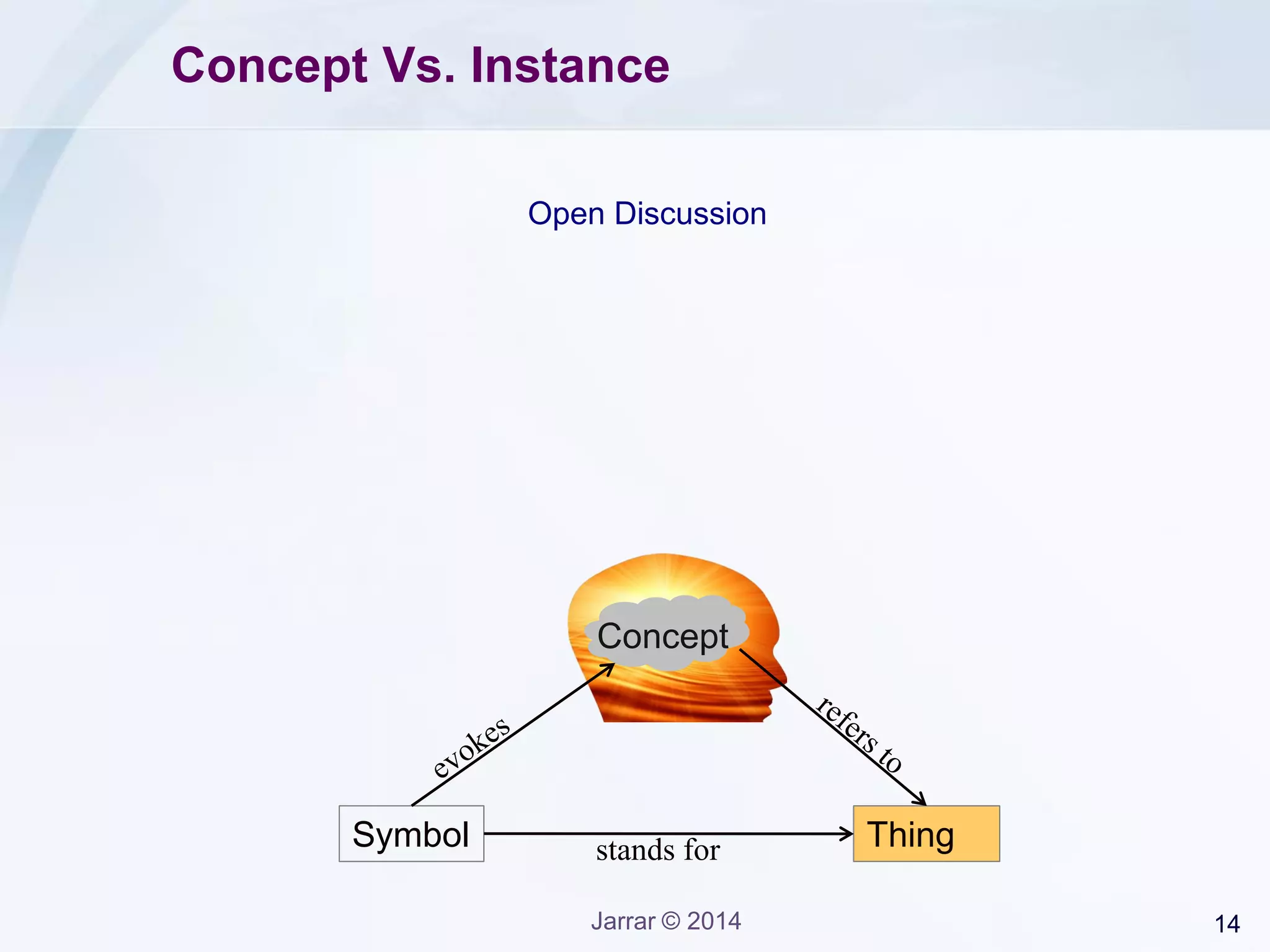
Concept Vs. Instance
Open Discussion
Symbol Thingstands for
Concept
15Jarrar © 2014
Recommended Reading
Ḥayy ibn Yaqẓān (Arabic: ‫يقظان‬ ‫ابن‬ ‫"حي‬Alive,
son of Awake"; Latin: Philosophus
Autodidactus "The Self-Taught Philosopher";
English: The Improvement of Human Reason:
Exhibited in the Life of Hai Ebn Yokdhan), the
first Arabic novel, was written by Ibn Tufail
(also known as Aben Tofail or Ebn Tophail), a
Moorish philosopher and physician, in early
12th century Islamic Spain. The novel was
itself named after an earlier Arabic allegorical
tale and philosophical romance of the same
name, written by Avicenna (Ave Cena) in early
11th century,[1] though they had different
stories.[2]
-wikipedia
Ḥayy Bin Yaqdhan Novel
16Jarrar © 2014
Lexical Semantics and Multilingualism
• Linguistic Ontologies vs. Application Ontologies
• Lexical Semantics
• The Semantic Triangle
• Polysemy and Synonymy
• Multilingually
17Jarrar © 2014
Concept
Polysemy
Symbol Thing“Table” stands for
A set of data arranged in rows and columns
• Polysemy: is the capacity of a lexical unit to refer to multiple
meanings/concepts. These meanings can be related or different.
• Polysemy is the consequence of meaning evolution. The constant
discussion over how to name and what words mean is in the discourse of
a community and implies language evolution. [3]
• Note: the most frequent word forms are the most polysemous! [4]
A piece of furniture having a smooth flat top that is
usually supported by one or more vertical legs
An instance of a concept ( )
Concept: a set of rules we
have in mind to distinguish
similar things in reality[J05].
‫الماصدق‬
18Jarrar © 2014
Concept
Synonymy
Symbol Thingstands for
A set of data arranged in rows and columns
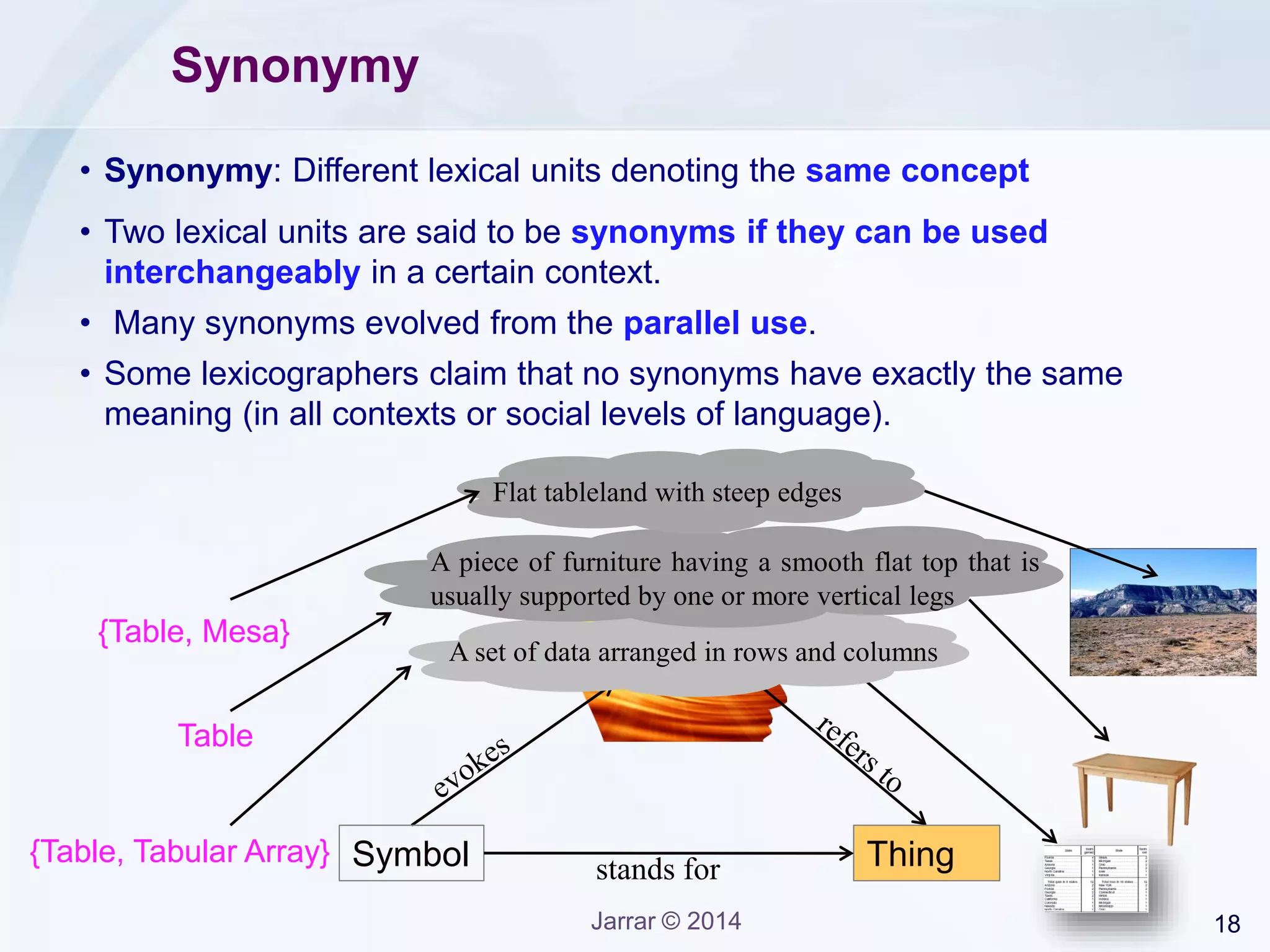
• Synonymy: Different lexical units denoting the same concept
• Two lexical units are said to be synonyms if they can be used
interchangeably in a certain context.
• Many synonyms evolved from the parallel use.
• Some lexicographers claim that no synonyms have exactly the same
meaning (in all contexts or social levels of language).
A piece of furniture having a smooth flat top that is
usually supported by one or more vertical legs
{Table, Tabular Array}
Table
{Table, Mesa}
Flat tableland with steep edges
19Jarrar © 2014
Lexical Semantics and Multilingualism
• Linguistic Ontologies vs. Application Ontologies
• Lexical Semantics
• The Semantic Triangle
• Polysemy and Synonymy
• Multilingually
20Jarrar © 2014
Concept
Multilingually
Symbol Thing“Table” stands for
A set of data arranged in rows and columns
A piece of furniture having a smooth flat top that is
usually supported by one or more vertical legs
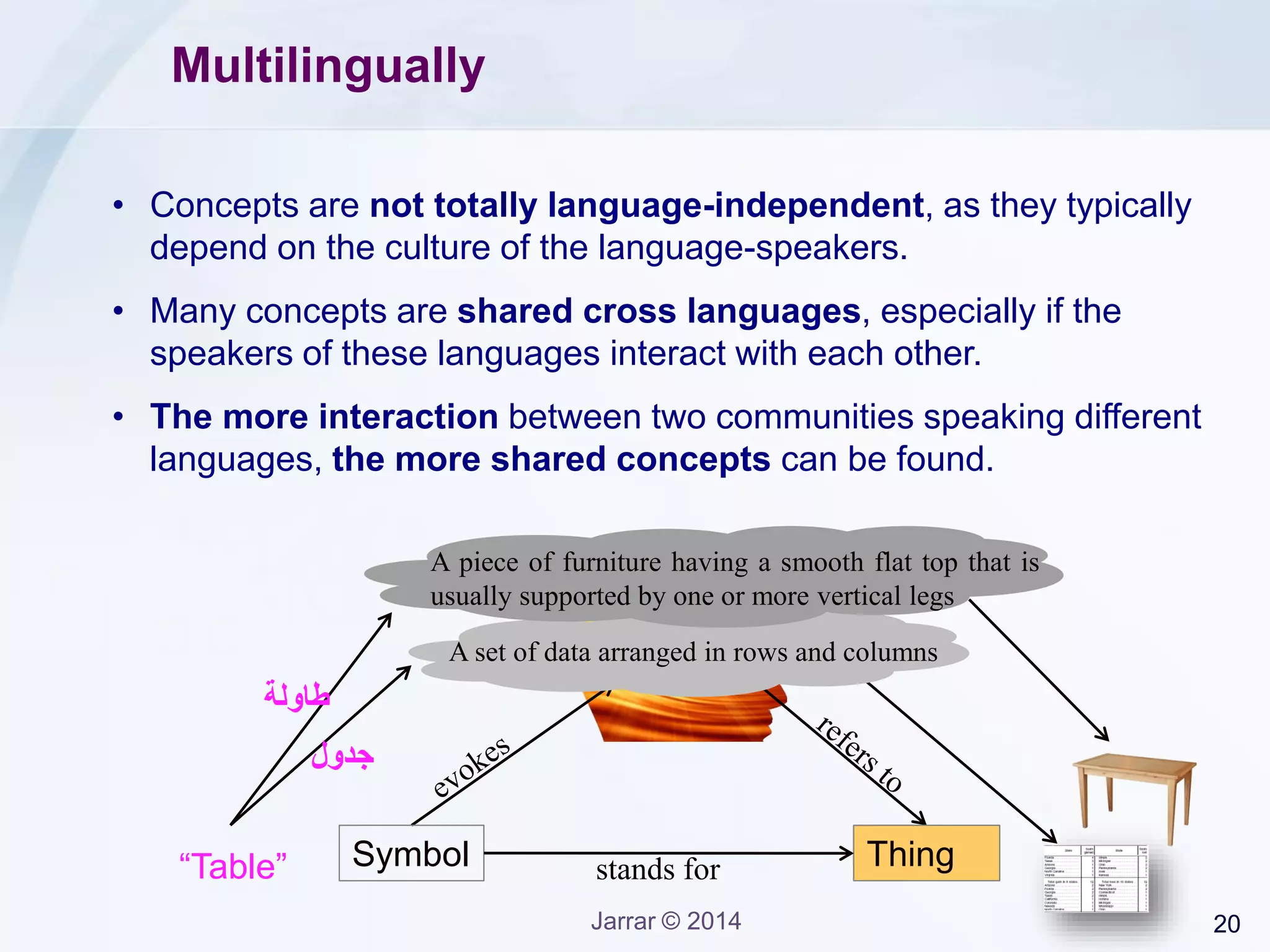
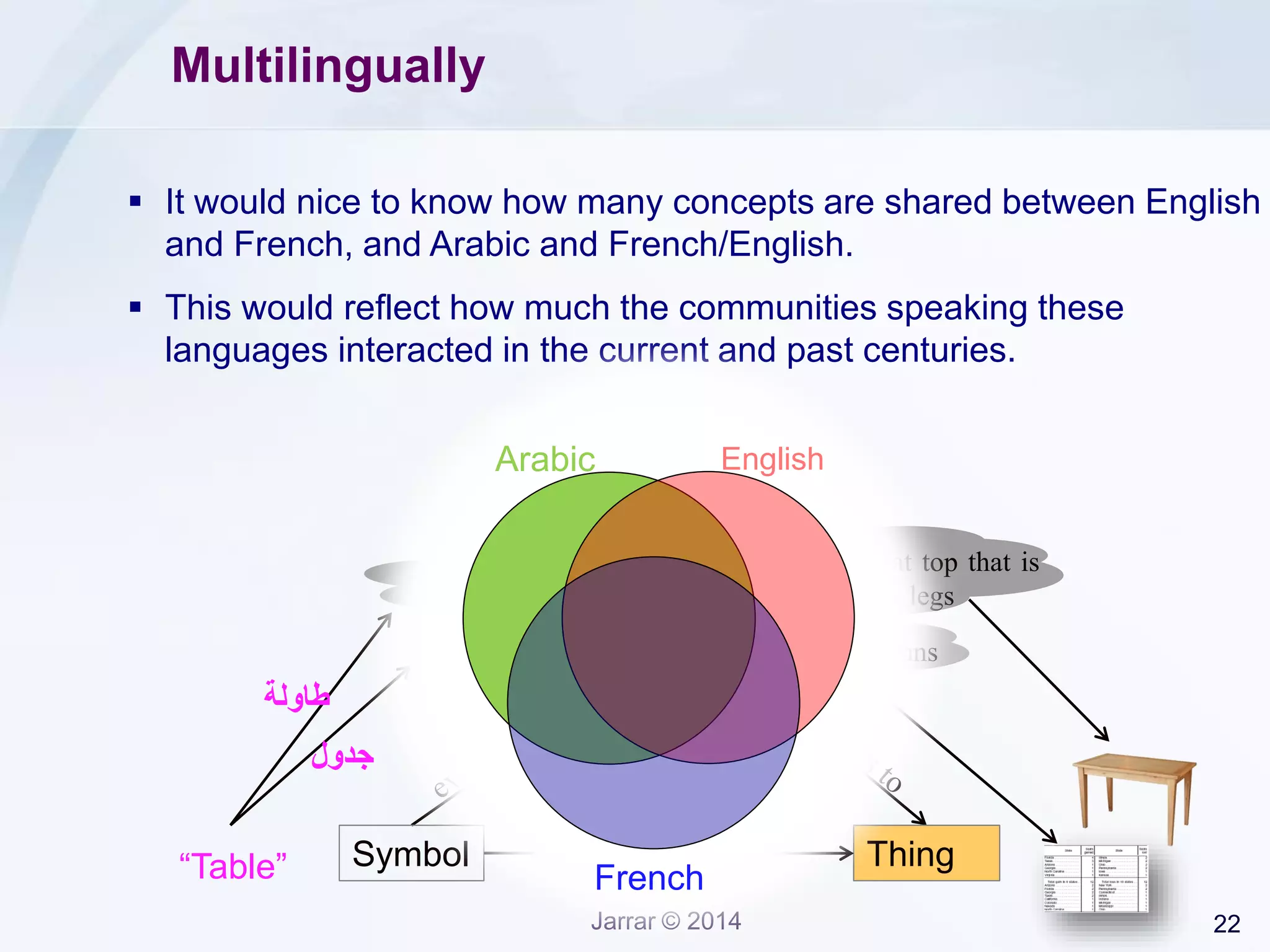
• Concepts are not totally language-independent, as they typically
depend on the culture of the language-speakers.
• Many concepts are shared cross languages, especially if the
speakers of these languages interact with each other.
• The more interaction between two communities speaking different
languages, the more shared concepts can be found.
‫طاولة‬
‫جدول‬
21Jarrar © 2014
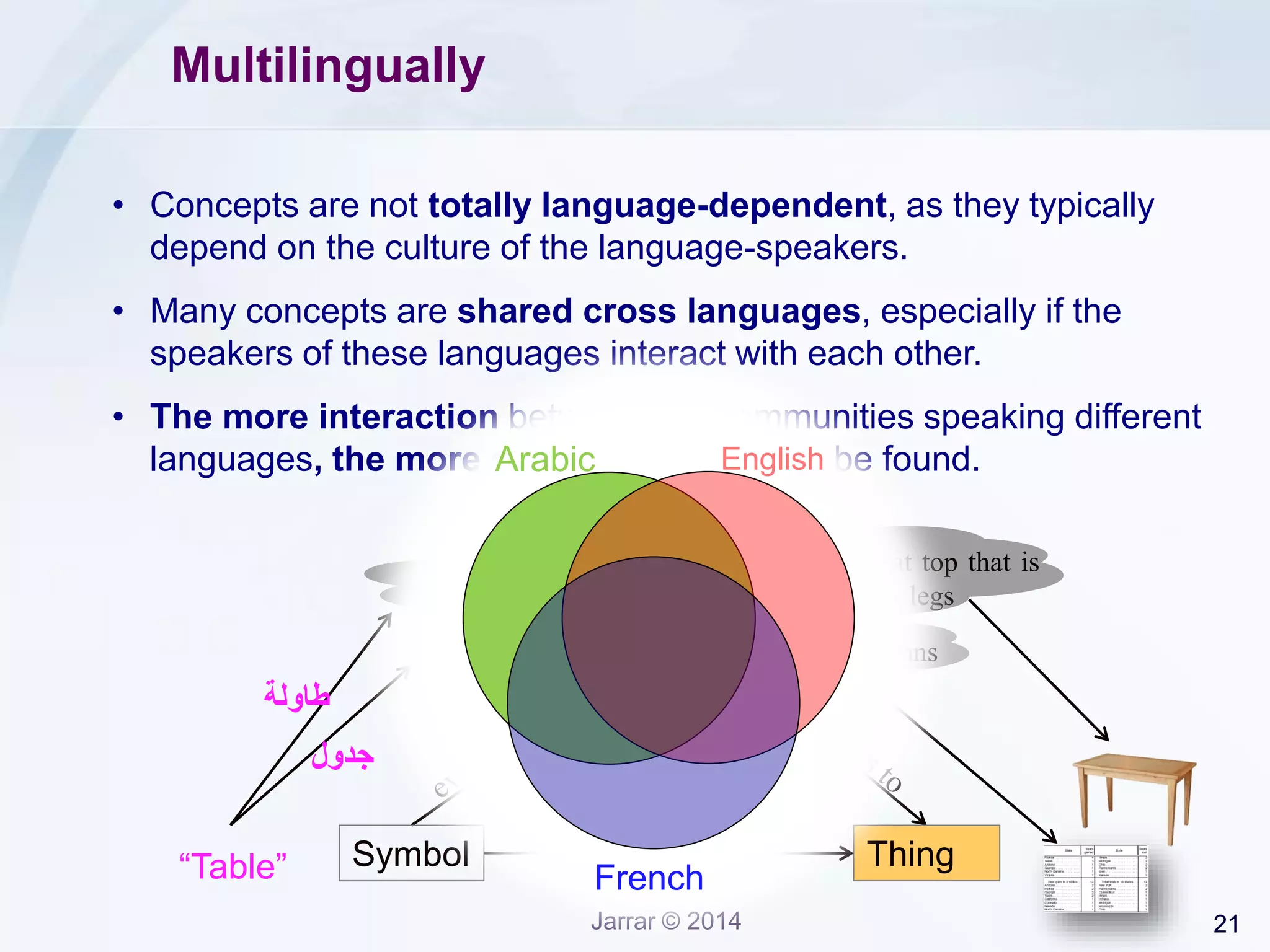
• Concepts are not totally language-dependent, as they typically
depend on the culture of the language-speakers.
• Many concepts are shared cross languages, especially if the
speakers of these languages interact with each other.
• The more interaction between two communities speaking different
languages, the more shared concepts can be found.
Concept
Multilingually
Symbol Thing“Table” stands for
A set of data arranged in rows and columns
A piece of furniture having a smooth flat top that is
usually supported by one or more vertical legs
French
EnglishArabic
‫طاولة‬
‫جدول‬
22Jarrar © 2014
Concept
Multilingually
Symbol Thing“Table” stands for
A set of data arranged in rows and columns
A piece of furniture having a smooth flat top that is
usually supported by one or more vertical legs
 It would nice to know how many concepts are shared between English
and French, and Arabic and French/English.
 This would reflect how much the communities speaking these
languages interacted in the current and past centuries.
French
EnglishArabic
‫طاولة‬
‫جدول‬
23Jarrar © 2014
References
[1] Sayyed Hossein Nasr and Oliver Leaman (1996), History of Islamic Philosophy, p. 315, Routledge,
ISBN 0415131596.
[2] Davidson, Herbert Alan (1992), Alfarabi, Avicenna, and Averroes on Intellect: Their Cosmologies,
Theories of the Active Intellect, and Theories of Human Intellect, Oxford University Press,
p. 146, ISBN 0195074238
[3] Timmerman, Rita. "Questioning the Univocity Ideal. The Difference between Socio-cognitive
Terminology and Traditional Terminology." Journal of Linguistics 18 (1997): 51-90. Print.
[4] Christiane Fellbaum: Lecture Notes on Words, Concepts, Meanings
http://iaoa.org/isc2012/docs/fellbaum-trento-uno.pdf

Jarrar.lecture notes.lexicalsemanticsandmultilingualism

  • 1.
    1Jarrar © 2014 MustafaJarrar Sina Institute, University of Birzeit mjarrar@birzeit.edu www.jarrar.info Lecture Notes on Lexical Semantics and Multilingualism, University of Birzeit, Palestine Fall Semester, 2014 Lexical Semantics and Multilingualism
  • 2.
    2Jarrar © 2014 Watchthis lecture and download the slides from http://jarrar-courses.blogspot.com/2011/11/artificial-intelligence-fall-2011.html
  • 3.
    3Jarrar © 2014 Outline •Linguistic Ontologies vs. Application Ontologies • Lexical Semantics • The Semantic Triangle • Polysemy and Synonymy • Multilingualism Lecture Keywords: ‫االنطولوجيا‬‫و‬ ‫تطبيق‬ ‫انطولوجيا‬ ‫بين‬ ‫الفرق‬ ،‫للغة‬ ‫انطولوجيا‬ ،‫تطبيق‬ ‫انطولوجيا‬ ، ‫انطولوجيا‬،‫للغة‬،‫اللغات‬ ‫تعدد‬ ،‫الماصدق‬ ،‫المفهوم‬ ،‫المعنى‬ ،‫الداللة‬ ،‫الداللة‬ ‫علم‬‫الترادف‬ ‫المعاني‬ ‫تعدد‬ ،‫اللغوي‬ Application Ontologies, Linguistic Ontologies, Lexical Semantics, Semantics, Meaning, Concept, Instance, Multilingualism, Synonymy, Polysemy
  • 4.
    4Jarrar © 2014 Applicationontology vs. Linguistic Ontology • The importance of linguistic ontologies is growing rapidly. • An application ontology is a representation of the semantics of a certain domain/application. Such as, the FOAF ontology, the Palestinian e- government ontology, the CContology, etc.  Each word convey one concept (no polysemy).  Represents application’s knowledge and data structure.  Used only by a certain application, or a class of applications. • A linguistic ontology is a representation the semantics of all words of a human language, independently of a particular application. Such as WordNet for English.  Each word may convey several concepts (Polysemy).  Represents common-sense knowledge (lexical semantics).  Can be used for general purposes.  Let’s first understand the relations between a word and its meaning(s).
  • 5.
    5Jarrar © 2014 LexicalSemantics and Multilingualism • Application Ontologies vs. Linguistic Ontologies • Lexical Semantics • The Semantic Triangle • Polysemy and Synonymy • Multilingualism
  • 6.
    6Jarrar © 2014 Whatis Lexical Semantics? The study of how and what the words of a language denote. • Whether the meaning of a lexical unit is established by looking at its neighborhood in the semantic net (by looking at the other words it occurs with in natural sentences), or if the meaning is already locally contained in the lexical unit? • There are several theories of the classification and decomposition of word meaning, the differences and similarities in lexical semantic structure between different languages, and the relationship of word meaning to sentence meaning and syntax. Lexical Semantics  focuses on the mapping of words to concepts. Lexical item: a single word or chain of words that forms the basic elements of a language's lexicon (vocabulary). E.g., "cat", "traffic light", "take care of", "by-the-way“, etc.
  • 7.
    7Jarrar © 2014 Whatis Lexical Semantics? • There are different theories and approaches in defining the relation between a lexical unit and its meaning. For example: can we understand the meaning independently of a sentence? can we understand the meaning independently of the grammar (morphology)? and so on. • Such theories and approaches are: Prestructuralist semantics, Structuralist and nostructuralist semantics, interpretative semantics and generative semantics, Cognitive semantics. • In this lecture, we don’t investigate these theories, but rather, we study the “meaning” from a computational and engineering viewpoints, so to enable computer applications.
  • 8.
    8Jarrar © 2014 LexicalSemantics and Multilingualism • Linguistic Ontologies vs. Application Ontologies • Lexical Semantics • The Semantic Triangle • Polysemy and Synonymy • Multilingually
  • 9.
    9Jarrar © 2014 TheSemantic Triangle Symbol Thingstands for • Humans require words (or at least symbols) to communicate efficiently. The mapping of words to things is indirect. We do it by creating concepts that refer to things. • The relation between symbols and things has been described in the form of the meaning triangle (by Gomperz 1908) : Concept
  • 10.
    10Jarrar © 2014 Concept TheSemantic Triangle Symbol Thing“Table” stands for A set of data arranged in rows and columns A piece of furniture having a smooth flat top that is usually supported by one or more vertical legs • Humans require words (or at least symbols) to communicate efficiently. The mapping of words to things is indirect. We do it by creating concepts that refer to things. • The relation between symbols and things has been described in the form of the meaning triangle (by Gomperz 1908) :
  • 11.
    11Jarrar © 2014 Concept TheSemantic Triangle Symbol Thing“Table” stands for A set of data arranged in rows and columns A piece of furniture having a smooth flat top that is usually supported by one or more vertical legs Concept: a set of rules we have in mind to distinguish similar things in reality[J05]. An instance of a concept ( ) ‫الماصد‬ ‫ق‬ • Meaning/ = Concept/ = Semantics • The meaning/semantics of a term is its concepts. ‫معنى‬ ‫مفهو‬ ‫م‬
  • 12.
    12Jarrar © 2014 Concept TheSemantic Triangle Symbol Thing“Table” stands for A set of data arranged in rows and columns • A concept might not be agreed among all people (i.e., not exactly the same set of rules/properties are agreed by all people). • Thus, “most common properties” are used within:  a community of practice (e.g., professions, or language communities).  Large community & less interactions  less concepts are shared. A piece of furniture having a smooth flat top that is usually supported by one or more vertical legs An instance of a concept ( ) Concept: a set of rules we have in mind to distinguish similar things in reality[J05]. ‫الماصدق‬
  • 13.
    13Jarrar © 2014 Numberof Terms vs Concepts in a Language ‫قرفصاء‬ ‫سجود‬ Why there is no word in Arabic to describe this situation? ?? We give names to the concepts we use more. Some societies love to give/invite names to concepts (as Arabs in the past)
  • 14.
    14Jarrar © 2014 ConceptVs. Instance Open Discussion Symbol Thingstands for Concept
  • 15.
    15Jarrar © 2014 RecommendedReading Ḥayy ibn Yaqẓān (Arabic: ‫يقظان‬ ‫ابن‬ ‫"حي‬Alive, son of Awake"; Latin: Philosophus Autodidactus "The Self-Taught Philosopher"; English: The Improvement of Human Reason: Exhibited in the Life of Hai Ebn Yokdhan), the first Arabic novel, was written by Ibn Tufail (also known as Aben Tofail or Ebn Tophail), a Moorish philosopher and physician, in early 12th century Islamic Spain. The novel was itself named after an earlier Arabic allegorical tale and philosophical romance of the same name, written by Avicenna (Ave Cena) in early 11th century,[1] though they had different stories.[2] -wikipedia Ḥayy Bin Yaqdhan Novel
  • 16.
    16Jarrar © 2014 LexicalSemantics and Multilingualism • Linguistic Ontologies vs. Application Ontologies • Lexical Semantics • The Semantic Triangle • Polysemy and Synonymy • Multilingually
  • 17.
    17Jarrar © 2014 Concept Polysemy SymbolThing“Table” stands for A set of data arranged in rows and columns • Polysemy: is the capacity of a lexical unit to refer to multiple meanings/concepts. These meanings can be related or different. • Polysemy is the consequence of meaning evolution. The constant discussion over how to name and what words mean is in the discourse of a community and implies language evolution. [3] • Note: the most frequent word forms are the most polysemous! [4] A piece of furniture having a smooth flat top that is usually supported by one or more vertical legs An instance of a concept ( ) Concept: a set of rules we have in mind to distinguish similar things in reality[J05]. ‫الماصدق‬
  • 18.
    18Jarrar © 2014 Concept Synonymy SymbolThingstands for A set of data arranged in rows and columns • Synonymy: Different lexical units denoting the same concept • Two lexical units are said to be synonyms if they can be used interchangeably in a certain context. • Many synonyms evolved from the parallel use. • Some lexicographers claim that no synonyms have exactly the same meaning (in all contexts or social levels of language). A piece of furniture having a smooth flat top that is usually supported by one or more vertical legs {Table, Tabular Array} Table {Table, Mesa} Flat tableland with steep edges
  • 19.
    19Jarrar © 2014 LexicalSemantics and Multilingualism • Linguistic Ontologies vs. Application Ontologies • Lexical Semantics • The Semantic Triangle • Polysemy and Synonymy • Multilingually
  • 20.
    20Jarrar © 2014 Concept Multilingually SymbolThing“Table” stands for A set of data arranged in rows and columns A piece of furniture having a smooth flat top that is usually supported by one or more vertical legs • Concepts are not totally language-independent, as they typically depend on the culture of the language-speakers. • Many concepts are shared cross languages, especially if the speakers of these languages interact with each other. • The more interaction between two communities speaking different languages, the more shared concepts can be found. ‫طاولة‬ ‫جدول‬
  • 21.
    21Jarrar © 2014 •Concepts are not totally language-dependent, as they typically depend on the culture of the language-speakers. • Many concepts are shared cross languages, especially if the speakers of these languages interact with each other. • The more interaction between two communities speaking different languages, the more shared concepts can be found. Concept Multilingually Symbol Thing“Table” stands for A set of data arranged in rows and columns A piece of furniture having a smooth flat top that is usually supported by one or more vertical legs French EnglishArabic ‫طاولة‬ ‫جدول‬
  • 22.
    22Jarrar © 2014 Concept Multilingually SymbolThing“Table” stands for A set of data arranged in rows and columns A piece of furniture having a smooth flat top that is usually supported by one or more vertical legs  It would nice to know how many concepts are shared between English and French, and Arabic and French/English.  This would reflect how much the communities speaking these languages interacted in the current and past centuries. French EnglishArabic ‫طاولة‬ ‫جدول‬
  • 23.
    23Jarrar © 2014 References [1]Sayyed Hossein Nasr and Oliver Leaman (1996), History of Islamic Philosophy, p. 315, Routledge, ISBN 0415131596. [2] Davidson, Herbert Alan (1992), Alfarabi, Avicenna, and Averroes on Intellect: Their Cosmologies, Theories of the Active Intellect, and Theories of Human Intellect, Oxford University Press, p. 146, ISBN 0195074238 [3] Timmerman, Rita. "Questioning the Univocity Ideal. The Difference between Socio-cognitive Terminology and Traditional Terminology." Journal of Linguistics 18 (1997): 51-90. Print. [4] Christiane Fellbaum: Lecture Notes on Words, Concepts, Meanings http://iaoa.org/isc2012/docs/fellbaum-trento-uno.pdf