DEIXIS AND DISTANCE
MAMOONA SHEHZADI
AMNA ZAHID
TAIBA AROOJ
PRESENTED BY
CONTENT
DEIXES AND DISTANCE
THREE TYPES OF DEIXES
DEIXES AND GRAMMAR
Deixis
 Deixis means “pointing via language”.
Any linguistic form used to do this “pointing” is called a
deictic expression. Words like here, there, this, that,
now and then, as well as most pronouns, such as I, we,
you, he, her and them are deictic expressions.
What is Deixis
 Deixis is an important field of language study in its own right -
and very important for learners of second languages. But it has
some relevance to analysis of conversation and pragmatics
because it directly concerns the relationship between the
structure of languages and the context in which they are
used.It is often and best described as “verbal pointing”, that is
to say pointing by means of language. The linguistic forms of
this pointing are called deictic expressions, deictic markers
or deictic words; they are also sometimes called indexicals.
What is indexicals
 In linguistics and in philosophy of language, an
indexical behavior or utterance symbolically points to
(or indicates) some state of affairs.
For example,
I refers to whoever is speaking;
now refers to the time at which that word is uttered;
and here refers to the place of utterance.
Deictic expressions include such
lexemes (words) as:
 Personal or possessive pronouns
(I/you/mine/yours),
 Demonstrative pronouns
(this/that),
 (Spatial/temporal) adverbs
(here/there/now),
 Personal or possessive adjectives
(my/your),
 Demonstrative adjectives
(this/that),
 Articles
(the).
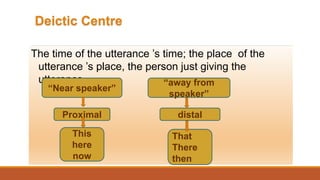
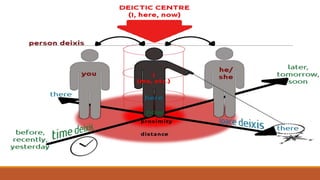
Deictic Centre
The time of the utterance ‟s time; the place of the
utterance ‟s place, the person just giving the
utterance.
Proximal distal
This
here
now
That
There
then
“Near speaker”
“away from
speaker”
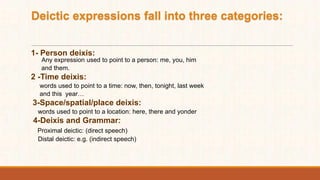
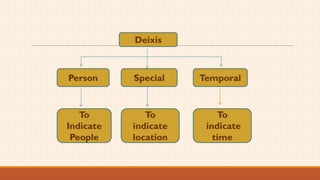
Deictic expressions fall into three categories:
1- Person deixis:
Any expression used to point to a person: me, you, him
and them.
2 -Time deixis:
words used to point to a time: now, then, tonight, last week
and this year…
3-Space/spatial/place deixis:
words used to point to a location: here, there and yonder
4-Deixis and Grammar:
Proximal deictic: (direct speech)
Distal deictic: e.g. (indirect speech)
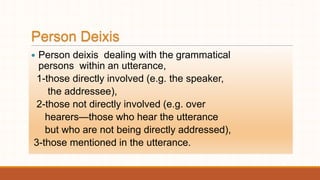
Person Deixis
 Person deixis dealing with the grammatical
persons within an utterance,
1-those directly involved (e.g. the speaker,
the addressee),
2-those not directly involved (e.g. over
hearers—those who hear the utterance
but who are not being directly addressed),
3-those mentioned in the utterance.
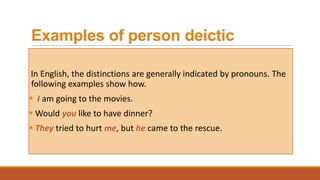
Examples of person deictic
In English, the distinctions are generally indicated by pronouns. The
following examples show how.
 I am going to the movies.
 Would you like to have dinner?
 They tried to hurt me, but he came to the rescue.
Person Deixis
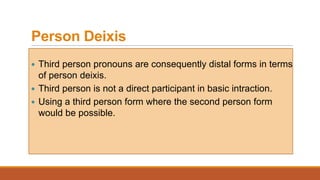
 Third person pronouns are consequently distal forms in terms
of person deixis.
 Third person is not a direct participant in basic intraction.
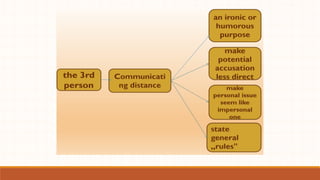
 Using a third person form where the second person form
would be possible.
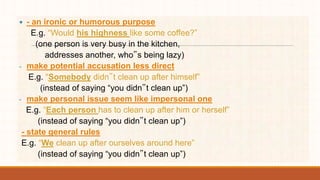
 - an ironic or humorous purpose
E.g. “Would his highness like some coffee?”
(one person is very busy in the kitchen,
addresses another, who‟s being lazy)
- make potential accusation less direct
E.g. “Somebody didn‟t clean up after himself”
(instead of saying “you didn‟t clean up”)
- make personal issue seem like impersonal one
E.g. “Each person has to clean up after him or herself”
(instead of saying “you didn‟t clean up”)
- state general rules
E.g. “We clean up after ourselves around here”
(instead of saying “you didn‟t clean up”)
Deictic Projection
 Deictic projection = speakers being able to project
themselves into other locations, time or shift person
reference. Eg. via dramatic performances, when using
direct speech to represent the person, location and
feelings of someone else.
Example
 A Hebrew teacher, discovering that he had left his
comfortable slippers back in the house, sent a student
after them with a note for his wife.The note read: “Send
me your slippers with this boy”. When the student asked
why he had written „your‟ slippers, the teacher answered:
„Yold!(Fool) If I wrote „my‟ slippers, she would read „my
slippers‟ and would send her slippers. What could I do
with her slippers? So I wrote „your‟ slippers, she‟ll read
„your‟ slippers and send me mine.”
Spatial diexis
PRESENTED BY:
AMNA ZAHID
Spatial diexis
The idea of a speaker 'pointing out' something in space or
time in order to draw the attention of the addressee to it is
basic to both spatial and temporal deixis (see e.g. Lyons
1977, Fillmore 1982b, Lakoff 1987).
CONTINUED……..
They indicate distance and proximity from the speaker,
physical distance or proximity, mental and psychological
distance or proximity.
Examples:
• The station is two hundred yards from the college.
• Bring that here and take this there.
Continued…….
Place deixis, also known as space deixis, concerns itself with
the spatial locations relevant to an utterance. Similarly to
person deixis, the locations may be either those of the
speaker and addressee or those of persons or objects being
referred to. The most salient English examples are
the adverbs “here” and “there” and
the demonstratives “this” and “that” and these are used to
mark the movement towards the speaker.
EXAMPLES
The church is behind the town hall.
• I enjoy living in this city.
• Here is where we will place the statue.
• She was sitting over there.
• Here is a good spot; it is too sunny over there.
CONTINUED…..
• Older texts have various distinct expressions. Yonder
(more distant) hither (to this place) and thence
(from that place) which are still applicable but
archaic.
Continued……
• Some verbs of motion ‘come’ and ‘go’ retain a
deictic sense which means towards the speaker and
away from the speaker. These are commonly used
for pointing the position of people.
CONT………
• The words that seem to be the first deictic meaning.
• This and here (can be seen).
• That and there (cannot be seen).
CONTI……..
Examples.
• This is my book lying here
• That building is there in switzerland.
CONTINUED…..
• It is important to remember that location from the
speaker’s perspective can be fixed mentally as well as
physically.
• People away from there homes use ‘here’ to show and
mean their home location.
Deictic Projection
• To project or show the mean of different words and to
manipulate a location.
• Examples
• I am not here now.
• I was looking at this little puppy in a cage with such a sad
expression on its face. It was like, ‘Oh, I’m so unhappy
here, will you set me free?’
Psychological Distance
Pragmatic basis of spatial deixis is actually named as
psychological distance.
It can be understood in terms of
• Objects physically close
Example
This cat sitting here is lovely
CONTINUED……..
Objects physically distant
Example
That teacher sitting over there.
• A speaker may also wish to show something distant which is actually
close.
Example
I don’t like that.
This shows that the word ‘that’ does not have a fixed specific
meaning but it can be changed with respect to context.
ACTIVITY
Pick out the spatial deixis from the following.
• This one (here) is bigger than that one (over there).
• I like this/that one better.
• The old man was dead. I removed the bed and examined the
corpse. Yes, he was stone, stone dead. I placed my hand upon
the heart and held it there many minutes. There was no
pulsation. He was stone dead. His eye would trouble me no
more. [Edgar Allen Poe: The tell tale heart]
Pick out the spatial deixis.
• Benvolio. See, where he comes: so please you, step aside;
• I'll know his grievance, or be much denied.
• Montague. I would thou wert so happy by thy stay,
• To hear true shrift. Come, madam, let's away.
• [Exeunt Montague and Lady Montague]
• Benvolio. Good-morrow, cousin.
• Romeo. Is the day so young?
• Benvolio. But new struck nine.
• Romeo. Ay me! sad hours seem long.
• Was that my father that went hence so fast?
• Benvolio. It was. What sadness lengthens Romeo's hours?
TEMPORAL DEIXIS
PRESENTED BY:
TAIBA AROOJ
WHATARE TEMPORAL DEIXIS?
Temporal comes from the Latin word temporalis which
means "of time"
 The expressions which are used to point to a time are
called temporal deixis.
What do you think?
What are temporal deixis?
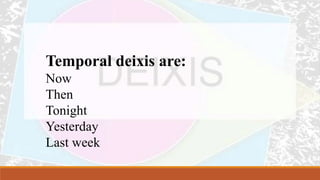
Temporal deixis are:
Now
Then
Tonight
Yesterday
Last week
CONCEPT OF TIME
The concept of time is represented by three main
classes of expressions:
1) grammatical expressions (whether inflectional
or by means of auxiliaries)
2) lexical expressions (like, today, tomorrow, and
yesterday).
3) lexically composite expressions (like, ten minutes
ago).
Lexicalization of Temporal
Deixis
Lexicalization of temporal deixis comprises two
divisions:
simple lexical deictics
lexically composite deictics
It includes now, then, soon, tomorrow, today and this
day, the day before yesterday, last/ next Monday
USE of time adverbs NOW and
THEN
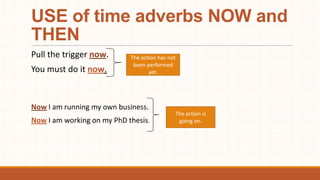
Pull the trigger now.
You must do it now.
Now I am running my own business.
Now I am working on my PhD thesis.
The action has not
been performed
yet.
The action is
going on.
Can u give me some
example?
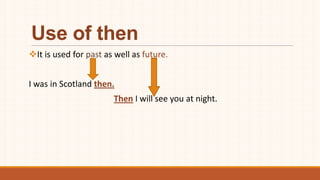
Use of then
It is used for past as well as future.
I was in Scotland then.
Then I will see you at night.
Can you differentiate between
both usage of then?
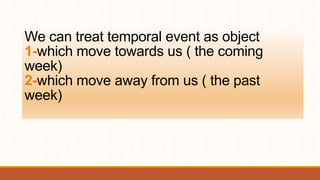
We can treat temporal event as object
1-which move towards us ( the coming
week)
2-which move away from us ( the past
week)
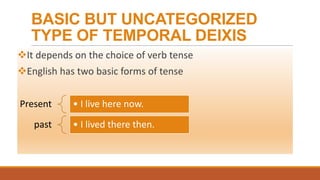
BASIC BUT UNCATEGORIZED
TYPE OF TEMPORAL DEIXIS
It depends on the choice of verb tense
English has two basic forms of tense
Present • I live here now.
past • I lived there then.
Continued……
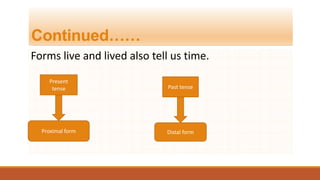
Forms live and lived also tell us time.
Present
tense
Proximal form
Past tense
Distal form
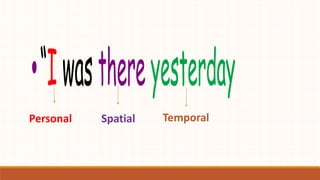
Activity
Can you point out which words are deictic in this sentence:
“I was there yesterday.”
Personal Spatial Temporal
USE OF DEIXIS
People can actually use Deixis to have fun.
The coffee shop owner who puts up a big sign that
reads “ Free snacks Tomorrow” ( to get you to
return to his shop) can always claim that you are
one day too early for the meal.
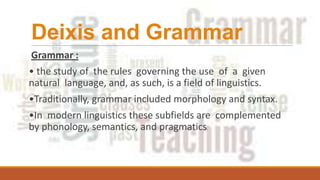
Deixis and Grammar
Grammar :
• the study of the rules governing the use of a given
natural language, and, as such, is a field of linguistics.
•Traditionally, grammar included morphology and syntax.
•In modern linguistics these subfields are complemented
by phonology, semantics, and pragmatics.
CONTINUED…….
Pragmatics:
•how do people use sentences in communication,
•Characterize acceptable/unacceptable use.
•It is no longer possible to consider sentences in
isolation: we need to take the context into account.
CONTINUED….
Deixis:
• those words in a language that entirely depend on
context (Fromkin, et. al., 1991). The meaning of
deixis is 'pointing to' something. In verbal
Communication however, deixis in its narrow sense
refers to the contextual meaning of pronouns, and
in its broad sense, what the speaker means by a
particular utterance in a given speech context.
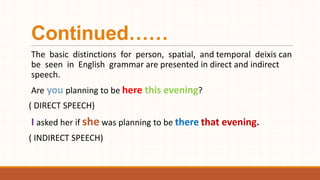
Continued……
The basic distinctions for person, spatial, and temporal deixis can
be seen in English grammar are presented in direct and indirect
speech.
Are you planning to be here this evening?
( DIRECT SPEECH)
I asked her if she was planning to be there that evening.
( INDIRECT SPEECH)
WHAT WE HAVE LEARNT
TODAY?
DEIXIS AND ITS TYPES
PERSON, SPACIAL AND TEMORAL DEIXIS
DEIXIS AND GRAMMAR
Presentation on deixis and distance

Presentation on deixis and distance

  • 2.
    DEIXIS AND DISTANCE MAMOONASHEHZADI AMNA ZAHID TAIBA AROOJ PRESENTED BY
  • 3.
    CONTENT DEIXES AND DISTANCE THREETYPES OF DEIXES DEIXES AND GRAMMAR
  • 4.
    Deixis  Deixis means“pointing via language”. Any linguistic form used to do this “pointing” is called a deictic expression. Words like here, there, this, that, now and then, as well as most pronouns, such as I, we, you, he, her and them are deictic expressions.
  • 5.
    What is Deixis Deixis is an important field of language study in its own right - and very important for learners of second languages. But it has some relevance to analysis of conversation and pragmatics because it directly concerns the relationship between the structure of languages and the context in which they are used.It is often and best described as “verbal pointing”, that is to say pointing by means of language. The linguistic forms of this pointing are called deictic expressions, deictic markers or deictic words; they are also sometimes called indexicals.
  • 6.
    What is indexicals In linguistics and in philosophy of language, an indexical behavior or utterance symbolically points to (or indicates) some state of affairs. For example, I refers to whoever is speaking; now refers to the time at which that word is uttered; and here refers to the place of utterance.
  • 7.
    Deictic expressions includesuch lexemes (words) as:  Personal or possessive pronouns (I/you/mine/yours),  Demonstrative pronouns (this/that),  (Spatial/temporal) adverbs (here/there/now),  Personal or possessive adjectives (my/your),  Demonstrative adjectives (this/that),  Articles (the).
  • 8.
    Deictic Centre The timeof the utterance ‟s time; the place of the utterance ‟s place, the person just giving the utterance. Proximal distal This here now That There then “Near speaker” “away from speaker”
  • 10.
    Deictic expressions fallinto three categories: 1- Person deixis: Any expression used to point to a person: me, you, him and them. 2 -Time deixis: words used to point to a time: now, then, tonight, last week and this year… 3-Space/spatial/place deixis: words used to point to a location: here, there and yonder 4-Deixis and Grammar: Proximal deictic: (direct speech) Distal deictic: e.g. (indirect speech)
  • 12.
    Person Deixis  Persondeixis dealing with the grammatical persons within an utterance, 1-those directly involved (e.g. the speaker, the addressee), 2-those not directly involved (e.g. over hearers—those who hear the utterance but who are not being directly addressed), 3-those mentioned in the utterance.
  • 13.
    Examples of persondeictic In English, the distinctions are generally indicated by pronouns. The following examples show how.  I am going to the movies.  Would you like to have dinner?  They tried to hurt me, but he came to the rescue.
  • 14.
    Person Deixis  Thirdperson pronouns are consequently distal forms in terms of person deixis.  Third person is not a direct participant in basic intraction.  Using a third person form where the second person form would be possible.
  • 16.
     - anironic or humorous purpose E.g. “Would his highness like some coffee?” (one person is very busy in the kitchen, addresses another, who‟s being lazy) - make potential accusation less direct E.g. “Somebody didn‟t clean up after himself” (instead of saying “you didn‟t clean up”) - make personal issue seem like impersonal one E.g. “Each person has to clean up after him or herself” (instead of saying “you didn‟t clean up”) - state general rules E.g. “We clean up after ourselves around here” (instead of saying “you didn‟t clean up”)
  • 17.
    Deictic Projection  Deicticprojection = speakers being able to project themselves into other locations, time or shift person reference. Eg. via dramatic performances, when using direct speech to represent the person, location and feelings of someone else.
  • 18.
    Example  A Hebrewteacher, discovering that he had left his comfortable slippers back in the house, sent a student after them with a note for his wife.The note read: “Send me your slippers with this boy”. When the student asked why he had written „your‟ slippers, the teacher answered: „Yold!(Fool) If I wrote „my‟ slippers, she would read „my slippers‟ and would send her slippers. What could I do with her slippers? So I wrote „your‟ slippers, she‟ll read „your‟ slippers and send me mine.”
  • 19.
  • 20.
    Spatial diexis The ideaof a speaker 'pointing out' something in space or time in order to draw the attention of the addressee to it is basic to both spatial and temporal deixis (see e.g. Lyons 1977, Fillmore 1982b, Lakoff 1987).
  • 21.
    CONTINUED…….. They indicate distanceand proximity from the speaker, physical distance or proximity, mental and psychological distance or proximity. Examples: • The station is two hundred yards from the college. • Bring that here and take this there.
  • 22.
    Continued……. Place deixis, alsoknown as space deixis, concerns itself with the spatial locations relevant to an utterance. Similarly to person deixis, the locations may be either those of the speaker and addressee or those of persons or objects being referred to. The most salient English examples are the adverbs “here” and “there” and the demonstratives “this” and “that” and these are used to mark the movement towards the speaker.
  • 23.
    EXAMPLES The church isbehind the town hall. • I enjoy living in this city. • Here is where we will place the statue. • She was sitting over there. • Here is a good spot; it is too sunny over there.
  • 24.
    CONTINUED….. • Older textshave various distinct expressions. Yonder (more distant) hither (to this place) and thence (from that place) which are still applicable but archaic.
  • 25.
    Continued…… • Some verbsof motion ‘come’ and ‘go’ retain a deictic sense which means towards the speaker and away from the speaker. These are commonly used for pointing the position of people.
  • 26.
    CONT……… • The wordsthat seem to be the first deictic meaning. • This and here (can be seen). • That and there (cannot be seen).
  • 27.
    CONTI…….. Examples. • This ismy book lying here • That building is there in switzerland.
  • 28.
    CONTINUED….. • It isimportant to remember that location from the speaker’s perspective can be fixed mentally as well as physically. • People away from there homes use ‘here’ to show and mean their home location.
  • 29.
    Deictic Projection • Toproject or show the mean of different words and to manipulate a location. • Examples • I am not here now. • I was looking at this little puppy in a cage with such a sad expression on its face. It was like, ‘Oh, I’m so unhappy here, will you set me free?’
  • 30.
    Psychological Distance Pragmatic basisof spatial deixis is actually named as psychological distance. It can be understood in terms of • Objects physically close Example This cat sitting here is lovely
  • 31.
    CONTINUED…….. Objects physically distant Example Thatteacher sitting over there. • A speaker may also wish to show something distant which is actually close. Example I don’t like that. This shows that the word ‘that’ does not have a fixed specific meaning but it can be changed with respect to context.
  • 32.
    ACTIVITY Pick out thespatial deixis from the following. • This one (here) is bigger than that one (over there). • I like this/that one better. • The old man was dead. I removed the bed and examined the corpse. Yes, he was stone, stone dead. I placed my hand upon the heart and held it there many minutes. There was no pulsation. He was stone dead. His eye would trouble me no more. [Edgar Allen Poe: The tell tale heart]
  • 33.
    Pick out thespatial deixis. • Benvolio. See, where he comes: so please you, step aside; • I'll know his grievance, or be much denied. • Montague. I would thou wert so happy by thy stay, • To hear true shrift. Come, madam, let's away. • [Exeunt Montague and Lady Montague] • Benvolio. Good-morrow, cousin. • Romeo. Is the day so young? • Benvolio. But new struck nine. • Romeo. Ay me! sad hours seem long. • Was that my father that went hence so fast? • Benvolio. It was. What sadness lengthens Romeo's hours?
  • 34.
  • 35.
    WHATARE TEMPORAL DEIXIS? Temporalcomes from the Latin word temporalis which means "of time"  The expressions which are used to point to a time are called temporal deixis.
  • 36.
    What do youthink? What are temporal deixis?
  • 37.
  • 38.
    CONCEPT OF TIME Theconcept of time is represented by three main classes of expressions: 1) grammatical expressions (whether inflectional or by means of auxiliaries) 2) lexical expressions (like, today, tomorrow, and yesterday). 3) lexically composite expressions (like, ten minutes ago).
  • 39.
    Lexicalization of Temporal Deixis Lexicalizationof temporal deixis comprises two divisions: simple lexical deictics lexically composite deictics It includes now, then, soon, tomorrow, today and this day, the day before yesterday, last/ next Monday
  • 40.
    USE of timeadverbs NOW and THEN Pull the trigger now. You must do it now. Now I am running my own business. Now I am working on my PhD thesis. The action has not been performed yet. The action is going on.
  • 41.
    Can u giveme some example?
  • 42.
    Use of then Itis used for past as well as future. I was in Scotland then. Then I will see you at night.
  • 43.
    Can you differentiatebetween both usage of then?
  • 44.
    We can treattemporal event as object 1-which move towards us ( the coming week) 2-which move away from us ( the past week)
  • 45.
    BASIC BUT UNCATEGORIZED TYPEOF TEMPORAL DEIXIS It depends on the choice of verb tense English has two basic forms of tense Present • I live here now. past • I lived there then.
  • 46.
    Continued…… Forms live andlived also tell us time. Present tense Proximal form Past tense Distal form
  • 47.
    Activity Can you pointout which words are deictic in this sentence: “I was there yesterday.”
  • 48.
  • 49.
    USE OF DEIXIS Peoplecan actually use Deixis to have fun. The coffee shop owner who puts up a big sign that reads “ Free snacks Tomorrow” ( to get you to return to his shop) can always claim that you are one day too early for the meal.
  • 50.
    Deixis and Grammar Grammar: • the study of the rules governing the use of a given natural language, and, as such, is a field of linguistics. •Traditionally, grammar included morphology and syntax. •In modern linguistics these subfields are complemented by phonology, semantics, and pragmatics.
  • 51.
    CONTINUED……. Pragmatics: •how do peopleuse sentences in communication, •Characterize acceptable/unacceptable use. •It is no longer possible to consider sentences in isolation: we need to take the context into account.
  • 52.
    CONTINUED…. Deixis: • those wordsin a language that entirely depend on context (Fromkin, et. al., 1991). The meaning of deixis is 'pointing to' something. In verbal Communication however, deixis in its narrow sense refers to the contextual meaning of pronouns, and in its broad sense, what the speaker means by a particular utterance in a given speech context.
  • 53.
    Continued…… The basic distinctionsfor person, spatial, and temporal deixis can be seen in English grammar are presented in direct and indirect speech. Are you planning to be here this evening? ( DIRECT SPEECH) I asked her if she was planning to be there that evening. ( INDIRECT SPEECH)
  • 54.
    WHAT WE HAVELEARNT TODAY? DEIXIS AND ITS TYPES PERSON, SPACIAL AND TEMORAL DEIXIS DEIXIS AND GRAMMAR