

DENGUE FEVER
Dr.T.V.Rao MD
Professor of Microbiology
Arboviruses
 The Arboviruses are also called as Arthropod
borne viruses, represent an ecological grounding
of viruses with complex transmission cycles
involving Arthropods
 These viruses have diverse physical and chemical
properties and are classified in several virus
families.
 Dengue infection is caused by Arboviruses
History Dengue
 This disease was first described 1780, and the
virus was isolated by Sabin 1944. Dengue virus
infection is the most common arthropod-borne
disease worldwide with an increasing incidence
in the tropical regions of Asia, Africa, and
Central and South America. There are four
serotypes of the virus. All are transmitted by
mosquitoes, which are not affected by the
disease, although an infected mosquito may
infect others (not via man).
Current Trends
 In the 1980s, DHF began a second expansion
into Asia when Sri Lanka, India, and the
Maldives Islands had their first major DHF
epidemics; Pakistan first reported an epidemic
of dengue fever in 1994. The epidemics in Sri
Lanka and India were associated with multiple
dengue virus serotypes, but DEN-3 was
predominant and was genetically distinct from
DEN-3 viruses previously isolated from infected
persons in those countries.
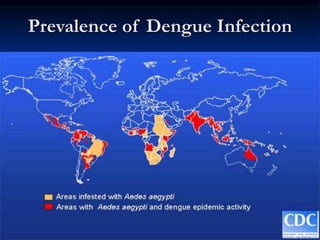
Prevalence of Dengue Infection
Dengue Infection and
Implications
 Dengue virus (DENV) infects 50 million
(WHO) to 100 million (NIH) people annually.
Forty percent of the world’s population,
predominately in the tropics and sub-tropics, is
at risk for contracting dengue virus. DENV
infection can cause dengue fever, dengue
hemorrhagic fever, dengue shock syndrome, and
death.
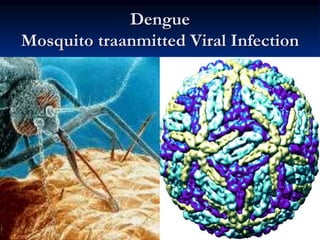
Dengue
Mosquito traanmitted Viral Infection
What causes Dengue
 Dengue (DF) and dengue hemorrhagic fever
(DHF) are caused by one of four closely related,
but antigenically distinct, virus serotypes (DEN-
1, DEN-2, DEN-3, and DEN-4), of the genus
Flavivirus. Infection with one of these serotypes
provides immunity to only that serotype for life,
Aedes aegypti – Vector
 Aedes aegypti, a domestic, day-biting mosquito
that prefers to feed on humans, is the most
common Aedes species. Infections produce a
spectrum of clinical illness ranging from a
nonspecific viral syndrome to severe and fatal
hemorrhagic disease. Other species of Aedes
can also transmit.
Dengue Virus – A Flavivirius
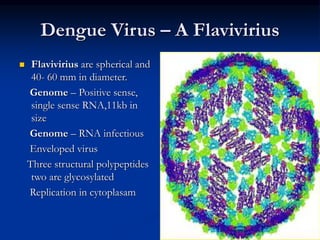
 Flavivirius are spherical and
40- 60 mm in diameter.
Genome – Positive sense,
single sense RNA,11kb in
size
Genome – RNA infectious
Enveloped virus
Three structural polypeptides
two are glycosylated
Replication in cytoplasam
How Mosquitos spread the infection
 The disease starts during the rainy season, when vector
Mosquito Aedes aegypti is abundant
 The Aedes breeds in the tropical or semitropical
climates in water holding receptacles or in plants close
to human dwellings
 A female Aedes acquires the infection feeding upon a
viremic human.
 After a period of 8 – 14 days mosquitoes are infective
and remain infective for life. ( 1- 3 ) months.
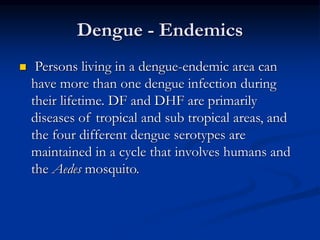
Dengue - Endemics
 Persons living in a dengue-endemic area can
have more than one dengue infection during
their lifetime. DF and DHF are primarily
diseases of tropical and sub tropical areas, and
the four different dengue serotypes are
maintained in a cycle that involves humans and
the Aedes mosquito.
Clinical Manifestations
 Any or few of the following events can occur.
 Fever,
 Severe head ache
 Muscle and joint pains
 Nausea, vomiting,
 Eye pain
How Dengue Infection starts and
manifests
 Incubation period 4 – 7 days ( 3 – 14 days)
 Fever may start with, Malise,chills,head ache
 Soon leads to severe back ache, joint pains, muscular pain, pain
in the eye ball.
 Temperature may persist for 3 -5 days.
 On some occasions once again raises in about 5 – 8 days ( Saddle
back fever )
 Myalgia may be severe with deep bone pain
( Break bone fever ) characteristic of the Disease
On majority of the occasions a self limited condition,
Subside on its own
Death is a rare event.
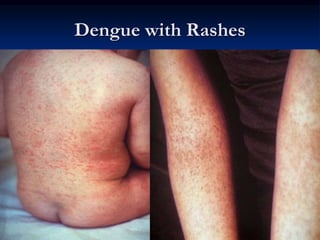
Dengue with Rashes
Dengue Hemorrhagic Fever
 Common in children.
 In children passively acquired contributed by the
maternal antibodies transferred to the fetus.
 In other ( Adults ) the presence of antibodies
due to previous infection with different serotype
 Initially presents like classical Dengue infection
 But patients condition abruptly worsens, an
important cause of morbidity and mortality in
Dengue
Risk factor for DHF
 Important risk factors for DHF include the
strain of the infecting virus, as well as the age,
and especially the prior dengue infection history
of the patient
Dengue Hemorrhagic Syndrome
 Chateresied by shock and hemoconcentration
 Contributed by circustantial evidence suggests
secondary infection with Dengue type 2
following type 1 infection in the past.
Pathogenesis
 Presence of existing Dengue antibody,
associated with fresh viral infection with new
serotype complexes and forms within few days
of the second dengue infection.
 Non neutralizing enhancing antibodies promote
infection of higher number of Mononuclear
cells.
Dengue hemorraghigic
Syndrome
 DHS is caused due to release of,
1 Release of cytokines
2 Vasoactive mediators.
3 Procoagulants
Manifest with disseminated
intravascular coagulation
Risk of Hemorrhagic Fever
 The risk of hemorrhagic fever syndrome is about 0.2%
during the first attack
 The second attack with different serotype increases the
risk to ten fold
 The fatality rate with dengue hemorrhagic fever can
reach 15% but proper medical care and symptomatic
mangement can reduce mortality to less than 1%
 On few occasions patients condition abruptly worsens
into Dengue shock syndrome, a more severe form of
disease characterized by shock and hemoconcentration.
Diagnosis
In resource rich establishments
1 Reverse transcriptase polymerase chain
reaction methods help rapid identification
2 Isolation of virus is difficult
3 The current favored approach is inoculation of
mosquito cell line with patient serum coupled
with nucleic acid assay to identify a recovered
virus.
Dengue Serology
 The serology is limited with cross reactivity of IgG
antibodies to heterologus Flavivirius antigens
 Most commonly used methods are
Viral protein specific capture IgM or IgG by ELISA
IgM antibodies develop within few days of illness
Neutralizing anti Hemagglutination inhibiting antibodies
appear within a week after onset of Dengue fever
Importance of paired sample testing
in Serology
 Testing one sample for serum and reporting a
negative test is fallacious
 Analysis of paired acute and
convalescent sera to show significant
rise in antibody titer is the most
reliable evidence of an active dengue
infection.
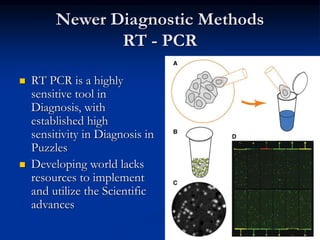
Newer Diagnostic Methods
RT - PCR
 RT PCR is a highly
sensitive tool in
Diagnosis, with
established high
sensitivity in Diagnosis in
Puzzles
 Developing world lacks
resources to implement
and utilize the Scientific
advances
Immunology Dengue
 Four serotypes exist distinguished by Molecular
basis and Nt tests
 Infection confers life long immunity
 But cross protection between serotypes is of
short duration.
 Reinfection with different serotype after primary
attack is more dangerous causes Dengue
hemorrhagic fever.
Treatment
 No Anti viral therapy available
 Symptomatic management in Majority of cases
 Dengue Hemorrhagic fever to be treated with
suitable fluid replacement
 No Vaccine available, difficult in view of four
serotypes.
Control of Dengue
 Control of Mosquito breeding places.
 Anti mosquito measures
 Use of Insecticides.
 Screened windows and doors can reduce
exposure to vectors.
Epidemiology - Dengue
 Dengue virus are distributed world wide in
tropical regions.
 Where the Aedes vectors exist, are endemic
areas
 Changing and increasing incidences are
associated with rapid urban population growth,
over crowding and lax mosquito control
measures
Dengue a Reemerging Infection
 Dengue in 2005 identified as the most important
mosquito borne viral disease
 An estimated 50 million or more cases occur
annually worldwide
 400,000 cases of dengue hemorrhagic fever.
 Asian counties report major cases of childhood
deaths
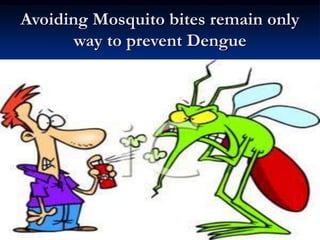
Avoiding Mosquito bites remain only
way to prevent Dengue
Created for Training
Medical and Health Care
Workers in Developing
World
Dr.T.V.Rao MD
Email
doctortvrao@gmail.com

Dengue 1214446525598008-8

  • 1.
  • 2.
    Arboviruses  The Arbovirusesare also called as Arthropod borne viruses, represent an ecological grounding of viruses with complex transmission cycles involving Arthropods  These viruses have diverse physical and chemical properties and are classified in several virus families.  Dengue infection is caused by Arboviruses
  • 3.
    History Dengue  Thisdisease was first described 1780, and the virus was isolated by Sabin 1944. Dengue virus infection is the most common arthropod-borne disease worldwide with an increasing incidence in the tropical regions of Asia, Africa, and Central and South America. There are four serotypes of the virus. All are transmitted by mosquitoes, which are not affected by the disease, although an infected mosquito may infect others (not via man).
  • 4.
    Current Trends  Inthe 1980s, DHF began a second expansion into Asia when Sri Lanka, India, and the Maldives Islands had their first major DHF epidemics; Pakistan first reported an epidemic of dengue fever in 1994. The epidemics in Sri Lanka and India were associated with multiple dengue virus serotypes, but DEN-3 was predominant and was genetically distinct from DEN-3 viruses previously isolated from infected persons in those countries.
  • 5.
  • 6.
    Dengue Infection and Implications Dengue virus (DENV) infects 50 million (WHO) to 100 million (NIH) people annually. Forty percent of the world’s population, predominately in the tropics and sub-tropics, is at risk for contracting dengue virus. DENV infection can cause dengue fever, dengue hemorrhagic fever, dengue shock syndrome, and death.
  • 7.
  • 8.
    What causes Dengue Dengue (DF) and dengue hemorrhagic fever (DHF) are caused by one of four closely related, but antigenically distinct, virus serotypes (DEN- 1, DEN-2, DEN-3, and DEN-4), of the genus Flavivirus. Infection with one of these serotypes provides immunity to only that serotype for life,
  • 9.
    Aedes aegypti –Vector  Aedes aegypti, a domestic, day-biting mosquito that prefers to feed on humans, is the most common Aedes species. Infections produce a spectrum of clinical illness ranging from a nonspecific viral syndrome to severe and fatal hemorrhagic disease. Other species of Aedes can also transmit.
  • 10.
    Dengue Virus –A Flavivirius  Flavivirius are spherical and 40- 60 mm in diameter. Genome – Positive sense, single sense RNA,11kb in size Genome – RNA infectious Enveloped virus Three structural polypeptides two are glycosylated Replication in cytoplasam
  • 11.
    How Mosquitos spreadthe infection  The disease starts during the rainy season, when vector Mosquito Aedes aegypti is abundant  The Aedes breeds in the tropical or semitropical climates in water holding receptacles or in plants close to human dwellings  A female Aedes acquires the infection feeding upon a viremic human.  After a period of 8 – 14 days mosquitoes are infective and remain infective for life. ( 1- 3 ) months.
  • 12.
    Dengue - Endemics Persons living in a dengue-endemic area can have more than one dengue infection during their lifetime. DF and DHF are primarily diseases of tropical and sub tropical areas, and the four different dengue serotypes are maintained in a cycle that involves humans and the Aedes mosquito.
  • 13.
    Clinical Manifestations  Anyor few of the following events can occur.  Fever,  Severe head ache  Muscle and joint pains  Nausea, vomiting,  Eye pain
  • 14.
    How Dengue Infectionstarts and manifests  Incubation period 4 – 7 days ( 3 – 14 days)  Fever may start with, Malise,chills,head ache  Soon leads to severe back ache, joint pains, muscular pain, pain in the eye ball.  Temperature may persist for 3 -5 days.  On some occasions once again raises in about 5 – 8 days ( Saddle back fever )  Myalgia may be severe with deep bone pain ( Break bone fever ) characteristic of the Disease On majority of the occasions a self limited condition, Subside on its own Death is a rare event.
  • 15.
  • 16.
    Dengue Hemorrhagic Fever Common in children.  In children passively acquired contributed by the maternal antibodies transferred to the fetus.  In other ( Adults ) the presence of antibodies due to previous infection with different serotype  Initially presents like classical Dengue infection  But patients condition abruptly worsens, an important cause of morbidity and mortality in Dengue
  • 17.
    Risk factor forDHF  Important risk factors for DHF include the strain of the infecting virus, as well as the age, and especially the prior dengue infection history of the patient
  • 18.
    Dengue Hemorrhagic Syndrome Chateresied by shock and hemoconcentration  Contributed by circustantial evidence suggests secondary infection with Dengue type 2 following type 1 infection in the past.
  • 19.
    Pathogenesis  Presence ofexisting Dengue antibody, associated with fresh viral infection with new serotype complexes and forms within few days of the second dengue infection.  Non neutralizing enhancing antibodies promote infection of higher number of Mononuclear cells.
  • 20.
    Dengue hemorraghigic Syndrome  DHSis caused due to release of, 1 Release of cytokines 2 Vasoactive mediators. 3 Procoagulants Manifest with disseminated intravascular coagulation
  • 21.
    Risk of HemorrhagicFever  The risk of hemorrhagic fever syndrome is about 0.2% during the first attack  The second attack with different serotype increases the risk to ten fold  The fatality rate with dengue hemorrhagic fever can reach 15% but proper medical care and symptomatic mangement can reduce mortality to less than 1%  On few occasions patients condition abruptly worsens into Dengue shock syndrome, a more severe form of disease characterized by shock and hemoconcentration.
  • 22.
    Diagnosis In resource richestablishments 1 Reverse transcriptase polymerase chain reaction methods help rapid identification 2 Isolation of virus is difficult 3 The current favored approach is inoculation of mosquito cell line with patient serum coupled with nucleic acid assay to identify a recovered virus.
  • 23.
    Dengue Serology  Theserology is limited with cross reactivity of IgG antibodies to heterologus Flavivirius antigens  Most commonly used methods are Viral protein specific capture IgM or IgG by ELISA IgM antibodies develop within few days of illness Neutralizing anti Hemagglutination inhibiting antibodies appear within a week after onset of Dengue fever
  • 24.
    Importance of pairedsample testing in Serology  Testing one sample for serum and reporting a negative test is fallacious  Analysis of paired acute and convalescent sera to show significant rise in antibody titer is the most reliable evidence of an active dengue infection.
  • 25.
    Newer Diagnostic Methods RT- PCR  RT PCR is a highly sensitive tool in Diagnosis, with established high sensitivity in Diagnosis in Puzzles  Developing world lacks resources to implement and utilize the Scientific advances
  • 26.
    Immunology Dengue  Fourserotypes exist distinguished by Molecular basis and Nt tests  Infection confers life long immunity  But cross protection between serotypes is of short duration.  Reinfection with different serotype after primary attack is more dangerous causes Dengue hemorrhagic fever.
  • 27.
    Treatment  No Antiviral therapy available  Symptomatic management in Majority of cases  Dengue Hemorrhagic fever to be treated with suitable fluid replacement  No Vaccine available, difficult in view of four serotypes.
  • 28.
    Control of Dengue Control of Mosquito breeding places.  Anti mosquito measures  Use of Insecticides.  Screened windows and doors can reduce exposure to vectors.
  • 29.
    Epidemiology - Dengue Dengue virus are distributed world wide in tropical regions.  Where the Aedes vectors exist, are endemic areas  Changing and increasing incidences are associated with rapid urban population growth, over crowding and lax mosquito control measures
  • 30.
    Dengue a ReemergingInfection  Dengue in 2005 identified as the most important mosquito borne viral disease  An estimated 50 million or more cases occur annually worldwide  400,000 cases of dengue hemorrhagic fever.  Asian counties report major cases of childhood deaths
  • 31.
    Avoiding Mosquito bitesremain only way to prevent Dengue
  • 32.
    Created for Training Medicaland Health Care Workers in Developing World Dr.T.V.Rao MD Email doctortvrao@gmail.com