Stimulants


Chynna & April
Stimulants
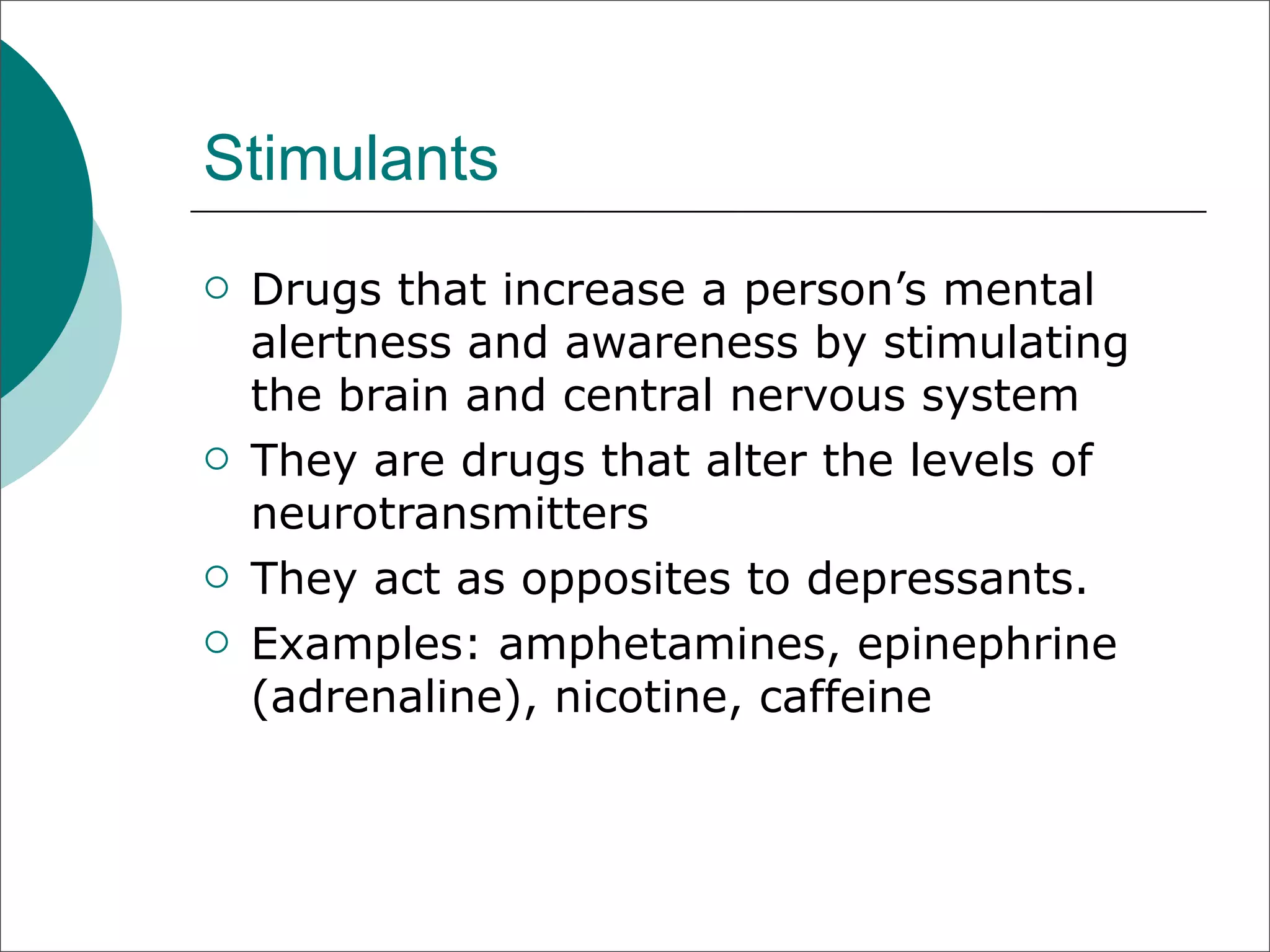
   Drugs that increase a person’s mental
    alertness and awareness by stimulating
    the brain and central nervous system
   They are drugs that alter the levels of
    neurotransmitters
   They act as opposites to depressants.
   Examples: amphetamines, epinephrine
    (adrenaline), nicotine, caffeine
D.5.1 List the physiological effects of
stimulants

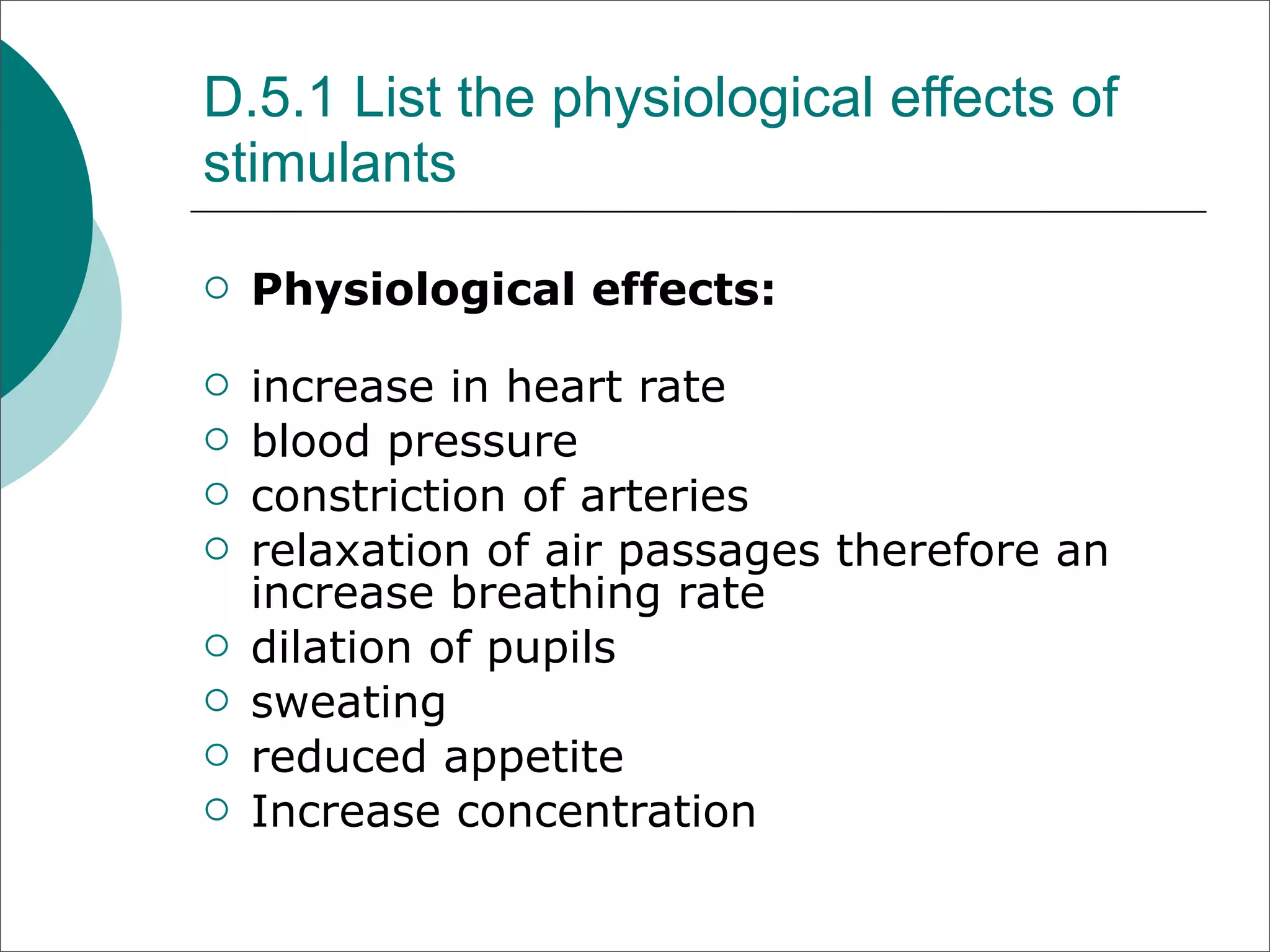
   Physiological effects:

   increase in heart rate
   blood pressure
   constriction of arteries
   relaxation of air passages therefore an
    increase breathing rate
   dilation of pupils
   sweating
   reduced appetite
   Increase concentration
D.5.1 List the physiological effects of
stimulants

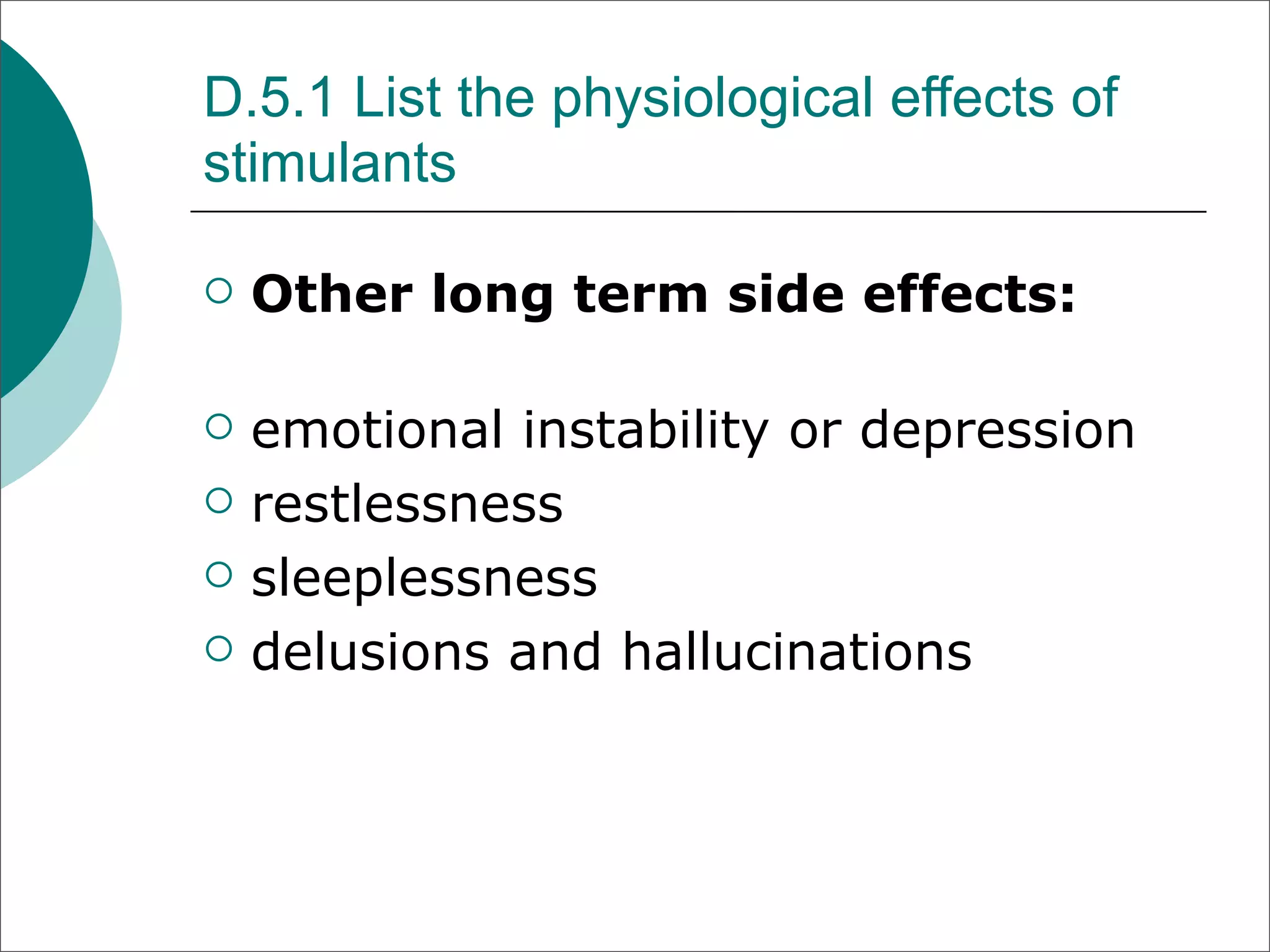
   Other long term side effects:

   emotional instability or depression
   restlessness
   sleeplessness
   delusions and hallucinations
D.5.2 Compare amphetamines and
epinephrine (adrenaline)

   Epinephrine (adrenaline): a
    hormone secreted by the adrenal
    medulla upon stimulation by the
    central nervous system
        A response to stress
       Results in Anger or fear
       Causes: increased heart rate, blood
        pressure, cardiac output, carbohydrate
        metabolism
D.5.2 Compare amphetamines and
epinephrine (adrenaline)
   Amphetamines : chemically related to adrenaline
       Sympathomimetic drug
       Initially used to treat narcolepsy and issued to
        airmen in WWII to combat fatigue.
       50s and 60s used as anti-depressants and slimming
        pills.
       Regular use can lead to both tolerance and
        dependence
       Short-term effects: increase heart race and
        breathing, dilation of pupils, decrease in appetite 
        fatigue  possible depression (as it wears off)
       Long term effects: weight loss, constipation,
        emotional instability
D.5.2 Compare amphetamines and
epinephrine (adrenaline)
   Physiological Similarities

   Increase physical energy by: 1) Increasing heart rate and
    blood pressure. 2) Increasing blood flow to the brain and
    muscles. 3) Increasing air flow to the lungs
   Increase mental awareness; trigger the "fight or flight"
    syndrome
   Dilation of the pupils
   Reduce appetite
   induce a sense of euphoria
   Both can lead to the rapid development of both tolerance and
    dependence (addiction),
   Both can have serious long-term effects if abuse/over used -
    depression and reduced resistance to infection. Abuse of
    amphetamines through overuse is a serious problem.
D.5.2 Compare amphetamines and
epinephrine (adrenaline)

   Physiological Differences

   epinephrine (adrenaline) is
    regulated/produced naturally by the
    brain
   amphetamines are synthetic drugs
   Amphetamines are
    sympathomimetic
D.5.2 Compare amphetamines and
epinephrine (adrenaline)
   Sympathomimetic drugs

   Mimics the effect of stimulation on the
    sympathetic nervous system, which deals with
    subconscious nerve responses
   Mimic the effects of naturally produced
    epinephrine (adrenaline)
   speeds up heart rate
   increases sweat production
   increases breathing rate
   examples: nicotine, amphetamine,
    methamphetamine, speed, ecstasy
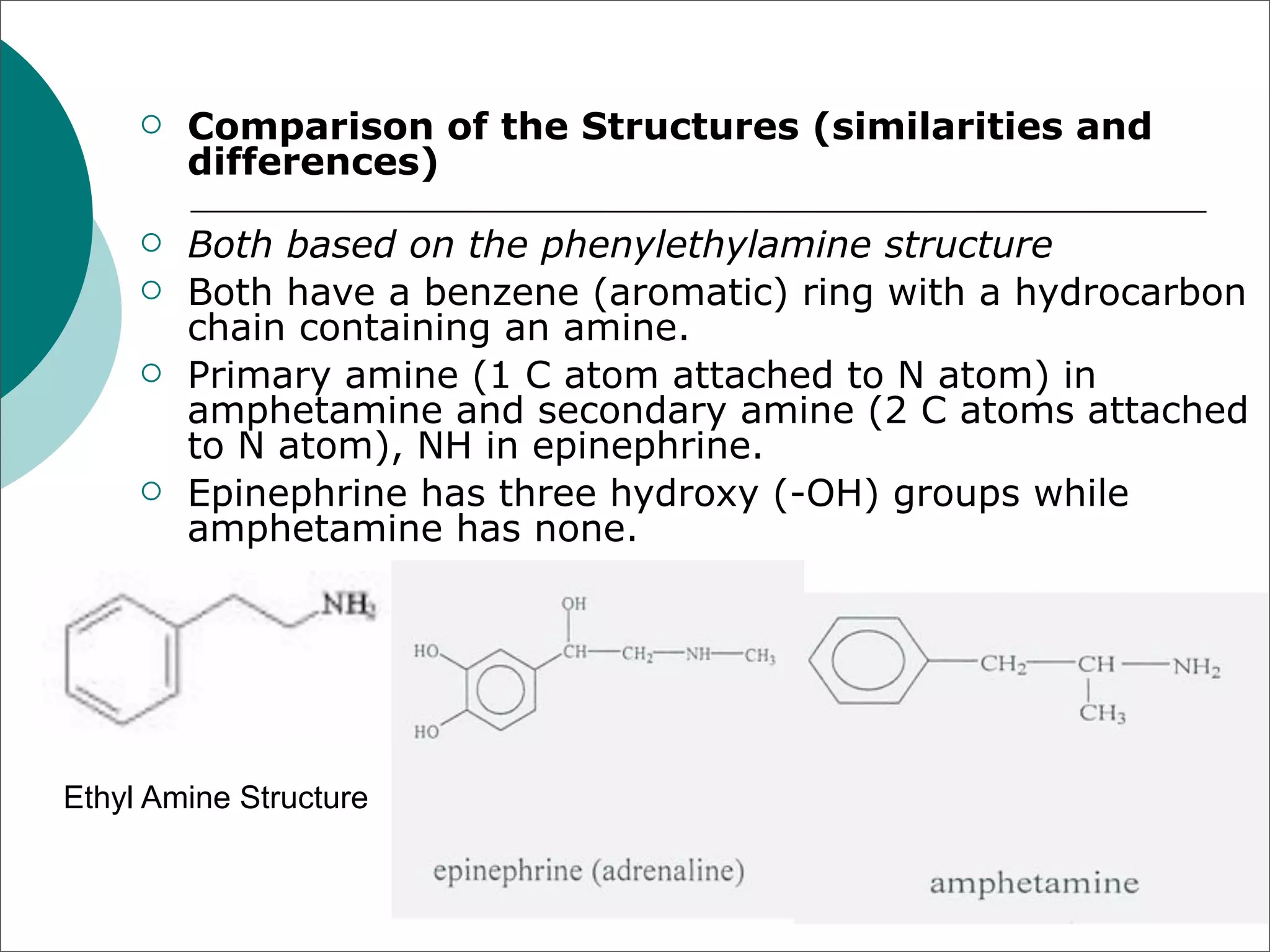
   Comparison of the Structures (similarities and
         differences)

        Both based on the phenylethylamine structure
        Both have a benzene (aromatic) ring with a hydrocarbon
         chain containing an amine.
        Primary amine (1 C atom attached to N atom) in
         amphetamine and secondary amine (2 C atoms attached
         to N atom), NH in epinephrine.
        Epinephrine has three hydroxy (-OH) groups while
         amphetamine has none.


Ethyl Amine Structure
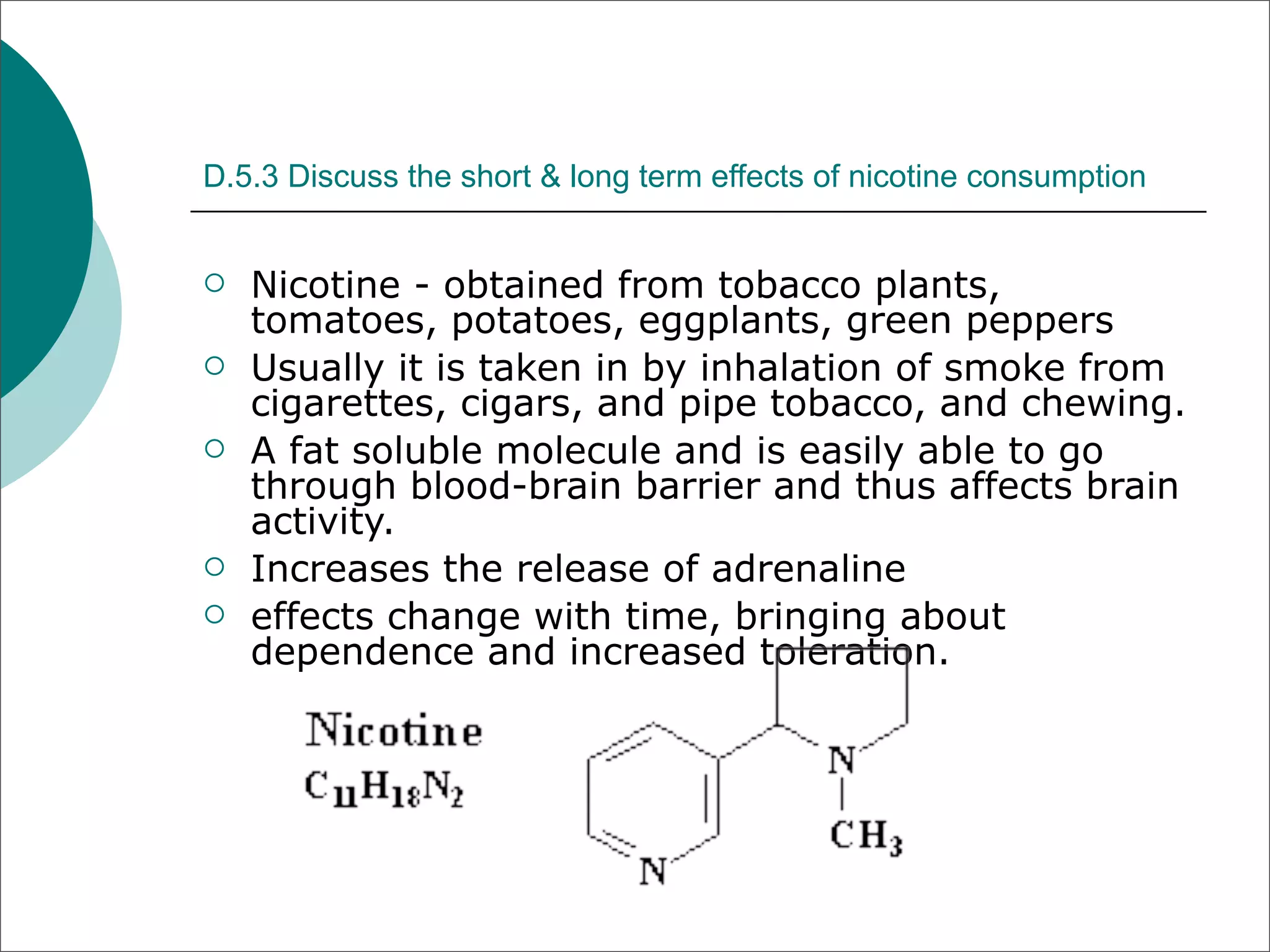
D.5.3 Discuss the short & long term effects of nicotine consumption


   Nicotine - obtained from tobacco plants,
    tomatoes, potatoes, eggplants, green peppers
   Usually it is taken in by inhalation of smoke from
    cigarettes, cigars, and pipe tobacco, and chewing.
   A fat soluble molecule and is easily able to go
    through blood-brain barrier and thus affects brain
    activity.
   Increases the release of adrenaline
   effects change with time, bringing about
    dependence and increased toleration.
Nicotine
   Largely responsible for 1/3 of the
    world’s population being addicted to
    smoking
   Withdrawal symptoms: craving for
    tobacco, nausea, weight gain,
    insomnia, irritability, and depression
   Sympathomimetic drug
D.5.3 Discuss the short & long term effects of nicotine
consumption


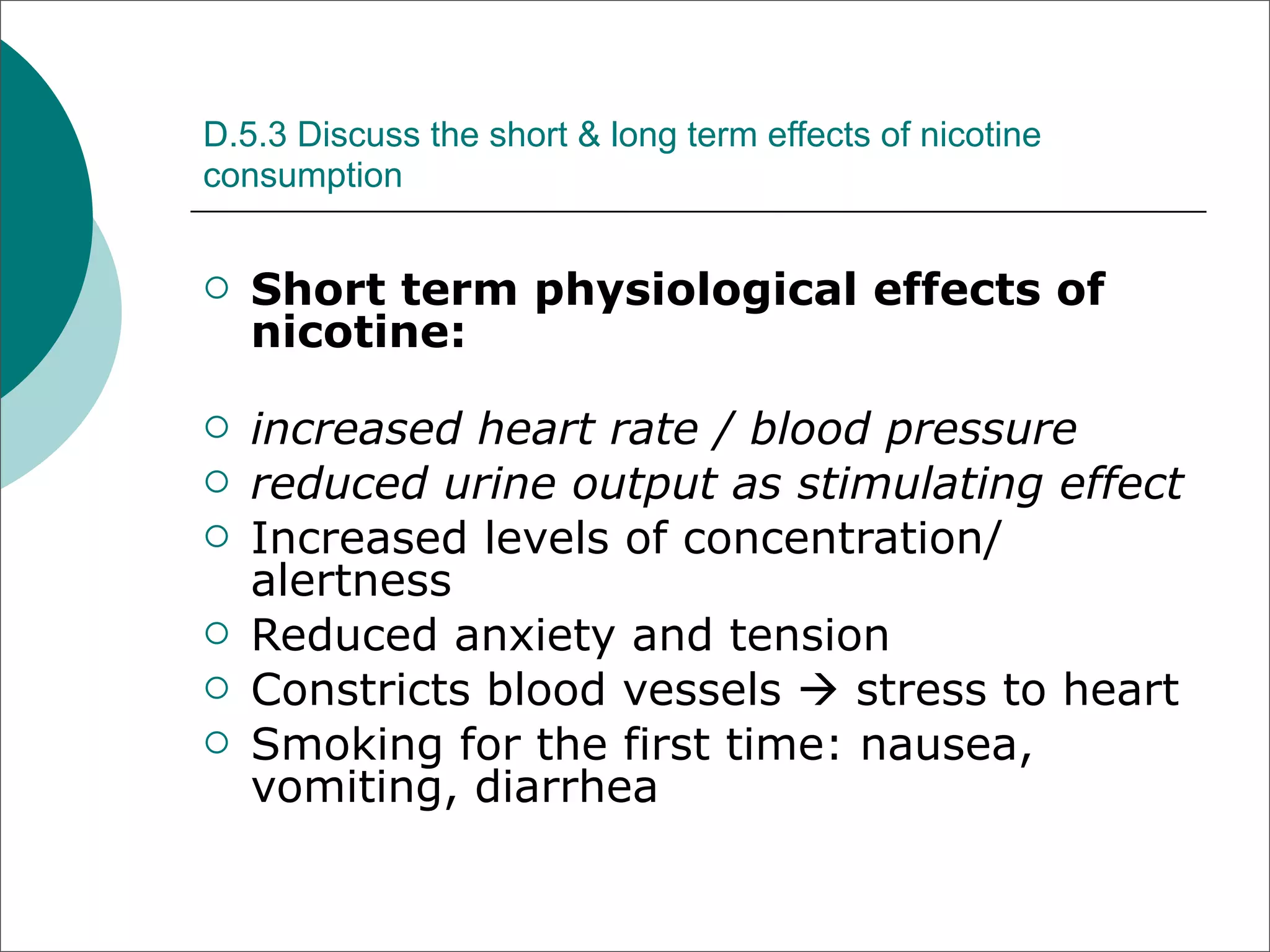
   Short term physiological effects of
    nicotine:

   increased heart rate / blood pressure
   reduced urine output as stimulating effect
   Increased levels of concentration/
    alertness
   Reduced anxiety and tension
   Constricts blood vessels  stress to heart
   Smoking for the first time: nausea,
    vomiting, diarrhea
D.5.3 Discuss the short & long term effects of nicotine
consumption

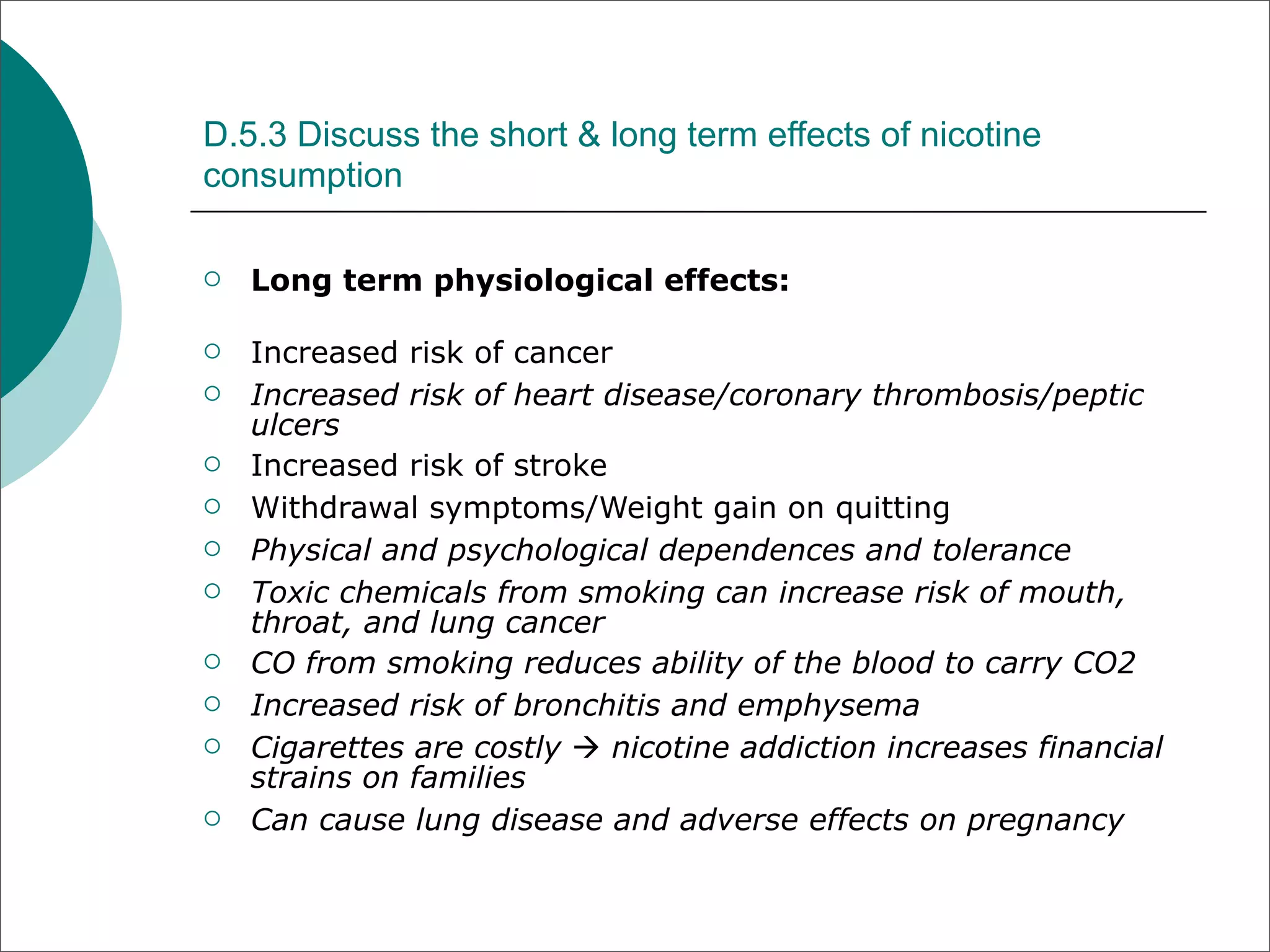
   Long term physiological effects:

   Increased risk of cancer
   Increased risk of heart disease/coronary thrombosis/peptic
    ulcers
   Increased risk of stroke
   Withdrawal symptoms/Weight gain on quitting
   Physical and psychological dependences and tolerance
   Toxic chemicals from smoking can increase risk of mouth,
    throat, and lung cancer
   CO from smoking reduces ability of the blood to carry CO2
   Increased risk of bronchitis and emphysema
   Cigarettes are costly  nicotine addiction increases financial
    strains on families
   Can cause lung disease and adverse effects on pregnancy
D.5.4 Describe effects of caffeine &
compare structure with that of nicotine
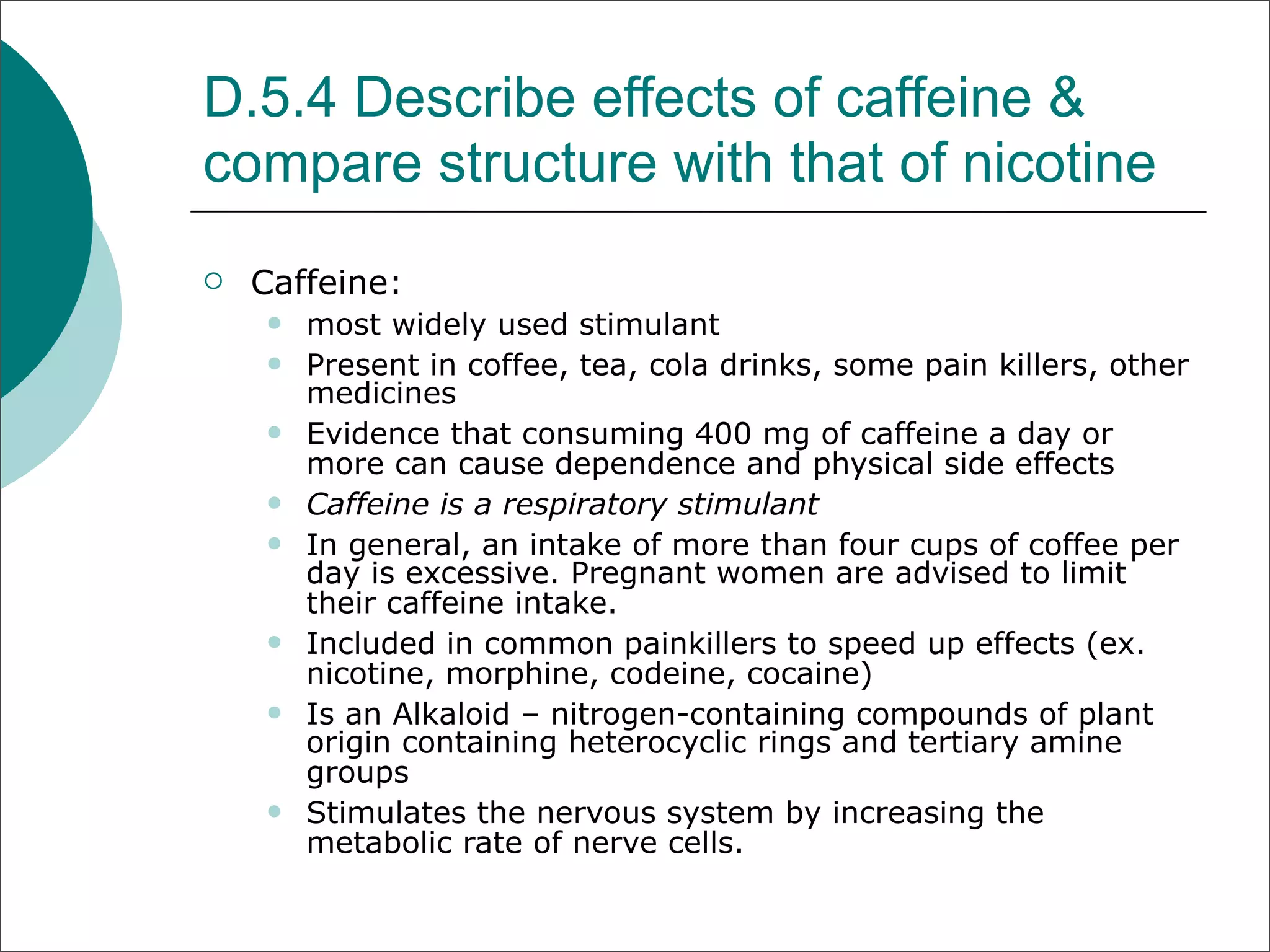
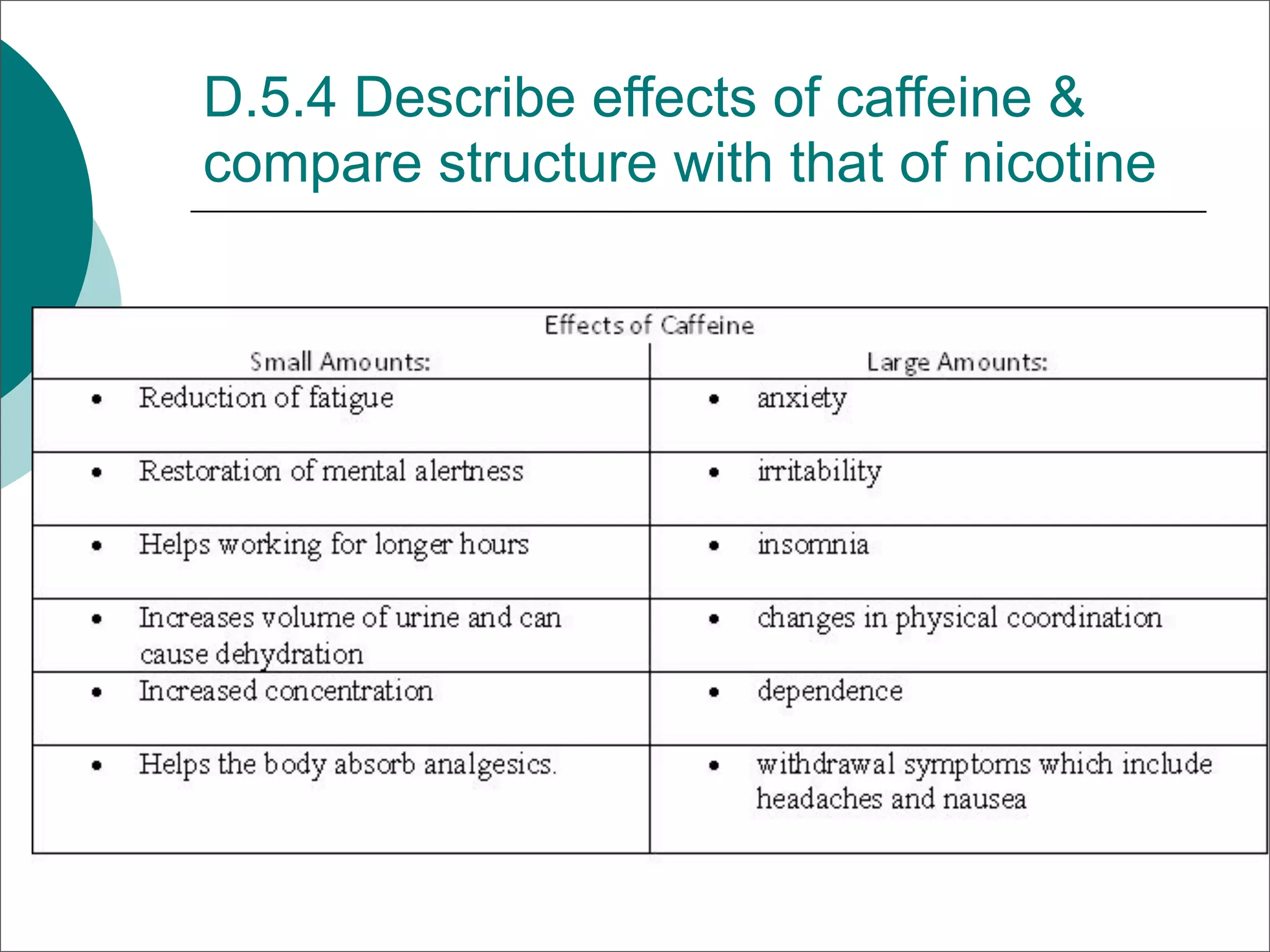
   Caffeine:
       most widely used stimulant
       Present in coffee, tea, cola drinks, some pain killers, other
        medicines
       Evidence that consuming 400 mg of caffeine a day or
        more can cause dependence and physical side effects
       Caffeine is a respiratory stimulant
       In general, an intake of more than four cups of coffee per
        day is excessive. Pregnant women are advised to limit
        their caffeine intake.
       Included in common painkillers to speed up effects (ex.
        nicotine, morphine, codeine, cocaine)
       Is an Alkaloid – nitrogen-containing compounds of plant
        origin containing heterocyclic rings and tertiary amine
        groups
       Stimulates the nervous system by increasing the
        metabolic rate of nerve cells.
D.5.4 Describe effects of caffeine &
compare structure with that of nicotine

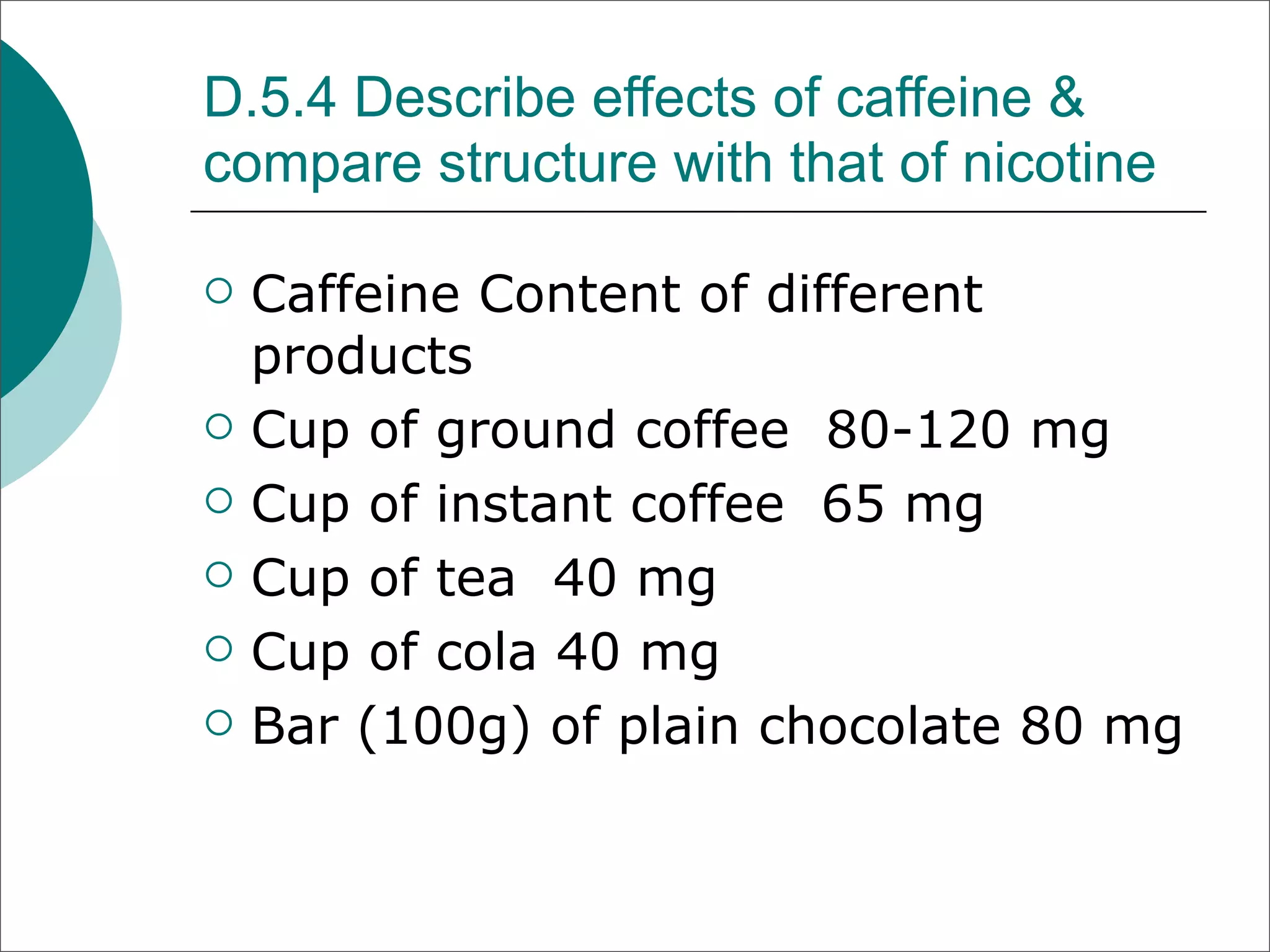
   Caffeine Content of different
    products
   Cup of ground coffee 80-120 mg
   Cup of instant coffee 65 mg
   Cup of tea 40 mg
   Cup of cola 40 mg
   Bar (100g) of plain chocolate 80 mg
D.5.4 Describe effects of caffeine &
compare structure with that of nicotine
D.5.4 Describe effects of caffeine &
compare structure with that of nicotine
D.5.4 Describe effects of caffeine &
compare structure with that of nicotine
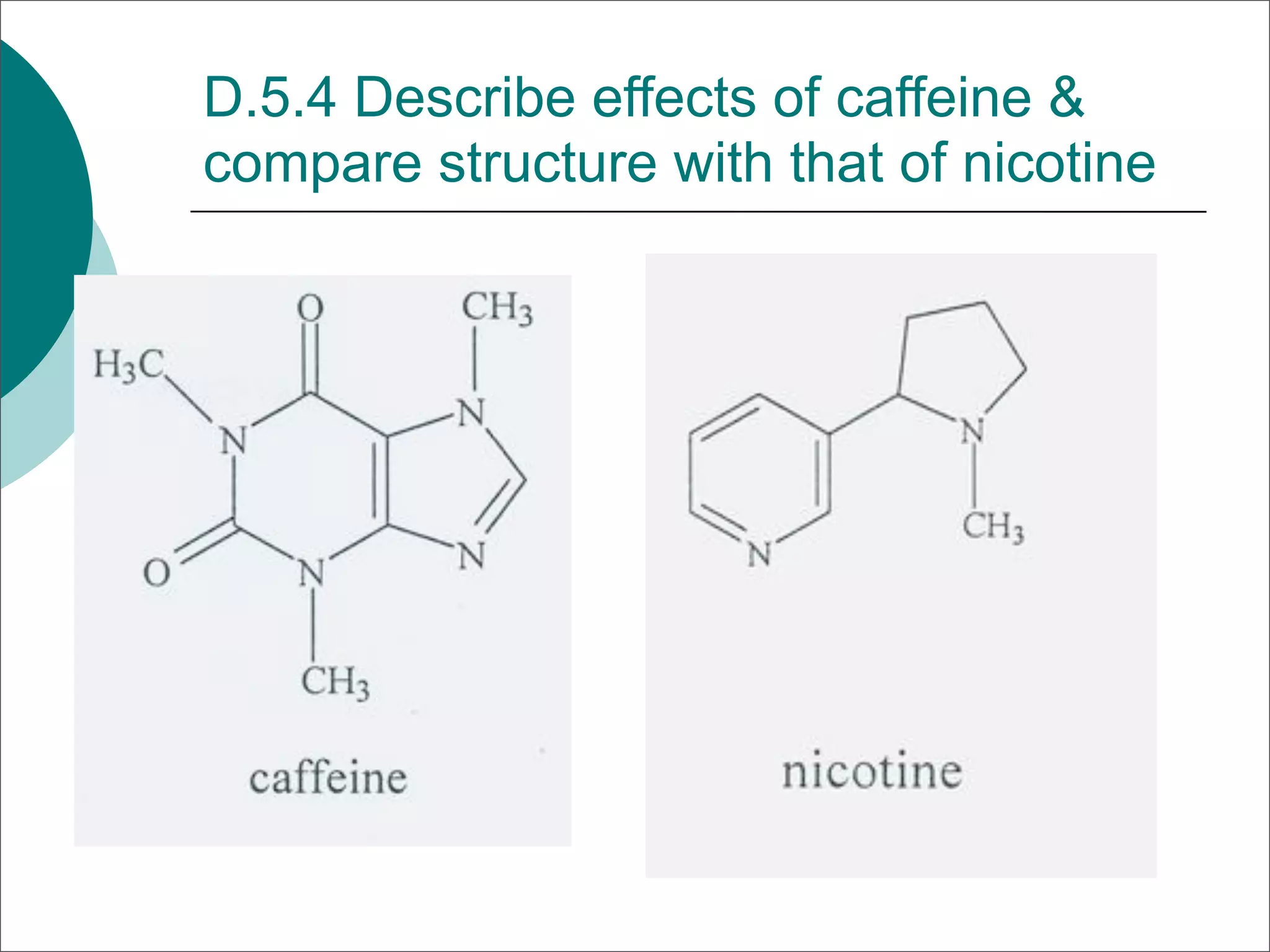
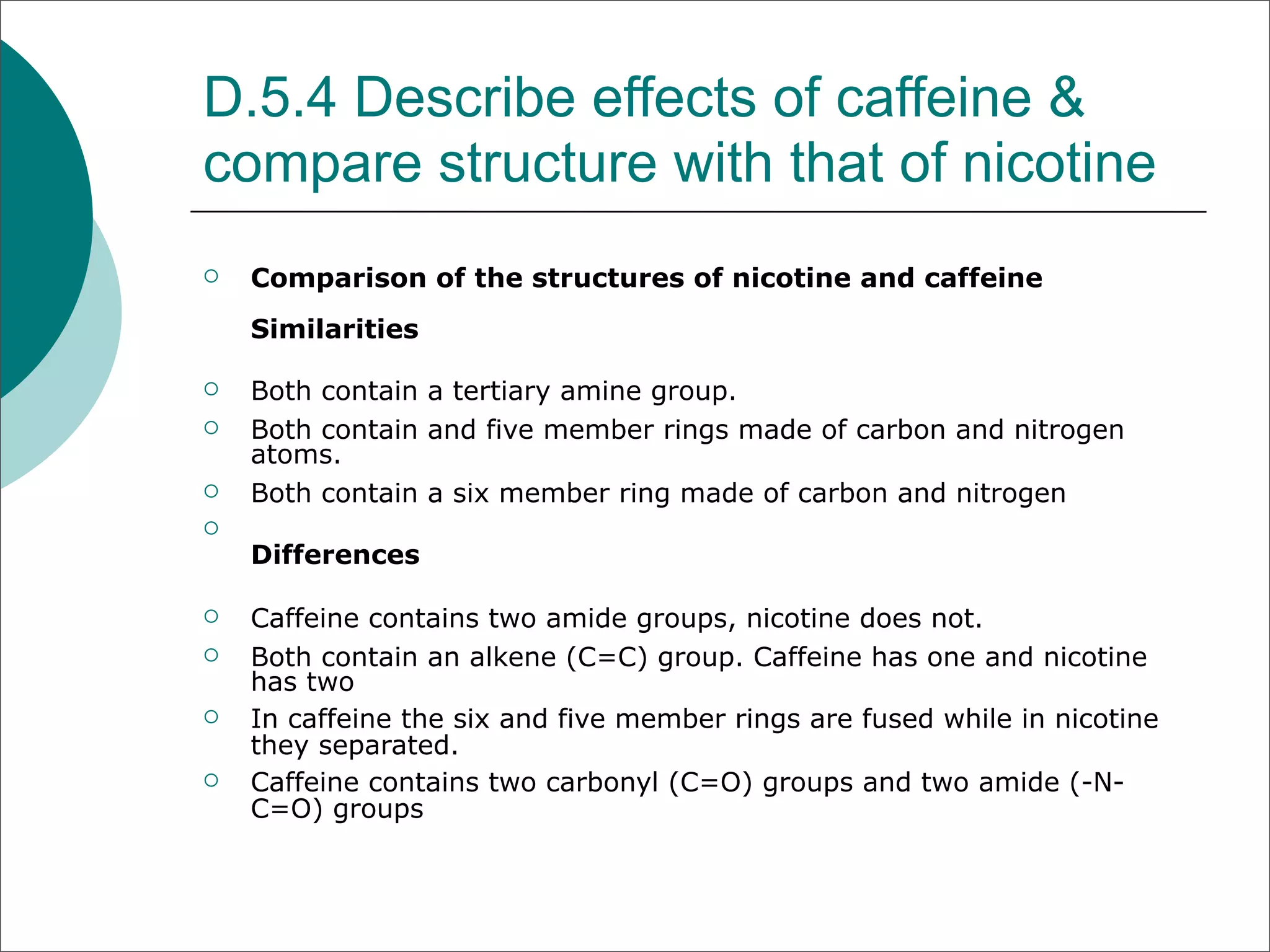
   Comparison of the structures of nicotine and caffeine
    Similarities

   Both contain a tertiary amine group.
   Both contain and five member rings made of carbon and nitrogen
    atoms.
   Both contain a six member ring made of carbon and nitrogen

    Differences

   Caffeine contains two amide groups, nicotine does not.
   Both contain an alkene (C=C) group. Caffeine has one and nicotine
    has two
   In caffeine the six and five member rings are fused while in nicotine
    they separated.
   Caffeine contains two carbonyl (C=O) groups and two amide (-N-
    C=O) groups

D5 presentation

  • 1.
  • 2.
    Stimulants  Drugs that increase a person’s mental alertness and awareness by stimulating the brain and central nervous system  They are drugs that alter the levels of neurotransmitters  They act as opposites to depressants.  Examples: amphetamines, epinephrine (adrenaline), nicotine, caffeine
  • 3.
    D.5.1 List thephysiological effects of stimulants  Physiological effects:  increase in heart rate  blood pressure  constriction of arteries  relaxation of air passages therefore an increase breathing rate  dilation of pupils  sweating  reduced appetite  Increase concentration
  • 4.
    D.5.1 List thephysiological effects of stimulants  Other long term side effects:  emotional instability or depression  restlessness  sleeplessness  delusions and hallucinations
  • 5.
    D.5.2 Compare amphetaminesand epinephrine (adrenaline)  Epinephrine (adrenaline): a hormone secreted by the adrenal medulla upon stimulation by the central nervous system  A response to stress  Results in Anger or fear  Causes: increased heart rate, blood pressure, cardiac output, carbohydrate metabolism
  • 6.
    D.5.2 Compare amphetaminesand epinephrine (adrenaline)  Amphetamines : chemically related to adrenaline  Sympathomimetic drug  Initially used to treat narcolepsy and issued to airmen in WWII to combat fatigue.  50s and 60s used as anti-depressants and slimming pills.  Regular use can lead to both tolerance and dependence  Short-term effects: increase heart race and breathing, dilation of pupils, decrease in appetite  fatigue  possible depression (as it wears off)  Long term effects: weight loss, constipation, emotional instability
  • 7.
    D.5.2 Compare amphetaminesand epinephrine (adrenaline)  Physiological Similarities  Increase physical energy by: 1) Increasing heart rate and blood pressure. 2) Increasing blood flow to the brain and muscles. 3) Increasing air flow to the lungs  Increase mental awareness; trigger the "fight or flight" syndrome  Dilation of the pupils  Reduce appetite  induce a sense of euphoria  Both can lead to the rapid development of both tolerance and dependence (addiction),  Both can have serious long-term effects if abuse/over used - depression and reduced resistance to infection. Abuse of amphetamines through overuse is a serious problem.
  • 8.
    D.5.2 Compare amphetaminesand epinephrine (adrenaline)  Physiological Differences  epinephrine (adrenaline) is regulated/produced naturally by the brain  amphetamines are synthetic drugs  Amphetamines are sympathomimetic
  • 9.
    D.5.2 Compare amphetaminesand epinephrine (adrenaline)  Sympathomimetic drugs  Mimics the effect of stimulation on the sympathetic nervous system, which deals with subconscious nerve responses  Mimic the effects of naturally produced epinephrine (adrenaline)  speeds up heart rate  increases sweat production  increases breathing rate  examples: nicotine, amphetamine, methamphetamine, speed, ecstasy
  • 10.
    Comparison of the Structures (similarities and differences)  Both based on the phenylethylamine structure  Both have a benzene (aromatic) ring with a hydrocarbon chain containing an amine.  Primary amine (1 C atom attached to N atom) in amphetamine and secondary amine (2 C atoms attached to N atom), NH in epinephrine.  Epinephrine has three hydroxy (-OH) groups while amphetamine has none. Ethyl Amine Structure
  • 11.
    D.5.3 Discuss theshort & long term effects of nicotine consumption  Nicotine - obtained from tobacco plants, tomatoes, potatoes, eggplants, green peppers  Usually it is taken in by inhalation of smoke from cigarettes, cigars, and pipe tobacco, and chewing.  A fat soluble molecule and is easily able to go through blood-brain barrier and thus affects brain activity.  Increases the release of adrenaline  effects change with time, bringing about dependence and increased toleration.
  • 12.
    Nicotine  Largely responsible for 1/3 of the world’s population being addicted to smoking  Withdrawal symptoms: craving for tobacco, nausea, weight gain, insomnia, irritability, and depression  Sympathomimetic drug
  • 13.
    D.5.3 Discuss theshort & long term effects of nicotine consumption  Short term physiological effects of nicotine:  increased heart rate / blood pressure  reduced urine output as stimulating effect  Increased levels of concentration/ alertness  Reduced anxiety and tension  Constricts blood vessels  stress to heart  Smoking for the first time: nausea, vomiting, diarrhea
  • 14.
    D.5.3 Discuss theshort & long term effects of nicotine consumption  Long term physiological effects:  Increased risk of cancer  Increased risk of heart disease/coronary thrombosis/peptic ulcers  Increased risk of stroke  Withdrawal symptoms/Weight gain on quitting  Physical and psychological dependences and tolerance  Toxic chemicals from smoking can increase risk of mouth, throat, and lung cancer  CO from smoking reduces ability of the blood to carry CO2  Increased risk of bronchitis and emphysema  Cigarettes are costly  nicotine addiction increases financial strains on families  Can cause lung disease and adverse effects on pregnancy
  • 15.
    D.5.4 Describe effectsof caffeine & compare structure with that of nicotine  Caffeine:  most widely used stimulant  Present in coffee, tea, cola drinks, some pain killers, other medicines  Evidence that consuming 400 mg of caffeine a day or more can cause dependence and physical side effects  Caffeine is a respiratory stimulant  In general, an intake of more than four cups of coffee per day is excessive. Pregnant women are advised to limit their caffeine intake.  Included in common painkillers to speed up effects (ex. nicotine, morphine, codeine, cocaine)  Is an Alkaloid – nitrogen-containing compounds of plant origin containing heterocyclic rings and tertiary amine groups  Stimulates the nervous system by increasing the metabolic rate of nerve cells.
  • 16.
    D.5.4 Describe effectsof caffeine & compare structure with that of nicotine  Caffeine Content of different products  Cup of ground coffee 80-120 mg  Cup of instant coffee 65 mg  Cup of tea 40 mg  Cup of cola 40 mg  Bar (100g) of plain chocolate 80 mg
  • 17.
    D.5.4 Describe effectsof caffeine & compare structure with that of nicotine
  • 18.
    D.5.4 Describe effectsof caffeine & compare structure with that of nicotine
  • 19.
    D.5.4 Describe effectsof caffeine & compare structure with that of nicotine  Comparison of the structures of nicotine and caffeine Similarities  Both contain a tertiary amine group.  Both contain and five member rings made of carbon and nitrogen atoms.  Both contain a six member ring made of carbon and nitrogen  Differences  Caffeine contains two amide groups, nicotine does not.  Both contain an alkene (C=C) group. Caffeine has one and nicotine has two  In caffeine the six and five member rings are fused while in nicotine they separated.  Caffeine contains two carbonyl (C=O) groups and two amide (-N- C=O) groups