STOICHIOMETRY
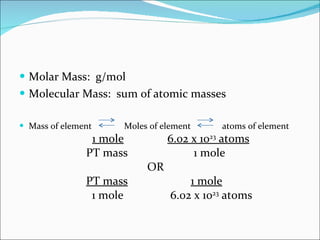
Molar Mass:  g/mol Molecular Mass:  sum of atomic masses Mass of element   Moles of element  atoms of element   1 mole   6.02 x 10 23  atoms  PT mass   1 mole OR   PT mass   1 mole   1 mole   6.02 x 10 23  atoms
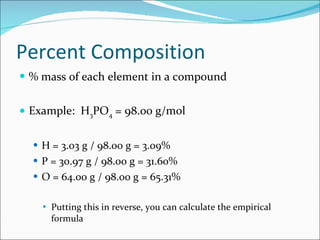
Percent Composition % mass of each element in a compound Example:  H 3 PO 4  = 98.00 g/mol H = 3.03 g / 98.00 g = 3.09% P = 30.97 g / 98.00 g = 31.60% O = 64.00 g / 98.00 g = 65.31% Putting this in reverse, you can calculate the empirical formula
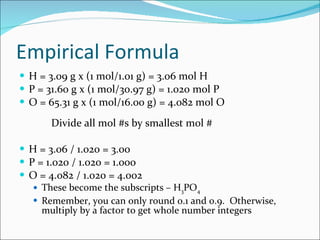
Empirical Formula H = 3.09 g x (1 mol/1.01 g) = 3.06 mol H P = 31.60 g x (1 mol/30.97 g) = 1.020 mol P O = 65.31 g x (1 mol/16.00 g) = 4.082 mol O Divide all mol #s by smallest mol # H = 3.06 / 1.020 = 3.00 P = 1.020 / 1.020 = 1.000 O = 4.082 / 1.020 = 4.002 These become the subscripts – H 3 PO 4 Remember, you can only round 0.1 and 0.9.  Otherwise, multiply by a factor to get whole number integers
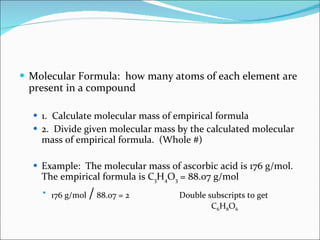
Molecular Formula:  how many atoms of each element are present in a compound 1.  Calculate molecular mass of empirical formula 2.  Divide given molecular mass by the calculated molecular mass of empirical formula.  (Whole #) Example:  The molecular mass of ascorbic acid is 176 g/mol.  The empirical formula is C 3 H 4 O 3  = 88.07 g/mol 176 g/mol  /  88.07 = 2 Double subscripts to get C 6 H 8 O 6
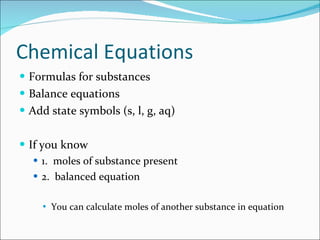
Chemical Equations Formulas for substances Balance equations Add state symbols (s, l, g, aq) If you know 1.  moles of substance present 2.  balanced equation You can calculate moles of another substance in equation
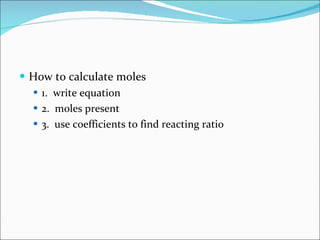
How to calculate moles 1.  write equation 2.  moles present 3.  use coefficients to find reacting ratio
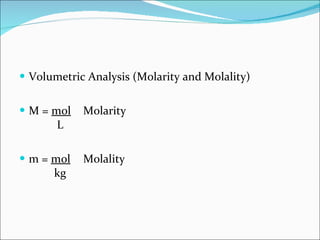
Volumetric Analysis (Molarity and Molality) M =  mol Molarity   L m =  mol Molality  kg
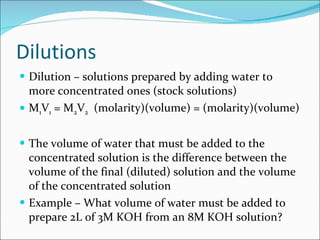
Dilutions Dilution – solutions prepared by adding water to more concentrated ones (stock solutions) M 1 V 1  = M 2 V 2   (molarity)(volume) = (molarity)(volume) The volume of water that must be added to the concentrated solution is the difference between the volume of the final (diluted) solution and the volume of the concentrated solution Example – What volume of water must be added to prepare 2L of 3M KOH from an 8M KOH solution?
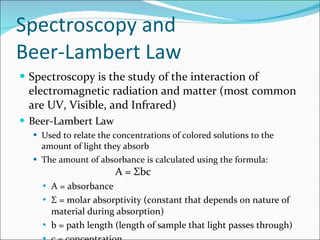
Spectroscopy and Beer-Lambert Law Spectroscopy is the study of the interaction of electromagnetic radiation and matter (most common are UV, Visible, and Infrared) Beer-Lambert Law Used to relate the concentrations of colored solutions to the amount of light they absorb The amount of absorbance is calculated using the formula: A =  Σ bc A = absorbance Σ  = molar absorptivity (constant that depends on nature of material during absorption) b = path length (length of sample that light passes through) c = concentration
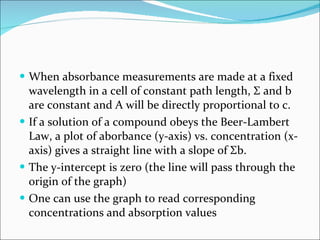
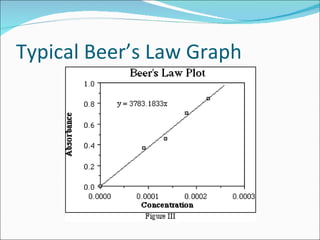
When absorbance measurements are made at a fixed wavelength in a cell of constant path length,  Σ  and b are constant and A will be directly proportional to c. If a solution of a compound obeys the Beer-Lambert Law, a plot of aborbance (y-axis) vs. concentration (x-axis) gives a straight line with a slope of  Σ b. The y-intercept is zero (the line will pass through the origin of the graph) One can use the graph to read corresponding concentrations and absorption values
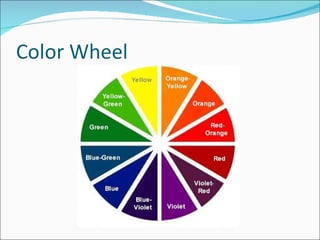
A plot of absorption against wavelength can be used to determine the exact color of a solution The point at which the greatest absorption is observed can be used to determine, via a color wheel, which wavelength is being reflected and, therefore, the color of the solution. The color that is observed is due to the wavelengths of light that the sample did not absorb For example, if a sample absorbs light in the orange region of the visible spectrum, then the solution will appear blue.
A color wheel can be used to relate absorbed and transmitted colors……the transmitted color being the complement color of the absorbed light. Although, theoretically the spectrophotometer can be used at a number of different wavelengths, because of the limitation of electronics, the optimal wavelength is one where the absorbance is highest
Performing an experiment at the point of highest absorbance offers 2 advantages: 1.  Beer’s Law linear relationship between concentration and absorbance is most likely to hold around this point 2.  When diluting the solution in order to investigate other lower concentrations, it is likely that if one starts at a point of maximum absorbance, that the absorbance will still remain significant and, therefore, detectable at the lower concentrations.
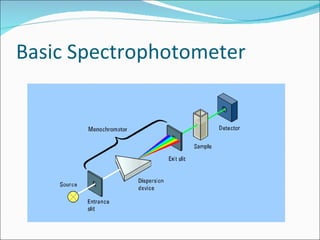
Basic Spectrophotometer
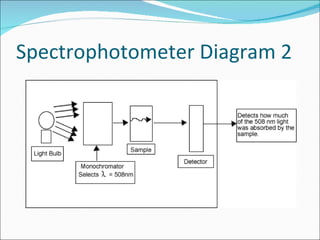
Spectrophotometer Diagram 2
Typical Beer’s Law Graph
Color Wheel
Analysis of Hydrates Hydrates are formula units with water associated with them CuSO 4  • 5H 2 O Copper (II) sulfate pentahydrate Strong heating evaporates the water When water is removed, the salt is called anhydrous Example:  8.69 g of CuSO 4  • xH 2 O is heated and left a residue of 5.56 g.  What is the formula?
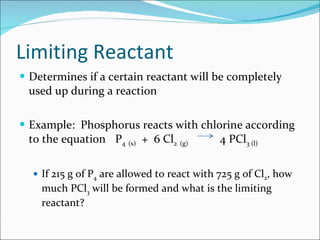
Limiting Reactant Determines if a certain reactant will be completely used up during a reaction Example:  Phosphorus reacts with chlorine according to the equation P 4   (s)   +  6 Cl 2   (g)     4 PCl 3 (l)   If 215 g of P 4  are allowed to react with 725 g of Cl 2 , how much PCl 3  will be formed and what is the limiting reactant?
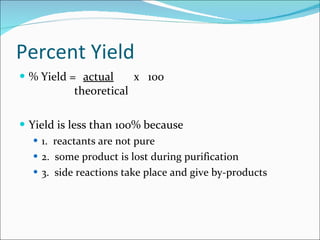
Percent Yield % Yield =  actual   x  100     theoretical Yield is less than 100% because 1.  reactants are not pure 2.  some product is lost during purification 3.  side reactions take place and give by-products

Chemistry- JIB Topic 4 Stoichiometry

  • 1.
  • 2.
    Molar Mass: g/mol Molecular Mass: sum of atomic masses Mass of element Moles of element atoms of element 1 mole 6.02 x 10 23 atoms PT mass 1 mole OR PT mass 1 mole 1 mole 6.02 x 10 23 atoms
  • 3.
    Percent Composition %mass of each element in a compound Example: H 3 PO 4 = 98.00 g/mol H = 3.03 g / 98.00 g = 3.09% P = 30.97 g / 98.00 g = 31.60% O = 64.00 g / 98.00 g = 65.31% Putting this in reverse, you can calculate the empirical formula
  • 4.
    Empirical Formula H= 3.09 g x (1 mol/1.01 g) = 3.06 mol H P = 31.60 g x (1 mol/30.97 g) = 1.020 mol P O = 65.31 g x (1 mol/16.00 g) = 4.082 mol O Divide all mol #s by smallest mol # H = 3.06 / 1.020 = 3.00 P = 1.020 / 1.020 = 1.000 O = 4.082 / 1.020 = 4.002 These become the subscripts – H 3 PO 4 Remember, you can only round 0.1 and 0.9. Otherwise, multiply by a factor to get whole number integers
  • 5.
    Molecular Formula: how many atoms of each element are present in a compound 1. Calculate molecular mass of empirical formula 2. Divide given molecular mass by the calculated molecular mass of empirical formula. (Whole #) Example: The molecular mass of ascorbic acid is 176 g/mol. The empirical formula is C 3 H 4 O 3 = 88.07 g/mol 176 g/mol / 88.07 = 2 Double subscripts to get C 6 H 8 O 6
  • 6.
    Chemical Equations Formulasfor substances Balance equations Add state symbols (s, l, g, aq) If you know 1. moles of substance present 2. balanced equation You can calculate moles of another substance in equation
  • 7.
    How to calculatemoles 1. write equation 2. moles present 3. use coefficients to find reacting ratio
  • 8.
    Volumetric Analysis (Molarityand Molality) M = mol Molarity L m = mol Molality kg
  • 9.
    Dilutions Dilution –solutions prepared by adding water to more concentrated ones (stock solutions) M 1 V 1 = M 2 V 2 (molarity)(volume) = (molarity)(volume) The volume of water that must be added to the concentrated solution is the difference between the volume of the final (diluted) solution and the volume of the concentrated solution Example – What volume of water must be added to prepare 2L of 3M KOH from an 8M KOH solution?
  • 10.
    Spectroscopy and Beer-LambertLaw Spectroscopy is the study of the interaction of electromagnetic radiation and matter (most common are UV, Visible, and Infrared) Beer-Lambert Law Used to relate the concentrations of colored solutions to the amount of light they absorb The amount of absorbance is calculated using the formula: A = Σ bc A = absorbance Σ = molar absorptivity (constant that depends on nature of material during absorption) b = path length (length of sample that light passes through) c = concentration
  • 11.
    When absorbance measurementsare made at a fixed wavelength in a cell of constant path length, Σ and b are constant and A will be directly proportional to c. If a solution of a compound obeys the Beer-Lambert Law, a plot of aborbance (y-axis) vs. concentration (x-axis) gives a straight line with a slope of Σ b. The y-intercept is zero (the line will pass through the origin of the graph) One can use the graph to read corresponding concentrations and absorption values
  • 12.
    A plot ofabsorption against wavelength can be used to determine the exact color of a solution The point at which the greatest absorption is observed can be used to determine, via a color wheel, which wavelength is being reflected and, therefore, the color of the solution. The color that is observed is due to the wavelengths of light that the sample did not absorb For example, if a sample absorbs light in the orange region of the visible spectrum, then the solution will appear blue.
  • 13.
    A color wheelcan be used to relate absorbed and transmitted colors……the transmitted color being the complement color of the absorbed light. Although, theoretically the spectrophotometer can be used at a number of different wavelengths, because of the limitation of electronics, the optimal wavelength is one where the absorbance is highest
  • 14.
    Performing an experimentat the point of highest absorbance offers 2 advantages: 1. Beer’s Law linear relationship between concentration and absorbance is most likely to hold around this point 2. When diluting the solution in order to investigate other lower concentrations, it is likely that if one starts at a point of maximum absorbance, that the absorbance will still remain significant and, therefore, detectable at the lower concentrations.
  • 15.
  • 16.
  • 17.
  • 18.
  • 19.
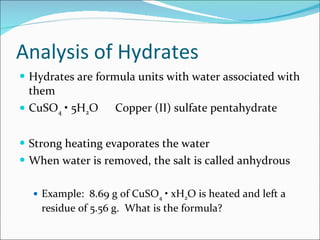
    Analysis of HydratesHydrates are formula units with water associated with them CuSO 4 • 5H 2 O Copper (II) sulfate pentahydrate Strong heating evaporates the water When water is removed, the salt is called anhydrous Example: 8.69 g of CuSO 4 • xH 2 O is heated and left a residue of 5.56 g. What is the formula?
  • 20.
    Limiting Reactant Determinesif a certain reactant will be completely used up during a reaction Example: Phosphorus reacts with chlorine according to the equation P 4 (s) + 6 Cl 2 (g) 4 PCl 3 (l) If 215 g of P 4 are allowed to react with 725 g of Cl 2 , how much PCl 3 will be formed and what is the limiting reactant?
  • 21.
    Percent Yield %Yield = actual x 100 theoretical Yield is less than 100% because 1. reactants are not pure 2. some product is lost during purification 3. side reactions take place and give by-products